90 |
P a g e
TWO AREA CONTROL OF AGC USING PI & PID
CONTROL BY FUZZY LOGIC
Puran Lal
1, Mainak Roy
21
M-Tech (EL) Student,
2Assistant Professor, Department of EEE,
Lingaya’s University, Faridabad, (India)
ABSTRACT
This work presents an efficient method based on a modified fuzzy PI control with parallel fuzzy PD control for automatic generation control (AGC) of a two-area power system. This describes the control schemes required to operate the two-area power system in the steady state. The model of a two-area power system is established using the equations describing dynamic behaviour of a two-area power system and control schemes in Matlab-Simulink program respectively. The performances of different controllers for variable inputs are compared for the same two area power system. The dynamic response of the load frequency control problem are studied using MATLAB simulink software. The results indicate that the proposed Fuzzy logic controller exhibits better performance.
Keywords: PI Control, Parallel Fuzzy PD Control, Automatic Generation Control, Power Systems,
Matlab/Simulink.
I. INTRODUCTION
Electrical Power systems are interconnected to provide secure and economical operation. [1]The main objective of automatic generation controller (AGC) is to maintain the balance between the generation and demand of a particular power system.
The interconnected power system is typically divided into control areas, with each consisting of one or more power utility companies. Sufficient supply for generation of each connected area to meet the load demand of its customers. In this paper Fuzzy Logic Controller (FLC) is used. This type of controller adds a pole at origin resulting in system type so reducing the steady state error. System load is never steady using controller these can be controlled. When uncontrolled case more oscillation, negative overshoot be observed but while comparing to conventional type controller PID and propose work result gives better performances of dynamic responses.
II
.
AGC FOR A TWO AREA SYSTEM
91 |
P a g e
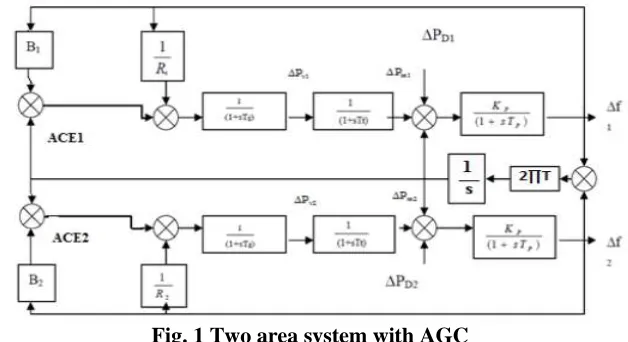
increases because of governor action. However, without AGC steady state frequency deviation will not be zero. Since generation in area 2 has increased, there will be tie line flow from area 2 to area 1 to share the additional load in area 1.Fig. 1 Two area system with AGC
III.
AGC CONTROL SCHEMES
3.1
PI Controller
The proportional plus integral controller produces an output signal consisting of two terms one proportional to error signal and other proportional to integral of error signal [12].
Where,
Kp-Proportional gain Ti- Integral time
92 |
P a g e
3.2
PID Controller
A proportional–integral–derivative controller (PID controller) is a generic control loop feedback mechanism widely used in industrial control systems – a PID is the most commonly used feedback controller. A PID controller calculates an "error" value as the difference between a measured process variable and a desired set point. The controller attempts to minimize the error by adjusting the process control inputs. In the absence of knowledge of the underlying process, PID controllers are the best controllers. However, for best performance, the PID parameters used in the calculation must be tuned according to the nature of the system – while the design is generic, the parameters depend on the specific system.
Fig.3 Basic block diagram of a conventional PID controller
The PID controller is probably the most-used feedback control design. PID is an acronym for Proportional-Integral-Derivative, referring to the three terms operating on the error signal to produce a control signal. If u(t) is the control signal sent to the system, y(t) is the measured output and r(t) is the desired output, and tracking error e(t) = r(t) − y(t),
a PID controller has the general form
IV. FUZZY LOGIC CONTROLLER
Since power system dynamic characteristics are complex and variable, conventional control methods
cannot provide desired results. Intelligent controller can be replaced with conventional controller to get
fast and good dynamic response in load frequency problems. Fuzzy Logic Controller (FLC) can be more
useful in solving large scale of controlling problems with respect to conventional controller are slower.
Fuzzy logic controller is designed to minimize fluctuation on system outputs. There are many studied on
93 |
P a g e
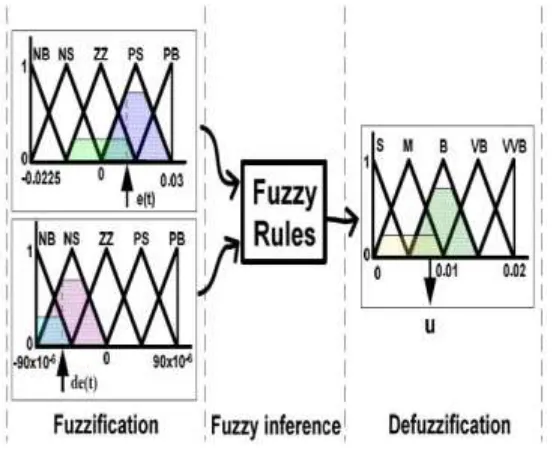
A fuzzy logic controller consist of three section namely fuzzifier, rule base and defuzzifier as shown in
figure 4.
Fig.4. Fuzzy Inference system for FLC
The error e and change in error de are inputs of FLC. Two inputs signals are converted to fuzzy numbers first in fuzzifier using five membership functions.
Positive Big (PB), Positive Small(PS), Zero (ZZ),Negative Small(NS),Negative Big (NB), Small (S), Medium (M), Big (B), very Big (VB), Very Very Big (VVB).
Finally resultant fuzzy subsets representing the controller output are converted to the crisp values using the central of area (COA) defuzzifier scheme.
TABLE I ( Fuzzy Rule)
94 |
P a g e
In this paper, the application of the fuzzy-PI+fuzzy-PD controller to AGC of a two-area power system isinvestigated. In the simulation, firstly, a step load increase in area 1 and then step load increase in area 1 and area 2
of the same power system are applied. The per-unit load changes from 0.01p.u.MW to 0.3 p.u.MW are applied to the power system with obtained the fuzzy-PI+fuzzy-PD controller. In this case, the frequency oscillations and tie-line power flow are investigated by using the simulation block diagrams. AGC is implemented to damp out the oscillations by using the fuzzy-PI+fuzzy-PD controller and conventional PID controller in each area in the power system.
Fig. 5 The simulation block diagram for automatic generation control of a two-area power system
with
Fuzzy PI+ Fuzzy PD controller
95 |
P a g e
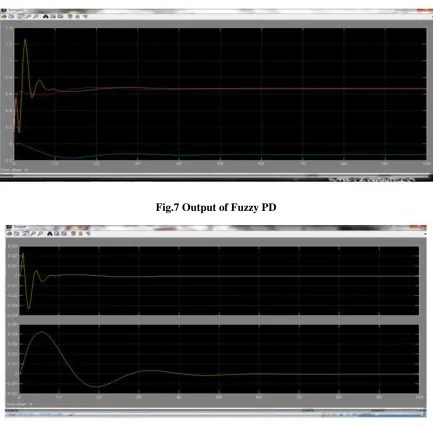
Fig.7 Output of Fuzzy PD
Fig. 8 Output of Area 1 and Area 2
In our simulation study, we chose the gain values of the conventional PID controller according to step load deviations in the power system with two areas.
The simulation results of a two area power system according to step load deviations are given as compare with the conventional PID controller and the fuzzy-PI+fuzzy-PD controller. The simulation results demonstrate show that the fuzzy-PI+fuzzy-PD controller improves effectively the damping of the oscillations after the load variation in one of the areas in the power system with two steam turbines. It can be observed that the responses with our proposed the fuzzy- PI+fuzzy-PD controller give better performance than the conventional PID controller.
VI. CONCLUSION
96 |
P a g e
system performance is observed on the basis of dynamic parameters i.e. settling time, overshoot and undershoot. The system performance characteristics reveals that the performance of fuzzy logic controller better than other controllers.As a further study, the proposed method can be applied to multi area power system load frequency control (ALFC) and also optimum values can be obtained by Genetic Algorithm and Neural networks.
REFERENCES
[1] Allen E., White N.La, Yoon Y., Chapman J. and Ilic M., “Interactive Object-Oriented Simulation of Interconnected Power Systems Using SIMULINK” IEEE Transactions on Education, 44(1): 87-95 (2001).
[2] Kundur P., Power system stability and control, McGraww-Hill (1994).
[3] Saadat H., Power System Analysis, McGraw-Hill, New York (1999).
[4] Khodabakhshian A., Hooshmand R. “A new PID controller design for automatic generation control of hydro power systems” Electrical Power and Energy Systems 32, 375–382 (2010).
[5] Sabahi K., Teshnehlab M., Shoorhedeli M.A., “Recurrent fuzzy neural network by using feedback error learning approaches for LFC in interconnected power system” Energy Conversion and Management 50: 938–946 (2009).
[6] Lu C-F, Liu C-C, Wu C., “Effect of battery energy storage system on load frequency control considering governor deadband and generation rate constraints”IEEE Trans Power Syst 10(3):555–61 (1995).
[7] Cavin JK, Budge MC, Rosmunsen P. “An optimal linear system approach to load-frequency Control” IEEE Trans Power Apparatus Syst, PAS-90:2472–82 (1971).
[8] Ai-Homouz ZM, Abdel-Magid YL. “Variable structure load frequency controllers for multi area power systems”, Int J Electr Power Energy Syst, 15(5):293–300 (1993).
[9] Chang CS, Fu W, “Area load frequency control using fuzzy gain scheduling of PI controllers”, Electr Power Syst Res, 42:145–52 (1997).
[10] Hiyama T., “Application of rule based stabilizing controller to power systems”, IEE Proc C 136:175–81(1989).
[11] Dash PK, Liew AC, Mishra BR, “An adaptive PID stabilizer for power systems using fuzzy Logic”, Electr Power Syst Re, :213–22 (1998).
[12] Kumar A, Malik OP, Hope GS., “Variable structure system control applied to AGC of an interconnected power system”, IEE Proc, 132(C-1):23–9 (1985).
[13] Zribi M, Al-Rashed M, Alrifai M., “Adaptive decentralized load frequency control of multi-area power systems”, Int J Electr Power Energy Syst,27:573–83 (2005).
[14] Chen G., “Conventional and Fuzzy PID Controller: an overview”, Int. J. Intell. Control Systems, 1:235-246 (1996).