Available Online at www.ijcsmc.com
International Journal of Computer Science and Mobile Computing
A Monthly Journal of Computer Science and Information Technology
ISSN 2320–088X
IJCSMC, Vol. 4, Issue. 5, May 2015, pg.87 – 91
RESEARCH ARTICLE
SUPER-RESOLUTION BASED IMAGE
IN
PAINTING
Ashwinraj
M.TechDept. of CSE, University B.D.T college of Engineering, Davanagere, Karnataka
E-mail: [email protected]
Abstract--- This paper introduces a new examplar-based inpainting framework. A coarse version of the input image is first inpainted by a non-parametric patch sampling. Compared to existing approaches, some improvements have been done (e.g. filling order computation, combination of K nearest neighbours). The inpainted of a coarse version of the input image allows to reduce the computational complexity, to be less sensitive to noise and to work with the dominant orientations of image structures. From the low-resolution inpainted image, a single-image super-resolution is applied to recover the details of missing areas. By sample of a non- parametric patch makes blur image which was given as input initially is goes in painted. When compared to previous approaches, some features have been improved. The in painted of a blur version of the input image permits to decrease the computational complexity, to be low sensitive to sound and to operate with the image structures dominant orientations. In painted image moulds from the low-resolution to a single-image which is super-low-resolution one and that is used to backup the data of areas which are missing. The outputs of researches on natural texture synthesis and images explain the effectiveness of the proposed system
Keywords: “Exemplar- based, Super-Resolution, Inpainting, Texture synthesis, K-NN method, Patch-Matching”
––––––––––––––––––––––––––––––––––––––––––––––––––––––––––––––––––––––––––––––––––––.
1. INTRODUCTION
be filled is large and another critical aspect is the high computational time in general required. These two problems are here addressed by considering a hierarchical approach in which a lower resolution of the input image is first computed and inpainted using a K-NN (K Nearest Neighbours) examplar-based method. Correspondences between the K-NN low- resolution and high-resolution patches are first learnt from the input image and stored in a dictionary. These correspondences are then used to find the missing pixels at the higher resolution following some principles used in single-image super-resolution methods. Super-Resolution (SR) refers to the process of creating one enhanced resolution image from one or multiple input low resolution images. The two corresponding problems are then referred to as single or multiple images SR, respectively. In both cases, the problem is of estimating high frequency details which are missing in the input image(s).
The proposed SR-aided inpainting method falls within the context of single-image SR on which thus focus in this section. The SR problem is ill-posed since multiple high-resolution images can produce the same low-resolution image. Solving the problem hence requires introducing some prior information. The prior information can be an energy functional defined on a class of images which is then used as a regularization term together with interpolation techniques [10]. This prior information can also take the form of example images or corresponding LR-HR (Low Resolution - High Resolution) pairs of patches learnt from a set of un-related training images in an external database [11] or from the input low resolution image itself [12]. This latter family of approaches is known as example-based SR methods [11]. An example- based SR method embedding K nearest neighbours found in an external patch database has also been described in [13]. Instead of constructing the LR-HR pairs of patches from a set of un-related training images in an external database, the authors in [12] extract these correspondences by searching for matches across different scales of a multi-resolution pyramid constructed from the input low- multi-resolution image.
II. PROBLEM STATEMENT A.Existing system
Existing methods can be classified into two main categories. The first category concerns diffusion-based approaches which propagate linear structures or level lines via diffusion based on partial differential equations and variation methods. Unfortunately, the diffusion-based methods tend to introduce some blur when the hole to be filled-in is large. The second family of approaches concerns exemplar-based methods which sample and copy best matches texture patches from the known image neighborhood. These methods have been inspired from texture synthesis techniques and are known to work well in cases of regular or repeatable textures. The first attempt to use exemplar-based techniques for object removal has been reported in. Authors in improve the search for similar patches by introducing an a priori rough estimate of the in painted values using a multi-scale approach which then results in an iterative approximation of the missing regions from coarse to fine levels.
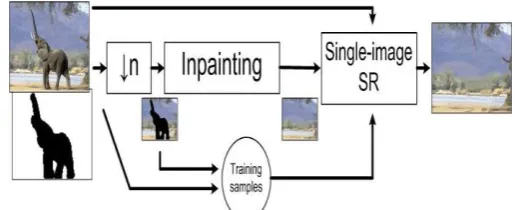
In proposed system two main components are the in-painting and the super-resolution algorithms. More specifically, the following steps are performed:
1. A low-resolution image is first built from the original picture;
2. An in-painting algorithm is applied to fill-in the holes of the low-resolution picture; 3. The quality of the in-painted regions is improved by using a single-image SR method.
Fig 2.1 Proposed method Framewor
III. MODULE DESCRIPTION
A.Image inpainting
B.Image restoration
Image restoration is the operation of taking a corrupted/noisy image and estimating the clean original image. Corruption may come in many forms such as motion blur, noise, and camera miss focus.
C.Super-resolution
Super resolution (SR) is a class of techniques that enhance the resolution of an imaging system. In some SR techniques—termed optical SR—the diffraction limit of systems is transcended, while in others—geometrical SR—the resolution of digital imaging sensors is enhanced.
Once the in painting of the low-resolution picture is completed, a single-image super-resolution approach is used to reconstruct the high resolution of the image. The idea is to use the low-resolution in painted areas in order to guide the texture synthesis at the higher resolution. The problem is to find a patch of higher-resolution from a database of examples
.
Fig 3.1 Flow-Chart of Super-Resolution Process Algorithm
1) Dictionary building
:
it consists of the correspondences between low and high resolution image patches. Theunique constraint is that the high-resolution patches have to be valid, i.e. entirely composed of known pixels. In the pro- posed approach, high-resolution and valid patches are evenly extracted from the known part of the image. The size of the dictionary is a user-parameter which might influence the overall speed/quality trade-off. An array is used to store the spatial coordinates of HR patches (D
HR
). Those of LR patches are simply deduced by using the decimation factor.
2) Filling order of the HR picture: the computation of the filling order is similar to the one described in Section 3.
It is computed on the HR picture with the sparsity-based method. The filling process starts with the patch ᵩpHR having the highest priority. This improves the quality of the in painted picture compared to a raster-scan filling order.
3) For the LR patch corresponding to the HR patch having the highest priority, its K-NN in the in painted images
of lower resolution are sought. The number of neighbors is computed as described in the previous section. The
similarity metric is also the same as previous.
4) Weights wp, pj are calculated by using a non-local means method as if i would like to perform a linear
combination of these neighbors. However, the similarity distance used to compute the weights is composed of
two terms: the first one is classical since this is the distance between the current LR patch and its LR neighbors, noted d ( LRp , LRp,pj ). The second term is the distance between the known parts of the HR patch HRp and the HR patches corresponding to the LR neighbours of LRp. Say differently, the similarity distance is the distance between two vectors composed of both pixels of LR and HR patches. The use of pixel values of HR patches allows to constraint the nearest neighbour search of LR patches.
5) A HR candidate is finally deduced by using a linear combination of HR patches with the weights previously
6) Stitching: the HR patch is then pasted into the missing areas. However, as an overlap with the already synthesized areas is possible, a seam cutting the overlapped regions is determined to further enhance the patch blending. The minimum error boundary cut [21] is used to find a seam for which the two patches match best. The similarity measure is the Euclidean distance between all pixel values in the overlapping region. More complex metrics have been tested but they do not substantially improve the final quality. At most four overlapping cases (Left, Right, Top and Bottom) can be encountered. There are sequentially treated in the aforementioned order. The stitching algorithm is only used when all pixel values in the overlapping region are known or already synthesized. Otherwise, the stitching is disabled. After the filling of the current patch, priority value is recomputed and the afore-mentioned steps are iterated while there exist unknown areas.
IV. RELATED WORK
In order to assess the performance of the proposed approach, the parameters of the algorithm are kept constant for the tests presented in this paper.
A. Implementation details and parameter.
Reproducible research: It is possible to reproduce results by using the executable software, the masks and pictures available on authors’ web page.
Parameters: Two versions of the proposed method are evaluated. One uses a down sampling factor of 4 in both directions (the patch size is equal to 5 × 5) whereas this factor is set to 2 for the second version (the patch size is equal to 7 × 7). For both versions, the size of the dictionary is the same and can contain at most 6000 patches evenly distributed over the picture. The LR patch size is 3 × 3 and the HR patch size is 15 × 15.
Line front feathering: in spite of the use of stitching method, the front line which is the border between known and unknown areas can still be visible. It is possible to hide this transition by feathering the pixel values across this seam.
A Gaussian kernel is used to perform the filtering.
B. Comparison with state-of-the-art methods.
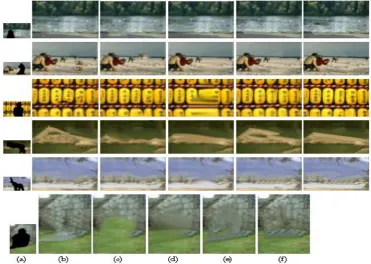
The comparison between the proposed methods and state-of- the-art methods. The proposed method (for both settings (e) and (f)) provides similar results to Patch Match and visually outperforms Criminisi’s approach.
Gives further results. For these examples, a large missing area has been filled in. Additional results for texture synthesis. A small chunk of texture (in the example 256 × 256) was placed into the upper left corner of an empty image. The performance of the proposed method for these kinds of texture. For deterministic textures, results are very good. For stochastic ones, some artefacts are visible. However, increasing the patch size would cope with these artefacts, as illustrated on the bottom-right. The running time on a 3 GHz CPU is less than one minute for pictures having a resolution of 512 × 512.
V.CONCLUSION
This paper introduced a novel algorithm for image in-painting that attempts to replicate the basic techniques used by professional restorators. The basic idea is to smoothly propagate information from the surrounding areas in the isophotes direction. The user needs only to provide the region to be in-painted; the rest is automatically performed by the algorithm in a few minutes. The in-painted images are sharp and without color artifacts. The examples shown suggest a wide range of applications like restoration of old photographs and damaged film, removal of superimposed text, and removal of objects. The results can either be adopted as a final restoration or be used to provide an initial point for manual restoration, thereby reducing the total restoration time by orders of magnitude.
ACKNOWLEDGEMENT
I would like to thank our Chairmen Dr. Mohamed Rafi, and Dr. Shreenivasa naika C.L for providing their information and help to carrying this research paper work.
REFERENCES
[1]. Bertalmio, M., Sapiro, G., Caselles, V., Ballester, C.: Image inpainting. In: SIG- GRPAH 2000. (2000)
[2]. Tschumperl´e, D., Deriche, R.: Vector-valued image regularization with pdes: a common framework for different applications. IEEE Trans. on PAMI 27 (2005) 506–517
[3]. Chan, T., Shen, J.: Variational restoration of non-flat image features: models and algorithms. SIAM J. Appl. Math. 61 (2001) 1338–1361
[4]. Criminisi, A., P´erez, P., Toyama, K.: Region filling and object removal by examplar-based image inpainting. IEEE Trans. On Image Processing 13 (2004) 1200–1212
[5]. Drori, I., Cohen-Or, D., Yeshurun, H.: Fragment-based image completion. ACM Trans. Graph. 22 (2003) 303–312
[6]. Harrison, P.: A non-hierarchical procedure for re-synthesis of complex texture. In: Proc. Int. Conf. Central Europe Comp. Graphics, Visua. And Comp. Vision. (2001)
[7]. Barnes, C., Shechtman, E., Finkelstein, A., Goldman, and D.B.: PatchMatch: A randomized correspondence algorithm for structural image editing. ACM Transactions on Graphics (Proc. SIGGRAPH) 28 (2009)
[8]. Efros, A.A., Leung, and T.K.: Texture synthesis by non-parametric sampling. In: International Conference on Computer Vision. (1999) 1033–1038
[9]. Le Meur, O., Gautier, J., Guillemot, C.: Examplar-based inpainting based on local geometry. In: ICIP. (2011)
[10]. Dai, S., Han, M., Xu, W., Wu, Y., Gong, Y., Katsaggelos, and A.: Softcuts: soft edge smoothness prior for color image super-resolution. IEEE Trans. On Image Processing 18 (2009) 969–981
[11]. Freeman, W.T., Jones, T.R., Pasztor, E.C.: Example-based super-resolution. IEEE Computer Graphics and Applications 22 (2002) 56–65
[12]. Glasner, D., Bagon, S., Irani, M.: Super-resolution from a single image. In: In 2009 IEEE 12th International Conference on Computer Vision (ICCV). Volume 10. (2009) 349356
[13]. Chang, H., Yeung, D.Y., Xiong, Y.: Super-resolution through neighbor embedding. In: Computer Vision and Pattern Recognition. Volume I. (2004) 275–282
[14]. Ashikhmin, M.: Synthesizing natural textures. In: I3D’01. (2001)