Authenticated Key Exchange from RLWE (Full
Version)
Chao Liu1, Zhongxiang Zheng2, Keting Jia2( ), and Qidi You3 1 Key Laboratory of Cryptologic Technology and Information Security, Ministry of
Education, Shandong University, P.R. China
liu [email protected] 2
Department of Computer Science and Technology, Tsinghua University, P.R. China
Space Star Technology co., LTD, P.R. China
Abstract. Three-party key exchange, where two clients aim to agree a session key with the help of a trusted server, is prevalent in present-day systems. In this paper, we present a practical and secure three-party password-based authenticated key exchange protocol over ideal lattices. Aside from hash functions our protocol does not rely on external prim-itives in the construction and the security of our protocol is directly relied on the Ring Learning with Errors (RLWE) assumption. Our pro-tocol attains provable security. A proof-of-concept implementation shows our protocol is indeed practical.
Keywords: Password authentication·Three-party Key exchange· Prov-able security·RLWE·Post-quantum.
1
Introduction
Key Exchange (KE), which is a fundamental cryptographic primitive, allows two or more parties to securely share a common secret key over insecure networks. KE is one of the most important cryptographic tools and is widely used in build-ing secure communication protocols. Authenticated Key Exchange (AKE), which enables each party to authenticate the other party, can prevent the adversary from impersonating the honest party in the conversation. Password-based Au-thenticated Key Exchange (PAKE), which allows parties to share a low-entropy password that is easy for human memory, has become an important cryptograph-ic primitive because it is easy to use and does not rely on special hardware to store high-entropy secrets.
protocols are available, each party must remember many passwords, for each en-tity with which he may wish to establish a session key corresponds to a password. In detail, assuming that a communication network hasnusers, in which any two users exchange a key, there will ben(n−1)/2 passwords to be shared, and all these passwords must be stored securely. This is unrealistic when the network is relatively large. To solve this problem, three-party PAKE (3PAKE) was pro-posed. In 3PAKE, each client shares a password with the trusted server, and then two clients will establish a common session key with the help of the server. This solution is very realistic in practical setup, because it provides each client user with the ability to exchange secure keys with all other client users, and each user only needs to remember one password. The 3PAKE protocol can be applied to various electronic applications, such as in the JobSearch International, trusted third parties can help employers and employees to hire on Jobsearch.
In 1995, Steiner et al. proposed the first 3PAKE protocol [26]. Then many works about 3PAKE protocols have been proposed [16,27,1,11,7]. For a security 3PAKE protocol, there are two types of attacks it should resist:undetectable on-line password guessing attacks[10] andoff-line password guessing attacks[16]. In 1995, Ding and Horster [10] and Sun et al. [27] pointed out that Steiner et al.’s protocol [26] was vulnerable to undetectable on-line password guessing attacks. That is, an adversary can stay un-detected and log into the server during an on-line transaction. In 2000, Lin et al. [16] further pointed out Steiner et al.’s protocols [26] also suffer from off-line password guessing attacks. In this attack, an attacker can guess passwords off-line until getting the correct one. There is another attack:detectable on-line password guessing attacks, which requires the participation of the authentication server. In this attack, the server will detect a failed guess and record it. Since after a few unsuccessful guesses, the server can stop any further attempts, this attack is less harmful. In practice, password-based authenticated key exchanges are required to have a property, forward secrecy, that when the password is compromised, it does not reveal the earlier established session keys and the updating password.
However, the existed 3PAKE are based on the classic hard problems, such as factoring, the RSA problem, or the computational/decisional DH problem. It is well known that those problems are vulnerable to quantum computers [25]. Since the vigorous development of quantum computers, searching other counterparts based on problems which are believed to be resistant to quantum attacks is more and more urgent. Hence the motivation of this paper is that can we propose a proven security 3PAKE that can resist quantum attacks? Note that lattice-based cryptographic have many advantages such as quantum attacks resistance, asymptotic efficiency, conceptual simplicity and worst-case hardness assumption, and it is a perfect choice to build lattice-based 3PAKE.
having the 3PAKE as a self-contained system, we show that our protocol directly relys on the hardness of RLWE and Pairing with Errors problem (PWE), which can reduce to the RLWE problem, in the random oracle model. Our protocol RLWE-3PAK resists undetectable on-line passwords guessing attacks and off-line passwords guessing attacks, and enjoys forward secrecy and quantum attacks resistance. Furthermore, our protocol enjoysmutual authentication, which means that the users and the server can authenticate one another.
In terms of protocol design, benefitting from the growth of lattice-based key exchange protocols [8,23], we can utilize the key agreement technique to construct our protocol. We use Peikert’s [23] reconciliation mechanism to achieve the key agreement in our protocol. At the same time, in order to make our protocol resist undetectable passwords guessing attacks and off-line passwords guessing attacks, we also use additional key reconciliation mechanism between server and clients to realize the mutual authentication. Our security model is modified from Bellare et al.’s model [2,3]. Since the interactions in three-party setting are more complex than that of two-party setting, proving the security of our 3PAKE protocol is a very tricky problem. We use a variant of the Pairing with errors problem [9] to simplify the proof and the proof strategy followed from [21]. Finally, we manage to establish a full proof of security for our protocol and show that our protocol enjoys forward security.
We select concrete choices of parameters and construct a proof-of-concept implementation. The performance results show that our protocol is efficient and practical.
Related works. In the existed literatures, 3PAKE protocols are based on pub-lic/private key cryptography [16,26,10], which usually incur additional compu-tation and communication overheads. Asymmetric key cryptography based pro-tocols [15,17,11] usually require “the ideal cipher model”, which is a strong assumption, to prove the security of the protocols. There are some other types of protocols [13,18] which are with no formal security proof.
Lattice-based AKE or PAKE.Zhang et al. [32] proposed an authenticated RLWE-based key exchange which is similar to HMQV [14]. In 2009, Katz and Vaikun-tanathan [12] proposed a CCA-secure lattice-based PAKE, which is proven se-cure in standard model security. In 2017, Ding et al. [9] proposed RLWE-based PAKE, whose proof is based on random oracle model (ROM), and its implemen-tation is very efficient. Then in 2017, Zhang and Yu [31] proposed a two-round CCA-secure PAKE based on the LWE assumption.
2
Preliminaries
2.1 Security Models
The security model is modified from [2] and [3]. The 3PAKE protocol involves three parties, two clientsAandB who wish to establish a shared secret session key and a trusted serverS who try to help distribute a key toA andB. LetP
be a 3PAKE protocol.
Security game.Given a security parameterκ, an algorithmic game initialized is played betweenCH- a challenger, and a probability polynomial time adversary
A. For simulating network traffic for the adversary,CH will essentially runP. Users and passwords. There is a fixed set ofusers, which is partitioned into two non-empty sets ofclientsandservers. We also assumeDis some fixed, non-empty dictionary with size of L. Then before the game starts, a passwordpwU is drawn uniformly at random from D and assigned to each clients outside of the adversary’s view. And for each server S, we set pwS := (f(pwU))U, where
U runs through all ofclients. Usually,f is some efficiently computable one-way function (in our protocol we letf be a hash function).
User instances.We denote some instanceiof auser U asΠUi. The adversary
A controls all the communications that exchange between a fixed number of parties by interacting with a set ofΠUi oracles. At any point of in time, an client user instance ΠUi may accept. When ΠUi accepts, it holds a partner-id (P ID)
pidiU, asession-id (SID) sidiU, and a session key (SK) skUi. The P ID is the identity of the user that the instance believes talking to, and SK is what the instance aims to compute after the protocol completed. TheSIDis an identifier and is used to uniquely name the ensuing session. Note that theSID andP ID
are open to the adversary, and theSK certainly is secret forA.
Oracle queries.The adversaryAhas an endless supply of oracles and it models various queries to them with each query models a capability of A. The oracle queries by the adversaryAare described as follows:
– TheSend(U, i, M) query allows the adversary to send some messageM to oracleΠUi of her choice at will. TheΠUi oracle, upon receiving such a query, will compute what the protocolP says, updates its state, and then returns toA the response message. IfΠi
U has accepted or terminated, this will be made known to the adversaryA. This query is for dealing with controlling the communications by the adversary.
– TheExecute(A, i, B, j, S, t) query causes P to be executed to completion between twoclients instancesΠi
A,Π j
B and aserver instanceΠSt, and hands all the execution’s transcripts toA. This query is for dealing with off-line password guessing attacks.
– TheReveal(U, i) query allows Ato expose session key SK that has been previously accepted. IfΠi
– The Corrupt(U) query allows A to corrupt the user U at will. If U is a server, returns (f(pwC))C to A, else returns pwU to A. This query is for dealing with forward secrecy.
– The Test(U, i) is a query that does not correspond to A’s abilities. The oracle chooses a bitb∈ {0,1} randomly. IfΠi
U has accepted with someSK and is being asked by such a query, thenA is given the actual session key whenb = 1;A is given a key chosen uniformly at random when b = 0. A
is allowed to query this oracle once and only on a freshΠUi (defined in the following). This query models the semantic security of the session keySK. Ending the game.Eventually, the adversary ends the game, and then outputs a single bitb0.
And next we define what constitutes the breaking of the 3PAKE protocol. First-ly we introduce the notions of instance partnering and instancefreshness with forward secrecy.
Definition 1. (Partnering)LetΠAi andΠBj be two instances. We shall say that
ΠAi andΠBj are partnered if both instances accept, holding (skiA, sidiA, pidiA) and (skBj, sidjB, pidjB) respectively, and the followings hold:
– sidiA=sidjB =sid is not null andskiA=skBj andpidiA=B andpidjB=A; – No instance besidesΠAi andΠBj accepts with a SID of sid.
Definition 2. (Freshness)InstanceΠi
Ais fs-fresh or it holds a fresh session key at the end of the execution if none of the following events occur:
– Reveal(A, i) was queried;
– aReveal(B, j) was queried whereΠBj is parted withΠi
A, if it has one; – before the Test query, a Corrupt(U) was queried for some user U and a
Send(A,i,M) query occurs for some string M.
Password Security. We say the adversary breaks the password security of 3PAKE if he learns the password of a user by either on-line or off-line password guessing attacks.
AKE security. We now define the advantage of the adversary Aagainst pro-tocolP for the authenticated key exchange (ake). Let Succake
P (A) be the event that the adversary makes a singleTest(A, i) query directed to some terminated fresh instancesΠi
A, and outputs a bitb0eventually, andb0=bwherebis the bit selected in theTest(A, i) query. ThenA’s advantage is defined as:
AdvakeP (A)def= 2PrhSuccakeP (A)i−1 It is easy to verify that
Pr(SuccakeP (A)) = Pr(SuccakeP0 (A)) +⇐⇒AdvakeP (A) = AdvakeP0 (A) + 2.
2.2 Notations
Letnbe an integer, which is a power of 2. We define the ring of integer polyno-mialsR:=Z[x]/(xn+ 1). For any positive integerq, we setR
q :=Zq[x]/(xn+ 1)
as the ring of integer polynomials moduloxn+ 1, where every coefficient is re-duced moduloq. For a polynomialyinR, identifyywith its coefficient vector in
Z. Let the norm of a polynomial to be the norm of its coefficient vector. Assume χ is a probability distribution over R, then x←−$ χ means the coefficients ofx
are sampled from χ.
For any positive realβ ∈ R, we set ρβ(x) =exp(−π
||x||2
β2 ) as the Gaussian function, which is scaled by a parameter β. Let ρβ(Zn) = Px∈Znρβ(x). Then
for a vectorx∈Zn, letDZn,β(x) = ρβ(x)
ρβ(Zn) to indicate then-dimensional discrete Gaussian distribution. Usually we denote this distribution asχβ.
2.3 Ring Learning with Errors
The Learning with Errors (LWE) problem was first introduced by Oded Regev in [24]. He showed that under a quantum reduction, solving LWE problem in the average cases was as hard as solving the worst cases of the certain lattice prob-lems. However since with a large key sizes ofO(n2), LWE based cryptosystems are not efficient for practical applications. In 2010, Lyubashevsky, Peikert, and Regev [20] introduced the version of LWE in the ring setting: the Ring Learning with Errors problem, which could drastically improve the efficiency.
For uniform random elementsa, s←−$ Rq and an error distributionχ, letAs,χ denote the distribution of the RLWE pair (a, as+e) with the errore←−$ χ. Then given polynomial number of such samples, the search version of RLWE is to find the secrets, and the decision version of the RLWE problem (DRLWEq,χ) is to distinguishAs,χfrom an uniform distribution pair onRq×Rq. RLWE enjoys a worst case hardness guarantee, which we state here.
Theorem 1. ([20], Theorem 3.6) Let R=Z[x]/(xn+ 1) wherenis a power of 2, α=α(n)<plogn/n, andq≡1 mod 2nwhich is a ploy(n)-bounded prime such that αq≥ω(√logn). Then there exists a ploy(n)-time quantum reduction from O˜(√n/α)-SIVP (Short Independent Vectors Problem) on ideal lattices in the ring R to solving DRLWEq,χ with l−1 samples, where χ = DZn,β is the discrete Gaussian distribution with parameterβ=αq·(nl/log(nl))1/4.
We have the following useful fact.
Lemma 1. ([19], Lemma 4.4) For anyk >0,Prx←χβ(|x|> kβ)≤2e
−πk2.
Note that takingk= 6 gives tail probability approximating 2−162.
Reconciliation mechanism.We now recall the reconciliation mechanism de-fined in [23]. This technique is one of the foundations of our protocol.
bp
q ·xc. Let the modulusq ≥ 2 and be an even, define disjoint intervalsI0 :=
{0,1, . . . ,bq
4e −1}, I1 := {−bq4e, . . . ,−1}modq. Note that when v ∈ I0∪I1,
bve2= 0, and whenv∈(I0+q2)∪(I1+q2),bve2= 1. Define the cross-rounding function h·i2 : Zq → Z2 as hvi2 := bq4 ·vcmod 2. Note that hvi2 =b ∈ {0,1} such thatv∈Ib∪(q2+Ib);.
Define the set E := [−q8,q8)∩Z. Then suppose v, w are sufficiently close,
and givenwandhvi2, we can recoverbve2 using the reconciliation function rec:
Zq×Z2→Z2:
rec(w, b) =
(
0 ifw∈Ib+E(modq), 1 otherwise.
Whenqis odd, to avoid the bias produced by the rounding function, Peikert introduced a randomized function dbl():Zq →Z2q. Forv∈Zq, dbl(v):= 2v−¯e∈
Z2q for some random ¯e ∈ Z which is independent of v and uniformly random
moduloes two. Usually we denotev with an overline to means that ¯v←dbl(v). For ease of presentation, we define function HelpRec(X): (1). X ←dbl(X); (2).W ← hXi2;K← bXe2; (3). return (K, W).
Note that for w, v ∈ Zq, we need apply the appropriated rounding func-tion from Z2q to Z2, which means that bxep = b2pq ·xe, hxi2 = b24q · xc, and similar with rec function. Obviously, if (K, W) ← HelpRec(X) and Y =
X +e with ||e||∞ < q8, we have rec(2·Y, W) = K. These definitions also can be extended to Rq by applying coefficient-wise to the coefficients in Zq of a ring elements. In other words, for a ring element v = (v0, . . . , vn−1) ∈
Rq, set bve2 = (bv0e2, . . . ,bvn−1e2);hvi2 = (hv0i2, . . . ,hvn−1i2); HelpRec(v) = (HelpRec(v0), . . . ,HelpRec(vn−1)). And for a binary-vector b= (b0, . . . , bn−1)∈
{0,1}n, set rec(v, b)=(rec(v
0, b0),. . . , rec(vn−1, bn−1)).
Lemma 2. ([23])Forq≥2 is even, if v is uniformly random chosen from Zq, then bve2 is uniformly random when given hvi2; if w =v+emodq for some
v ∈Zq ande∈E, then rec(w,hvi2)=bve2. Forq >2 is odd, if v is uniformly random chosen from Zq and ¯v ←dbl(v)∈Z2q, then b¯ve2 is uniformly random givenh¯vi2.
The PWE assumption.To prove the security of our protocol, we introduce the Pairing with Errors (PWE) assumption. This assumption is following the work in [9], and we replace the reconciliation mechanism of them by Peikert’s version. For any (a, s)∈R2
q, we setτ(a, s) :=base2and if there is (c, W)←HelpRec(as), thenτ(a, s) =c= rec(as, W). Assume that a PPT adversaryAtakes inputs of the form (a1, a2, b, W), where (a1, a2, b)∈R3q and W ∈ {0,1}n, and outputs a list of values in{0,1}n.A’s objective is to obtain the stringτ(a
2, s) in its output, wheresis randomly chosen fromRq,bis a “small additive perturbation” ofa1s,
W isha2si2. Define
AdvPWERq (A)def= P rha1 $
←−Rq;a2 $
←−Rq;s, e $
←−χβ;b←a1s+e;
W ← ha2si2:τ(a2, s)∈ A(a1, a2, b, W)
Let AdvPWERq (t, N) =maxA
n
AdvPWERq (A)
o
, where the maximum is taken over all adversaries times complexity which at most t that output a list containing at most N elements of {0,1}n. Then for t and N polynomial in κ, the PWE assumption states that AdvPWERq (t, N) is negligible.
To states the hardness of PWE assumption, We define the decision version of PWE problem as follows. If DPWE is hard, so is PWE.
Definition 3. (DPWE)Given(a1, a2, b, W, σ)∈Rq×Rq×Rq×{0,1}n×{0,1}n whereW =hKi2 for someK∈Rq, where K←dbl(K) andσ= rec(2·K, W). The Decision Pairing with Errors problem (DPWE) is to decide whether K =
a2s+e1,b=a1s+e2 for somes, e1, e2 is drawn fromχβ, or(K, b)is uniformly random in Rq×Rq.
In order to show the reduction of the DPWE problem to the RLWE problem, we would like to introduce a definition to what we called the RLWE-DH problem [9] which can reduce to RLWE problem.
Definition 4. (RLWE-DH) Let Rq and χβ be defined as above. Given an in-put ring element (a1, a2, b, K), where (a, X) is uniformly random in Rq2, The DRLWE-DH problem is to tell if K is a2s+e1 and b = a1s+e2 for some
s, e1, e2 $
←−χβ or (K, b) is uniformly random inRq×Rq.
Theorem 2. ([9], Theorem 1) Let Rq and χβ be defined as above, then the RLWE-DHproblem is hard to solve if RLWE problem is hard.
Theorem 3. Let Rq and χβ be defined as above. The DPWE problem is hard if the RLWE-DHproblem is hard.
Proof. Suppose there exists an algorithmDwhich can solve the DPWE problem on input (a1, a2, b, W, σ) where for some K ∈ Rq, W = hKi2 and σ = rec(2·
K, W) with non-negligible probability . By using D as a subroutine, we can build a distinguisherD0 on input (a01, a02, b0, K0), solve the RLWE-DH problem :
– ComputeW =hK0iandσ= rec(2·K0, W).
– RunD using the input (a01, a02, b0, W, σ).
• IfD outputs 1 thenK0 isa02s+e1 for somee1 $
←−χβ andb0 =a1s+e2 for somes, e1
$
←−χβ.
• Else (K0, b0) is uniformly random element fromRq×Rq.
Note that if (a01, b0), (a02, K0) is two RLWE pairs, with input (a01, a02, b0, W, σ) defined above, D outputs 1 with probability, hence RLWE-DH can be solved with probability using distinguisher D0. This means that RLWE-DH can be solved with non-negligible advantage, which contradicts RLWE-DH’s hardness.
u t
3
A New Three-party Password Authenticated Key
Exchange
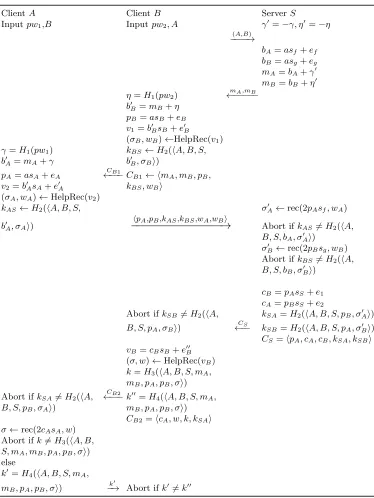
3.1 Description of RLWE-3PAK
Let q= 2ω(logn)+ 1 be an odd prime such that q≡ 1 mod 2n. Let a∈ R q be a fixed element chosen uniformly at random and given to all users. Let χβ be a discrete Gaussian distribution with parameter β. Let H1 : {0,1}∗ 7→ Rq be hash function, Hl : {0,1}∗ → {0,1}κ for l ∈ {2,3,4} be hash functions which is used for verification of communications, andH5:{0,1}∗→ {0,1}κ be a Key Derivation Function (KDF), where κis the bit-length of the final shared key. We model the hash functionsHl forl∈ {1,2,3,4,5}as random oracles. We will make use ofh·i2, b·e2, HelpRec() and rec() defined in Sect.2.3.
The functionf used to compute client passwords’ verifiers for the server is instantiated as : f(·) =−H1(·). Our protocol which is illustrated in Fig.1 con-sists of the following steps:
ClientB initiation.ClientB sends the identity ofA, the one who he wants to communicate with, and his own toS as an initial request. (Note that, this step also can be executed byA.)
Server S first response. Server S receivers B’s message, then S chooses
sf, ef, sg, eg $
←− χβ to compute bA = asf +ef and bB = asg+eg, and com-putes public elementsmA=bA+γ0 andmB =bB+η0 whereγ0:=−H1(pw1),
η0:=−H1(pw2). ThenS sendshmA, mBito B.
ClientBfirst response.After receivingS’s message, clientBchecks ifmA, mB∈
Rq. If not, aborts; otherwise retrieves b0B =mB+η where η = H1(pw2) and chooses sB, eB, e0B
$
←− χβ to compute pB = asB +eB and v1 = b0BsB +e0B. Then B uses v1 to compute (σB, wB) ← HelpRec(v1), and computes kBS ←
H2(hA, B, S, b0B, σBi).B sendshmA, mB, pB, kBS, wBitoA.
Client A first response. After receivingB’s message, A checks if mA, pB ∈
Rq. If not, aborts; otherwise similarly with B, retrieves b0A = mA+γ where
γ = H1(pw1) and chooses sA, eA, e0A $
←− χβ to compute pA = asA+eA and
v2=b0AsA+e0A. ThenAusesv2to compute (σA, wA)←HelpRec(v2), and com-putes kAS ← H2(hA, B, S, b0A, σAi). Finally A sendshpA, pB, kAS, kBS, wA, wBi toS.
Server S second response.After receivingA’s message,Schecks ifpA, pB ∈
Rq. If not, aborts; otherwise computesσA0 ←rec(2pAsf, wA) and checks ifkAS =
H2(hA, B, S, bA, σ0Ai). If not, aborts; otherwise computesσ0B ←rec(2pBsg, wB) and checks if kBS =H2(hA, B, S, bB, σA0 i). If not, aborts; otherwise continues. Then, S samples sS, e1, e2
$
←− χβ, and computes cB = pAsS +e1 and cA =
pBsS+e2 which will be used to retrieve the final messages byAandB. To give the authentication of S to B andA,S computeskSA ←H2(hA, B, S, pB, σ0Ai) andkSB←H2(hA, B, S, pA, σB0 i). FinallyS sendshpA, cA, cB, kSA, kSBitoB. ClientBsecond response.After receivingS’s message,Bchecks ifpA, cA, cB∈
Rq. If not, aborts; otherwise checks if kSB = H2(hA, B, S, pA, σBi). If not, aborts; otherwise samples e00B ←−$ χβ and computes vB =cBsB+e00B, (σ, w)← HelpRec(vB),k=H3(hA, B, S, mA, mB, pA, pB, σi),k00=H4(hA, B, S, mA, mB,
pA, pB, σi) andskB=H5(hA, B, S, mA, mB, pA, pB, σi). FinallyBsendshcA, w, k,
ClientA ClientB ServerS
Inputpw1,B Inputpw2, A γ0=−γ, η0=−η (A,B)
−−−−→
bA=asf+ef
bB=asg+eg
mA=bA+γ0
mB=bB+η0
η=H1(pw2) ←−−−−−mA,mB
b0B=mB+η
pB=asB+eB
v1=b0BsB+e0B
(σB, wB)←HelpRec(v1)
γ=H1(pw1) kBS←H2(hA, B, S,
b0A=mA+γ b0B, σBi)
pA=asA+eA
CB1
←−−−CB1 ← hmA, mB, pB,
v2=b0AsA+e0A kBS, wBi (σA, wA)←HelpRec(v2)
kAS ←H2(hA, B, S, σA0 ←rec(2pAsf, wA)
b0A, σAi)
hpA,pB,kAS,kBS,wA,wBi
−−−−−−−−−−−−−−→
Abort ifkAS6=H2(hA,B, S, bA, σ0Ai)
σ0B←rec(2pBsg, wB) Abort ifkBS6=H2(hA,
B, S, bB, σB0 i)
cB=pAsS+e1
cA=pBsS+e2
Abort ifkSB6=H2(hA, kSA=H2(hA, B, S, pB, σAi)0
B, S, pA, σBi)
CS
←−− kSB=H2(hA, B, S, pA, σB0 i)
CS=hpA, cA, cB, kSA, kSBi
vB=cBsB+e00B (σ, w)←HelpRec(vB)
k=H3(hA, B, S, mA,
mB, pA, pB, σi)
Abort ifkSA6=H2(hA, CB2
←−−−k00=H4(hA, B, S, mA,
B, S, pB, σAi) mB, pA, pB, σi)
CB2 =hcA, w, k, kSAi
σ←rec(2cAsA, w) Abort ifk6=H3(hA, B, S, mA, mB, pA, pB, σi) else
k0=H4(hA, B, S, mA,
mB, pA, pB, σi)
k0
−→ Abort ifk06=k00
Fig. 1. Three-party password authenticated protocol: RLWE-3PAK, where
sS, eS, sf, ef, sg, eg, sB, eB, e0B, e 00
ClientAsecond response.After receivingB’s message,Achecks ifcA∈Rq. If not, aborts; otherwise checks ifkSA=H2(hA, B, S, pB, σAi). If not, aborts; oth-erwise computesσ0 ←rec(2cAsA, w). Then checks ifk=H3(hA, B, S, mA, mB, pA,
pB, σ0i). If not, aborts; otherwise computesk0=H4(hA, B, S, mA, mB, pA, pB, σ0i) andskA=H5(hA, B, S, mA, mB, pA, pB, σ0i). FinallyAsendsk0 toB.
ClientB finish.After receivingk0 fromA,B checks ifk0=k00. If not, aborts; otherwise terminates.
3.2 Design Rationale
In our protocol, the check for ring elements ensures that all ring operations are valid. The participants are split into clients and servers and servers are allowed to store a password file. By having the server store not pw1, pw2, but hγ0, η0i allows us to improve the efficiency of the server.
Our 3PAKE may seem a bit complicated, but this is because of the need to provide authentication in the exchange sessions. When we remove all authenti-cation functions, we will find that the main body of the protocol is very simple. In the absence of authentication, party A and party B send pA and pB to S, respectively.ScomputescAandcBby usingpA,pBand a random valuesS, and sendscA(resp.cB) toA (resp.B). Finally,AandB can calculate the same se-cret key by using the reconciliation mechanism withcA,cB and their own secret keys.
In the 3PAKE model,AandBcan not authenticate each other, so they need the help of serverS to provide the authentication. In our protocol,kAS (kBS) can be viewed as an authentication ofA(resp.B) toS. Note thatSandAshare a password, soonly Acan calculate the correspondingbAwhich is set byS, and only B can calculate bB. Meanwhile,only A (resp.B) can calculate the same key valueσA (resp.σB) withS through the reconciliation mechanism.
Note that the adversary can not guess the password in a limited number of times, sokAS (orkBS) can not be computed by adversary in a few tries, which makes our protocol resist undetectable on-line password guessing attacks [10]. Finally in order to resist off-line password guessing attacks [16], session values delivered by the server also need to provide authentication ofStoAandB, that is why we addkSAandkSB in server’s outputs. In the security proof, two types of password guessing attacks is discussed in detail. Note that the final Client B finish step may seems redundant, but it is indispensable for the property of forward security [2].
3.3 Correctness
probability. We have
v2=bAsA+e0A= (asf+ef)sA+e0A =asfsA+efsA+e0A
and
pAsf =asAsf+eAsf.
Hence we need ||v2 −pAsf||∞ = ||efsA+e0A −eAsf||∞ < q8. Similarly for
the verification of kBS, we need ||v1−pBsg||∞ = ||egsB +e0B −eBsg||∞ <
q
8 with overwhelming probability. And to compute the correct key, it needs rec(2cAsA, w)=bvBe2, which means that||vB−cAsA||∞< q8. We have
vB=cBsB+e00B = (pAsS+e1)sB+e00B =asAsSsB+eAsSsB+e1sB+e00B and
cAsA= (pBsS+e2)sA
=asAsBsS+eBsAsS+e2sA.
Therefore, it also needs ||vB−cAsA||∞ = ||eAsBsS +e1sB+eB00 −eBsAsS −
e2sA||∞<q8 with overwhelming probability.
4
Security for RLWE-3PAK
Here we prove that the RLWE-3PAK protocol is secure, which means that an adversaryAwho attacks the system cannot determine theSKof fresh instances with greater advantage than that of an detectable on-line dictionary attack. Theorem 4. Let P:=RLWE-3PAK, described in Fig.1, using ringRq, and with a password dictionary of size L. Fix an adversary A that runs in time t, and makes nse, nex, nre, nco queries of type Send, Execute, Reveal, Corrupt, respectively. Then for t0=O(t+ (nro+nse+nex)texp):
Advake-fsP (A) =C·nsse+OnseAdvPWERq (t
0, n2
ro) + Adv DRLWE Rq (t
0, n
ro) +(nse+nex)(nro+nse+nex)
qn +
nse 2κ
where s ∈ [0.15,0.30] and C ∈ [0.001,0.1] are constant CDF-Zipf regression parameters depending on the password spaceL [29].
The proof of above theorem will proceed by introducing a series of protocols
adversaryAis natural detectable on-line password guessing attacks. Eventually, there are
AdvakeP0 ≤AdvakeP1 +1≤ · · · ≤AdvakeP7 +7
where 1, . . . , 7 are negligible values in k. Together with above relations, our result is given by computing the success probability of detectable on-line attack in P7 in the end of the proof.For the convenience of readers, we give a informal description of protocolsP0, P1, . . . , P7 in Fig.2, and given the proof sketches of negligible advantage gain fromPi−1 toPi in Fig.3.
We firstly explain our estimation parameters here. Let correctpw be the event that the adversary make a correct guess of password by detectable on-line passwords attacks. In most existing PAKE studies, passwords are assumed to follow a uniformly random distribution, and Pr(correctpw)≤ nse
L +negl(κ), where L is the size of the password dictionary, nse is the max number of A’s active on-line password guessing attempts before a Corruptquery and negl() is a negligible function. Ding Wang and Ping Wang [29] introduced CDF-Zipf model and in this model Pr(correctpw)≤C·nsse+negl(κ) for the Zipf param-eters C ands which is depended on the password spaceL. CDF-Zipf model is more consistent with the real world attacks than traditional formulation. For example, when considering trawling guessing attacks, the actual advantage will be 6.84% whennse= 102, and 12.45% whennse= 103 [28], but the traditional formulation greatly underestimate Advantage to be 0.01% whennse= 102, and 0.10% when nse = 103. When further considering targeted guessing attacks (in which the adversary makes use of the target users personal information), advan-tage will be about 20% when nse = 102, 25% when nse = 103, and 50% when
nse= 106 [30]. So we prefer this model in our analysis.
Proof. Firstly, we distinguish Client of A Action (CAA) queries, Client of B
Action (CBA) and Server Action (SA) queries. The adversary makes one of the following queries:
– CBA0 query if it instructs some unused Πi
B to send the first message to serverS, and this corresponds to clientB initiation in Sect.3.2;
– SA1 query if it sends some message to a previously unused Πt
S expecting some message which is intend to be sent to someB, and this corresponds to serverS first response;
– CBA1query if it sends some message to someΠBj expecting some message which is intend to be sent to someA and this corresponds to client B first response;
– CAA1 query if it sends some message to some unusedΠi
A expecting some message which is intend to be sent toS, and this corresponds to client A
first response;
– SA2 query if it sends some message to Πt
P0The original protocolP.
P1The hash function H1’s outputs are no longer a randomly chosen elementγ inRq, but a ring elementγ=as+e∈Rq, wheres, eis sampled fromχβ.
P2The honest parties randomly choosemA, mB, pA orpB values which are seen previ-ously in the execution, the protocol halts and the adversary fails.
P3The protocol answersSendandExecutequeries without using any random oracle queries. Subsequent random oracle queries made by A are backpatched, as much as possible, to be consistent with the responses to theSendandExecutequeries. (This is a standard technique for proofs involving random oracles.)
P4If anHl(·) query is made, for l∈ {3,4,5}, it is not checked for consistency against
Executequeries. That means instead of backpatching to maintain consistency with anExecutequery, the protocol responds with a random output.
P5If before aCorrputquery, a correct shared secret key guess is made against client
A or B (This can be determined by an Hl(·) query, for l ∈ {3,4,5}, using the correct inputs to computek,k0or session key), the protocol halts and the adversary automatically succeeds.
P6If the adversary makes a shared secret key guess against two partnered clients, the protocol halts and the adversary fails.
P7The protocol uses an internal password oracle, which holds all passwords and be used to exam the correctness of a given password. Such an oracle aims at the password security. (It also acceptsCorrupt(U) queries, which returns (f(pwC)))C ifU is an server and otherwise returnspwUtoA).
Fig. 2.Informal description of protocolsP0, P1, . . . , P7
P0→P1 Unless the decision version of RLWE is solved with non-negligible advantage, theses two protocols are indistinguishable.
P1→P2 This is straightforward.
P2→P3 By inspection, the two protocols are indistinguishable unless the decision ver-sion of RLWE is solved with non-negligible advantage or the adversary makes an
Client A second response(resp.Client B finish.) query with a k(resp.k0) value that is not the output of anH3(·) (resp.H4(·)) query that would be a correct shared secret key guess. However, the probability of these is negligible.
P3→P4This can be shown using a standard reduction from PWE. On input (a, X, Y =
asy+ey, W), wheresy, ey are unknown, we plug inY added by random RLWE pair for client B’pB values, andX added by random RLWE pair for server’cB values. Then from a correctHl(·) guess forl∈ {3,4,5}, we can computeτ(X, sy).
P4→P5 This is obvious.
P5→P6 This can be shown using a standard reduction from PWE, similar to the one forExecutequeries. On input (a, X, Y =asy+ey, W), wheresy, eyare unknown, we plug in Y for client A’ pA values, and X added by random RLWE pair for server’cAvalues. Then from a correctHl(·) guess forl∈ {3,4,5}, we can compute
τ(X, sy).
P6→P7 By inspection, there two protocols are indistinguishable. Finally, inP7, the adversary success only if he breaks the password security or makes a correct shared secret key guess. We show these happens with negligible abilities by using a standard reduction from PWE.
– CBA2 query if it sends a message to some ΠBj expecting some message which is intend to be sent to someA, and this corresponds clientB second response;
– CAA2query if it sends some message to someΠi
Aexpecting some message which is intend to be sent to someB, and this corresponds to clientAsecond response;
– CBA3 query if it sends some message to aΠBj expecting the last protocol message, and this corresponds to clientB finish.
For the convenience of the reader, we define some events in the following. Those events correspond to the adversaryAmaking a session key guess against the client instance or two partnered clients instances and verification key guess against the client and server, respectively.
– testsk(A, i, B, S, l): for somemA, mB, pA, pB,Amakes anHl(hA, B, S, mA, mB,
pA, pB, σi) query, CAA1 query to a client instance ΠAi with input hmA,
pB, kBS, wBiand output hpA, pB, kAS, kBS, wA, wBiand a CAA2 query to
Πi
Awith inputhcA, w, k, kSAi, where the latest query is either theHl(·) query or the CAA1 query,σ= rec(2cAsA, w). The associated value of this event is
Hl(hA, B, S, mA, mB, pA, pB, σi),l∈ {3,4,5}(respectively, thek, k0, skAi). – testsk!(A, i, B, S): for somewandka CAA2 query with inputhcA, w, k, kSAi
causes atestsk(A, i, B, S,3) event to occur, with associated valuek.
– testsk(B, j, A, S, l): for somemA, mB, pA, pB,Amakes anHl(hA, B, S, mA, mB,
pA, pB, σi) query, and previously made CBA0 query with output hA, Bi, CBA1 query to a client instance ΠBj with input hmA, mBi and output
hmA, pB, kBS, wBi, and previously made CBA2 query to Π j
B with input
hpA, cA, cB, kSA, kSBi and output hcA, w, k, kSAi, σ=b2cBsBe2. The asso-ciated value of this event is Hl(hA, B, S, mA, mB, pA, pB, σi), l ∈ {3,4,5} (respectively, thek, k00, skjB).
– testsk!(B, j, A, S): a CBA3 query to ΠBj is made with k0, where a
test-sk(B, j, A, S,4) event previously occurs with associated valuek0.
– testsk*(B, j, A, S):testsk(B, j, A, S, l) occurs for somel∈ {3,4,5}. – testsk(A, i, B, j, S) for some l ∈ {3,4,5}, both a testsk(A, i, B, S, l) event
and atestsk(B, j, A, S, l) event occur, whereΠAi is paired withΠBj andΠBi
is paired withΠAj after its CBA2 query.
– testexecsk(A, i, B, j, S, t): for somemA, mB, pA, pB,Amakes anHl(hA, B, S,
mA, mB, pA, pB, σi) query for l ∈ {3,4,5}, and previously A made an Ex-ecute(A, i, B, j, S, t) query that generates mA, mB, pA, pB, w, cA, cB, σ = rec(2cAsA, w) = rec(2cBsB, w).
– correctsk: before any Corrupt query, either a testsk!(A, i, B, S) event occurs for someA, i, BandS, or atestsk*(B, j, A, S) event occurs for some
B, j, AandS.
– correctskexec: atestexecsk(A, i, B, j, S, t) event occurs for someA, i, B, j, S
andt.
– correctkBS(resp.,correctkAS): for somemB, pB, (resp.,mA, pA)Amakes anH2(hA, B, S, bB, σBi) (resp.,H2(hA, B, S, bA, σAi))query, a SA1 query to a server instance Πt
S with input hA, Biand output hmA, mBi, and a SA2 query toΠt
S with inputhpA, pB, kAS, kBS, wA, wBi, and maybe aH1(pw2) (resp., H1(pw1)) query returning η (resp., γ) with a password pw2 (resp.,
pw1), where the latest query is either theH2(·) query or the SA2 query,σB= rec(2pBsg, wB), bB =mB−η, bB =asg+eg (resp.,σA = rec(2pAsf, wA),
bA = mA−γ, bA = asf +ef). The associated value of this event is kBS (resp.,kAS).
– correctkSB: for some mB, pB, A makes an H2(hA, B, S, pA, σBi) query, and a CBA1 query to a server instanceΠBj with inputhmA, mBiand output
hmA, pB, kBS, wBi, and a CBA2 query toΠBj with inputhpA, cA, cB, kSA, kSBi, and maybe aH1(pw2) query returningηwith a passwordpw2, where the lat-est query is either theH2(·) query or the CBA2 query,σB= rec(2pBsg, wB),
bB=mB−η,bB =asg+eg. The associated value of this event iskSB. – correctkSA: for some mA, pA, A makes an H2(hA, B, S, pB, σAi) query,
and a CAA1 query to a instance Πi
A with input hmA, pB, kBS, wBi and output hpA, pB, kAS, kBS, wA, wBi, and a CAA2 query to ΠAi with input
hcA, w, k, kSAi, and maybe a H1(pw1) query returning γ with a password
pw1, where the latest query is either the H2(·) query or the CAA2 query,
σA= rec(2pAsf, wA),bA=mA−γ,bA=asf+ef. The associated value of this event iskSA.
We assume that nro and nse+nex are both at least 1. And we make a standard assumption of the random oracle that a new query is answered with a fresh random value, and a query that is not new is answered identically to the past response. Furthermore, letH1:{0,1}∗→Rq, be a hash function where the final hashed element γ ∈Rq is sampled uniformly from Rq. We assume that if the adversary A made an Hl(·) query for l ∈ {3,4,5}, then the corresponding
Hl0(·) query is made automatically where l0∈ {3,4,5} \ {l}. Even if all queries
are considered to be made byA, Ais only able to see the outputs of the hash function.
ProtocolP0: LetP0 be the original protocolP.
Protocol P1: Let P1 be identical to P0 except that the hash function H1’s outputs are no longer a randomly chosen element γ in Rq, but a ring element
γ0 =as+e∈Rq, wheres, eis sampled from χβ. For details, hash function H1 would map password pw ∈ {0,1}∗ to (s, e) ∈R
q×Rq where s, e are sampled fromχβ, then computes a ring elementγ0 =as+e∈Rq, finally outputsγ0. Note thatγandγ0 are indistinguishable under the assumption of RLWE. HenceP1is indistinguishable fromP0until DRLWE is solved with non-negligible advantage. The reason why we define this protocol is to prove the security of our protocol correctly in P4,P6andP7.
Claim 1 For any adversaryA,
AdvakeP
0 (A)≤Adv ake
P1 (A) + Adv DRLWE Rq (t
0, n
The claim above is straightforward from the definition ofP1.
ProtocolP2: LetP2be identical toP1, except that if the honest parties random-ly choosemA,mB,pA orpB values which are seen previously in the execution, the protocol aborts and thus the adversary fails.
For convenient, here we define four events:
– LetE1(resp.,E2) be the event that anmA(resp.,mB) value generated in a SA1 orExecutequery is equal to anmA (resp.,mB) value already seen in a previous SA1 orExecute query, anmA (resp., mB) value which is used as input in a previous CAA1 (resp., CBA1) or SA1 query, or anmA (resp.,
mB) value in some previousHl(·) query (made byA), forl∈ {3,4,5}. – LetE3(resp.,E4) be the event that an pA (resp.,pB) value generated in a
CAA1 (resp., CBA1) query is equal to anpA(resp.,pB) value already seen in a previous CAA1 (resp., CBA1) or Execute query, an pA (resp., pB) value which is used as input in a previous SA1 query, or anpA (resp.,pB) value in some previousHl(·) query (made byA), forl∈ {3,4,5}.
LetE=E1∨E2∨E3∨E4thenP2is identical toP1except that ifEoccurs, the protocol aborts (and the adversary fails). This protocol can make sure that every
Hl(·) query returns a new one which is independent of anything that previously created.
Claim 2 For any adversaryA,
AdvakeP
1 (A)≤Adv ake P2 (A) +
O((nse+nex)(nro+nse+nex))
qn .
Proof. The probability thatmA, mB, pA, pB has previously been generated in a Send, Execute, or random oracle query is nro+nex+nse
qn . And if eventEdoesn’t
occur, there neednse+nex values to be unique. Hence the probability of any of
mA, mB, pA, pBnot being unique is
O((nse+nex)(nro+nse+nex))
qn . The claim follows. u t
Protocol P3: Let P3 be identical to P2, except that in Send and Execute queries, outputs are answered without using any random oracle querie. Subse-quent random oracle queries made by Aare backpatched, as much as possible, to be consistent with the responses to theSendandExecutequeries.
For details, the queries inP3 are answered as follows:
– In an Execute(A, i, B, j, S, t) query, mA ← asma +ema, mB ← asmb+
emb, pA←aspa+epa, pB←aspb+epb,wheresma, ema, smb, emb, spa, epa, spb,
epb $
←− χβ, w, wA, wB $
←− {0,1}n, k, k0, k
AS, kBS, kSA, kSB $
←− {0,1}κ and
ski A←sk
j B
$
←− {0,1}κ.
– In a SA1 query to instanceΠSt,mA←asma+ema, mB ←asmb+emb,where
sma, ema, smb, emb $
←−χβ.
– In a CBA1 query to instance ΠBj, pB ← aspb+epb, where spb, epb $
←−χβ,
kBS $
←− {0,1}κ,w B
$
– In a CAA1 query to instance Πi
A, pA ←aspa+epa, where spa, epa $
←−χβ,
kAS $
←− {0,1}κ,w A
$
←− {0,1}n. – In a SA1 query to instance Πt
S, if this query causes a correctkAS and correctkBS event to occur, then set cA ← asca+eca, cB ← ascb+ecb, wheresca, eca, scb, ecb
$
←−χβ,kSA, kSB $
←− {0,1}κ, else,Πt
S aborts.
– In a CBA2 query to instanceΠBj, if this query causes acorrectkSBevent to occur, then set w←− {$ 0,1}n, skj
B $
←− {0,1}κ, k, k00 $
←− {0,1}κ, otherwise
ΠBj aborts.
– In a CAA2 query to instanceΠi
A, do the following:
• If this query causes a testsk!(A, i, B, S) event andcorrectkSA event to occur, then setk0to associated value of the eventtestsk(A, i, B, S,4), and set keyski
A to associated value of the eventtestsk(A, i, B, S,5).
• Else ifΠAi is paired with an instanceΠBj,skiA←skjB,k0 ←− {$ 0,1}κ.
• Otherwise,Πi
A aborts.
– In a CBA3 query to instanceΠBj, if this query causes atestsk!(B, j, A, S) event to occur, or if instanceΠBj is paired with a client instanceΠAi, termi-nates. Otherwise,ΠBj aborts.
– In anHl(hA, B, S, . . .i) query, forl∈ {2,3,4,5}, if thisHl(·) query causes a testsk(A, i, B, S, l) event,testsk(B, j, A, S, l) event,testexecsk(A, i, B, j, S, t) event,correctkAS event,correctkBS event, correctkSA event or cor-rectkSBevent to occur, then output the associated value of the event, else outputs a random value from{0,1}κ.
Claim 3 For any adversaryA,
AdvakeP2 (A) = AdvPake3 (A) +O(nse)
2κ +O(Adv RLWE Rq (t
0, nro)).
Proof. InP2, in a CBA2 query of a client instanceΠ j
B, if acorrectkBSevent occurs, produces a skjB and k and k00 that are uniformly chosen from{0,1}κ, otherwise aborts, and since the Hl(·) query that determines sk
j
B is a new one, this session key is independent of anything that previously created. Then in a CBA3 query, if atestsk!(B, j, A, S) event occurs, orΠBj is paired, the instance terminates, and ifΠBj is unpaired and notestsk!(B, i, A, S) event occurs, then either the instance terminates or aborts, and it is easy to verify that the total probability of any instance terminating in this case is at most nse
2κ.
And inP2, for any client instanceΠAi, either: (1) acorrectkAS and test-sk!(A, i, B, S) event occurs, and thenk0andski
Aare set to the values associated with thetestsk(A, i, B, S,4) andtestsk(A, i, B, S,5) events, respectively. or (2) notestsk!(A, i, B, S) event occurs, but exactly one instance ΠBj is paired with
Πi
A, then set skiA=sk j
B, andk
0 is uniformly chosen from{0,1}κ, independent of anything that previously occurred (since notestsk(A, i, B, S,3) event could have occurred in this case), or (3) no testsk!(A, i, B, S) event occurs and no instance is paired withΠi
that in the last case the total probability of any instance terminating is at most nse
2κ.
Then for anyHl(hA, B, S,·,·,·,·i) query,l∈ {2,3,4,5}, either: (1) it causes a correctkASevent,correctkBSevent,correctkSAevent,correctkSBevent, testsk(B, j, A, S, l) event, ortestexecsk(A, i, B, j, S, t) event to occur, in which case the output is set to be the associated value of the event, or (2) it does not cause atestsk(A, i, B, j, S, t) event, but does cause atestsk(A, i, B, S,3) event to occur, where the CAA2 query of the event had inputh·,·, k,·i, in which case either ΠAi terminated and the output is k, or ΠAi aborted and the output is uniformly chosen from{0,1}κ\{k}, or (3)Hl(·) output a uniformly chosen value from {0,1}κ, which is independent of anything that previously produced, since this is a newHl(·) query, for l∈ {2,3,4,5}.
Forl = 3, the second case above, where the output is fixed can only occur when an unpaired client instance terminated with no testsk!(A, i, B, S) event. For l ∈ {4,5}, the second case occurs if only when an H3(·) query causes a second case where its output is fixed.
If an unpaired client instanceΠi
Anever terminates without atestsk!(A, i, B, S) event, an unpaired instance ΠBj never terminates without a testsk!(B, j, A, S) event, andAcan not solve decision version of RLWE, thenP3is consistent with
P2. The claim follows. ut
ProtocolP4: LetP4be identical toP3except that in anHl(hA, B, S, mA, mB, pA,
pB, σi) query, l ∈ {3,4,5}, there is no check for a testexecsk(A, i, B, j, S, t) event.
Claim 4 For any adversaryA running in time t, there is a t0 =O(t+ (nro+
nse+nex)texp)such that AdvakeP
3 (A)≤Adv ake
P4 (A) + 2Adv PWE Rq (t
0, n
ro).
Proof. LetE be the event that thetestexecsk(A, i, B, j, S, t) occurs. Obvious-ly, P3 and P4 are indistinguishable if E does not occur. When A is running against protocol P3, we suppose that the probability that E occurs is , then Pr(Succake
P3 (A))≤Pr(Succ ake
P4 (A))+and thus Adv ake
P3 (A)≤Adv ake
P4 (A)+2. Firstly, assume that the adversary can causetestexecsk(A, i, B, j, S, t) event occurs with non-negligible probability. Then we construct an algorithmD that attempts to solve PWE problem by running Aon a simulation of the protocol
P3. Given (a, X, Y, W), the objective is to findτ(X, sy) ifY =asy+ey for some
sy, ey $
←−χβ.D simulates P3 forAwith following changes:
– In anExecute(A, i, B, j, S, t) query, setpB=Y+asf+efwheresf, ef $
←−χβ
andcB =X+asg+eg wheresg, eg $
←−χβ;
– When A finishes, for every Hl(hA, B, S, mA, mB, pA, pB, σi) query, where
and
vB=cBsB+e00B= (X+asg+eg)(sy+sf) +e00B =Xsy+ (asg+eg)sy+ (X+asg+eg)sf+e00B
≈Xsy+Y ·sg+ (X+asg+eg)sf+e00B So we haveXsy ≈vB−Y ·sg−(X+asg+eg)sf−e00B.Let
σ0= rec(2(vB−Y ·sg−(X+asg+eg)sf−e00B), W). Add the value ofσ0 to the list of possible values forτ(X, sy).
Note that the simulation setspB=Y+ (asf+ef) instead ofpB =aspb+epb which is distinguishable if there are anyone who can solve the decision version of RLWE problem. It is the same for the setting of cB. Then if E occurs, D adds the correctτ(X, sy) to the list with non-negligible advantage. Such a simulation
Dis indistinguishable fromP3untilEoccurs or the decision version of DRLWE problem is solved with non-negligible advantage. IfEoccurs,Dadds the correct
τ(X, sy) to the list with non-negligible advantage. After E occurs, the simula-tion would be distinguishable from P3. But we do make the assumption thatA still follows the appropriate time and query bounds even ifA distinguishes the simulation fromP3.
If the running time of simulator ist0, and they creates a list of sizenro with advantage. Note thatt0=O(t+ (nro+nse+nex)texp), the claim follows from the fact that AdvPWE
Rq (D)≤Adv
PWE Rq (t
0, n
ro). ut
Protocol P5: Let P5 be identical to P4 except that if correctsk occurs then the protocol halts and the adversary succeeds automatically. Note that this causes following changes:
– In a CAA2 query toΠi
A, if atestsk!(A, i, B, S) event occurs and noCorrupt query has been made, the protocol halts and the adversary automatically succeeds.
– In anHl(·) query, for l∈ {3,4,5}, if atestsk*(B, j, A, S) event occurs and no Corrupt query has been made, the protocol halts and the adversary automatically succeeds.
Claim 5 For any adversaryA
AdvakeP4 (A)≤AdvakeP5 (A).
The above claim is obviously by the definition.
Note that inP5, untilcorrectsk event or a Corruptquery occurs, no un-paired client willterminate.
Claim 6 For any adversaryA running in time t, there is a t0 =O(t+ (nro+
nse+nex)texp)such that
AdvakeP5 (A)≤AdvakeP6 (A) + 2nseAdvPWERq (t0, nro).
Proof. WhenAis running against protocolP5, we suppose the probability that pairedskguessevent occurs is. Then Pr(Succake
P5 (A)≤Pr(Succ ake
P6 (A))+, and we have Advake
P5 (A)≤Adv ake
P6 (A)+2.
Here we construct an algorithmDwhich attempts to solve PWE by running the adversary on a simulation of the protocolP5. Given (a, X, Y, W),D chooses a random d ∈ {1, . . . , nse} and simulates P5 for the adversary with following changes:
– In the dth CAA1 query, say to a client instance Πi0
A, with some input
hmA, pB, kBS, wBi, set pA←Y. – In a SA1 query to a server instanceΠt
S, with inputhpA, pB, kAS, kBS, wA, wBi where there was a CBA1 query to ΠBj with input hmA, mBi and output
hmA, pB, kBS, wBi, and a CAA1 query toΠi
0
A (i.e., the instance with thedth CAA1 query) with inputhmA, pB, kBS, wBiand outputhpA, pB, kAS, kBS, wA,
wBi, set cA←X+asg+eg wheresg, eg $
←−χβ.
– In a CAA2 query toΠAi0, ifΠAi0 is unpaired,D outputs 0 and halts. – In a CBA2 query toΠBj, if ΠBj was paired with Πi0
A after its CBA2 query, but is not now paired with Πi0
A, no test for correctsk is made, and Π j B aborts.
– WhenAfinishes, for everyHl(hA, B, S, mA, mB, pA, pB, σi) query,l∈ {3,4,5} wherepAwas generated byΠi
0
A,pB,wwere generated byΠ j
BandmA, mB,cA were generated by a server instanceΠSt, respectively, whereΠBj was paired withΠAi0 after its CBA2 query,σ= rec(2vA, w) withvA=cAsA,
we can see that,
vA=cAsA= (X+asg+eg)sy =Xsy+ (asg+eg)sy
≈Xsy+Y ·sg SoXsy ≈vA−Y ·sg.And,
σ0= rec(2(vA−Y ·sg), W).
Finally, add the value ofσ0 to the list of possible values forτ(X, sy).
This simulation is perfectly indistinguishable fromP5until (1) atestsk(B, j,
A, S) event occurs, whereΠBj was paired withΠAi0 after the CBA2 query, or (2)
ΠAi0 is not paired with a client instance when the CBA2 query is made. Note that the probability of pairedskguessevent occurring forΠi0
A is at least nse,
and this is at most the probability of an event of type (1) occurring. Since an event of type (2) implies thatpairedskguesswould never have occurred inP5 for Πi0
Note that in either case, such a simulation may be distinguishable fromP5, but the fact that apairedskguessevent occur with probability at least n
se doesn’t
change. However even ifAcan distinguish the simulation fromP5,Astill follows the appropriate time and query bounds by our assumption.
Note that with advantage n
se, D creates a list of size nro, and the running
time ofD ist0=O(t+ (nro+nse+nex)texp). Then the claim follows from the fact that AdvPWE
Rq (D)≤Adv
PWE Rq (t
0, nro). ut
Protocol P7: Let P7 be identical to P6 except that there is an internal pass-word oracle, which holds all passpass-words and be used to exam the correctness of a given password. Such an oracle aims at the password security.Password oracle is not available to adversary and generates all passwords during initialization. Then this oracle accepts queries of the formtestpw(U, pw) and returns TRUE ifpw=pwU, and FALSE otherwise. It also acceptsCorrupt(U) queries, which returns (f(pwC))C if U is an server and otherwise returns pwU to A. When a Corrupt(U) query is received in the protocol, it is answered using a Corrup-t(U) query to the password oracle.
Claim 7 For any adversaryA,
AdvakeP6 (A) = AdvakeP7 (A).
Proof. Obviously,P6andP7 are indistinguishable. ut Let correctpw be the event that the adversary make a correct guess of password. From the description ofP7, it is easy to find that the probability of an adversaryAsucceeding inP7is bounded by
Pr(SuccakeP7 (A))≤Pr(correctpw) +
Pr(correctsk|¬correctpw) + Pr(SuccakeP7 (A)|¬correctsk∩ ¬correctpw)
·Pr(¬correctsk∩ ¬correctpw)·Pr(¬correctpw).
Firstly we compute Pr(correctpw). Consider two types of attacks: unde-tectable on-line password guessing attacks [10] and off-line password guessing attacks [16]. Note that in our protocol it provides the authentication ofAandB
to serverS. In details,Awould compute the correctbAusing his passwordpw1, and provides a correct verification valuekAS, (and this is the same withB). Thus a malicious input of SA2 query from the adversary would cause a wrongbA and hence a wrong verification (this can be detected). In other word the adversary can not causecorrectkBSor correctkASto occur within a few attempts.
And for off-line password guessing attack, letcorrectpwoffbe the event that the adversary can correctly guess a password off-line and causes correctkSA event or correctkSB event to occur. Let SuccPWER
q (A) be the event that A
solves the PWE problem. Let Pr[SuccPWER
q (t, N)] = maxA{Pr[Succ
PWE Rq (A)]},
Claim 8 For any adversaryA running in time t, there is a t0 =O(t+ (nro+
nse+nex)texp)such that
Pr[correctpwoff]≤2Pr[SuccPWERq (t
0, nro)].
Proof. Let E be the event that a correctkSA event occurs with an off-line guessing password pw2. Assume that the adversary can cause E event occurs with non-negligible probability. Then we construct an algorithmDthat attempts to solve PWE problem by running Aon a simulation of the protocolP6. Given (a, X, Y, W), the objective is to findτ(X, sy) ifY =asy+eyfor somesy, ey
$
←−χβ.
D simulatesP6 forAwith following changes:
– In anExecute(A, i, B, j, S, t) query, setmB =X+asg+eg wheresg, eg $
←−
χβ andpB=Y +asf+ef wheresf, ef $
←−χβ;
– WhenAfinishes, for every H2(hA, B, S, pA, σBi) query, where mB, pA, pB andwBwere generated in anExecute(A, i, B, j, S, t) query, and anH1(pw2) query returned η = asη +eη, σB = rec(2v1, wB) with v1 = bBsB +e0B,
bB=mB−η, and there is:
v1=bBsB+e0B = (X+asg+eg−η)(sy+sf) +e0B =Xsy+ (asg+eg−η)sy+ (X+asg+eg−η)sf+e0B
≈Xsy+Y ·(sg−sη) + (X+asg+eg−η)sf+e0B
So we haveXsy ≈v1−Y ·(sg−sη)−(X+asg+eg−η)sf−e0B.Let
σ0= rec(2(v1−Y ·(sg−sη)−(X+asg+eg−η)sf−e0B), W). and add the value ofσ0 to the list of possible values forτ(X, sy).
Note that the simulation setspB=Y+ (asf+ef) instead ofpB =aspb+epb which is distinguishable if there is anyone who can solve the decision version of RLWE problem. It is the same for the setting of mB. Then if E occurs,
D adds the correct τ(X, sy) to the list with non-negligible advantage. Such a simulationDis indistinguishable fromP6 untilEoccurs or the decision version of DRLWE problem is solved with non-negligible advantage. IfEoccurs,Dadds the correctτ(X, sy) to the list with non-negligible advantage. AfterEoccurs, the simulation would be distinguishable from P6. But we do make the assumption thatAstill follows the appropriate time and query bounds even ifAdistinguishes the simulation fromP6. And for eventcorrectkSB, the proof is the same.
If the running time of simulator ist0, and they creates a list of sizenro with advantage. Note thatt0=O(t+ (nro+nse+nex)texp), the claim follows from the fact that Pr[SuccPWERq (D)]≤Pr[SuccPWERq (t0, nro)]. ut
Therefore, we can only consider the detectable on-line attacks. In most exist-ing PAKE studies, passwords are assumed to follow a uniformly random dis-tribution, and in this model Pr(correctpw)≤ nse
password guessing attempts before a Corrupt query and negl() is a negligi-ble function. However, Ding Wang and Ping Wang [29] introduced CDF-Zipf model, which is more consistent with the real world attacks and we prefer this model in our analysis. In this model, Pr(correctpw)≤C·ns
se+negl(κ) for the Zipf parameters C ands which is depended on the password space L. That is Pr(correctpw)≤C·ns
se+2Pr[Succ PWE Rq (t
0, nro)].
Next we also need that probability thatcorrectskevent occurs is negligible.
Claim 9 For any adversaryA running in time t, there is a t0 =O(t+ (nro+
nse+nex)texp)such that
Pr[correctsk]≤2Pr[SuccPWERq (t
0, nro)].
Proof. Assume the adversary can cause eventcorrectskoccurs with non-negligible probability, we construct an algorithmD which attempts to solve PWE by run-ning the adversary on a simulation of the protocol P6. Given (a, X, Y, W), D chooses a random d ∈ {1, . . . , nse} and simulates P6 for the adversary with following changes:
– In thedth CAA1 query, say to a client instance Πi0
A, with input B, S, set
pA←Y.
– In a SA2 query to a server instanceΠt
S, with inputhpA, pB, kAS, kBS, wA, wBi where there was a CAA1 query toΠAi0 (i.e., the instance with thedth CAA0 query) with inputmA, pB, kBS, wB and output hpA, pB, kAS, kBS, wA, wBi, and a query to ΠBj with input mA, mB and output mA, pB, kBS, wB, set
cA←X+asg+eg wheresg, eg $
←−χβ.
– Tests for correctsk and pairedskguess are not made. In particular, un-paired client instances that receive a CAA2 query abort and unun-paired client instances that receive a CBA2 query abort. Also,Hl(·) queries always return a value which is uniformly chosen from{0,1}κ.
– WhenAfinishes, for everyHl(hA, B, S, mA, mB, pA, pB, σi) query,l∈ {3,4,5} wherepAwas generated byΠi
0
A,pB,wwere generated byΠBj andcA,cBwere generated by a server instanceΠt
S, respectively,σ= rec(2vA, w),vA=cAsA, we can see that,
vA=cAsA= (X+asg+eg)sy =Xsy+asgsy+egsy
≈Xsy+Y sg SoXsy≈vA−Y sg.And,
σ0= rec(2(vA−Y sg), W)
Finally, add the value ofσ0 to the list of possible values forτ(X, sy).
But this does not change the fact thatpairedpwguessevent occurs with negli-gible probability. When acorrectskevent occurs,Dadds the correctτ(X, sy) to the list with non-negligible probability. Hence fort0=O(t+(nro+nse+nex)texp), Pr(correctsk)≤2Pr[SuccPWERq (t
0, nro)], and obviously Pr(correctsk|¬
correct-pw)≤2Pr[SuccPWER
q (t
0, n
ro)] ut
Now we analysis the value of Pr(SuccakeP7 (A)|¬correctsk∩ ¬correctpw). Here we note that suppose correctsk event doesn’t occur, and the password security is not broken, then the adversary succeeds if and only if whenAmakes a Test query to a fresh instance ΠUi, and he guesses the bit used in the Test query. Next we will prove that the view of A is independent of ski
U, and then the probability of the adversary success is exactly 1
2.
Firstly we examineRevealqueries here. ForRevealqueries, we know that ifΠi
U is fresh, there could be no one forReveal(U, i) query. And supposeΠUi is partnered with some ΠUj0, there is no Reveal(U0, j) query. Furthermore, since sid includes the exchanged messages (mA, mB, pA, pB), if more than a single client A instance and a single client B instance accept with a same sid, the adversary fails (by protocol P2). Hence the output of Reveal queries is not dependent onskiU.
Second for H5(·) queries, note that from P5, until a correctpw event or a Corrupt query, there will be no unpaired client or server instance terminates, and this means that an instance may only be fresh and receives aTestquery if it is partnered. However by P6 ifΠUi is partnered by an H5(·) query will never reveal ski
U. Therefore, the view of Ais independent ofsk i
U and the probability of success is exactly 1
2. So,
Pr(SuccakeP7 (A))≤Pr(correctpw) +Pr(correctsk|¬correctpw) + Pr(SuccakeP
7 (A)|¬correctsk∩ ¬correctpw)
·Pr(¬correctsk∩ ¬correctpw)·Pr(¬correctpw) =Pr(correctpw) +Pr(correctsk|¬correctpw)
+1
2 ·(1−Pr(correctsk|¬correctpw))
·Pr(¬correctpw)
≤1
2 + 1
2Pr(correctpw) + 1
2Pr(correctsk) =1
2 + 1 2C·n
s
se+ 2·Pr[Succ PWE Rq (t
0, n
ro)]
The theorem follows from Claim 1-9 . ut
5
Concrete Parameters and Implementation of
RLWE-3PAK
Here we use the fact of the product of two Gaussian distributed random values that are stated in [32]. Letx, y∈Rbe two polynomials with degree ofn, and the coefficients ofxandyare distributed according to discrete Gaussian distribution with parameterβx, βy, respectively. Then the individual coefficients of the poly-nomialxy are approximately normally distributed around zero with parameter
βxβy
√
n. Hence for||vB−cAsA||∞=||eAsBsS+e1sB+e00B−eBsAsS−e2sA||∞<
q
8, by applying Lemma 1 we have that||vB−cAsA||∞>6
p
2n2β6+ 2nβ4+β2 with probability approximating 2−162. Hence we set 6p
2n2β6+ 2nβ4+β2< q 8, then the two clients will end with the same key with overwhelming probability. And such choices of parameter also make||v2−pAsf||∞< 8q and||v1−pBsg||∞<
q
8 with overwhelming probability be satisfied.
We taken= 1024,β = 8 andq= 232−1. Our implementations are written in C without any parallel computations or multi-thread programming techniques. The program is run on a 3.5GHz Intel(R) Core(IM) i7-4770K CPU and 4GB RAM computer running on Ubuntu 16.04.1 64 bit system. The timings for server and clients actions of the authentication protocol are presented in Table 1.
Table 1.Timings of proof-of-concept implementations inms B initiation Sfirst response B first response Afirst response
<0.001ms 0.165ms 1.960ms 1.779ms S second responseBsecond responseAsecond response B finish
2.030ms 2.195ms 2.088ms <0.001ms
Sampling and multiplication operations are the mainly time cost. The sam-pling technique used in our protocol is the same with [5], which use the Discrete Gaussian to approximate the continuous Gaussian. And to improve performance, we have used multiplication with FFT. Note that by the proof of concept im-plementation, our protocol can be very efficient.
6
Conclusion
In this paper, we propose a 3PAKE protocol based on RLWE: RLWE-3PAK. We provide a full proof of security of our protocol in the random oracle model. Finally, we construct a proof-of-concept implementation to examine the efficien-cy of our protocol. The performance results indicate that our protocol is very efficient and practical. Since some literature [4] show that it is delicate to prove quantum resistance with random oracle. It is meaningful to design an efficient 3PAKE protocol without random oracle heuristics in the future.
Key R&D Project(No. 2017C01062). Authors thank Aijun Ge for discussions and the anonymous ISPEC’19 reviewers for helpful comments.
References
1. Abdalla, M., Fouque, P., Pointcheval, D.: Password-based authenticated key ex-change in the three-party setting. In: Public Key Cryptography - PKC 2005, 8th International Workshop on Theory and Practice in Public Key Cryptography, Les Diablerets, Switzerland, January 23-26, 2005, Proceedings. pp. 65–84 (2005) 2. Bellare, M., Pointcheval, D., Rogaway, P.: Authenticated key exchange secure
a-gainst dictionary attacks. In: Advances in Cryptology - EUROCRYPT 2000, Inter-national Conference on the Theory and Application of Cryptographic Techniques, Bruges, Belgium, May 14-18, 2000, Proceeding. pp. 139–155 (2000)
3. Bellare, M., Rogaway, P.: Provably secure session key distribution: the three party case. In: Proceedings of the Twenty-Seventh Annual ACM Symposium on Theory of Computing, 29 May-1 June 1995, Las Vegas, Nevada, USA. pp. 57–66 (1995) 4. Boneh, D., Dagdelen, ¨O., Fischlin, M., Lehmann, A., Schaffner, C., Zhandry, M.:
Random oracles in a quantum world. In: Advances in Cryptology - ASIACRYPT 2011 - 17th International Conference on the Theory and Application of Cryptology and Information Security, Seoul, South Korea, December 4-8, 2011. Proceedings. pp. 41–69 (2011)
5. Bos, J.W., Costello, C., Naehrig, M., Stebila, D.: Post-quantum key exchange for the TLS protocol from the ring learning with errors problem. In: 2015 IEEE Sym-posium on Security and Privacy, SP 2015, San Jose, CA, USA, May 17-21, 2015. pp. 553–570 (2015)
6. Boyko, V., MacKenzie, P.D., Patel, S.: Provably secure password-authenticated key exchange using diffie-hellman. In: Advances in Cryptology - EUROCRYPT 2000, International Conference on the Theory and Application of Cryptographic Techniques, Bruges, Belgium, May 14-18, 2000, Proceeding. pp. 156–171 (2000) 7. Chang, T.Y., Hwang, M., Yang, W.: A communication-efficient three-party
pass-word authenticated key exchange protocol. Inf. Sci.181(1), 217–226 (2011) 8. Ding, J.: A simple provably secure key exchange scheme based on the learning
with errors problem. IACR Cryptology ePrint Archive 2012, 688 (2012), http: //eprint.iacr.org/2012/688
9. Ding, J., Alsayigh, S., Lancrenon, J., RV, S., Snook, M.: Provably secure password authenticated key exchange based on RLWE for the post-quantum world. In: Topics in Cryptology - CT-RSA 2017 - The Cryptographers’ Track at the RSA Conference 2017, San Francisco, CA, USA, February 14-17, 2017, Proceedings. pp. 183–204 (2017)
10. Ding, Y., Horster, P.: Undetectable on-line password guessing attacks. Operating Systems Review29(4), 77–86 (1995)
11. Dongna, E., Cheng, Q., Ma, C.: Password authenticated key exchange based on RSA in the three-party settings. In: Provable Security, Third International Confer-ence, ProvSec 2009, Guangzhou, China, November 11-13, 2009. Proceedings. pp. 168–182 (2009)