Scholarship@Western
Scholarship@Western
Electronic Thesis and Dissertation Repository
7-21-2011 12:00 AM
The role of reflection in audiology students’ development as
The role of reflection in audiology students’ development as
professional practitioners: A constructivist grounded theory
professional practitioners: A constructivist grounded theory
Stella Ng
The University of Western Ontario
Supervisor Doreen Bartlett
The University of Western Ontario Joint Supervisor S. Deborah Lucy
The University of Western Ontario
Graduate Program in Health and Rehabilitation Sciences
A thesis submitted in partial fulfillment of the requirements for the degree in Doctor of Philosophy
© Stella Ng 2011
Follow this and additional works at: https://ir.lib.uwo.ca/etd
Part of the Adult and Continuing Education and Teaching Commons, and the Speech Pathology and Audiology Commons
Recommended Citation Recommended Citation
Ng, Stella, "The role of reflection in audiology students’ development as professional practitioners: A constructivist grounded theory" (2011). Electronic Thesis and Dissertation Repository. 246.
https://ir.lib.uwo.ca/etd/246
This Dissertation/Thesis is brought to you for free and open access by Scholarship@Western. It has been accepted for inclusion in Electronic Thesis and Dissertation Repository by an authorized administrator of
A CONSTRUCTIVIST GROUNDED THEORY
(Spine title: Role of reflection in audiology students’ development)
(Thesis format: Monograph)
by
Stella Ng
Graduate Program in Health and Rehabilitation Sciences
A thesis submitted in partial fulfillment of the requirements for the degree of
Doctor of Philosophy
The School of Graduate and Postdoctoral Studies The University of Western Ontario
London, Ontario, Canada
ii
School of Graduate and Postdoctoral Studies
CERTIFICATE OF EXAMINATION
Joint supervisors
______________________________ Dr. Doreen Bartlett
______________________________ Dr. S. Deborah Lucy
Supervisory Committee
______________________________ Dr. E. Anne Kinsella
______________________________ Dr. Richard C. Seewald
Examiners
______________________________ Dr. Mary-Anne Andrusyszyn
______________________________ Dr. Mary Beth Jennings
______________________________ Dr. Arno Kumagai
______________________________ Dr. Lynn Shaw
The thesis by
Stella Lynn Yee Ng
entitled:
The role of reflection in audiology students’ development as
professional practitioners: A constructivist grounded theory
is accepted in partial fulfillment of the requirements for the degree of
Doctor of Philosophy
______________________ _______________________________
iii
Audiology is a young health profession striving toward a value for and use of
evidence-based practice (EBP). Currently within audiology, there is a lack of
attention to a complementary epistemology of practice; that is, one that explicitly
values experience as a valid and important source of knowledge, worthy of
theoretical and empirical scholarly attention. The current study addresses this
gap using a constructivist grounded theory approach to explore the research
question: How is reflection enacted and implicated in audiology students’
development as professional practitioners?
A total of 18 participants contributed data to this study (13 audiology students
from a single cohort, three clinical faculty members, and two clinical supervisors).
Methods included elicitation of guided written reflections from student participants
and intensive interviews with students and clinical faculty/supervisors. These
methods were repeated three times, from the beginning of the students’ graduate
audiology education into their first two to four months of professional practice.
Constant comparative analysis was performed and reflexivity emphasized.
A constructivist grounded theory of the evolving practitioner, supported by
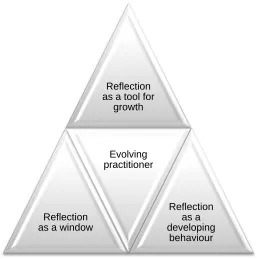
reflective processes, posits the following and their relationships: 1) reflection as a
window into the student/new practitioner experience, 2) reflection as a tool for
students/new practitioners, 3) the nature of reflection as a developing behaviour,
and 4) audiology students’ evolution as professional practitioners. This theory
may be referred to as Reflection in the Education and Socialization of
Practitioners: Novice Development (RESPoND).
This work offers a contribution to the empirical literature on reflection and
reflective practice in the health professions and to the sparse body of literature
on audiology education. Implications, strengths, and limitations are discussed
iv
audiology, reflection, reflective practice, professional education, professional
v
My supervisors, Doreen and Deb, have been a dependable source of support
and rational voices of reason. Thank you for giving me the freedom to learn, grow
and explore my research interests while always being there to cheer me on. You
represent the ideals of academic life and you have modeled an incomparable
work ethic and commitment to your students, to your research and service, to
your profession. Thank you for instilling these values in me through your
modeling of academic integrity at its finest.
My committeemembers, Anne and Richard. What valuable perspective and
expertise you brought to my work! Anne, thank you for pushing my thinking to
another level and opening up my perspective. You introduced me to Reflective
Practice and new ways of knowing, and in doing so, gave me a new lens, a voice
and a topic for my dissertation that would sustain my passion and devotion
throughout my doctoral education. Richard, your belief in my work gave me the
confidence to go forward into relatively uncharted territory, knowing that one of
the fathers of audiology approved of my mission.
I also wish to thank Lynn Shaw for thoughtful contributions to both my
comprehensive and thesis examination. Meg Cheesman, your support and
perspective were necessary for this research to take place. Jonathan White at
the University of Alberta, thank you for sharing your residents’ reflections with me
to inspire my own participants. Arno Kumagai, thank you for travelling to Canada
to participate in my dissertation defense. Since learning of your work at the
Engaging Reflection conference in 2009, I have been inspired by your journey.
I’m also very appreciative of Mary-Anne Andrusyszyn for serving as an examiner
and Mary Beth Jennings for serving as an examiner and acting as a trailblazer in
audiology.
My fellow students, working toward related research goals in Health and
vi
Wedlake, Christine Meston, Laya Poost-Foroosh, Anna Park, Niki Kiepek, and
others. The conversations we had about our research in courses and seminars,
over lunch, coffee or even by email, surely shaped much of my knowledge over
the past four years, and I think a little bit of each of you found its way into my
writing at some point. Danielle Glista, thanks for leading the way in HRS and
participating in countless caffeination sessions.
Jeff Crukley, thank you for being my critical companion and partner in all things
important. To have you journeying at my side with patience and thoughtfulness is
a true privilege. Your insight has spilled into the essence of this work, just as I’m
sure the knowledge in this document has tiptoed its way into your consciousness
too. I’m grateful for your openness to different ways of exploring and creating
knowledge, and most of all, for your resolute belief in my abilities and protection
of my spirit.
Myextendedsupport network, Susan Scollie, Marlene Bagatto, JB Orange,
Jack Scott, Frances Richert, Shane Moodie, and many others. You may not
realize that you have impacted my dissertation, but your support was felt and
appreciated. The work that you do professionally is also a source of inspiration
and motivation. Lucy Kieffer, I must thank you for 11 years of being there, taking
care of some of the most important details, always with kindness and respect.
Lorelei Lingard, though we talked about the future in our meetings, your
mentorship impacted my scholarship immensely. My audiology classmates of
2006 and my audiology and speech-language pathology students of the 2011
cohort – my communities of practice – thank you for sustaining and rejuvenating
my commitment to our profession. Kari Gough, thank you for your friendship and
for sharing your unique wisdom.
My TVDSB work family, and the group of six: Brenda, Ed, Mary Kay, Phyllis,
and Sandy. You kept me grounded in the real world and acted as my mental
vii
actually shaped my experience and knowledge over the past four years possibly
more than my time in the academic world. You are my role models in life, for the
truly heroic work and living you do so quietly, for all the right reasons, and for
being the very essence of compassion, integrity, friendship, family, and
perseverance. For sharing with me a re-humanization of human relationships,
thank you.
Myfamily, mom, dad, and Stephanie. Your love and support are immeasurable
and appreciated more than I could possibly express in a few short sentences.
Cathie and Neil, your kindness and generosity certainly helped bolster me
through the harder parts of the journey. Thank you.
My participants, Of course this work would be impossible without you. Thank
you for giving of yourselves so freely and generously. It is my hope that I have
done your experiences justice.
Funding Acknowledgements:
Financial support was provided by: Ontario Graduate Scholarship, Ontario
Graduate Scholarship in Science and Technology, Educational Audiology
viii
CERTIFICATE OF EXAMINATION ... ii
Abstract ... iii
Keyword ...iv
Acknowledgments ... v
Table of Contents ... viii
List of Tables ... xvi
List of Figures ... xvii
List of Appendices ... xviii
List of Abbreviations ... xix
Preface ...xx
Glossary ... xxi
Chapter 1 ... 1
1 Reflection and reflective practice: Theory and applications in audiology... 1
1.1 The origins of reflective practice ... 2
1.1.1 Dewey: Experience and reflection in education ... 3
1.1.2 Habermas: Reflection for emancipation ... 5
1.1.2.1 Critically reflective practice ... 7
1.1.3 Kolb: Reflection in experiential learning ... 8
1.1.4 Schön: Reflective practice ... 10
1.1.4.1 Tacit knowledge, knowing-in-action, and professional artistry ... 10
1.1.4.2 Epistemologies of practice ... 11
1.1.4.3 Summary of Schön’s reflective practice ... 12
ix
1.2.1 Non-dichotomous epistemological perspective ... 13
1.2.2 The importance of experience to learning: Experience as a valid source of knowledge ... 15
1.2.3 The need for and role of action: Pushing boundaries through dynamic knowledge creation and use ... 16
1.2.3.1 Reflection-in-action versus reflection-on-action ... 16
1.2.3.2 Reflection-in-action in audiology ... 18
1.3 Summary: A reflective roadmap ... 18
1.4 Reflection in audiology ... 19
1.4.1 A brief reflection – Audiology’s swampy lowland ... 21
1.4.1.1 Critical reflection in audiology practice ... 21
1.4.2 Where are we now? Audiology’s journey into reflection ... 23
1.4.2.1 A brief profile of audiology students ... 24
1.4.2.2 Early attempts at reflective audiology ... 25
1.4.3 Fostering reflection in audiology... 27
1.4.4 Research needs in reflection and reflective practice ... 29
1.5 Closing reflections ... 29
1.6 The research question ... 30
Chapter 2 ... 32
2 Methodology: The methodological spiral of grounded theory ... 32
2.1 Defining grounded theory ... 33
2.2 A rationale for grounded theory ... 35
2.2.1 Seeking understanding of interconnected processes through the process of developing grounded theory ... 35
x
2.5 My position on the methodological spiral ... 41
2.5.1 The philosophical fit of grounded theory to my research question and goals ... 43
2.5.2 Context ... 45
2.5.3 Philosophies and theories in grounded theory ... 46
2.6 The grounded theory methods: Methodology-methods package ... 47
2.6.1 Theoretical sensitivity ... 48
2.6.2 Reflexivity ... 49
2.6.3 Literature reviews ... 50
2.6.4 Theoretical sampling ... 50
2.6.5 Theoretical saturation ... 52
2.6.6 Constant comparative method ... 53
2.7 Synthesis and summary ... 53
2.8 Starting assumptions for the research ... 56
Chapter 3 ... 60
3 Study design and methods ... 60
3.1 Design overview ... 61
3.2 Ethics approval ... 61
3.3 Participant details ... 63
3.3.1 Recruitment and sampling ... 63
3.3.1.1 Student participants ... 63
3.3.1.2 Non-student participants: Clinical faculty and supervisors ... 63
3.3.2 Demographics ... 64
xi
3.4.2 Intensive interviews ... 65
3.4.3 Professional behaviour goals ... 65
3.5 Procedures ... 66
3.5.1 Reflective practice workshops ... 66
3.5.2 Data collection procedures ... 67
3.5.2.1 Written reflections and interviews ... 67
3.5.2.2 Written professional behaviour goals ... 68
3.6 Ethical considerations ... 69
3.7 Data management ... 69
3.8 Analysis ... 70
3.8.1 Constant comparative method ... 70
3.8.2 Theoretical sensitivity ... 72
3.8.3 Reflexivity ... 73
3.8.4 Coding ... 73
3.8.5 Theoretical sampling ... 74
3.8.6 Theoretical sufficiency ... 75
3.8.7 Memo-writing... 75
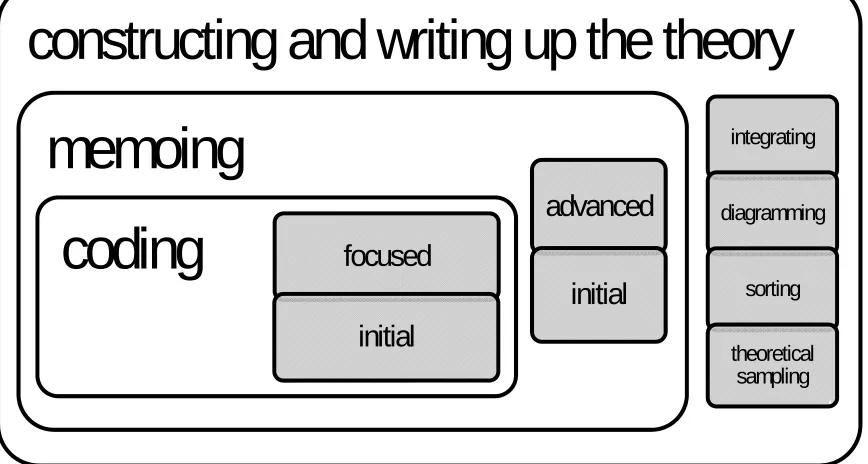
3.8.8 Sorting, diagramming, and integrating ... 76
3.9 Design considerations... 76
3.9.1 Influence on participants ... 76
3.9.2 Elicited, guided, written reflection ... 77
3.9.2.1 Researcher response to written reflections ... 77
3.9.3 Interview guides: from semi-structured to loosely guided ... 77
xii
3.10.2 Originality ... 78
3.10.3 Resonance ... 79
3.10.4 Usefulness ... 79
3.11 Development of the grounded theory: Overview ... 79
Chapter 4 ... 81
4 The grounded theory ... 81
4.1 The overarching grounded theory: The role of reflection in audiology students’ development as professional practitioners ... 81
4.2 Presentation style and format ... 84
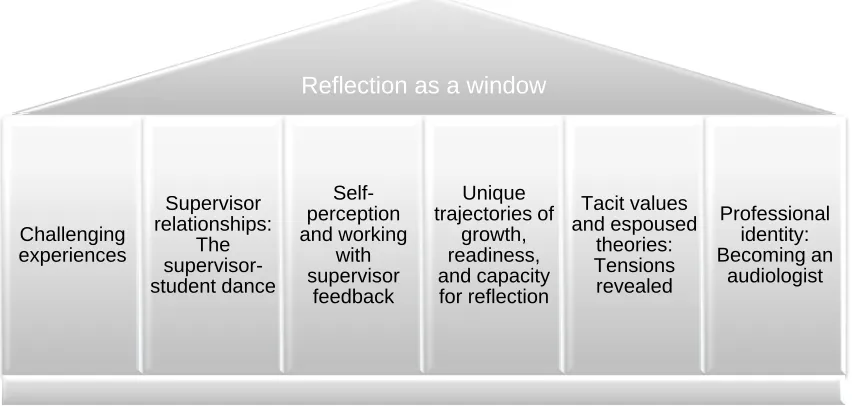
4.3 Facet 1: The reflection window: Illuminating the personal and the tacit ... 86
4.3.1 Challenging experiences ... 87
4.3.2 Supervisor relationships: The supervisor-student dance ... 87
4.3.3 Self-perceptions and working with supervisor feedback ... 90
4.3.4 Unique trajectories of growth, readiness, and capacity for reflection ... 93
4.3.5 Tacit values and espoused theories: Tensions revealed ... 95
4.3.6 Professional identity: Becoming an audiologist ... 98
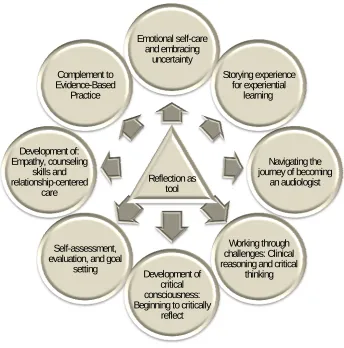
4.4 Facet 2: Reflection as a tool for students: What reflection offers students for personal and professional development ... 101
4.4.1 Emotional self-care and embracing uncertainty ... 102
4.4.2 Storying experience for experiential learning ... 106
4.4.3 Navigating the journey of becoming an audiologist ... 108
4.4.4 Working through challenges: Clinical reasoning and critical thinking ... 108
xiii
4.4.7 Development of skills ... 119
4.4.8 Complement to evidence-based practice ... 121
4.5 Facet 3: Reflection as developing behaviour ... 122
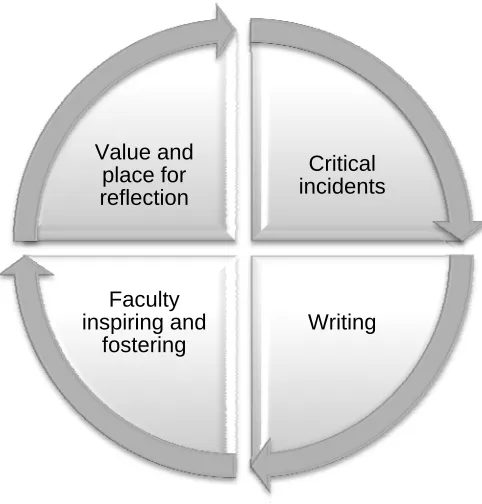
4.5.1 Reflection sparked by critical incidents ... 124
4.5.2 Reflection developed through writing ... 125
4.5.3 Faculty inspiring and fostering reflection ... 129
4.5.4 Valuing and finding a place for reflection ... 131
4.6 Underlying process: Development from student clinician to professional practitioner (Evolving practitioner) ... 134
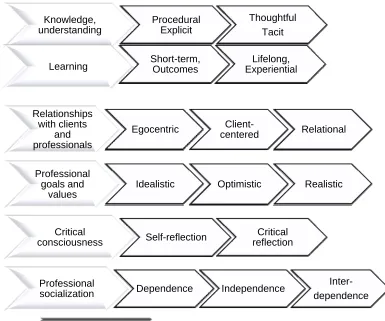
4.6.1 Knowledge, understanding, and learning ... 135
4.6.2 Relationships with clients and professionals ... 137
4.6.3 Professional goals and values ... 141
4.6.4 Critical consciousness ... 142
4.6.5 Professional socialization ... 143
4.7 A multi-faceted theory ... 145
Chapter 5 ... 150
5 The RESPoND grounded theory ... 150
5.1 Reflexivity revealed: My practice, teaching, and the research journey .. 150
5.2 Scope of the RESPoND gounded theory ... 156
5.3 Discussion of the theory ... 157
5.3.1 Critical companionship and faculty/supervisor inspiring and fostering ... 158
5.3.2 Naming experiences, storying experience, and experiential learning ... 160
xiv
5.3.5 Embracing uncertainty ... 164
5.3.6 Beyond self-assessment ... 166
5.3.7 Three main themes for audiology: Relating the developed grounded theory to the “backbone” of reflection for audiology .... 167
5.3.7.1 Non-dichotomous epistemological position ... 167
5.3.7.2 The importance of experience ... 170
5.3.7.3 The role of and need for action ... 170
5.3.8 Summary ... 172
5.4 Comparing to similar empirical literature ... 172
5.4.1 Within audiology ... 172
5.4.2 Across health professions ... 173
5.5 Practical implications ... 177
5.5.1 Explicit applications ... 177
5.5.1.1 Inspire and foster as opposed to mandate and evaluate 179 5.5.1.2 Joint supervisor-student journals ... 182
5.5.2 Implicit impact ... 183
5.6 Quality of the theory ... 184
5.6.1.1 Credibility ... 184
5.6.1.2 Originality ... 185
5.6.1.3 Resonance ... 185
5.6.1.4 Usefulness ... 186
5.6.1.5 Aesthetics of the writing ... 186
5.7 Strengths and limitations ... 187
xv
5.7.1.2 Longitudinal nature ... 187
5.7.2 Limitations ... 188
5.7.2.1 Participation versus non-participation, and participant attrition ... 188
5.7.2.2 Limitations of elicited reflection ... 188
5.8 Reflections on the research journey ... 189
5.9 Conclusion: A representation of complexity ... 191
5.9.1 A look ahead ... 192
Epilogue ... 194
References ... 195
xvi
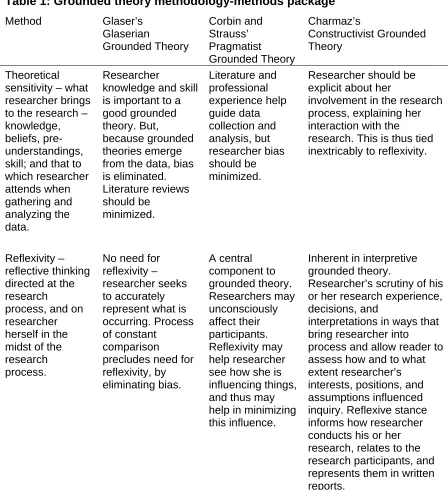
Table 1: Grounded theory methodology-methods package ... 40
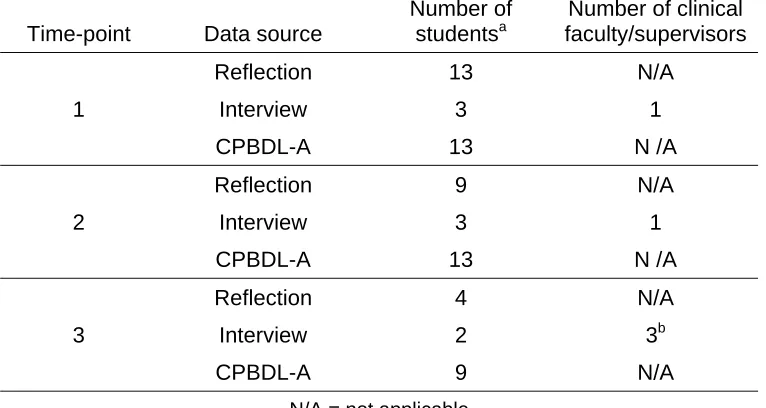
Table 2: Number of participants per data source and time-point ... 68
Table 3: Concepts for discussion, defined ... 151
Table 4: Interconnected RESPoND grounded theory ... 158
xvii
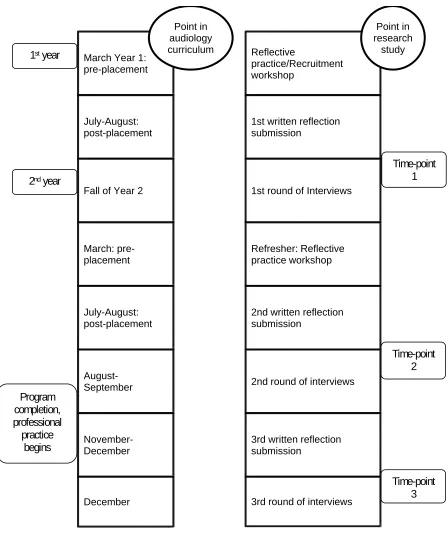
Figure 1: Overarching design timeline. ... 62
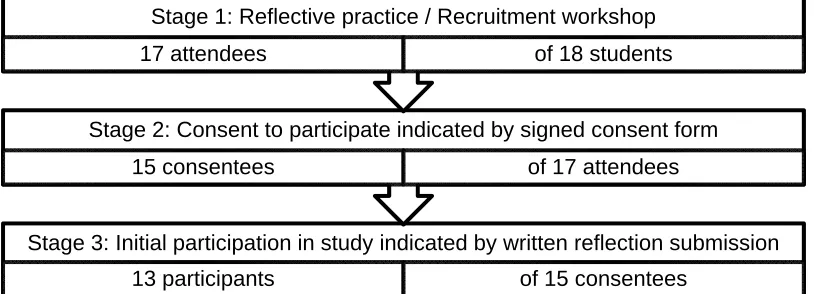
Figure 2: Student participant recruitment numbers by stage ... 63
Figure 3: Constant comparative method: A schematic ... 72
Figure 4: The prism of reflection: The three linked facets of the role of reflection in audiology students’ development as professional practitioners ... 83
Figure 5: Properties of the facet reflection as a window ... 87
Figure 6: Properties of the facet reflection as a tool for growth ... 102
Figure 7: Properties of the facet reflection as a developing behaviour ... 124
Figure 8: Properties of the development from student to professional practitioner (evolving practitioner) ... 135
Figure 9: The RESPoND theory: Reflection in the Education and Socialization of Practitioners: Novice Development. A grounded theory of the evolving practitioner, supported by reflective processes. ... 149
xviii
Appendix A: Ethics approval notices ... 207
Appendix B: Workshop materials ... 213
Appendix C: Letters of information and consent forms ... 218
Appendix D: Audiology Education Program Summary ... 226
Appendix E: Initial interview guides (Questions subsequently evolved based on theoretical sampling) ... 228
xix ABR: Auditory Brainstem Response AR: Aural Rehabilitation
AuD: Doctor of Audiology
CPBDL-A: Comprehensive Professional Behaviours Development Log - Audiology
CSD: Communication Sciences and Disorders EBP: Evidence-based practice
ENT: Ear Nose and Throat physician (otolaryngologist) ID: Participant identification number
IHP: Infant Hearing Program
RESPoND: Reflection in the Education and Socialization of Practitioners: Novice Development
SLP: Speech-Language Pathology
SMART: Specific, Measureable, Action-oriented, Realistic, and Time-Constrained QDA: Qualitative Data Analysis
xx
In facilitating a course with a cohort of audiology and speech-language pathology
students, I kept a blog through which I shared my reflections of professional and
teaching experiences with students. Before the course even began, I wrote one
reflection following a series of “snow days,” in which the school board for which I
worked closed all schools due to inclement weather, for a number of days. This
decision was met with much controversy, sparking my reflective blog about the
difficult decisions people “in power” must make when faced with situations that
have no straightforward “right answer.” In a sense, this blog post represented
critical reflection, and anticipatory reflection, as I envisioned what the course
would achieve and promote for students. At the end of the course, I shared this
initial blog post again, coming full circle as we celebrated the success of the
course. We had built a community experience that would hopefully support years
of lifelong learning. The connection to my dissertation was not so clear at the
time, but as I searched for a fitting quotation to preface this body of work, I came
back to this blog post, which I share in part with you here. It may be unusual to
have as much personal reflection in an academic dissertation as I have included
in mine. However, in the course of this dissertation, I learned, and in turn must
emphasize, the value of personal and professional experience as an equal
counterpart to science and technique as a source of knowledge. As such, this
dissertation draws heavily on multiple sources of knowledge: the theoretical, the
empirical, the substantive, the professional, and the personal.
Dececember 8, 2010 – Instructor’s Blog:
…At the end of this snow day, I realize that teaching Professional Issues is about
helping you all reach the point of understanding that practice is not black and
white, and that this greyness, and the need for artistry to navigate the swamp...is
to be embraced. Seeing practice in shades of grey, realizing that our strong
opinions are sometimes met with equal and opposing forces, and engaging our
professional artistry to do the best we can for clients when there is no known
xxi
Concept Definition Reference
Anticipatory reflection
Constructionism
Constructivism
Reflection that occurs in anticipation of a specific situation or systemic, task-oriented reflection in the context of planning ahead.
In contrast to the individualistic nature of constructivism defined below, constructionism involves the social world as source of meaning-making and emphasizes interactions and interpretations between human beings and their social worlds.
Epistemological position that holds that individuals experience world uniquely,
constructing knowledge that is in flux rather than found in static form. In terms of practice,
practitioners make meaning based on reflective conversations that they hold with the materials of their situation, which results in a remaking of the practitioners’ practice world.
(Kinsella, 2000; Van Manen, 1991) (Crotty, 1998) (Goodman, 1978; Kinsella, 2006a; Schön, 1987) Critical companion Critical reflection
A dialogic partner, who promotes one’s reflective thinking through listening, enabling, challenging, critical questioning, and supporting development and growth.
A critique of assumptions about the content or process of problem solving, or making a taken-for-granted situation problematic, raising questions regarding its validity and recognizing the role of power. Focuses on systemic and social issues through multiple lenses.
(Higgs & Titchen, 2001; Johns, 1984, 2002). (Brookfield, 1998; Mezirow, 1990)
Eudaimonia An Aristotleian concept, which in health professional practice has been defined as genuine happiness and human flourishing for the patient, “whatever that means for the individual patient/client” (p. 255).
(Flaming, 2001)
Guided reflection Reflection that occurs in collaboration with a mentor, peer, or critical companion.
(Johns, 2002)
Indeterminate zones of practice
The uncertain, unique, and value-conflicted situations of practice, in which technical problem solving may not be sufficient. Indeterminate zones of practice are central to professional practice.
xxii
publicly observable, with the knowing residing in
the action.
Phronesis An Aristotleian concept, phronesis is deliberation about values with reference to praxis (theory to practice). Phronesis is pragmatic, variable and context-dependent, oriented toward action, and based on practical value-rationality. Phronesis is related to ethics, but is not analogous to it; there is no modern-day analogous term. Phronesis provides a complementary conception to research-based practice. (Flaming, 2001; Flyvbjerg, 2001; Kinsella, 2001) Professional artistry
“A high-powered, esoteric” type of competence exhibited in everyday acts of “recognition, judgment and skilful performance.”
(Schön, 1987, p. 22)
Reflection “Active, persistent, and careful consideration of any belief or supposed form of knowledge in light of the grounds that support it and further conclusions to which it tends.”
(Dewey, 1910, p. 6)
Reflection-in-action
Reflection in the midst of action without interruption or temporal delay; our thinking reshapes what we are doing as we are doing it.
(Schön, 1987)
Reflection-on-action
Intentional reflection on action of the past, to make sense of the action and possibly learn from it, thus a way of learning or generating knowledge from experience, which will potentially influence future action. Can take many forms, often written.
(Schön, 1983; Schön, 1987)
Reflective practice
A way of practicing, emphasizing processes of critical consideration (based on multiple sources of knowledge) and resultant improvement of clinical actions before, during, and after clinical actions take place.
(Ng, Bartlett, & Lucy, Accepted Jan 17, 2011; Schön, 1983)
Schön’s
epistemology of practice
Traditionally, technical rationality has been the dominant epistemology of practice. Schön suggests an alternate epistemology of practice, beginning with the practitioner's practice
experience, including artistic, intuitive processes used to navigate uncertain, unstable, unique, and value-conflicted situations (indeterminate zones of practice).
xxiii
to put into words how we know how to do certain things.
1958; Schön, 1983)
Technical rationality
Dominant epistemology of practice in which professional activity consists of instrumental problem solving through application of scientific theory and technique.
Chapter 1
1
Reflection and reflective practice: Theory and
applications in audiology
Reflective practice is one of the most commonly cited topics in the broad field of
professional knowledge and competence (Eraut, 1994). Professions that have
discussed the use of reflective processes in the context of professional
knowledge and development include business (Cunliffe, 2002), education (Boud
& Walker, 1998; Schön, 1983, 1987), medicine (Kumagai & Lypson, 2009),
nursing (Benner, 1984), occupational therapy (Kinsella, 2001), physical therapy,
and social work (Plath, 2006). Common threads in the reflective practice
literature across disciplines include its potential to bring otherwise tacit elements
of practice to the surface (Higgs, Andresen, & Fish, 2004), to help professionals
develop their practice knowledge and expertise (King et al., 2007), to lead to
questioning of assumptions (Kinsella, 2001), and to stimulate or complement
critical thinking (Gross Forneris & Peden-McAlpine, 2006; Price, 2004) and
evidence-based practice (EBP: Avis & Freshwater, 2006; Mantzoukas, 2007,
2008). Yet, despite the popularity and utility of reflective practice, the hearing
healthcare profession of audiology has been slow to explicitly explore the
theories of reflection, evidenced by the paucity of literature on the topic within the
field. In this chapter I outline the theoretical background of reflection and
reflective practice and propose three key considerations in adopting the
discourse for audiology, summarize early attempts to bring scholarship about
reflective practice into the field of audiology, and outline potential ways to foster
reflection in audiology students. I conclude this chapter by posing a research
question to begin to fill the void of literature on this topic in audiology.
Different theorists and disciplines have theorized and applied reflective practice
in a variety of ways, making it confusing for newcomers to navigate their way
through the large body of literature. The danger in this confusion is the possibility
oversimplified. Although most thoughtful considerations of reflective practice
share the same roots, many offshoots and branches also exist (Moon, 1999).
The offshoots exist, in part, because the reflection literature spans a range of
perspectives and applications. Thus, it would benefit a discipline in the early
stages of theorizing about reflection and reflective practice to take some time to
study the theoretical foundations of these topics. A critical challenge, identified by
my early attempts to discuss reflective practice in audiology, lies in framing
reflection so that it is accessible and appealing to a profession strongly governed
by what the father of reflective practice, Donald Schön, has called technical
rationality. Technical rationality is defined by Schön as the dominant
epistemology of practice in which professional activity consists of instrumental
problem solving through application of scientific theory and technique. Clearly,
there are many problems in practice that elude technical solution. Reflective
practice is thus offered as a complementary epistemology of practice (Schön,
1983).
1.1
The origins of reflective practice
An understanding of the theoretical background of reflective practice is
necessary to avoid generic and nonspecific approaches and misinformed
application. Reflection and reflective practice are related but different constructs,
but it is helpful to understand reflection even if one’s focus is on reflective
practice. Reflection is a way of thinking, which may manifest itself in learning,
practice, or in one’s way of being. Reflective practice is a way of theorizing about
the embodied and tacit, and intentional and explicit, forms of reflection within
professional practice (Kinsella, 2007b). To fully appreciate Schön’s conception of
reflective practice, it is helpful to understand reflection as it relates more basically
to thinking, knowledge, learning, and education.
Moon (1999) identifies four main theorists, whose work she contends makes up
the “backbone” (Moon, 1999) of scholarship in reflection as it relates to learning
and professional development. These theorists are: educational philosopher
psychological perspective as it pertains to education; critical philosopher Jürgen
Habermas (1971), who views reflection in an epistemological sense, as a way
toward emancipation; David Kolb (1984), who positions reflection as one piece
within an experiential learning cycle; and applied philosopher Donald Schön
(1983, 1987, 1992), who popularized the concept of reflective practice in the
context of professional practice. Redmond (2004) also includes the above four
theorists in her overview of key thinkers in reflection. Of these four main
theorists, only Schön focuses on reflective practice. Dewey, Habermas, and Kolb
focus on reflective thinking in learning and education, critical reflection, and
experiential learning, respectively.
Writing this chapter served as a way to discover the most resonant and relevant
aspects of the reflection and reflective practice literature for audiology and for the
research study. The above four theorists formed a compass, as they guided me
in different directions within the vast landscape of reflection. On each excursion
within the journey, I also learned about other thinkers of reflection and reflective
practice, who I acknowledge in relation to the main thinker below. The following
section serves as a map of reflection and reflective practice. I conclude this
section with a summary of important themes of reflection as they relate to
reflective practice, which will inform my work in looking at how reflection is
enacted and implicated as audiology students develop as professional
practitioners.
1.1.1
Dewey: Experience and reflection in education
Pragmatist philosopher Dewey defines reflective thought as “Active, persistent,
and careful consideration of any belief or supposed form of knowledge in light of
the grounds that support it and further conclusions to which it tends …” (Dewey,
1910, p. 6). Dewey suggests that without reflection, action is merely impulsive
and self-serving. The two sub-processes of reflective thinking include: 1) a state
of perplexity, hesitation, or doubt and 2) an investigation to support or disprove
the suggested belief (Dewey, 1910). In other words, by looking deeper into one’s
1.1.4), one can develop new insights in a process of shaping knowledge based in
experience.
The two sub-processes of reflective thinking outlined above are embedded within
most explorations of reflective practice, in some form. For example, Dewey’s
sub-processes can be found in Benner’s (1984) critical incident analysis for
nursing practitioners. Benner (1984) encourages nurses to reflect on experiences
critical to their practice, including those that are especially ordinary, particularly
demanding, or incidents that went unusually well. This suggestion aligns with
Dewey’s first step in reflective thinking: identifying an uncertainty. Next, these
critical incidents should be reflected upon in terms of context, why the incident
was critical, what the practitioner’s concerns were at the time, and how one might
accordingly adjust future practice (Benner, 1984). This step aligns with Dewey’s
second stage of reflective thinking, with the nurse or practitioner investigating the
reasons for their previous uncertainty. Benner (1984) views the critical incident
analysis as a way to facilitate study of expert practice and to move novice
practitioners toward expert levels of practice.
Dewey (1910) suggests that when confronted with a problem, a reflective thinker
reflects on theories to find a solution. These theories are based on past
experience and prior knowledge. Thus, the role of reflection in the process of
creating new knowledge based in experience is emphasized. Experience is an
especially important aspect of Dewey’s work.
In fact, Dewey (1910, 1938) proposes an educational philosophy based in
experience, and criticizes the “traditional” education system of his time. Dewey’s
(1938) philosophy of education involves two related components. First, Dewey
discusses continuity; for an experience to be educationally worthwhile, it must in
some way have a long-lasting impact on the learner. This prerequisite is called
continuity of experience. Second, Dewey emphasizes interaction; the interaction
of objective conditions (such as knowledge of experts) and internal conditions
educational experience valuable. That is, an educational experience in which a
student actively learns and acquires meaningful knowledge, rather than passively
receives information, is necessary for a successful learning experience that will
have longevity of impact. Dewey’s (1938) educational philosophy of experience is
an early example of a call for consideration of various sources and alternative
conceptions of knowledge in education.
Dewey’s (1910, 1938) philosophy of education may thus be credited with
positioning experience in the center of learning and highlighting reflection
(including reflection on experience) as a crucial step in learning, acquiring, and
creating knowledge. These are ideas that Kolb (1984) later developed in his
model of experiential learning.
In summary, I derive inspiration from the following points relevant to reflection
from Dewey’s work: experience as a source for knowledge and central
component of learning; and the role of reflection in transforming actions and
experiences into meaningful learning and pushing knowledge to another level.
These themes also recur in the work of the following three theorists and help
guide my exploration of the use of reflection by audiology students developing as
professional practitioners.
1.1.2
Habermas: Reflection for emancipation
Critical philosopher Habermas (1971) was part of a movement away from
thinking about reflection pragmatically, toward an emancipatory ideal. Habermas
served as inspiration for others, including Brookfield, Kemmis, and Mezirow, to
continue to develop the concept of critical reflection (e.g. Brookfield, 1988; Carr &
Kemmis, 1986; Mezirow, 1990). Critical reflection is neatly distinguished from
reflection by Mezirow (1990). Mezirow (1990) states that reflection is the
“process of critically assessing the content, process, or premise(s) of our efforts
to interpret and give meaning to an experience,” whereas critical reflection
considers the “critique of assumptions about the content or process of problem
regarding its validity” (p. 104-5). Critical reflection places emphasis on systemic
and societal conditions and more explicitly seeks change and emancipation.
As previously discussed, Dewey (1910) was concerned that action is reduced to
habit and impulse in the absence of reflection. Similarly, Habermas (1971) is
concerned about uncritical acceptance leading to hegemonic perpetuation.
Habermas (1971) identifies three broad areas for knowledge generation:
technical, practical, and emancipatory. Technical knowledge is, most commonly,
associated with empirical-analytic sciences. Practical knowledge, on the other
hand, is mostly tied to “historical-hermeneutic” sciences, which are more
concerned with language and meaning (Habermas, 1971). Habermas (1971)
associates emancipatory knowledge with critical social science, which focuses on
overcoming societal constraints and creating change. Habermas (1971) argues
that it is in the third area of knowledge generation, emancipation, that critical
reflection is most crucial.
From the critical reflection perspective, reflection is necessary to help reveal
systematic and societal controls that otherwise obstruct freedom to acquire
knowledge (Habermas, 1971). The goal of reflection for Habermas (1971) is
transformation of self, personal, or social worlds. In other words, by reflecting
critically, people can become aware of their assumptions and how they are being
influenced by societal presuppositions. This awareness can then lead to the
development of alternative social structures (Habermas, 1971). For Habermas,
technical and practical knowledge are clouded by existing social structures and
thus cannot lead to the same degree of change and improvement. Habermas
suggests that reflection leading to emancipation is not something that
empirical-analytic disciplines can readily achieve (Habermas, 1971; Moon, 1999).
In summary, Habermas (1971) was interested in uncovering and understanding
meaning in practical, social science disciplines, and he differentiated this from
the goals of technical disciplines. Critical reflection, or reflection upon
1990), is thus informed by Habermas’ (1971) concern with emancipatory
interests as they relate to human knowledge. In audiology, critical reflection can
be useful for bringing taken-for-granted assumptions and situations into light and
for identifying and navigating ethical dilemmas and systemic challenges, which in
my experience, can be quite significant in audiology practice settings. Although
critical reflection and Dewey’s pragmatic reflection are distinct, I see them as
compatible and complementary. Habermas places a critical lens on reflection,
and his work can be applied to professional practice.
1.1.2.1
Critically reflective practice
Brookfield (1998) theorizes about critical reflection in professional practice.
According to Brookfield (1998), critically reflective practitioners constantly try to
discover and research the assumptions that frame how they work. This research
occurs by seeing practice through four complementary lenses: 1) one’s own
autobiography as a learner of reflective practice; 2) the learners’ [or in a health
profession, the patients’/clients’] eyes; 3) colleagues’ perceptions; and 4)
theoretical, philosophical, and research literature. Brookfield’s (1998) discussion
of theoretical literature as a lens through which to see our own practice resonates
with my experience of learning of the theory of reflective practice.
Brookfield writes: “Theory helps us ‘name’ our practice by illuminating the general
elements of what we think are idiosyncratic experiences…theory can help us
realize that what we thought were signs of our personal failings as practitioners
can actually be interpreted as the inevitable consequence of certain economic,
social, and political processes” (Brookfield, 1998, p. 200). Before I was
introduced to the literature surrounding reflective practice, I held within me many
unspoken tensions about professional practice issues in audiology. I did not
possess the language of reflection and reflective practice, so I doubted that what
I was experiencing and how I was processing my experiences could be valid. I
felt disheartened and wanted to change the status quo or at least find a way to
practice optimally within it. Yet, I was unsure of how to solve the problems I was
had filled with the technical-rational tools that I had acquired in school. When I
began to read Schön’s The Reflective Practitioner, I felt vindicated. I was given
the gift of a language with which to voice and explore my concerns, and with this
I could begin to address some of the issues in which I was immersed. Despite my
appreciation for this new ability to “name” my practice, I must state with certainty
that one could not be a good audiologist without a well-equipped technical toolkit.
Audiology has not widely embraced the theory of reflection and reflective
practice, and will likely always rely more heavily on technical rationality, with
good reason given the context of the profession’s practices. Thus, in terms of
accessibility and appeal to the field of audiology, Schön’s epistemology of
practice benefits from explanation of how reflection has been theorized in various
contexts. Audiology borrows some of its theoretical basis from cognitive
psychology; thus I suggest that the cognitive psychology-based “cycle” of
experiential learning (Kolb, 1984) may serve my goal of making the theory of
reflection and reflective practice accessible and appealing to the field of
audiology.
1.1.3
Kolb: Reflection in experiential learning
Kolb (1984) places reflection within an experiential learning cycle. Kolb (1984)
views learning as a continuous process grounded in experience, which aligns
with Dewey’s (1938) emphasis on experience and continuity. Kolb also views
learning as tension- and conflict- laden, which corresponds with: Dewey’s
problems that arise in learning, Habermas’ purpose for reflection in the
development of emancipatory knowledge, and Schön’s (1983, 1987)
indeterminate zones of practice to be discussed below.
Kolb (1984) suggests that learners require four types of ability to effectively learn:
concrete experience abilities, reflective observation abilities, abstract
conceptualization abilities, and active experimentation abilities. For Kolb (1984),
reflection mainly serves as part of the experiential learning process; but, his
writing has clearly been identified as part of the history of reflection and learning
and learning; to understand learning, we must understand what constitutes
knowledge, because knowledge is the outcome of learning. In this way then, we
must be able to envision knowledge that is borne of personal and professional
experience, and not only knowledge that is derived from scientific research
evidence.
I agree with Moon (2004) who suggests that Kolb’s experiential learning cycle,
while highly popular, is neither complete nor self-sufficient. However, I believe
the cycle is an important starting point for audiology because it is a well-known,
practical theory derived from a cognitive psychology perspective, that positions
reflection clearly within the process of experiential learning. Building on Kolb’s
work, Moon (2004) summarizes seven points that characterize experiential
learning: 1) it is not usually ‘taught’ in a traditional sense; 2) rather, the material
of learning is usually direct experience; 3) it is potentially more meaningful,
potentially empowering due to the way experiential learning is used; 4) reflection
is either deliberately or unintentionally involved in most cases of experiential
learning; 5) action is involved; 6) feedback takes place; 7) it involves formal intent
to learn. The fourth point above is worth expanding upon. Reflection is
intertwined with experiential learning, and arguably, is necessary for optimizing
experiential learning. However, reflection can take place outside of experiential
learning. For example, reflection on pre-existing knowledge and ideas can make
them deeper and more meaningful (Moon, 2004).
Kolb (1984) emphasizes that learning is a process that should not be measured
in terms of finite outcomes because of its dynamic nature. Drawing from Dewey
(1938), Kolb (1984) states that ideas are formed and re-formed through
experience and that no two thoughts are ever the same, because experience
intervenes. Kolb (1984) suggests that rather than memorizing knowledge and
allowing the knowledge gained to remain static, we should aim to continually
learn through experience. Further, learning is actually an act of re-learning and
ever-changing and expanding learning, in that we do not start out in learning
learning is centered on a resolution of conflicts between opposing views, is
intricately tied to the environment of the learner, and results in new knowledge.
In summary, Kolb’s experiential learning theory is helpful because it emphasizes
that reflection on its own, or experience on its own, is insufficient for effective
learning. Relating this to professional practice, reflection plays a role in bringing
together theories and past actions to (re)conceptualize practice, or to develop
professional practice knowledge by making meaning from experience. The active
experimentation phase of Kolb’s learning cycle involves the testing of newly
learned or developed theories. Moon’s (2004) work helps relate and distinguish
experiential learning and reflection. Experiential learning always involves some
form of external experience, whereas reflection can take place without any
external input, but with an entirely internal experience (Moon (2004) calls this
cognitive housekeeping). Experiential learning usually involves reflection, and
reflection is important to experiential learning, but reflection is separate in that it
can occur without “new” material. That is, we can reflect on what we have
already learned (Moon, 2004). The challenge with this relationship is that to
reflect on what we know likely transforms the pre-existing knowledge, thus
becoming a learning experience itself. Schön helps us distinguish reflection on
an existing experience or prior knowledge from reflection as a part of a new or
ongoing learning experience; his theory of reflective practice is discussed next.
1.1.4
Schön: Reflective practice
1.1.4.1
Tacit knowledge, knowing-in-action, and professional artistry
An important feature of Schön’s theory of reflective practice is tacit knowledge, a
form of knowledge discussed in detail by Polanyi (1958). Tacit knowledge is
defined as the often unspoken knowing that guides us in intelligent action; it is
the notion that it is difficult to put into words how we know how to do certain
things (Schön, 1983). The aim of Polanyi’s (1958) writing is to bridge dichotomies
that existed within conceptions of knowledge (for example, between subjectivity
Polanyi (1958) himself bridged a dichotomy: he trained as a chemist and he
wrote as a philosopher. Schön’s reflective practice is influenced by Polanyi’s
(1958) notions of tacit knowledge (Kinsella, 2007b).
Schön also names a tacit kind of knowing that we experience as practitioners:
knowing-in-action. Knowing-in-action is similar to Polanyi’s tacit knowledge, with
perhaps more emphasis on the use of tacit knowledge in action. Schön (1987)
describes knowing-in-action as the intelligent action we demonstrate, which is
publicly observable, with the knowing residing in the action. For example,
knowing-in-action is demonstrated by the physical act of riding a bicycle; even if
we are able to skilfully perform this task, we may be unable to make the
performance verbally explicit. Knowing-in-action thus occurs in the everyday
practice life of a practitioner, spontaneously or automatically, but intelligently. If a
practitioner encounters an indeterminate zone of practice (an uncertain, unique,
conflicted, and challenging practice situation), professional artistry may come into
play. Schön (1987) explains professional artistry as a “high-powered, esoteric
type of competence” exhibited in everyday acts of “recognition, judgment and
skillfull performance ” (p. 22). Professional artistry is the competence used by
practitioners to handle indeterminate zones of practice, and is rigorous in its own
right (Schön, 1987).
1.1.4.2
Epistemologies of practice
For Schön (1983, 1987), reflection is necessary because technical rationality
alone is insufficient to provide practitioners with solutions to the indeterminate
zones of practice. Well-formed problems that do lend themselves to technical
rationality tend to occur on what Schön calls the high, hard ground of
professional practice. However, Schön (1983, 1987) observes that many
important professional practice issues defy technical solution; researchers and
practitioners are often wading in a swampy lowland (Schön, 1983) of professional
practice, where reflection is necessary to identify and solve complex problems. In
order to navigate this swamp, practitioners need to be equipped with an
epistemology of practice, he has turned the relationship between research
knowledge and professional practice “upside down,” focusing first on the
question of what we can learn from professional artistry, instead of the more
common question of how we can better make use of research knowledge
(Kinsella, 2007c).
1.1.4.3
Summary of Schön’s reflective practice
Kinsella (2007b) suggests that tacit knowledge, knowing-in-action, and
professional artistry are key aspects of Schön’s (1983, 1987) theory of reflective
practice, inspired by Polanyi (1958). Schön draws from Polanyi’s tacit knowledge
in his alternative view of professional knowledge. Schön argues for the need to
make tacit knowledge explicit in order for practitioners to improve their practice.
Thus, Schön proposes knowing-in-action as a way to theorize the tacit
knowledge that practitioners use in their everyday practice. Finally, Schön
describes professional artistry as one way that practitioners can approach
practice, especially in the indeterminate zones of practice that often defy
technical rationality (Kinsella, 2007b). An important element of Schön’s theory,
the distinction between reflection-in-action and reflection-on-action, is discussed
in Section 1.2.3.
1.1.4.4
Schön’s constructivist perspective
Schön discusses knowledge from a constructivist perspective (Goodman, 1978;
Kinsella, 2006a, 2009; Schön, 1983, 1987): “When practitioners respond to the
indeterminate zones of practice by holding a reflective conversation with the
materials of their situations, they remake a part of their practice world and
thereby reveal the usually tacit processes of worldmaking that underlie all their
practice” (Schön, 1987, p. 36).We can attempt to make our tacit knowledge and
in-action explicit, but Schön states that our descriptions of our
knowing-in-action will always be constructions, or explicit, symbolic representations of tacit
knowledge. Knowing-in-action is dynamic, but facts and procedures are static
An understanding of the constructivist perspective that informs Schön’s work
helps in developing an appreciation for what Schön offers. For Schön, shifting
from an objectivist to constructivist view of practice makes terms such as “truth”
and “effectiveness” problematic. Truths and effectiveness are only relevant within
a frame, or in other words, within given assumptions about what it means to
know. “With their different ways of framing the situation, [different professions]
tend to pay attention to different sets of facts, see “the same facts” in different
ways, and make judgments of effectiveness based on different kinds of criteria”
(Schön, 1987, p. 218). An inflexible and restrictive frame may make it difficult to
work productively with other professionals, who may be operating within a very
different frame. A constructivist view of knowledge draws attention to the
significance of reflective practice and professional artistry in the very
context-specific lives of professionals and their patients/clients.
1.2
The backbone of reflective practice: Three important
themes for audiology
1.2.1
Non-dichotomous epistemological perspective
Schön’s work is perhaps most famous for its critique of technical rationality
(Eraut, 1994), which is often interpreted as creating a dichotomy (Moon, 1999).
Yet, Kinsella (2007c) suggests that rather than creating a dichotomous portrayal
of technical rationality versus an epistemology of practice, Schön actually works
to overcome such a divide. Schön (1983) suggests that we turn the problems of
professional practice upside down. In other words, we could reflect on the
experiential and contextual elements of practice, in order to set the frame of a
problem, before we attempt to solve problems in a technical-rational manner.
Indeed, this approach is very different from a dichotomy. Schön (1983) does not
suggest that we rid ourselves of technical rationality, but rather that in many
cases, we consider and value alternative ways of approaching practice.
The discipline of audiology stands to benefit from a view that practitioners should
of practice, as a complement to technical or research-based knowledge.
Although Schön (1983) tentatively suggests that 85% of the problems of practice
lie in indeterminate zones and are better served by artistry than technical
solution, this may not be the case in audiology. Audiology is a profession in
which science and technology contribute very significantly to good hearing
healthcare. Still, practice that too rigidly relies on technical rationality and
overlooks affective aspects of patient/client care leaves the patient/client less
satisfied and with sub-optimal outcomes (Berg, Canellas, Salbod, & Velayo,
2008). Following the summary of a three key themes of reflective practice, I
reflect on common audiology cases that demonstrate the limitations of technical
rationality as a sole approach to competent professional practice.
Schön (1987) viewed reflective practice as a bridge between the university world
and practice world. Dewey (1938) was disheartened by the gap between what is
taught, and what is learned through experience. He disagreed with a model of
education that viewed knowledge as deposited into students (i.e. teacher feeds
student knowledge), also referred to as a banking model of education (Freire,
2007). The theory-practice divide is noted as a challenge by many scholars of
professional and practice knowledge (Eraut, 1995; Higgs, et al., 2004; Kemmis,
2005; Kinsella, 2001; Polanyi, 1958). Many educational settings currently
struggle to overcome the dichotomy of theory versus practice. Dewey (1910,
1938), Habermas (1971), Kolb (1984), and Schön (1983, 1987, 1992) each
highlight the importance of connecting theory and practice, and of valuing
practice knowledge. However, it is understandable that misinterpretations,
especially of Schön’s work, may be perpetuated without a careful interpretation of
the original texts. Toward my goal of making reflective practice accessible and
appealing to audiology, the concept of a non-dichotomous epistemology of
1.2.2
The importance of experience to learning: Experience as a
valid source of knowledge
The centrality of experience in education and learning began with Dewey (1938)
and his philosophy of experience for education. For Dewey, experience is vital to
education. Kolb (1984) is credited with popularizing and theorizing experiential
learning and he defines learning as “the process whereby knowledge is created
through the transformation of experience” (p. 38). He notes that this definition
highlights the experiential learning perspective, by emphasizing adaptation and
learning as opposed to content and outcomes. Further, the transformative
process of knowledge, or the creation and recreation of knowledge, is highlighted
in this definition. This definition of learning also contrasts with a model of
education in which knowledge is acquired, transmitted, or deposited finitely. Such
a model was opposed by Dewey (1938) and others (notably, Freire, 2007).
Schön (1983) also envisions a practice world that prioritizes the practitioner’s
experience, with his call for an epistemology of practice. Schön (1992) discusses
reflecting -in and -on practice experiences, implicating active, dynamic process
for improving practice, informed by both pre-existing knowledge and in-action
discoveries.
Although experiential learning can occur without our conscious awareness (Kolb,
1984), making it explicit can help us become more aware of the process and
attend more carefully to potential experiential lessons, thus improving the
effectiveness of the learning experience (Kinsella, 2001). Reflecting on
experience can result in new perspectives (Atkins & Murphy, 1993), novel action
(Eraut, 1995), and transformation (Habermas, 1971).
This theme is important for audiology because audiology is a profession that is
striving for EBP as a guiding theory (Cox, 2005; Moodie, Johnson, & Scollie,
2008; Palmer, 2006). Evidence-based practice is important but in itself is
insufficient; thus the explicit, scholarly exploration of experience as a source of
offers a way to consider experience as a source of knowledge for practice,
complementary to EBP’s critical appraisal of research evidence.
1.2.3
The need for and role of action: Pushing boundaries through
dynamic knowledge creation and use
There are two types of action that I describe in this section. First, I discuss action
in a critical, emancipatory sense. Habermas (1971) stresses the importance of
using knowledge to guide action, change, and transformation. According to Van
Manen (1977), Habermas offers educators an intellectual form of practical
reasoning and action, rooted in emancipatory concern; his perspective is capable
of linking knowledge, theory, practice, and action, all centered on human
interests. For Habermas (1971), action means significant change, at a personal
and social level. Indeed, for the critical reflection theorists informed by
Habermas (e.g. Brookfield, 1988; Mezirow, 1990), reflection can be used as a
tool for questioning assumptions (which can lead to action), transforming
perspectives, overcoming system- or society-imposed oppression, and ultimately
improving one’s personal and practice life. I mention this as a key element of
reflection for audiology because I believe in the importance of questioning
assumptions, challenging status quo, and advocating for change, if we are to
foster practices that best support our patients/clients and satisfaction of
audiologists. That is, reflection can have the power to spark change, if action is
taken based on the important knowledge created through reflection upon
perturbations of practice or professional issues. In the absence of reflection, such
perturbations may go unaddressed, or even unacknowledged. This way of
thinking about reflection is important because it offers an emancipatory
framework for audiologists to attend to ethical dilemmas and to advocate for
systemic change and improvement.
1.2.3.1
Reflection-in-action versus reflection-on-action
Next, I discuss action in terms of daily professional practice. Schön (1983) states
suggesting that his theory is fraught with ambiguity and inconsistency. In Eraut’s
(1995) attempt to clarify Schön’s message, he proposes a reframing of reflective
practice around the aspect of action. Eraut (1995) claims that Schön’s main
contribution is to the theory of metacognition, or self awareness of cognitive
processes. Eraut (1995) argues that although Schön emphasizes the notion of
reflection-in-action, his examples actually focus exclusively on reflection on past
actions.
In some respects, I disagree with Eraut’s (1995) critique. Schön’s (1983, 1987)
description of reflection-in-action refers to the expert use of tacit knowledge that
has been developed through experience. Schön’s reflective practitioner may
indeed reflect on practice after it has occurred, but the practitioner can also make
use of experiences to guide practice as it unfolds, or in-action. As explained
above, this involves the use of tacit knowledge, which when enacted in practice,
is seen as knowing-in-action. An example Schön (1992) uses is that of a
musician or athlete, who learns and improvises based on lessons that are
learned and adapted quickly, online, during and within practice and play.
Musicians and athletes also use reflection in a longer term process of learning or
playing. For example, musicians may listen to an audio recording of their playing,
and athletes may watch a video recording of a game or practice session. Thus,
Schön does not restrict reflection to any one temporal domain.
Reflection-in-action and -on-Reflection-in-action are both necessary to good practice, and knowing-in-Reflection-in-action
often underlies our practices. Of the two temporal domains, reflection-in-action is
perhaps more difficult to develop or make explicit. Yet, reflection-in-action offers
a valuable theoretical insight to audiology because it highlights the importance of
in-the-moment problem solving and learning that does not exclusively occur
following significant temporal delay. Much literature on reflective practice
emphasizes reflection-on-action, in the form of thinking back on practice or
writing about practice. Yet, this view of reflective practice is narrow and
incomplete. Reflection-on-action affords a change in future actions based on
change, refinement, or optimization within actions as they unfold, while the action
taking place can still be impacted, seamlessly within the moment.
1.2.3.2
Reflection-in-action in audiology
Reflection-in-action refers to reflective processes that occur in the midst of action
without interruption; our thinking reshapes what we are doing as we are doing it
(Schön, 1987). An example of reflection-in-action in audiology occurs when a
proficient, experienced audiologist is performing Visual Reinforcement
Audiometry (VRA) to assess infant hearing. This operant conditioning procedure
requires the audiologist to present appropriate auditory test signals at various
levels as required, present visual reinforcement when the infant performs a
head-turn after hearing the auditory stimuli, center the infant’s gaze back to midline,
and record all correct head turns, lack of head turns, false positives, and control
trials. This involves operating several pieces of equipment at once and must be
done in a seamless fashion, because infants have such short attention spans
and are relatively unpredictable in terms of how they will react and respond to the
procedure. The audiologist must be able to assess if the infant is
developmentally ready to perform the VRA tasks, and must efficiently and
effectively monitor and make adjustments to her own performance, based on the
infant’s individual needs. I use the word performance here because it is both an
art and a science to obtain accurate hearing thresholds from the infant, while also
ensuring that the experience is enjoyable, rather than unsettling or traumatic. A
negative experience in the sound booth may make it difficult to regain the infant’s
trust for undergoing future assessment and habilitation. Further, the audiologist
must make “on the fly” decisions when the assessment is not going as planned,
whether the infant i) will not condition to the task, ii) is frightened by the
environment, stimuli, or reinforcement, or iii) simply feels irritable that day.
1.3
Summary: A reflective roadmap
The literature about reflection contains many different interpretations. I have