Zi-Yuan Liu1, Yi-Fan Tseng1?, Raylin Tso1, and Masahiro Mambo2 1
Department of Computer Science, National Chengchi University, Taipei 11605, Taiwan
{zyliu, yftseng, raylin}@cs.nccu.edu.tw 2
Institute of Science and Engineering, Kanazawa University, Kakuma-machi, Kanazawa 920-1192, Japan [email protected]
Abstract. Public-key encryption with keyword search (PEKS), proposed by Boneh et al., allows users to search encrypted keywords without losing data privacy. Although extensive studies have been conducted on this topic, only a few have focused on insider keyword guessing attacks (IKGA) that can reveal a user’s sensitive information. In particular, after receiving a trapdoor used to search ciphertext from a user, a malicious insider (e.g., a server) can randomly encrypt possible keywords using a user’s public key, and then test whether the trapdoor corresponds to the selected keyword. This paper introduces a new concept called designated-ciphertext searchable encryption (DCSE), which provides the same desired functionality as a PEKS scheme and prevents IKGA. Each trapdoor in DCSE is designated to a specific ciphertext, and thus malicious insiders cannot perform IKGA. We further propose a generic DCSE scheme that employs identity-based encryption and a key encapsulation mechanism. We provide formal proofs to demonstrate that the generic construction satisfies the security requirements. Moreover, we provide a lattice-based instantiation whose security is based on NTRU and ring-learning with errors assumptions; the proposed scheme is thus considered to be resistant to the quantum-computing attacks.
Keywords: Quantum-resistant · Searchable Encryption · Insider Keyword Guessing Attack · Designated-ciphertext·Lattices
1
Introduction
With the development of the 5G and Internet of Things (IoT), the importance of cloud storage is increasing. However, because the cloud providers cannot be easily trusted, to avoid data leakage or abuse, data owners need to ensure the privacy of sensitive data. A straightforward method is data encryption before upload to cloud servers. However, encrypted data loses its processing flexibility and cannot be used for useful operations, such as sorting or searching. Specifically, search functionality is important for cloud storage. If a data owner wants to search for some specific files among large encrypted data sets, it becomes necessary to download and decrypt all the data to search, which is impractical and resource-consuming. To resolve this issue, Song et al. [45] proposed the first searchable encryption (SE) that allows the ciphertext to be searched using the corresponding trapdoor. However, because their construction is based on a symmetric key primitive, only the owner of a particular secret key can generate any corresponding ciphertext and trapdoor. Hence, as with a symmetric cryptosystem, their work faces the key distribution problem when it is deployed in public cloud environments.
1.1 Public-key Encryption with Keyword Search
To circumvent the issue of the symmetric searchable encryption and allow multiple data owners to easily gen-erate different ciphertexts for a single data receiver, Boneh et al. [10] proposed the first public-key encryption with keyword search (PEKS). The scheme, unlike Song et al.’s work [45], is built on a public-key cryptosystem. The PEKS scheme has three entities: data owner (Alice), data receiver (Bob), and cloud server. Consider the following scenario: Alice wants to store files that can be accessed and searched by Bob without any leakage of information to the cloud server. Therefore, in addition to encrypting files using Bob’s public key pk, she also encrypts the related keywords of the files using a P EKS algorithm that allows ciphertexts to be searched, e.g.,
Enc(pk,file)kP EKS(pk,“pkc”)k · · · kP EKS(pk,“crypto”); she uploads the encrypted keywords to the cloud server. If Bob would like to request the cloud server to search for any encrypted files containing the keyword “crypto,” he first generates a trapdoor for “crypto” by using his private key, and then sends the trapdoor to the cloud server. Using this trapdoor, the cloud server can test the value of all P EKS, determine which value is generated by the keyword “crypto”, and return the corresponding encrypted file to Bob.
?
Compared with symmetric searchable encryption, PEKS is more suitable for purposes such as cloud services, IoT, and email. In the first two decades of the twenty-first century, numerous PEKS schemes suitable for different scenarios that provide notable functionality were proposed.
1.2 Motivation
Even though numerous PEKS schemes have been advanced, their security precautions are inadequate. For instance, as most of the proposed schemes assume the insider (e.g., cloud server, mail server, or IoT gateway) to be trustworthy and thus do not consider possible attacks from insiders. In actual fact, because of the small number of commonly used keywords, a insider can guess some keywords from a trapdoor and obtain some useful information; this attack is called aninsider keyword guessing attack (IKGA). More concretely, after receiving a trapdoor from the authorized data receiver, a malicious insider can encrypt possible keywords using the data receiver’s public key. Then, the insider can test whether the trapdoor corresponds to the selected keywords.
On the other hand, Shor [44, 43] demonstrates the existence of quantum algorithms that can break some difficult assumptions in number theory (i.e.,the discrete logarithm assumption and the integer factoring assumption), the potential threat of quantum computers to modern cryptography is foreseeable. Arute et al.[8] recently proposed a 53-qubit quantum computer. Scholars believe that quantum computing will become mature in the twenty-first century. Although many studies on quantum-resistant PEKS [9, 47, 35, 48] to resist quantum computing attacks have been proposed, only Maoet al.[35] is IKGA secure. The security of this scheme is based on the learning-with-errors assumption, which has been proven to be as difficult as solving worst-case lattice problems [40]. However, this scheme not sufficiently practical because of size constraints; public keys and private keys would thus be as large as hundreds of megabytes.
Actually, Abdallaet al.[6] proved that an IND-ANON-ID-CPA secure identity-based encryption (IBE) scheme can obtain a secure PEKS scheme. However, how to support IKGA security based on it is still unknown. In this paper, we consider the following question:
Can we instantiate a cryptographic primitive that is quantum-resistant and supports search functionality as well as the strength against IKGA using IND-ANON-ID-CPA secure IBE scheme as a building block?
1.3 Our Results
To answer our question, we first introduce a new cryptographic primitive, called “designated-ciphertext searchable encryption” (DCSE), to provide the same functionality as a PEKS scheme with additional strength against IKGA. In contrast to PEKS, each trapdoor in DCSE is designated to a ciphertext. Thus, an adversarial insider cannot adaptively select keywords to generate various ciphertexts and then test these ciphertexts with the trapdoor received. In addition, by combining a key encapsulation mechanism (KEM) with a pseudorandom generator, we use IBE to formalize a generic construction of our DCSE scheme under the standard model. Moreover, we implemented a lattice-based DCSE based on NTRU and ring-learning with errors (ring-LWE) assumptions; our implementation is more efficient, more secure, and more practical than other advanced schemes.
to identify the keyword the data receiver is searching for. Furthermore, unlike PEKS, must test every ciphertext, the cloud server in the proposed scheme can quickly find all the matching ciphertexts by using the tag vi as the index value.
For DCSE, we define two security models: indistinguishability under chosen-keyword attack (IND-CKA) and indistinguishability under insider-keyword-guessing attack (IKGA). In particular, CKA security and IND-IKGA security ensure that no adversary can retrieve any information about the keyword from the ciphertext and the trapdoor, even if that adversary can query a polynomial-time trapdoor oracle. Because the ability of a malicious insider exceeds that of a malicious outsider, we only consider IND-IKGA against DCSE.
Generic Formulation and Its Security. We present a generic formulation for DCSE with a pseudorandom generatorF(·), an IND-ANON-ID-CPA secure IBE schemeIBE = (KeyGen,Extract,Enc,Dec), and an IND-CCA2 secure KEM schemeKEM= (KeyGen,Encaps,Decaps). The high-level idea is as follows: To encrypt a keywordw for an authorized data receiver, the data owner first uses KEM to generate a random keyk and its corresponding encapsulationeusing the data receiver’s public key, that is (k, e)← KEM.Encaps(pk). The data owner then defines the output of pseudorandom generatorf ←F(kkw) as an identity and use it to encrypt another random message r, that is ct← IBE.Enc(pk, f, r). Here, we can view the encapsulatione as a tag of the ciphertext ct. Only the authorized data receiver can decapeusing her/his private key to obtain the private information, keyk. That data receiver then generates the trapdoortfor the “identity”f ←F(kkw). In this way, the trapdoor actually links to a tag related to a ciphertext. Therefore, a malicious insider cannot randomly generate ciphertext to test the trapdoor. Additionally, we provide rigorous proofs to demonstrate that this generic construction satisfies the criteria of IND-CKA and IND-IKGA security. Our main idea for proving security levels is a sequence of games, which slightly modify our origin protocol so that the challenge message contains no information of the keyword in the final game. Consequently, the strategy by which an adversary wins the games can only be guessed at, that is, the adversary cannot gain any advantage by attacking our construction.
Lattice-based Instantiation. We provide an instantiation utilizing two efficient and secure lattice-based con-structions: the NTRU-based IBE [22] and the NTRU-based KEM [29]. The security of these constructions is based on the ring-LWE and NTRU assumptions that in turn makes our instantiation quantum-resistant. We also ex-perimentally evaluated the performance of the instantiation on a modern laptop. Each encryption, trapdoor, test algorithm only required approximately 1, 0.3, 0.01 (ms), respectively. In comparison with other state-of-the-art schemes, our scheme is not only more efficient and practical, it also provides more robust security.
1.4 Paper Organization
The remainder of this paper is organized as follows. In Section 2, we describe the related works of PEKS. In Section 3, we introduce some notations and preliminaries. In Section 4, we introduce three cryptographic building blocks: pseudorandom generator, KEM scheme, and IBE scheme. In Section 5, we introduce a new notion, “designated-ciphertext searchable encryption,” and define its system model and security requirements. In Section 8, we formalize DCSE from the IBE scheme and KEM scheme, and provide its security proofs. In Section 7, an efficient lattice-based DCSE is proposed. Finally, in Section 8, we provide the conclusion.
2
Related Works
Byunet al. [15] first reported IND-IKGA and indicated that Bonehet al.’s work [10] could not withstand such an attack. The schemes that are resist to IKGAs can be separated into the following three categories.
2.1 Designated-tester Public-key Encryption with Keyword Search
Some studies first utilized another server to perform the test algorithm, that is, decentralizing the power of the insider so that when the two insiders do not collude, the schemes can fend off IKGA. Rhee et al. [41] therefore proposed an enhanced security model for public key searchable cryptography called ”trapdoor indistinguishability,” to obtained the scenario of the IKGA. Then, the authors also proposed a secure public key searchable encryption scheme with a designated tester, and proved that the scheme is secure under the enhanced security model. Chen
2.2 Public-key Authenticated Encryption with Keyword Search
By adding a test server or designating an additional server, the malicious insider cannot obtain the private infor-mation (i.e., trapdoor) required for the test, so IKGA can be effectively avoided. However, adding another server may increase other communication overhead in an actual environment. Moreover, scholars do not presently know how to ensure that a designated server is trustworthy and will not collude with malicious insiders. Consequently, some studies have begun to investigate how to authenticate ciphertext let trapdoors only be valid for authenticated ciphertext.
Fang et al. [23, 24] proposed the first public key searchable encryption using a one-time signature and proved its security without random oracle. Huang and Li [28] introduced a new notion called “public-key authenticated encryption with keyword search (PAEKS),” to resist IKGAs. In their schemes, the data sender not only encrypts the keyword, but also authenticates it, and the trapdoor generated by the data receiver is only valid for the ciphertext authenticated by the data sender. Therefore, the malicious server cannot adaptively generate ciphertext to perform IKGA. However, Noroozi and Eslami [37] show that Huang and Li’s scheme even insecure to outsider keyword guessing attacks; thus, they provide an improvement without adding the cost complexity.
Based on the concept of authenticating the ciphertext, Zhanget al.[48] proposed a forward secure lattice-based keyword search to protect against IKGAs. However, Liu et al. [32] recently demonstrated the security model in the work does not capture the IKGAs, and thus it is insecure. Additionally, Pakniatet al. [38] proposed the first certificateless PAEKS scheme.
Additionally, Qin et al. [39] and Li et al. [31] further consider the leakage of the information about the data receiver’s query pattern. In other words, they ensure that only server can execute the test algorithm to avoid that an adversary can decide whether two ciphertexts share some identical keywords or not.
2.3 Witness-based Searchable Encryption
Maet al.[34] introduced cryptographic primitive called “witness-based searchable encryption” in which the trapdoor is valid only when the ciphertext have a witness relation to the trapdoor. Chenet al.[19] further gave an improvement to reduce the complexity of the size of the trapdoor.
3
Preliminary
3.1 Notations
For simplicity and readability, we use the following notations throughout the paper. Letλbe the natural security parameter. We use standard notations,Oando, to classify the growth of functions. The notationnegl(n) is denoted as an arbitrary functionf isnegligiblein n, wheref(n) =o(n−c) for every fixed constantc. The notation poly(n) denotes an arbitrary functionf(n) =O(nc) for some constantc. By
N(resp.ZandR) we denote the set of positive
integers (resp. integers and reals). In addition, for a primeq,Zq denotes a finite field (or Galois field) with orderq. For a power-of-twon,R=Z[x]/(xn+ 1) andRq =Zq[x]/(xn+ 1). The PPT is short for probabilistic polynomial-time. For two stringa, b, the concatenation ofaandbis denoted asakb. Matrices are denoted by bold capital letters (e.g.,X). For a vectorxand a matrixX, the Euclidean norm ofxandXis denoted bykxk andkXk respectively. For a finite setQ, a ←Q denotes that a is sampled from Q with uniform distribution. For two vectors a, b, the inner product ofaandb is denoted asha, bi.
3.2 Lattices
The formalization of our instantiation is based on the NTRU lattices. In this section, we first briefly introduce lattice theory, and then review some lattice hardness assumptions.
A m-dimension latticeΛ is an additive discrete subgroup ofRm. Basically, a lattice is the set of all the integer combinations of some linearly independent vectors, called the basis of the lattice. The formal definition of a lattice is as follows.
Definition 1 (Lattice). Let B = [b1| · · · |bn] ∈Rm×n be an m×n matrix, where b1,· · ·, bn ∈ Rm are n linear independent vectors. Them-dimensional latticeΛ generated by Bis the set,
Λ(B) =Λ(b1,· · ·, bn) = n
X
i=1
biai|ai∈Z
.
Hardness Assumptions. Regev introduced a new lattice hardness assumption, called learning with errors (LWE); he demonstrated that several worst-case lattice problems can be reduced to the LWE problem [40]. In addition, he proposed the first public-key cryptosystem based on the hardness of the LWE assumption.
Definition 2 (LWE Assumption). Given n, m∈N,qas a prime, a probability distribution χ overZq. Suppose
there exists an oracle On
s that outputs m samples of the form (a,ha, si+e) where a∈ Znq and e ∈ χ are chosen
freshly at random for each sample, and s ←Znq is the same for every sample. The search-LWE assumption is to
find the s. In addition, let Or be an oracle that outputs samples (a, b) ← (Znq ×Z n
q) uniformly at random. The
decision-LWE assumption is to guess whether you are interacting withOn s orOr.
After Regev’s seminal work, many LWE-based cryptosystems have been proposed [25, 26, 7, 13, 14]. However, these cryptosystems encountered practical problems, because of their overly large key sizes and inefficiency. To solve the issue, in 2009, Lyubashevskyet al. introduced a new algebraic variant of the LWE assumption from [46], and called it ring-LWE [33]. The ring-LWE assumption is the LWE assumption specifically for polynomial rings over finite fields that can also be stated in “search” version and “decision” version that are defined as follows.
Definition 3 (Ring-LWE Assumption).Given n, m∈N, letqbe a prime, a probability distributionχ overRq.
Suppose there exists an oracleOsthat outputsmsamples of the form(a,ha, si+e)wherea∈ Rq ande∈χis chosen
freshly at random for each sample, ands← Rq is the same for every sample. The search-Ring-LWE assumption is
to find the s. In addition, let Or be an oracle that outputs samples (a, b)←(Rq× Rq) uniformly at random. The
decision-Ring-LWE assumption is to guess whether the user is interacting withOs orOr.
Another lattice hardness assumption is the NTRU assumption, defined in [27].
Definition 4 (NTRU Assumption). Let χ be a probability distribution over Rq. The NTRU assumption is to
distinguish the following two distributions. The first distribution sample is a polynomialh=g/f, where f, g ←χ
andf is invertible, and the second distribution uniformly samples a polynomial hoverRq.
3.3 Public Key Encryption with Keyword Search
In this section we introduce the system model of the PEKS that was proposed by Bonehet al.[10]. A PEKS scheme consists of a set of four-tuple PPT algorithmsPEKS = (KeyGen, P EKS, T rapdoor, T est), described as follows:
– KeyGen(1λ): Taking the security parameter λas input, this algorithm outputs a master private keymskand a master public key mpk.
– P EKS(mpk, w): Taking the master public key mpk and a keyword w, this algorithm produces a searchable encryption cofw.
– T rapdoor(msk, w): Taking the master private keymskand a keywordw, this algorithm generate a trapdoort. – T est(mpk, c, t): Taking the master public key, a searchable encryption s = P EKS(mpk, w), and a trapdoor
t=T rapdoor(msk, w0), this algorithm output 1 if w=w0 and 0 otherwise.
Definition 5 (Correctness of PEKS). Letλbe a security parameter. We say that a PEKS scheme is correct if:
Pr[T est(mpk, P EKS(mpk, w), T radpoor(msk, w)) = 1] = 1−negl(λ),
where(msk,mpk)←KeyGen(1λ).
4
Cryptographic Building Blocks
4.1 Pseudorandom Generator
In our generic construction, we use a pseudorandom generator to generate a “pseudorandom.” Informally, we say that a distributionDis pseudorandom if any polynomial-time distinguisher that can distinguish a strings← Dfrom a string schosen randomly and uniformly does not exits. We recall the definition of the pseudorandom generator in [30] Definition 3.15.
Definition 6 (Pseudorandom Generator). Let F :{0,1}n → {0,1}n0 be a deterministic polynomial-time
algo-rithm, wheren0 =poly(n)andn0> n. We say thatF is a pseudorandom generator if it satisfies the following two conditions:
– Expansion: For every n, it holds that n0> n.
– Pseudorandomness: For all PPT distinguishers D,
|Pr[D(r) = 1]−Pr[D(F(s)) = 1]| ≤negl(n),
where r is chosen randomly and uniformly from {0,1}n0, the seed s is chosen randomly and uniformly from {0,1}n, and the probabilities depend on the random coins used byD and the choice ofr ands.
4.2 Identity-based Encryption (IBE)
IBE is an essential primitive of public key encryption, in which the public key of a user is information that can identify the user (such as e-mail address, name, and social security number). Its concept was first proposed by Shamir [42] as early as 1984. However, the first construction was realized by Cocks [20] based on the quadratic residuosity problem. Later, Boneh and Franklin [11, 12] proposed a more practical and secure IBE using the pairing technique.
An IBE scheme is a four-tuple of PPT algorithmsIBE = (Setup,Extract,Enc,Dec), described as follows:
– Setup(1λ): Taking the security parameter λ as input, this algorithm outputs a master private key msk and master public keympk.
– Extract(msk,id): Taking the master private key msk and an identity id as input, this algorithm outputs the corresponding private key skid for the identity.
– Enc(mpk,id, m): Taking the master public key,mpk, an identityid, and a messagem as input, this algorithm outputs a ciphertext ctencrypted byid.
– Dec(skid,ct): Taking a private keyskid, and a ciphertextctas input, this algorithm outputs a decrypted message m0.
Definition 7 (Correctness of IBE).
We say that an IBE scheme, IBE, is correct if
Pr[Dec(skid,Enc(mpk,id, m)) =m] = 1−negl(λ),
where(mpk,msk)←Setup(1λ)andskid←Extract(msk,id).
Moreover, an IBE scheme must satisfy the indistinguishability under any adaptive identity chosen-plaintext attack (IND-ID-CPA), defined using the following game between a challengerBand an adversaryA. Game IND-ID-CPA:
– Setup.In this stage,Bruns theSetup(1λ) algorithm to generate the master public keympkand master private keymsk. Then, Bkeepsmsksecret, and sendsmpkto A.
– Phase 1.Amakes a polynomially bounded number of queries to theExtract oracle on any identityid, and B returns a private key skid toA.
– Challenge.In this stage, A sends two challenge messages,m0, m1, and a challenge identity, id∗, to B, where id∗has never been queried toExtract oracle. After receiving the messages and identity,Bchooses a random bit, b← {0,1}, and generates the challenge ciphertext,ct∗←Enc(mpk,id∗, mb). Finally,Breturnsct∗ toA. – Phase 2. Acan continue to ask for theExtract oracle the same as inPhase 1. The only restriction is thatA
cannot issue anExtract query on the challenge identityid∗.
– Guess.Aoutputs its guessb0. The adversary is said to win the game ifb0 =b. The advantage ofAis as follows:
Definition 8 (IND-ID-CPA secure IBE).
We say that an IBE scheme IBE is IND-ID-CPA secure, if no PPT adversaryA can win the aforementioned game with an advantage exceeding negl(λ).
Moreover, we say that an IBE schemeIBE is anonymous if it satisfies the following stronger notion of security: Game IND-ANON-ID-CPA:
– Setup.In this stage,Bruns theSetup(1λ) algorithm to generate the master public keympkand master private keymsk. ThenB keepsmsksecret, and sendsmpktoA.
– Phase 1.Amakes a polynomially bounded number of queries to theExtract oracle on any identityid, and B returns a private key skid toA.
– Challenge.In this stage,Asends a challenge messagem, and two challenge identitiesid0,id1 toB, whereid0 and id1 have never been queried to Extract oracle. After receiving the messages and identities, B chooses a random bit,b← {0,1}, and generates the challenge ciphertext,ct∗ ←Enc(mpk,idb, m). Finally, Breturnsct∗ to A.
– Phase 2.Acan continue to ask for theExtract oracle, the same as inPhase 1. The only restriction is thatA cannot issue anExtract query on the challenge identitiesid0andid1.
– Guess. Aoutputs its guessb0.
We say that the adversary wins the game, if b0=b. The advantage ofAis defined as follows: AdvIND-ANON-ID-CPAIBE,A (λ) =|Pr[b0=b]−1
2|.
Definition 9 (IND-ANON-ID-CPA secure IBE). We say that an IBE schemeIBE is IND-ANON-ID-CPA secure if no PPT adversaryAcan win the aforementioned game with an advantage exceeding negl(λ).
4.3 Key Encapsulation Mechanism (KEM)
KEM, first proposed by Cramer and Shoup [21], is a variant of the public key encryption. Rather than encrypting a message, KEM “encaps” a random value using public key, and outputs an encapsulation. With the corresponding private key, anyone can “decaps” the encapsulation to obtain the same random value.
A KEM scheme is a three-tuple of PPT algorithms,KEM= (KeyGen,Encaps,Decaps), described as follows.
– KeyGen(1λ): Taking the security parameterλas input, this algorithm outputs a public key pkand a private keysk.
– Encaps(pk): Taking the public keypkas input, this algorithm outputs a keykand an encapsulatione. – Decaps(sk, e): Taking the private keyskand an encapsulationeas input, this algorithm outputs the
correspond-ing keyk, or an invalid symbol⊥.
Definition 10 (Correctness of KEM). We say that a KEM scheme,KEM, is correct, if
Pr[Decaps(sk, e) =k: (k, e)←Encaps(pk)] = 1−negl(λ),
where(pk,sk)←KeyGen(1λ).
Indistinguishability under the adaptive chosen-ciphertext-attack (IND-CCA2) security of a KEM is defined using the following game between a challengerBand an adversaryA.
Game IND-CCA2:
– KeyGen. In this stage, B runs the KeyGen(1λ) algorithm to generate the public/private key pair (pk,sk). Then, BsendspktoA.
– Phase 1. Amakes a polynomially bounded number of queries to theDecaps oracle on any encapsulation e;B returns a key kor invalid symbol⊥toA.
– Challenge. In this stage, B chooses a random bitb← {0,1}. Then, Bgenerates (e∗, k∗0)←Encaps(pk), and randomly chooses k1∗ from the key spaceK. Finally,Breturns the challenge ciphertext (e∗, kb∗) toA.
– Phase 2. A can continue to ask for the Decaps oracle, same as in Phase 1. The only restriction is that A cannot issue a Decaps query one∗.
– Guess. Aoutputs its guessb0.
We say that the adversary wins the game, if b0=b. The advantage ofAis defined as
AdvIND-CCA2KEM,A (λ) =|Pr[b0=b]−12|.
5
Designated-ciphertext Searchable Encryption (DCSE)
In this section, we formalize the system model of a DCSE scheme and its security models.
5.1 System Model
We extend the system model of Boneh et al.’s work [10]. In DCSE, the trapdoor is linked not only to a keyword, but also to a ciphertext. More specifically, each ciphertext has a corresponding tag that the data receiver uses along with the keyword to generate a trapdoor for the search.
Letλbe a security parameter,W be a keyword space,C be a ciphertext space, andV be a tag space. A DCSE scheme is a four-tuple of PPT algorithmsDCSE = (KeyGen,DCSE,Trapdoor, Test), described as follows.
– KeyGen(1λ): Taking the security parameter λas input, this algorithm outputs a public key pk and a private keysk.
– DCSE(pk, w): Taking a public key pk, and a keyword w ∈ W, this algorithm outputs a searchable ciphertext c∈ C and a tagv∈ V of the ciphertext.
– Trapdoor(sk, w0, v0): Taking a private key sk, a keyword w0 ∈ W, and a tag v0 ∈ V of the ciphertext, this algorithm outputs a trapdoort.
– Test(c, t): Taking a searchable ciphertextc, and a trapdoortas input, this algorithm outputs 1, iftandcshare the same keyword and thet is actually generated from the tag corresponding toc. Otherwise, it output 0.
Definition 12 (Correctness of DCSE). Let λ be a security parameter, W be a keyword space, (pk,sk) ←
KeyGen(1λ), and(c, v)be a pair of a searchable ciphertext and its corresponding tag generated from DCSE(pk, w), wherew∈ W. We say that a DCSE scheme is correct if:
Pr[Test(c,Trapdoor(sk, w, v)) = 1] = 1−negl(λ).
5.2 Security Models
We require that the proposed DCSE scheme satisfy the following two security requirements: indistinguishability under chosen-keyword attack CKA) and indistinguishability under insider keyword guessing attack (IND-IKGA), which are modeled through the following two games executed by an adversaryAand a challenger B. Note that because the ability of a malicious insider exceeds that of a malicious outsider, we only consider the IND-IKGA here.
Indistinguishability under Chosen-keyword Attack. The IND-CKA security ensures that the adversary can-not obtain any information on the keyword from a ciphertext and its corresponding tag.
Game IND-CKA:
– KeyGen.In this stage,Bruns theKeyGen(1λ) algorithm to generate the user’s public keypkand private key sk. Then, BsendssktoA.
– Phase 1. Amakes a polynomially bounded number of queries to the Trapdoor oracle. When Aissues such a query on (w, v),Breturns a trapdoor ttoAusingTrapdoor algorithm with the private keysk.
– Challenge.Asends two challenge keywords w0, w1∈ W, wherew0, w1 have not been queried inPhase 1. B chooses a random bit b← {0,1}, generates the challenge ciphertextc∗ and the corresponding challenge tagv∗ from DCSE(pk, wb), and returns (c∗, v∗) toA.
– Phase 2. Acan continue to ask for theTrapdoor oracle, same as in Phase 1. The only restriction is thatA cannot issue a Trapdoor query on w0 orw1.
– Guess. Aoutputs its guessb0.
We say that the adversary wins the game, if b0=b. The advantage ofAwins this game is defined as
AdvIND-CKADCSE,A (λ) =|Pr[b0=b]−1 2|.
Indistinguishability under Insider-keyword-guessing Attack. The IND-IKGA security ensures that the ad-versary cannot obtain any information about the keyword from a trapdoor.
Game IND-IKGA:
– KeyGen.In this stage,Bruns theKeyGen(1λ) algorithm to generate the user’s public keypkand private key sk. Then, BsendspktoA.
– Phase 1. Amakes a polynomially bounded number of queries to the Trapdoor oracle. When Aissues such a query on (w, v),Breturns a trapdoor ttoAusingTrapdoor algorithm with private keysk.
– Challenge.Asends two challenge keywords w0, w1∈ W, wherew0, w1 have not been queried inPhase 1. B first randomly chooses a tag v∗ from V. Then, it chooses a random bitb← {0,1}and generates the challenge trapdoor t∗←Trapdoor(sk, wb, v∗). Finally,Breturnst∗ to A.
– Phase 2. Acan continue to ask for theTrapdoor oracle, same as in Phase 1. The only restriction is thatA cannot issue a Trapdoor query on w0 orw1.
– Guess. Aoutputs its guessb0.
We say that the adversary wins the game, if b0=b. The advantage ofAwins this game is defined as
AdvIND-IKGADCSE,A (λ) =|Pr[b0 =b]−12|.
Definition 14 (IND-IKGA of DCSE).We say that a DCSE schemeDCSE is IND-IKGA secure, if there is no PPT adversaryA, that can win the aforementioned game with an advantage exceedingnegl(λ).
6
Efficient Generic Construction of DCSE
In this section, we first propose a generic construction of DCSE from an IND-ANON-ID-CPA secure IBE scheme and an IND-CCA2 secure KEM scheme. Then, we present rigorous proofs to demonstrate that this construction satisfies the correctness and security requirements defined in Section 5.
6.1 Generic Construction
To construct a DCSE schemeDCSE, we first set the following parameters. LetIBE = (Setup,Extract,Enc,Dec) be an IND-ANON-ID-CPA IBE scheme, andKEM= (KeyGen,Encap,Decaps) be an IND-CCA2 secure KEM. LetW andC be the keyword space and ciphertext space ofDCSE, respectively, and letK be the key space ofKEM. Let F :X → Y be a pseudorandom generator with appropriate domain X and rangeY. Here, the domainX includes the set of any keywordw∈ W concatenating any key k∈ K. That is, X ={wkk| w∈ W ∧k∈ K}. Furthermore, let the rangeY include an appropriate length of randomness used by the algorithmIBE.Extract. In addition, letH be a collision-resistant hash function defined on{0,1}∗× {0,1}∗→ {0,1}∗. We then present a generic construction
of DCSE from Algorithm 1 to Algorithm 4.
Algorithm 1KeyGen(1λ)
Input: a security parameterλ
Output: user’s key pair (pk,sk) 1: (pk1,sk1)← KEM.KeyGen(1λ) 2: (pk2,sk2)← IBE.Setup(1
λ )
3: Set public keypk= (pk1,pk2), private keysk= (sk1,sk2) 4: Output a key pair (pk,sk)
Algorithm 2DCSE(pk, w)
Input: data receiver’s public keypk= (pk1,pk2) and a keywordw∈ W
Output: a ciphertextcand the tagvof the ciphertext 1: (e, k)← KEM.Encaps(pk1)
2: Randomly chooser← {0,1}∗
3: f←F(wkk)
4: ct← IBE.Enc(pk2, f, r) 5: Computeh=H(ct, r)
6: Output a ciphertextc= (ct, h) and tagv=e
if data owner wants to encrypt different keywords for the same data receiver, he can re-use the same keykwithout re-running the encapsulation algorithm to reduce the computation cost.
To generate a trapdoor to search a ciphertext encrypted by a keywordw, the data receiver first obtains the key hidden in the tag,k← KEM.Decaps(sk, v), and computes “identity”f ←F(wkk). He then generates a trapdoor t for the identityf,t← IBE.Extract(sk, f), and sends it to the server.
Algorithm 3Trapdoor(sk, w, v)
Input: user’s private keysk= (sk1,sk2), a keywordw∈ W, and its corresponding tagv=e
Output: a trapdoortfor keywordwand tagv
1: k← KEM.Decaps(v,sk1) 2: if k=⊥then
3: Set trapdoortto be an invalid symbol⊥
4: else
5: f←F(wkk)
6: Set trapdoort← IBE.Extract(sk2, f) 7: end if
8: Output a trapdoort
After receiving the trapdoor, because the ciphertext is actually encrypted by an identity, the server first decrypts the ciphertext to obtain the plaintextr← IBE.Dec(t,ct). The can then check whether H(ct, r) =h. If it matches, output 1. Otherwise, output 0. In a real-world scenario, the data receiver could not only sends the trapdoor but also sends an additional tag that she or he uses. The server can then use the tag as an index to quickly find any ciphertext that might need to be tested.
Algorithm 4Test(c, t)
Input: a ciphertextc= (ct, h), and a trapdoort
Output: 1 iftmatchescor 0 otherwise 1: if t=⊥then
2: Output 0 3: else
4: r← IBE.Dec(t,ct)
5: Output 1 ifH(ct,r) =hand 0, otherwise 6: end if
6.2 Correctness and Security Proofs
Theorem 1. The proposed construction is correct, according to Definition 12.
In the following, we prove that the proposed generic construction is IND-CKE secure and IND-IKGA secure. At a high level, our strategy is to use a series of games: we gradually modify the structure of the challenge phase so that the challenge does not contain any keywords in the final game. Therefore, the advantages of an attacker for winning the IND-CKE and IND-IKGA games are no higher than mere speculation.
Theorem 2. The proposed schemeDCSEis IND-CKA secure if the underlying KEM schemeKEMis IND-CCA2 secure, the IBE schemeIBE is IND-ANON-ID-CPA secure.
Proof (Proof of Theorem 2). We prove Theorem 2 using a sequence of games, defined as follows.
– Game0: This is the original IND-CKA game, as shown in Section 5.2.
– Game1: We now make a minor change to the aforementioned game. Rather than obtainkfromKEM.Encaps(pk1), we choose k0 from the range of the output ofKEM.Encaps(pk1) randomly.
– Game2: We now transform Game1 into Game2. In this game, let f = F(wkk0); we substitute the value ct← IBE.Enc(f, r) withct← IBE.Enc(f0, r), wheref0is chosen randomly fromY, andY is the output range ofF.
LetAdvi denote the adversary’s advantage for winning inGamei. We have the following claims.
Claim. For all the PPT algorithms A01, |Adv0−Adv1| is negligible, if the underlying KEM scheme KEM is IND-CCA2 secure.
Proof (Proof of Claim 6.2).Suppose that there exists an adversaryA01such that|Adv0−Adv1|is non-negligible, then, there exists another challengerB01 that can win the IND-CCA2 game in the underlying KEM schemeKEM with non-negligible advantage.
– KeyGen. B01 first invokes the IND-CCA2 game of KEM to obtain pk1. Next, B01 computes (pk2,sk2) ← IBE.Setup(1λ). Finally,B
01sets the public keypk= (pk1,pk2), and sendspktoA01.
– Phase 1.In this phase, A01 can make polynomially manyTrapdoor queries with (pk, w, v), andB01 responds as follows. B01 first invokesKEM.Decaps oracle onv. The oracle returns an invalid symbol ⊥ or a valid key k. If the oracle returns ⊥, B01 also responds with ⊥ to A01. Otherwise, B01 computes f ← F(wkk) and t← IBE.Extract(sk2, f). Finally,t is returned toA01.
– Challenge.A01 sends two challenge keywords w0, w1 ∈ W, wherew0, w1 have not been queried in Phase 1. After receiving these challenge keywords, B01chooses a random bitb← {0,1}, and runs the following steps:
• Invoke the Challenge phase of the IND-CCA2 game to obtain the challenge ciphertext (e∗, k∗). • Pickr∗← {0,1}∗
• Computef∗←F(wbkk∗). • Computect∗← IBE.Enc(f∗, r∗) • Computeh∗=H(ct∗, r∗). • Setv∗=e∗.
Then, B01 returns (c∗= (ct∗, h∗), v∗) toA01.
– Phase 2. A01 can continue to make Trapdoor queries, same as inPhase 1. The only restriction is thatA01 cannot make a Trapdoor query onw0or w1.
– Guess. A01outputs its guessb0. ThenB01outputsb0.
Note that, ifk∗is a valid key,B01gives the view ofGame0toA01; ifk∗is a random element, thenB01gives the view of Game1 to A01. If|Adv0−Adv1|is non-negligible, B01 must also have non-negligible advantage against the IND-CCA2 game of the underlying KEM scheme. Therefore,
|Adv0−Adv1| ≤nege(λ).
Claim. For all the PPT algorithms, A12, |Adv1−Adv2| is negligible, if the underlying IBE schemeIBE is IND-ANON-ID-CPA.
Proof (Proof of Claim 6.2). Suppose that there is an adversary A12 such that |Adv1−Adv2| is non-negligible, then, there exists another challengerB12that can win the IND-ANON-ID-CPA game of the underlying IBE scheme IBE with non-negligible advantage.B12constructs a hybrid game interacting with an adversary A12as follows:
– Phase 1.In this phase,A12 is able to make polynomially manyTrapdoor queries with the (pk, w, v), andB12 responds as follows. B12 first obtains k← KEM.Decaps(v,sk1). If kis an invalid symbol⊥, B12 returns ⊥to A12. Otherwise,B12 invokesIBE.Extract oracle onF(kkw) to obtain a trapdoort. Finally,B12sendsttoA12. – Challenge. A12 sends two challenge keywords w0, w1, where w0, w1 have not been queried in Phase 1. B12
chooses a random bitb← {0,1}, and performs the following steps: • Compute (e∗, k∗)← KEM.Encaps(pk1).
• Randomly choosek0∗from the range of the output ofKEM.Encaps(pk1). • Randomly choosef0 ← Y.
• Pickr∗← {0,1}∗.
• Invoke the Challenge phase of the IND-ANON-ID-CPA game usingF(wbkk0∗, r∗) and (f0, r∗) to obtain the challenge ciphertextct∗.
• Computeh∗=H(ct∗, r∗). • Setv∗=e∗.
Then, B12 returns (c∗= (ct∗, h∗), v∗) toA12.
– Phase 2. A12 can continue to makeTrapdoor queries, similar to Phase 1. The only restriction is thatA12 cannot make a Trapdoor query onw0or w1.
– Guess. A12outputs its guessb0. Then,B12 outputsb0.
Note that if ct∗ is generated from (F(wbkk0∗), r∗), B12 gives the view of Game1 to A12; if ct∗ is generated from (f0, r∗), thenB12 gives the view of Game2 to A12. If |Adv1−Adv2| is non-negligible, B12 must also have non-negligible advantage in the IND-ANON-ID-CPA game of the underlying IBE scheme. Therefore,
Adv1−Adv2≤negl(λ).
Claim. Adv2= 0.
Proof (Proof of Claim 6.2). The proof of Claim 6.2 is intuitive. Because the ciphertext c∗ is irrelevant to the keywordsw0, w1, the ciphertext reveals nothing about the information of the keywords. The adversaryA2can only returnb0 by guessing. Therefore,
Adv2= 0.
Combining Claim 6.2, Claim 6.2, and Claim 6.2, we can conclude that the advantages of the adversary of the three adjacent games are negligibly close, and thus|Adv0−Adv2|is negligibly close to 0. This completes the proof of Theorem 2.
Theorem 3. The proposed scheme is IND-IKGA secure, if the underlying KEM scheme KEM is IND-CCA2 secure, and pseudorandom generatorF satisfies pseudorandomness.
Proof (Proof of Theorem 3). We prove Theorem 3 through a sequence of games, defined as follows.
– Game0: This is the original IND-IKGA game, as shown in Section 5.2.
– Game1: This game is identical to Game0, except that k is randomly chosen from the output range of KEM.Encaps(pk1), rather than being computed fromKEM.Encaps(pk1).
– Game2This game is the same asGame1, except thatf is chosen randomly fromY, instead of being computed from F(wbkk).
LetAdvi denote the adversary’s advantage inGamei. We have the following claims.
Claim. For all the PPT algorithms, A01, |Adv0−Adv1| is negligible, if the underlying KEM scheme KEM is IND-CCA2 secure.
Proof (Proof of Claim 6.2).Suppose that there exists an adversaryA01such that|Adv0−Adv1|is non-negligible, then, there exists another challengerB01 that can win the IND-CCA2 game of the underlying KEM schemeKEM with non-negligible advantage.
– KeyGen. B01 first invokes the IND-CCA2 game of KEM to obtain pk1. Next, B01 computes (pk2,sk2) ← IBE.Setup(1λ). Finally,B
01sets the public keypk= (pk1,pk2), and sendspktoA01.
– Challenge.A01 sends two challenge keywords w0, w1 ∈ W, wherew0, w1 have not been queried in Phase 1. B01 chooses a random bitb← {0,1}, and runs the following steps:
• Invoke the Challenge phase of the IND-CCA2 game to obtain the challenge (e∗, k∗). • Computef∗←F(wbkk∗).
• Computet∗← IBE.Extract(sk2, f). Then, B01 returnst∗ toA01.
– Phase 2. A01 can continue to make Trapdoor queries, same as inPhase 1. The only restriction is thatA01 cannot make a Trapdoor query onw0or w1.
– Guess. A01outputs its guessb0. Then,B01 outputsb0.
Note that if k∗ is a valid key, B01 gives the view ofGame0 toA01; if k∗ is a random element, then, B01 gives the view ofGame1toA01. If|Adv0−Adv1|is non-negligible,B01 must also have non-negligible advantage in the IND-CCA2 game. Therefore,
|Adv0−Adv1| ≤negl(λ).
Claim. For all the PPT algorithms,A12,|Adv1−Adv2|is negligible, ifF is a secure pseudorandom generator.
Proof (Proof of Claim 6.2).We prove the claim by describing a PPT reduction algorithmB12 that plays a pseudo-random generator security game. Given a challenge stringT ∈ Y and the description of a pseudorandom generator F,B12constructs a hybrid game, interacting with an adversary A12as follows.
– KeyGen. B12 chooses the public parameters, as described in Section 6.1, except that, instead of choosing a proper pseudorandom generator from the pseudorandom generator family,B12 setsF as the public parameter. Then, B12 generates the key pair (pk,sk)←KeyGen(1λ), and sends pkto A12. Note that B12 has full control of the private keysk.
– Phase 1.In this phase,A12can make polynomially manyTrapdoor queries using (pk, w, v). Due to the knowl-edge of sk,B12 answers the queries by simply running theTrapdoor algorithm.
– Challenge.A12 sends two challenge keywords w0, w1 ∈ W, wherew0, w1 have not been queried in Phase 1. B12 chooses a random bitb← {0,1}, and runs the following steps:
• Setf∗=T.
• Computet∗← IBE.Extract(sk2, f∗). Then, B12 returnst∗ toA12.
Note that, ifT is generated fromF, B12provides the view of Game1 toA12; ifT is a random string sampled from Y, then B12 provides the view of Game2 to A12. If |Adv1−Adv2| is non-negligible, B12 must also have non-negligible advantage against the pseudorandom generator security game. Therefore,
|Adv1−Adv2| ≤negl(λ).
Claim. Adv2= 0.
Proof (Proof of Claim 6.2).The proof of Claim 6.2 is intuitive. Because the trapdoort∗is irrelevant to the keywords, w0andw1, the trapdoor reveals nothing about the information of the keywords. The adversaryA2 can only return b0 by guessing. Therefore,
Adv2= 0.
Combining Claim 6.2, Claim 6.2, and Claim 6.2, we can conclude that the advantages of the adversary of three adjacent games are negligibly close, and, thus,|Adv2−Adv0|is negligibly close to 0. This completes the proof of Theorem 3.
7
Efficient Instantiation and Comparison
Table 1: Comparison with related schemes on the basis of security properties Schemes Quantum-resistance IKGA security
[10] 7 7
[9] 3 7
[47] 3 7
[48] 3 7
[35] 3 3
Ours 3 3
Table 2: Comparison with related schemes on the basis of Key size, Trapdoor size, and Ciphertext size (in bytes). Note that|ID|refers to the length of user identity.
Schemes PK SK Trapdoor Ciphertext [10] 0.38 0.19 0.38 0.57
[9] 27.2 35 27 52 [47] |ID| 560128 113 113 [48] 3657.05 139325.1 142.86 14.28 [35] 3657.42 139325.1 71.42 57.14 Ours 31.88 59.98 38.98 23
Table 3: Time taken (operations per second) by different operations of KeyGen (key generation), Encryption (PEKS in [10, 9] and DCSE in our scheme), Extract, and Test.
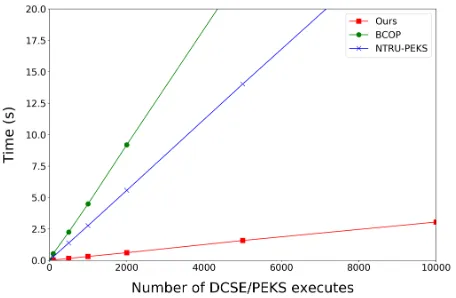
Scheme KeyGen Encryption Extract Test [10] 84.88 186.48 17.41 100908.17
[9] 0.10 349.28 67.42 174.64 Ours 26.56 3224.35 739.06 63451.77
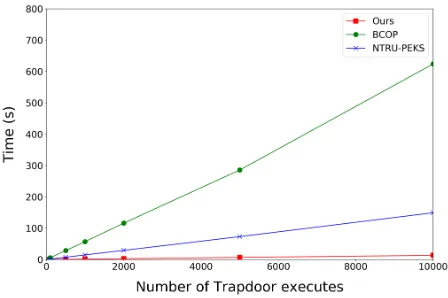
Fig. 3: Time taken by DCSE / PEKS algorithm. Fig. 4: Time taken by the test algorithm.
7.1 Efficient Instantiation
Our instantiation utilizes the IBE of Ducas et al. [22] and KEM of H¨ulsing et al. [29] (hereafter, referred to as DLP-IBE and HRSS-KEM, respectively).
The DLP-IBE is the first lattice-based IBE scheme with practical parameters. Its security is based on the NTRU and Ring-LWE assumptions. In addition, Behniaet al.have also proven that the DLP-IBE is IND-ANON-ID-CPA secure [9]. The first implementation of the DLP-IBE was provided by Ducas [3], written in C++ based on the NTL library [2]. Although this implementation is very efficient, it is merely a proof of concept (PoC) without any optimization. To improve efficiency, McCarthyet al. propose a practical implementation of the DLP-IBE, written in ANSI C, using the number theoretic transform (NTT) optimizations [36].
The HRSS-KEM is a candidate cryptographic KEM in the Round 2 of the National Institute for Standards and Technology’s Post-Quantum Project [1]. In the work, H¨ulsing et al. first provide a OW-CPA secure NTRU-based encryption scheme with optimized parameters; then, they transform the scheme into a IND-CCA2 secure NTRU-based KEM under quantum-accessible random oracle model.
For concrete instantiation, we use SHA256 as a secure hash function, and symmetric encryption AES-256 as a pseudorandom generator. We used open source project software for DLP-IBE [5] and HRSS-KEM [4] to test the feasibility of our DCSE scheme on an Intel Core i7-8700 3.2-GHz CPU with 10G of RAM. For the DLP-IBE, we selected parameters n= 1024, q ≈227 for 192-bit security level, and for HRSS-KEM, we selected parameters n= 701, p= 3, q= 8192 for 128-bit security level.
7.2 Comparison
To compare the proposed scheme with other state-of-the-art schemes, we set the parameters as follows. For the pairing-based PEKS scheme in [10], we chose the 160-bit group order and 2048-bit group elements G,GT. For the NTRU-based PEKS scheme in [9], we chosen= 1024, q= 227 for 192-bit security level. For the LWE-based PEKS schemes in [47, 35, 48], we adopted the same secure parameter as in [47], that isn= 256, dimensionm= 9753, and prime q= 4093. In addition, we set the number of distinct keywords k= 1 and unusual keywords k0 = 1 for [35],
and the security levell= 10 for [48].
Table 1 compares of our scheme with other schemes on the basis of its security properties. Only Maoet al.’s work [35] is quantum-resistant and IKGA secure. However, as illustrated in Table 2, the scheme’s overly large key sizes make it impractical. We also note that Maoet al.’s scheme require another server to execute test algorithm; thus, the computation overhead is increased. Furthermore, compared with Mao’s schemes [35], our public and private key sizes is 1/115 times smaller.
8
Conclusions
This paper proposed a new cryptographic primitive, DCSE, to counter IKGA in public key searchable encryption. We first provided a generic formulation of DCSE using an IND-ANON-ID-CPA secure IBE and an IND-CCA2 secure KEM, and then proved its security in the standard model. Furthermore, we provided a quantum-resistant instantiation from NTRU lattices utilizing the DLP-IBE and HRSS-KEM. In conclusion, this paper provides a novel solution to IKGA in a searchable encryption. In addition to yielding interesting theoretical results, the proposed scheme is notably more efficient and safe compared with other state-of-the-art schemes.
9
Acknowledgements
This research was supported by the Ministry of Science and Technology, Taiwan (ROC), under Project Num-bers MOST 108-2218-E-004-001-, MOST 108-2218-E-004-002-MY2, and by Taiwan Information Security Center at National Sun Yat-sen University (TWISC@NSYSU).
References
1. NIST: Post-Quantum Cryptography - Round 2 Submissions. https://csrc.nist.gov/projects/post-quantum-cryptography/round-2-submissions, accessed: January, 2019
2. NTL: A Library for Doing Number Theory. http://www.shoup.net/ntl, accessed: December, 2019
3. Open Source Project of Identity-Based Encryption over NTRU Lattices. https://github.com/tprest/Lattice-IBE, ac-cessed: March, 2019
4. Open Source Project of NTRU-HRSS. https://github.com/ntru-hrss/ntru-hrss, accessed: December, 2019
5. Secure Architectures of Future Emerging Cryptography. https://github.com/safecrypto/libsafecrypto, accessed: Decem-ber, 2019
6. Abdalla, M., Bellare, M., Catalano, D., Kiltz, E., Kohno, T., Lange, T., Malone-Lee, J., Neven, G., Paillier, P., Shi, H.: Searchable Encryption Revisited: Consistency Properties, Relation to Anonymous IBE, and Extensions. In: Shoup, V. (ed.) Annual International Cryptology Conference - CRYPTO’05. pp. 205–222. Springer, Berlin, Heidelberg (2005). https://doi.org/10.1007/11535218 13
7. Agrawal, S., Boneh, D., Boyen, X.: Efficient Lattice (H)IBE in the Standard Model. In: Gilbert, H. (ed.) Annual In-ternational Conference on the Theory and Applications of Cryptographic Techniques - EUROCRYPT’10. pp. 553–572. Springer, Berlin, Heidelberg (2010). https://doi.org/10.1007/978-3-642-13190-5 28
8. Arute, F., Arya, K., Babbush, R., Bacon, D., Bardin, J.C., Barends, R., Biswas, R., Boixo, S., Brandao, F.G., Buell, D.A., et al.: Quantum Supremacy using a Programmable Superconducting Processor. Nature574(7779), 505–510 (2019). https://doi.org/10.1038/s41586-019-1666-5
9. Behnia, R., Ozmen, M.O., Yavuz, A.A.: Lattice-based Public Key Searchable Encryption from Experimental Perspectives. IEEE Transactions on Dependable and Secure Computing (2018). https://doi.org/10.1109/TDSC.2018.2867462, (early access)
10. Boneh, D., Di Crescenzo, G., Ostrovsky, R., Persiano, G.: Public Key Encryption with Keyword Search. In: Cachin, C., Camenisch, J.L. (eds.) International Conference on the Theory and Applications of Cryptographic Techniques -EUROCRYPT’04. pp. 506–522. Springer, Berlin, Heidelberg (2004). https://doi.org/10.1007/978-3-540-24676-3 30 11. Boneh, D., Franklin, M.: Identity-based Encryption from the Weil Pairing. In: Kilian, J. (ed.) Annual International
Cryptology Conference - CRYPTO’01. pp. 213–229. Springer, Berlin, Heidelberg (2001). https://doi.org/10.1007/3-540-44647-8 13
12. Boneh, D., Franklin, M.: Identity-based Encryption from the Weil Pairing. SIAM Journal on Computing32(3), 586–615 (2003). https://doi.org/10.1137/S0097539701398521
13. Boyen, X.: Attribute-based Functional Encryption on Lattices. In: Sahai, A. (ed.) Theory of Cryptography Conference - TCC’13. pp. 122–142. Springer, Berlin, Heidelberg (2013). https://doi.org/10.1007/978-3-642-36594-2 8
14. Brakerski, Z., Vaikuntanathan, V.: Efficient Fully Homomorphic Encryption from (Standard) LWE. SIAM Journal on Computing43(2), 831–871 (2014)
15. Byun, J.W., Rhee, H.S., Park, H.A., Lee, D.H.: Off-line Keyword Guessing Attacks on Recent Keyword Search Schemes over Encrypted Data. In: Workshop on Secure Data Management - SDM’06. pp. 75–83. Springer, Berlin, Heidelberg (2006). https://doi.org/https://doi.org/10.1007/11844662 6
16. Chen, R., Mu, Y., Yang, G., Guo, F., Huang, X., Wang, X., Wang, Y.: Server-aided Public Key Encryp-tion with Keyword Search. IEEE TransacEncryp-tions on InformaEncryp-tion Forensics and Security 11(12), 2833–2842 (2016). https://doi.org/10.1109/TIFS.2016.2599293
18. Chen, R., Mu, Y., Yang, G., Guo, F., Wang, X.: Dual-server Public-key Encryption with Keyword Search for Secure Cloud Storage. IEEE Transactions on Information Forensics and Security 11(4), 789–798 (2015). https://doi.org/10.1109/TIFS.2015.2510822
19. Chen, Y.C., Xie, X., Wang, P.S., Tso, R.: Witness-based Searchable Encryption with Optimal Overhead for Cloud-edge Computing. Future Generation Computer Systems 100, 715–723 (2019). https://doi.org/https://doi.org/10.1016/j.future.2019.05.038
20. Cocks, C.: An Identity Based Encryption Scheme based on Quadratic Residues. In: Honary, B. (ed.) IMA Inter-national Conference on Cryptography and Coding - IMACC’01. pp. 360–363. Springer, Berlin, Heidelberg (2001). https://doi.org/10.1007/3-540-45325-3 32
21. Cramer, R., Shoup, V.: Design and Analysis of Practical Public-key Encryption Schemes Secure against Adaptive Chosen Ciphertext Attack. SIAM Journal on Computing33(1), 167–226 (2003). https://doi.org/10.1137/S0097539702403773 22. Ducas, L., Lyubashevsky, V., Prest, T.: Efficient Identity-based Encryption over NTRU Lattices. In: Sarkar, P., Iwata, T.
(eds.) International Conference on the Theory and Application of Cryptology and Information Security - ASIACRYPT’14. pp. 22–41. Springer, Berlin, Heidelberg (2014). https://doi.org/10.1007/978-3-662-45608-8 2
23. Fang, L., Susilo, W., Ge, C., Wang, J.: A Secure Channel Free Public Key Encryption with Keyword Search Scheme without Random Oracle. In: Garay, J., Miyaji, A., Otsuka, A. (eds.) International Conference on Cryptology and Network Security - CANS’09. pp. 248–258. Springer, Berlin, Heidelberg (2009)
24. Fang, L., Susilo, W., Ge, C., Wang, J.: Public Key Encryption with Keyword Search Secure against Keyword Guessing Attacks without Random Oracle. Information Sciences238, 221–241 (2013). https://doi.org/10.1016/j.ins.2013.03.008 25. Gentry, C.: A Fully Homomorphic Encryption Scheme. Ph.D. thesis, Stanford University (2009),
crypto.stanford.edu/craig
26. Gentry, C., Peikert, C., Vaikuntanathan, V.: Trapdoors for Hard Lattices and New Cryptographic Constructions. In: Proceedings of the Fortieth Annual ACM Symposium on Theory of Computing - STOC’08. pp. 197–206. Association for Computing Machinery (2008). https://doi.org/10.1145/1374376.1374407
27. Hoffstein, J., Pipher, J., Silverman, J.H.: NTRU: A Ring-based Public Key Cryptosystem. In: Buhler, J. (ed.) In-ternational Algorithmic Number Theory Symposium - ANTS’98. pp. 267–288. Springer, Berlin, Heidelberg (1998). https://doi.org/10.1007/BFb0054868
28. Huang, Q., Li, H.: An Efficient Public-key Searchable Encryption Scheme Secure against Inside Keyword Guessing Attacks. Information Sciences403, 1–14 (2017). https://doi.org/10.1016/j.ins.2017.03.038
29. H¨ulsing, A., Rijneveld, J., Schanck, J., Schwabe, P.: High-speed Key Encapsulation from NTRU. In: Fischer, W., Homma, N. (eds.) International Conference on Cryptographic Hardware and Embedded Systems - CHES’17. pp. 232–252. pringer, Cham (2017). https://doi.org/10.1007/978-3-319-66787-4 12
30. Katz, J., Lindell, Y.: Introduction to Modern Cryptography. Chapman and Hall/CRC (2014)
31. Li, H., Huang, Q., Shen, J., Yang, G., Susilo, W.: Designated-server Identity-based Authenticated Encryption with Key-word Search for Encrypted Emails. Information Sciences481, 330–343 (2019). https://doi.org/10.1016/j.ins.2019.01.004 32. Liu, Z.Y., Tseng, Y.F., Tso, R.: Cryptanalysis of “FS-PEKS: Lattice-based Forward Secure Public-key Encryption with Keyword Search for Cloud-assisted Industrial Internet of Things”. Cryptology ePrint Archive, Report 2020/651 (2020), https://eprint.iacr.org/2020/651
33. Lyubashevsky, V., Peikert, C., Regev, O.: On Ideal Lattices and Learning with Errors over Rings. In: Gilbert, H. (ed.) Annual International Conference on the Theory and Applications of Cryptographic Techniques - EUROCRYPT’10. pp. 1–23. Springer, Berlin, Heidelberg (2010). https://doi.org/10.1007/978-3-642-13190-5 1
34. Ma, S., Mu, Y., Susilo, W., Yang, B.: Witness-based Searchable Encryption. Information Sciences453, 364–378 (2018). https://doi.org/10.1016/j.ins.2018.04.012
35. Mao, Y., Fu, X., Guo, C., Wu, G.: Public Key Encryption with Conjunctive Keyword Search Secure against Key-word Guessing Attack from Lattices. Transactions on Emerging Telecommunications Technologies30(11), e3531 (2019). https://doi.org/10.1002/ett.3531
36. McCarthy, S., Smyth, N., O’Sullivan, E.: A Practical Implementation of Identity-based Encryption over NTRU Lattices. In: O’Neill, M. (ed.) IMA International Conference on Cryptography and Coding - IMACC’17. pp. 227–246. Springer, Springer, Cham (2017). https://doi.org/10.1007/978-3-319-71045-7 12
37. Noroozi, M., Eslami, Z.: Public Key Authenticated Encryption with Keyword Search: Revisited. IET Information Security
13(4), 336–342 (2018). https://doi.org/http://dx.doi.org/10.1049/iet-ifs.2018.5315
38. Pakniat, N., Shiraly, D., Eslami, Z.: Certificateless Authenticated Encryption with Keyword Search: Enhanced Security Model and a Concrete Construction for Industrial IoT. Journal of Information Security and Applications 53, 102525 (2020). https://doi.org/https://doi.org/10.1016/j.jisa.2020.102525
39. Qin, B., Chen, Y., Huang, Q., Liu, X., Zheng, D.: Public-key Authenticated Encryption with Keyword Search Revisited: Security Model and Constructions. Information Sciences516, 515–528 (2020)
40. Regev, O.: On Lattices, Learning with Errors, Random Linear Codes, and Cryptography. In: Proceedings of the Thirty-seventh Annual ACM Symposium on Theory of Computing - STOC’05. pp. 84–93. ACM, New York, NY, USA (2005). https://doi.org/10.1145/1060590.1060603
42. Shamir, A.: Identity-based Cryptosystems and Signature Schemes. In: Blakley, G., Chaum, D. (eds.) Workshop on the Theory and Application of Cryptographic Techniques - CRYPTO’84. pp. 47–53. Springer, Berlin, Heidelberg (1984). https://doi.org/10.1007/3-540-39568-7 5
43. Shor, P.W.: Algorithms for Quantum Computation: Discrete Logarithms and Factoring. In: Proceedings 35th Annual Symposium on Foundations of Computer Science - FOCS’94. pp. 124–134. IEEE (1994). https://doi.org/10.1109/SFCS.1994.365700
44. Shor, P.W.: Polynomial-time Algorithms for Prime Factorization and Discrete Logarithms on a Quantum Computer. SIAM Review41(2), 303–332 (1999). https://doi.org/10.1137/S0097539795293172
45. Song, D.X., Wagner, D., Perrig, A.: Practical techniques for searches on encrypted data p. 44 (2000)
46. Stehl´e, D., Steinfeld, R., Tanaka, K., Xagawa, K.: Efficient public key encryption based on ideal lattices. In: International Conference on the Theory and Application of Cryptology and Information Security. pp. 617–635. Springer (2009) 47. Xu, L., Yuan, X., Steinfeld, R., Wang, C., Xu, C.: Multi-writer searchable encryption: An lwe-based realization and
implementation. In: Proceedings of the 2019 ACM Asia Conference on Computer and Communications Security. pp. 122–133. ACM (2019)