operators for ABCs
Antonio de la Piedra
Radboud University Nijmegen, ICIS DS, Nijmegen, The Netherlands
Abstract. In the last few years several practitioners have proposed dif-ferent strategies for implementing Attribute-based credentials (ABCs) on smart cards. ABCs allow citizens to prove certain properties about them-selves without necessarily revealing their full identity. The Idemix ABC is the most versatile ABC system proposed in the literature, supporting pseudonyms, equality proofs of representation, verifiable encryption of attributes and proving properties of attributes viaAND, NOT andOR
operators. Recently, Vullers et al. and De La Piedra et al. addressed the implementation of the selective disclosure operations, pseudonyms and multi-credential proofs such as equality proofs of representation. In this manuscript, we present implementation strategies for proving properties of user attributes via these operators and show how to combine them via external and internal commitment reordering.
Keywords: Attribute-based credentials, Smart Cards.
1
Introduction
Our everyday life is full of situations where we must identify ourselves. This is exemplified where we buy alcohol, cigarettes or other type of adult goods. In such process, we usually rely on our IDs in order to show that our age is consistent with the current legislation. However, in most of those operations we do not need to reveal our full identity. ABCs solve these privacy breaches by enabling users to reveal or hide the set of attributes that represent their iden-tity according to the real need of the identification process. In so doing, the usual identification operation is replaced by an authorization according to the restricted set of attributes that are asked for. ABCs generally consist of a set of signed attributes that through certain cryptographic primitives can be used for authentication while tracing is avoided as well as ensuring that nobody can reuse the credential attributes or have access to them. Modern anonymous credential systems such as Idemix [8] and U-Prove [4] rely on blind and randomizable sig-natures in combination with proofs of knowledge [13]. While some practitioners have proposed several implementations of ABCs [3, 19], the IRMA card1 is the only open-source and practical implementation of Idemix. In this paper we rely on the current version of the card.
1
The main operation of ABCs is the selective disclosure. A user can reveal a reduced set of her attributes according to a presentation policy sent by a verifier [6]. However, in certain cases it can be useful to prove relations across attributes of the same credential. For instance, a restricted service can enforce an access control based on the ownership of an attribute a ORanother one b. Moreover, it can ask if the cardholder is not owning a special type of attribute e.g. one that describes that her age isNOThigher than 18. All these operations are related to the AND, OR and NOT operators introduced by Camenisch et al. in [7]. In this manuscript, we address their implementation on constrained devices.
In the next section, we describe the work of other practitioners who im-plemented ABCs on smart cards and relate their performance figures with our work. In Section 3 we describe the main building blocks of ABCs. In Section 4, we sketch out the internals of the IRMA card. In Sections 5 and 6 we present our strategies for executing complex proofs based on the AND, OR and NOT
operators. We describe our results for combining them in Section 7. Finally, we end in Section 8 with some conclusions.
2
Related work
Bichsel et al. [3] presented in 2009 the first implementation of Idemix based on Java Card (7.4 seconds, 1,280 bit RSA modulus) solely based on the selec-tive disclosure of one attribute. These results preceded the design of Sterckx et al. [19] (4.2 seconds, 1,024 bit RSA modulus). Using the MULTOS platform, Vullers et al. presented an implementation of the issuing and verification oper-ations of Idemix using credentials of 5 attributes (1-1.5 seconds, 1,024 bit RSA modulus). De La Piedra et al. [18] proposed the implementation of larger cre-dentials, pseudonyms (1,486.51 ms) and multi-credential proofs (2,261.19 ms) on the same platform using a PRNG and variable reconstruction in RAM relying on the implementation of Vullers et al [18].
Contribution In this manuscript, we present strategies for executingOR,NOT
and AND operators over credentials based on prime-encoded attributes as de-scribed by [7]. Relying on theANDoperator we found the limit of the amount of attributes we can issued in the target device2 is 44. We always can perform this
operation using attributes of different lengths in less than 2.7 seconds whereas issuing more than 5 attributes using traditional attributes requires more than 3 seconds [20]. This suggests that issuing prime-encoded attributes can be ac-companied by the computation of pseudonyms. On the other hand, we observed that the verification of attributes using this operator is only optimal when none 2 Our performance figures have been extracted relying on a MULTOS ML3-R3-80K
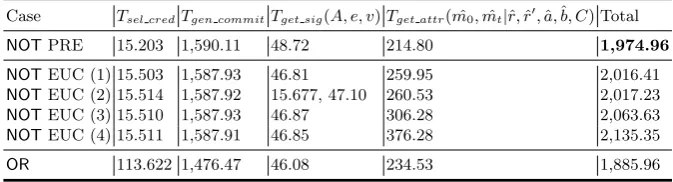
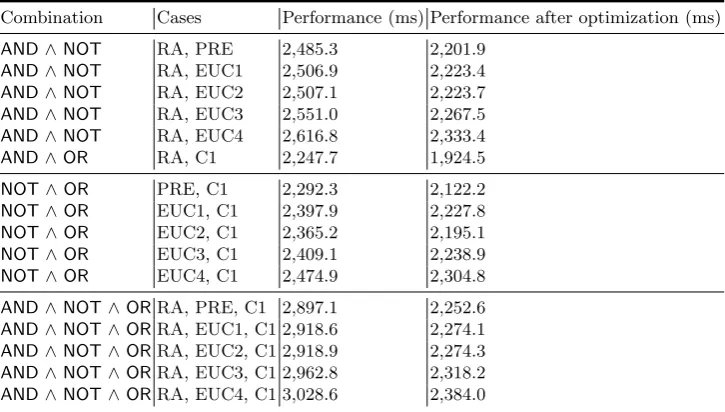
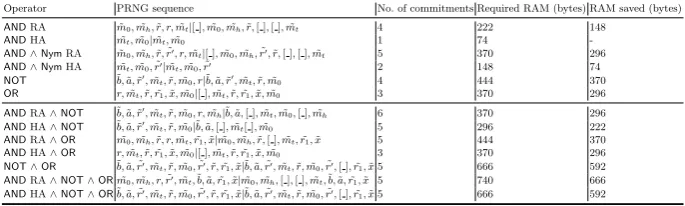
of the the attributes are revealed (1.2 seconds, Section 7.1.3). We also present the implementation of theNOToperator using three approaches for solving the required Diophantine equation. Using credentials of the same size of the IRMA card we can perform theNOToperator in 1,974.96 ms with precomputatoin and between 2,016.41 and 2,135.53 ms using the extended Euclidean algorithm. We can perform theORoperator using the same type of credentials in 1,885.96 ms. Finally, we propose the internal and external reorganization of commitments for making it possible the combination of this operators: AND ∧ NOT (2,201.90 ms), AND ∧ OR (1,924.5 ms), NOT ∧ OR (2,122.20 ms) and AND ∧ NOT ∧ OR(2,252.60 ms). By performing the proposed reorganizations of commitments we obtained reductions between 170.10 ms and 644.60 ms and between 9·74 and 1·74 bytes savings in RAM. Our results suggest that is actually possible to execute complex proofs of knowledge on embedded devices in reasonable times for on-line settings. Moreover, our performance figures are consistent with the current results in the literature [18, 20].
3
Preliminaries
The IRMA card relies on a subset of the Idemix specification [20]. In this sec-tion, we describe the fundamentals of private ABCs and their main crypto-graphic blocks: non-interactive commitment schemes, blind signatures and zero-knowledge proofs. In this respect, we present the Camenisch-Lysyanskaya (CL) digital signature [10], the Fujisaki-Okamoto commitment scheme [16] and the Idemix ABC [8].
Non-interactive commitment schemes These constructions are utilized in Idemix for committing to secret values during the issuing and verification op-erations. In so doing, one of the parties proves the knowledge of a committed value such as an attribute that is not revealed. Typically, a commitment scheme consists of two stages: commit and reveal i.e. a value x that is received as an input in the first stage will be revealed during the second one. Idemix relies on the Fujisaki-Okamoto commitment [16] scheme, which is statistically hiding and computationally binding when factoring is a hard problem. Given an RSA spe-cial modulo n,h∈QRn andg ∈< h >, the commitment function for an input x, and random valuer∈Zn is computed asgxhr modn.
Zero-knowledge proofs In a proof of knowledge, a verifier is convinced that a witness w satisfies a polynomial time relation R only known by the prover. If this is performed in a way that the verifier does not learn w, this is called a zero-knowledge proof of knowledge. Damg˚ard proved that is possible to generate zero-knowledge protocols via sigma protocols [14]. In Idemix, the typical three movement of sigma protocols (commitment, challenge and response3) is
trans-3
formed into a Non Interactive Proof of Knowledge (NIZK) via the Fiat-Shamir heuristic [15] in the random oracle model. A variety of zero-knowledge protocols are utilized in Idemix. For instance, proofs of knowledge of discrete logarithm representation modulo a composite are used during issuing and verification [16].
The CL digital signature scheme The CL signature scheme is the main block of Idemix [10]. It provides multi-show unlinkability via the randomization of the issued signature. This signature is secure under the Strong RSA assumption. A CL signature is generated (Gen) by a certain issuer according to her public key (S, Z, R0, R1, ..., R5∈QRn, n) using its secret key (p, q). For instance, a CL signature over a set of attributes (m0, ..., m5) is computed by selectingA,eandv
s.t.Ae=ZR−m0
0 R
−m1
1 R
−m2
2 R
−m3
3 R
−m4
4 R
−m5
5 S−
v modn. Then, a third party can check the validity of the signature by using the issuer’s public key and the triple (A, e, v) asZ ≡AeRm0
0 R m1 1 R m2 2 R m3 3 R m4 4 R m5
5 Sv modn(Verify).
Private ABC systems In private ABCs systems [12], the users remain anony-mous and are only known by their pseudonyms. They consist of organizations that issue and verify credentials so a user can prove its identity to a verifier while the issuer remains oblivious. In Idemix, this is performed via the multi-show unlinkability property of the CL digital signature scheme. Avoiding the transference of credentials between users is enforced using a secret key that is only known to the user and not by the system (namely, a master secret m0 in
Idemix). In this system, there are two main protocols: issuing (orGrantCred[9]) and verification (orVerifyCred[9]). In the first one, a certain cardholder performs a protocol for signing a committed value, for instance, a set of attributes that represent her identity e.g. m0, ..., ml forl attributes. At the end of the proto-col, she receives a signatureσwhereas the signer did not learn anything about m0, ..., ml. On the other hand, the verification operation serves for proving the
knowledge of a signature over a committed value, for instance a set of attributes and the master secret m0 of the user for a pair cardholder/verifier. This
pro-tocol enables the possibility of using policies (see for instance [5]), i.e. a list of attributes or conditions in a certain credential that must be fulfilled during an authentication operation4.
4
The IRMA card
IRMA supports up to 5 attributes by credential and relies on 1,204 special RSA modulus for performance reasons5. IRMA is based on the MULTOS card.
4
For instance, an empty proof of possession over a set of attributes (m0, ..., m5) is
represented using the Camenisch-Staedler notation [11] as:NIZK:{(ε0, ν0, α0, ..., α5) :
Z ≡ ±Rα0
0 R α1 1 R α2 2 R α3 3 R α4 4 R α5 5 A ε0
Sν0 modn}being the Greek letters (ε0, ν0) and (α0, ..., α5) the values of the signature and the set of attributes proved in zero
knowl-edge and not revealed.
5 As described in [18], the attributes are represented as l
Particularly, our target device is the ML3-80K-R1 version. It is based on the SLE 78CX1280P chip by Infineon6. This processor, clocked up to 33 MHz, provides an instruction set compatible with the Intel 8051 and hardware accelerators for ECC, RSA, 3DES and AES.
Issuing in IRMA Issuing in Idemix is related to the generation of a CL blind signature over the attributes of the cardholder. In so doing, the issuer cannot extract the master secretm0of the cardholder and the generated tuple (A, e, v)
remains hidden too. However, in IRMA the cardholder’s attributes are never revealed to the issuer.
Table 1: Message flow for issuing a CL signature over a set of attributes (I: Issuer, C: Cardholder)
Common inputs:The public key of the issuer (S, Z, R0, R1, ..., R5∈QRn, n), the
num-ber of attributes that are issued.
Cardholder inputs:The credential involved and its set of attributesm0, ..., m5.
Issuer inputs:The private key of the issuerp, q.
Protocol:The cardholder first proves the knowledge of the representation ofUasNIZK: {(ν0, α
0) :U≡ ±Sν
0
Rα0 modn}. Then, the issuer proves the knowledge of 1/e.
1. I →C: The user chooses a random noncen1∈R{0,1}lø and sends it to the
card-holder.
2. C→I: The cardholder computes the commitmentU =Sv0Rm0 modnwithv0 ∈ ±{0,1}ln+lo. It proves in zero knowledgem
0 with a randomizer α0, v0. Then ,it
generates the s values for ˆv0, ˆrtogether with the challengecwith the context,Uand the noncen1. Finally, it sends to the issuern2∈R{0,1}lo.
3. I→C: It verifies theNIZKas ˆU=U−c(Svˆ0Rαˆ0
0 ) modn. Then, it proves the
knowl-edge of 1
evia random valuese, ˜v,v
00. It computes the commitmentsQ=Z U−1S−v00
modn, A=Qe−1 modp0q0 modn. It sends (A, e, v00) and creates the proofNIZK: {(1/e) :A ≡ ±Qe−1 modn}. It computes ˜A =Qr modnfor r∈R Zp0q0, and obtains the challenge c0 as the hash of the context,Q, A,n2 and ˜A. It computes
Se=r−c0·e−1 modp0q0and sendsA, e, v00, Se, c0to the cardholder.
4. C : Computesv =v00+v0 and verifies (A, e, v) as Q= Z S−vRm0
0 modn with
ˆ
Q=Ae modn.
Issuing requires two NIZK (Table 1). In IRMA, the issuing part of Idemix mimics the Cardholder-Issuer interaction as a set of states:ISSUE_CREDENTIAL,
ISSUE_PUBLIC_KEY,ISSUE_ATTRIBUTES,ISSUE_COMMITMENT,ISSUE_COMMITMENT_ lø = 80 (security parameter of the statistical ZKP),lH = 256 (domain of the hash function in the Fiat-Shamir heuristic), le = 504 (size ofe),ln = 1,024 (size of the RSA modulus) andlv= 1,604 bits (size ofv).
6
PROOF,ISSUE_CHALLENGE,ISSUE_SIGNATUREandISSUE_VERIFY. The first, state
ISSUE_CREDENTIAL, puts the card in in issuance mode, sends the identifier of the credential that will be issued and the context of the operation. Then, dur-ing the ISSUE_PUBLIC_KEY state, the card accepts the public key of the is-suer: n, S, Z, R0, ..., R5. The attributes to be issued are sent to the card in the
ISSUE_ATTRIBUTES state. The rest of the states are related to the execution of the two NIZK. During ISSUE_COMMITMENTthe cardholder receives the nonce n1, it computes U and returns it. Then, in ISSUE_COMMITMENT_PROOF, the
re-quired values for proving the knowledge of ms in U: c,vˆ0, ˆs are generated. In
ISSUE_CHALLENGE, it sendsn2. During theISSUE_SIGNATURE mode, the issuer
constructs the blinded CL signature and sends to the card the partial signa-ture (A, e, v00). Finally, in ISSUE_VERIFY the card verifies the signature using the values sent the verifier (c,Se).
We can model the latency of the issuing process in the IRMA card by rep-resenting the time required for performing the operation described in Table 1 as Tissuing(n) wherenis the number of attributes that will be issued in a cer-tain credential. This latency would be result of summing up the time required for getting the public key of the issuer, adding the computation of the involved proofs and the process of obtaining and verifying the signature:
Tissuing(n) =Tsel cred+
X
i=n,S,Z,Ri
Tget P K(i) +
n
X
i=1
Tget attr(i) +Tgen commitment+
X
i=c,vˆ0,sˆ
Tgen proof(i)+
X
i=A,e,v00
Tget signature(i) +Tverif y(n)
(1)
From this model, we know that there are only two operations that depends on the number of attributes issued that are part of a certain credential:Tget attr(i) and Tverif y(n). That would mean that in order to optimize the overall latency ofTissuing(n) there are two strategies: (1) reduce the number of attributes that are part of the credential (we analyze this aspect in Section 5.1) and (2) reduce then number of operations in the verification part of the proof, which is already implemented on the IRMA card where the second proof is optionally verified for reducing the computational complexity of the operation.
Verification in IRMA When the card receives a verification request, it changes its initial state to PROVE_CREDENTIAL. Then, it acquires a presentation policy with the description of the attributes that must be revealed. Then, the card performs the operations depicted in Table 2 (PROVE_COMMITMENT). Afterwards, the card changes its working state toPROVE_SIGNATURE. In this state, the ver-ifier can request the randomized tuple (A0,e,ˆ ˆv0). Finally, the card switches to
and hidden attributes related to the proof. This set of states is mapped to the three moves described in Table 2.
Table 2: Message flow for proving the ownership of a CL signature over a set of attributes (V: Verifier, C: Cardholder)
Common inputs:The public key of the issuer (S, Z, R0, R1, ..., R5∈QRn, n), the
pre-sentation policy i.e. those attributes that must be revealedmi∈Ar w.r.t. to those that
can be hiddenmi∈A¯r.
Cardholder inputs:The credential involved and its set of attributesm0, ..., m5,
ran-domizers and the tuple (A, e, v) overm0, ..., m5.
Verifier inputs:A0, v0, mi∈Ar, mi∈Ar¯
Protocol:The (cardholder, verifier) pair perform the followingNIZKwhere the cardholder proves the ownership of a CL signature over m0, ..., m5 and reveals, for instance m1:
NIZK:{(ε0, ν0, α0, α2, α3, α4, α5) :ZR
−m1 1 ≡ ±R
α0 0 R
α2 2 R
α3 3 R
α4 4 R
α5 5 A
ε0Sν0 modn}.
1. V →C: The verifier sends a fresh noncen1to the verifier together with a presentation
policy that must be fulfilled.
2. C → V: Using the tuple (A, e, v) overm0, ..., m5, it randomizes the signature by
generatingrA∈R{0,1}ln+lø and obtaining the new tuple (A0, e0, v0) asA0=ASrA
modn,v0=v−erAande0=e−2le−1. Afterwards, it generates the randomizers ˜e∈R
±{0,1}l0e+lø +lH, ˜v0∈R±{0,1}lv+lø +lH, and ˜mi∈R±{0,1}lm+lø +lH(i∈A¯r) and
computes the commitment (t-value) ˜Z = A0e˜(Q
i∈Ar¯R ˜
mi i )S
˜
v0. Then, it generates
the challengecby hashing the context, the t value and the nonce. It generates the response values (s-values) ˆe= ˜e+ce0, ˆv0 = ˜v0+cv0 andmˆi= ˜mi+cmi(i∈A¯r).
Finally, It sends the challengec, the common valueA0, the response values andmi∈ Ar to the verifier.
3. V: Verifies if the proof is correct via the issuer public key by computing ˆZ = (Z A0−2le−1Π
i∈ArR
−mi i )
−c(A0)ˆe(Π i∈Ar¯R
ˆ
mi i )S
ˆ
v0) and checking ifcequals the hash
ofA0, ˆZandn1.
As described in [18] the latency of the verification operation can be mod-eled first according to the number of attributes per credential together with the number of attributes that are revealed (r) or hidden.
Tverif y(n, r) =Tsel cred+Tgen commit(n, r)
+ X
i=A,e,v
Tget sig(i) + n X
i=1
Tget attr(i) (2)
The time the PROVE_CREDENTIALstate requires is represented by Tsel cred. Further, Tgen commit(n, r) represents PROVE_COMMITMENT. Finally, Tget sig(i) is related to thePROVE_SIGNATUREstate whereasTget attr(i) represents thePROVE_
ATTRIBUTEstate.
values. In so doing, it is possible to generate the associated pseudorandomness during the generation of the t-values and obtain, on the fly, the same sequence while generating the s values by resetting the PRNG as described in [18] e.g. initP RN G()⇒m˜i⇒resetP RN G()⇒m˜i.
5
Performance evaluation of AND, OR and NOT
operators
The main operation of Idemix is the modular exponentiation. This operation is related to the number of attributes that a certain cardholder hides in an operation. In [7], Camenisch et al. proposed encoding the user attributes as prime numbers, reducing the overall number of modular exponentiations to 2. In so doing, they only utilize a baseR1for encoding all the attributes as product
mt =Q l
i=1mi forl attributes. This encoding technique enables the possibility of performing selective disclosure (namely, using theANDoperator), proving the absence of an attribute in a certain credential (NOToperator) and the possibility that one or more attributes are presents inmts.t.Rm1t via theORoperator. This
encoding technique is useful where the number of possible values in an attribute is restricted to only some e.g. masculine or feminine, and each possibility has associated a prime number.
We rely on the PRNG described in [18] for making it possible the execution of these proofs. Moreover, we introduce two techniques (internal and external commitment reorganizations) for reducing the amount of required exponentia-tions and the RAM required for storing the respective commitment in each step. External commitment reorganizations make it possible enabling the chaining of several proofs using the AND, NOTandORoperators in tandem. The internal reorganization of commitments means reordering the computations of commit-ments of a certain proof in order to save the computation time and the amount of utilized RAM.
5.1 The AND operator
This operator performs the selective disclosure of these attributes by proving that a certain valuemi (which can be one attribute or a product of several ones) di-videsmt. In this respect, proving that a certain attributem1belongs tomtis rep-resented in zero knowledge as NIZK:{(ε0, ν0, α0, α1) :Z≡ ±Rα00(R
m1
1 )α1Aε 0
Sν0 modn}. In addition, the commitments C = ZmtSr modn, ˜C = (Zm1)m˜hSr mod n and ˜C0 =Zm˜tSr˜ modn must be computed, wheremh =mt/mi and miconsists of the product of attributes that are revealed (in this casemi=m1).
In this case, the PRNG would compute the following sequence:initP RN G()⇒
˜
mi ⇒m˜h ⇒ ˜r⇒ r ⇒m˜t ⇒ resetP RN G()⇒ m˜i ⇒m˜h ⇒r˜. Otherwise, not revealing any attribute, that is, only proving the ownership of the signature would be represented asNIZK:{(ε0, ν0, α0, α1) :Z ≡ ±Rα00R
α1
1 A
We can apply the internal organization of commitments. For instance, in the computation of theANDproofs we need to commit to themtvalue, i.e. the first attribute of the first base asC=ZmtSr modn. However, the next commitment requires the computation of theSragain as ˜C= (Zm1)m˜h)Sr. In order to avoid recomputing Sr, we can proceed by reordering all the computations and reuse this value from the last commitment. In this case, the order of computations would be (1) ZmtSr,(2) [Sr](Zm1)m˜h by leaving the result Sr in RAM and proceeding with the next multiplication. This resulted in an speed up of 78 ms per operation.
Issuing prime-encoded attributes Since the number of bases (and modular exponentiations) is reduced to the number of attributes in the credential to 2, we can compare the performance of the Idemix issuing operation using both prime-encoded and traditional attributes [20]. In this respect, it is expected that issuing prime-encoded attributes could reduce the latency associated to Tissuing(n) as the number of attributes increase (Section 4). In the IRMA card, only 5 attributes w.r.t. the bases R0, ..., R5 are used. On the other hand, we
can store any number of prime-encoded attributes s.t. the only limitation would be the prime size. Hence, we can compare how the issuing operation in Idemix scales and observe how many attributes we can issue in the limit case of IRMA (5 attributes) [20].
We rely on the following methodology. First, we set a limit of 50 attributes per credential. Then, the only restriction is that |mt| cannot be greater than the lm = 256 bit limitation according to the Idemix specification. Hence, we create the following cases: (1) one possibility per attribute: we rely on the first 50 primes, (2) 10 possibilities per attribute: we rely on the first 500 primes, (3) 100 possibilities per attribute, we rely on the first 5,000 primes, (4) 1,000 possibilities per attribute, we rely on the first 50,000 primes. We select attributes from the list of the first 50 primes, 500 primes, 5,000 primes, 50,000 primes and so on in order to construct our credentials w.r.t. the mt exponent for the base R1 as Q
l
i=0mi forl= 50−1.
What we want to know is for each case, what is the maximum number of attributes per credential we can store according to lm. Then, we create a list of primes according to its possibilities in each case when 50, 500, 5,000, 50,000 primes are involved. We can randomly choose prime numbers from that list and construct our credentials from 1 to 50 attributes, stopping when |mt| ≥ 256 bits. After repeating this experiment 100 times for each case, we obtained the approximate maximum number of attributes: 44 attributes (case 1), 25 attributes (case 2), 18 attributes (case 3) and 14 attributes (case 4).
2500 2600 2700 2800 2900 3000
0 5 10 15 20 25 30 35 40
Execution time (ms)
Number of attributes per credential Credential issuing using traditional attributes
Traditional encoding Prime encoding, case 1 Prime encoding, case 2 Prime encoding, case 3 Prime encoding, case 4
(a) Performance of issuing attributes via prime-encoded and traditional attributes
1000 1200 1400 1600 1800 2000 2200 2400 2600
0 5 10 15 20 25 30 35 40
Execution time (ms)
Number of revealed attributes Selective disclosure using traditional and prime encoding attributes (AND)
Traditional encoding Prime encoding, case 1 Prime encoding, case 2 Prime encoding, case 3 Prime encoding, case 4
(b) Performance of selective disclosure using both types of encoding
Fig. 1: Issuing and verifying prime-encoded attributes
maintain a decent performance in comparison to the utilization of traditional attributes but issuing from 3 to 8 times more attributes [20].
Verification of prime-encoded attributes Due to the computation of theC, ˜
Co and ˜C commitments together with the two extra response values, revealing attributes via theANDoperator undermines any speed up in comparison to the issuing operation relying on traditional attributes. We take the limit case of IRMA (5 attributes) and compare it with verifying and hiding prime encoded attributes in Figure 1 (b). Hiding attributes is computationally more expensive using traditional attributes in comparison to prime-encoded ones whereas hiding attributes only has a constant performance related to prove the ownership ofm0
andmtw.r.t.Rm00R
mt
1 . Hence, only proving the ownership of a CL signature over
a set of attributes without revealing any only requires 1,198.21 ms. In contrast, revealing all the attributes requires the computation ofC, ˜C and ˜C0.
Besides, the cost of this operation is related to the computation of theZmr exponentiation w.r.t. of mr as the product of the cardholder’s attributes that are revealed together with the product itself (Tgen commit(n, r)). Therefore, it is expected that theANDoperator increases the computation time as the number of attributes are revealed at a speed related to the primes utilized (Figure 1 (b)). In this respect, an alternative for reducing the latency ofTgen commit(n, r) is to precompute a restricted set of combinations for revealing attributes Zmr and store them in ROM soTgen commit(n, r) is constant w.r.t.C, C0,C˜.
5.2 The NOT operator
By using prime-encoded attributes it is possible to prove that anmiattribute or set of attributes do not belong tomt. This is done by showing that the integers x, yexists w.r.t. the following linear Diophantine equation x·mt+y·mi = 1.
We prove the ownership of a CL signature overm0, mt and the existence of (x, y) via zero knowledge asNIZK:{(ε0, ν0, α0, α1, χ, υ, ρ, ρ0) :Z≡ ±Rα00R
α1
1 A
modn ∧C ≡ ±Zα1Sρ modn∧Z ≡ ±Cχ(Zmi)υSρ0} modn. The card must compute the commitments C=ZmtSr modn, ˜C =Cx˜(Zmi)y˜Sr˜0 modnand
˜
Cc=Zm˜tSr˜ modnwhere ˜r, ˜r0, ˜x,˜y are randomizers [7].
In this case, the critical operation is the computation of the(a, b)pairs and how this operation scales for large primes. We propose two type of implementa-tions: (1) precomputing the pairs (x, y) and (2) solving the Diophantine equation on the card. In the first case, given (x, y) forx·mi+y·mt= 1,mthas always the same value and there are several combinations formi. Those possibilities can be stored in EEPROM if a small number of attributes is utilized. The number of (x, y) pairs that must be stored is related to the number of attributes per credential as
l
P
i=1
cin = l
P
i=1
n i
. Hence, for l = 2 attributes per credential, we would have to store three (x, y) pairs. In the case of 4 attributes, we store 15 pairs.
The second design is related to the computation of the Extended Euclidean algorithm on the smart card. We can use the instructionPRIM DIVIDENfrom the MULTOS specification that extracts the Euclidean division of two numbers i.e.q andr(O(ln3N)) in order to implement it. Other alternative is to use the binary
GCD or Stein’s algorithm [17]. This algorithm replaces the multiplications and divisions by bit-wise operations. Finally, the Lehmer’s algorithm relies on the following idea (O(ln2N)). Whenaandbhave the same size, the integer partw of the quotienta/bhas one only digit. The goal is to findwwhile it is small and continue the involved operations via a matrix. The advantage of this method is that a large division is only done when needed, if w is greater than a certain baseM.
In order to test the performance of these three algorithms, we have created four possible cases and have extracted performance figures in our target device. The attributemican vary according to the number of attributes that are proved that are not inmt. Its length will be greater according to the number of possi-bilities for each credential. In order to obtain an estimation of the computation time of each method on the MULTOS card we take 4 cases. If we take the first 10,000 primes, the numbers consist of 2 to 104,729. We can encode these val-ues using 1 byte to 3 bytes (e.g. 0x019919 in the case of 104,729). However,mi andmtcan increase according to all the possibilities an attribute can represent together with the number of involved attributes. We take four cases for an im-plementation based on 5 attributes (mt) with different possibilities7. We rely
7
Table 3: Performance of GCD using the proposed algorithms
Case|mi|(bytes)|mt|(bytes) Euclid (ms) Stein (ms) Lehmer (ms) Extended Euclidean Algorithm (Euclid, ms)
1 1 2 17.05 70.62 18.43 21.51
2 1 4 17.52 131.78 18.92 21.76
3 3 6 37.49 254.37 38.86 65.64
4 5 9 68.07 289.58 95.61 131.47
on credentials of 5 attributes in this case in order to compare the performance of this operation with the selective disclosure via traditional attributes of the IRMA card [20].
The first aspect we notice from Table 3 is that the Stein’s variant obtained the worst computational figures for the cases proposed despite it is been based on bit-wise operations, that are suppose to require less time as claimed by Akhavi et al. [1]. This is, however not true for MULTOS. For the maximum length of case 4 (9 bytes), we have measured the latency of all the operations involved: Euclidean division (11.852 ms), comparison (11.047 ms), Boolean and (10.411 ms), right shift (10.634 ms), increment (10.354 ms) and subtraction (10.647 ms). These latencies make this option ill-suited when replacing the Euclidean division by operations that are suppose to require less cycles. On one hand, the Stein’s variant requires more control operations and branches and on the other one, bit-wise operations have a similar latency than the Euclidean division. Due to the proprietary nature of the SLE 78CX1280P chip we cannot claim that the Euclidean division is being performed via the hardware accelerator of the target device. Moreover, since MULTOS is based on MEL byte code that is executed in a virtual machine, we cannot be sure that code optimizations (written in C) can result in any speed up. Finally, we are unaware of any side channel analysis (SCA) countermeasures implemented on the card, but there is a possibility that the designers wanted to homogenize the latency of a group of simple arithmetic operations in order to make them indistinguishable.
In the case of the Lehmer’s variant, for single-precision values of 32 bits or less, we obtain similar results as the Euclidean algorithm. We believe that due to that when we overcome that value (multi-precision), there are more calls to the operating system for performing bit-wise operations, multiplications and di-visions that increase the latency of the algorithm despite this is not expected, whereas in the traditional Euclidean algorithm we are only performing one Eu-clidean division by step. Moreover, in our target device is not possible to tune the precision and adjust the assembler code since that is then translated into byte codes, executed by the virtual machine.
We have depicted in Table 48 the performance figures of theNOT operator for each case. In the precomputation strategy we only show the first case since 8 We use the following notation in Tables 4, 5 and 6: PRE means precomputation,
Table 4: Performance figures of theNOToperator while precomputing the (x, y) pair and relying on the Euclidean algorithm (ms)
Case Tsel credTgen commitTget sig(A, e, v)Tget attr( ˆm0,mˆt|r,ˆrˆ0,a,ˆˆb, C) Total
NOTPRE 15.203 1,590.11 48.72 214.80 1,974.96
NOTEUC (1) 15.503 1,587.93 46.81 259.95 2,016.41
NOTEUC (2) 15.514 1,587.92 15.677, 47.10 260.53 2,017.23
NOTEUC (3) 15.510 1,587.93 46.87 306.28 2,063.63
NOTEUC (4) 15.511 1,587.91 46.85 376.28 2,135.35
OR 113.622 1,476.47 46.08 234.53 1,885.96
increasing the length of the operand does not alter the result significantly. On the other hand, the computation of the pairs (x, y) is performed during the computation of ˆa, adding its latency to Tget attr(i) (Section 2). Thanks to the low latency operation of the PRIM DIVIDEN primitive we obtained latencies between 2,015.41 and 2,135.35 ms.
5.3 The OR operator
The utilization of this operator enables the cardholder to prove that an attribute mi or more attributes encoded as a product can be found inmts.t.mt=Q
l i=0
w.r.t.Rmt
1 . In so doing, we rely on the following fact: given an attributemi∈mt, an integerxexists s.t.x·mi=Q
l
i=1mi =mt. This is proved in zero knowledge as NIZK: {(ε0, ν0, α
0, α1, χ, ρ, ρ0) :Z ≡ ±Rα00R
α1
1 A
ε0Sν0 modn∧C ≡ ±Zα1Sρ
modn∧C0 ≡ ±CχSρ0} modn9. The card must compute three commitments
C =Zmt·Sr modn,C˜ =Zm˜t·Sr˜ modn,T˜ =Cx˜·Sr˜1 w.r.tx= mt mi s.t.R
mt
1
and r1 =−r0·x where r, r0,r,˜ r˜0,r˜1,m˜t,x˜ are randomizers. The first obstacle for implementing this primitive was to over come the lack of support of signed arithmetic on the card. This means creating wrappers over the multiplication and addition operations supporting sign extensions due to the computation of r1 = r0 ·x. Afterwards, the operation is performed in two’s complement. By
using the RAM reductions achieved thanks to the PRNG described in [18] and executing all the two’s complement operations in RAM, we cold reduce the computational time ofr1=−ρ0·χ from 495.530 ms to 90.260 ms.
We have depicted in Table 4 the performance figures of case 1, described in Section 5.1. We can compute this operation withing 1,885.96 ms. Since this operation scales withmiat the same pace of theAND,ORoperators without the mt product. Since the commitments utilized only involved two multi modular exponentiations, we can obtain a reduction of 1,974.96 - 1,885.96 (89) ms in comparison to theNOToperation.
9
Table 5: Estimation of the performance obtained by the combination of operators for prime-encoded credentials (5 attributes)
Combination Cases Performance (ms) Performance after optimization (ms)
AND∧NOT RA, PRE 2,485.3 2,201.9
AND∧NOT RA, EUC1 2,506.9 2,223.4
AND∧NOT RA, EUC2 2,507.1 2,223.7
AND∧NOT RA, EUC3 2,551.0 2,267.5
AND∧NOT RA, EUC4 2,616.8 2,333.4
AND∧OR RA, C1 2,247.7 1,924.5
NOT∧OR PRE, C1 2,292.3 2,122.2
NOT∧OR EUC1, C1 2,397.9 2,227.8
NOT∧OR EUC2, C1 2,365.2 2,195.1
NOT∧OR EUC3, C1 2,409.1 2,238.9
NOT∧OR EUC4, C1 2,474.9 2,304.8
AND∧NOT∧ORRA, PRE, C1 2,897.1 2,252.6
AND∧NOT∧ORRA, EUC1, C1 2,918.6 2,274.1
AND∧NOT∧ORRA, EUC2, C1 2,918.9 2,274.3
AND∧NOT∧ORRA, EUC3, C1 2,962.8 2,318.2
AND∧NOT∧ORRA, EUC4, C1 3,028.6 2,384.0
5.4 Combination of operators for prime-encoded credentials
It can be useful to prove certain properties of a prime-encoded credential by utilizing a group of these operators. For instance, one could prove that an at-tributeais inmts.t.R1mt,bisNOT ANDcORd could be present. In so doing,
it can be possible to perform some degree of commitment reorganization (i.e. external reorganization) in order to optimize the computation of the required commitments and response values.
Given the AND, NOT and OR operators, we consider the following combi-nations in order to obtain the best combination and estimate its performance. First, we discussAND∧NOT. In theANDproof we always to commit tomt as C =Zmt·Sr in order to prove that a certainm
1 can dividemtafterward and utilize the ˜mt,˜rrandomizers for proving the ownership ofmtas ˜C0=Zm˜t·Sr˜.
oper-Table 6: RAM savings by recomputing the pseudorandomnes in each primitive Operator PRNG sequence No. of commitments Required RAM (bytes) RAM saved (bytes)
ANDRA m˜0,m˜h,˜r, r,m˜t|[ ],m˜0,m˜h,r,˜[ ],[ ],m˜t 4 222 148
ANDHA m˜t,m˜0|m˜t,m˜0 1 74
-AND∧NymRA m˜0,m˜h,r,˜r˜0, r,m˜t|[ ],m˜0,m˜h,r˜0,r,˜[ ],[ ],m˜t 5 370 296
AND∧NymHA m˜t,m˜0,r˜0|m˜t,m˜0,r˜0 2 148 74
NOT ˜b,˜a,r˜0,m˜
t,˜r,m˜0, r|˜b,˜a,˜r0,m˜t,˜r,m˜0 4 444 370
OR r,m˜t,˜r,r˜1,x,˜m˜0|[ ],m˜t,˜r,r˜1,x,˜m˜0 3 370 296
ANDRA∧NOT ˜b,˜a,r˜0,m˜
t,˜r,m˜0, r,m˜h|˜b,˜a,[ ],m˜t,m˜0,[ ],m˜h 6 370 296
ANDHA∧NOT ˜b,˜a,r˜0,m˜
t,˜r,m˜0|˜b,˜a,[ ],m˜t[ ],m˜0 5 296 222 ANDRA∧OR m˜0,m˜h,r, r,˜ m˜t,r˜1,x|˜m˜0,m˜h,r,˜[ ],m˜t,r˜1,˜x 5 444 370
ANDHA∧OR r,m˜t,r,˜r˜1,x,˜m˜0|[ ],m˜t,˜r,r˜1,x,˜m˜0 3 370 296
NOT∧OR ˜b,˜a,r˜0,m˜
t,˜r,m˜0,r˜0,r,˜r˜1,x|˜˜b,˜a,r˜0,m˜t,˜r,m˜0,r˜0,[ ],r˜1,˜x5 666 592 ANDRA∧NOT∧ORm˜0,m˜h, r,r˜0,m˜t,˜b,˜a,r˜1,x|˜m˜0,m˜h,[ ],[ ],m˜t,˜b,˜a,r˜1,˜x 5 740 666 ANDHA∧NOT∧OR˜b,˜a,r˜0,m˜t,˜r,m˜0,r˜0,˜r,r˜1,x|˜˜b,˜a,r˜0,m˜t,˜r,m˜0,r˜0,[ ],r˜1,˜x5 666 592
ators enable the possibility of performing internal commitment reorganizations. Finally,AND∧NOT∧OR. This is the combination that enable us to perform a greater number of optimizations, First,C,C,˜ mˆt,rˆdo not need to be performed three times and the AND operator can be executed with internal commitment reorganization.
By performing external commitment reorganization we can obtain reductions in performance between 170.10 ms and 644.60 ms (Table 5) as well as in RAM (Table 6). This is mainly achieved where the three types of operators are being used and the commitments C,C˜ are reused together with the randomizers re-computed by the PRNG described in [18]. We rely on 5 attributes and on the cases created for the NOT operator (Section 5.2) together with the option where
ANDhas the worst performance i.e. revealing all the attributes.
6
Conclusions
References
1. Ali Akhavi and Brigitte Vall´ee. Average bit-complexity of euclidean algorithms. In Ugo Montanari, Jos´e D. P. Rolim, and Emo Welzl, editors, Automata, Languages and Programming, 27th International Colloquium, ICALP 2000, Geneva,
Switzer-land, July 9-15, 2000, Proceedings, volume 1853 of Lecture Notes in Computer
Science, pages 373–387. Springer, 2000.
2. Joseph A. Akinyele, Christina Garman, Ian Miers, Matthew W. Pagano, Michael Rushanan, Matthew Green, and Aviel D. Rubin. Charm: a framework for rapidly prototyping cryptosystems. J. Cryptographic Engineering, 3(2):111–128, 2013. 3. Patrik Bichsel, Jan Camenisch, Thomas Groß, and Victor Shoup. Anonymous
credentials on a standard Java Card. InACM Conference on Computer and Com-munications Security, pages 600–610, 2009.
4. Stefan A. Brands. Rethinking Public Key Infrastructures and Digital Certificates:
Building in Privacy. MIT Press, Cambridge, MA, USA, 2000.
5. Jan Camenisch, Maria Dubovitskaya, Robert R. Enderlein, Anja Lehmann, Gre-gory Neven, Christian Paquin, and Franz-Stefan Preiss. Concepts and languages for privacy-preserving attribute-based authentication. J. Inf. Sec. Appl., 19(1):25– 44, 2014.
6. Jan Camenisch, Maria Dubovitskaya, Anja Lehmann, Gregory Neven, Christian Paquin, and Franz-Stefan Preiss. Concepts and languages for privacy-preserving attribute-based authentication. InIDMAN, pages 34–52, 2013.
7. Jan Camenisch and Thomas Groß. Efficient attributes for anonymous credentials (extended version). IACR Cryptology ePrint Archive, 2010:496, 2010.
8. Jan Camenisch and Els Van Herreweghen. Design and implementation of the
idemixanonymous credential system. InACM Conference on Computer and
Com-munications Security, pages 21–30, 2002.
9. Jan Camenisch and Anna Lysyanskaya. An efficient system for non-transferable anonymous credentials with optional anonymity revocation. InProceedings of the International Conference on the Theory and Application of Cryptographic
Tech-niques: Advances in Cryptology, EUROCRYPT ’01, pages 93–118, London, UK,
UK, 2001. Springer-Verlag.
10. Jan Camenisch and Anna Lysyanskaya. A signature scheme with efficient protocols.
InProceedings of the 3rd international conference on Security in communication
networks, SCN’02, pages 268–289, Berlin, Heidelberg, 2003. Springer-Verlag. 11. Jan Camenisch and Markus Stadler. Efficient group signature schemes for large
groups (extended abstract). InCRYPTO, pages 410–424, 1997.
12. David Chaum. Security without identification: Transaction systems to make big brother obsolete. Commun. ACM, 28(10):1030–1044, 1985.
13. Ivan Damg˚ard. Commitment schemes and zero-knowledge protocols. In Lectures on Data Security, pages 63–86, 1998.
14. Ivan Damgrd. Efficient concurrent zero-knowledge in the auxiliary string model. In Bart Preneel, editor,Advances in Cryptology EUROCRYPT 2000, volume 1807 ofLecture Notes in Computer Science, pages 418–430. Springer Berlin Heidelberg, 2000.
15. Amos Fiat and Adi Shamir. How to prove yourself: Practical solutions to identifi-cation and signature problems. InCRYPTO, pages 186–194, 1986.
17. Donald E. Knuth. The Art of Computer Programming, Volume II: Seminumerical Algorithms, 2nd Edition. Addison-Wesley, 1981.
18. Antonio De La Piedra, Jaap-Henk Hoepman, and Pim Vullers. Towards a full-featured implementation of attribute based credentials on smart cards. In Dimitris Gritzalis, Aggelos Kiayias, and Ioannis G. Askoxylakis, editors, Cryptology and Network Security - 13th International Conference, CANS 2014, Heraklion, Crete,
Greece, October 22-24, 2014. Proceedings, volume 8813 ofLecture Notes in
Com-puter Science, pages 270–289. Springer, 2014.
19. Michael Sterckx, Benedikt Gierlichs, Bart Preneel, and Ingrid Verbauwhede. Ef-ficient implementation of anonymous credentials on java card smart cards. In 1st IEEE International Workshop on Information Forensics and Security (WIFS
2009), pages 106–110, London,UK, 2009. IEEE.