Combined Attacks on the AES Key Schedule
Fran¸cois Dassance and Alexandre Venelli
Inside Secure
Avenue Victoire, 13790 Rousset, France
{fdassance,avenelli}@insidefr.com
Abstract. We present new combined attacks on the AES key sched-ule based on the work of Rocheet al.[16]. The main drawbacks of the original attack are: the need for high repeatability of the fault, a very particular fault model and a very high complexity of the key recovery algorithm. We consider more practical fault models, we obtain improved key recovery algorithms and we present more attack paths for combined attacks on AES. We propose to inject faults on the different operations of the key schedule instead of the key state of round 9 or the correspond-ing data state. We also consider fault injections in AES constants such as theRConor the affine transformation of theSubWord. By corrupting these constants, the attacker can easily deduce the value of the error. The key recovery complexity can then be greatly improved. Notably, we can obtain a complexity identical to a classical differential side-channel at-tack. Our attacks defeat most AES implementations secure against both high-order side-channel attacks and fault attacks.
Keywords: Side-channel analysis, Fault analysis, Combined attack, AES
1
Introduction
Side-channel attacks are a major threat to most cryptosystems implemented on embedded devices. The main principle of these attacks is to exploit a physical leakage from the device in order to find some information on the used secret. Side-channel attacks are categorized in Simple Side-Channel Analysis (SSCA) andDifferential Side-Channel Analysis(DSCA). Another kind of physical attack is theFault Analysis (FA) that evaluates the faulty behavior of a cryptosystem to learn information on the secret. Since the first paper of Kocher et al.[8] on DSCA, many countermeasures have been proposed to thwart physical attacks on different cryptosystems.
Recently, the principle of combined attacks has been proposed in order to attack a cryptosystem protected against both side-channel analysis and fault analysis. Amiel et al. [1] first clearly presented this new kind of attack on an RSA implementation secure against SSCA and FA. Combined attacks on the
developed for block ciphers. The most intuitive countermeasure often consists in the duplication of the block cipher or the computation of its inverse operation. However combined attacks offer a new attack path. They exploit information, through either SSCA or DSCA, obtained from a fault before most of FA coun-termeasures in the literature are able to detect them. Hence, new protections and new implementation methods have to be considered.
In this article, we present new combined attacks on AES and more partic-ularly on the AES key schedule. Based on the work of Roche et al. [16], we evaluate different attack scenarios and implementations of the key schedule that lead to powerful and efficient combined attacks. Moreover, some of our attack paths require additional countermeasures compared to Rocheet al.’s work.
The paper is organized as follows. In Section 2, we give a brief description of the AES. Section 3 summarizes the main combined attacks proposed in the literature on asymmetric and symmetric cryptosystems. We also recall Roche
et al.’s attack and give remarks on its efficiency considering a somewhat more realistic fault model. In Section 4, we describe our proposed combined attacks on the AES key schedule. We target different internal operations and we consider different fault models. We report countermeasures against these attacks on AES in Section 5. We conclude this article in Section 6.
2
The AES Algorithm
The AES is defined for 128-bit blocks and key sizes 128, 192 and 256 bits. The 128-bit plaintext is viewed as a 4×4 byte matrix, called state, bytes correspond-ing in some way to elements of IF28.
The AES operates on states by iterating transformation rounds. The ini-tial round consists in the AddRoundKey operation, the next rounds consist in applying successively the transformationsSubBytes,ShiftRows,MixColumnsand
AddRoundKey, but the last round omits the MixColumns transformation. The
SubBytes is the main building block of AES regarding the side-channel aspect. Each byte of the state matrix is replaced by its substitute in an SBox. This SBox is the composition of two transformations: an inversion in IF28 and an
affine transformation. ShiftRows is a cyclic shift operation on each of the four rows of the state. The first row is unchanged, the second is cyclically shifted by one byte to the left, the third by two bytes and the fourth by three bytes.
In the rest of this paper, we focus our work on AES-128. For more details on AES, one can refer to the AES standard [10].
SubWord
RCon8
RotWord K0 8 K1 8 K2 8 K3 8 K4 8 K5 8 K6 8 K7 8 K8 8 K9 8 K10 8 K11 8 K12 8 K13 8 K14 8 K15 8 SubWord RCon9
RotWord K0 9 K1 9 K2 9 K3 9 K4 9 K5 9 K6 9 K7 9 K8 9 K9 9 K10 9 K11 9 K12 9 K13 9 K14 9 K15 9 SubWord RCon10
RotWord K0 10 K1 10 K2 10 K3 10 K4 10 K5 10 K6 10 K7 10 K8 10 K9 10 K10 10 K11 10 K12 10 K13 10 K14 10 K15 10
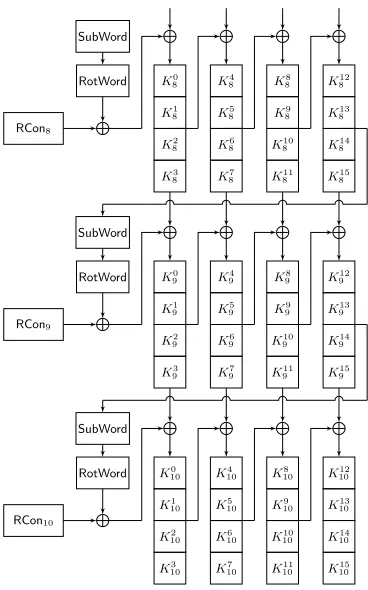
Fig. 1.Last three rounds of the AES-128 key schedule.
3
Related Work on Combined Attacks
Recently, one of the main area of research in side-channel analysis is combined attacks. A combined attack exploits leakage information from both a Fault Anal-ysis (FA) and a classical side-channel attack likeSimple Side-Channel Analysis
3.1 Combined Attacks on Asymmetric Cryptosystems
Amielet al.[1] combine a fault attack with an SSCA in order to break a modu-lar exponentiation that is supposedly secure against faults and SSCA. The au-thors attack a left-to-right atomic square-and-multiply algorithm that is SSCA-resistant. By injecting a fault in one of the registers at the beginning of the ex-ponentiation, they detect information on the secret exponent by SSCA. Hence, the FA protection that is present at the end of the algorithm cannot prevent the SSCA leakage that has already occurred during the computation. In [1], the authors propose a countermeasure called Detect and Derive based on the prin-ciple of infective computation. However, it was shown vulnerable in [17]. In this paper, Schmidt et al. propose an exponentiation algorithm, as well as a scalar multiplication algorithm, also based on infective computation. The idea is to be able to detect a fault as soon as it happens and corrupt the data if necessary so that no leakage information is available. The principle of the attack of Amiel
et al.seems to be applicable to any classic left-to-right atomic algorithm, either exponentiation or scalar multiplication. Right-to-left implementations as well as regular algorithms seem resistant against this kind of combined attack.
In [5], Fanet al.study the case of combined attacks specially targeting elliptic curve scalar multiplication. Using the properties of elliptic curves, they develop a powerful attack that can defeat atomic and regular algorithms. In order to perform the attack, one needs to choose a particular input point of the scalar multiplication. By injecting a fault after the initial point verification, the attacker is then able to obtain a point with a small order. During the scalar multiplication, computations with the faulted point will end up on the infinity point which is particularly visible by SSCA in most implementations. The attacker is then able to find information on the secret scalar.
A recent DSCA countermeasure proposed by Dupaquis and Venelli in [4] seems to be an efficient generic countermeasure against combined attacks. Using randomized reduction algorithms, one can refresh masks within a modular expo-nentiation or scalar multiplication for a small overhead. Hence, an attacker is not able to find by SSCA a particular pattern induced by a fault. However, as the randomization added by this countermeasure is based on the form of the mod-ulus, it is not sufficient to prevent combined attacks on a scalar multiplication for sparse modulus,e.g.like NIST elliptic curves [9].
3.2 Combined Attacks on Symmetric Cryptosystems
Clavieret al.[3] successfully attack an AES protected with first-order mask-ing. More generally, their combined attack reduces the DSCA countermeasure of one order. This attack is focused on the first round and requires the knowledge of faulty ciphertexts. Hence, a fault countermeasure like the inverse computation or the duplication of the AES prevents this attack.
Recently, Roche et al. [16] propose the first combined attack on AES im-plementation that can defeat both a boolean masking of any order and a fault countermeasure. The attack targets the last round, more precisely, it targets the key state of round 9. If the attacker is able to inject a fault with good enough repeatability, he has to perform statistical tests using three simultane-ous hypothesis to recover one byte of the key. Depending on the fault model considered, either bit-flip or stuck-at, the fault repeatability can be impacted, hence the number of power consumption curves required to perform the DSCA. Considering thebit-flipmodel, an attacker can defeat a boolean masking of any order without any overhead in the attack. However, if one considers the stuck-at model, masking induces a repeatability automatically divided by 2. As our attacks are based on the work of Roche et al., we recall the principle of their attack and we propose improvements depending on the fault model considered.
3.3 Remarks on Roche et al.’s Combined Attack
Algorithm 1Rocheet al.’s combined attack key retrieval algorithm.
Input: N triplets of valid-faulty ciphertexts and the side-channel information of the faulted execution: (C1,C˜1,L1), . . . ,(CN,C˜N,LN)
Output: The guessed round 10 keyk10
1: forj= 0 to 15do
2: for k10j , e
j
9, e
j
10
= (0,0,0) to (255,255,255)do
3: fori= 1 toN do
4: Vi=φ SubBytes SubBytes−1 Cij⊕k
j
10
⊕ej9
⊕k10j ⊕e
j
10
5: end for
6: σ(kj
10,e
j
9,e
j
10)=A
(Li)1≤i≤N,(Vi)1≤i≤N
7: end for
8: The maximalσ(kj
10,e
j
9,e
j
10)
forej96= 0 corresponds to the guessed valuekj10 9: end for
10: return k10
We detail the attack of Rocheet al.in Algorithm 1. We denote byφthe con-sidered leakage model function,e.g.Hamming weight or identity. LetAbe any DSCA statistical function,e.g.Pearson correlation [2] or mutual information [6]. Algorithm 1 has a complexity of 228A on N leakage measurements. We recall
the main relation of Rocheet al.’s attack:
˜
with ˜Cij the faulty ciphertext bytej of messagei, Cij the byte j of the correct ciphertext of messagei,kj10the guessed bytejof the round keyK10,ej9the error
in the byte j of K9 and ej10 the error in byte j of K10. We denote by Krj the byte j of the correct round keyr. In order to retrieve the 16 bytes ofK10 with
Algorithm 1, we need to assume that for each triplet (Ci,C˜i,Li) the attacker was able to inject a fault modifying the 16 bytes ofK9, whereLiis the side-channel
measurement of the faulty messagei.
On the efficiency of the combined attack. We fix that N side-channel leakages are sufficient to obtain a distinguishable correct triplet (k10j , ej9, ej10) for any byte j for a given fault repeatability using the test A. The efficiency of the combined attack depends on the complexity of its key retrieval algorithm as well as the value ofN that impacts the complexity of A. We recall that the complexity of a classical DSCA is 212A to retrieve 16 bytes compared to 228A
of Algorithm 1. In order to break a masked implementation, an higher-order DSCA has the same key retrieval complexity of 212A but the high number of
required plaintext N can dramatically reduce the efficiency of the attack. On the other hand, this combined attack is able to break a masked implementation of any order with a simple DSCA targeting first-order leakages, hence requiring much less plaintexts. As an example, we can note that in the experimentations of [16, Section 5.3], a combined attack with 90% success rate can be obtained with N < 2000 plaintexts considering a fault repeatability only slightly above 50% and a standard deviation of noise σ= 5. In [12, Section 5] a second-order DSCA is successful on a first order boolean masking with 45 000 plaintexts on a similar setup (considering a 90% success rate andσ≈5).
Note also that this combined attack defeats implementations protected against faults using a single-fault injection mechanism,i.e.no complex multi-fault setup is required to bypass the protection [18].
On the fault injection assumptions. In [16], the authors consider a fault injection mechanism that faults the 16 bytes of K9 at each execution of AES
(whatever the pattern of the fault within each byte). The attacker only needs
N fault injections hence N side-channel leakages measurements to perform Al-gorithm 1. The complexity of the key retrieval alAl-gorithm is 228AwithN faults
injected.
Injecting a fault on the 16 bytes ofK9 during one execution of AES is not
trivial on most implementations. For example, the bytes of the key stateK9may
be spread over a large area on the chip and the spot size of the laser may be so large that the device would almost certainly cease to function as a result of the disruption to surrounding circuitry. Note also that if the 16 bytes of the key state are not computed in one cycle, a fault injection using a clock glitch cannot impact all bytes.
of index j (a single byte fault model). The attacker has to perform 16 fault injection campaigns each time retrievingN side-channel leakages. Then, he can perform Algorithm 1 on each of the bytes with each of the 16 sets of side-channel leakages. However the attacker has to perform 16N faults as well as side-channel measurements. Note that if the injected fault modifies mbytes of the key (a m-byte fault model), the attacker needs d16/meN faults and side-channel measurements.
Remark 1. Considering the single byte fault model, if a fault is injected in one of the bytes K9j, then we have that ej10 = ej9 for 0 ≤ j ≤ 15. This property can reduce the complexity of Algorithm 1 to 220A to find the complete key. If
the fault is wider than a single byte, simple relations between ej10 and ej9 can be found as long as the fault only impacts the bytes (K9j)0≤j≤11. We can also
obtain a complexity of 216Afor each of these 12 bytes. If a fault affects multiple
bytes with one byte of the last column of K9, i.e. (K
j
9)12≤j≤15, the SubWord
transformation on this column makes it impossible to find relationships between errors. For example, consider thatK0
9andK913are simultaneously faulted. From
the equations of the key schedule forK10, we note that the error onK913goes in
the input of the SubWord and is then XOR-ed to K0
10. Hence, one cannot find
easy relations between the values of errors in round 9 and 10.
In this fault model, the main drawbacks of this combined attack are:
– the need for a high repeatability of fault effects, – a great number of injected faults,
– a key recovery algorithm of very high complexity.
In the following, we propose new attacks that improve these points.
4
Combined Attacks on the AES Key Schedule
4.1 Targeting the Recursive Structure of the Key Schedule Round
We recall the key schedule equations to compute the bytes of the round keyK9:
K90=K80⊕RCon9⊕SubBytes K813
K91=K81⊕SubBytes K814
K92=K82⊕SubBytes K815
K93=K83⊕SubBytes K812
K9j =K8j⊕K9j−4 for 4≤j ≤15 .
Due to the recursive property of the key schedule, a fault injected during the computation of K0
9 is propagated in K94, K98 and K912. Hence, we obtain the
following relations for given errors e0
9, e19, e29, e39 during the computation of the
first 4 bytes of K9:
e09=ej9 forj∈ {4,8,12} e19=ej9 forj∈ {5,9,13}
e29=ej9 forj∈ {6,10,14} e39=ej9 forj∈ {7,11,15} .
We can also deduce relations on the errorsej10 onK10. Indeed, if K90 is faulted
during its computation we have from the key schedule equations of round 10:
ej10=ej9 forj∈ {0,8} ej10= 0 forj∈ {4,12} .
Similar relations can easily be obtained if a fault is injected during the compu-tation ofK1
9,K92or K93.
The attacker only needs 4N faults and side-channel measurements to recover the complete key. The key recovery algorithm can also be improved from 220A
of the original attack (see Remark 1). In order to retrieve the byte K0 10, the
attacker needs a loop onk0
10 ande09, as the errore010is known from the error on
round 9. Hence, the complexity to find this byte is 216A. Oncee0
9 is found, the
attacker directly determines the errors for the bytes K4
9, K98 and K912. Thus, a
simple loop onkj10withj= 4,8,12 for each of those bytes is necessary. Then, the complexity for these 3 bytes is only 28A. The same method applies to the bytes K1
9,K92andK93. The complexity for the complete key is (4×(216+ 3×28))A=
(218+ 3×210)A.
4.2 Targeting the RCon
Single byte random fault model. First, we assume a fault that has a random effect on a byte. We recall the equations to compute the first bytes of the columns ofK9:
K90=K80⊕RCon9⊕SubWord K813
K94=K84⊕K90
K98=K88⊕K94 K912=K812⊕K98 .
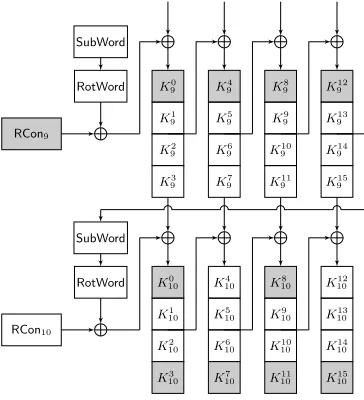
Note thatRCon9 affects 4 bytes ofK9, more preciselyRCon9is implicitly
XOR-ed with the bytesK0
fault noted9 into the round constant of round 9 of the key schedule, then this
fault will affect the 4 bytes ofK9in the exact same way. Figure 2 represents the
impact of such a fault on the end of the key schedule. An attack scenario similar to the one presented previously in §4.1 can be applied to recover the bytes
K0
10, K104 , K108 and K1012. The attacker only needs N faults and side-channel
measurements. The complexity of the key recovery is only (216+ 3×28)A to
retrieve 4 bytes. Finally, note that the fault can be injected at any time before the computation of the round 9 of the key schedule. The fault can also have a permanent effect on RCon9. In this case, the attacker only needs one fault
injection andN side-channel measurements to perform the attack.
SubWord
RCon9
RotWord K0 9 K1 9 K2 9 K3 9 K4 9 K5 9 K6 9 K7 9 K8 9 K9 9 K10 9 K11 9 K12 9 K13 9 K14 9 K15 9 SubWord RCon10
RotWord K0 10 K1 10 K2 10 K3 10 K4 10 K5 10 K6 10 K7 10 K8 10 K9 10 K10 10 K11 10 K12 10 K13 10 K14 10 K15 10
Fig. 2.Effect of a fault injection onRCon9 on the end of the key schedule. The color
gray represents faulty elements.
Single byte known fault model. An adversary can use the fact that he attacks a known constant in order to deduce the value of the error he injects. He is then able to lower the complexity of the key recovery algorithm. Suppose that the attacker has characterized his fault injection setup but is not able to know which bit he targets, he can greatly reduce the number of hypothesis on the error onK9. For example, in a single bitstuck-at 0 or 1 model, the error9 can take
only 4 possible values due to the value ofRCon9=0x1B. In a single bitbit-flip
model, the error can take 8 different values. Finally, if the attacker knows which bit he targets, he can directly deduce the value of the error. In this last case, the attacker knows the values ofe0
of the corresponding errors onK10as shown in§4.1. The complexity of the key
recovery algorithm is approximately 210A to recover 4 bytes which is the cost
of a classical first-order DSCA on 4 bytes. A permanent fault onRCon9 has the
same consequences on the number of faults and side-channel measurements as previously noted.
4.3 Targeting the Affine Transformation
In this section, we consider implementations of AES where the SubWord (and
SubBytes) operations are computed as an inverse in IF28 followed by the affine
transformation. Most first-order DSCA countermeasures use this type of imple-mentation,e.g.[11, 19]. More importantly, most higher-order DSCA countermea-sures compute the inverse and the affine transformation separately,e.g.[14, 13, 7]. In this case, we can find a similar but more efficient approach than previously.
LetInvIF28 be the inverse in IF28 with the convention InvIF
28(0) = 0. Let f
be the affine transformation of the SubBytes such as:f(x) =ω(x) +δdefined in the standard basis byΩ.X+∆ as:
Ω=
1 1 1 1 1 0 0 0 0 1 1 1 1 1 0 0 0 0 1 1 1 1 1 0 0 0 0 1 1 1 1 1 1 0 0 0 1 1 1 1 1 1 0 0 0 1 1 1 1 1 1 0 0 0 1 1 1 1 1 1 0 0 0 1
and ∆=
0 1 1 0 0 0 1 1 .
Practically in the AES, an elementX ∈IF28is identified to the integerX727+ X626+· · ·+X0. Hence,∆is considered as∆=0x63 in a real implementation.
TheSubBytesoperation then becomes:SubBytes(X) =Ω.InvIF28(X)⊕∆. As the SubWordoperation of the key schedule corresponds to theSubByteson 4 bytes, the same remark also applies.
We write again the first key schedule equations forK9detailing theSubBytes:
K90=K80⊕RCon9⊕Ω.InvIF28 K813
⊕∆
K91=K81⊕Ω.InvIF28 K814
⊕∆
K92=K82⊕Ω.InvIF28 K815
⊕∆
K93=K83⊕Ω.InvIF28 K812
⊕∆ .
and side-channel measurements. The complexity of the key recovery algorithm is (218+ 3×210)A.
In a second scenario, we consider that the implementation has a variable
∆SW for the SubWord different from the ∆SB of the SubBytes. In the case of an hardware implementation, we can similarly consider that the SubBytes and
SubWordlogical structures are located at different physical positions on the chip. Suppose that an attacker can inject a fault in ∆SW that lasts until the end of AES. Then, this error affects both K9 andK10. We can find relations between
the errors in round 9 and 10 to simplify the key recovery algorithm. First, let ]
∆SW =∆SW ⊕eSW whereeSW is the error injected in ∆SW. From the round 9 key schedule equations, we have:
e
K9j=K9j⊕eSW for 0≤j≤15 ,
with Kerj the faulty key bytej of round keyr. From the fact that we have the
same erroreSW in theSubWordof round 10, we have:
e
K100 =Ke90⊕RCon10⊕SubBytes
e
K913⊕eSW
=K100 ⊕ SubBytes K913⊕eSW
⊕SubBytes K913
=K100 ⊕e010
e
K101 =K101 ⊕ SubBytes K914⊕eSW⊕SubBytes K914
=K101 ⊕e110
e
K102 =K102 ⊕ SubBytes K915⊕eSW⊕SubBytes K915
=K102 ⊕e210
e
K103 =K103 ⊕ SubBytes K912⊕eSW
⊕SubBytes K912
=K103 ⊕e 3 10 .
Hence we obtain the following errors for the other bytes ofK10, forj∈ {0,1,2,3}:
ej10+4=ej10+12=ej10⊕eSW
ej10+8=ej10 .
With onlyN faults and side-channel measurements, the attacker can retrieve all 16 bytes ofK10. Using the previous relations, we can also simplify Algorithm 1.
A loop on the three hypothesis (k0
10, e09, e010) is necessary as there is no known
relation between e0
9 and e010, i.e. a complexity of 224A. Once e09 is found, the
attacker knows that e0 9 =e
j
9 for 1≤j ≤15. However e110, e210 and e310 are still
unknown. The complexity to retrieve the corresponding bytes is 3×216A. Finally,
the attacker knows ej9 and ej10 for 4≤j ≤15 from the previous relations. The overall complexity to retrieve all the bytes is (224+ 3×216+ 3×210)A.
If the fault in∆ lasts until the end of AES, it affectsK9,K10and theSubBytes
in the data path of the last round. The same observations as in the last scenario applies. However, as the data path is also modified we need to adapt Equation (1), corresponding to Line 4 of Algorithm 1, into :
SubBytesSubBytes−1Cij⊕k10j ⊕ej9⊕ej9⊕k10j ⊕ej10 .
The error ej9 is the same at the output of SubWord in round 9 of key schedule and in the last SubBytes of the data path. Hence, we just have to add a XOR with ej9 after the SubBytes in order to retrieve the key. The number of faults and the complexity of the key recovery algorithm are identical to the previous scenario.
Single byte known fault model. As in theRConcase, we know the value of the constant∆we want to fault. If the attacker characterized his fault injection setup, he should be able to reduce to a small subset (or directly determine) the value of the error. In this case, the attacker knows ej9 for 0 ≤ j ≤ 15. Considering the first scenario where the attacker temporarily faults a∆ in one of the SubBytes, he needs to obtain 4N faults and side-channel measurements as well as a key recovery complexity of 212A to retrieve the key. We obtain a combined attack with complexity identical to a classical DSCA. In the second and third scenarios, the key recovery complexity becomes (220+ 3×210)Awith
onlyN faults and side-channel measurements in order to retrieve the key.
Remark 2. The attack of [16] targets a key state or data state possibly masked with a high-order DSCA countermeasure. Hence, if the fault injection setup has a stuck-at effect, the repeatability of the fault is divided by 2. However, most AES implementations do not consider AES constants masked. Thus our attacks onRCon and the affine transformation are not affected by the decrease in fault repeatability of astuck-at model.
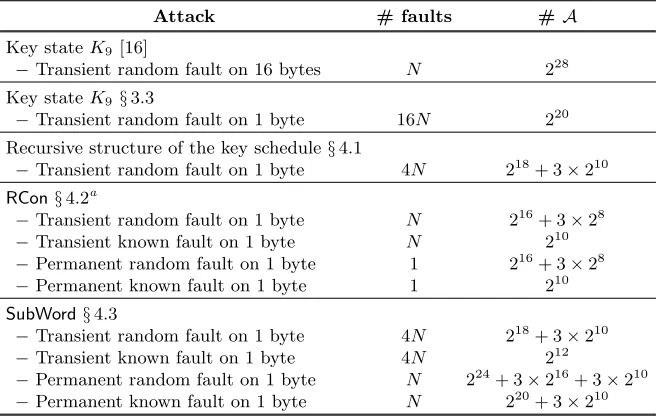
We summarize in Table 1 the different attacks proposed in this paper. For each scenario, we note the fault model considered, the number of necessary faults and the number of statistical testsAperformed in the key recovery algorithm.
5
Countermeasures
An intrinsic property of Roche et al.’s attack and our propositions is that it requires that an attacker can cipher the same plaintext twice. Note that this is not possible in certain cryptographic protocols, notably in banking transactions. Indeed, a counter can be added to the plaintext and make this kind of combined attack impossible.
As already pointed out in [16, Remark 6], the original combined attack of Rocheet al.does not necessarily target the keyK9 but can also target the data
state in the round 9. In that case, the keyK10is correct. Thus one cannot only
Table 1.Summary of the complexities of the different combined attacks, where Ais a DSCA statistical test used on N measurements to recover a byte of key. We recall that the complexity of a classical DSCA is 212Ato retrieve 16 bytes.
Attack # faults # A
Key stateK9 [16]
−Transient random fault on 16 bytes N 228
Key stateK9 §3.3
−Transient random fault on 1 byte 16N 220
Recursive structure of the key schedule§4.1
−Transient random fault on 1 byte 4N 218+ 3×210
RCon§4.2a
−Transient random fault on 1 byte N 216+ 3×28
−Transient known fault on 1 byte N 210
−Permanent random fault on 1 byte 1 216+ 3×28
−Permanent known fault on 1 byte 1 210
SubWord§4.3
−Transient random fault on 1 byte 4N 218+ 3×210
−Transient known fault on 1 byte 4N 212
−Permanent random fault on 1 byte N 224+ 3×216+ 3×210
−Permanent known fault on 1 byte N 220+ 3×210
a
Attack on 4 bytes.
The aim of this combined attack is to find correlations on the plain cipher-text. Hence, an efficient countermeasure consists in storing the ciphertext still masked while either an inverse operation or a duplication of the operation is performed [16]. Consider C1⊕M1 and C2⊕M2 the ciphertexts C1 and C2 of
the same message masked with M1 and M2 respectively. The final coherence
verification is then performed as (C1⊕M1)⊕M2 ?
= (C2⊕M2)⊕M1. This
countermeasure thwarts most our attacks.
Note that if a permanent fault is injected in the affine transformation, a coherence check consisting of two AES encryptions would not detect the error. A check using an AES encryption and a decryption would detect it as the affine transformation differs between the two process. However, even if the error is not detected, this does not offer a valid attack path as the data state would be corrupted from the first round of the AES. Hence, the attacker is not able to find relationships between errors at the rounds 9 and 10.
However, a coherence check cannot detect a permanent fault on RCon9 as
presented in §4.2. The value RCon9 is XOR-ed in the key schedule and it is
symmetrically used in the encryption and decryption process. Hence, performing two encryptions or an AES and its inverse does not detect a faultyRCon9 while
our combined attack is still feasible. A possible countermeasure would be to perform a known answer test or to compute an integrity check on the value of
6
Conclusion
We propose in this paper combined attacks on the AES key schedule that de-feat classical AES implementations secure against high-order DSCA and fault attacks. We present attacks on the different parts of the key schedule that use its structure in order to reduce the number of faults injected as well as the key recovery complexity. Contrary to the original attack, the performance of our pro-posed attacks on AES constants is not impacted whether astuck-at or abit-flip
model is considered when attacking a masked implementation. Moreover, the key recovery algorithm of [16] can be greatly improved from the original complexity of 228 DSCA statistical tests on N measurements to only 212 which is equiv-alent to a classical DSCA key retrieval. The coherence check proposed in [16] defeat most of our propositions. However, our attack path on RCon9 requires a
particular integrity check.
References
1. Amiel, F., Villegas, K., Feix, B., Marcel, L.: Passive and Active Combined Attacks: Combining Fault Attacks and Side Channel Analysis. In: Breveglieri, I., Gueron, S., Koren, I., Naccache, D., Seifert, J. (eds.) Workshop on Fault Diagnosis and Tolerance in Cryptography. pp. 92–102. IEEE Computer Society, Washington, DC, USA (2007)
2. Brier, E., Clavier, C., Olivier, F.: Correlation Power Analysis with a Leakage Model. In: Joye, M., Quisquater, J.J. (eds.) Cryptographic Hardware and Em-bedded Systems - CHES 2004, Lecture Notes in Computer Science, vol. 3156, pp. 135–152. Springer Berlin / Heidelberg (2004)
3. Clavier, C., Feix, B., Gagnerot, G., Roussellet, M.: Passive and Active Combined Attacks on AES: Combining Fault Attacks and Side Channel Analysis. In: Breveg-lieri, L., Joye, M., Koren, I., Naccache, D., Verbauwhede, I. (eds.) Workshop on Fault Diagnosis and Tolerance in Cryptography. pp. 10–19. IEEE Computer Soci-ety, Los Alamitos, CA, USA (2010)
4. Dupaquis, V., Venelli, A.: Redundant Modular Reduction Algorithms. In: Prouff, E. (ed.) Smart Card Research and Advanced Applications, Lecture Notes in Com-puter Science, vol. 7079, pp. 102–114. Springer Berlin / Heidelberg (2011) 5. Fan, J., Gierlichs, B., Vercauteren, F.: To Infinity and Beyond: Combined Attack on
ECC Using Points of Low Order. In: Preneel, B., Takagi, T. (eds.) Cryptographic Hardware and Embedded Systems - CHES 2011, Lecture Notes in Computer Sci-ence, vol. 6917, pp. 143–159. Springer Berlin / Heidelberg (2011)
6. Gierlichs, B., Batina, L., Tuyls, P., Preneel, B.: Mutual Information Analysis. In: Oswald, E., Rohatgi, P. (eds.) Cryptographic Hardware and Embedded Systems CHES 2008, Lecture Notes in Computer Science, vol. 5154, pp. 426–442. Springer Berlin / Heidelberg (2008)
7. Kim, H., Hong, S., Lim, J.: A Fast and Provably Secure Higher-Order Masking of AES S-Box. In: Preneel, B., Takagi, T. (eds.) Cryptographic Hardware and Embedded Systems - CHES 2011, Lecture Notes in Computer Science, vol. 6917, pp. 95–107. Springer Berlin / Heidelberg (2011)
9. National Institute Standards and Technology: Digital Signature Standard (DSS). Publication 186–2 (2000)
10. National Institute Standards and Technology: Advanced Encryption Standard (AES). Publication 197 (2001)
11. Oswald, E., Schramm, K.: An Efficient Masking Scheme for AES Software Im-plementations. In: Song, J.S., Kwon, T., Yung, M. (eds.) Information Security Applications, Lecture Notes in Computer Science, vol. 3786, pp. 292–305. Springer Berlin / Heidelberg (2006)
12. Prouff, E., Roche, T.: Attack on a Higher-Order Masking of the AES Based on Homographic Functions. In: Gong, G., Gupta, K. (eds.) Progress in Cryptology -INDOCRYPT 2010, Lecture Notes in Computer Science, vol. 6498, pp. 262–281. Springer Berlin / Heidelberg (2010)
13. Prouff, E., Roche, T.: Higher-Order Glitches Free Implementation of the AES Using Secure Multi-party Computation Protocols. In: Preneel, B., Takagi, T. (eds.) Cryptographic Hardware and Embedded Systems - CHES 2011, Lecture Notes in Computer Science, vol. 6917, pp. 63–78. Springer Berlin / Heidelberg (2011) 14. Rivain, M., Prouff, E.: Provably Secure Higher-Order Masking of AES. In:
Mangard, S., Standaert, F.X. (eds.) Cryptographic Hardware and Embedded Systems -CHES 2010, Lecture Notes in Computer Science, vol. 6225, pp. 413–427. Springer Berlin / Heidelberg (2010)
15. Robisson, B., Manet, P.: Differential Behavioral Analysis. In: Paillier, P., Ver-bauwhede, I. (eds.) Cryptographic Hardware and Embedded Systems - CHES 2007, Lecture Notes in Computer Science, vol. 4727, pp. 413–426. Springer Berlin / Hei-delberg (2007)
16. Roche, T., Lomn, V., Khalfallah, K.: Combined Fault and Side-Channel Attack on Protected Implementations of AES. In: Prouff, E. (ed.) Smart Card Research and Advanced Applications, Lecture Notes in Computer Science, vol. 7079, pp. 65–83. Springer Berlin / Heidelberg (2011)
17. Schmidt, J.M., Tunstall, M., Avanzi, R., Kizhvatov, I., Kasper, T., Oswald, D.: Combined Implementation Attack Resistant Exponentiation. In: Abdalla, M., Bar-reto, P. (eds.) Progress in Cryptology - LATINCRYPT 2010, Lecture Notes in Computer Science, vol. 6212, pp. 305–322. Springer Berlin / Heidelberg (2010) 18. Trichina, E., Korkikyan, R.: Multi Fault Laser Attacks on Protected CRT-RSA.
In: Fault Diagnosis and Tolerance in Cryptography (FDTC), 2010 Workshop on. pp. 75–86 (2010)