Nothing is for Free: Security in Searching
Shared & Encrypted Data
Qiang Tang
Abstract—Most existing symmetric searchable encryption schemes aim at allowing a user to outsource her encrypted data to a cloud server and delegate the latter to search on her behalf. These schemes do not qualify as a secure and scalable solution for the multi-party setting, where users outsource their encrypted data to a cloud server and selectively autho-rize each other to search. Due to the possibility that the cloud server may collude with some malicious users, it is a chal-lenge to have a secure and scalable multi-party searchable encryption (MPSE) scheme. This is shown by our analysis on the Popa-Zeldovich scheme, which says that an honest user may leak all her search patterns even if she shares only one of her documents with another malicious user. Based on our analysis, we present a new security model for MPSE by considering the worst-case and average-case scenarios, which capture different server-user collusion possibilities. We then propose a MPSE scheme by employing the bilinear property of Type-3 pairings, and prove its security based on the Bilinear Diffie-Hellman Variant (BDHV) and Symmetric eXternal Diffie-Hellman (SXDH) assumptions in the random oracle model.
Index Terms—Multi-party Searchable Encryption (MPSE), Data Privacy, Trapdoor Privacy, Pairing.
I. Introduction
With the advancement of communication technolo-gies, particularly online social networks such as Twitter and Facebook, information sharing has become ubiqui-tous in our life. Take Twitter as an example, a user may publish a lot of tweets to share information with her followers, in the mean time she may follow many other users to access their data. Due to the private nature of personal data, there is an inherent need for a user to selectively share her data with different recipients. In practice, what a user can do is to set some access control policy and then rely on the cloud server (e.g. Twitter and Facebook) to enforce them. Unfortunately, this approach is not realistic due to two reasons. One is that the users have no means to prevent the server from accessing their data. The other is that, even if the server is benign, it may also be forced to share users’ data with other parties.
The concept of searchable encryption provides a promising direction in solving the above problem. Such schemes allow users to store their data in encrypted form at an untrusted server, and then delegate the server to search on their behalf by issuing a trapdoor (i.e. encrypted keyword). A detailed survey of searchable encryption schemes can be found in [26].
The author is with APSIA group, SnT, University of Luxembourg, Luxembourg. e-mail: [email protected]
A. Problem Statement
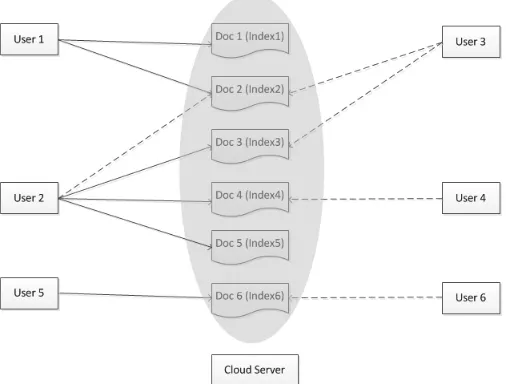
In this work, we are interested in multi-party search-able encryption (MPSE) schemes in the symmetric set-ting, which can be regarded as a multi-party version of the symmetric searchable encryption proposed by Song et al. [24]. Briefly, a MPSE scheme allows every user to build an encrypted index for each of her documents and store it at a cloud server. The index contains a list of encrypted keywords, as well as some authorization information which selectively authorizes other users to search over this index. A toy example is shown in Fig. 1. The real line from a user to index means that the user owns the index, while a dashed line means that the user is authorized by the index owner to search.
Fig. 1. Search Shared & Encrypted Data
It is worth noting that the server stores all encrypted index (shadowed in Fig. 1) and process all search queries in the encrypted form. A user is able to search an encrypted index means that the server can match this user’s trapdoor with the index.
Our objective is first to formulate MPSE and its secu-rity properties and then to provide a scalable and secure construction. Informally, the scalability and security cri-teria in our mind are the following:
If Alice has been authorized by another Y users to search their indexes, when Alice wants to search for a keyword w then the size of her trapdoor should not be linear inY.
• As to security, there should not be any additional trusted third party (TTP) involved, and the informa-tion leaked to the server and malicious users should be minimal. Referring to Fig. 1, the cloud server will inevitably know which indexes match which search queries, and the cloud server and User 1 together will potentially be able to recover what User 3 is searching for (since Index2 is generated by User 1 and the cloud server is delegated by User 3 to search over Index2). But, other leakages should be prevented.
B. Related Work
The investigation of searchable encryption schemes in the symmetric setting was initiated by Song et al. [24] and followed up by many others (e.g. [8], [10], [11], [12], [13], [14], [15], [16], [17], [18], [19], [20], [22], [23]). This setting typically assumes one user and one server, where the user can generate searchable contents and stores them at the server, and later delegate the server to search on her behalf. To address our problem with any of these schemes, one needs to independently generate a key to protect each document (i.e. instantiate the scheme once for every document) and then shares the key with the users who will be authorized to search this document. As a result, the number of trapdoors required to search for a keyword will equal to the number of documents (or, indexes), so that the solution obviously does not satisfy our scalability criteria. Some other schemes are intended for more complex settings (e.g. [2], [4], [5], [12], [13], [14], [25], [21]) which are analyzed in more details below.
1) Some Existing Multi-User Schemes: Curtmola et al.
[12] proposed the concept of multi-user searchable en-cryption schemes, where a user can authorize multiple other users to search her encrypted data. However, the proposed primitive does not take into account the fact that the same user may also be authorized to search other users’ data and the corresponding security issues. As a result, the primitive from [12] offers a solution for a much more simplified problem than ours, and it seems not trivial to construct a scalable solution for our problem based on their scheme. In the work of Bao et al. [4], a new party, namely user manager, is introduced into the system, to manage multiple users’ search ca-pabilities (e.g. enable them to search each other’s data). In this extension, the user manager needs to be fully trusted since it is capable of submitting search queries and decrypting encrypted data. This conflicts with our security criteria (i.e. there should not be additional TTP involved). The schemes of Dong, Russello and Dulay [13], [14] have similar issues. In the work from [2], [5], [25], the authors have investigated order preserving encryption, where the ciphertexts preserve the order the
plaintexts so that every entity can perform an equality comparison. Clearly, these schemes also conflict with our security criteria (i.e. leak minimal information to the server).
2) Popa-Zeldovich Scheme: The Popa-Zeldovich scheme
[21] is the only available work that addresses a similar problem to ours. Let λ be the security parameter, their scheme consists of the following algorithms.
• MK.Setup(λ): run GP to generate Γ =
(p,G1,G2,GT,e,ˆ g2), and return the public parameters
params = (Γ,H1,H2), where H1 : {0,1}∗ → G1 and
H2 :GT×GT → {0,1}∗ are two hash functions. The
bilinear pairing parameter generation algorithmGP
is defined in Section II.
• MK.KeyGen(params): randomly selectkfromZpand
return k. Note that this algorithm is used by a user to generate her long-term private key (denoted as
uk) and also generate an independent secret key (de-noted as f k) for protecting each of her documents.
• MK.Delta(uk,f k): return∆ = g
f k uk 2 . • MK.Token(uk,w): returntk=H1(w)uk.
• MK.Enc(f k,w): return c = (r,H2(r,eˆ(H1(w),g2)f k)),
where r∈RGT.
• MK.Adjust(tk,∆): return tk′=eˆ(tk,∆).
• MK.Match(tk′,c): parsecas (r,h), returnH2(r,tk′)=? h. Next, we show that this scheme leaks unnecessary information to the server, so that it does not satisfy our security criteria. Informally, the granularity of authoriza-tion is very coarse, i.e. an honest user may leak the keywords in all her search queries to the server if she authorizes a malicious user to search her index.
Let the long-term user keys of Ui and Uj be denoted as uki and ukj respectively. Suppose that Ui wants to build an index index0 and authorizes Uj to search, she performs as follows:
1) Ui runs MK.KeyGen to generate a secret key
f k0, and runs MK.Enc to generate index0 =
MK.Enc(f k0,w0). For simplicity, we assume the
in-dex encodes only one keywordw0.Uistoresindex0
and ∆i = MK.Delta(uki,f k0) = g f k0 uki
2 at the server.
Here we assume Ui wants to enable herself to
search overindex0.
2) Ui and Uj magically computes ∆j =
MK.Delta(ukj,f k0) = g f k0 ukj
2 and stores it at the
server. Note that the scheme does not specify how
∆jshould be computed (see Remark 1 below), but
this does not affect our security analysis.
Now suppose that Uj colludes with the server, then
the latter can trivially recover gf k0
2 . Afterwards, for any
tokentk=H1(w)uki fromUi, the server can first compute
ˆ
e(tk,∆i)=eˆ(H1(w),g2f k), and then identifywby computing
ˆ
e(H1(w′),g2f k) for all w′ given that the keyword set is
and Uj should only be able to tell whether w equals to
w0or not. This is captured in the the worst-case trapdoor
privacy property of our security model in Section IV-B.
Remark 1: Besides the security issue, Popa and
Zel-dovich did not explicitly specify how a user Ui can authorize another user Uj to search his index. Take the above analysis as example. The first possibility is that
Ui may want to send the secret key f k0 to Uj through
a secure channel, so that Uj can generate ∆j. In this
case, if Ui would like to authorize a large number of
users to search her index, she needs to communicate with all of them for sharing her secret key. Moreover, such communications are required for every index, so the solution is clearly unscalable. The second possibility is that Ui may want to run an interactive protocol with Uj for the latter to generate ∆j without revealing f k0 in
clear. This may be even worse than in the first possibility.
C. Our Contribution
We first present a new formulation for MPSE. Com-pared with [21], we explicitly introduce a Follow algo-rithm, which enables a user Alice to assign a token to other users through a public channel. With this token, other users can authorize Alice to search their indexes without any further interaction with Alice. Since the communication of token is once for all, we solve the in-herent scalability problem in the Popa-Zeldovich scheme [21], as indicated in Remark 1.
We then present a security model for MPSE by consid-ering the worst-case and average-case scenarios. In the worst-case scenario, we assume that every user except the honest user will collude with the cloud server, and we define the worst-case data and trapdoor privacy properties. It is worth noting that the worst-case trap-door privacy property eliminates the aforementioned information leakage in the Popa-Zeldovich scheme. In the average-case scenario, we assume that a group of honest users, who do not share data from any one outside of the group, will not collude with the cloud server, and we define a hybrid privacy property.
We finally propose a MPSE scheme by employing the bilinear property of Type-3 pairings, and prove its security based on the Bilinear Diffie-Hellman Variant (BDHV) and Symmetric eXternal Diffie-Hellman (SXDH) assumptions in the random oracle model. Similar to the Popa-Zeldovich scheme, the proposed scheme is also motivated by the PEKS construction of [6]. But, it is different in the sense that an index contains separate searchable contents for the data owner and other au-thorized users, in order for the scheme to be provably secure in our security model. As a side effect, we do not need the eXternal Diffie-Hellman Variant (XDHV) assumption (required in [21]) which is stronger than the SXDH assumption.
D. Organization
The rest of this paper is organized as follows. In Section II, we present the preliminary knowledge. In
Section III, we present the algorithmic definition for MPSE. In Section IV, we present the security model for MPSE. In Section V, we present our main construction for MPSE. In Section VI, we conclude the paper.
II. Preliminary
Throughout the paper, we use the following no-tation. x||y means the concatenation of x and y, P.P.T. means probabilistic polynomial time, and x ←$
A(m1,m2,· · ·;O1,O2,· · ·) means that x is the output of
the algorithm A which runs with the input m1,m2,· · ·
and access to oraclesO1,O2,· · ·. WhenXis a set,x∈RX
means thatxis chosen fromXuniformly at random, and
|X|means the size ofX. For b∈ {0,1}, ¯brepresents 1−b. A function P(λ) :Z →R is said to be negligible with respect toλif, for every polynomial f(λ), there exists an integer Nf such thatP(λ)< f(λ)1 for allλ≥Nf. IfP(λ) is
negligible, then we say 1−P(λ) isoverwhelming.
A. Pairing and Hardness Assumptions
A prime-order bilinear group generator is an algo-rithmGPthat takes as input a security parameterλand
outputs a descriptionΓ =(p,G1,G2,GT,e,ˆ g1,g2) where: • G1, G2, and GT are groups of prime-order p with
efficiently-computable group laws.
• g1is a randomly-chosen generator ofG1 and g2 is a
randomly-chosen generator of G2.
• eˆ is an efficiently-computable bilinear pairing ˆe :
G1 × G2→GT, i.e., a map satisfying two properties:
– Bilinearity: ˆe(ga
1,gb2)=eˆ(g1,g2)ab for all a,b∈Zp; – Non-degeneracy: ˆe(g1,g2),1.
According to [9], a pairing is Type-3 if there is no efficiently computable isomorphism betweenG1 andG2.
The following assumption requires a Type-3 pairing. GivenΓ =(p,G1,G2,GT,e,ˆ g1,g2), the Symmetric
eXter-nal Diffie-Hellman (SXDH) assumption [3] holds if, for every P.P.T. attackerA, the advantageϵsxdh=max{ϵ1, ϵ2}
is negligible for x1,x2,x3,x4,r1,r2∈RZp.
ϵ1=|Pr[A(Γ,gx11,gx12,gx11x2)=1]−Pr[A(Γ,gx11,gx12,gr11)=1]|
ϵ2=|Pr[A(Γ,gx23,gx24,gx23x4)=1]−Pr[A(Γ,gx23,gx24,gr22)=1]|
This essentially says that the Decisional Diffie-Hellman (DDH) assumption holds for bothG1 and G2.
Given Γ = (p,G1,G2,GT,e,ˆ g1,g2), the Bilinear Diffi
e-Hellman Variant (BDHV) assumption [21] holds if, for
x1,x2,x3 ∈R Zp and R ∈R GT, every P.P.T. attacker A’s
advantageϵbdhv=|Pr[A(Γ,X0)=1]−Pr[A(Γ,X1)=1]| is
negligible.
X0=(gx11,g 1 x1 2 ,g
x2 x1 2 ,g
x3
1 ,eˆ(g1,g2)x2x3),X1=(g
x1 1,g
1 x1 2 ,g
x2 x1 2 ,g
x3 1,R).
Lemma 1:Suppose an attacker has the advantagesϵbdhv
andϵsxdhin solving the BDHV and SXDH problems, then
its advantage in distinguishing Y0 and Y1 is at most
Y0=(gx11,g 1 x1 2 ,g
x2 x1 2 ,g
x3 1,g
x4
1,eˆ(g1,g2)
x2x3,eˆ(g
1,g2)x2x4)
Y1=(gx11,g 1 x1 2 ,g
x2 x1 2 ,g
x3 1,g
x4 1 ,R0,R1)
Proof. For the attacker, we consider another inputY2,
where Y2=(gx11,g 1 x1 2 ,g
x2 x1 2 ,g
x3 1 ,g
x4 1,R0,R
x4 x3 0 )
From Y0 and Y2 we can unanimously obtain X0 and
X1 (defined in the BDHV assumption) by getting rid of
two elements (e.g. the last and third last ones), therefore
|Pr[A(Γ,Y0)=1]−Pr[A(Γ,Y2)=1]| ≥ϵbdhv. On the other
hand, from X0 and X1 we can unanimously obtain Y0
and Y2 by adding two elements (e.g. choose r ∈R Zp
and set gx4 1 =g
x3r
1 , and generate a new element by rasing
the last element of X0 or X1 to the power r), therefore |Pr[A(Γ,Y0)= 1]−Pr[A(Γ,Y2)=1]| ≤ ϵbdhv. As a result,
we have|Pr[A(Γ,Y0)=1]−Pr[A(Γ,Y2)=1]|=ϵbdhv.
As to distinguishing Y1 and Y2, note the fact that
gx1 1,g
1 x1 2 ,g
x2 x1
2 are irrelevant to the rest of Y1 and Y2, we
have |Pr[A(Γ,Y1) = 1] −Pr[A(Γ,Y2) = 1]| equals to |Pr[A(Γ, α0)=1]−Pr[A(Γ, α1)=1]|, where
α0=(gx13,gx14,R0,R1), α1=(gx13,gx14,R0,R x4 x3 0 )
Furthermore, it is obvious that |Pr[A(Γ, α0) = 1] −
Pr[A(Γ, α1) = 1]| ≤ |Pr[A(Γ, β0) = 1]−Pr[A(Γ, β1) = 1]|,
where
x5,x6∈RZp, β0=(g1x3,gx14,gx15,gx16), β1=(g1x3,gx14,gx15,g x4x5
x3 1 ).
Finally,|Pr[A(Γ, β0)=1]−Pr[A(Γ, β1)=1]| ≤ϵsxdhso that |Pr[A(Γ,Y1)=1]−Pr[A(Γ,Y2)=1]| ≤ϵsxdh.
Based on |Pr[A(Γ,Y0) = 1]−Pr[A(Γ,Y2) =1]| = ϵbdhv
and |Pr[A(Γ,Y1)=1]−Pr[A(Γ,Y2)=1]| ≤ϵsxdh, we have |Pr[A(Γ,Y0) = 1]−Pr[A(Γ,Y1) = 1]| ≤ ϵbdhv+ϵsxdh. The
lemma now follows.
Given Γ = (p,G1,G2,GT,e,ˆ g1,g2), the n-Parallel
Deci-sional Diffie-Hellman (PDDHn) assumption [1] holds in
G1if, forx1,x2,· · ·,xn∈RZpandR1,R2,· · ·,Rn∈RG1,
ev-ery P.P.T. attacker A’s advantageϵpddhn =|Pr[A(Γ,Z0)=
1]−Pr[A(Γ,Z1)=1]| is negligible.
Z0=(gx11,g1x2,· · ·,gx1n,g1x1x2,gx12x3,· · ·,gx1nx1),
Z1=(gx11,gx12,· · · ,gx1n,R1,R2,· · · ,Rn).
It has been proven that this assumption is equivalent to DDH assumption inG1[1], namelyϵddh≤ϵpddhn ≤nϵddh≤
nϵsxdh. Next, we further extend the PDDHn assumption.
GivenΓ =(p,G1,G2,GT,e,ˆ g1,g2), the extended PDDHn
(e-PDDHn) assumption holds inG1if, forx1,x2,· · ·,xn∈R
Zp and R1,R2,· · ·,Rn(n−1)
2 ∈RG1, every P.P.T. attackerA’s
advantage ϵe−pddhn =|Pr[A(Γ,U0)=1]−Pr[A(Γ,U1)=1]|
is negligible.
U0=(gx11,gx12,· · ·,g1xn,gx1ixj(1≤i<j≤n))
U1=(gx11,gx12,· · ·,g1xn,R1,R2,· · · ,Rn(n−1) 2 ).
Lemma 2: The e-PDDHn assumption can be reduced
to the DDH assumption in G1. More precisely, we have
ϵddh≤ϵe−pddhn≤
n(n−1)·ϵddh
2 ≤
n(n−1)·ϵsxdh
2 .
Proof. It is clear that e-PDDH2is the DDH assumption
inG1andϵddh≤ϵe−pddh2≤ 2·ϵddh
2 ≤ 2·ϵ2sxdh. Based on this, we
will recursively prove this lemma. Suppose that ϵddh ≤
ϵe−pddhn ≤
n(n−1)·ϵddh
2 ≤
n(n−1)·ϵsxdh
2 , we will prove that ϵddh ≤
ϵe−pddhn+1≤
n(n+1)·ϵddh
2 ≤
n(n+1)·ϵsxdh
2 .
Forn+1,U0 andU1are as follows. Note that we have
underlined the new elements in contrast to the case of
n.
U0=(gx11,g x2
1,· · ·,gxn1 ,gxn1+1,g xixj
1 (1≤i<j≤n),g x1xn+1 1 ,g
x2xn+1
1 ,· · ·,gxnxn1 +1)
U1=(gx11,g x2
1,· · ·,gxn1,gxn1+1,R1,R2,· · ·,Rn(n−1) 2
,Rn(n−1) 2 +1
,Rn(n−1) 2 +1
,· · ·,Rn(n−1) 2 +n
)
Now consider a new vector U2.
U2=(gx11,gx12,· · ·,g1xn,gxn1+1,R1,R2,· · ·,Rn(n−1) 2
,gx1xn+1 1 ,g
x2xn+1 1 ,· · ·,g
xnxn+1 1 )
For any P.P.T. attacker, its advantage in distinguishing
U0 and U2 is ϵe−pddhn and its advantage in
distinguish-ing U1 and U2 is nϵddh based on the standard hybrid
argument as in proving the PDDHn assumption [1]. As
a result, the attacker’s advantage in distinguishing U0
and U1 is bounded by nϵddh+ϵe−pddhn, which result in
ϵddh ≤ ϵe−pddhn+1 ≤
n(n+1)·ϵddh
2 ≤
n(n+1)·ϵsxdh
2 . The lemma now
follows.
In a similar way, both PDDHnand e-PDDHn
assump-tions can be defined forG2.
III. NewDefinition forMPSE
A MPSE scheme involves two types of entities: a cloud server and a set of usersUi (1≤i≤N) where Ncan be
any integer and should be a polynomial in the security parameter. Every user can generate encrypted indexes and authorize others to search, while the cloud server stores all encrypted contents and search on the users’ behalf. We envision the following workflow for MPSE.
1) The users together set up some global public pa-rameters.
2) Every user Ui, for 1 ≤ i ≤ N, generates a master
public/private key pair. The private key is mainly used to for three purposes.
• Generate tokens to follow other users who can then authorize Ui to search their encrypted
indexes.
• Derive document-specific secret keys to gener-ate encrypted indexes.
• Generate trapdoors to search over encrypted indexes.
3) For every her document, Ui first extracts a list of
4) To search for a specific keyword,Uiissues the cloud server a trapdoor, generated based on her master private key and the keyword.
5) With the trapdoor fromUi, the cloud server first
se-lects the encrypted indexes (from bothUiand other
users) whose attached authorization information indicates thatUi is authorized to search. Then, for
each selected index, the cloud server runs a match algorithm to decide whether the index contains the same keyword as that in the trapdoor.
Intuitively, we wish Ui’s master private key to
estab-lish a link between her trapdoors and all indexes that have been authorized to her (generated by herself and others). As a result, Ui is able to search all indexes with
only one trapdoor.
Remark 2:The authorization information in each index
gives the server an indication who can search which in-dex. This is crucial for the server’s operational efficiency in practice. Otherwise, with a search request, the server needs to try all indexes in its database. Consider the server may have many users and each of them may store a lot of indexes, the absence of explicit authorization information will make it impossible to have a practical solution.
A. Algorithmic Definition for MPSE
Let λ be the security parameter. A MPSE scheme
consists of the following algorithms.
• Setup(λ): Taking the security parameterλas input, it sets up the global public parameter params. It is required that params includes a definition for a keyword spaceW.
• KeyGen(params): Run by user Ui, for every 1 ≤ i≤N, it generates a master public/private key pair
(MPKi,MSKi).
• Follow(MSKi,MPKj): Run byUi, it generates a token
TKi→j. We use i→ j to denoteUi followsUj.
• Formindex(MSKi,doc,T K): The doc parameter is a keyword set {w1,w2, · · ·, wn} where no keyword
should repeat, andT K contains tokens of the form
TKt→i. IfUi wants to authorize herself to search,
in-stead ofTKi→i, we assumeMPKishould be included
inT K.Ui performs as follows.
1) Select a unique identifierid for the index, and generate a document-specific secret keyFKid.
2) Based onFKid, run theEncalgorithm to
gener-ateTAGid={Tagw1,Tagw2,· · ·,Tagwn}.
3) Based on MSKi and T K, generate authoriza-tion informaauthoriza-tion∆id that allows the users affi
l-iated with the tokens from T K to search the index.
4) Returnindexid=(id,TAGid,∆id).
• Enc(FKid,w): It generates a tagTagwfor the keyword wbased on the secret key FKid.
• Trapdoor(MSKi,w): Run by Ui, this algorithm out-puts a trapdoorTrapw for keywordw.
• Match(Trapw,indexid): Let indexid = (id,TAGid,∆id)
and TAGid ={Tagw1,Tagw2, · · ·,Tagwn}. Run by the
cloud server, when Trapw issuer’s token has been included in generating ∆id, it returns 1 if w = wi
form some 1≤i≤n and 0 otherwise.
Remark 3: Even though Ui needs to authorize herself
to search her own data, for both security and efficiency reasons, we assume that she will not explicitly issue a token TKi→i and stores it locally. Instead, she should
authorize herself on the fly in theFormindex algorithm.
B. Soundness Property
Given (MPKi,MSKi) = KeyGen(params) and
(MPKj,MSKj) = KeyGen(params), a MPSE scheme
is sound if the followings are true.
• Ifw∈doc,Match(Trapdoor(MSKj,w),Formindex(MSKi,
doc,T K))=1 holds with overwhelming probability when TKj→i is in T K or MPKj is in T K (in which
case j=i).
• Ifw<doc,Match(Trapdoor(MSKj,w),Formindex(MSKi,
doc,T K))=0 holds with overwhelming probability when TKj→i is in T K or MPKj is in T K (in which
case j=i).
IV. SecurityModel forMPSE
In the context of searchable encryption, it is realistic to assume that the de facto size of the keyword space
Wis polynomial with respect to the security parameter
λ even though we can specify a space of any size in our theoretical cryptographic scheme. This implies that a scheme can be in the danger of dictionary attacks, as shown in Section I-B2. We further make the following assumptions.
• We assume that the cloud server will honestly per-form search on every user’s behalf (e.g. if an index is matched by a search query, the cloud server will not say no.), but it can be malicious in trying to obtaining user’s private information by colluding with dishonest users or simply forging new users in the system.
• We assume that there is a secure channel between every user and the cloud server to transmit trap-doors. This leads us to consider the cloud server as the primary attacker since a dishonest user alone will not learn anything due to the secure channel. In the context of MPSE, it is infeasible for a user to be absolutely confident about which other users will be honest in the long run (or, will not be compromised in the future). As such, we choose to investigate the security properties for MPSE in two scenarios.
4 and User 6 in the example shown in Fig. 1 of Section I-A).
• In the average-case scenario, an honest user assumes all other users who have authorized her to search are honest. For example, in the example shown in Fig. 1 of Section I-A, User 3 needs to assume User 1 and User 2 are honest. In this scenario, we define the average-case hybrid privacy property in Section IV-B.
It is worth noting that the security properties in the two scenarios do not imply each other, so that it is essential for a MPSE scheme to achieve them all. In the following, we define the security properties through the standard challenger-attacker attack games.
A. Security in the Worst-case Scenario
Without loss of generality, we present the definitions by assuming U1 is honest. In the attack games, the
challenger simulatesU1with key pair (MPK1,MSK1) and
interacts with the attackerAwhich plays the role of the cloud server and all colluded users Ui (2 ≤i≤ N). The attacker may issue the following types of oracle queries to the challenger:Follow,Formindex,Trapdoor.
• For a Follow oracle query, the attacker has MPKi
for some 2 ≤ i ≤ N as input, and receives a
token TK1→i =Follow(MSK1,MPKi). We assume the
attacker generates (MPKi,MSKi) for 2≤i≤N.
• For a Formindex oracle query, the attacker has
a document parameter doc and a set of tokens
T K as input, and receives an index indexid =
Formindex(MSK1,doc,T K). If the attacker wantsU1
to search her own index, it includesMPK1 in T K.
Note that T K mainly contains tokens of the form
TKi→1.
• For a Tarpdoor oracle query, the attacker has a keywordwas input, and receives a trapdoorTrapw=
Trapdoor(MSK1,w).
Remark 4: In answering the oracle queries, the
chal-lenger should check the inputs from the attacker are well-formed. For instance, in a Follow oracle query the
MPKi should be in the right form, and in a Formindex
oracle query the parameter doc contain keywords from the right domain. For the sake of simplicity, we skip enumerating all these checks.
Intuitively, the worst-case data privacy property says that, ifU1 has not authorized an index to any other user
(e.g. Index1 for Doc 1 in the toy example, shown in Fig. 1 of Section I-A), then the attacker will not learned any-thing about the keywords in this index unlessU1reveals
it by issuing the relevant trapdoors. This property is an analog to the semantic security for PEKS in [6].
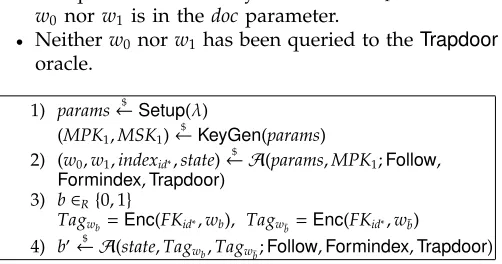
Definition 1: A MPSE scheme achieves
worst-case data privacy if any P.P.T. attacker A’s advantage (i.e. |Pr[b′=b]−12|) is negligible in the attack game shown in Fig. 2. In the game, there are two restrictions.
• In theFormindexoracle query to generateindexid∗, it
is required thatT Konly containsMPK1and neither
w0 norw1 is in thedoc parameter.
• Neitherw0 norw1has been queried to theTrapdoor
oracle.
1) params←$ Setup(λ) (MPK1,MSK1)
$
←KeyGen(params) 2) (w0,w1,indexid∗,state)
$
← A(params,MPK1;Follow,
Formindex,Trapdoor) 3) b∈R{0,1}
Tagwb =Enc(FKid∗,wb), Tagw¯b =Enc(FKid∗,wb¯)
4) b′← A$ (state,Tagwb,Tagwb¯;Follow,Formindex,Trapdoor)
Fig. 2. Worst-case Data Privacy Game
When generating the challenge (Tagwb,Tagw¯b) in Step
3, FKid∗ is the secret key the challenger has used in
generating indexid∗. In the above definition, the first
restriction is to guarantee that no keyword should repeat in the index and the index has not been authorized to the attacker. Note that the challenger will return
Tagwb and Tagw¯b generated under FKid∗, if the attacker
queriesFormindexwith w0 orw1 then the keyword will
repeat in the index. The second restriction is obviously essential. Given Trapw0 or Trapw1 (the attacker knows
the corresponding keyword w0 or w1), the attacker can
trivially recoverbby running the Matchalgorithm.
Remark 5:In the definition, we have set the challenge to
be (Tagwb,Tagw¯b), which equals to (Tagw0,Tagw1) ifb=0
and equals to (Tagw1,Tagw0) otherwise. The attacker’s
task is to tell b, namely which tag is for w0 or w1.
This is in contrast to the usual definitions, e.g. those from [6], [21], where the challenge only contains Tagwb.
For searchable encryption schemes in the asymmetric setting, e.g. [6], this feature does not make much diff er-ence because the attacker can generate tags on its own, but it seems to result in a strictly stronger definition for symmetric searchable encryption schemes (including MPSE) because (Tagwb,Tagwb¯) reveals more information
thanTagwb alone to the attacker.
Intuitively, the worst-case trapdoor privacy property says that, ifU1 does not follow any other user, then the
attacker will not learn anything about the keywords in theU1’s trapdoors unless these trapdoors match an index
(e.g. Index 3 or Index4 in the toy example, shown in Fig. 1 of Section I-A) that has been shared with the attacker.
Definition 2: A MPSE scheme achieves
worst-case trapdoor privacy if any P.P.T. attacker
A’s advantage (i.e. |Pr[b′ = b]− 12|) is negligible in the attack game shown in Fig. 3. In the game, there are three restrictions.
• For any Formindex oracle query with the input
(doc,T K), the following two situations should not happen at the same time: (1) w0 or w1 is in thedoc
parameter; (2)T K contains TKi→1 for somei.
• For any Formindex oracle query with the input
(doc,T K), if T K contains only MPK1 then w0 and
• Neitherw0 norw1 has been queried to theTrapdoor
oracle.
1) params←$ Setup(λ) (MPK1,MSK1)
$
←KeyGen(params) 2) (w0,w1,state)
$
← A(params,MPK1;Formindex,Trapdoor) 3) b∈R{0,1}, Trapwb =Trapdoor(MSK1,wb)
Trapwb¯ =Trapdoor(MSK1,w¯b)
4) b′← A$ (state,Trapwb,Trapwb¯;Formindex,Trapdoor)
Fig. 3. Worst-case Trapdoor Privacy Game
In the above definition, the first restriction says that an index should not simultaneously be authorized to the attacker and contain the keyword w0 orw1. Otherwise,
the attacker can recover b by comparing search results
of Trapwb to the results of its own trapdoors forw0 and
w1 (this is possible because the attacker is authorized
to search). The second restriction is essential. If onlyw0
or w1 is in an index (the attacker knows which one),
then the attacker can recover b in Trapwb by running
theMatchalgorithm on Trapwb and the index. The third
restriction is essential, because, given Trapw0 or Trapw1
(the attacker knows the corresponding keyword w0 or
w1), the attacker can trivially recover b in Trapwb by
running the Matchalgorithm based on these trapdoors and comparing their results.
Remark 6:It is worth noting that we allow the attacker
to access tags for w0 and w1 in the game through the
Formindexoracle. This is in the vein ofenhancedfunction privacy for IBE and enhanced keyword privacy for PEKS [7]. In contrast to Definition 1, the attacker has no access to the Follow oracle in Definition 2. As a result, it seems difficult to have a hybrid definition to cover both properties.
B. Security in the Average-case Scenario
Unlike in the worst-case scenario, where the challenger simulates only one honest user U1, in the average-case
scenario the challenger simulates a set of honest users who do not follow any user from outside of the set. Without loss of generality, we assume that Ut (1≤ j≤t) are honest andtis an integer determined by the attacker. The attacker may query the following oracles: Follow, Formindex,Trapdoor.
• For aFolloworacle query, the attacker hasx,ywhere
1 ≤ x , y ≤ t as input and receives TKx→y =
Follow(MSKx,MPKy).
• For aFormindexoracle query, the attacker hasMPKx
where 1 ≤x ≤ t, a document parameter doc and a set of tokens T K as input, and receives an index
indexid=Formindex(MSKx,doc,T K).
• For aTarpdoororacle query, the attacker hasxwhere 1≤x≤tand a keywordw as input, and receives a trapdoorTrapw=Trapdoor(MSKx,w).
Intuitively, the average-case hybrid privacy property is defined for a group of honest users, who do not follow
any other user outside of the group. For example, User 1, User 2, and User 3 form such a group, as shown in Fig. 1 of Section I-A. This property implies that the attacker cannot learn more information than what can be inferred from the shared indexes by the honest users (e.g. Index4). The following definition can be considered as a hybrid version of the worst-case data and trapdoor privacy properties, as we ask the attacker to distinguish two (tag, trapdoor) pairs for (v0,w0) and (v1,w1) respectively,
which are chosen by the attacker.
Definition 3: A MPSE scheme achieves
average-case hybrid privacy if any P.P.T. attacker
A’s advantage (i.e. |Pr[b′ = b] − 12|) is negligible in the attack game shown in Fig. 4. Let the set
S = {MPK1,· · ·,MPKt,TKx→y (1 ≤ x , y ≤ t)}. The
set T AGvb contains Enc(FKid,vb) for every FKid that
is generated in answering the Formindex oracle query with an input (MPKx,doc,T K) where T K ⊆ S (i.e. the index has not been authorized to the attacker). The set T RAPwb contains Trapdoor(MSKx,wb) for every
1 ≤ x ≤ t. T AGv¯b and T RAPwb¯ are defined similarly.
There are the following restrictions.
• v0=w0 iff v1=w1, and v0=w1 iffv1=w0.
• Any ofv0,w0,v1,w1should not be in the input to the
Trapdoororacle.
• For any Formindex oracle query with the input
(MPKx,doc,T K), if T K ∩ S , ∅ and T K \ S , ∅ (the index has been authorized to both the attacker and some honest users), then none ofv0,w0,v1,w1is
included in thedoc parameter.
• For any Formindex oracle query with the input
(MPKx,doc,T K), if T K ⊆ S (i.e. the index has
not been authorized to the attacker), then none of
v0,w0,v1,w1 should be in thedoc parameter.
1) params←$ Setup(λ) 2) (t,state)← A$ (params)
3) (MPK1,MSK1,· · ·,MPKt,MSKt) $
←KeyGen(params)
MPK∗=(MPK1,· · ·,MPKt)
4) (v0,w0,v1,w1,state)
$
← A(state,MPK∗;Follow, Formindex,Trapdoor)
5) b∈R{0,1}, T AGvb, T RAPwb, T AGvb¯, T RAPw¯b
6) b′← A$ (state,T AGvb,T RAPwb,T AGv¯b,T RAPw¯b; Follow,Formindex,Trapdoor)
Fig. 4. Average-case Hybrid Privacy Game
The first and second restrictions are essential because otherwise the attacker can trivially recoverbby matching the trapdoors and the tags in the challenge. The third restriction is necessary since it means that if an index is authorized to the attacker then none of v0,w0,v1,w1
should be included in it. The fourth restriction is to guarantee that no keyword will repeat in any index.
Consider the example shown in Fig. 1 of Section I-A, if the attacker chooses t = 3 in the attack (i.e. User 1, User 2, and User 3 are not compromised) then
T AGvb,T RAPwb,T AGvb¯, T RAPw¯b are defined as
under the document-specific secret keys of index1, in-dex2, index3 and index5.T RAPwb andT RAPwb¯ contain
trapdoors forwbandw¯bunder the long-term private keys
of User 1, User 2 and User 3.
C. Remarks on the Security Model
In [21], Popa and Zeldovich defined two security prop-erties for their multi-key searchable encryption scheme.
• One is data hiding property. In the attack game, the challenger generates the key materials after the attacker has chosen its parameters. This property is similar to worst-case data privacy property for MPSE, but seems to be weaker (see Definition 1 and Remark 5 in Section IV-A).
• The other is trapdoor hiding property (called token hiding property in [21]), which is similar to the worst-case trapdoor privacy property (Definition 2 in Section III) for MPSE. The trapdoor hiding prop-erty definition is weaker because it does not allow the attacker to query any trapdoor from the honest user. In contrast, in our worst-case trapdoor privacy property definition, we allow the attacker to query any trapdoors except for the two challenged key-wordsw0,w1. This explains why the Popa-Zeldovich
scheme does not achieve our worst-case trapdoor privacy property.
V. MainMPSE Construction
In the literature, searchable encryption schemes in the symmetric setting are usually based on lightweight cryp-tographic primitives such as block ciphers and pseudo-random functions. As a result, they are much more efficient than schemes in the asymmetric setting where relatively expensive primitives (e.g. bilinear pairings) are required. Unfortunately, for MPSE, it seems difficult to have an instantiation only based on these lightweight primitives due to the fact that a user needs to selectively authorize other users to search her indexes. This fact has lead Popa and Zeldovich to design their scheme based on bilinear pairings [21], by employing the bilinear property of pairings.
In our construction, we follow a very similar approach to that of Popa and Zeldovich, by adapting the PEKS construction of [6] to the symmetric setting. However, our construction is different in two aspects.
• One is that an index contains separate searchable contents for the owner and other authorized users, so that we can avoid the undesirable property of the Popa-Zeldovich scheme.
• The other is that we add parameters for users to use a static variant of ElGamal encryption to protect
their credential (i.e. g
1 yi
2 for user Ui) in running the
Followalgorithm. As a side effect, we get rid of the
eXternal Diffie-Hellman Variant (XDHV)
assump-tion required in [21]. Note that other encrypassump-tion can also be used, but they will be less efficient in space and size.
A. The Proposed MPSE Scheme
Let λ be the security parameter, the proposed MPSE scheme consists of the following algorithms.
• Setup(λ): run GP to generate Γ =
(p,G1,G2,GT,e, ,ˆ g1,g2), and return params =
(Γ,H,H1), where H : {0,1}∗ → G1 and
H1:{0,1}∗→G2 are two hash functions.
• KeyGen(params): Run by Ui, for every 1≤i ≤N, it returns (MPKi,MSKi), whereMPKi=gxi
2 andMSKi=
(MPKi,xi,yi) forxi,yi∈RZp.
• Follow(MSKi,MPKj): parse MSKi as (MPKi,xi,yi)
and MPKj as gx2j, and return TKi→j =
(MPKi,MPKj,H1(gxixj 2 ||i||j)·g
1 yi 2 ).
• Formindex(MSKi,doc,T K): parse MSKi as
(MPKi,xi,yi) and doc as (w1, w2, · · ·,wn), and
then do the following.
1) Select a unique identifier id ∈R {0,1}λ for the
index, and generate a document-specific secret keyFKid=(k1,k2) wherek1,k2∈RZp.
2) Generate TAGid =
{Enc(FKid,w1),Enc(FKid,w2),· · ·,Enc(FKid,wn)}Permute,
which is a randomly permutated set of the ciphertexts.
3) For every TKt→i = (MPKt,MPKi,H1(gx2txi||t||i)·
g
1 yt
2 ) from T K, first recover g 1 yt
2 and then
gen-erateΘMPKt =g k2 yt 2 .
4) If MPKi ∈ T K, generate ΘMPKi = g k1 yi
2 and set
∆id = (ΘMPKt,· · ·;ΘMPKi), otherwise set ∆id =
(ΘMPKt,· · ·).
5) Returnindexid=(id,TAGid,∆id).
• Enc(FKid,w): parse FKid as k1,k2 and return c =
(c1,c2), wherec1=eˆ(H(w),g2)k1,c2=eˆ(H(w),g2)k2. • Trapdoor(MSKi,w): parse MSKi as (MPKi,xi,yi),
re-turn Trapw=(MPKi,H(w)yi).
• Match(Trapw,indexid): parse Trapw as (α, β)
and parse indexid as (id, {Enc(FKid,w1),
Enc(FKid,w2),· · · ,Enc(FKid,wn)}Permute,∆id) and
proceed as follows: 1) IfΘα<∆id, return 0.
2) If id is generated by the issuer of Trapw, then
if Test1(Enc(FKid,wj), β)=1 for some 1≤ j≤n
return 1 otherwise return 0. LetEnc(FKid,wj)=
(c1,c2), we define Test1(Enc(FKid,wj), β) = 1 iff
c1=eˆ(β,Θα).
3) IfTest2(Enc(FKid,wj), β)=1 for some 1≤ j≤n
return 1, otherwise return 0. LetEnc(FKid,wj)= (c1,c2), we define Test2(Enc(FKid,wj), β) = 1 iff
c2=eˆ(β,Θα).
B. Analysis of the Proposed Scheme
Let MPKi = gxi
2, MSKi = (MPKi,xi,yi) and MPKj =
gxj
2, MSKj = (MPKj,xj,yj). Given any FKid = (k1,k2)
• Given (c1,c2) = Enc(FKid,w), the equalities c1 =
ˆ
e(H(w)yi,g k1 yi
2 ) andc2 =eˆ(H(w)yj,g k2 yj
2 ) hold with
prob-ability 1.
• Given (c1,c2) = Enc(FKid,w) and w′ , w, the
in-equalities c1 ,eˆ(H(w′)yi,g k1 yi
2 ) and c2 , eˆ(H(w′)yj,g k2 yj 2 )
hold with overwhelming probability. In fact, these inequalities do not hold only ifH(w′)=H(w) which has a negligible probability.
As a result, the value of
Match(Trapdoor(MSKj,w),Formindex(MSKi,doc,T K)) is the same as required in the soundness definition in Section III-B. The proposed scheme is sound.
With the following three theorems, we show that the proposed scheme achieves all three properties defined in our security model, defined in Section IV.
Theorem 1: The proposed MPSE scheme achieves
worst-case data privacy property under Definition 1, based on the BDHV and SXDH assumptions in the random oracle model.
Proof. Suppose that the number of queries to the Formindex oracle is bounded by q1 and the number of
queries to the random oracle H is bounded by q2. For
a P.P.T. attacker,q1 and q2 should be polynomials in the
security parameter λ.
Game 0: The challenger faithfully simulates every-thing. Let the attacker’s advantage be ϵ.
Game 1: The challenger tries to guess id∗,w0 and w1
in the attacker’s output in Step 2 of the attack game. If the guess is correct, the challenger continues, and aborts otherwise. The challenger’s success probability is
1
q1q2(q2−1). Let the attacker’s advantage beϵ1, which equals
to q ϵ
1q2(q2−1).
Game 2: The challenger performs the same as in Game 1, except for the following. For a query to H with the input w where w < {w0,w1}, the challenger first check
whether the same query has been made. If so, return the existing hash value, otherwise chooses r∈R Zp and
return gr
1 as the hash value. The challenger also send the
exponent r to the attacker. If w0 or w1 is queried to H,
then the challenger randomly choose a value from G1
as the hash value. This game is identical to Game 1. Let the attacker’s advantage beϵ2in this game, and we have
ϵ2 =ϵ1.
Game 3: The challenger performs the same as in
Game 2, except for the following. Let MPK1 = gx
∗ 2,
MSK1 = (MPK1,x∗,y∗), FKid∗ = (k∗
1,k∗2) and k∗2 = k∗1z∗ for
z∗ ∈R Zp. The challenger gives x∗, gy
∗
1, g 1 y∗ 2 , g
k∗1 y∗
2 and z∗ to
the attacker. With the given information, the attacker can answer Formindex, Follow and Trapdoor oracles on its own. Let the attacker’s advantage beϵ3in this game, and
it is clear ϵ3 ≥ϵ2 because of the additional information
given to the attacker.
In Game 3, the attacker is given the following infor-mation and is asked to guess b.
(g1y∗,g
1 y∗ 2 ,g
k∗ 1 y∗
2 ,H(w0),H(w1),eˆ(H(wb),g2)
k∗1,eˆ(H(w
¯
b),g2)k ∗ 1)
ˆ
e(H(wb),g2)k ∗
1 and ˆe(H(wb¯),g2)k∗1 are from the
chal-lenge, and we have ignored (ˆe(H(wb),g2)k ∗
1)z∗ and
(ˆe(H(wb¯),g2)k ∗
1)z∗ since they are redundant. It is worth
mentioning that we deliberately ignore other redundant information such asx∗ because they are not relevant to the rest of our proof.
Game 4: The challenger performs the same as in Game 3, except for randomly setting the challenge.
The attacker will obtain (gy1∗,g
1 y∗ 2 ,g
k∗1 y∗
2 ,H(w0),H(w1),R0,R1),
where R0,R1 ∈R GT. Let the attacker’s advantage be ϵ4
in this game, and we have |ϵ4−ϵ3| ≤ ϵbdhv+ϵsxdh based
on Lemma 1.
In Game 4, it is clear thatϵ4 =0 because the challenge
is independent from b. To sum up, we have q ϵ
1q2(q2−1) ≤
ϵbdhv +ϵsxdh. Since q1q2(q2 − 1) is a polynomial in the
security parameter, therefore, ifϵbdhv+ϵsxdh is negligible thenϵis also negligible. The theorem now follows.
Theorem 2: The proposed MPSE scheme achieves
worst-case trapdoor privacy property under Definition 2, based on the SXDH assumption in the random oracle model.
Proof. Suppose that the number of queries to the random oracleHis bounded by q2. For a P.P.T. attacker,
q2 should be a polynomial in the security parameterλ.
Game 0: The challenger faithfully simulates every-thing. Let the attacker’s advantage be ϵ.
Game 1: The challenger tries to guess w0 and w1
in the attacker’s output in Step 2 of the attack game. If the guess is correct, the challenger continues, and aborts otherwise. The challenger’s success probability is
1
q2(q2−1). Let the attacker’s advantage beϵ1, which equals
to q2(qϵ2−1).
Game 2: The challenger performs the same as in Game 1, except for the following. For a query to H with the input w where w < {w0,w1}, the challenger first check
whether the same query has been made. If so, return the existing hash value, otherwise chooses r∈R Zp and
returngr
1as the hash value. The challenger also send the
exponent rto the attacker. If w0 or w1 is queried to H,
then the challenger randomly choose a value from G1
as the hash value. This game is identical to Game 1. Let the attacker’s advantage beϵ2in this game, and we have
ϵ2=ϵ1.
Game 3: The challenger performs the same as in Game 2, except for the following. Let MPK1 = gx
∗ 2 and
MSK1 = (MPK1,x∗,y∗). The challenger gives x∗ and gy ∗
1
to the attacker. With the given information, the attacker
can answer the Trapdoor oracle on its own. Let the
attacker’s advantage be ϵ3 in this game, and it is clear
ϵ3 ≥ ϵ2 because of the additional information given to
the attacker.
Game 4: The challenger performs the same as in Game 3, except for the following. The challenger selects k1∗ ∈R
Zp to compute g
k∗ 1 y∗
2 , and also computes H(wb)y ∗
,H(wb¯)y∗.
• IfMPK1<T K, reject the query and let the attacker
answer on its own.
• If MPK1 ∈ T K and T K \ {MPK1} , ∅, do the
following. In this case,w0,w1 <doc.
1) Select a unique identifier id ∈R {0,1}λ for the
index.
2) Select k2,z∈RZp.
3) For every w∈doc, suppose H(w)=gr
1 then set
its ciphertext (ˆe(gy1∗,g
k∗1 y∗
2 )rz, ˆe(gr1,g2)k2). Shuffle all
the ciphertexts to generate TAGid.
4) Set ∆MPK1 = g k∗
1z y∗
2 , use k2 to generate ∆MPKt for
all TKt→1 ∈ T K, and then set∆id.
5) Return (id,TAGid,∆id).
• IfT K={MPK1}, do the following.
1) Select a unique identifier id ∈R {0,1}λ for the
index.
2) Select k2,z∈RZp.
3) If w0,w1 ∈ doc, set their ciphertexts to
be (ˆe(H(wb)y
∗
,g
k∗1 y∗
2 )z,eˆ(H(wb)y ∗
,g
k∗1 y∗
2 )zk2) and
(ˆe(H(w¯b)y∗,g k∗
1 y∗
2 )z,eˆ(H(wb¯)y
∗
,g
k∗ 1 y∗
2 )zk2). For every
w ∈ doc and w < {w0,w1}, suppose
that H(w) = gr
1 then set its ciphertext
(ˆe(g1y∗,g
k∗1 y∗ 2 )rz,eˆ(g
y∗
1,g k∗1 y∗
2 )rzk2). Shuffle all the
ciphertexts to generate TAGid.
4) Set ∆MPK1=g k∗
1z y∗
2 and then set∆id={∆MPK1}.
5) Return (id,TAGid,∆id).
This game is indeed identical to Game 3. Let the at-tacker’s advantage be ϵ4 in this game, and we have
ϵ4 =ϵ3.
By looking at the simulation, it is clear that the
chal-lenger only needs (gy1∗,g
k∗1 y∗
2 ,H(w0),H(w1),H(wb)y ∗
,H(wb¯)y∗)
to faithfully answer all the oracle queries from the attacker. In particular, the challenger does not need to know k∗1 and the value ofb. Since the random number
k∗1 only appears ing
k∗1 y∗
2 , the challenger indeed only needs
(gy1∗,H(w0),H(w1),H(wb)y ∗
,H(w¯b)y
∗
) to faithfully answer all the oracle queries from the attacker in the game.
Game 5: The challenger performs the same as in Game 4, except for replacingH(wb)y∗ withR
1∈RG1 and
replac-ing H(wb¯)y∗ with R2 ∈RG1. Let the attacker’s advantage
be ϵ5 in this game. It is clear that, in game 4 and Game
5, the attacker can be regarded as a distinguisher for extended 3-PDDH problem in G1, andϵe−pddh3 ≤3ϵddh≤
3ϵsxdh. Therefore, we have |ϵ5−ϵ4| ≤3ϵsxdh.
In Game 5, it is clear thatϵ4=0 because the challenge
is independent from b. To sum up, we have q2(qϵ2−1) ≤
3ϵsxdh. Since q2(q2 −1) is a polynomial in the security
parameter, therefore, if ϵsxdh is negligible then ϵ is also negligible. The theorem now follows.
Theorem 3: The proposed MPSE scheme achieves
average-case hybrid privacy property under Definition
3, based on the SXDH assumption in the random oracle model.
Proof. Suppose that the number of queries to the random oracleHis bounded by q2. For a P.P.T. attacker,
q2 should be a polynomial in the security parameter λ.
In the attack game, there are five general cases for the valuesv0,w0,v1,w1.
1) v0 = w0, v1 = w1, and v0 , v1 (or equivalently,
v0=w1,v1=w0 andv0,v1)
2) v0,v1,w0,w1
3) v0=v1=w0=w1
4) v0=v1 andw0,w1,v0
5) w0=w1 and v0 ,v1,w0
It is clear that the attacker’s advantage is 0 in the third case (i.e.v0=v1 =w0 =w1)and the fourth and fifth cases
is covered in the first case. Next, we consider the first and second cases only.
Proof for Case 1:v0=w0,v1=w1, and v0,v1
Game 0: The challenger faithfully simulates every-thing. Let the attacker’s advantage be ϵ.
Game 1: The challenger tries to guess v0,w0,v1,w1 in
the attacker’s output in Step 4 of the attack game (in fact, the challenger only needs to guessv0andv1). If the guess
is correct, the challenger continues, and aborts otherwise. The challenger’s success probability is 1
q2(q2−1). Let the
attacker’s advantage beϵ1, which equals to q2(qϵ2−1).
Game 2: The challenger performs the same as in Game 1, except for the following. For a query to H with the input w where w < {v0,w0,v1,w1}, the challenger first
check whether the same query has been made. If so, return the existing hash value, otherwise choosesr∈RZp
and returngr
1as the hash value. The challenger also send
the exponent r to the attacker. If one of {v0,w0,v1,w1}
is queried to H, then the challenger randomly choose a value fromG1 as the hash value. This game is identical
to Game 1. Let the attacker’s advantage be ϵ2 in this
game, and we haveϵ2 =ϵ1.
Game 3: The challenger performs the same as in Game 2, except for the following. For eachFolloworacle with the input (i,j), the challenger returns TKi→j =
(MPKi,MPKj,R) where R ∈R G2. Let the attacker’s
advantage be ϵ3 in this game. Game 3 is identical to
Game 2 unless the attacker queries the H1 oracle with
gxixj
2 ||i||j for some i,j (referred to as an event EVT).
Straightforwardly, the attacker has advantage Pr[EVT] in solving the extended PDDHtproblem inG2. As a result, |ϵ3−ϵ2| ≤Pr[EVT]≤ t(t−1)·ϵ2 sxdh.
Game 4: The challenger performs the same as in Game 3, except for the following. LetMPK1=gx21 andMSK1 =
(MPK1,x1,y1). For 2≤i≤t, set MPKi= gx2i and MSKi =
(MPKi,xi,y1ri) for ri ∈R Zp. Set r1 = 1. The challenger
givesgy1
1 andri(2≤i≤t) to the attacker. With the given
information, the attacker can answer theTrapdoororacle on its own. Let the attacker’s advantage be ϵ4 in this
game, and it is clear ϵ4 ≥ ϵ3 because of the additional
Game 5: The challenger performs the same as in Game 4, except for the following. Let S=MPK∗∪ {TKu→v(1≤ u ,v ≤ t)}. The challenger selects k∗1 ∈R Zp to compute g
k∗1 y∗
2 and also compute H(wb)y ∗
,H(wb¯)y∗ for b ∈R {0,1}. In
the following, we implicitly set y1=y∗.
• The challenger answers anyFormindexoracle query with the input (MPKj, doc,T K) for some 1≤ j ≤t
as follows.
1) If S ∩ T K =∅, do the following.
a) Select a unique identifierid∈R{0,1}λ for the
index.
b) Selectk2,k1∈RZp.
c) For every w ∈ doc, set its ciphertext
(ˆe(H(w),g2)k1, ˆe(H(w),g2)k2). Shuffle all the
ciphertexts to generateTAGid.
d) Use k2 to generate ∆MPKu for every token
TKu→j∈ T K and then set∆id.
e) Return (id,TAGid,∆id).
2) IfT K ∩S,∅andT K \S,∅, do the following. In this case,v0,w0,v1,w1<doc.
a) Select a unique identifierid∈R{0,1}λ for the
index.
b) Selectk2,z∈RZp.
c) For everyw∈doc, supposeH(w)=gr
1, set its
ciphertext (ˆe(g1y∗,g
k∗1 y∗
2 )rz, ˆe(gr1,g2)k2). Shuffle all
the ciphertexts to generateTAGid.
d) For everyMPKi∈ T K and TKi→j∈ T K for
1≤i≤t, set∆MPKi =g k∗
1z y∗ri
2 , usek2 to generate ∆MPK for every other token TKu→j ∈ T K,
and then set∆id.
e) Return (id,TAGid,∆id).
3) If T K ⊆ S, do the following.
a) Select a unique identifierid∈R{0,1}λ for the
index.
b) Selectk2,z∈RZp.
c) For everyw∈doc, supposeH(w)=gr1, set its ciphertext (ˆe(gy1∗,g
k∗1 y∗ 2 )rz,eˆ(g
y∗
1,g k∗1 y∗
2 )rzk2). Shuffle
all the ciphertexts to generateTAGid.
d) For everyMPKi∈ T K and TKi→j∈ T K, set
∆MPKi =g k∗1z y∗ri
2 , and then set∆id.
e) Return (id,TAGid,∆id).
• In generating the challenge, the challenger proceeds as follows.
– For every k2,z in the third case of
answer-ing the Formindex oracle, set Enc(FKid,vb) =
(ˆe(H(wb)y∗,g
k∗ 1 y∗
2 )z,eˆ(H(wb)y ∗
,g
k∗ 1 y∗
2 )zk2). Set T AGvb as
the set of all these ciphertexts.
– Set T RAPwb =(H(wb)
y∗,H(wb)y∗r2,· · ·,H(wb)y∗rt).
– For every k2,z in the third case of
answer-ing the Formindex oracle, set Enc(FKid,vb¯) =
(ˆe(H(w¯b)y∗,g k∗
1 y∗
2 )z,eˆ(H(wb¯)y
∗
,g
k∗ 1 y∗
2 )zk2). Set T AGv¯b as
the set of all these ciphertexts.
– SetT RAPwb¯ =(H(wb¯)
y∗,H(w¯ b)y
∗r
2,· · ·,H(w¯
b)y
∗r t).
This game is indeed identical to Game 4. Let the attacker’s advantage be ϵ5 in this game, and we have
ϵ5=ϵ4.
By looking at the simulation, it is clear that the
chal-lenger only needs (g1y∗,g
k∗ 1 y∗
2 ,H(w0),H(w1),H(wb)y ∗
,H(wb¯)y∗)
to faithfully answer all the oracle queries from the
attacker. Recall that v0 = w0 and v1 = w1. In
particular, the challenger does not need to know k∗1
and the value of b. Since the random number k∗1
only appears in g
k∗1 y∗
2 , the challenger indeed only needs
(g1y∗,H(w0),H(w1),H(wb)y
∗
,H(wb¯)y∗) to faithfully answer all
the oracle queries from the attacker in the game. Game 6: The challenger performs the same as in Game 5, except for replacingH(wb)y
∗
withR1∈RG1 and
replac-ing H(wb¯)y∗ with R2 ∈R G1. Let the attacker’s advantage
be ϵ6 in this game. It is clear that, in game 5 and Game
6, the attacker can be regarded as a distinguisher for the extended PDDH3 problem in G1, and ϵe−pddh3 ≤ 3ϵddh ≤
3ϵsxdh. Therefore, we have|ϵ6−ϵ5| ≤3ϵsxdh.
In Game 6, it is clear thatϵ6 =0 because the challenge
is independent from b. To sum up, we have q2(qϵ2−1) ≤
(t(t−1)+6)ϵsxdh
2 . Sinceq2(q2−1) and tare polynomials in the
security parameter, therefore, ifϵsxdh is negligible thenϵ is also negligible.
Proof for Case 2: v0 ,v1,w0,w1
Game 0: The challenger faithfully simulates every-thing. Let the attacker’s advantage be ϵ.
Game 1: The challenger tries to guess v0,w0,v1,w1
in the attacker’s output in Step 4 of the attack game. If the guess is correct, the challenger continues, and aborts otherwise. The challenger’s success probability is
1
q2(q2−1)(q2−2)(q2−3). Let the attacker’s advantage beϵ1, which
equals to q2(q2−1)(qϵ2−2)(q2−3).
Game 2: The challenger performs the same as in Game 1, except for the following. For a query to H with the input w where w < {v0,w0,v1,w1}, the challenger first
check whether the same query has been made. If so, return the existing hash value, otherwise choosesr∈RZp
and returngr1as the hash value. The challenger also send the exponent r to the attacker. If one of {v0,w0,v1,w1}
is queried to H, then the challenger randomly choose a value fromG1 as the hash value. This game is identical
to Game 1. Let the attacker’s advantage be ϵ2 in this
game, and we haveϵ2 =ϵ1.
Game 3: The challenger performs the same as in Game 2, except for the following. For eachFolloworacle with the input (i,j), the challenger returns TKi→j =
(MPKi,MPKj,R) where R ∈R G2. Let the attacker’s
advantage be ϵ3 in this game. Game 3 is identical to
Game 2 unless the attacker queries the H1 oracle with
gxixj
2 ||i||j for some i,j (referred to as an event EVT).