Post-quantum key exchange – a new hope
∗
Erdem Alkim
Department of Mathemathics, Ege University, Turkey
Léo Ducas
Centrum voor Wiskunde en Informatica, Amsterdam, The Netherlands
Thomas Pöppelmann
Infineon Technologies AG, Munich, Germany
Peter Schwabe
Digital Security Group, Radboud University, The Netherlands
Abstract
In 2015, Bos, Costello, Naehrig, and Stebila (IEEE Security & Privacy 2015) proposed an instantiation of Ding’s1 ring-learning-with-errors (Ring-LWE) based
key-exchange protocol (also including the tweaks pro-posed by Peikert from PQCrypto 2014), together with an implementation integrated into OpenSSL, with the af-firmed goal of providing post-quantum security for TLS.
In this work we revisit their instantiation and stand-alone implementation. Specifically, we propose new pa-rameters and a better suited error distribution, analyze the scheme’s hardness against attacks by quantum com-puters in a conservative way, introduce a new and more efficient error-reconciliation mechanism, and propose a defense against backdoors and all-for-the-price-of-one attacks. By these measures and for the same lattice di-mension, we more than double the security parameter, halve the communication overhead, and speed up com-putation by more than a factor of 8 in a portable C implementation and by more than a factor of 27 in an optimized implementation targeting current Intel CPUs. These speedups are achieved with comprehensive protec-tion against timing attacks.
∗This work was initiated while Thomas Pöppelmann was a Ph.D.
student at Ruhr-University Bochum with support from the European Union H2020 SAFEcrypto project (grant no. 644729). This work has furthermore been supported by TÜBITAK under 2214-A Doctoral Re-search Program Grant, by the European Commission through the ICT program under contract ICT-645622 (PQCRYPTO), and by the Nether-lands Organisation for Scientific Research (NWO) through Veni 2013 project 13114 and through a Free Competition Grant. Permanent ID of this document: 0462d84a3d34b12b75e8f5e4ca032869. Date: 2019-07-10.
1Previous versions of this paper inappropriately attributed the
pro-tocol to Peikert only. To the best of our knowledge, the propro-tocol (with a slightly different reconciliation mechanism) was first described in a draft by Ding [http://eprint.iacr.org/2012/387] and again in a preprint by Ding, Xie and Lin [http://eprint.iacr.org/2012/ 688].
1
Introduction
The last decade in cryptography has seen the birth of numerous constructions of cryptosystems based on lat-tice problems, achieving functionalities that were previ-ously unreachable (e.g., fully homomorphic cryptogra-phy [43]). But even for the simplest tasks in asymmetric cryptography, namely public-key encryption, signatures, and key exchange, lattice-based cryptography offers an important feature: resistance to all known quantum algo-rithms. In those times ofquantum nervousness[77,78], the time has come for the community to deliver and op-timize concrete schemes, and to get involved in the stan-dardization of a lattice-based cipher-suite via an open process.
encryption based on LWE2, which has also made various other implementations [32,83] slower and more complex than they would have to be.
1.1
Contributions
In this work, we propose solutions to the performance and security issues of the aforementioned BCNS pro-posal [22]. Our improvements are possible through a combination of multiple contributions:
• Our first contribution is an improved analysis of the failure probability of the protocol. To push the scheme even further, inspired by analog error-correcting codes, we make use of the lattice D4
to allow error reconciliation beyond the original bounds of [22]. This drastically decreases the mod-ulus toq=12289<214, which improves both effi-ciency and security.
• Our second contribution is a more detailed secu-rity analysis against quantum attacks. We pro-vide a lower bound on all known (or even pre-supposed) quantum algorithms solving the shortest-vector problem (SVP), and deduce the potential per-formance of a quantum BKZ algorithm. Accord-ing to this analysis, our improved proposal provides 128 bits of post-quantum security with a comfort-able margin.
• We furthermore propose to replace the almost-perfect discrete Gaussian distribution by some-thing relatively close, but much easier to sample, and prove that this can only affect the security marginally.
• We replace the fixed parameter a of the original scheme by a freshly chosen random one in each key exchange. This incurs an acceptable overhead but prevents backdoors embedded in the choice of this parameter and all-for-the-price-of-one attacks.
• We specify an encoding of polynomials in the number-theoretic transform (NTT) domain which allows us to eliminate some of the NTT transfor-mations inside the protocol computation.
• To demonstrate the applicability and performance of our design we provide a portable reference im-plementation written in C and a highly optimized vectorized implementation that targets recent Intel CPUs and is compatible with recent AMD CPUs. We describe an efficient approach to lazy reduction inside the NTT, which is based on a combination
2This is very different for lattice-based signatures or trapdoors,
where distributions need to be meticulously crafted to prevent any leak of information on a secret basis.
of Montgomery reductions and short Barrett reduc-tions.
Availability of software. We place all software de-scribed in this paper into the public domain and make it available online at https://cryptojedi. org/crypto/#newhope and https://github.com/ tpoeppelmann/newhope.
Acknowledgments.We are thankful to Mike Hamburg and to Paul Crowley for pointing out mistakes in a pre-vious version of this paper, and we are thankful to Isis Lovecruft for thoroughly proofreading the paper and for suggesting the name JARJARfor the low-security variant of our proposal. We are thankful to Patrick Mertens and an anonymous reviewer of a follow-up paper for mak-ing us aware of the off-by-one error in the definition of the binomial distribution. We are thankful to Christian Berghoff for thoroughly reporting and helping us correct several mistakes in the failure analysis section.
2
Lattice-based key exchange
LetZbe the ring of rational integers. We define for an
x∈Rthe rounding functionbxe=bx+12c ∈Z. LetZq,
for an integerq≥1, denote the quotient ringZ/qZ. We
defineR=Z[X]/(Xn+1)as the ring of integer
polyno-mials moduloXn+1. ByRq=Zq[X]/(Xn+1)we mean
the ring of integer polynomials moduloXn+1 where each coefficient is reduced moduloq. In caseχis a prob-ability distribution overR, thenx←$ χ means the
sam-pling ofx∈Raccording toχ. When we writea←$ Rq
this means that all coefficients ofaare chosen uniformly at random fromZq. For a probabilistic algorithmA we
denote byy←$ A that the output ofA is assigned toy and thatA is running with randomly chosen coins. We recall the discrete Gaussian distributionDZ,σ which is
parametrized by the Gaussian parameterσ ∈Rand
de-fined by assigning a weight proportional to exp(−x2
2σ2)to
all integersx.
2.1
Ding’s protocol with Peikert’s tweak
This KEM closely resembles previously introduced (Ring-)LWE encryption schemes [66,70] but due to a new error-reconciliation mechanism, oneRqcomponent of the ciphertext can be replaced by a more compact ele-ment inR2.
This efficiency gain is possible due to the observa-tion that it is not necessary to transmit an explicitly cho-sen key to establish a secure ephemeral session key. In Ding’s scheme, the reconciliation allows both parties to derive the session key from an approximately agreed pseudorandom ring element. For Alice, this ring ele-ment isus=ass0+e0sand for Bob it isv=bs0+e00=
ass0+es0+e00. For a full explanation of the reconcil-iation we refer to the original papers [34,35,81] but briefly recall the cross-rounding functionh·i2from [81]
defined as hvi2:=b4q·ve mod 2 and the randomized
function dbl(v):=2v−e¯ for some random ¯e, where ¯
e=0 with probability 12, ¯e=1 with probability 14, and ¯
e=−1 with probability 14. LetI0={0,1, . . . ,bq2e −1},
I1={−bq2c, . . . ,−1}, andE= [−q4,q4)then the
reconcil-iation functionrec(w,b)is defined as
rec(w,b) =
(
0, ifw∈Ib+E(mod q)
1, otherwise.
If these functions are applied to polynomials this means they are applied to each of the coefficients separately.
Parameters:q,n,χ
KEM.Setup():
a←$ Rq
Alice (server) Bob (client)
KEM.Gen(a): KEM.Encaps(a,b):
s,e←$ χ s0,e0,e00←$ χ
b←as+e −→b u←as0+e0 v←bs0+e00
¯
v←$ dbl(v)
KEM.Decaps(s,(u,v0)): u,v
0
←−− v0=hv¯i2
µ←rec(2us,v0) µ←bv¯e2
Protocol 1: Peikert’s version of the KEM mechanism.
2.2
The BCNS proposal
In a work by Bos, Costello, Naehrig, and Stebila [22] (BCNS), the above KEM [34,35,81] was phrased as a key-exchange protocol (see again Protocol1), instan-tiated for a concrete parameter set, and integrated into OpenSSL (see Section8for a performance comparison). Selection of parameters was necessary as previous work do not contain concrete parameters and the security as
well as error estimation are based on asymptotics. The authors of [22] chose a dimension n=1024, a modu-lusq=232−1, χ=DZ,σ and the Gaussian parameter
σ=8/ √
2π≈3.192. It is claimed that these parameters
provide a classical security level of at least 128 bits con-sidering the distinguishing attack [66] with distinguish-ing advantage less than 2−128 and 281.9bits of security against an optimistic instantiation of a quantum adver-sary. The probability of a wrong key being established is less than 2−217=2−131072. The messagebsent by Alice is a ring element and thus requires at least log2(q)n=32 kbits while Bob’s response(u,r)is a ring element Rq and an element fromR2 and thus requires at least 33
kbits. As the polynomiala∈Rqis shared between all parties this ring element has to be stored or generated on-the-fly. For timings of their implementation we refer to Table2. We would also like to note that besides its aim for securing classical TLS, the BCNS protocol has already been proposed as a building block for Tor [89] on top of existing elliptic-curve infrastructure [46].
2.3
Our proposal: N
EWH
OPEIn this section we detail our proposal and modifications of the above protocol3. For the same reasons as described in [22] we opt for an unauthenticated key-exchange pro-tocol; the protection of stored transcripts against future decryption using quantum computers is much more ur-gent than post-quantum authentication. Authenticity will most likely be achievable in the foreseeable future us-ing proven pre-quantum signatures and attacks on the signature will not compromise previous communication. Additionally, by not designing or instantiating a lattice-based authenticated key-exchange protocol (see [38,91]) we reduce the complexity of the key-exchange protocol and simplify the choice of parameters. We actually see it as an advantage to decouple key exchange and authen-tication as it allows a protocol designer to choose the optimal algorithm for both tasks (e.g., an ideal-lattice-based key exchange and a hash-ideal-lattice-based signature like [18] for authentication). Moreover, this way the design, se-curity level, and parameters of the key-exchange scheme are not constrained by requirements introduced by the authentication part.
Parameter choices.A high-level description of our pro-posal is given in Protocol2and as in [22,34,35,81] all polynomials except forr∈R4 are defined in the ring
Rq=Zq[X]/(Xn+1)withn=1024 andq=12289. We decided to keep the dimensionn=1024 as in [22] to be able to achieve appropriate long-term security. As
poly-3For the TLS use-case and for compatibility with BNCS [22] the
nomial arithmetic is fast and also scales better (doubling n roughly doubles the time required for a polynomial multiplication), our choice ofnappears to be acceptable from a performance point of view. We chose the modulus q=12289 as it is the smallest prime for which it holds that q≡1 mod 2n so that the number-theoretic trans-form (NTT) can be realized efficiently and that we can transfer polynomials in NTT encoding (see Section7).
As the security level grows with the noise-to-modulus ratio, it makes sense to choose the modulus as small as possible, improving compactness and efficiency together with security. The choice is also appealing as the prime is already used by some implementations of Ring-LWE en-cryption [32,67,86] and BLISS signatures [36,82]; thus sharing of some code (or hardware modules) between our proposal and an implementation of BLISS would be pos-sible.
Noise distribution and reconciliation.Notably, we also change the distribution of the LWE secret and error and replace discrete Gaussians by the centered binomial dis-tribution ψk of parameterk=16 (see Section4). The
reason is that it turned out to be challenging to imple-ment a discrete Gaussian sampler efficiently and pro-tected against timing attacks (see [22] and Section 5). On the other hand, sampling from the centered binomial distribution is easy and does not require high-precision computations or large tables as one may sample fromψk
by computing∑ki=−01bi−bi0, where thebi,b0i∈ {0,1}are
uniform independent bits4. The distributionψk is
cen-tered (its mean is 0), has variance k/2 and fork=16 this gives a standard deviation ofς=p16/2. Contrary
to [22,34,35,81] we hash the output of the reconciliation mechanism, which makes a distinguishing attack irrele-vant and allows us to argue security for the modified error distribution.
Moreover, we generalize previous reconciliation mechanisms using an analog error-correction approach (see Section5). The design rationale is that we only want to transmit a 256-bit key but haven=1024 coefficients to encode data into. Thus we encode one key bit into four coefficients; by doing so we achieve increased error resilience which in turn allows us to use larger noise for better security.
Short-term public parameters. NEWHOPE does not rely on a globally chosen public parameteraas the ef-ficiency increase in doing so is not worth the measures that have to be taken to allow trusted generation of this value and the defense against backdoors [15]. Moreover, this approach avoids the rather uncomfortable situation that all connections rely on a single instance of a lattice
4In an earlier version of this paper the definition of the binomial
dis-tribution contained an off-by-one error and was wrongly defined from 0 tok.
problem (see Section3) in the flavor of the “Logjam” DLP attack [1].
No key caching. For ephemeral Diffie-Hellman key-exchange in TLS it is common for servers to cache a key pair for a short time to increase performance. For example, according to [26], Microsoft’s SChannel library caches ephemeral keys for 2 hours. We re-mark that for the lattice-based key exchange described in [22,34,35,81], and also for the key exchange described in this paper, such short-term caching would be disas-trous for security. Indeed, it is crucial that both parties use fresh secrets for each instantiation (thus the perfor-mance of the noise sampling is crucial). As short-term key caching typically happens on higher layers of TLS li-braries than the key-exchange implementation itself, we stress that particular care needs to be taken to eliminate such caching when switching from ephemeral (elliptic-curve) Diffie-Hellman key exchange to post-quantum lattice-based key exchange. This issue is discussed in more detail in [37].
One couldenable key caching with a transformation from the CPA-secure key exchange to a CCA-secure key exchange as outlined by Peikert in [81, Section 5]. Note that such a transform would furthermore require changes to the noise distribution to obtain a failure probability that is negligible in the cryptographic sense.
3
Preventing backdoors and
all-for-the-price-of-one attacks
One serious concern about the original design [22] is the presence of the polynomialaas a fixed system parameter. As described in Protocol2, our proposal includes pseu-dorandom generation of this parameter for every key ex-change. In the following we discuss the reasons for this decision.
Backdoor.In the worst scenario, the fixed parameter a could be backdoored. For example, inspired by NTRU trapdoors [55,88], a dishonest authority may choose mildly smallf,g such that f=g=1 modp for some prime p≥4·16+1 and set a=gf−1modq. Then,
given (a,b=as+e), the attacker can compute bf=
afs+fe=gs+fe modq, and, becauseg,s,f,eare small enough, computegs+feinZ. From this he can compute t=s+emodp and, because the coefficients ofsand eare smaller than 16, their sums are in[−2·16,2·16]: knowing them modulop≥4·16+1 is knowing them in
Z. It now only remains to compute(b−t)·(a−1)−1= (as−s)·(a−1)−1=smodqto recover the secrets.
Parameters:q=12289<214,n=1024 Error distribution:ψ16
Alice (server) Bob (client)
seed← {$ 0,1}256
a←Parse(SHAKE-128(seed))
s,e←$ ψ16n s0,e0,e00←$ ψ16n
b←as+e −−−−→(b,seed) a←Parse(SHAKE-128(seed))
u←as0+e0 v←bs0+e00
v0←us ←−−(u,r) r←$ HelpRec(v) ν←Rec(v0,r) ν←Rec(v,r)
µ←SHA3-256(ν) µ←SHA3-256(ν)
Protocol 2: Our Scheme. For the definitions ofHelpRecandRecsee Section5. For the definition of encodings and the definition ofParsesee Section7.
this process may be partially abused [15], and when not strictly required it seems preferable to avoid it.
All-for-the-price-of-one attacks.Even if this common parameter has been honestly generated, it is still rather uncomfortable to have the security of all connections rely on a single instance of a lattice problem. The sce-nario is an entity that discovers an unforeseen cryptan-alytic algorithm, making the required lattice reduction still very costly, but say, not impossible in a year of computation, given its outstanding computational power. By findingoncea good enough basis of the latticeΛ=
{(a,1)x+ (q,0)y|x,y∈R}, this entity could then com-promiseallcommunications, using for example Babai’s decoding algorithm [7].
This idea of massive precomputation that is only de-pendent on a fixed parameteraand then afterwards can be used to break all key exchanges is similar in fla-vor to the 512-bit “Logjam” DLP attack [1]. This at-tack was only possible in the required time limit because most TLS implementations use fixed primes for Diffie-Hellman. One of the recommended mitigations by the authors of [1] is to avoid fixed primes.
Against all authority.Fortunately, all those pitfalls can be avoided by having the communicating parties gen-erate a fresha at each instance of the protocol (as we propose). If in practice it turns out to be too expen-sive to generateafor every connection, it is also possi-ble to cache a on the server side5 for, say a few hours
without significantly weakening the protection against all-for-the-price-of-one attacks. Additionally, the perfor-mance impact of generatingais reduced by samplinga uniformly directly in NTT format (recalling that the NTT
5But recall that the secretss,e,s0,s0,e00have to be sampled fresh for
every connection.
is a one-to-one map), and by transferring only a short 256-bit seed fora(see Section7).
A subtle question is to choose an appropriate prim-itive to generate a “random-looking” polynomial a out of a short seed. For a security reduction, it seems to the authors that there is no way around the (non-programmable) random oracle model (ROM). It is ar-gued in [39] that such a requirement is in practice an overkill, and that any pseudorandom generator (PRG) should also work. And while it is an interesting question how such a reasonable pseudo-random generator would interact with our lattice assumption, the cryptographic notion of a PRGis nothelpful to argue security. Indeed, it is an easy exercise6to build (under the NTRU assump-tion) a “backdoored” PRG that is, formally, a legitimate PRG, but that makes our scheme insecure.
Instead, we prefer to base ourselves on a standard cryptographic hash-function, which is the typical choice of an “instantiation” of the ROM. As a suitable op-tion we seeKeccak[21], which has recently been stan-dardized as SHA3 in FIPS-202 [76], and which offers extendable-output functions (XOF) namedSHAKE. This avoids costly external iteration of a regular hash function and directly fits our needs.
We use SHAKE-128for the generation of a, which offers 128-bits of (post-quantum) security against colli-sions and preimage attacks. With only a small perfor-mance penalty we could have also chosenSHAKE-256, but we do not see any reason for such a choice, in partic-ular because neither collisions nor preimages lead to an attack against the proposed scheme.
6Consider a secure PRG p, and parse its output p(seed)as two
small polynomial(f,g): an NTRU secret-key. Definep0(seed) =gf−1
4
Choice of the error distribution
On non-Gaussian errors.In works like [22,32,86], a significant algorithmic effort is devoted to sample from a discrete Gaussian distribution to a rather high precision. In the following we argue that such effort is not neces-sary and motivate our choice of a centered binomialψk
as error distribution.
Indeed, we recall that the original worst-case to average-case reductions for LWE [84] and Ring-LWE [71] state hardness for continuous Gaussian dis-tributions (and therefore also trivially apply torounded Gaussian, which differ from discrete Gaussians). This also extends to discrete Gaussians [23] but such proofs are not necessarily intended for direct implementations. We recall that the use of discrete Gaussians (or other dis-tributions with very high-precision sampling) is only cru-cial for signatures [69] and lattice trapdoors [44], to pro-vide zero-knowledgeness.
The following Theorem states that choosingψkas
er-ror distribution in Protocol2 does not significantly de-crease security compared to a rounded Gaussian distri-bution with the same standard deviationσ=p16/2.
Theorem 4.1 Letξ be the rounded Gaussian
distribu-tion of parameter σ = √
8, that is, the distribution of
b√8·xewhere x follows the standard normal distribu-tion. LetPbe the idealized version of Protocol2, where the distributionψ16is replaced byξ. If an (unbounded)
algorithm, given as input the transcript of an instance of Protocol2succeeds in recovering the pre-hash keyν
with probability p, then it would also succeed againstP with probability at least
q≥p9/8/26.
Proof See AppendixB.
As explained in Section6, our choice of parameters leaves a comfortable margin to the targeted 128 bits of post-quantum security, which accommodates for the slight loss in security indicated by Theorem 4.1. Even more important from a practical point of view is that no known attack makes use of the difference in error distri-bution; what matters for attacks are entropy and standard deviation.
Simple implementation.We remark that sampling from the centered binomial distribution ψ16 is rather trivial
in hardware and software, given the availability of a uniform binary source. Additionally, the implementa-tion of this sampling algorithm is much easier to pro-tect against timing attacks as no large tables or data-dependent branches are required (cf. to the issues caused by the table-based approach used in [22]).
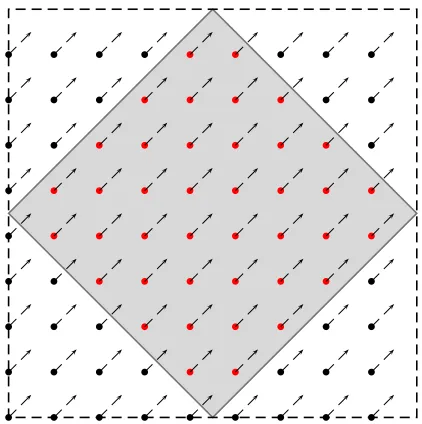
(0,0) (1,0) (0,1) (1,1)
(12, 1 2)
Figure 1: The lattice ˜D2with Voronoi cells
5
Improved error-recovery mechanism
In most of the literature, Ring-LWE encryption allows to encrypt one bit per coordinate of the ciphertext. It is also well known how to encrypt multiple bits per coordinate by using a larger modulus-to-error ratio (and therefore decreasing the security for a fixed dimensionn). How-ever, in the context of exchanging a symmetric key (of, say, 256 bits), we end up having a message space larger than necessary and thus want to encryptone bit in multi-ple coordinates.
In [83] Pöppelmann and Güneysu introduced a tech-nique to encode one bit into two coordinates, and verified experimentally that it led to a better error tolerance. This allows to either increase the error and therefore improve the security of the resulting scheme or to decrease the probability of decryption failures. In this section we pro-pose a generalization of this technique in dimension 4. We start with an intuitive description of the approach in 2 dimensions and then explain what changes in 4 dimen-sions. AppendicesCandDgive a thorough mathemati-cal description together with a rigorous analysis.
Let us first assume that both client and server have the same vectorx∈[0,1)2⊂
R2and want to map this vector
to a single bit. Mapping polynomial coefficients from
{0, . . . ,q−1}to[0,1)is easily accomplished through a division byq.
Now consider the lattice ˜D2with basis{(0,1),(12,12)}.
This lattice is a scaled version of the root lattice D2,
specifically, ˜D2=12·D2. Part of ˜D2is depicted in
Fig-ure1; lattice points are shown together with their Voronoi cells and the possible range of the vector x is marked with dashed lines. Mapping x to one bit is done by finding the closest-vector v∈D˜2. If v= (12,12) (i.e., xis in the grey Voronoi cell), then the output bit is 1; if v∈ {(0,0),(0,1),(1,0),(1,1)} (i.e., x is in a white Voronoi cell) then the output bit is 0.
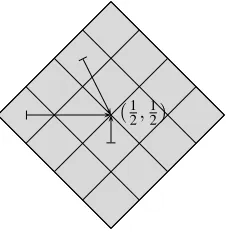
(1 2,
1 2)
Figure 2: Splitting of the Voronoi cell of(12,12)into 2rd=
16 sub-cells, some with their corresponding difference vector to the center
vectors are close, but they are not the same and can be on different sides of a Voronoi cell border.
Error reconciliation. The approach described above now allows for an efficient solution to solve this agreement-from-noisy-data problem. The idea is that one of the two participants (in our case the client) sends as areconciliation vectorthe difference of his vectorxc
and the center of its Voronoi cell (i.e., the point in the lattice). The server adds this difference vector toxsand
thus moves away from the border towards the center of the correct Voronoi cell. Note that an eavesdropper does not learn anything from the reconciliation information: the client tells the difference to a lattice point, but not whether this is a lattice point producing a zero bit or a one bit.
This approach would require sending a full additional vector; we can reduce the amount of reconciliation in-formation through r-bit discretization. The idea is to split each Voronoi cell into 2dr sub-cells and only send in which of those sub-cells the vectorxcis. Both
partici-pants then add the difference of the center of the sub-cell and the lattice point. This is illustrated for r=2 and d=2 in Figure2.
Blurring the edges.Figure1may suggest that the prob-ability ofxbeing in a white Voronoi cell is the same as forxbeing in the grey Voronoi cell. This would be the case ifxactually followed a continuous uniform distri-bution. However, the coefficients ofxare discrete values in{0,1q, . . . ,q−q1}and with the protocol described so far, the bits ofνwould have a small bias. The solution is to
add, with probability 12, the vector(21q,21q)toxbefore running the error reconciliation. This has close to no ef-fect for most values ofx, but, with probability 12 moves x to another Voronoi cell if it is very close to one side of a border. AppendixEgives a graphical intuition for this trick in two dimensions and withq=9. The proof that it indeed removes all biases in the key is given in
LemmaC.2.
From 2 to 4 dimensions. When moving from the 2-dimensional case considered above to the 4-2-dimensional case used in our protocol, not very much needs to change. The lattice ˜D2 becomes the lattice ˜D4 with basis B=
(u0,u1,u2,g), whereuiare the canonical basis vectors of Z4andgt= 12,
1 2,
1 2,
1 2
. The lattice ˜D4is a rotated and
scaled version of the root latticeD4. The Voronoi cells
of this lattice are no longer 2-dimensional “diamonds”, but 4-dimensional objects called icositetrachoron or 24-cells [65]. Determining in which cell a target point lies in is done using the closest vector algorithmCVPD˜4, and
a simplified version of it, which we callDecode, gives the result moduloZ4.
As in the 2-dimensional illustration in Figure2, we are using 2-bit discretization; we are thus sendingr·d=8 bits of reconciliation information per key bit.
Putting all of this together, we obtain the HelpRec function to compute ther-bit reconciliation information as
HelpRec(x;b) =CVPD˜4
2r
q(x+bg)
mod 2r,
whereb∈ {0,1}is a uniformly chosen random bit. The corresponding functionRec(x,r) =Decode(1qx− 1
2rBr) computes one key bit from a vectorxwith 4 coefficients inZq and a reconciliation vectorr∈ {0,1,2,3}4. The
algorithmsCVPD4˜ andDecodeare listed as Algorithm1
and Algorithm2, respectively.
Algorithm 1CVPD4˜ (x∈R4)
Ensure: An integer vector zsuch that Bzis a closest vector tox:x−Bz∈V
1: v0←bxe 2: v1←bx−ge
3: k←(kx−v0k1<1)? 0 : 1 4: (v0,v1,v2,v3)t←vk
5: return (v0,v1,v2,k)t+v3·(−1,−1,−1,2)t
Algorithm 2Decode(x∈R4/Z4)
Ensure: A bitksuch thatkgis a closest vector tox+Z4:
x−kg∈V +Z4
1: v=x− bxe
2: return 0 ifkvk1≤1 and 1 otherwise
6
Post-quantum security analysis
In [22] the authors chose Ring-LWE for a ring of rank n=1024, while most previous instantiations of the Ring-LWE encryption scheme, like the ones in [32,47,67,83], chose substantially smaller rankn=256 orn=512. It is argued that it is unclear if dimension 512 can offer post-quantum security. Yet, the concrete post-quantum security of LWE-based schemes has not been thoroughly studied, as far as we know. In this section we propose such a (very pessimistic) concrete analysis. In particu-lar, our analysis reminds us that the security depends as much onqand its ratio with the error standard deviation
ςas it does on the dimensionn. That means that our
ef-fort of optimizing the error recovery and its analysis not only improves efficiency but also offers superior security.
Security level over-shoot?With all our improvements, it would be possible to build a scheme with n =512 (andk=24,q=12289) and to obtain security some-what similar to the one of [22,47], and therefore further improve efficiency. We call this variant JARJARand de-tails are provided in AppendixA. Nevertheless, as his-tory showed us with RSA-512 [31], the standardization and deployment of a scheme awakens further cryptan-alytic effort. In particular, NEWHOPE could withstand a dimension-halving attack in the line of [41, Sec 8.8.1] based on the Gentry-Szydlo algorithm [45,64] or the sub-field approach of [2]. Note that so far, such attacks are only known for principal ideal lattices or NTRU lattices, and there are serious obstructions to extend them to Ring-LWE, but such precaution seems reasonable until lattice cryptanalysis stabilizes.
We provide the security and performance analysis of JARJAR in Appendix A mostly for comparison with other lower-security proposals. We strongly recommend NEWHOPEfor any immediate applications, and advise against using JARJAR until concrete cryptanalysis of lattice-based cryptography is better understood.
6.1
Methodology: the core SVP hardness
We analyze the hardness of Ring-LWE as an LWE prob-lem, since, so far, the best known attacks do not make use of the ring structure. There are many algorithms to con-sider in general (see the survey [3]), yet many of those are irrelevant for our parameter set. In particular, because there are onlym=nsamples available one may rule out BKW types of attacks [57] and linearization attacks [6]. This essentially leaves us with two BKZ [28,87] attacks, usually referred to as primal and dual attacks that we will briefly recall below.
The algorithm BKZ proceeds by reducing a lattice ba-sis using an SVP oracle in a smaller dimensionb. It is
known [52] that the number of calls to that oracle re-mains polynomial, yet concretely evaluating the number of calls is rather painful, and this is subject to new heuris-tic ideas [27,28]. We choose to ignore this polynomial factor, and rather evaluate only thecore SVP hardness, that is the cost ofone callto an SVP oracle in dimension b, which is clearly a pessimistic estimation (from the de-fender’s point of view).
6.2
Enumeration versus quantum sieve
Typical implementations [25,28,40] use an enumeration algorithm as this SVP oracle, yet this algorithm runs in super-exponential time. On the other hand, the sieve al-gorithms are known to run in exponential time, but are so far slower in practice for accessible dimensionsb≈130. We choose the latter to predict the core hardness and will argue that for the targeted dimension, enumerations are expected to be greatly slower than sieving.
Quantum sieve.A lot of recent work has pushed the ef-ficiency of the original lattice sieve algorithms [73,79], improving the heuristic complexity from (4/3)b+o(b)≈
20.415b down to p3/2b+o(b) ≈20.292b (see [12,59]). The hidden sub-exponential factor is known to be much greater than one in practice, so again, estimating the cost ignoring this factor leaves us with a significant pes-simistic margin.
Most of those algorithms have been shown [58,60] to benefit from Grover’s quantum search algorithm, bring-ing the complexity down to 20.265b. It is unclear if fur-ther improvements are to be expected, yet, because all those algorithms require classically building lists of size
p
4/3b+o(b)≈20.2075b, it is very plausible that the best quantum SVP algorithm would run in time greater than 20.2075b.
Irrelevance of enumeration for our analysis.In [28], predictions of the cost of solving SVP classically us-ing the most sophisticated heuristic enumeration algo-rithms are given. For example, solving SVP in dimension 100 requires visiting about 239 nodes, and 2134 nodes in dimension 250. Because this enumeration is a back-tracking algorithm, it does benefit from the recent quasi-quadratic speedup [74], decreasing the quantum cost to about at least 220to 267 operations as the dimension in-creases from 100 to 250.
On the other hand, our best-known attack bound 20.265bgives a cost of 266in dimension 250, and the best plausible attack bound 20.2075b≈239. Because enumera-tion is super-exponential (both in theory and practice), its cost will be worse than our bounds in dimension larger than 250 and we may safely ignore this kind of algo-rithm.7
6.3
Primal attack
The primal attack consists of constructing a unique-SVP instance from the LWE problem and solving it using BKZ. We examine how large the block dimension b is required to be for BKZ to find the unique solution. Given the matrix LWE instance(A,b=As+e)one builds the latticeΛ={x∈Zm+n+1:(A| −Im| −b)x=0modq}of
dimensiond=m+n+1, volumeqm, and with a unique-SVP solutionv= (s,e,1)of normλ ≈ς
√
n+m. Note that the number of used samplesmmay be chosen be-tween 0 and 2nin our case and we numerically optimize this choice.
Success condition.We model the behavior of BKZ us-ing the geometric series assumption (which is known to be optimistic from the attacker’s point of view), that finds a basis whose Gram-Schmidt norms are given by kb?ik =δd−2i−1·Vol(Λ)1/d where δ = ((πb)1/b·
b/2πe)1/2(b−1) [3,27]. The unique short vectorv will
be detected if the projection ofvonto the vector space spanned by the last b Gram-Schmidt vectors is shorter thanb?d−b. Its projected norm is expected to be ς
√
b, that is the attack is successful if and only if
ς √
b≤δ2b−d−1·qm/d. (1)
6.4
Dual attack
The dual attack consists of finding a short vector in the dual latticew∈Λ0={(x,y)∈Zm×Zn:Atx=ymodq}.
Assume we have found a vector(x,y)of length ` and computez=vt·b=vtAs+vte=wts+vtemodqwhich
is distributed as a Gaussian of standard deviation `ς if (A,b)is indeed an LWE sample (otherwise it is uniform mod q). Those two distributions have maximal vari-ation distance bounded by8 ε=4 exp(−2π2τ2) where τ=`ς/q, that is, given such a vector of length` one
has an advantageεagainst decision-LWE.
The length`of a vector given by the BKZ algorithm is given by`=kb0k. Knowing thatΛ0has dimensiond= m+nand volumeqnwe get`=δd−1qn/d. Therefore,
obtaining anε-distinguisher requires running BKZ with
block dimensionbwhere
−2π2τ2≥ln(ε/4). (2)
Note that small advantagesε are not relevant since the agreed key is hashed: an attacker needs an advantage of at least 1/2 to significantly decrease the search space of the agreed key. He must therefore amplify his success
athttp://www.di.ens.fr/~ychen/research/Full_BKZ.pdf.
8A preliminary version of this paper contained a bogus formula for
εleading to under-estimating the cost of the dual attack. Correcting this formula leads to better security claim, and almost similar cost for the primal and dual attacks.
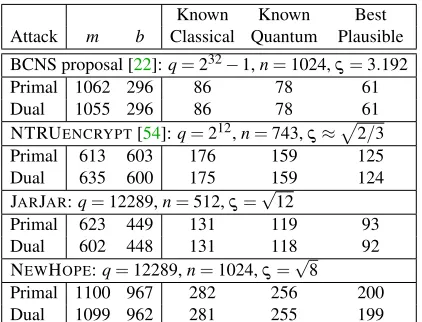
Known Known Best Attack m b Classical Quantum Plausible
BCNS proposal [22]:q=232−1,n=1024,
ς=3.192
Primal 1062 296 86 78 61 Dual 1055 296 86 78 61 NTRUENCRYPT[54]:q=212,n=743,ς≈p2/3 Primal 613 603 176 159 125 Dual 635 600 175 159 124 JARJAR:q=12289,n=512,ς=
√
12
Primal 623 449 131 119 93 Dual 602 448 131 118 92 NEWHOPE:q=12289,n=1024,ς=
√
8 Primal 1100 967 282 256 200 Dual 1099 962 281 255 199
Table 1: Core hardness of NEWHOPEand JARJARand se-lected other proposals from the literature. The valuebdenotes the block dimension of BKZ, andmthe number of used sam-ples. Cost is given in log2and is the smallest cost for all pos-sible choices ofmandb. Note that our estimation is very op-timistic about the abilities of the attacker so that our result for the parameter set from [22]does notindicate that it can be bro-ken with≈280bit operations, given today’s state-of-the-art in cryptanalysis.
probability by building about 1/ε2many such short
vec-tors. Because the sieve algorithms provide 20.2075b
vec-tors, the attack must be repeated at leastRtimes where
R=max(1,1/(20.2075bε2)).
This makes the conservative assumption that all the vec-tors provided by the Sieve algorithm are as short as the shortest one.
6.5
Security claims
According to our analysis, we claim that our proposed parameters offer at least (and quite likely with a large margin) a post-quantum security of 128 bits. The cost of the primal attack and dual attacks (estimated by our scriptscripts/PQsecurity.py) are given in Table1. For comparison we also give a lower bound on the secu-rity of [22] and do notice a significantly improved se-curity in our proposal. Yet, because of the numerous pessimistic assumption made in our analysis, we do not claim any quantum attacks reaching those bounds.
Most other RLWE proposals achieve considerably lower security than NEWHOPE; for example, the highest-security parameter set used for RLWE encryption in [47] is very similar to the parameters of JARJAR. The situ-ation is different for NTRUENCRYPT, which has been instantiated with parameters that achieve about 128 bits of security according to our analysis9.
homoge-Specifically, we refer to NTRUENCRYPT with n=
743 as suggested in [54]. A possible advantage of NTRUENCRYPT compared to NEWHOPE is somewhat smaller message sizes, however, this advantage becomes very small when scaling parameters to achieve a sim-ilar security margin as NEWHOPE. The large
down-side of using NTRUENCRYPT for ephemeral key ex-change is the cost for key generation. The implemen-tation of NTRUENCRYPTwithn=743 in eBACS [19] takes about an order of magnitude longer for key gener-ation alone than NEWHOPEtakes in total. Also, unlike our NEWHOPEsoftware, this NTRUENCRYPTsoftware is not protected against timing attacks; adding such pro-tection would presumably incur a significant overhead.
7
Implementation
In this section we provide details on the encodings of messages and describe our portable reference implemen-tation written in C, as well as an optimized implementa-tion targeting architectures with AVX vector instrucimplementa-tions.
7.1
Encodings and generation of a
The key-exchange protocol described in Protocol1and also our protocol as described in Protocol 2 exchange messages that contain mathematical objects (in particu-lar, polynomials inRq).Implementationsof these proto-cols need to exchange messages in terms of byte arrays. As we will describe in the following, the choice of en-codings of polynomials to byte arrays has a serious im-pact on performance. We use an encoding of messages that is particularly well-suited for implementations that make use of quasi-linear NTT-based polynomial multi-plication.
Definition of NTT and NTT−1. The NTT is a tool commonly used in implementations of ideal lattice-based cryptography [32,47,67,83]. For some background on the NTT and the description of fast software im-plementations we refer to [51,72]. In general, fast quasi-logarithmic algorithms exist for the computation of the NTT and a polynomial multiplication can be per-formed by computing c=NTT−1(NTT(a)◦NTT(b))
fora,b,c∈R. An NTT targeting ideal lattices defined inRq=Zq[X]/(Xn+1)can be implemented very
effi-ciently ifnis a power of two andqis a prime for which it holds that q≡1 mod 2n. This way a primitiven-th root of unityωand its square rootγ exist. By multiply-ing coefficient-wise by powers ofγ=√ω modqbefore
neous Ring-LWE instance. We do not take into account the combinato-rial vulnerabilities [56] induced by the fact that secrets are ternary. We note that NTRU is a potentially a weaker problem than Ring-LWE: it is in principle subject to a subfield-lattice attack [2], but the parameters proposed for NTRUENCRYPTare immune.
the NTT computation and after the reverse transforma-tion by powers ofγ−1, no zero padding is required and ann-point NTT can be used to transform a polynomial withncoefficients.
For a polynomialg=∑1023i=0 giXi∈Rqwe define
NTT(g) =gˆ=
1023
∑
i=0ˆ
giXi, with
ˆ gi=
1023
∑
j=0γjgjωi j,
where we fix then-th primitive root of unity toω =49
and thusγ= √
ω=7. Note that in our implementation
we use an in-place NTT algorithm which requires bit-reversal operations. As an optimization, our implemen-tations skips these bit-reversals for the forward transfor-mation as all inputs are only random noise. This opti-mization is transparent to the protocol and for simplicity omitted in the description here.
The function NTT−1 is the inverse of the function
NTT. The computation of NTT−1 is essentially the same as the computation ofNTT, except that it usesω−1
modq=1254, multiplies by powers ofγ−1 modq=
8778 after the summation, and also multiplies each coef-ficient by the scalarn−1 modq=12277 so that
NTT−1(gˆ) =g=
1023
∑
i=0giXi, with
gi=n−1γ−i
1023
∑
j=0ˆ gjω−i j.
The inputs toNTT−1 arenotjust random noise, so in-sideNTT−1 our software has to perform the initial bit reversal, makingNTT−1slightly more costly thanNTT.
Definition ofParse.The public parameterais generated from a 256-bit seed through the extendable-output
func-tionSHAKE-128[76, Sec. 6.2]. The output of
SHAKE-128is considered as an array of 16-bit, unsigned, little-endian integers. Each of those integers is used as a coef-ficient ofaif it is smaller than 5qand rejected otherwise. The first such 16-bit integer is used as the coefficient of X0, the next one as coefficient ofX1and so on. Earlier
versions of this paper described a slightly different way of rejection sampling for coefficients ofa. The more ef-ficient approach adopted in this final version was sug-gested independently by Gueron and Schlieker in [50] and by Yawning Angel in [5]. However, note that a re-duction moduloq of the coefficients of a as described in [50] and [5] is not necessary; both our implementa-tions can handle coefficients ofain{0, . . . ,5q−1}.
what is required isn=1024 coefficients that are smaller than 5q. The minimal amount of output is thus 2 KB; the average amount is≈2184.5 bytes. The resulting poly-nomiala(denoted as ˆa) is considered to be inNTT do-main. This is possible because theNTTtransforms uni-form noise to uniuni-form noise.
Using a variable amount of output fromSHAKE-128 leaks information about a through timing information. This is not a problem for most applications, since a is public. As pointed out by Burdges in [24], such a tim-ing leak of public information can be a problem when deploying NEWHOPE in anonymity networks like Tor. AppendixFdescribes an alternative approach forParse, which is slightly more complex and slightly slower, but does not leak any timing information abouta.
The message format of(b,seed)and (u,r). With the definition of the NTT, we can now define the format of the exchanged messages. In both(b,seed)and(u,r)
the polynomial is transmitted in theNTTdomain (as in works like [83,86]). Polynomials are encoded as an array of 1792 bytes, in a compressed little-endian format. The encoding of seed is straight-forward as an array of 32 bytes, which is simply concatenated with the encoding of b. Also the encoding ofris fairly straight-forward: it packs four 2-bit coefficients into one byte for a to-tal of 256 bytes, which are again simply concatenated with the encoding ofu. We denote these encodings to byte arrays asencodeAandencodeBand their inverses asdecodeAanddecodeB. For a description of our key-exchange protocol including encodings and with explicit NTTandNTT−1transformations, see Protocol3.
7.2
Portable C implementation
This paper is accompanied by a C reference implemen-tation described in this section and an optimized imple-mentation for Intel and AMD CPUs described in the next section. The main emphasis in the C reference imple-mentation is on simplicity and portability. It does not use any floating-point arithmetic and outside the Kec-cak (SHA3-256andSHAKE-128) implementation only needs 16-bit and 32-bit integer arithmetic. In particular, the error-recovery mechanism described in Section5 is implemented with fixed-point (i.e., integer-) arithmetic. Furthermore, the C reference implementation does not make use of the division operator (/) and the modulo op-erator (%). The focus on simplicity and portability does not mean that the implementation is not optimized at all. On the contrary, we use it to illustrate various optimiza-tion techniques that are helpful to speed up the key ex-change and are also of independent interest for imple-menters of other ideal-lattice-based schemes.
NTT optimizations. All polynomial coefficients are
represented as unsigned 16-bit integers. Our in-place NTT implementation transforms from bit-reversed to natural order using Gentleman-Sande butterfly oper-ations [29,42]. One would usually expect that each NTT is preceded by a bit-reversal, but all inputs to NTTare noise polynomials that we can simply consider as being already bit-reversed; as explained earlier, the NTT−1operation still involves a bit-reversal. The core of theNTTandNTT−1operation consists of 10 layers of transformations, each consisting of 512 butterfly operations of the form described in Listing2.
Montgomery arithmetic and lazy reductions.The per-formance of operations on polynomials is largely deter-mined by the performance of NTT and NTT−1. The main computational bottleneck of those operations are 5120 butterfly operations, each consisting of one addi-tion, one subtraction and one multiplication by a precom-puted constant. Those operations are inZq; recall thatq
is a 14-bit prime. To speed up the modular-arithmetic operations, we store all precomputed constants in Mont-gomery representation [75] with R=218, i.e., instead of storing ωi, we store 218ωi (modq). After a
multi-plication of a coefficientgby some constant 218ωi, we can then reduce the resultrtogωi (modq)with the fast Montgomery reduction approach. In fact, we do not al-ways fully reduce moduloq, it is sufficient if the result of the reduction has at most 14 bits. The fast Montgomery reduction routine given in Listing1acomputes such a re-duction to a 14-bit integer for any unsigned 32-bit integer in{0, . . . ,232−q(R−1)−1}. Note that the specific
im-plementation does not work for any 32-bit integer; for example, for the input 232−q(R−1) =1073491969 the additiona=a+ucauses an overflow and the function re-turns 0 instead of the correct result 4095. In the following we establish that this is not a problem for our software.
Aside from reductions after multiplication, we also need modular reductions after addition. For this task we use the “short Barrett reduction” [10] detailed in List-ing1b. Again, this routine does not fully reduce modulo q, but reduces any 16-bit unsigned integer to an integer of at most 14 bits which is congruent moduloq.
Parameters:q=12289<214,n=1024 Error distribution:ψ16n
Alice (server) Bob (client)
seed← {$ 0, . . . ,255}32
ˆ
a←Parse(SHAKE-128(seed))
s,e←$ ψ16n s0,e0,e00←$ ψ16n
ˆ
s←NTT(s)
ˆ
b←aˆ◦ˆs+NTT(e) −−−−−−−−−−−−→ma=encodeA(seed,bˆ)
1824 Bytes (
ˆ
b,seed)←decodeA(ma)
ˆ
a←Parse(SHAKE-128(seed))
ˆ
t←NTT(s0)
ˆ
u←aˆ◦ˆt+NTT(e0)
v←NTT−1(bˆ◦ˆt) +e00
(uˆ,r)←decodeB(mb)
mb=encodeB(uˆ,r)
←−−−−−−−−−−
2048 Bytes r
$
←HelpRec(v)
v0←NTT−1(uˆ◦sˆ) ν←Rec(v,r)
ν←Rec(v0,r) µ←SHA3-256(ν)
µ←SHA3-256(ν)
Protocol 3: Our proposed protocol includingNTT andNTT−1computations and sizes of exchanged messages; ◦
denotes pointwise multiplication; elements inNTTdomain are denoted with a hat (ˆ)
obtained if t is 215−1 and a[j+d] is zero; we thus obtain 215+3·q = 69634. All precomputed constants are in {0, . . . ,q −1}, so the expression
(W * ((uint32_t)t + 3*12289 - a[j+d]), the in-put to the Montgomery reduction, is at most 69634·(q−
1) =855662592 and thus safely below the maximum in-put that the Montgomery reduction can handle.
Listing 1Reduction routines used in the reference im-plementation.
(a)Montgomery reduction (R=218). uint16_t mred(uint32_t a) {
uint32_t u; u = (a * 12287); u &= ((1 << 18) - 1); a += u * 12289; return a >> 18; }
(b)Short Barrett reduction.
uint16_t bred(uint16_t a) { uint32_t u;
u = ((uint32_t) a * 5) >> 16; a -= u * 12289;
return a; }
Fast random sampling.As a first step before perform-ing any operations on polynomials, both Alice and Bob need to expand the seed to the polynomial a using SHAKE-128. The implementation we use is based on the “simple” implementation by Van Keer for the Kec-cak permutation and slightly modified code taken from
Listing 2The Gentleman-Sande butterfly inside odd lev-els of our NTT computation. Alla[j]andWare of type
uint16_t.
W = omega[jTwiddle++]; t = a[j];
a[j] = bred(t + a[j+d]);
a[j+d] = mred(W * ((uint32_t)t + 3*12289 - a[j+d]));
the “TweetFIPS202” implementation [20] for everything else.
The sampling of centered binomial noise polynomi-als is based on a fast PRG with a random seed from
/dev/urandomfollowed by a quick summation of 16-bit chunks of the PRG output. Note that the choice of the PRG is a purely local choice that every user can pick independently based on the target hardware archi-tecture and based on routines that are available anyway (for example, for symmetric encryption following the key exchange). Our C reference implementation uses ChaCha20 [14], which is fast, trivially protected against timing attacks, and is already in use by many TLS clients and servers [61,62].
7.3
Optimized AVX2 implementation
of the “Haswell” generation of CPUs, this support was extended also to 256-bit vectors of integers of various sizes (AVX2). It is not surprising that the enormous com-putational power of these vector instructions has been used before to implement very high-speed crypto (see, for example, [16,18,48]) and also our optimized refer-ence implementation targeting Intel Haswell processors uses those instructions to speed up multiple components of the key exchange.
NTT optimizations.The AVX instruction set has been used before to speed up the computation of lattice-based cryptography, and in particular the number-theoretic transform. Most notably, Güneysu, Oder, Pöppelmann and Schwabe achieve a performance of only 4 480 cycles for a dimension-512 NTT on Intel Sandy Bridge [51]. For arithmetic modulo a 23-bit prime, they represent co-efficients as double-precision integers.
We experimented with multiple different approaches to speed up the NTT in AVX. For example, we vector-ized the Montgomery arithmetic approach of our C ref-erence implementation and also adapted it to a 32-bit-signed-integer approach. In the end it turned out that floating-point arithmetic beats all of those more sophisti-cated approaches, so we are now using an approach that is very similar to the approach in [51]. One computation of a dimension-1024 NTT takes 8 448 cycles, unlike the numbers in [51] this does include multiplication by the powers ofγand unlike the numbers in [51], this excludes
a bit-reversal.
Fast sampling. Intel Haswell processors support the AES-NI instruction set and for the local choice of noise sampling it is obvious to use those. More specifically, we use the public-domain implementation of AES-256 in counter mode written by Dolbeau, which is included in the SUPERCOP benchmarking framework [19]. Trans-formation from uniform noise to the centered binomial is optimized in AVX2 vector instructions operating on vectors of bytes and 16-bit integers.
For the computation of SHAKE-128 we use the same code as in the C reference implementation. One might expect that architecture-specific optimizations (for exam-ple, using AVX instructions) are able to offer significant speedups, but the benchmarks of the eBACS project [19] indicate that on Intel Haswell, the fastest implementation is the “simple” implementation by Van Keer that our C reference implementation is based on. The reasons that vector instructions are not very helpful for speeding up SHAKE (or, more generally, Keccak) are the inherently sequential nature and the 5×5 dimension of the state matrix that makes internal vectorization hard.
Error recovery. The 32-bit integer arithmetic used by the C reference implementation for HelpRec and Rec is trivially 8-way parallelized with AVX2 instructions.
With this vectorization, the cost forHelpRecis only 3 404 cycles, the cost forRecis only 2 804 cycles.
8
Benchmarks and comparison
In the following we present benchmark results of our software. All benchmark results reported in Table2were obtained on an Intel Core i7-4770K (Haswell) running at 3491.953 MHz with Turbo Boost and Hyperthreading disabled. We compiled our C reference implementation with gcc-4.9.2 and flags-O3 -fomit-frame-pointer -march=corei7-avx -msse2avx. We compiled our optimized AVX implementation with clang-3.5 and flags
-O3 -fomit-frame-pointer -march=native. As described in Section 7, the sampling of a is not running in constant time; we report the median run-ning time and (in parentheses) the average runrun-ning time for this generation, the server-side key-pair generation and client-side shared-key computation; both over 1000 runs. For all other routines we report the median of 1000 runs. We built the software from [22] on the same machine as ours and—like the authors of [22]— usedopenssl speedfor benchmarking their software and converted the reported results to approximate cycle counts as given in Table2.
Comparison with BCNS and RSA/ECDH.As previ-ously mentioned, the BCNS implementation [22] also uses the dimension n=1024 but the larger modulus q=232−1 and the Gaussian error distribution with
Gaussian parameterσ=8/ √
2π=3.192. When the
au-thors of BCNS integrated their implementation into SSL it only incurred a slowdown by a factor of 1.27 compared to ECDH when using ECDSA signatures and a factor of 1.08 when using RSA signatures with respect to the num-ber of connections that could be handled by the server. As a reference, the reported cycle counts in [22] for a
Table 2: Intel Haswell cycle counts of our proposal as compared to the BCNS proposal from [22].
BCNS[22] Ours (C ref) Ours (AVX2)
Generation ofa 43 440a 37 470a
(43 607)a (36 863)a
NTT 55 360 8 448
NTT−1 59 864b 9 464b
Sampling of a noise polynomial 32 684c 5 900c
HelpRec 14 608 3 404
Rec 10 092 2 804
Key generation (server) ≈2 477 958 258 246 88 920 (258 965) (89 079) Key gen+shared key (client) ≈3 995 977 384 994 110 986 (385 146) (111 169)
Shared key (server) ≈481 937 86 280 19 422
aIncludes reading a seed from/dev/urandom bIncludes one bit reversal
cExcludes reading a seed from/dev/urandom, which is shared across multiple calls to the noise generation
7748 [63].
In comparison to the BCNS proposal we see a large performance advantage from switching to the binomial error distribution. The BCNS software uses a large pre-computed table to sample from a discrete Gaussian dis-tribution with a high precision. This approach takes 1 042 700 cycles to samples one polynomial in constant time. Our C implementation requires only 32 684 cy-cles to sample from the binomial distribution. Another factor is that we use the NTT in combination with a smaller modulus. Polynomial multiplication in [22] is using Nussbaumer’s symbolic approach based on re-cursive negacyclic convolutions [80]. The implemen-tation in [22] only achieves a performance of 342 800 cycles for a constant-time multiplication. Additionally, the authors of [22] did not perform pre-transformation of constants (e.g., a) or transmission of coefficients in FFT/Nussbaumer representation.
Follow-Up Work.We would like to refer the reader to follow-up work in which improvements to NEWHOPE
and its implementation were proposed based on a preprint version of this work [4]. In [50] Gueron and Schlieker introduce faster pseudorandom bytes gener-ation by changing the underlying functions, a method to decrease the rejection rate during sampling (see Sec-tion7.1), and a vectorization of the sampling step. Longa and Naehrig [68] optimize the NTT and present new modular reduction techniques and are able to achieve a speedup of factor-1.90 for the C implementation and a factor-1.25 for the AVX implementation compared to the preprint [4] (note that this version has updated numbers). An alternative NTRU-based proposal and
implementa-tion of a lattice-based public-key encrypimplementa-tion scheme, which could also be used for key exchange, is given by Bernstein, Chuengsatiansup, Lange, and van Vredendaal in [17], but we leave a detailed comparison to future work. An efficient authenticated lattice-based key ex-change scheme has recently been proposed by del Pino, Lyubashevsky, and Pointcheval in [33].
References
[1] ADRIAN, D., BHARGAVAN, K., DURUMERIC, Z., GAUDRY, P., GREEN, M., HALDERMAN, J. A., HENINGER, N., SPRINGALL, D., THOMÉ, E., VALENTA, L., VANDERSLOOT, B., WUSTROW, E., BÉGUELIN, S. Z.,ANDZIMMERMANN, P. Imperfect forward secrecy: How Diffie-Hellman fails in practice. InCCS ’15 Proceedings of the 22nd ACM SIGSAC Conference on Computer and Communications Security(2015), ACM, pp. 5–17.
https://weakdh.org/.4,5
[2] ALBRECHT, M., BAI, S.,ANDDUCAS, L. A subfield lattice attack on overstretched NTRU assumptions. IACR Cryptology ePrint Archive report 2016/127, 2016.http://eprint.iacr. org/2016/127.8,10
[3] ALBRECHT, M. R., PLAYER, R.,ANDSCOTT, S. On the con-crete hardness of learning with errors. IACR Cryptology ePrint Archive report 2015/046, 2015. http://eprint.iacr.org/ 2015/046/.8,9
[4] ALKIM, E., DUCAS, L., PÖPPELMANN, T., ANDSCHWABE, P. Post-quantum key exchange – a new hope. IACR Cryptol-ogy ePrint Archive report 2015/1092, 2015.https://eprint. iacr.org/2015/1092/20160329:201913.14
[5] ANGEL, Y. Post-quantum secure hybrid handshake based on NewHope. Posting to the tor-dev mailing list, 2016.
[6] ARORA, S., AND GE, R. New algorithms for learning in presence of errors. InAutomata, Languages and Programming
(2011), L. Aceto, M. Henzingeri, and J. Sgall, Eds., vol. 6755 of
LNCS, Springer, pp. 403–415. https://www.cs.duke.edu/ ~rongge/LPSN.pdf.8,18
[7] BABAI, L. On Lovász’ lattice reduction and the nearest lattice point problem. Combinatorica 6, 1 (1986), 1–13.
http://www.csie.nuk.edu.tw/~cychen/Lattices/ On%20lovasz%20lattice%20reduction%20and%20the% 20nearest%20lattice%20point%20problem.pdf.5
[8] BAI, S., ANDGALBRAITH, S. D. An improved compression technique for signatures based on learning with errors. InTopics in Cryptology – CT-RSA 2014(2014), J. Benaloh, Ed., vol. 8366 ofLNCS, Springer, pp. 28–47. https://eprint.iacr.org/ 2013/838/.1
[9] BAI, S., LANGLOIS, A., LEPOINT, T., STEHLÉ, D.,ANDSTE
-INFELD, R. Improved security proofs in lattice-based cryp-tography: using the Rényi divergence rather than the statisti-cal distance. InAdvances in Cryptology – ASIACRYPT 2015
(2015), T. Iwata and J. H. Cheon, Eds., LNCS, Springer. http: //eprint.iacr.org/2015/483/.18
[10] BARRETT, P. Implementing the Rivest Shamir and Adleman pub-lic key encryption algorithm on a standard digital signal proces-sor. InAdvances in Cryptology – CRYPTO ’86(1987), A. M. Odlyzko, Ed., vol. 263 ofLecture Notes in Computer Science, Springer-Verlag Berlin Heidelberg, pp. 311–323.11
[11] BATCHER, K. E. Sorting networks and their applications. In AFIPS conference proceedings, volume 32: 1968 Spring Joint Computer Conference(1968), Thompson Book Company, pp. 307–314. http://www.cs.kent.edu/~batcher/conf. html.22
[12] BECKER, A., DUCAS, L., GAMA, N.,ANDLAARHOVEN, T. New directions in nearest neighbor searching with applications to lattice sieving. InSODA ’16 Proceedings of the twenty-seventh annual ACM-SIAM symposium on Discrete Algorithms(2016 (to appear)), SIAM.8
[13] BERNSTEIN, D. J. Curve25519: new Diffie-Hellman speed records. In Public Key Cryptography – PKC 2006 (2006), M. Yung, Y. Dodis, A. Kiayias, and T. Malkin, Eds., vol. 3958 ofLNCS, Springer, pp. 207–228.http://cr.yp.to/papers. html#curve25519.13
[14] BERNSTEIN, D. J. ChaCha, a variant of Salsa20. InWorkshop Record of SASC 2008: The State of the Art of Stream Ciphers
(2008).http://cr.yp.to/papers.html#chacha.12
[15] BERNSTEIN, D. J., CHOU, T., CHUENGSATIANSUP, C., HÜLS
-ING, A., LANGE, T., NIEDERHAGEN, R.,AND VANVREDEN
-DAAL, C. How to manipulate curve standards: a white paper for the black hat. IACR Cryptology ePrint Archive report 2014/571, 2014.http://eprint.iacr.org/2014/571/.4,5
[16] BERNSTEIN, D. J., CHUENGSATIANSUP, C., LANGE, T.,AND
SCHWABE, P. Kummer strikes back: new DH speed records. In
Advances in Cryptology – EUROCRYPT 2015(2014), T. Iwata and P. Sarkar, Eds., vol. 8873 ofLNCS, Springer, pp. 317–337. full version:http://cryptojedi.org/papers/#kummer.13
[17] BERNSTEIN, D. J., CHUENGSATIANSUP, C., LANGE, T.,AND VANVREDENDAAL, C. NTRU Prime. IACR Cryptology ePrint Archive report 2016/461, 2016. https://eprint.iacr.org/ 2016/461.14
[18] BERNSTEIN, D. J., HOPWOOD, D., HÜLSING, A., LANGE, T., NIEDERHAGEN, R., PAPACHRISTODOULOU, L., SCHNEIDER, M., SCHWABE, P., ANDWILCOX-O’HEARN, Z. SPHINCS: practical stateless hash-based signatures. InAdvances in Cryp-tology – EUROCRYPT 2015 (2015), E. Oswald and M. Fis-chlin, Eds., vol. 9056 ofLNCS, Springer, pp. 368–397. https: //cryptojedi.org/papers/#sphincs.3,13
[19] BERNSTEIN, D. J.,ANDLANGE, T. eBACS: ECRYPT bench-marking of cryptographic systems. http://bench.cr.yp.to
(accessed 2015-10-07).10,13
[20] BERNSTEIN, D. J., SCHWABE, P., AND ASSCHE, G. V. Tweetable FIPS 202, 2015. http://keccak).noekeon.org/ tweetfips202.html(accessed 2016-03-21).12
[21] BERTONI, G., DAEMEN, J., PEETERS, M., AND ASSCHE, G. V. Keccak. InAdvances in Cryptology – EUROCRYPT 2013
(2013), T. Johansson and P. Q. Nguyen, Eds., vol. 7881 ofLNCS, Springer, pp. 313–314.5
[22] BOS, J. W., COSTELLO, C., NAEHRIG, M.,ANDSTEBILA, D. Post-quantum key exchange for the TLS protocol from the ring learning with errors problem. In2015 IEEE Symposium on Secu-rity and Privacy(2015), pp. 553–570.http://eprint.iacr. org/2014/599.1,2,3,4,6,8,9,13,14
[23] BRAKERSKI, Z., LANGLOIS, A., PEIKERT, C., REGEV, O.,
ANDSTEHLÉ, D. Classical hardness of learning with errors. In
Proceedings of the forty-fifth annual ACM symposium on Theory of computing(2013), ACM, pp. 575–584.http://arxiv.org/ pdf/1306.0281.6
[24] BURDGES, J. Post-quantum secure hybrid handshake based on NewHope. Posting to the tor-dev mailing list, 2016. https://lists.torproject.org/pipermail/ tor-dev/2016-May/010886.html.11
[25] CADÉ, D., PUJOL, X., AND STEHLÉ, D. fplll 4.0.4, 2013.
https://github.com/dstehle/fplll (accessed 2015-10-13).8
[26] CHECKOWAY, S., FREDRIKSON, M., NIEDERHAGEN, R., EV
-ERSPAUGH, A., GREEN, M., LANGE, T., RISTENPART, T., BERNSTEIN, D. J., MASKIEWICZ, J.,ANDSHACHAM, H. On the practical exploitability of Dual EC in TLS implementations. InProceedings of the 23rd USENIX security symposium(2014).
https://projectbullrun.org/dual-ec/index.html.4
[27] CHEN, Y.Lattice reduction and concrete security of fully homo-morphic encryption. PhD thesis, l’Université Paris Diderot, 2013.
http://www.di.ens.fr/~ychen/research/these.pdf. 8,
9
[28] CHEN, Y., AND NGUYEN, P. Q. BKZ 2.0: Better lattice security estimates. InAdvances in Cryptology – ASIACRYPT 2011, D. H. Lee and X. Wang, Eds., vol. 7073 of LNCS. Springer, 2011, pp. 1–20. http://www.iacr.org/archive/ asiacrypt2011/70730001/70730001.pdf.8
[29] CHU, E.,ANDGEORGE, A.Inside the FFT Black Box Serial and Parallel Fast Fourier Transform Algorithms. CRC Press, Boca Raton, FL, USA, 2000.11
[30] CONWAY, J.,ANDSLOANE, N. J. A. Sphere packings, lattices and groups, 3rd ed., vol. 290 ofGrundlehren der mathematischen Wissenschaften. Springer Science & Business Media, 1999.19
[31] COWIE, J., DODSON, B., ELKENBRACHT-HUIZING, R. M., LENSTRA, A. K., MONTGOMERY, P. L.,ANDZAYER, J. A world wide number field sieve factoring record: on to 512 bits. InAdvances in Cryptology – ASIACRYPT’96(1996), K. Kim and T. Matsumoto, Eds., vol. 1163 ofLNCS, Springer, pp. 382–394.
http://oai.cwi.nl/oai/asset/1940/1940A.pdf.8
[32] DECLERCQ, R., ROY, S. S., VERCAUTEREN, F.,ANDVER
-BAUWHEDE, I. Efficient software implementation of ring-LWE encryption. InDesign, Automation & Test in Europe Conference & Exhibition, DATE 2015(2015), EDA Consortium, pp. 339– 344.http://eprint.iacr.org/2014/725.2,4,6,8,10
[33] DELPINO, R., LYUBASHEVSKY, V.,ANDPOINTCHEVAL, D. The whole is less than the sum of its parts: Constructing more ef-ficient lattice-based AKEs. IACR Cryptology ePrint Archive re-port 2016/435, 2016.https://eprint.iacr.org/2016/435.

![Table 2: Intel Haswell cycle counts of our proposal as compared to the BCNS proposal from [22].](https://thumb-us.123doks.com/thumbv2/123dok_us/7920876.1315226/14.612.147.463.93.273/table-intel-haswell-cycle-counts-proposal-compared-proposal.webp)