An improved AODV routing protocol based on energy
optimization
Zhong Shuai Jiao*, Yanfang Guo*
*Chongqing Key Lab of Mobile Communications Technology, Chongqing University of Posts and Telecommunications, Chongqing 400065, P. R. China
E-mai: [email protected],
Abstract
To solve the problem of network partition which results from the limited energy of nodes and excessive consumption in present Ad Hoc network, the thesis puts forward an improved AODV routing protocol based on energy optimization. The energy optimization of nodes is always taken as the metric standard during the routing process, so that nodes can quickly and efficiently complete the path selection to ensure the reliability of data transmission. The specific method is demonstrated as follows: energy information of nodes and hops of route are considered in the selection of path, and during the process of route establishment, intermediate nodes forward route request in according to delay function which associated with their own energy, thus nodes that have high energy have greater probability to participate in routing request, as much as possible to reduce the participation of low energy nodes; and the destination node has a delay record and waits for the arrival of all request packets, and then selects the best route according to evaluation function. Simulation results show that the improved scheme can balance the energy consumption of the network, and has great advantages in terms of packet delivery ratio and throughput, and prolongs the lifetime of network.
Keywords: Ad Hoc network, energy optimization, delay calculation, AODV routing protocol
1. Introduction
At present, the nodes in ad hoc networks almost rely on power to maintain the operation provided by relatively portable mobile devices, fully use the energy as much as possible and then increase the network lifetime which has become a key issue. If using the energy classification strategy it can effectively improve the energy efficiency of the whole network, and maintain a longer network lifetime. Overall: from the view of entire network, making the path of the total energy consumption at least, in terms of the single node, selecting the nodes with more remaining energy to participate in forwarding.
Traditional the minimum hop routing algorithm[1-3] for the principles mainly from the point of view overall energy consumption to choose the least energy consumption path, but if from the single node, there may makes the selected path contain multiple used same node, and then make the energy consumption of nodes faster than other nodes, and it may lead to routing path failure containing the node, severely reducing the network usage time. Therefore, the minimum hop scheme exist drawback in energy optimization.
For neglected energy factor, this paper makes some improvement to routing establishment and routing maintenance process based on classical AODV routing protocol. It can make better use of energy between nodes, and ultimately prolong the survival time of the network. We call the improved AODV routing protocol based on energy optimization IEO-AODV protocol for short.
The rest of this paper is structured as follows: In the second part is the design idea of IEO-AODV; the third part is improvement measures of IEO-AODV. The fourth part is routing establishment process of IEO-AODV; the fifth part is the scheme of the simulation analysis. Finally, we conclude the paper in Section 5.
2. The basic idea of IEO-AODV protocol
It is difficult to make the entire network and individual nodes achieve the best state at the same time when select the path in the Hoc Ad network, can only make two situations for some degree of balance. In the aspect of the transmission power consumption, generally path with the least number of hops is the smallest total power. But consider of the total energy consumption, the shortest route is not necessarily required for optimal network path.
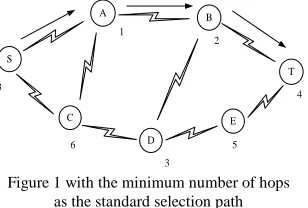
The following example gives a simple description of the AODV routing protocol. As shown in Figure 1, the number next to the nodes represents the energy consumption level of this node, the smaller the value, on behalf of the energy is less, the faster the consumption. As it can be seen from Figure 1, path with minimum hop is
D B A
www.ijiset.com
But if you have been using this path for packet transmission, since the energy consumption of the nodes much faster than other nodes, and ultimately it will make the link is down, impede the network communications.
S E D C T B A 3 1 2 4 5 3 6
Figure 1 with the minimum number of hops as the standard selection path
AODV routing protocol is a standard protocol in the choice of path with the least number of hops. Node only simply blindly react to the first RREQpacket and the reply
RREP packet, but did not effectively deal with energy nodes in the process, which may cause some nodes to be used frequently, resulting in excessive energy consumption, the final out of the network. On the other hand, since the flooding to be transmitted in RREQ packets, a large number of studies have shown that up to 90% of the cost of the route comes from broadcast RREQ packet, which is a major cause leading to a lot of energy wasted node[4].
In this paper, consider of the node energy issues at the time of selecting the path node, no longer continue to use the same path for packet transmission, can quickly began the process of establishing a new route after routing fractured, and re-select a different path complete network communication.
The basic idea of the improved program is: First, consider of the remaining energy of the nodes and the hop number of the path, define an evaluation function to select the optimal path. In the process of routing do RREQ
packet forwarding by setting an energy threshold, intermediate node forward packets with its own remaining energy-related delay; When select route in the destination node, adopt delay recording scheme, select the needing optimal path from all available paths according to the evaluation function. Evaluation function is defined as formula (1):
∑
∑
∑
− = − = − = ∗ + = 1 2 1 2 2 1 11 , 1 N
i initial N i remain N i hop assessment i i j i E E Num
F
ω
ω
(1)
N
is the total number of nodes in the selected path;j i
hop Num
, is the hops path between node
i
and nodej
;i
remain
E is the remaining energy of node
i
, can be obtained from the remaining battery capacity;1
ω ω2is the weights
that are adjustable parameter, which determines the proportion of each path factor values.
3. Improved Method of IEO-AODV protocol
First, introduce a remaining energy threshold, defined as 20% of the initial value of the node energy, which is the restriction of the route request forwarding. Add the remaining energy value of the node into the RREQpacket format of the reserved field. The node do a judgment after receive a RREQpacket, if it’s not the destination node and need to be forwarded, then compare the value of the remaining energy and the energy threshold of the nodes, and if the former bigger than the latter, immediately forward, otherwise discard.
After an intermediate node receives a packet, update the remaining energy before forwarding the packet based on local information about each node on the path, in this case there will be a delay in forwarding the packet, the delay time which is calculated by the formula (2):
) 1 , 0 ( random d E E E D T initial remain initial
delay + ×
− ×
= (2)
D
is the maximum delay time, Einitial is the initial energy of the node,remain
E is the current remaining energy value of the node, which means that the higher the remaining energy of node, the shorter the delay.
d
is a small number, random(0,1)is a random value in the range of 0-1.This forwarding rules make more nodes with adequate remaining energy participate in the selection path, while less remaining energy node will have a greater delay, effectively reduce the probability of lower energy node involvement.
the destination node no longer immediately respond to the first RREQ packet received from the source node, rather than begin a delayed recording process, Destination node collect and timely assessment information on the path through the RREP packet feedback to the source node,
When the source node receives a RREP packet, begin to
send packet according to the path satisfying the evaluation function. For the last chosen path, based on the principle of the minimum evaluation function, namely using the evaluation function as selecting path standard which replace the original AODV protocol routing hops.
Since the topology dynamic in Ad Hoc network, setting delay record is more troublesome. The length of the delay will affect the performance of network, this program uses the literature [5] given concave functions to record delay, defined as formula (3):
( )
2 2 2 2 2(
)
2
2 2
d
E D E D
F e E e
D D
+ +
= − −
(3)
4. Working process of IEO-AODV protocol
4.1 Route establishment process
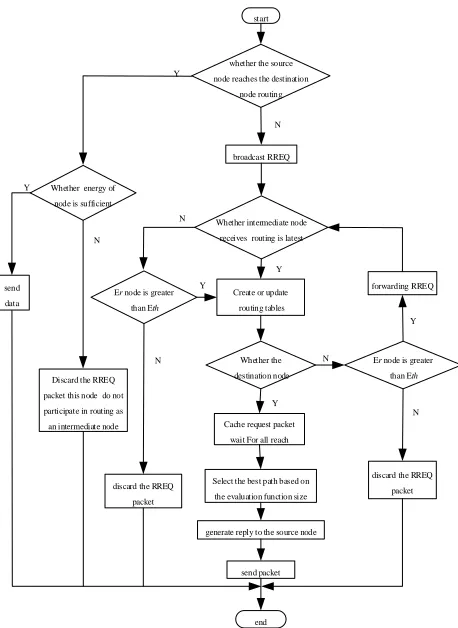
Add remaining energy value of the current node and the next hop address to reserved field of the RREQ packet format. This information will be added to each packet when forwarding packets.
start
whether the source
node reaches the destination node routing
send data
broadcast RREQ
Whether intermediate node receives routing is latest Y
N
Create or update
routing tables Y
Whether the destination node
Y
Cache request packet wait For all reach
generate reply to the source node
end N
Er node is greater
than Eth Y
N
discard the RREQ
packet
N Er node is greater
than Eth
N
discard the RREQ
packet Y forwarding RREQ Whether energy of
node is sufficient
N Y
Discard the RREQ packet this node do not
participate in routing as an intermediate node
send packet Select the best path based on
the evaluation function size
Fig2. IEO-AODV routing protocol establish process
4.2 Route maintenance process
It is time to select local repair mode when the remaining energy is more and more close to the destination node; If the remaining energy is less or relatively close to the source node, we will use source node reconstruction, then need to broadcast RERR messages to the source node. If need to communicate, and begin the process of establishing a new route when the source node receives the message.
Route maintenance process example is shown in Figure 3, the greater the figure represent the remaining energy more. Using such method can effectively exclude some nodes energy is almost depleted continue participation routes, greatly improves the performance of the network.
S
F C
B
D E
A
2
1 4
5
3
Fig3. Route maintenance process
5. Simulation analysis
In order to fully verify the performance of the reform program, we use Cygwin + NS2 simulation platform, nodes random move with Random Waypoint Model, simulation results take an average of 20 simulations. The main parameters are shown in Table 1.
Table 1 simulation parameters
Simulation parameters value
scene scale 1000*1000m2
number of nodes 100
node communication range 250m
weight
ω
i ω1=ω2=0.5MAC 802.11
size of packet 512bytes
packet type CBR
flit sending speed 4packet/s
max connections 15
pause time of node 10s
mobility rate of node 0,5,10,15,20,25,30
simulation time 600s
initial energy of node 20J
In this paper, simulate the improvement of the IEO-AODV routing protocol and the classical IEO-AODV routing protocol, while compare to the EA-AODV routing protocol proposed in the literature [6].
www.ijiset.com
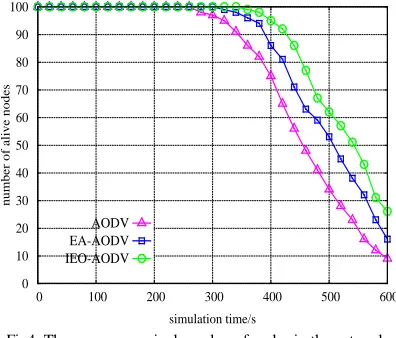
around 8% to 9% more than the EA-AODV routing protocol, most of AODV routing protocol are about 16% to 19%. Therefore, using the IEO-AODV routing protocol can make the network has less energy consumption, can also further extend the life of the network when select a path.
0 10 20 30 40 50 60 70 80 90 100
0 100 200 300 400 500 600
number of alive nodes
simulation time/s AODV
EA-AODV IEO-AODV
Fig4. The average survival number of nodes in the network
0 0.2 0.4 0.6 0.8 1
0 100 200 300 400 500 600
total energy consumption ratio
simulation time/s
AODV EA-AODV IEO-AODV
Fig5. Proportion of total energy consumption
Figure 5 shows the total energy consumption proportions of the three routing protocol with the time of the network simulation run increases. The picture is a simulation of the statistical average once every 50s, followed by 20 times the average of the results obtained the results figure by 20 times the average. As can be seen, as the simulation progresses, there are more nodes involved in the routing, the network connection becomes more complex, the total energy consumption in the network increases accordingly. The total energy consumption of the IEO-AODV routing protocol is less than the other two kinds of some, this is because node avoid some low energy node involvement blindly forwarded when it participates in the route, rather than selecting some the higher energy node forwarding, which makes the number of nodes involved in forward link at the
same time different, and then make the total energy consumption of IEO-AODV routing protocol consumes less at the same time.
0 0.2 0.4 0.6 0.8 1
0 5 10 15 20 25 30
packet delivery ratio
mobility speed(m/s) AODV
EA-AODV IEO-AODV
Figure6. node mobility ratevs packet delivery ratio
Figure 6 shows that packet delivery ratio of the three kinds of routing protocol changes with the rate of movement of the nodes, In the environment of node mobile rate increasing, frequency of network topology also change in increased, which leads to more and more route frequent interrupted. Severe cases it can cause network separation, thereby reduce the success rate of the whole network for data transmission. At the same rate, IEO-AODV routing protocol packet delivery rate is higher than the others, that is because of the reform program deals with the lower energy nodes, increase the chances of higher energy node involvement route. It reply to RREQ not be blind, considering the remaining energy and hop count of path when selecting routes, effectively reduce the possibility of a fracture of the link, significantly improves the packet delivery success rate. When the mobile rate of node is 10, packet delivery success rate of the IEO-AODV routing protocol is higher than the EA-AODV routing protocol about 4%, and higher than the classical AODV routing protocol about 9.6%.
0 100 200 300 400 500
0 5 10 15 20 25 30
network lifetime(s)
mobility speed(m/s) AODV
EA-AODV IEO-AODV
Figure7. node mobility ratevs packet network lifetime
Figure 8 reflects the throughput of the network under rate of movement of different nodes. The figure shows that node mobility rate began to decline with the increase of network throughput. The IEO-AODV routing protocol will do a delay calculation according to their remaining energy level when routing request forwarding each time, thereby it consume more time. Network throughput decreases more and more obvious with the rate of movement increases. The EA-AODV routing protocol in document [6] will consume more time because it uses the energy-aware policy that uses minimal energy routes judgment model when forward data, classic AODV routing protocol forwarding packets is relatively simple. Therefore, the performance of the IEO-AODV routing protocol is weaker than the classical AODV routing protocol.
0.3 0.4 0.5 0.6 0.7 0.8 0.9 1
0 5 10 15 20 25 30
throughput (bps)*10k
mobility speed(m/s)
AODV EA-AODV IEO-AODV
Figure8. node mobility ratevs network throughput
Figure 9 reflects the mobile nodes with different rates, the average end to end delay network also changes. As can be seen from figure: the average end to end delay of the network for three routing protocol also increased with the speed of the node increasing, at low speed, the network
topology has not changed much, difference of the three is not great. But with the increasing rate of the mobile node, network topology changes faster and faster; In order to select a higher energy node to improve the probability of participating in the route. IEO-AODV routing protocol will calculate delay further begin to forward the packet during the routing forward every time. In addition, because the IEO-AODV routing protocol will also has delay record when it accord evaluation function to select the best route from all destination node path, so the average end to end delay is bigger than the classical AODV routing protocol when node rate increases in late period.
0 0.1 0.2 0.3 0.4 0.5
0 5 10 15 20 25 30
average end to end delay(s)
mobility speed(m/s) AODV
EA-AODV IEO-AODV
Figure9. node mobility ratevs the average end to end delay
5. Conclusions
To solve the problem that the network nodes with limited energy and excessive consumption could easily lead to the partition of the network, this paper presents an improved scheme. Experimental results show that the reform program reduce the number of death nodes in the network in a certain extent, thereby extend the lifetime of the network, while also balance the energy consumption, and has a distinct advantage in the packet delivery ratio and network throughput, but the downside is that the average end to end delay has not been effectively improved.
Acknowledgments
This work was supported in part by the Program for Chang jiang Scholars and Innovative Research Team in
University (IRT1299), Project of CSTC
(CSTC2012jjA40044, CSTC2013yykfA40010) and
special fund of Chongqing key laboratory (CSTC).
References
www.ijiset.com networks[C]// International Symposium on Modeling, Analysis and
Simulation of Computer and Telecommunication Systems, 2001. Proceedings. 2001:117-124.
[2] WU Hua-feng, CHEN Xin-qiang. Improved ant colony algorithm based on natural selection strategy for solving TSP problem [J]. Journal on Communications, 2013, 34(4): 165-170.
[3] Garcia J E, Kallel A, Kyamakya K, et al. A novel DSR-based energy-efficient routing algorithm for mobile ad-hoc networks[C]// Vehicular Technology Conference, 1988, IEEE 38th. 2003:2849-2854 Vol.5. [4] PAN Yun-xia, JI Chang-peng. AODV Energy Strategy [J]. Computer Engineering, 2010, 36(22): 103-105.
[5] William Emmanuel S Yu, Jung-Won Lee. DSR-based energy-aware routing protocols in Ad hoc networks[J/OL]. International Conference on Wireless Networks(ICWN), 2002[2016-03-28].
http:www.ece.utexas.edu/.June, 2002: 06-22.