An extended abstract of this paper is published in the proceedings of the twelfth IACR Theory of Cryptography Conference—TCC 2015. This is the full version.
From Single-Bit to Multi-Bit Public-Key Encryption
via Non-Malleable Codes
Sandro Coretti ETH Zurich [email protected]
Ueli Maurer ETH Zurich [email protected]
Bj¨orn Tackmann∗ UC San Diego [email protected] Daniele Venturi
Sapienza University of Rome [email protected]
August 3, 2015
Abstract
One approach towards basing public-key encryption (PKE) schemes on weak and credible as-sumptions is to build “stronger” or more general schemes generically from “weaker” or more re-stricted ones. One particular line of work in this context was initiated by Myers and shelat (FOCS ’09) and continued by Hohenberger, Lewko, and Waters (Eurocrypt ’12), who provide constructions of multi-bit CCA-secure PKE from single-bit CCA-secure PKE.
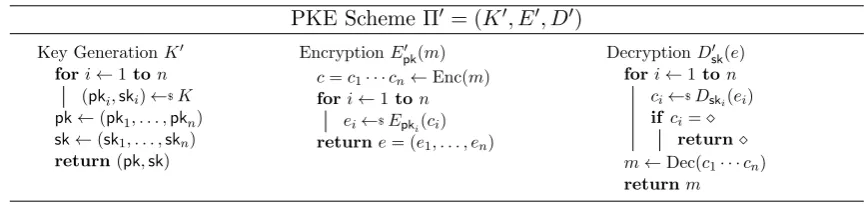
It is well-known that encrypting each bit of a plaintext string independently is not CCA-secure— the resulting scheme ismalleable. We therefore investigate whether this malleability can be dealt with using the conceptually simple approach of applying a suitable non-malleable code (Dziem-bowski et al., ICS ’10) to the plaintext and subsequently encrypting the resulting codeword bit-by-bit. We find that an attacker’s ability to ask multiple decryption queries requires that the underlying code be continuously non-malleable (Faust et al., TCC ’14). Since, as we show, this flavor of non-malleability can only be achieved if the code is allowed to “self-destruct,” the resulting scheme inherits this property and therefore only achieves a weaker variant of CCA security.
We formalize this new notion of so-calledself-destruct CCA security (SD-CCA)as CCA security with the restriction that the decryption oracle stops working once the attacker submits an invalid ciphertext. We first show that the above approach based on non-malleable codes yields a solution to the problem of domain extension for SD-CCA-secure PKE, provided that the underlying code is continuously non-malleable against a reduced form of bit-wise tampering. Then, we prove that the code of Dziembowskiet al. is actually already continuously non-malleable against (even full) bit-wise tampering; this constitutes the first information-theoretically secure continuously non-malleable code, a technical contribution that we believe is of independent interest. Compared to the previous approaches to PKE domain extension, our scheme is more efficient and intuitive, at the cost of not achieving full CCA security. Our result is also one of the first applications of non-malleable codes in a context other than memory tampering.
Contents
1 Introduction 1
1.1 Overview . . . 1
1.2 Techniques and Contributions . . . 2
1.3 More Details on Related Work . . . 4
2 Preliminaries 5 2.1 Systems: Resources and Converters, Distinguishers, and Reductions . . . 5
2.2 Discrete Systems . . . 6
2.3 The Notion of Construction . . . 6
2.4 Public-Key Encryption Schemes . . . 6
2.5 Continuously Non-Malleable Codes . . . 7
3 From Single-Bit to Multi-Bit Channels 8 3.1 Single-Bit PKE Viewed Constructively . . . 8
3.2 Tying the Channels Together . . . 9
3.3 Plugging It Together . . . 10
4 Continuous Non-Malleability against Bit-Wise Tampering 10 A The Composition Theorem of Constructive Cryptography 18 B Channel Resources 18 C Non-Malleable Codes and the One-Time Pad 19 C.1 The Malleability of the One-Time Pad . . . 19
C.2 Getting Rid of the Malleability . . . 20
D SD-CCA Security and Deferred Material from Section 3 21 D.1 Formal Definition of SD-CCA . . . 21
D.2 Single-bit Channels from Single-bit PKE . . . 22
D.3 Tying the Channels Together . . . 23
D.4 From Protocols to PKE Schemes . . . 24
D.5 Game-Based Proof . . . 25
E Achieving Adaptive Continuous Non-Malleability 27 F On the Necessity of Self-Destruct 30 F.1 Proof of Theorem 19 . . . 31
1 Introduction
1.1 Overview
A public-key encryption (PKE) scheme enables a sender A to send messages to a receiver B confi-dentially if B can send a single message, the public key, to A authentically. A encrypts a message with the public key and sends the ciphertext to B via a channel that could be authenticated or in-secure, and B decrypts the received ciphertext using the private key. Following the seminal work of Diffie and Hellman [21], the first formal definition of public-key encryption has been provided by Goldwasser and Micali [31], and to date numerous instantiations of this concept have been proposed, e.g., [49, 24, 16, 28, 32, 35, 50, 48], for different security properties and based on various different computational assumptions.
One natural approach towards developing public-key encryption schemes based on weak and credi-ble assumptions is to build “stronger” or more general schemes generically from “weaker” or less general ones. While the “holy grail”—generically building a chosen-ciphertext secure scheme based on any chosen-plaintext secure one—has so far remained out of reach, and despite negative results [30], vari-ous interesting positive results have been shown. For instance, Cramer et al.[15] buildbounded-query chosen-ciphertext secure schemes from chosen-plaintext secure ones, Choi et al. [10] non-malleable schemes from chosen-plaintext secure ones, and Lin and Tessaro [37] show how the security of weakly chosen-ciphertext secure schemes can be amplified. A line of work started by Myers, Sergi, and she-lat [46] and continued by Dachman-Soled [17] shows how to obtain chosen-ciphertext secure schemes from plaintext-aware ones. Most relevant for our work, however, are the results of Myers and shelat [47] and Hohenberger, Lewko, and Waters [33], which generically build a multi-bit chosen-ciphertext secure scheme from a single-bit chosen-ciphertext secure one.
A na¨ıve attempt at solving this problem would be to encrypt each bit mi of a plaintext m =
m1· · ·mk under an independent public key pki of the single-bit scheme. Unfortunately, this simple
approach does not yield chosen-ciphertext security. The reason is that the above scheme ismalleable: given a ciphertext e= (e1, . . . , ek), where ei is an encryption of mi, an attacker can generate a new
ciphertext e0 6= e that decrypts to a related message, for instance by copying the first ciphertext component e1 and replacing the other components by fresh encryptions of, say, 0.
The above malleability issue suggests the following natural “encode-then-encrypt-bit-by-bit” ap-proach: first encode the message using a non-malleable code1 (a concept introduced by Dziembowski et al. [23]) to protect its integrity, obtaining an n-bit codeword c=c1· · ·cn; then encrypt each bit ci
of the codeword using public keypki as in the na¨ıve protocol from above.
It turns out that non-malleable codes as introduced by [23] are not sufficient: Since they are only secure against a single tampering, the security of the resulting scheme would only hold with respect to a single decryption. Continuously non-malleable codes (Faustet al.[25]) allow us to extend this guarantee to multiple decryptions. However, such codes “self-destruct” once an attack has been detected, and, therefore, so must any PKE scheme built on top of them. This is a restriction that we prove to be unavoidable for this approach based on non-malleable codes.
The resulting scheme achieves a notion weaker than full CCA, which we termself-destruct chosen-ciphertext security (SD-CCA). Roughly, SD-CCA security is CCA security with the twist that the decryption oracle stops working once the adversary submits an invalid ciphertext.
Our paper consists of two main parts: First, we prove that the above approach allows to build multi-bit SD-CCA-secure PKE from single-bit SD-CCA-secure PKE, provided that the underlying code is continuously non-malleable against areduced form of bit-wise tampering. This proof is greatly facilitated by rephrasing the problem using the paradigm of constructive cryptography [39], since it follows almost immediately from the composition theorem. For comparison we also provide a purely game-based proof. Second, we show that a simplified variant of the code by Dziembowskiet al.[23] is already continuously non-malleable against the aforementioned reduced bit-wise tampering and that
1
the full variant of said code achieves continuous non-malleability againstfull bit-wise tampering. This constitutes the first information-theoretically secure continuously non-malleable code, a contribution that we believe is of independent interest, and forms the technical core of this paper.
1.2 Techniques and Contributions
Constructive cryptography [39]. Security statements for cryptographic schemes can be stated as constructions of a “stronger” or more useful desired resource from a “weaker” or more restricted assumed one. Two such construction steps can be composed, i.e., if a protocolπ constructs a resource
S from an assumed resource R, denoted by R ==π⇒ S, and, additionally, a protocol ψ assumes resource S and constructs a resource T, then the composition theorem of constructive cryptography (see Appendix A) states that the composed protocol, denotedψ◦π, constructs resourceT fromR. The resources considered in this work are different types of communication channels between two partiesA
and B; a channel is a resource that involves three entities: the sender, the receiver, and a (potential) attackerE.
We use and extend the notation by [43], denoting different types of channels by different arrow symbols. Aconfidential channel (later denoted−→→•) hides the messages sent byAfrom the attacker
E but potentially allows her to injectindependent messages; anauthenticated channel (later denoted •−→→) is dual to the confidential channel in that it potentially leaks the message to the attacker but prevents modifications and injections; an insecure channel (later denoted − →→) protects neither the confidentiality nor the authenticity. In all cases, the double arrow head indicates that the channel can be used to transmit multiple messages. A single arrow head, instead, means that channels are single-use. All channels used within this work are described formally in Appendix B.
Warm-up: dealing with the malleability of the one-time pad. To illustrate the intuition behind our approach, consider the following simple example: The one-time pad allows to encrypt an
n-bit message m using ann-bit shared keyκ by computing the ciphertext e=m⊕κ. If eis sent via an insecure channel, an attacker can replace it by a different ciphertexte0, in which case the receiver will computem0 =e0⊕κ=m⊕(e⊕e0). This can be seen, as described in [42], as constructing from an insecure channel and a shared secret n-bit key an “XOR-malleable” channel, denoted−−⊕→•, which is confidential but allows the attacker to specify a mask δ ∈ {0,1}n (= e⊕e0) to be XORed to the
transmitted message.
Non-malleable codes can be used to deal with the XOR-malleability. To transmit a k-bit message
m, we encodemwith a (k, n)-bit non-malleable code, obtaining ann-bit codewordc, which we transmit via the XOR-malleable channel −−⊕→•. Since by XORing a mask δ to a codeword transmitted via −−⊕→•the attacker can influence the value of each bit of the codeword only independently, a code that is non-malleable w.r.t. the function class Fbit, which (in particular) allows to either “keep” or “flip” each bit of a codeword only individually, is sufficient. Indeed, the non-malleability of the code implies that the decoded message will be either the original message or a completely unrelated value, which is the same guarantee as formulated by the single-message confidential channel (denoted −→•), and hence using the code, one achieves the construction
−−⊕→• ==⇒ −→•.
A more detailed treatment and a formalization of this example appears in Appendix C; suitable non-malleable codes are described in [14, 23, 9].
can be used to construct a confidential channel −→→• from A to B from an authenticated chan-nel ←−• from B to A and an insecure channel − →→ from A to B. As shown in Section 3, this and the composition theorem imply that using nindependent single-bit PKE schemes, one can construct
n(independent) instances of the single-bit confidential channel −→1-bit→•, written 1-bit
−→→•n . The remaining step is showing how to achieve the construction
1-bit
−→→•n
==⇒ −→k-bit→• (1)
for some k > 1. Then, by the composition theorem, plugging these two steps together yields a protocol m-pke that constructs a k-bit confidential channel from an authenticated channel and an insecure channel.
To achieve construction (1), we use non-malleable codes. The fact that the channels are multiple-use leads to two important differences to the one-time-pad example above: First, the attacker can fabricate multiple codewords, which are then decoded. Second, each bit of such a codeword can be created by combining any of the bits sent by A over the corresponding channel. These capabilities can be formally captured by a particular class Fcopy of tampering functions. We prove in Section 3
that any code that iscontinuously non-malleable w.r.t. Fcopy can be used to achieve (1).
Unfortunately, we show in Appendix F that any code, in order to satisfy the above type of non-malleability, has to “self-destruct” in the event of a decoding error. For the application in the setting of public-key encryption, this means that the decryption algorithm of the receiverB also has to deny processing any further ciphertext once the code self-destructs.
Self-destruct CCA security. In Section 3 we show how the protocolm-pkecan be seen as a PKE scheme that achievesself-destruct CCA security (SD-CCA) and show that the single-bit confidential channel −→1-bit→• can also be constructed using a single-bit SD-CCA scheme (instead of a CCA-secure one). Thus, overall we obtain a way to transform 1-bit CCA-secure PKE into multi-bit SD-CCA-secure PKE. For comparison we also provide a direct, entirely game-based proof that combining a single-bit SD-CCA PKE scheme with a non-malleable code as above yields a multi-bit SD-CCA scheme (see Appendix D).
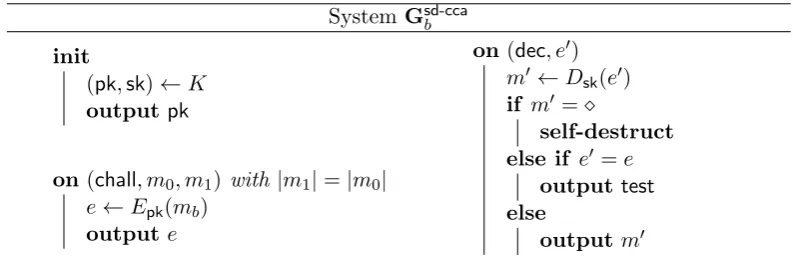
SD-CCA is a (weaker) CCA variant that allows the scheme to self-destruct in case it detects an invalid ciphertext. The standard CCA game can easily be extended to include the self-destruct mode of the decryption: the decryption oracle keeps answering decryption queries as long as no invalid ciphertext (i.e., a ciphertext upon which the decryption algorithm outputs an error symbol) is received; after such an event occurs, no further decryption query is answered.
The guarantees of SD-CCA are perhaps best understood if compared to theq-bounded CCA notion by [10]. While q-CCA allows ana priori determined number q of decryption queries, SD-CCA allows an arbitrary number ofvalid decryption queries and one invalid query. From a practical viewpoint, an attacker can efficiently violate the availability with a scheme of either notion. However, as long as no invalid ciphertexts are received, an SD-CCA scheme can run indefinitely, whereas aq-CCA scheme has to necessarily stop afterq decryptions.
Subsequent work [13] shows that SD-CCA security can in fact be achieved from CPA security only, by generalizing a technique by Choi et al. [10]. The resulting scheme, however, is considerably less efficient than the one we provide in this paper. In [13], the authors also study the relation between SD-CCA and other standard security notions and discuss possible applications.
Continuous non-malleability w.r.t.Fcopy. The classFcopycan be seen as a multi-encoding version
of the function class Fset, which consists of functions that tamper with every bit of an encoding
individually and may either leave it unchanged or replace it by a fixed value. In Section 4 we build a continuously non-malleable code w.r.t. Fcopy; the code consists of a linear error-correcting secret
tampering with an encoding, an attacker cannot infer (too much) useful information about it. Then, we show that if a code is continuously non-malleable w.r.t. Fcopy against tampering with a single
encoding, then it is also adaptively continuously non-malleable w.r.t. Fcopy, i.e., against tampering
with many encodings simultaneously. In addition, in Appendix G, we also show that the full version of the code by [23] is non-malleable againstfull bit-wise tampering (i.e., when additionally the tamper function is allowed to flip bits of an encoding). These are the main technical contributions of this work.
1.3 More Details on Related Work
The work of Hohenberger et al. [33]—building on the work of Myers and shelat [47]—describes a multi-bit CCA-secure encrytion scheme from a single-bit CCA-secure one, a CPA-secure one, and a 1-query-bounded CCA-secure one. Their scheme is rather sophisticated and has a somewhat circular structure, requiring a complex security proof. The public key is of the form pk = (pkin,pkA,pkB), where the “inner” public key pkin is the public key of a DCCA secure PKE scheme, and the “outer” public keyspkAandpkBare, respectively, the public key of a 1-bounded CCA and a CPA secure PKE scheme. To encrypt a k-bit messagemone first encrypts a tuple (rA, rB, m), using the “inner” public
key, obtaining a ciphertextein, whererA andrB are thought as being the randomness for the “outer”
encryption scheme. Next, one has to encrypt ein under the “outer” public keypkA(resp. pkB) using
randomness rA (resp. rB) and thus obtaining a ciphertext eA (resp. eB). The output ciphertext is
e= (eA, eB).
To use the above scheme, we have to instantiate the DCCA, 1-bounded CCA and CPA components. As argued in [33], all schemes can be instantiated using a single-bit CCA-secure PKE scheme yielding a fully black-box construction of a multi-bit CCA-secure PKE from a single-bit CCA-secure PKE. Let us denote with lp (resp.,le) the bit-length of the public key (resp., the ciphertext) for the
single-bit CCA-secure PKE scheme. When we refer to the construction of [15] for the 1-bounded CCA component, we get a public key of size roughly (3 + 16s)·lp for the public key and (k+ 2s)·4s·l2e for
the ciphertext, for security parameter s.2
In contrast, our scheme instantiated with the information-theoretic LECSS scheme of [23] has a ciphertext of length ≈ 5k·le and a public key of length k·lp. Note that the length of the public
key depends on the length of the message, as we need independent public keys for each encrypted bit (whereas the DCCA scheme can use always the same public key). However, we observe that when k
is not too large, e.g. in case the PKE scheme is used as a key encapsulation mechanism, we would have k≈syielding public keys of comparable size. On the negative side, recall that our construction needs to self-destruct in case an invalid ciphertext is processed, which is not required in [33], and thus our construction only achieves SD-CCA security and not full-blown CCA security.
As shown in [12], the constructive security statement for public-key encryption corresponds to replayable CCA security (RCCA), a notion proposed by Canettiet al.[6]. Hence, our scheme actually achieves replayable self-destruct CCA security (SD-RCCA)—see Appendix D. We remark, however, that if one is interested in SD-CCA security, this can be achieved generically from SD-RCCA security using the transformation in [6].
Non-malleable codes. Beyond the constructions of [23, 9, 25], non-malleable codes exists against block-wise tampering [11], against bit-wise tampering and permutations [5, 4], against split-state tampering—both information-theoretic [22, 2, 7, 3, 1] and computational [38, 18]—and in a setting where the computational complexity of the tampering functions is limited [8, 27, 34]. We stress that the typical application of non-malleable codes is to protect cryptographic schemes against mem-ory tampering (see, e.g., [29, 23, 19, 20]). A further application of non-malleable codes has been shown by Agrawal et al.[4] (in concurrent and independent work). They show that one can obtain a non-malleable multi-bit commitment scheme from a non-malleable single-bit commitment scheme by
2
For simplicity, we assumed that the random stringsrA,rB are computed by stretching the seed (of lengths) of a
encoding the value with a (specific) non-malleable code and then committing to the codeword bits. Despite the similarity of the approaches, the techniques applied in their paper differ heavily from ours. The class of tampering functions the code has to protect against is different, and we additionally need continuous non-malleability to handle multiple decryption queries (this is not required for the commitment case).
2 Preliminaries
2.1 Systems: Resources and Converters, Distinguishers, and Reductions
Resources and converters. We use the concepts and terminology of abstract [41] and constructive cryptography [39]. The resources we consider are different types of communication channels, which are systems with three interfaces labeled by A, B, and E. A converter is a two-interface system which is directed in that it has aninside and anoutside interface. Converters model protocol engines that are used by the parties, and using a protocol is modeled by connecting the party’s interface of the resource to the inside interface of the converter (which hides those two interfaces) and using the outside interface of the converter instead. We generally use upper-case, bold-face letters (e.g., R,S) or channel symbols (e.g., •−→→) to denote resources or single-interface systems and lower-case Greek letters (e.g., α, β) or sans-serif fonts (e.g., enc, dec) for converters. We denote by Φ the set of all resources and by Σ the set of all converters.
For I ∈ {A, B, E}, a resource R ∈ Φ, and a converter α ∈ Σ, the expression αIR denotes the composite system obtained by connecting the inside interface of α to interface I of R; the outside interface of α becomes the I-interface of the composite system. The systemαIR is again a resource (cf. Figure 2 on page 9). For two resourcesRandS, [R,S] denotes the parallel composition ofR and
S. For each I ∈ {A, B, E}, the I-interfaces ofR and S are merged and become thesub-interfaces of theI-interface of [R,S].
Two converters α and β can be composed serially by connecting the inside interface of β to the outside interface of α, writtenβ ◦α, with the effect that (β◦α)IR=βIαIR. Moreover, converters can also be taken in parallel, denoted by [α, β], with the effect that [α, β]I[R,S] = [αIR, βIS]. We assume the existence of an identity converter id ∈ Σ with idIR = R for all resources R ∈ Φ and interfaces I ∈ {A, B, E}and of a special converter ⊥ ∈Σ with an inactive outside interface.
Distinguishers. A distinguisher D connects to all interfaces of a resource U and outputs a sin-gle bit at the end of its interaction with U. The expression DU defines a binary random variable corresponding to the output of D when interacting with U, and the distinguishing advantage of a distinguisherD on two systems U and V is defined as
∆D(U,V) :=|P[DU= 1]−P[DV= 1]|.
The distinguishing advantage measures how much the output distribution of D differs when it is connected to either U orV. Note that the distinguishing advantage is a pseudo-metric.3
Reductions. When relating two distinguishing problems, it is convenient to use a special type of systemCthat translates one setting into the other. Formally, Cis a converter that has aninside and anoutside interface. When it is connected to a systemS, which is denoted byCS, the inside interface of Cconnects to the (merged) interface(s) of S and the outside interface ofC is the interface of the composed system. Cis called areduction system (or simply reduction).
To reduce distinguishing two systems S,T to distinguishing two systems U,V, one exhibits a reduction C such that CS≡U and CT≡V. Then, for all distinguishers D, we have ∆D(U,V) = ∆D(CS,CT) = ∆DC(S,T). The last equality follows from the fact thatCcan also be thought of as
being part of the distinguisher (which follows from the composition-order independence [41]).
2.2 Discrete Systems
The behavior of systems can be formalized by random systems as in [45, 40]: A random systemS is a sequence (pSYi|Xi)i≥1 of conditional probability distributions, where pSYi|Xi(yi, xi) is the probability of
observing the outputsyi = (y1, . . . , yi) given the inputsxi = (x1, . . . , xi). If for two systemsRand S,
pRYi|Xi =pSYi|Xi
for all iand for all parameters where both are defined, they are calledequivalent, denoted byR≡S. In that case, ∆D(R,S) = 0 for all distinguishers D.
A system S can be extended by a so-called monotone binary output (or MBO) B, which is an additional one-bit output B1, B2, . . . with the property that Bi = 1 implies Bi+1 = 1 for all i.4 The
enhanced system is denoted by ˆS, and its behavior is described by the sequence (pSYˆi,Bi|Xi)i≥1. If for
two systems ˆRand ˆS with MBOs,
pRYˆi,Bi=0|Xi =p
ˆ S
Yi,Bi=0|Xi
for all i, they are called game equivalent, which is denoted by ˆR ≡g Sˆ. In such a case, ∆D(R,S) ≤ ΓD( ˆR) = ΓD(ˆS), where ΓD( ˆR) denotes the probability thatD provokes the MBO. For more details and a proof of this fact, consult [40].5
2.3 The Notion of Construction
We formalize the security of protocols via the notion of construction, introduced in [39]:
Definition 1. Let Φ and Σ be as above, and let ε1 and ε2 be two functions mapping each
distin-guisher D to a real number in [0,1]. A protocol π = (π1, π2) ∈ Σ2 constructs resource S ∈ Φ from
resource R∈Φ with distance (ε1, ε2) and with respect the simulator σ∈Σ, denoted6 R π,σ,==(ε⇒1,ε2) S,
if for all distinguishers D,
∆D(π1Aπ2B⊥ER,⊥ES) ≤ε1(D) (availability)
∆D(π1Aπ2BR, σES) ≤ε2(D) (security).
The availability condition captures that a protocol must correctly implement the functionality of the constructed resource in the absence of the attacker. The security condition models the requirement that everything the attacker can achieve in the setting with the assumed resource and the protocol, she can also accomplish in the setting with the constructed resource (using the simulator to translate the behavior). The notion of construction composes; details can be found in Appendix A.
2.4 Public-Key Encryption Schemes
A public-key encryption (PKE) scheme with message space M ⊆ {0,1}∗ and ciphertext space E is defined as three algorithms Π = (K, E, D), where the key-generation algorithm K outputs a key pair (pk,sk), the (probabilistic) encryption algorithm E takes a message m∈ M and a public keypk and outputs a ciphertexte←Epk(m), and the decryption algorithm takes a ciphertexte∈ E and a secret
key sk and outputs a plaintext m ← Dsk(e). The output of the decryption algorithm can be the
special symbol, indicating an invalid ciphertext. A PKE scheme is correct ifm=Dsk(Epk(m)) (with probability 1 over the randomness in the encryption algorithm) for all messages m and all key pairs (pk,sk) generated by K.
We introduce security notions for PKE schemes as we need them.
4
In other words, once the MBO is 1, it cannot return to 0.
System SrealF init
i←0
on(encode, x)
i←i+ 1
c(i)←$Enc(x)
on(tamper, f)withf∈ F(i)
c0←f(c(1), . . . , c(i))
x0←Dec(c0) ifx0=
self-destruct outx0
System SsimuF,τ init
i←0
on(encode, x)
i←i+ 1
x(i)←$x
on(tamper, f)withf∈ F(i)
x0←$τ(i, f) ifx0=
self-destruct ifx0= (same, j)
x0←x(j)
outx0
Figure 1: SystemsSreal
F and SsimuF,τ defining adaptive continuous non-malleability of(Enc,Dec). The
commandself -destructhas the effect that is output and all future queries are answered by.
2.5 Continuously Non-Malleable Codes
Non-malleable codes, introduced in [23], arecoding schemes that protect the encoded messages against certain classes of adversarially chosen modifications, in the sense that the decoding will result either in the original message or in an unrelated value.
Definition 2(Coding scheme). A (k, n)-coding scheme (Enc,Dec) consists of a randomized encoding function Enc : {0,1}k → {0,1}n and a deterministic decoding function Dec :{0,1}n → {0,1}k∪ {}
such thatDec(Enc(x)) =x (with probability 1 over the randomness of the encoding function) for each
x∈ {0,1}k. The special symbol indicates an invalid codeword.
Basicnon-malleable codes [23] provide the above guarantee in a context where the adversary is allowed to modify a (random) codeword c (of a message of his choice) by specifying a function f :{0,1}n →
{0,1}n from a particular function class F and observe the output of the decoding algorithm applied
to thetampered codeword f(c).
Continuous non-malleability, introduced in [25], extends this guarantee to the case where the adversary is allowed to perform multiple such modifications of a target codeword c. That is, he can repeatedly and adaptively specify functions f ∈ F and see the decoding of the tampered codeword
f(c). The functions f specified by the adversary are always applied to the samec.
The notion of adaptive continuous non-malleability considered here is an extension of continuous non-malleability in that the adversary is allowed to (adaptively) specifymultiple messagesx(1), x(2), . . .
and the functions may depend on all of the corresponding codewords c(1), c(2), . . .. That is, the class F is actually a sequence (F(i))
i≥1 of function families withF(i) ⊆ {f |f : ({0,1}n)i→ {0,1}n}, and
after encoding i messages, the adversary chooses functions from F(i). A similar adaptive notion has
been already considered for continuous strong non-malleability in the split-state model [26].
Formally, adaptive continuous non-malleability w.r.t. F is defined by comparing the two random systems SrealF and SsimuF,τ defined in Figure 1. Both systems process encode and tamper queries from a distinguisher D, whose objective is to tell the two systems apart.
System Sreal
F produces a random encoding c(i) of each message x(i) specified by D and allows D
to repeatedly issue tampering functions f ∈ F(i). For each such query, Sreal
F computes the modified
codeword c0 = f(c(1), . . . , c(i)) and outputs Dec(c0). Whenever Dec(c0) = , the system enters a self-destruct mode, in which all further queries are replied to by .
The second random system, SsimuF,τ , features a simulator τ, which is allowed to keep state. The simulator repeatedly takes a tampering function and outputs either a message x0, (same, v) for v ∈ {1, . . . , i}, or, where (same, v) is used byτ to indicate that (it believes that) the tampering results in an n-bit string that decodes to the vth message encoded. System SsimuF,τ outputs whatever τ outputs, except that (same, v) is replaced by the vth message x(v) specified byD. Moreover, in case of ,SsimuF,τ
self-destructs.
For `, q ∈ N, SrealF,`,q is the system that behaves as SrealF except that only the first `encode-queries and the first q tamper-queries are handled (and similarly for SsimuF,τ,`,q and SsimuF,τ ). Note that by setting
`= 1, one recovers continuous non-malleability as defined in [25],7 and by additionally setting q = 1
the original definition of non-malleability.
Definition 3 (Continuous non-malleability). Consider a sequence F = (F(i))
i≥1 of function families F(i) ⊆ {f |f : ({0,1}n)i → {0,1}n} and let `, q ∈
N. A coding scheme (Enc,Dec) is adaptively
continuously (F, ε, `, q)-non-malleable(or simply (F, ε, `, q)-non-malleable) if there exists a simulator
τ such that ∆D(SrealF,`,q,SsimuF,τ,`,q)≤ε for all distinguishers D.
3 From Single-Bit to Multi-Bit Channels
In this section we examine the question of domain extension for CCA-secure public-key encryption (PKE) via the following intuitive non-malleable code based approach: first encode a k-bit message using a non-malleable (k, n)-code to protect its integrity, obtaining an n-bit codewordc; then encrypt
c bit-wise using n independent public keys for a single-bit CCA-secure PKE. We observe that the adversary’s ability of asking multiple decryption queries requires to opt for continuously non-malleable codes. The self-destruct property of these codes, however, translates to the resulting PKE scheme, and thus we achieve domain extension only for schemes with so-called self-destruct CCA security, a variant of CCA security where the decryption oracle stops working after the attacker submits an invalid ciphertext; this variant is defined more precisely in Section D.1.
We stress that the need for self-destruct is not a limitation of the security proof of our code (cf. Section 4), as continuous non-malleability for the class of tampering functions required for the above transformation to work is impossible without the self-destruct property (cf. Appendix F for details).
As shown below, phrasing PKE domain extension using the paradigm of constructive cryptography allows to decompose the problem into two independent parts: The first part includes a (canonical) reduction to the SD-CCA security of the single-bit PKE scheme, whereas the second part, which involves non-malleable codes, is purely information-theoretic. The two parts can then be combined to obtain a single protocol, whose security follows from the composition theorem. We also show how the resulting protocol can be understood as a PKE scheme and that it achieves SD-CCA security.
All channel resources that appear in this section are formally defined in Section B of the appendix; to understand the statements and explanations below, the informal descriptions given in Section 1.2 are sufficient, however.
3.1 Single-Bit PKE Viewed Constructively
Following the proof of [12, Theorem 2], one can show that a 1-bit SD-CCA-secure PKE scheme can be used to design a protocol that achieves the construction
[←−•,− →→] ==⇒ −→1-bit→•, (2)
where, in a nutshell, the receiver’s protocol converter is responsible for key generation, decryption, as well as self-destructing, the sender’s protocol converter for encryption, and where the authenticated channel←−• is used for the transmission of the public key and the insecure channel− →→ for sending ciphertexts. The constructed single-bit confidential channel −→1-bit→• hides all messages sent by the sender from the attacker and allows the attacker to either deliver already sent messages or to inject independentmessages. This captures the intuitive (SD-)CCA guarantee that an attacker, by modifying a particular ciphertext, can either leave the message contained therein intact or replace it by an independently created one.
1-bit −→→•
1-bit −→→•
.. .
1-bit −→→•
encode decode
A B
E
A B
E
k-bit −→→•
σ
Figure 2: Left: The assumed resource [−→1-→•bit ]n with protocol convertersencode and decode attached
to interfaces AandB, denoted encodeAdecodeB[−→1-→•bit ]n. Right: The constructed resource−→k-→•bit with
simulator σ attached to the E-interface, denoted σE −→k-→•bit . In particular, σ must simulate the
E-interfaces of[−→1-→•bit ]n. The protocol is secure if the two systems are indistinguishable.
3.2 Tying the Channels Together
We now show how to construct, using an adaptive continuously non-malleable (k, n)-code (cf. Sec-tion 2.5), a (single)k-bit confidential channel from the nindependent single-bit confidential channels constructed in the previous section. This is achieved by having the sender encode the message with the non-malleable code and sending the resulting codeword over the 1-bit channels (bit-by-bit), while the receiver decodes alln-bit strings received via these channels. Additionally, due to the self-destruct property of continuously non-malleable codes, the receiver must stop decoding once an invalid code-word has been received.
More precisely, let (Enc,Dec) be a (k, n)-coding scheme and consider the following protocolnmc= (encode,decode): Converter encode encodes every message m ∈ {0,1}k input at its outside interface
with fresh randomness, resulting in an n-bit encodingc=c1· · ·cn←Enc(m). Then, for i= 1, . . . , n,
it outputs bitci to theithchannel at the inside interface. Converterdecode, whenever it receives ann
-bit stringc0 =c01· · ·c0n(where theithbitc0iwas received on theith channel), it computesm0 ←Dec(c0) and outputs m0 at the outside interface. If m0 = , it implements the self-destruct mode, i.e., it answers all future encodings received at the inside interface by outputting at the outside interface.
The goal is now to show that protocol nmcachieves the construction
[−→1-bit→•]n ==nmc⇒ −→k-bit→•. (4)
The required non-malleability. By inspecting both sides of Figure 2, it becomes immediately apparent why adaptive continuously non-malleable codes are the proper choice to achieve construc-tion (4): On the left-hand side, the distinguisher can repeatedly input messages m(i) at interface
A, which results in encodings c(i) being input (bit-by-bit) into the single-bit channels. Using the
E-interfaces of these channels, the distinguisher can repeatedly see the decoding of an n-bit string
c0 =c01· · ·c0nat interfaceB, where each bitc0j results from either forwarding one of the bits already in thejth channel or from injecting a fresh bit that is either 0 or 1.
Put differently, the distinguisher can effectively launch tampering attacks using functions from Fcopy := (Fcopy(i) )i≥1, where Fcopy(i) ⊆ {f |f : ({0,1}n)i → {0,1}n} and each function f ∈ Fcopy(i) is
char-acterized by a vector χ(f) = (f1, . . . , fn) where fj ∈ {zero,one,copy1, . . . ,copyi}, with the meaning
that f takes as input i codewords (c(1), . . . , c(i)) and outputs an n-bit string c0 = c01· · ·c0n in which each bitc0j is either set to 0 (zero), set to 1 (one), or copied from thejth bit in a codewordc(v) (copy
v)
forv∈ {1, . . . , i}.
already sent by A or to inject independent messages. The simulator σ required to prove (4) needs to simulate the E-interfaces of the single-bit confidential channels at its outside interface and, based solely on what is input at these interfaces, decide whether to forward or inject a message, which corresponds exactly to the task of the simulatorτ in the non-malleability experiment (cf. Section 2.5). Theorem 1 below formalizes this correspondence; its proof is essentially a technicality: one merely needs to “translate” between the channel settings and the non-malleability experiment. For complete-ness it is provided in full detail in Appendix D.3.
Theorem 1. For any`, q ∈N, if(Enc,Dec) is(Fcopy, ε, `, q)-continuously non-malleable, there exists a simulator σ such that
[1−→-bit→•,`,q]n (nmc==,σ,⇒(0,ε)) k−→-bit→•,`,q,
where the additional superscripts `, q on a channel mean that it only processes the first ` queries at the A-interface and only the first q queries at the E-interface.
3.3 Plugging It Together
The composition theorem of constructive cryptography (cf. Appendix A) implies that the protocol m-pke = nmc◦1-pke resulting from composing the protocols 1-pke and nmc for transformations (3) and (4), respectively, achieves
[←−•,− →→] ==m-pke⇒ −→k-bit→•. (5) Protocolm-pkecorresponds (in a straight-forward manner) to a PKE scheme Π that achieves SD-CCA security, as shown in Section D.4 of the appendix.8 Hence, overall, we obtain a domain extension technique for SD-CCA-secure PKE schemes.
Furthermore, in Section D.5, we also provide a direct game-based proof of the fact that combining single-bit CCA-secure PKE with a non-malleable code as shown above yields a multi-bit SD-CCA-secure PKE scheme. That proof is a hybrid argument and is obtained by “unwrapping” the concatenation of the statements in this section. The modular nature and the intuitive simplicity of the proofs are lost, however.
4 Continuous Non-Malleability against Bit-Wise Tampering
In this section, we describe a code that is adaptively continuously non-malleable w.r.t. Fcopy. For
completeness, in Appendix G, we also provide a code secure w.r.t. to an extension F0
copy ofFcopy that
allows bit-flips as well.
The transition from continuous to adaptive continuous non-malleability w.r.t. Fcopy is achieved
generically:
Theorem 2. If a (k, n)-coding scheme (Enc,Dec) is continuously (Fcopy, ε,1, q)-non-malleable, it is also continuously (Fcopy,2`ε+2q`k, `, q)-non-malleable, for all `, q∈N.
The proof of Theorem 2 appears in Appendix E. It remains to construct a continuously non-malleable code that is secure against tampering with a single encoding, which we do below.
Continuous non-malleability for single encoding. The code is based on a linear error-correcting secret-sharing (LECSS). The use of a LECSS is inspired by the work of [23], who proposed a (non-continuous) non-malleable code against bit-wise tampering based on a LECSS and, additionally, an AMD-code (cf. Appendix G), where the AMD-code essentially handles bit-flips. As we do not need to provide non-malleability against bit-flips, using only the LECSS is sufficient for our purposes. The following definition is taken from [23]:9
8
Actually, our protocol only achievesreplayable SD-CCA security, which, however, is not a major issue as explained in Section D.4.
Definition 4 (LECSS code). A (k, n)-coding scheme (Enc,Dec) is a (d, t)-linear error-correcting secret-sharing (LECSS) code if the following properties hold:
• Linearity: For all c∈ {0,1}n such that Dec(c)6=⊥, all δ ∈ {0,1}n, we have
Dec(c⊕δ) = (
⊥ if Dec(δ) =⊥
Dec(c)⊕Dec(δ) otherwise.
• Distance d: For all c0 ∈ {0,1}n with Hamming weight 0< wH(c0)< d, we haveDec(c0) =⊥.
• Secrecy t: For any fixed x ∈ {0,1}k, the bits of Enc(x) are individually uniform and t-wise
independent (over the randomness in the encoding).
It turns out that a LECSS code is already continuously non-malleable with respect to Fcopy:
Theorem 3. Assume that (Enc,Dec) is a (t, d)-LECSS (k, n)-code for d > n/4 and d > t. Then (Enc,Dec) is (Fcopy, ε,1, q)-continuously non-malleable for all q∈Nand
ε= 2−(t−1)+
t n(d/n−1/4)2
t/2
.
For brevity, we writeFsetforFcopy(1) below, with the idea that the tampering functions inFcopy(1) only
allow to keep a bit or to set it to 0 or to 1. More formally, a function f ∈ Fset can be characterized by a vectorχ(f) = (f1, . . . , fn) where fi∈ {zero,one,keep}, with the meaning that f takes as input a
codeword c and outputs a codeword c0 = c01· · ·c0n in which each bit is either set to 0 (zero), set to 1 (one), or left unchanged (keep).
For the proof of Theorem 3, fix q ∈ N and some distinguisher D. For the remainder of this section, let F :=Fset, SrealF := SrealF,1,q and SsimuF,τ :=SsimuF,τ,1,q (for a simulator τ to be determined). For
a tamper query f ∈ F with χ(f) = (f1, . . . , fn) issued by D, let A(f) := {i | fi ∈ {zero,one}},
B(f) :={i|fi ∈ {keep}}, and a(f) :=|A(f)|. Moreover, letval(zero) := 0 andval(one) := 1. Queries
f with 0≤a(f) ≤t,t < a(f) < n−t, and n−t≤a(f) ≤nare called low queries,middle queries, and high queries, respectively.
Handling Middle Queries. Consider the hybrid system H that proceeds as SrealF , except that as soon asDspecifies a middle queryf,Hself-destructs, i.e., answersf and all subsequent queries by.
Lemma 4. ∆D(Sreal
F ,H)≤ 21t +
t n(d/n−1/4)2
t/2 .
Proof. Define a successful middle query to be a middle query that does not decode to . On both systems SrealF and H, one can define an MBO B (cf. Section 2.2) that is provoked if and only if the first middle query is successful and the self-destruct has not been provoked up to that point.
Clearly,SrealF and Hbehave identically until MBOB is provoked, thus ˆSrealF ≡g Hˆ, and ∆D(SrealF ,H)≤ΓD(ˆSrealF ).
Towards bounding ΓD(ˆSrealF ), note first that adaptivity does not help in provoking B: For any distinguisher D, there exists a non-adaptive distinguisher D0 with
ΓD(ˆSrealF )≤ΓD
0
(ˆSrealF ). (6)
D0 proceeds as follows: First, it (internally) interacts withD only. Initially, it stores the message x
output by D internally. WheneverD outputs a low query,D0 answers withx. WheneverD outputs a high query f = (f1, . . . , fn), D0 checks whether there exists a codeword c∗ that agrees with f in
positions i wherefi ∈ {zero,one}. If it exists, it answers with Dec(c∗), otherwise with . As soon as
To prove (6), fix all randomness in experiment D0SrealF , i.e., the coins of D (inside D0) and the randomness of the encoding (inside Sreal
F ). SupposeD would provokeB in the direct interaction with SrealF . In that case all the answers by D0 are equal to the answers by SrealF . This is due to the fact that the distance of the LECSS is d > t; a successful low query must therefore result in the original message x and a successful high query in Dec(c∗). Thus, whenever D provokesB,D0 provokes it as well.
It remains to analyze the success probability of non-adaptive distinguishers D0. Fix the coins of
D0; this determines the tamper queries. Suppose there is at least one middle case, as otherwise B is trivially not provoked. The middle case’s success probability can be analyzed as in [23, Theorem 4.1], which leads to
ΓD0(ˆSrealF )≤
1 2t +
t n(d/n−1/4)2
t/2
(recall that the MBO cannot be provoked after an unsuccessful first middle query).
Simulator. The final step of the proof consists of exhibiting a simulator τ such that ∆D(H,SsimuF,τ ) is small. The indistinguishability proof is facilitated by defining two hardly distinguishable systems
B and B0 and a wrapper system W such thatWB≡Hand WB0≡Ssimu F,τ .
SystemBworks as follows: Initially, it takes a valuex∈ {0,1}k, computes an encodingc
1· · ·cn←$
Enc(x) of it, and outputs λ (where the symbol λ indicates an empty output). Then, it repeatedly accepts guesses gi = (j, b), where (j, b) is a guess b for cj. If a guess gi is correct, B returns ai = 1.
Otherwise, it outputsai =and self-destructs (i.e., all future answers are). The system B0 behaves
asB except that the initial inputx is ignored and thec1, . . . , cnare chosen uniformly at random and
independently.
The behavior ofB (and similarly that ofB0) is described by a sequence (pBAi|Gi)i≥0 of conditional
probability distributions (cf. Section 2.2), wherepBAi|Gi(ai, gi) is the probability of observing the
out-puts ai = (λ, a1, . . . , ai) given the inputs gi = (x, g1, . . . , gi). For simplicity, assume below thatgi is
such that no position is guessed twice (a generalization is straight-forward) and thatai is of the form {λ}{1}∗{}∗ (as otherwise it has probability 0 anyway).
For system B, all i, and any gi, pBAi|Gi(ai, gi) = 2−(s+1) if ai has s < min(i, t) leading 1’s; this
follows from thet-wise independence of the bits of Enc(x). All remaining output vectorsai, i.e., those with at least min(i, t) preceding 1’s, share a probability mass of 2−min(i,t), in a way that depends on the code in use and on x. (It is easily verified that this yields a valid probability distribution.) The behavior of B0 is obvious given the above (simply replace “t” by “n” in the above description).
Lemma 5. ∆D(B,B0)≤2−t.
Proof. On both systems B and B0, one can define an MBO B that is zero as long as less than t
positions have been guessed correctly. In the following, ˆB and ˆB0 denote B and B0 with the MBO, respectively.
Analogously to the above, the behavior of ˆB(and similarly that of ˆB0) is described by a sequence (pBAˆi,Bi=0|Gi)i≥0 of conditional probability distributions, where pABˆi,Bi=0|Gi(ai, gi) is the probability
of observing the outputs ai = (λ, a
1, . . . , ai) and b0 = b1 = . . . = bi = 0 given the inputs gi =
(x, g1, . . . , gi). One observes that due to thet-wise independence of Enc(x)’s bits, for i < t,
pBAˆi,Bi=0|Gi(ai, gi) =p
ˆ B0
Ai,Bi=0|Gi(ai, gi) =
2−(s+1) ifai hass < i leading 1’s, 2−i ifai hasileading 1’s, and
0 otherwise,
and for i≥t,
pBAˆi,Bi=0|Gi(ai, gi) =p
ˆ B0
Ai,Bi=0|Gi(ai, gi) =
(
2−(s+1) ifai has s < t leading 1’s,
System W init
∀i∈[n] :ci←∅
on first (encode, x) at o out x ati
on(tamper, f) with0≤a(f)≤t at o for iwhere fi ∈A(f)
g←val(fi)
if ci=∅
out(i, g) at i geta∈ {,1} ati if a=
self-destruct ci←g
else
if ci 6=g
self-destruct out x atout
on(tamper, f) witht < a(f)< n−t ato self-destruct
on(tamper, f) withn−t≤a(f)≤n ato for iwhere fi ∈A(f)
c0i←val(fi)
if ∃codeword c∗ :∀i∈A(f) :c0i =c∗i for iwhere fi∈B(f)
g←c∗i if ci=∅
out(i, g) at i get a∈ {,1} ati if a=
self-destruct ci←g
else
if ci 6=g
self-destruct else
self-destruct out Dec(c∗) atout
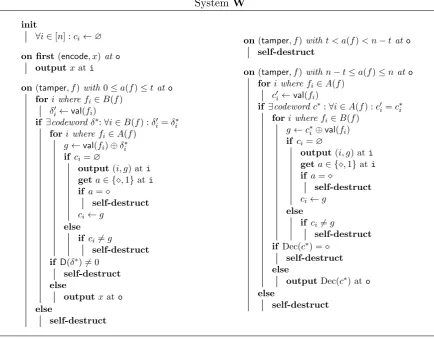
Figure 3: The wrapper system W. The command self -destructcauses Wto output at oand to answer all future queries by . The symbol ∅stands for “undefined.”
Therefore, ˆB ≡g Bˆ0 and ∆D(B,B0) ≤ ΓD( ˆB0). Observe that by an argument similar to the one
above, adaptivity does not help in provoking the MBO of ˆB0. Thus, ΓD( ˆB0) ≤2−t, since an optimal non-adaptive strategy simply tries to guess distinct positions.
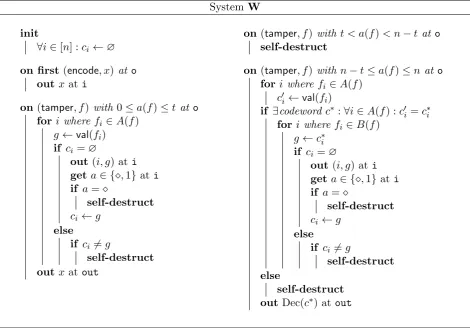
Recall that the purpose of the wrapper system W is to emulate H and SsimuF,τ using B and B0, respectively. The key point is to note that low queries f can be answered knowing only the positions
A(f) of Enc(x), high queries knowing only the positions in B(f), and middle queries can always be rejected. A full description ofW can be found in Figure 3. It has an outside interfaceoand an inside interfacei; at the latter interface, W expects to be connected to eitherB orB0.
Lemma 6. WB≡H.
Proof. Since the distance of the LECSS is d > t, the following holds: A low query results in same if all injected positions match the corresponding bits of the encoding, and in otherwise. Similarly, for a high query, there can be at most one codeword that matches the injected positions. If such a codeword c∗ exists, the outcome is Dec(c∗) if the bits in the keep-positions matchc∗, and otherwise . By inspection, it can be seen that W acts accordingly.
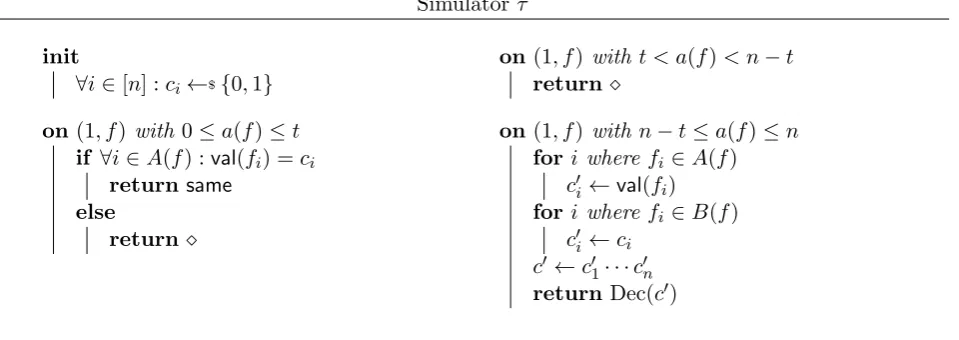
Consider now the system WB0. Due to the nature of B0, the behavior of WB0 is independent of the value x that is initially encoded. This allows to easily design a simulator τ as required by Definition 3. A full description of τ can be found in Figure 4.
Simulatorτ init
∀i∈[n] :ci←${0,1} on(1, f) with 0≤a(f)≤t
if ∀i∈A(f) :val(fi) =ci
return same
else
return
on (1, f) with t < a(f)< n−t
return
on (1, f) with n−t≤a(f)≤n foriwhere fi∈A(f)
c0i←val(fi)
foriwhere fi∈B(f)
c0i←ci
c0←c01· · ·c0n returnDec(c0)
Figure 4: The simulatorτ.
Proof. Consider the systems WB0 and SsimuF,τ . Both internally choose uniform and independent bits
c1, . . . , cn. SystemWB0 answers low queries with the valuexinitially encoded if all injected positions
match the corresponding random bits and with otherwise. Simulator τ returns same in the former case, whichSsimuF,τ replaces by x, and in the latter case.
Observe that the answer by WB0 to a high query f always matches Dec(c01· · ·c0n), where for
i∈ A(f), c0i =val(fi), and for i∈ B(f), c0i =ci: If no codeword c∗ matching the injected positions
exists, then Dec(c01· · ·c0n) =, which is also what WB0 outputs. If such c∗ exists and c∗i =ci for all
i∈B(f), the output of WB0 is Dec(c01· · ·c0n). If there exists ani∈B(f) withc∗i 6=ci,WB0 outputs
, and in this case Dec(c01· · ·c0n) =since the distance of the LECSS isd > t. The proof of Theorem 3 now follows from a simple triangle inequality.
Proof (of Theorem 3). From Lemmas 4, 5, 6, and 7, one obtains that for all distinguishersD, ∆D(SrealF ,SsimuF,τ )≤∆D(SrealF ,H) + ∆D(H,WB)
| {z }
=0
+ ∆D(WB,WB0)
| {z }
=∆DW(B,B0)
+ ∆D(WB0,SsimuF,τ )
| {z }
=0
≤2−t+
t n(d/n−1/4)2
t/2
+ 2−t≤2−(t−1)+
t n(d/n−1/4)2
t/2
.
References
[1] Divesh Aggarwal, Yevgeniy Dodis, Tomasz Kazana, and Maciej Obremski. Non-malleable re-ductions and applications. Cryptology ePrint Archive, Report 2014/821, 2014. http://eprint.
iacr.org/.
[2] Divesh Aggarwal, Yevgeniy Dodis, and Shachar Lovett. Non-malleable codes from additive com-binatorics. InSTOC, pages 774–783, 2014.
[3] Divesh Aggarwal, Stefan Dziembowski, Tomasz Kazana, and Maciej Obremski. Leakage-resilient non-malleable codes. Cryptology ePrint Archive, Report 2014/807, 2014. http://eprint.iacr. org/. To appear in TCC 2015.
[4] Shashank Agrawal, Divya Gupta, Hemanta K. Maji, Omkant Pandey, and Manoj Prabhakaran. Explicit non-malleable codes resistant to permutations and perturbations. Cryptology ePrint Archive, Report 2014/841, 2014. http://eprint.iacr.org/.
[5] Shashank Agrawal, Divya Gupta, Hemanta K. Maji, Omkant Pandey, and Manoj Prabhakaran. Explicit optimal-rate non-malleable codes against bit-wise tampering and permutations. Cryp-tology ePrint Archive, Report 2014/842, 2014. http://eprint.iacr.org/. To appear in TCC 2015.
[6] Ran Canetti, Hugo Krawczyk, and Jesper Buus Nielsen. Relaxing chosen-ciphertext security. In CRYPTO, pages 565–582, 2003.
[7] Eshan Chattopadhyay and David Zuckerman. Non-malleable codes against constant split-state tampering. InFOCS, pages 306–315, 2014.
[8] Mahdi Cheraghchi and Venkatesan Guruswami. Capacity of non-malleable codes. InITCS, pages 155–168, 2014.
[9] Mahdi Cheraghchi and Venkatesan Guruswami. Non-malleable coding against bit-wise and split-state tampering. InTCC, pages 440–464, 2014.
[10] Seung Geol Choi, Dana Dachman-Soled, Tal Malkin, and Hoeteck Wee. Black-box construction of a non-malleable encryption scheme from any semantically secure one. InTCC, pages 427–444, 2008.
[11] Seung Geol Choi, Aggelos Kiayias, and Tal Malkin. BiTR: Built-in tamper resilience. In ASI-ACRYPT, pages 740–758, 2011.
[12] Sandro Coretti, Ueli Maurer, and Bj¨orn Tackmann. Constructing confidential channels from authenticated channels - public-key encryption revisited. In ASIACRYPT (1), pages 134–153, 2013.
[13] Sandro Coretti, Ueli Maurer, Bj¨orn Tackmann, and Daniele Venturi. From single-bit to multi-bit public-key encryption via non-malleable codes. IACR Cryptology ePrint Archive, 2014:324, 2014. [14] Ronald Cramer, Yevgeniy Dodis, Serge Fehr, Carles Padr´o, and Daniel Wichs. Detection of algebraic manipulation with applications to robust secret sharing and fuzzy extractors. In EU-ROCRYPT, pages 471–488, 2008.
[16] Ronald Cramer and Victor Shoup. A practical public key cryptosystem provably secure against adaptive chosen ciphertext attack. In Hugo Krawczyk, editor, CRYPTO 1998, volume 1462 of LNCS, pages 13–25, Heidelberg, 1998. Springer.
[17] Dana Dachman-Soled. A black-box construction of a CCA2 encryption scheme from a plaintext aware encryption scheme. In Hugo Krawczyk, editor,PKC, LNCS. Springer, 2014.
[18] Dana Dachman-Soled, Feng-Hao Liu, Elaine Shi, and Hong-Sheng Zhou. Locally decodable and updatable non-malleable codes and their applications. Cryptology ePrint Archive, Report 2014/663, 2014. http://eprint.iacr.org/. To appear in TCC 2015.
[19] Ivan Damg˚ard, Sebastian Faust, Pratyay Mukherjee, and Daniele Venturi. Bounded tamper resilience: How to go beyond the algebraic barrier. InASIACRYPT (2), pages 140–160, 2013. [20] Ivan Damg˚ard, Sebastian Faust, Pratyay Mukherjee, and Daniele Venturi. The chaining lemma
and its application. Cryptology ePrint Archive, Report 2014/979, 2014. http://eprint.iacr. org/.
[21] Whitfield Diffie and Martin E. Hellman. New directions in cryptography. IEEE Transactions on Information Theory, 22(6):644–654, 1976.
[22] Stefan Dziembowski, Tomasz Kazana, and Maciej Obremski. Non-malleable codes from two-source extractors. In CRYPTO (2), pages 239–257, 2013.
[23] Stefan Dziembowski, Krzysztof Pietrzak, and Daniel Wichs. Non-malleable codes. In ICS, pages 434–452, 2010.
[24] Taher ElGamal. A public key cryptosystem and a signature scheme based on discrete logarithms. InCRYPTO, pages 10–18, 1984.
[25] Sebastian Faust, Pratyay Mukherjee, Jesper Buus Nielsen, and Daniele Venturi. Continuous non-malleable codes. InTCC, pages 465–488, 2014.
[26] Sebastian Faust, Pratyay Mukherjee, Jesper Buus Nielsen, and Daniele Venturi. A tamper and leakage resilient von Neumann architecture. IACR Cryptology ePrint Archive, 2014:338, 2014. To appear in PKC 2015.
[27] Sebastian Faust, Pratyay Mukherjee, Daniele Venturi, and Daniel Wichs. Efficient non-malleable codes and key-derivation for poly-size tampering circuits. InEUROCRYPT, pages 111–128, 2014. [28] Eiichiro Fujisaki, Tatsuaki Okamoto, David Pointcheval, and Jacques Stern. RSA-OAEP is secure under the RSA assumption. In Joe Kilian, editor,CRYPTO 2001, volume 2139 of LNCS, pages 260–274, Heidelberg, 2001. Springer.
[29] Rosario Gennaro, Anna Lysyanskaya, Tal Malkin, Silvio Micali, and Tal Rabin. Algorithmic tamper-proof (ATP) security: Theoretical foundations for security against hardware tampering. InTCC, pages 258–277, 2004.
[30] Yael Gertner, Tal Malkin, and Steven Myers. Towards a separation of semantic and CCA security for public key encryption. In TCC, pages 434–455, 2007.
[31] Shafi Goldwasser and Silvio Micali. Probabilistic encryption. J. Comput. Syst. Sci., 28(2):270– 299, 1984.
[33] Susan Hohenberger, Allison B. Lewko, and Brent Waters. Detecting dangerous queries: A new approach for chosen ciphertext security. InEUROCRYPT, pages 663–681, 2012.
[34] Zahra Jafargholi and Daniel Wichs. Tamper detection and continuous non-malleable codes. Cryp-tology ePrint Archive, Report 2014/956, 2014. http://eprint.iacr.org/. To appear in TCC 2015.
[35] Eike Kiltz, Krzysztof Pietrzak, Martijn Stam, and Moti Yung. A new randomness extraction paradigm for hybrid encryption. In Antoine Joux, editor, EUROCRYPT 2009, volume 5479 of LNCS, pages 590–609, Heidelberg, 2009. Springer.
[36] Markulf Kohlweiss, Ueli Maurer, Cristina Onete, Bj¨orn Tackmann, and Daniele Venturi. Anonymity-preserving public-key encryption: A constructive approach. In Privacy Enhancing Technologies, pages 19–39, 2013.
[37] Huijia Lin and Stefano Tessaro. Amplification of chosen-ciphertext security. In EUROCRYPT, pages 503–519, 2013.
[38] Feng-Hao Liu and Anna Lysyanskaya. Tamper and leakage resilience in the split-state model. In CRYPTO, pages 517–532, 2012.
[39] Ueli Maurer. Constructive cryptography - a new paradigm for security definitions and proofs. In TOSCA, pages 33–56, 2011.
[40] Ueli Maurer. Conditional equivalence of random systems and indistinguishability proofs. In2013 IEEE International Symposium on Information Theory Proceedings (ISIT), pages 3150–3154, 2013.
[41] Ueli Maurer and Renato Renner. Abstract cryptography. In ICS, pages 1–21, 2011.
[42] Ueli Maurer, Andreas R¨uedlinger, and Bj¨orn Tackmann. Confidentiality and integrity: A con-structive perspective. InTCC, pages 209–229, 2012.
[43] Ueli Maurer and Pierre Schmid. A calculus for security bootstrapping in distributed systems. Journal of Computer Security, 4(1):55–80, 1996.
[44] Ueli Maurer and Bj¨orn Tackmann. On the soundness of authenticate-then-encrypt: formalizing the malleability of symmetric encryption. InACM Conference on Computer and Communications Security, pages 505–515, 2010.
[45] Ueli M. Maurer. Indistinguishability of random systems. InEUROCRYPT, pages 110–132, 2002. [46] Steven Myers, Mona Sergi, and Abhi Shelat. Blackbox construction of a more than non-malleable CCA1 encryption scheme from plaintext awareness. In Ivan Visconti and Roberto De Prisco, editors,Security and Cryptography for Networks, volume 7485 ofLNCS, pages 149–165. Springer, 2012.
[47] Steven Myers and Abhi Shelat. Bit encryption is complete. In FOCS, pages 607–616, 2009. [48] Chris Peikert and Brent Waters. Lossy trapdoor functions and their applications. SIAM J.
Comput., 40(6):1803–1844, 2011.
[49] Ronald L. Rivest, Adi Shamir, and Leonard M. Adleman. A method for obtaining digital signa-tures and public-key cryptosystems (reprint). Commun. ACM, 26(1):96–99, 1983.
A The Composition Theorem of Constructive Cryptography
The main statement we prove in the main paper shows the security of one protocol step in isolation, i.e., we show for the non-malleable code that it constructs the multi-bit confidential channel from multiple assumed single-bit confidential channels. The composition theorem now states that two such construction steps can be composed: If one (lower-level) protocol constructs the resource that is assumed by the other (higher-level) protocol, then the composition of those two protocols constructs the same resource as the higher-level protocol, but from the resources assumed by the lower-level protocol, under the assumptions that occur in (at least) one of the individual security statements.
The composition theorem was first explicitly stated in [44], but the statement there was restricted to asymptotic settings. Later, in [36], the theorem was stated in a way that also allows to capture concrete security statements. The proof, however, still follows the same steps as the one in [44].
To state the theorem, we make use of a special converterid that behaves transparently (i.e., allows access to the underlying interface of the resource). Furthermore, we assume the operation [·, . . . ,·] to be left-associative; in this way we can simply express multiple resources using the single variableU.
Theorem 8. Let R,S,T,U∈Φ be resources. Let π= (π1, π2) andψ= (ψ1, ψ2) be protocols, σπ and
σψ be simulators, and(ε1π, ε2π), (ε1ψ, ε2ψ) such that
R (π,σπ,(ε 1
π,ε2π))
==⇒ S and S
(ψ,σψ,(ε1ψ,ε2ψ))
==⇒ T.
Then
R (α,σα,(ε 1
α,ε2α))
==⇒ T
with α = (ψ1 ◦π1, ψ2◦π2), σα = σπ ◦σψ, and εiα(D) = εiπ(DσψE) +εiψ(DπA1πB2), where DσψE and
DπA1π2B mean that D applies the converters at the respective interfaces. Moreover
[R,U] ([π,(id,id)],[σπ,id],(¯ε
1
π,ε¯2π))
==⇒ [S,U],
with ε¯iπ(D) = εiπ(D[·,U]), where D[·,U] means that the distinguisher emulates U in parallel. (The analogous statement holds with respect to [U,R] and [U,S].)
B Channel Resources
From the perspective of constructive cryptography, the purpose of a public-key encryption scheme is to construct a confidential channel from non-confidential channels. A channel is a resource that involves a senderA, a receiverB, and—to model channels with different levels of security—an attackerE. The main types of channels relevant to this work are defined below with respect to interface set{A, B, E}. All channels are parametrized by a message space M ⊆ {0,1}∗, which is only made explicit in the confidential channel (see below), however.
Insecure multiple-use channel. The insecure channel − →→ transmits multiple messagesm∈ M and corresponds to, for instance, communication via the Internet. If no attacker is present (i.e., in case ⊥E− →→), then all messages are transmitted from A to B faithfully. Otherwise (for − →→), the
communication can be controlled via the E-interface, i.e., the attacker learns all messages input at the A-interface and chooses the messages to be output at the B-interface. The channel is described in more detail in Figure 5.
Channel ⊥E− →→
onmatA
outputmatB
Channel− →→ onmatA
output(msg, m) atE
on(inj, m)atE
outputmatB
Figure 5: Insecure, multiple-use communication channel fromA toB.
ever be delivered). The channel guarantees thatif a message is delivered toB,then this message was input by A before. There are different constructions that result in the channel •−→, based on, for instance, MACs or signature schemes.
Channel⊥E•−→
on firstmatA
outputmatB
Channel •−→ on firstmatA
output(msg, m) atE
on firstdlvatE
outputmatB(if defined)
Figure 6: Authenticated, single-use communication channel fromA toB.
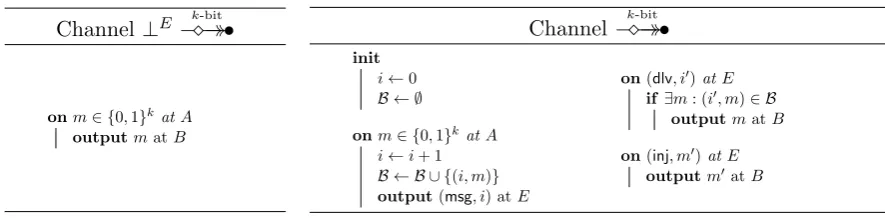
Confidential multiple-use channel. Thek-bit confidential channel−→k-bit→•allows to transmit mul-tiple messages m ∈ {0,1}k. If no attacker is present (i.e., in case ⊥E −→k-bit→•), then all messages are
transmitted from A to B faithfully. Otherwise (for −→k-bit→•), all messages m ∈ {0,1}k input at the
A-interface are stored in a buffer B.10 The attacker can then choose messages from the buffer B (by
using an index) to be delivered at theB-interface, or inject messages from {0,1}kwhich are then also
output at the B-interface. Note that E cannot inject messages that depend on those in B, i.e., the confidential channel is non-malleable. It is described in more detail in Figure 7.
Channel ⊥E −→k-bit→•
onm∈ {0,1}k atA
outputmatB
Channel −→k-bit→• init
i←0
B ← ∅
onm∈ {0,1}k atA
i←i+ 1
B ← B ∪ {(i, m)}
output(msg, i) atE
on(dlv, i0)atE
if ∃m: (i0, m)∈ B
outputmatB
on(inj, m0)atE
outputm0atB
Figure 7: Confidential, multiple-use k-bit channel from AtoB.
C Non-Malleable Codes and the One-Time Pad
C.1 The Malleability of the One-Time Pad
The one-time pad encryption scheme is strongly malleable: If a transmitted ciphertext e ∈ {0,1}n
(corresponding to some message m ∈ {0,1}n) is replaced by a different ciphertexte0 ∈ {0,1}n, then
the decryption of e0 will result in m⊕(e⊕e0). From the attacker’s perspective, the one-time pad is XOR-malleable: By replacing the ciphertextebye⊕δ for someδ ∈ {0,1}n, he can maul the plaintext
from m intom⊕δ.
This circumstance is captured by the XOR-malleable channel (an {A, B, E}-resource), described in Figure 8. It allows the senderAto input a single message m. If no attacker is present (i.e., in case ⊥E −−⊕→•n-bit ), m is simply output atB. Otherwise (for −−⊕→•n-bit ), the attacker at interface E can specify
a maskδ to be added to the plaintext m.
Channel ⊥E −−⊕→•n-bit
on firstm∈ {0,1}natA
outputmatB
Channel −−⊕→•n-bit on firstm∈ {0,1}natA
output(msg,1) atE
on first(xor, δ)atE
outputm⊕δatB(if defined)
Figure 8: The XOR-malleable channel from AtoB.
Let •===n-bit• be the resource that outputs a uniformly random n-bit key at A and B and offers no functionality at E. Additionally, let −→ and −→• the single-use versions of − →→ and −→→•, respectively (cf. Section B). Moreover, consider the (straight-forward) protocolotp= (otp-enc,otp-dec) that implements one-time pad encryption. Then,
[•===n-bit•,−→] ==otp⇒ −−⊕→•n-bit . (7) The proof of (7) is a restricted case of [44, Lemma 2].
C.2 Getting Rid of the Malleability
One can overcome the malleability described above using a non-malleable code secure against the class Fbit of tampering functions that modify every bit independently.11 Thus, assume there exists a (k, n)-coding scheme (Enc,Dec) that is (Fbit,1,1, ε)-non-malleable for some ε > 0 (according to Definition 3),12 and consider the following protocol nmc = (encode,decode): Converter encode, ob-taining a message m ∈ {0,1}k at its outside interface, computes c←$Enc(m) and outputs c at its
inside interface; converter decode, obtaining a message c0 ∈ {0,1}n at its inside interface, computes
m0 ←Dec(c0) and outputsm0 at its outside interface.
Theorem 9. Assume that (Enc,Dec) is a (k, n)-coding scheme and (Fbit, ε)-non-malleable. Then, there exists a simulator σ such that
n-bit
−−⊕→• (nmc==,σ,⇒(0,ε)) −→•k-bit .
Proof. The availability condition holds by the correctness of the code.
Let F := Fbit, SrealF := SrealF,1,1 and SsimuF,τ := SsimuF,τ,1,1, where τ is the simulator guaranteed to exist
by Definition 3. Note that a function f ∈ F can be characterized by a vector χ(f) = (f1, . . . , fn)
where fi ∈ {zero,one,keep,flip}, with the meaning that f takes as input a codeword cand outputs a
codewordc0 =c01· · ·c0n in which each bit is either set to 0 (zero), set to 1 (one), left unchanged (keep), or flipped (flip).
Consider the following simulator σ (based onτ), which simulates the E-interface of −−⊕→•n-bit at its outside interface: When it receives (msg,1) at the inside interface, it outputs (msg,1) at the outside interface. When it gets (xor, δ) with δ =δ1· · ·δn at the outside interface, it computes x0←$τ(1, f),
wheref is the function such thatχ(f) = (f1, . . . , fn) for
fj :=
(
keep ifδj = 0, and
flip ifδj = 1.
Ifx= (same,1),σ outputs (dlv,1) at the inside interface, and otherwise, it outputs (inj, x).
Consider the following reduction C, which provides interfaces A, B, and E on the outside and expects to connect to either SrealF or SsimuF,τ on the inside: When a message m is input at the A -interface, Coutputs (msg,1) at theE interface. When (xor, δ) is input at interface E, it computesf 11The proof below makes apparent that one would in fact only need a non-malleable code secure against tampering functions that either keep or flip each bit of the encoding independently.
12
This is a slight abuse of notation, sinceFbitis just a single family of tamper functions and not a sequence thereof.

![Figure 2: Left: The assumed resource [−⋄→1-→•bit]n with protocol converters encode and decode attachedto interfaces A and B, denoted encodeAdecodeB[−⋄→1-→•bit]n](https://thumb-us.123doks.com/thumbv2/123dok_us/7917056.1314576/11.595.99.500.76.219/figure-assumed-resource-protocol-converters-attachedto-interfaces-encodeadecodeb.webp)