Final Project Report
Working together to include potable water
recycling in Source Development Planning
A report of a study funded by the
Australian Water Recycling Centre of Excellence
Governance, Decision-Making and Pricing
(Sub-Stream 2.4)
This report has been prepared as part of the National Demonstration Education and Engagement Program (NDEEP). This Program has developed a suite of high quality, evidence-based information, tools and engagement strategies that can be used by the water industry when considering water
recycling for drinking purposes. The products are fully integrated and can be used at different phases of project development commencing at “just thinking about water recycling for drinking water purposes as an option” to “nearly implemented”.
Sub-Stream Project Leaders
Dr John Marsden, Director Rod Carr, Associate Director Marsden Jacob Associates 3/683 Burke Rd
Camberwell VIC 3124 AUSTRALIA Telephone: +61 3 9882 1600
Contact: Dr John Marsden [[email protected]] Rod Carr [[email protected]]
About the Australian Water Recycling Centre of Excellence
The mission of the Australian Water Recycling Centre of Excellence is to enhance management and use of water recycling through industry partnerships, build capacity and capability within the recycled water industry, and promote water recycling as a socially, environmentally and
economically sustainable option for future water security.
The Australian Government has provided $20 million to the Centre through its National Urban Water and Desalination Plan to support applied research and development projects which meet water recycling challenges for Australia’s irrigation, urban development, food processing, heavy industry and water utility sectors. This funding has levered an additional $40 million investment from more than 80 private and public organisations, in Australia and overseas.
ISBN 978-1-922202-13-0 ACN 072 233 204
© Australian Water Recycling Centre of Excellence
This work is copyright. Apart from any use permitted under the Copyright Act 1968, no part of it may be reproduced by any purpose without the written permission from the publisher. Requests and inquiries concerning reproduction right should be directed to the publisher.
Date of publication: [July 2014]
Publisher:
Australian Water Recycling Centre of Excellence Level 5, 200 Creek St, Brisbane, Queensland 4000 www.australianwaterrecycling.com.au
This report was funded by the Australian Water Recycling Centre of Excellence through the Australian Government’s National Urban Water and Desalination Plan.
Disclaimer
F
INAL
J
ULY
2014
Working together to include Potable Water
Recycling in Source Development Planning
The case for long-term engagement with
decision-making stakeholders
Marsden Jacob Associates
Financial & Economic Consultants ABN 66 663 324 657
ACN 072 233 204
Internet: http://www.marsdenjacob.com.au E-mail: [email protected] Melbourne office:
Postal address: Level 3, 683 Burke Road, Camberwell Victoria 3124 AUSTRALIA
Telephone: +61 3 9882 1600 Facsimile: +61 3 9882 1300 Brisbane office:
Level 14, 127 Creek Street, Brisbane Queensland, 4000 AUSTRALIA Telephone: +61 7 3229 7701 Facsimile: +61 7 3229 7944 Perth office:
Level 1, 220 St Georges Terrace, Perth Western Australia, 6000 AUSTRALIA Telephone: +61 8 9324 1785 Facsimile: +61 8 9322 7936 Sydney office:
119 Willoughby Road Crows Nest NSW 2068 Telephone: +61 418 765 393
Authors: Rod Carr, [email protected] John Marsden, [email protected]
This report has been prepared in accordance with the scope of services described in the contract or agreement between Marsden Jacob Associates Pty Ltd ACN 072 233 204 (MJA) and the Client. Any findings, conclusions or recommendations only apply to the aforementioned circumstances and no greater reliance should be assumed or drawn by the Client. Furthermore, the report has been prepared solely for use by the Client and Marsden Jacob Associates accepts no responsibility for its use by other parties.
MARSDEN JACOB ASSOCIATES
T
ABLE OFC
ONTENTSPage
1. Introduction ... 1
1.1 Governance Case Studies ... 1
1.2 Purpose and objectives ... 4
1.3 This Report ... 5
2. Project Need: Why Governance Matters ... 6
2.1 The policy context ... 6
2.2 National Urban Water Planning Principles... 7
2.3 The case for potable water recycling ... 7
2.4 The time is right for long term engagement on governance ... 8
3. Potable Water Recycling Decision-making ... 10
3.1 Long-term engagement: a potable water recycling pre-requisite ... 11
3.2 Stage 1: Pre-feasibility ... 12
3.3 Stage 2: Develop the approvals process ... 14
3.4 Stage 3: Source development plans (the longer term outcome) ... 17
4. Timelines and Potential Benefits ... 20
4.1 Timelines ... 20
4.2 Benefits and risks... 21
4.3 In conclusion... 22
L
IST OFT
ABLES Page Table 1: Dam Storage Levels (Capital Cities), 2014 ... 9Table 2: Stage 1 (Pre-Feasibility), Key Issues for Consideration ... 13
Table 3: Stage 2 (Developing the Approvals Process), Key Issues for Consideration ... 15
Table 4: Service providers, agencies and coordination groups identified in the ACT, SEQ and WA case studies ... 16
Table 5: Stage 3 (Source Development Planning), Key Issues for Consideration ... 19
L
IST OFF
IGURES Page Figure 1: Supply cost of alternative water sources, various locations around Australia (Levelised Costs, 2012) ... 8Figure 2: Planning stages for infrastructure projects ... 10
Figure 3: Timeline ... 20
Australian Water Recycling Centre of Excellence
Long-term engagement on governance and decision-making
1.
1.
Introduction
The Australian Water Recycling Centre of Excellence commissioned research under Goal 3 of its Strategic Research Plan to examine, understand and develop approaches to remove impediments to the acceptance of potable recycled water in Australia.
The overarching aim of Goal 3 is that “Reclaimed water is seen as an acceptable ‘alternative water’ for augmenting drinking water supplies”.1
To achieve Goal 3, a consortium of organisations is working with the Australian water industry to develop a national demonstration, education and engagement program that supports successful public engagement and addresses stakeholder concerns (in particular the media, policy makers, community and politicians) through the provision of contemporary information on potable water recycling as a viable supply option.
As part of this project (sub-stream 2.4), Marsden Jacob Associates undertook research into governance, decision-making and pricing related impediments to investment in potable water recycling facilities, compared with alternative water supplies.
For this purpose of this project we have defined governance as encompassing political, regulatory, policy and institutional arrangements at all levels of water resource planning (both formal and informal) in Australia.
1.1
Governance Case Studies
The foundation of the Marsden Jacob research was three case studies that developed a decision-making timeline, storyline and narrative, for each case study location. The case studies can be accessed by clicking on the following links:
Western Corridor Recycled Water Scheme in South East Queensland Water Purification in the Australian Capital Territory
Groundwater Replenishment in Perth, Western Australia
South East Queensland – Case Study 1
The Western Corridor Recycled Water Project is a $2.4 billion project built over 2007 and 2008 in South East Queensland (SEQ). The project is a component of the $6.9 billion SEQ water supply network and it has the capacity to deliver over 80 gigalitres per annum of potable recycled water. This is nearly 30 percent of the total water production across SEQ in 2012-13, which was around 276 gigalitres2.
The case study confirmed the critical importance of governance arrangements as they relate to water source augmentation. The key findings from the case study include:
1 Australian Water Recycling Centre of Excellence, Strategic Research Plan, www.australianwaterrecycling.com.au/strategic-research-plan.html, accessed 10 June 2014
2
Australian Water Recycling Centre of Excellence
Long-term engagement on governance and decision-making
2.
1. In simple terms, drought pushed the acceptance of recycled water and the breaking of the drought permitted its rejection. Moreover, the case study shows that emergency driven decision-making is unlikely to result in good decisions. Particularly when, the magnitude of the investment means that manufactured water facilities (i.e., desalination or recycled water) cannot be planned and developed quickly. So they need to be part of a systematic supply augmentation planning process ahead of any emergency situation.
2. Water planning and supply is a critical responsibility and function. In addition to ensuring clarity of objectives and roles, accountability and authority must be adequate and matched and the entities must have the financial capacity. In South East Queensland, the initial lack of clear authority and fragmentation of water supply planning (across numerous local governments) meant the project decisions and implementation had to be elevated to the Coordinator-General. This took time and inadvertently exacerbated the depth of the water supply crisis. The Coordinator-General was necessarily focused on facilitating the delivery of the project. Unfortunately, with the benefit of hindsight, there was insufficient attention paid to messaging, communication with regulators and information provision to the public.
3. The regulatory obligations should be mapped early in the process, to confirm that there is role clarity and stability across the key regulators and their role vis-à-vis other institutions is agreed and understood. Thus it should clearly identify who holds legislated decision-responsibilities (e.g. project, environmental, health approvals) as well as non-regulatory decision-influencers (e.g. guidelines). These approvals were sought very late in the South East Queensland process.
4. The infrastructure to manufacture water (whether desalination or water recycling) is considerably more expensive to operate than traditional water supplies (dams). As a result, the pricing implications need to be considered up front and the potential for operational flexibility needs to be considered at the outset.
Australian Capital Territory – Case Study 2
In the midst of the millennium drought, the Australian Capital Territory (ACT) seriously and ultimately systematically considered the development of a recycled water facility and other options. This option was progressed to a ‘detailed design’ stage. However, ‘climate dependent’ options were ultimately selected because they were deemed to be more cost-effective on initial cost estimates (Cotter dam: initially $150 million, but ultimately cost over $400 million) and technical constraints (particularly brine disposal) were difficult to overcome. Despite not progressing with the development of a water recycling facility, the case study confirmed the critical importance of governance arrangements as they relate to water source augmentation. The key findings from the ACT case study include:
1. Clarity and transparency around regulatory responsibilities is important to achieving time and cost efficient decision-making. In the case of the ACT there was initially some uncertainty around regulators authority, which (some) stakeholders believe led to competition between regulators, and between them and other parties.
Australian Water Recycling Centre of Excellence
Long-term engagement on governance and decision-making
3.
Executives Water Group and the Expert Panel on Health). These activities undoubtedly improved the information available to decision-makers, but the delays inadvertently contributed to the depth of the water crisis.
3. Regulations, policies and decision-making processes need to be coherent and integrated. When designing the regulatory regime for water recycling it needs to be economical and trust building, with decision-makers in each of the sectors focused on their specific issues. Perth, Western Australia – Case Study 3
Whereas in SEQ and the ACT consideration of potable recycled water was prompted by the emergency of sustained drought. In Western Australia it has been actively considered for the last two decades and progressed to a point where potable water recycling has been trialled, is publically recognised and is now approved as the:
“next new climate independent water source for Perth”3. The key findings from the Perth case study include:
1. Understand and exploit your natural advantages. Perth’s natural advantages include a clear climate signal which necessitated and facilitated a move to ‘climate independent’
sources, a significant groundwater resource which buffers supplies and the fact that multiple small augmentation increments could be developed.
2. Understand your institutional advantages. Perth’s water supply is managed by a stable
and large water supply institution (Water Corporation) that can provide quality services and build stakeholder trust. The Water Corporation’s ability to provide high quality
customer service is important for trust building: “one man’s gold plating is another man’s trust building activity”.
3. Know your decision makers and regulators. If decision processes are unclear, put in place actions to clarify and resolve decision-making arrangements, and thus empower regulators to make decisions and share communication responsibilities (where appropriate). In Perth, a groundwater replenishment trial has been implemented to provide a context for regulators to develop health and environmental regulation and water allocation policy for groundwater replenishment.
4. Long term engagement (two way dialogue) with water service providers and decision-makers on water source planning can help depoliticise the planning process. A number of stakeholders observed that “effective engagement can help depoliticise the water source decision process and build customer trust”. A number of stakeholders also observed that the Memorandum of Understanding between the Department of Health and Water Corporation facilitates the engagement process and is potentially a model of best practice. 5. Don’t depend on a single supply augmentation solution. If the preferred solution isn’t
approved you need to have backup plans and you need to be actively communicating the
cost, price and water security implications of the ‘Plan B’ scenario to decision-makers. 6. Recycled water should not, at least initially, be intended to supply a large proportion of the
drinking water supply. In Perth, groundwater replenishment is currently only intended to “contribute about 10 percent of our total water supply”. This approach replicates the strategy adopted in Singapore for NEWater.
Australian Water Recycling Centre of Excellence
Long-term engagement on governance and decision-making
4.
7. Terminology is very location specific. The decision to call the trial a ‘Groundwater Replenishment Trial’ was taken following extensive consultation. It is understood that a
range of other terms were also considered (such as recycled water, purified water and drinking water), however, groundwater replenishment was ultimately selected for its transparency and because it built on the desire of local stakeholders to maintain the health
of Perth’s aquifers.
These three case studies provide strong lessons on what processes and institutional arrangements appear to work best, and similar lessons on what to avoid.
The findings and directions resulting from this body of work are complemented by earlier work such as the Council of Australian Governments (COAG) agreed National Urban Water Planning Principles (see Box 1) and the PMSEIC report Water for Our Cities: building resilience in a climate of uncertainty4.
1.2
Purpose and objectives
The overarching objective of this report is to help ensure that Australian cities have security of water supply at least cost and risk.
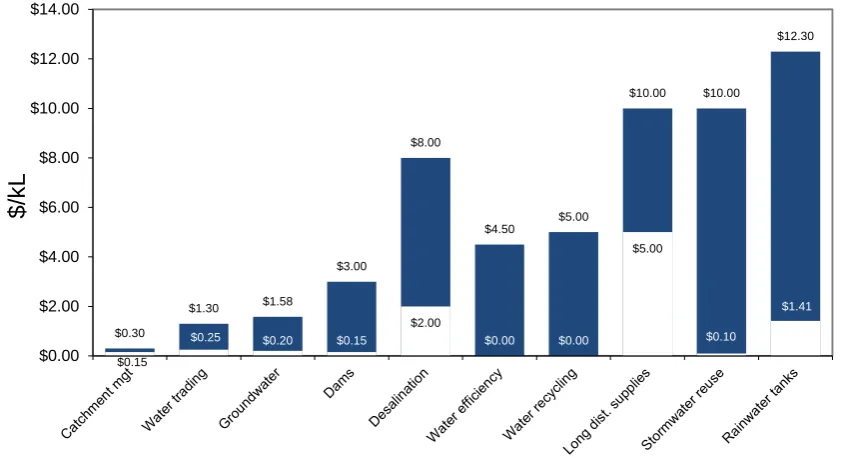
Potable water recycling is a potentially attractive option because it is: less climate dependent than traditional sources (such as dams); and potentially cheaper than other sources (such as desalination). Despite these potential advantages, unless potable recycling is objectively considered then it may be unnecessarily excluded for source portfolio consideration. This report is focused on two prime audiences:
1. Those responsible for water supply planning and delivery; and
2. Those responsible for reviewing and establishing on-going governance, regulatory and institutional arrangements for the water industry.
This report has been developed to put and keep all source development options ‘on the table’, so that potable water recycling is on the source development schedule where it is economic and is implemented when key trigger thresholds (population growth, water storage/supply constraint) are reached.
While Ministers are the ultimate decision-makers, the case studies have confirmed that regulators, and in particular health regulators, are critical to the deliberations on water recycling as a source augmentation option. Water resource planning for water recycling projects needs to pay careful attention to the obligations placed on health, environmental and economic regulators. It also needs to provide these regulators with a structured framework, trusted information and the opportunity to make timely and well informed decisions.
4 PMSEIC (2007) Water for Our Cities: building resilience in a climate of uncertainty,
Australian Water Recycling Centre of Excellence
Long-term engagement on governance and decision-making
5.
1.3
This Report
This report captures the key findings from the case studies and presents the case for water utilities and planning authorities to invest into a long term systematic and considered engagement with the key regulators. 5
This report was developed because the case study research found that governance and decision-making arrangements can emerge as a key impediment to potable water recycling projects being considered as a viable source augmentation alternative.
This document has been drafted using non-technical language, as it is intended to provide strategic guidance that is easily understood by technical and non-technical audiences. The structure of this report is:
Section 1: Introduction
Section 2: Project Need: Why Governance Matters Section 3: Decision-Making on Potable Water Recycling Section 4: Timelines and Potential Benefits
5 The report was developed in consultation with members of the project’s Industry Reference Group. These discussions
Australian Water Recycling Centre of Excellence
Long-term engagement on governance and decision-making
6.
2.
Project Need: Why Governance Matters
The project research has shown that many water planning agencies and water service providers are interested in the potential of potable water recycling as a source development option. However, many find it impossible to move from concept to reality.
2.1
The policy context
For instance, the Western Corridor Recycled Water Project was developed at a cost of $2.4 billion, but it was never implemented because of a lack of political commitment to the project. Elsewhere across eastern Australia a number of stakeholders interviewed as part of this project have confirmed that some governments are opposed to water recycling and this makes it “very difficult to even investigate the technical and economic viability of this source
alternative”.
In the case of South East Queensland, even when dam storage levels were below 30 percent and falling – potable water recycling was still viewed in 2006 by Premier Beatty as the “Armageddon solution”.
Governance factors contributing to the lack of potable water recycling as a water source option, include:
politicised decision-making that is influenced by media and advocacy campaigns, rather than informed by the considered advice of health and other regulators, water planners and economists. This is particularly obvious in South East Queensland where even when the infrastructure was in place there was a lack of political commitment to its operation for potable supply;
lack of consultation with the regulators and unclear responsibilities for decision-making on potable water recycling projects under existing legislative and institutional arrangements. This was a challenge in both South East Queensland (where decision-making had to be elevated to the Coordinator-General) and the Australian Capital Territory (where expert advisory groups were established to fill the perceived knowledge gaps); and
a perceived lack of local familiarity with the technology. This is a common issue for all three case study locations. However, the slower structured process in Western Australia allowed a trial to be implemented to test the technology, provide a context for regulators to develop health and environmental regulations, and raise awareness and seek
community input into groundwater replenishment as a future drinking water supply option6. Conversely, we note that where the technology is well known (e.g., dams and desalination) the regulatory arrangements, processes and pathways are generally well established which allows for easier decision-making.
This section presents the case for investment by the water industry in a long-term Governance Project that gets all water source options ‘on the table’.
6 Water Corporation (2011) Progress Report No 10, Groundwater Replenishment Trial Project,
Australian Water Recycling Centre of Excellence
Long-term engagement on governance and decision-making
7.
2.2
National Urban Water Planning Principles
In 2008, the Council of Australian Government agreed the National Urban Water Planning Principles (the Principles). The Principles were adopted by COAG, in the context of a decade or more of drought across much of Australia; a water industry under unprecedented pressure to meet the short-term water supply-demand imbalance; and growing recognition of the
potential impacts of climate change on long term water supplies.
Of particular relevance to this report, Principle 5, stipulates that water planners must: “consider the full portfolio of water supply and demand options”.
The Principles are summarised in Box 1. Despite this having been agreed at COAG, a number of stakeholders have revealed that some governments are either explicitly or implicitly
opposed to potable water recycling. This means that water utilities and planning departments find themselves unable to undertake even preliminary viability assessment of potable water recycling as a source development alternative, despite the fact that COAG has previously agreed that “all options should be on the table”.
Box 1: The National Urban Water Planning Principles
The National Urban Water Planning Principles were adopted by COAG in 2008, and were designed to improve planning for secure urban water supplies.
There are eight National Urban Water Planning Principles:
1. Deliver urban water supplies in accordance with agreed levels of service;
2. Base urban water planning on the best information available at the time and invest in acquiring information on an ongoing basis to continually improve the knowledge base.
3. Adopt a partnership approach so that stakeholders are able to make an informed contribution to urban water planning, including consideration of the appropriate supply/demand balance.
4. Manage water in the urban context on a whole-of-water-cycle basis. 5. Consider the full portfolio of water supply and demand options. 6. Develop and manage urban water supplies within sustainable limits.
7. Use pricing and markets, where efficient and feasible, to help achieve planned urban water supply/demand balance.
8. Periodically review urban water plans.
Source: www.environment.gov.au/topics/water/water-cities-and-towns/policy-and-reform-area-urban-water/national-urban-water-planning
2.3
The case for potable water recycling
Australian Water Recycling Centre of Excellence
Long-term engagement on governance and decision-making
8.
Figure 1: Supply cost of alternative water sources, various locations around Australia (Levelised Costs, 2012)
Source: Marsden Jacob analysis
2.4
The time is right for long term engagement on governance
Water utilities, planning departments and regulatory decision-makers have the opportunity to
commence the development of a ‘slow burn’ (long term) governance project that gets all
options on the table and avoids emergency decision-making when the next water shortage crisis emerges.
The case studies identify that if potable water recycling is only seriously considered when water security is threatened then it is very challenging for decision-makers to approve the construction or implement operation of potable water recycling infrastructure – emergency
doesn’t deliver. Agencies with responsibilities for water resource planning should therefore engage pre-emptively with health and other regulators well in advance of any was security threat.
Perth has been able to do this because of the groundwater buffer, but the opportunity is equally present across eastern Australia because there is currently no water supply shortage, so future water supply options can be carefully and strategically considered.
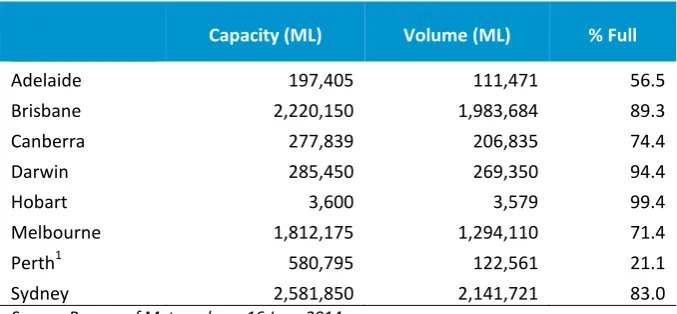
The opportunity to engage pre-emptively exists for capital cities across Australia. Table 1 shows that (as at June 2014) dam storage levels in most of Australia’s capital cities are above
75 percent and the only city with a dam storage level below 30 percent is Perth. Most of these cities have also developed ‘climate independent’ water supply infrastructure (desalination, water supply networks and water recycling), in response to the Millennium drought, which further improves their water security.
The time will come when water security re-emerges as a key issue, so the timing is ideal in many parts of Australia to commence a project that:
$0.30
$1.30 $1.58
$3.00
$8.00
$4.50
$5.00
$10.00 $10.00
$12.30
$0.15
$0.25 $0.20 $0.15
$2.00
$0.00 $0.00
$5.00
$0.10
$1.41
$0.00 $2.00 $4.00 $6.00 $8.00 $10.00 $12.00 $14.00
$
Australian Water Recycling Centre of Excellence
Long-term engagement on governance and decision-making
9.
1. assesses the technical and economic merit of water recycling;
2. investigates and maps the decision pathways on all source options; and
3. establishes cooperative and well informed engagement activities between decision-makers.
Table 1: Dam Storage Levels (Capital Cities), 2014
Capacity (ML) Volume (ML) % Full
Adelaide 197,405 111,471 56.5
Brisbane 2,220,150 1,983,684 89.3
Canberra 277,839 206,835 74.4
Darwin 285,450 269,350 94.4
Hobart 3,600 3,579 99.4
Melbourne 1,812,175 1,294,110 71.4
Perth1 580,795 122,561 21.1
Sydney 2,581,850 2,141,721 83.0
Australian Water Recycling Centre of Excellence
Long-term engagement on governance and decision-making
10.
3.
Potable Water Recycling Decision-making
The case studies reveal that decision-making on potable water recycling differs from other water sources, because:
health concerns are seen to be very different for water recycling when compared with dam, desalinated seawater or groundwater;
water recycling technology is relatively new and untested in parts of Australia; and there is a commonly held belief that it is easier for regulators and decision-makers to say
‘no’ when they are under-pressure or have doubts.
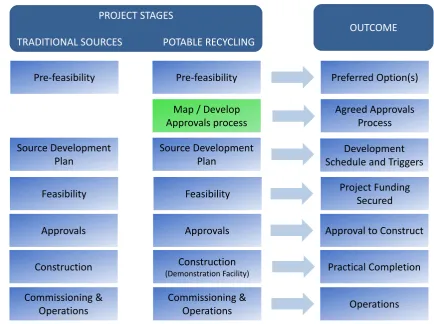
Figure 2 presents the typical planning stages for water source infrastructure projects for both traditional sources and potable water recycling. The key point to note is that when potable water recycling is being considered there is a new stage in the development process: mapping and developing the approvals process. This stage arises because the development of potable water recycling infrastructure in most Australian jurisdictions is novel, so established planning and decision processes and regulatory approval frameworks do not exist. But, it is important that these framework are developed, because traditional sources – which are an easier default option – may not be appropriate with declining surface water security.
As a result the governance, and in particular the regulatory approvals, process needs to be carefully considered, specified and agreed. There is little need for similar mapping for other water supply options, since most of them have been used many times before.
Figure 2: Planning stages for infrastructure projects
Source: Marsden Jacob Associates
PROJECT STAGES
TRADITIONAL SOURCES POTABLE RECYCLING
OUTCOME
Pre-feasibility Pre-feasibility Preferred Option(s)
Feasibility
Approvals
Construction Commissioning &
Operations
Agreed Approvals Process Map / Develop
Approvals process
Feasibility
Approvals Construction
(Demonstration Facility)
Commissioning & Operations
Project Funding Secured Approval to Construct
Practical Completion
Operations Source Development
Plan Source Development
Plan
Australian Water Recycling Centre of Excellence
Long-term engagement on governance and decision-making
11.
While only three in-depth case studies have been undertaken under the project this additional stage was found to be necessary in all three locations, and our prior experience confirms that it is equally relevant to many other locations across Australia that have not previously
implemented a potable water recycling project. Without this new stage having been completed the critical gaps in governance will not be revealed until it is too late.
3.1
Long-term engagement: a potable water recycling
pre-requisite
In this section we focus on the first three stages (in Figure 1) in further detail. The case studies have identified that to facilitate consideration of potable water recycling in source
development planning water service providers and water planning agencies need to pay particular attention to these stages, because it is at this point that governance related impediments to potable water recycling are most prevalent:
Stage 1: Pre-Feasibility
Stage 2: Map and Develop the Approvals Process
Evidence from the Case Studies
South East Queensland: Timely development of the SEQ Water Grid was only achieved by implementing emergency legislation to pass control to the Coordinator-General in the Department of Infrastructure, this should not be the default position:
o July 06 State Development and Public Works Organisation (Water Infrastructure
Project Board) Regulation 2006; and
o August 06 Water Amendment Regulation No.6 2006, under the Water Act 2000
Australian Capital Territory: Decision-making on potable water recycling as a source alternative was protracted because:
o ACT regulators and government didn’t have any prior experience with potable water; and thus
o it took a considerable period of time to realise that disposal of the brine stream
and dilution of the potable recycled water were critical technical constraints.
Western Australia: A Demonstration Groundwater Replenishment Trial was implemented over the period 2010 to 2012 to:
o provide a context for regulators to develop health and environmental regulation
and water allocation policy for a large groundwater replenishment scheme;
o demonstrate the technical feasibility of the approach to reliably deliver a safe,
sustainable and viable climate-independent drinking water source; and
o raise awareness and seek community input into groundwater replenishment as a
Australian Water Recycling Centre of Excellence
Long-term engagement on governance and decision-making
12.
Stage 3: Source Development Planning
The case studies revealed that each of these stages needs to be considered over an extended timeframe. The timeframe stretches well beyond political timeframes (3-4 years) and reflects the extended timeframes associated with:
Water source infrastructure decision-making and development: typically a 6-10+ year process depending on the nature, location and scope of the infrastructure;
The development of major water source infrastructure, which commonly exceeds 3-4 years from design commencement to commissioning; and
Water source infrastructure operating life, which can range from 25-30 years for
manufactured water facilities (desalination plants and potable water recycling facilities) up to 80+ years for surface water storages (dams).
Each of these stages is discussed in more detail below. We note that while not unique to water planning in Western Australia, this process has been successfully followed in Western Australia. In Western Australia it took 18 years for Groundwater replenishment to move from
concept to ‘next water source’.
3.2
Stage 1: Pre-feasibility
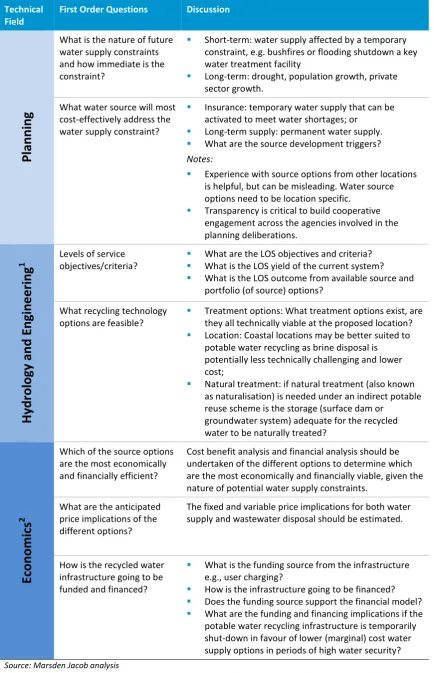
The purpose of the pre-feasibility stage (Stage 1) is to test whether potable water recycling is a viable source development alternative. The pre-feasibility stage focuses on identifying the: nature of future water supply constraints; technical solutions to address the constraint that meet level of service obligations; identifying the most economically, financially,
environmentally and socially beneficial source solutions and portfolios; and understanding the price implications of the different alternatives.
The pre-feasibility stage is critical because water utilities and water planning departments need to consider at the outset whether potable water recycling is technically viable and economically efficient. For instance, the ACT case study revealed that they spent a great deal of time investigating potable water recycling in the midst of a mounting water supply crisis, only to discover that brine disposal and dam storage capacity “for naturalisation of the potable recycled water” were critical physical constraints and were going to be highly expensive when compared with the (dramatically underestimated) cost of increasing the capacity of the Cotter Dam.
Key Considerations
Australian Water Recycling Centre of Excellence
Long-term engagement on governance and decision-making
13.
Table 2: Stage 1 (Pre-Feasibility), Key Issues for Consideration
Technical Field
First Order Questions Discussion
Plann
in
g
What is the nature of future water supply constraints and how immediate is the constraint?
Short-term: water supply affected by a temporary constraint, e.g. bushfires or flooding shutdown a key water treatment facility
Long-term: drought, population growth, private sector growth.
What water source will most cost-effectively address the water supply constraint?
Insurance: temporary water supply that can be activated to meet water shortages; or
Long-term supply: permanent water supply. What are the source development triggers?
Notes:
Experience with source options from other locations is helpful, but can be misleading. Water source options need to be location specific.
Transparency is critical to build cooperative engagement across the agencies involved in the planning deliberations.
Hydr
o
lo
gy
an
d
En
gi
n
e
er
ing
1Levels of service objectives/criteria?
What are the LOS objectives and criteria? What is the LOS yield of the current system? What is the LOS outcome from available source and
portfolio (of source) options? What recycling technology
options are feasible?
Treatment options: What treatment options exist, are they all technically viable at the proposed location? Location: Coastal locations may be better suited to
potable water recycling as brine disposal is potentially less technically challenging and lower cost;
Natural treatment: if natural treatment (also known as naturalisation) is needed under an indirect potable reuse scheme is the storage (surface dam or
groundwater system) adequate for the recycled water to be naturally treated?
Econom
ic
s
2
Which of the source options are the most economically and financially efficient?
Cost benefit analysis and financial analysis should be undertaken of the different options to determine which are the most economically and financially viable, given the nature of potential water supply constraints.
What are the anticipated price implications of the different options?
The fixed and variable price implications for both water supply and wastewater disposal should be estimated.
How is the recycled water infrastructure going to be funded and financed?
What is the funding source from the infrastructure e.g., user charging?
How is the infrastructure going to be financed? Does the funding source support the financial model? What are the funding and financing implications if the potable water recycling infrastructure is temporarily shut-down in favour of lower (marginal) cost water supply options in periods of high water security? Source: Marsden Jacob analysis
Note: 1. For more information on recycled water technology refer to the outputs of Streams 1 and 3 of the program. 2. For information on the economics of recycled water refer to Marsden Jacob’s report at
Australian Water Recycling Centre of Excellence
Long-term engagement on governance and decision-making
14.
Outcome
The pre-feasibility analysis will identify whether potable water recycling, as a source development solution, compares favourably on technical and economic grounds to other supply and demand alternatives.
If potable water recycling compares favourably then Stages 2 and 3 should be considered.
3.3
Stage 2: Develop the approvals process
The purpose of Stage 2 is to clarify and identify any gaps in the decision-making or approvals process and implement measures to address them ahead of an actual project being submitted for regulatory approval.
The case studies revealed that unlike other sources a long-term planning, engagement and legislative mapping program should be implemented for potable water recycling. This is essential because neither the regulatory process nor the regulators themselves operate in known (familiar) territory when potable water recycling projects are being considered: the regulatory approval pathway in most locations is unclear or absent;
decision makers need to consider how decision processes will be undertaken and may also need to implement changes to existing legislation, regulations or guidelines; and
decision-makers (particularly health and environmental regulators) need adequate time to understand the technologies being proposed to inform their decision-making and the development of any regulations/guidelines.
Evidence from the Case Studies
Health Related Decision-Making: In all three jurisdictions the health regulator has been integral to the decision-making on potable water recycling. In all three case study locations it was critical that the heath regulator had adequate time to understand the technology:
In South East Queensland, the health regulations (Water Supply (Safety and
Reliability) Act 2008) were released months after the potable water recycling facility
at Bundamba was completed. (see SEQ case study 2012).
In 2007 (at the height of the water security crisis) senior staff from ACT Health
travelled to “Singapore, Belgium, the United Kingdom and the United States to meet
with regulators and treatment plant operators within these countries to discuss
drinking water recycling.” (see ACT case study 2013)
In Western Australia, the Department of Health and Water Corporation signed a
Australian Water Recycling Centre of Excellence
Long-term engagement on governance and decision-making
15.
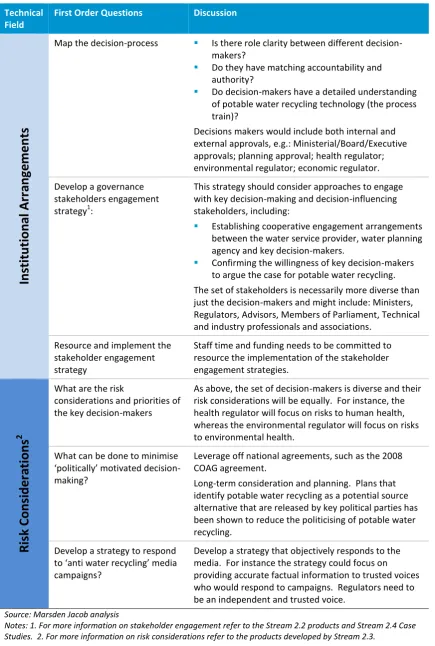
In Stage 2 (Develop the Approvals Process) the focus shifts from the planning, hydrology, engineering and economics to institutional arrangements and risk considerations. Key issues for consideration in the pre-feasibility stage are presented in Table 3.
Table 3: Stage 2 (Developing the Approvals Process), Key Issues for Consideration
Technical Field
First Order Questions Discussion
Instit
ut
ion
al
Ar
ra
nge
ment
s
Map the decision-process Is there role clarity between different decision-makers?
Do they have matching accountability and authority?
Do decision-makers have a detailed understanding of potable water recycling technology (the process train)?
Decisions makers would include both internal and external approvals, e.g.: Ministerial/Board/Executive approvals; planning approval; health regulator; environmental regulator; economic regulator. Develop a governance
stakeholders engagement strategy1:
This strategy should consider approaches to engage with key decision-making and decision-influencing stakeholders, including:
Establishing cooperative engagement arrangements between the water service provider, water planning agency and key decision-makers.
Confirming the willingness of key decision-makers to argue the case for potable water recycling. The set of stakeholders is necessarily more diverse than just the decision-makers and might include: Ministers, Regulators, Advisors, Members of Parliament, Technical and industry professionals and associations.
Resource and implement the stakeholder engagement strategy
Staff time and funding needs to be committed to resource the implementation of the stakeholder engagement strategies.
Ris
k
Co
ns
ide
ra
tio
ns
2What are the risk
considerations and priorities of the key decision-makers
As above, the set of decision-makers is diverse and their risk considerations will be equally. For instance, the health regulator will focus on risks to human health, whereas the environmental regulator will focus on risks to environmental health.
What can be done to minimise
‘politically’ motivated decision -making?
Leverage off national agreements, such as the 2008 COAG agreement.
Long-term consideration and planning. Plans that identify potable water recycling as a potential source alternative that are released by key political parties has been shown to reduce the politicising of potable water recycling.
Develop a strategy to respond
to ‘anti water recycling’ media
campaigns?
Develop a strategy that objectively responds to the media. For instance the strategy could focus on providing accurate factual information to trusted voices who would respond to campaigns. Regulators need to be an independent and trusted voice.
Source: Marsden Jacob analysis
Australian Water Recycling Centre of Excellence
Long-term engagement on governance and decision-making
16.
The Approvals Challenge
The case study research confirms:
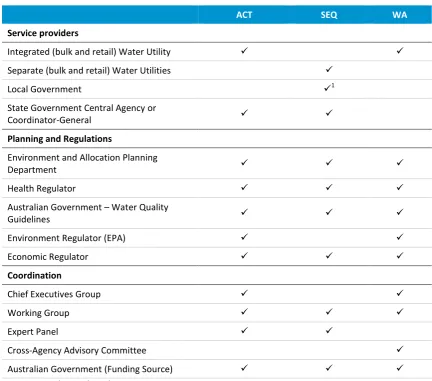
there are multiple decision-makers involved. Table 4 (which is based on information from the three case studies) highlights that between 9 and 11 agencies, regulators and working groups were centrally involved in decision-making on potable water recycling in each of the case study locations,
clarity of roles for all parties is at a premium. Without this clarity territorial disputes can emerge and this delays decision-making,
information requirements of each of the regulators needs to be carefully identified and coordinated, and
there needs to be a process by which all parties can contribute to structured and systematic decisions.
The case studies also found that meeting this challenge where the option of potable water recycling is put forward in an emergency (water crisis) situation is fraught, as the SEQ and ACT case studies demonstrate.
Table 4: Service providers, agencies and coordination groups identified in the ACT, SEQ and WA case studies
ACT SEQ WA
Service providers
Integrated (bulk and retail) Water Utility
Separate (bulk and retail) Water Utilities
Local Government 1
State Government Central Agency or
Coordinator-General
Planning and Regulations
Environment and Allocation Planning
Department
Health Regulator
Australian Government – Water Quality
Guidelines
Environment Regulator (EPA)
Economic Regulator
Coordination
Chief Executives Group
Working Group
Expert Panel
Cross-Agency Advisory Committee
Australian Government (Funding Source)
Source: Marsden Jacob Analysis
Australian Water Recycling Centre of Excellence
Long-term engagement on governance and decision-making
17.
It must be recognised that in n terms of water supply planning and the inclusion of potable recycled water as a serious potential source, Perth has two natural physical advantages. These are:
The clarity of the down steps in rainfall and streamflow which means that all stakeholders accept the need for additional water sources to be rainfall independent; and
The relatively small increments to supply capacity and therefore the small magnitude of each investment. These result from the small size of the south west catchments and the low cost for extraction from the extensive groundwater resources. As a result,
government tends to look at the process rather than particular projects or options.
Water supply planning in Perth enjoys other advantages compared with Australia’s eastern
states, because of the institutional framework, geographic coverage and relative size of the institutions, but these advantages are replicable since (at a cost) they are within the gift and discretion of the executive arms of the respective state governments.
Outcomes
The outcomes from Stage 2 include:
Clarity of roles, responsibilities and decision-making processes for all parties; Adequate and matched authority and accountability; and
Adequate financial (and organisational) capacity and sustainability across the decision-making organisations.
It is important to note that it is not critical that supportive institutional settings exist at the outset. Rather, the engagement and analysis in Stage 2 should aim to foster cooperative engagement, and thus work towards getting favourable institutional arrangements in place over-time.
3.4
Stage 3: Source development plans (the longer term
outcome)
The longer term objective of this project is to help make certain that if potable water recycling is identified as technically viable and economically efficient then it is included in source development plans all options are on the table.
This does not mean that potable water recycling should immediately be included in source development plans as a ‘definite source’, rather the case studies have identified that a staged process can help facilitate awareness and thus acceptance of the technology.
The case studies identified that potable water recycling benefits from being included incrementally in water source plans, as follows:
Australian Water Recycling Centre of Excellence
Long-term engagement on governance and decision-making
18.
2. Demonstration or pilot phase: A demonstration or pilot project phase means that regulators can do extensive testing of the technology and confirm reliability, regulatory framework, decision-making processes and outcomes.
3. Small incremental source augmentation: Small incremental source augmentations are recommended over large developments for potable water recycling. This way potable water recycling would only constitute a small proportion of the drinking water supply, and the cost and price implications of the development would also be constrained.
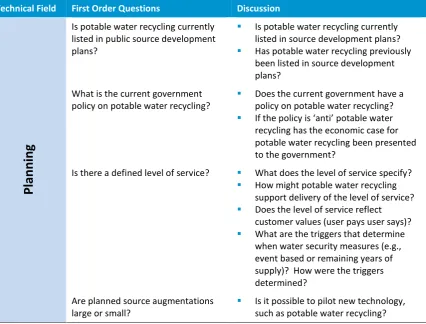
In Stage 3 (Source Development Planning) the focus shifts back to planning and continues to advance the institutional arrangements. The key issues for consideration in Stage 3 are presented in Table 5.
Evidence from the Case Studies
In Western Australia:
1995: Groundwater replenishment was identified as a Water source that is under consideration and is being subjected to technical research.
2008: Groundwater replenishment was elevated to be a demonstration or pilot project.
Australian Water Recycling Centre of Excellence
Long-term engagement on governance and decision-making
19.
Table 5: Stage 3 (Source Development Planning), Key Issues for Consideration
Technical Field First Order Questions Discussion
Plann
in
g
Is potable water recycling currently listed in public source development plans?
Is potable water recycling currently listed in source development plans? Has potable water recycling previously
been listed in source development plans?
What is the current government policy on potable water recycling?
Does the current government have a policy on potable water recycling? If the policy is ‘anti’ potable water recycling has the economic case for potable water recycling been presented to the government?
Is there a defined level of service? What does the level of service specify? How might potable water recycling
support delivery of the level of service? Does the level of service reflect
customer values (user pays user says)? What are the triggers that determine
when water security measures (e.g., event based or remaining years of supply)? How were the triggers determined?
Are planned source augmentations large or small?
Is it possible to pilot new technology, such as potable water recycling? Source: Marsden Jacob analysis
Outcome
In stage 3, the aim is to see potable water recycling included in source development plans over several years. That way, potable water recycling can be progressively developed from concept to demonstration to small incremental source solution by a well-resourced and qualified ‘cross agency’ team.
Australian Water Recycling Centre of Excellence
Long-term engagement on governance and decision-making
20.
4.
Timelines and Potential Benefits
This section discussed the project timeline and benefits that could be realised by implementing the project.
4.1
Timelines
As discussed above, the timeline for engagement on governance relating to potable water recycling is necessarily long. It is not possible to precisely specify a timeline as this is location and organisation specific, however, the case studies have identified that a deliberate long-term strategy has the greatest chance of successfully elevating potable water recycling onto source development plans.
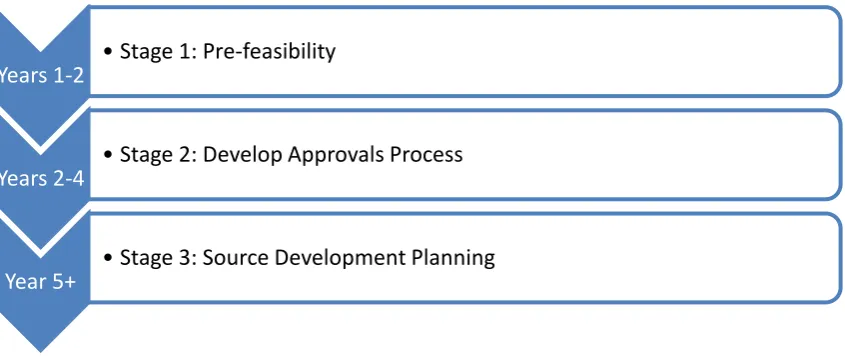
In this document we propose that the consideration of potable recycling be undertaken in three discrete but linked stages. It is our assessment that this will take several years to complete.
Figure 3: Timeline
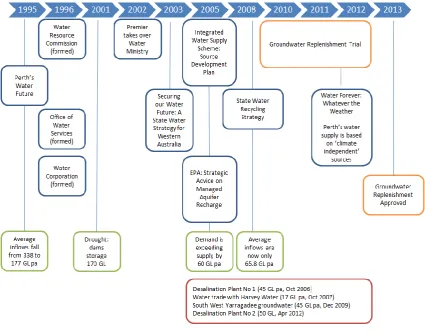
Supporting this finding, Figure 4 details the timeline in Western Australia that lead to the successful implementation of the Groundwater Replenishment Trial and subsequent
announcement that groundwater replenishment is the next new climate independent water source for Perth.7
7
Advanced recycling to help secure water supply,
http://www.mediastatements.wa.gov.au/pages/StatementDetails.aspx?listName=StatementsBarnett&StatId=7615, accessed 25 November 2013
Years 1-2
•
Stage 1: Pre-feasibility
Years 2-4
•
Stage 2: Develop Approvals Process
Australian Water Recycling Centre of Excellence
Long-term engagement on governance and decision-making
21.
Figure 4: Project Schedule (Western Australia)
4.2
Benefits and risks
The benefits from implementing a long term governance focus engagement strategy that elevates the objective consideration of potable water recycling are potentially great. If potable water recycling is a viable and cost-efficient source augmentation solution, then a carefully planned and resourced strategy could:
1. help to ensure that when the time comes for potable water recycling to be implemented all of the decision-makers are on-board and decision processes are well established. 2. result in lower prices for water users. Depending on the location potable water recycling
could be considerably more cost effective than other sources (e.g., dams or desalination). 3. improve water supply reliability and facilitate least cost delivery of level of service
objectives, as potable water recycling is considerably less climate dependent than surface water storages.
4. avoid augmentation costs. For instance, if the existing wastewater system is capacity constrained potable water recycling could delay or avoid a wastewater network augmentation.
Implementation of long-term engagement with decision-makers is not without risk. The key risk is that organisational time and financial investment fail to facilitate the objective
Australian Water Recycling Centre of Excellence
Long-term engagement on governance and decision-making
22.
4.3
In conclusion
Governance and decision-making arrangements can emerge as a key impediment to potable water recycling projects being considered as a viable source augmentation alternative. The case studies show that:
Potable water recycling is a potentially attractive option because it is: less climate dependent than traditional sources (such as dams); and potentially cheaper than other sources (such as desalination). But. unless potable recycling is objectively considered it may be unnecessarily excluded.
There are multiple parties involved in decision-making. Their relative roles need to be carefully and clearly defined, information requirements identified and structured processes need to be established. In particular, it is critical that the approvals process is developed because it is inherently more complex than it is for more familiar water source options.
Regulator participation is critical and a key component of the public engagement process, as they have a trusted voice. Health and other regulators need to be included in a structured and transparent process.
Decisions on institutional and governance arrangements for the water sector need to recognise that the cost of water supply to consumers is dominated by the efficiency or otherwise of capital decisions. Excluding any water source options from consideration risks higher costs and thus prices to consumers. All options should be on the table.
Relying on emergency situations to justify the acceptable of potable recycled water may be an obvious temptation, but logic and the experience of the case studies demonstrate that decisions are easily reversed when the emergency recedes.