Available online: https://edupediapublications.org/journals/index.php/IJR/ P a g e | 1496
Web Based Material Feedback System for Industrial Applications
Gopal Tiwari1, P.Raghu2, K. Ashwin Kumar3
1 B. Tech Scholar, Department of Computer Science Engineering, Siddhartha Institute of Engineering and
Technology, Vinobha Nagar, Ibrahimpatnam, Hyderabad, Telangana 501506.
2 Asst. Prof., Department of Computer Science Engineering, Siddhartha Institute of Engineering and
Technology, Vinobha Nagar, Ibrahimpatnam, Hyderabad, Telangana 501506.
3 Asst. Prof., Department of Computer Science Engineering, Siddhartha Institute of Engineering and
Technology, Vinobha Nagar, Ibrahimpatnam, Hyderabad, Telangana 501506.
Abstract: This paper presents a web based
application for the online implementation which can be used for a campus or organization for proving it for usage by all the people means to use it at any moment and at any time from any place. The project server administrator views the details of faculty and students and maintain their database in an efficient and effective manner so that their maintenance will be easy. The services providing for administrator are approving the faculty and students, maintain the personal details of faculty and students, add/delete the courses, consign a announcement regarding the course, view the feedbacks. The services provided to the faculty are the faculty can view and update their personal details, upload the content for a course, conduct a test for the students, and places key and results of a test, view the discussion board and feedbacks and reply to the students. The services provided to the students are view and update their details, view the content of a course, add/view the discussion, gives feedback to the faculty. Whenever anything is modified by the users, then the modified data, about the person who updated is maintained in the database. By this we are providing security to the users.
I. INTRODUCTION
This project titled Online Course Portal for a Campus is a web based application for the online implementation which can be used for a campus or organization for proving it for usage by all the people means to use it at any moment and at any time from any place.
The services providing for administrator are approving the faculty and students, maintain the personal details of faculty and students, add/delete the courses, consign announcement regarding the course, and view the feedbacks.
The services provided to the faculty are the faculty can view and update their personal details, upload the content for a course, conduct a test for the students, and places key and results of a test, view the discussion board and feedbacks and reply to the students. The services provided to the students are view and update their details, view the content of a course, take a test and view the key and result of a exam, add/view the discussion, gives feedback to the faculty. Whenever anything is modified by the users, then the modified data, about the person who updated is maintained in the database. By this we are providing security to the users.
Available online: https://edupediapublications.org/journals/index.php/IJR/ P a g e | 1497
members. There is no proper self-assessment test in the current course portal. Discussion board plays a vital role in clarifying the doubts for students which was lacked in the current scenario. Faculty approval mechanism is lacking the current course portal. . In the existing system there is no chance to give the feedback to any faculty and there is no chance of viewing the feedback by the administrator.
In order to keep the portal always active there should be some announcements regarding new material or any test which is lacking in the present system.
II. SYSTEM ANALYSIS
System Analysis is the process of collecting and interpreting facts, disposing problem and use the information about the existing system, which is also called as system study.
a. System analysis is about understanding situation but not solving the problem.
b. System analysis is performed to determine whether it is feasible to design to determine the user requirements and to eliminate the weakness of the present system a general requirements are concerned.
a) The new system should be cost effective.
b) To improve productivity and service.
c) To enhance the user interface.
d) To improve information presentation and durability.
e) To upgrade system reliability, availability, and flexibility.
f) To address human factors for better usage acceptance.
2.1PROPOSED SYSTEM
In the proposed system faculty can register to the course portal at any time as there is no restriction in registration process. Here no pre-registered usernames and passwords will be given to the faculty as it was not constrained to certain number. Every registered faculty member can upload their own material. It makes the student to grab more content on a particular course.
In the developing system online self-assessment test will be provided by the faculty. Timer indicates that the test should be completed in limited time span. The system will automatically generates the random paper each time when the student takes the test and the faculty can view the test result.
The problem of discussion board was overcome in proposed system so that the students can easily clarify their doubts by direct interaction with faculty through discussions.
Faculty approval mechanism was the new idea that is going to implement in this proposed system to differentiate the faculty from students by comparing the registered faculty with faculty working in the organization.
The announcements make the portal active always. Latest updates in the portal help the users to know about the course management and the latest materials that were uploaded.
Feedback module helps the faculty to assess the usage of materials by the students. Administrator view the feedback given to all the faculty members and faculty can view their own feedback to any particular course.
Available online: https://edupediapublications.org/journals/index.php/IJR/ P a g e | 1498 On spot registrations for the faculty.
Online self-assessment test will be provided with timer.
Discussion board is provided for students to clear their doubts.
Faculty approval mechanism is the new feature added.
Announcements are made to keep the portal always active.
Feedback module is provided to assess the usage of material.
2.2 Scope of Project:
The proposed Online Course Portal for a Campus is expected to automate the process of registration to the portal, publishing the announcements and communication between the faculty and students of a campus. The process of Test Creation will also be automated. The registration and login records management will be automated and the process of learning courses is made easier using the system.
2.3 Assumptions:
Only one Administrator for the portal
Faculty can even register as student to learn courses.
All the maintenance of the portal is done only by the administrator.
Other than faculty of the campus are not allowed to access the portal.
2.4 Requirement Specification:
The requirement specification gives the detailed requirements for each individual working in the development of the new system & the functionalities required fulfilling the objective of the new system.
Developer responsibilities:
i) Developing the system, this meets the SRS and solves all the requirements.
ii) Demonstrating the system and installing the system at clients’ location after the acceptance testing is successful.
iii) Submitting the required user manual describing the system interfaces to work on it and also documents of system.
iv) Conducting any user training that might be needed for using the system interfaces to work on it.
v) Maintaining the system for a period of one year.
III. DESIGN OF THE PROPOSED
SYSTEM
System design is transition from a user oriented document to programmers or data base personnel. The design is a solution, how to approach to the creation of a new system. This is composed of several steps. It provides the understanding and procedural details necessary for implementing the system recommended in the feasibility study. Designing goes through logical and physical stages of development, logical design reviews the present physical system, prepare input and output specification, details of implementation plan and prepare a logical design walkthrough.
Available online: https://edupediapublications.org/journals/index.php/IJR/ P a g e | 1499 3.1Software design:
In designing the software following principles are followed:
1. Modularity and partitioning: software is
designed such that, each system should consists of hierarchy of modules and serve to partition into separate function.
2. Coupling: modules should have little dependence on other modules of a system.
3. Cohesion: modules should carry out in a single processing function.
4. Shared use: avoid duplication by allowing a single module be called by other that need the function it provides.
3.2 Module design:
The major modules of the project are Administrator Module
Faculty Module
Student Module
3.3 Database design:
Registration Table
Table 3.3.1 gives the details about the person i.e name, username, password, confirm password, mobile number, date, college, department, qualification, semester, address, designation of user, reg-id, role, fac-id.
Course Registration Table:
Table 3.3.2 is the course registration table which contains the details about Course-id, course-name, username and status.
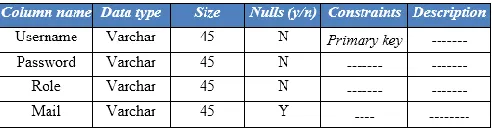
Login Table
Table 3.3.3 is the login table that gives the details about the username, password, role and mail-id
Available online: https://edupediapublications.org/journals/index.php/IJR/ P a g e | 1500
Table 3.3.4 is the faculty courses table that gives details about the course-id and faculty name.
Student_Courses Table
Course Table
Table 3.3.6 is the course table that gives details about the course-id, course-name, description, status, date.
Reply Table
Table3.3.7 is the reply table that gives details about the description-id, course-id, username, topic, reply-message, Id.
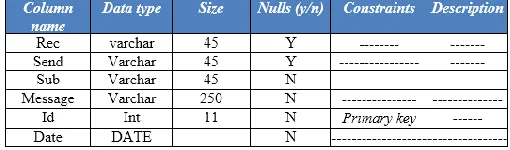
Mail Table
Table 3.3.8 is the mail table that gives details about the receiver, sender, subject, message, id and date.
Announcements Table
Table 3.3.9 is the Announcement table that gives details about the Announcement-id, course-id, date and description.
Feedback Table
Table 3.3.10 is the Feedback table that gives details about the feedback-id, username, course-id, grade and suggestion.
Available online: https://edupediapublications.org/journals/index.php/IJR/ P a g e | 1501
3.3.11 is the test table that gives details about the test-id, questions ,options for the question, answer and course-id.
Campus Table
Table 3.3.12 is the Campus table that gives details about the faculty-id, faculty- name, college, department, Qualification and Designation.
File Table
Table 3.3.13 is the File table that gives details about the file-id, course-name, filepath, filename and date.
Test Result Table
Table 3.3.14 is the Test Result table that gives details about the id, username, course, score for the test and date.
IV. RESULTS AND DISCUSSIONS
Index Page :
Fig 4.1 is the index page in which any user can login by entering the username and password.
Available online: https://edupediapublications.org/journals/index.php/IJR/ P a g e | 1502
Fig 4.2 is the Faculty Registration page which contains the form required to be filled by the faculty who wants to register.
Admin Home Page:
Fig 4.3 is the Administrator homepage which contains all the options to add faculty, create course, view registered faculty, compose mail ,view feedbacks
Course Creation By Admin:
Fig 4.4 is the course creation page where the admin can create a course by providing the course name and the course file.
View Feedback Page:
Fig:4.5 is the view feedback page where the admin can view the feedback given by the students to the faculty.
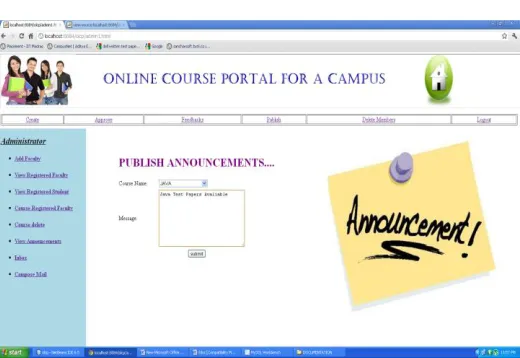
Publishing Announcements Page:
Fig 4.6 is Publish Announcements Page where the admin can publish announcements by providing the course name and the message.
Available online: https://edupediapublications.org/journals/index.php/IJR/ P a g e | 1503
Fig:4.7 is the Faculty Home Page which is displayed by entering the valid username and password in the index page.
Course Registration Page :
Fig:4.8 is the Course registration page where the faculty can register to the course by clicking the register button beside the course.
Courses Page:
Fig 4.9 is the Course Page where the faculty can view the available courses.
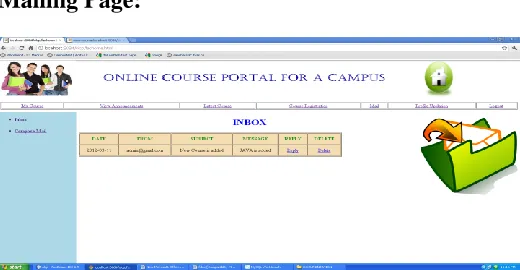
Mailing Page:
Fig4.10 is the Inbox Page where the faculty can view the mails and can reply.
Available online: https://edupediapublications.org/journals/index.php/IJR/ P a g e | 1504
Fig:4.11 is the compose mail page where the faculty can mail by providing the subject ,message and mail-id of the receiver.
Course (JAVA) Home Page For Faculty :
Fig;4.12 is the Course Home Page which contains the material of the particular course
Student Home Page:
Fig:4.13 is the Student HomePage which is displayed after entering the valid username and password by the student.
CONCLUSIONS AND FUTURE WORK
CONCLUSION:
The application, 'Online Course Portal for a Campus’ has been developed as a web-based application so that students can get benefited as well as the organization
as all the course materials can be available up to date for the students which also reduces the burden to the faculty in the organization.
The Course Portal is a custom web-based application that integrates campus- specific information, course details, activities etc, so that students are aware of latest things like latest announcements, materials updated from time to time and utilize privileges like internal mailing system, feedback system, discussion board to interact with different users.
FUTURE ENHANCEMENT:
The scope for future enhancements of our project is good. The main extension is to make the mode of creating test in a more flexible manner and to make the portal include not only single cse course but also all the other courses.
REFERENCES
[1] (2010). All-in-one Permit for Physical Aspects: (Omgevingsvergunning) in a Nutshell
[2] United States Code. (2002, Jul.). Sarbanes-Oxley Act of 2002, PL 107-204, 116 Stat 745
[3] W. M. P. van der Aalst, M. Rosemann, and M. Dumas, “Deadline-based escalation in process-aware information systems,” Decision Support Syst., vol. 43, no. 2, pp. 492–511, 2011.
[4] M. Dumas, W. M. P. van der Aalst, and A. H. M. Ter Hofstede, ProcessAware Information Systems: Bridging People and Software Through Process Technology. New York, NY, USA: Wiley, 2005.
Available online: https://edupediapublications.org/journals/index.php/IJR/ P a g e | 1505
[6] W.M.P.vanderAalst,Process Mining: Discovery, Conformance and Enhancement of Business Processes. NewYork, NY, USA:SpringerVerlag, 2011.
[7] F. Daniel, S. Dustdar, and K. Barkaoui, “Process mining manifesto,” in BPM 2011 Workshops, vol. 99. New York, NY, USA: Springer-Verlag, 2011, pp. 169–194.
[8] R. P. J. C. Bose, W. M. P. van der Aalst, I. Žliobait˙e, and M. Pechenizkiy, “Handling concept drift in process mining,” in Proc. Int. CAiSE, 2011, pp. 391–405.
[9] J. Carmona and R. Gavaldà, “Online techniques for dealing with concept drift in process mining,” in Proc. Int. Conf. IDA, 2012, pp. 90–102. [10] J. Schlimmer and R. Granger, “Beyond
incremental processing: Tracking concept drift,” in Proc. 15th Nat. Conf. Artif. Intell., vol. 1. 1986, pp. 502–507.
[11] A. Bifet and R. Kirkby. (2011). Data Stream Mining: A Practical Approach, University of Waikato, Waikato, New Zealand [Online]. Available:
http://www.cs.waikato.ac.nz/~abifet/MOA/Strea mMining.pdf
[12] I. Žliobait˙e, “Learning under concept drift: An Overview,” CoRR, vol. abs/1010.4784, 2010
[Online]. Available:
http://arxiv.org/abs/1010.4784
[13] N. Mulyar, “Patterns for process-aware information systems: An approach based on colored Petri nets,” Ph.D. dissertation, Dept. Comput. Sci., Univ. Technol., Eindhoven, The Netherlands, 2009.
[14] B. Weber, S. Rinderle, and M. Reichert, “Change patterns and change support features in process-aware information systems,” in Proc. 19th Int., 2007, pp. 574–588.
[15] G. Regev, P. Soffer, and R. Schmidt, “Taxonomy of flexibility in business processes,” in Proc. 7th Workshop BPMDS, 2006, pp. 1–4. [16] H. Schonenberg, R. Mans, N. Russell, N.
Mulyar, and W. M. P. van der Aalst, “Process flexibility: A survey of contemporary approaches,” in Proc. Adv. Enterprise Eng. I, 2008, pp. 16–30.
[17] K. Ploesser, J. C. Recker, and M. Rosemann, “Towards a classification and lifecycle of business process change,” in Proc. BPMDS, vol. 8. 2008, pp. 1–9.
[18] C. W. Günther, S. Rinderle-Ma, M. Reichert, and W. M. P. van der Aalst, “Using process mining to learn from process changes in evolutionary systems,” Int. J. Business Process Integr. Manag., vol. 3, no. 1, pp. 61–78, 2008.
[19] M. van Leeuwen and A. Siebes,
“StreamKrimp: Detecting change in data streams,” in Proc. Mach. Learn. Knowl. Discovery Databases, 2008, pp. 672–687.
[20] I. Žliobait˙e and M. Pechenizkiy. (2010). Handling Concept Drift in Information Systems
[Online]. Available:
http://sites.google.com/site/zliobaite/CD_applicat ions_2010.pdf
[21] H. Wang, W. Fan, P. S. Yu, and J. Han, “Mining concept-drifting data streams using ensemble classifiers,” in Proc. 9th ACM SIGKDD Int. Conf. Knowl. Discovery Data Mining. 2003, pp. 226–235.
[22] D. Brzezinski and J. Stefanowski, “Reacting to different types of concept drift: The accuracy updated ensemble algorithm,” IEEE Trans. Neural Netw.Learn.Syst., Apr. 2013.
Available online: https://edupediapublications.org/journals/index.php/IJR/ P a g e | 1506
Engineering and Technology. His subjects of interest are Cloud computing and Database security.
P. Raghu M.Tech, working as Asst. Prof at CSE Dept in Siddhartha Institute of Engineering and Technology. His area of interest is Computer Programming, Design Patterns, OOPS Through Java, Web Technologies and Big Data.
K.Ashwin Kumar M.Tech, Working As Asst.Prof