Zilong Kong
Wufangfa Computer Technology Service Department, Guangzhou, China Email: [email protected]
Received June 30,2013; revised August 2, 2013; accepted September 3, 2013
Copyright © 2013 Zilong Kong. This is an open access article distributed under the Creative Commons Attribution License, which permits unrestricted use, distribution, and reproduction in any medium, provided the original work is properly cited.
ABSTRACT
The periodic table of elements is arranged based on a series of regular polyhedron. The stability of inert gas atoms can be explained by the distribution of electrons, as well as their motion and magnetic force structure. A magnetic force regular octahedron is proposed. It is a unique configuration that best satisfies the convergence of electrons moving in the same direction within regular polyhedra. In the case of an electrostatic force crust, the formal electron spin accounts for the crusts intrinsic magnetic moment exceeding the speed of light. If one is to consider that the electron has a mag-netic outer layer and an electrostatic inner layer, then the question can be solved and abovementioned inference can provide the basis for magnetic force and momentum for the regular octahedron model. The electron periphery has twenty-petal adsorptive substances; the existence of adsorptive substance causes the magnetic force greater than the electrostatic force. Each electronic shell in the regular polyhedron is in accordance with the electron configuration of periodic table of elements; the kinetic track of each electron is a surface of regular polyhedron. The magnetic properties of iron, cobalt, and nickel can be explained by the regular dodecahedron electronic shell of an atom. The electron orbit converged from reverse direction can explain diamond. The adsorptive substances found in atomic nuclei and electrons are defined as magnetic particles called magnetons. The thermodynamic magneton theory can be better explained when it is analyzed using principles of thermodynamics, superconductivity, viscosity, and even in the creation of glass. The structure of the light is a helical line.
Keywords: Atomic Structure; Regular Polyhedron; Electronic Shell; Periodic Table of Elements; Light; Diamond
1. Introduction
The study of quantum mechanics entails quantifying atom from energy and momentum, wave properties of particle and other aspects, and various electron configu- rations. Based on the structure of hydrogen atom, a single electron system is initially developed. The present me- thod is still confined to the energy level, as in a unitary approach. Solid and liquid do not have characteristic spectrum, and they lacked an item of information in en-ergy difference. This article regards the inert gases atom as the initiation point for multiple electron system. The magnetic force structure, in which the electrons interact, is analyzed for the formation of electron configuration, using the simple geometric model, which provides the obvious details.
The octet rule [1] describes the most appearance prob-ability of electrons of stable inert gases atoms configuration situated at the corners of the cube, and this may regard as which indicates that the electrons are close to resting. Now this article discusses the state at which electrons are moving: if one is to disregard that each electron motion must be
around the atomic nucleus, changing its motion to a circle around the line that connects the nucleus with eight vertices of cube, then a configuration of eight electrons with stable motion is gained. Its symmetry is unique in the magnetic force structure.
If the electron has an electrostatic force crust, the for-mal electron spin accounts for the crusts intrinsic mag-netic moment exceeding the speed of light, which was found by Wolfgang Pauli.
Compton wavelength of electron should be ex-plained by a substance. C
2. The Unique Properties of the Regular
Octahedron Configuration
system must be maintained.
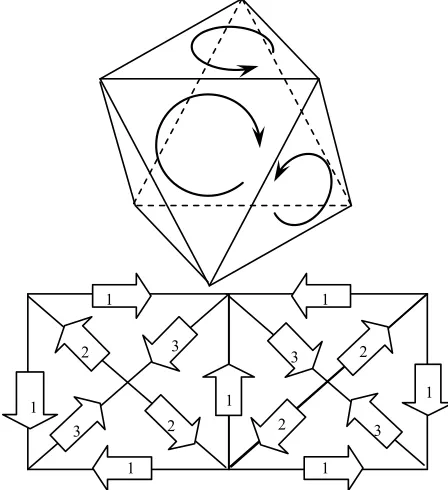
When the motion track of electrons is projected around the eight vertices on the six surfaces of cube (regular hexahedron), and the direction of motion of electron is drawn (Figure 1), the condition wherein electrons with
the same direction of motion converge is satisfied. In the unfurled map, the same number of cube faces denotes synchronization of the track of motion of the electrons projected on these two faces. Because the electron track from an edge comes into a face and comes out from the other edge, the number of entry edges is equal to that of the exit edges, thus the total number of edges of the face must be an even number. All regular polyhedra have only five kinds, with the number of the faces taken separately as 4, 6, 8, 12, 20. This is a mathematical theorem (pla-tonic solids, see Appendix 1). The number of edges of
each face in a regular hexahedron is an even number, and other polyhedron is an odd number, thus such structure is unique.
Only the projection of electron motion is reflected above the regular hexahedron. If the circle track of elec-tron motion is to be regarded as a face, then the distances
1
2 2
3 3
[image:2.595.58.288.369.711.2]1
Figure 1. The projection and the unfurled map on the regu-lar hexahedron.
from the nucleus to each of the faces are equal. Eight electrons can form a regular octahedron (Figure 2),
which only reflects the track of motion of electrons. Electrons converge at the edges of the regular octahedron, satisfying the condition at which electrons converge with the same direction of motion. In the unfurled map, the edges of the same number denote synchronization of the track of motion of electrons at the four edges. Because the electron track from an edge comes into a vertex and comes out from the outer edge, the number of entry edges is equal to that of the exit edges, such that the number of edges of vertex in the regular octahedron must be an even number (see Appendix 1), and other
polyhe-dron is an odd number. This again explains the unique property of the structure. The dual polyhedron of the regular octahedron is a regular hexahedron, which is why this result is obtained.
3. The Magnetic Moment and Adsorptive
Substance of Electron
Usually, the magnetic force between two electrons is far less than the electrostatic force. Their difference is
2 2 e
v c factor, where e is the speed of electron, and
is the speed of light. Then the magnetic force of elec-trons that converge on a regular octahedron is too small that it can be ignored, but the fact is not of circumstance. The electron has an intrinsic magnetic moment, if the electron is a small sphere with a crust of electrostatic force, where the charge collects on the surface of the
v
c
1
1
1
1 2
1
2
2 2
1
3 3
3
3
1
[image:2.595.309.533.461.706.2]value of the intrinsic magnetic moment has to be ap-proximated, the surface speed of sphere will have to greatly exceed the speed of light, many literature referred to this problem. Thus, in terms of distance, the magnetic force and the electrostatic force between two electrons can be compared. Otherwise, if some theory treated the electron as a point particle, this issue may be disregarded, or slide over this question.
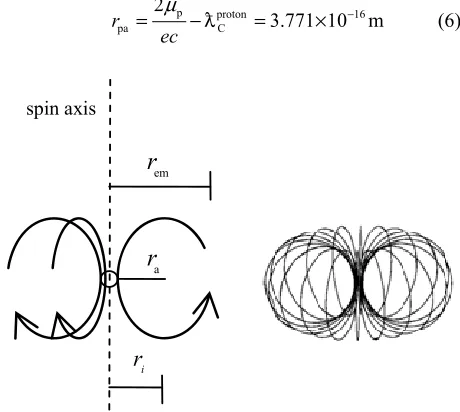
Now and here assume that the electron has a magnetic outer layer and an electrostatic force inner layer. The electron exterior is surrounded with a layer of magnetic substance that brings about magnetic force; this layer substance is attracted by the electron that joins and ro-tates about the electron, producing magnetic force and moment. This is the adsorptive substance of electron: its scope radius is a lot greater than the inner layer radius of the electron. When an electron interacts with another particle outside the scope of the adsorptive substance, it produces electrostatic force, magnetic force, and mag-netic moment; if another particle enters into the scope of the adsorptive substance, the adsorptive substance is de-stroyed or changed, the magnetic force and magnetic moment of the adsorptive substance are eliminated or weakened, and the electrostatic force of electron takes over. This assumption is in contrast with that of exceed-ing the speed of light with a great magnetic radius of the outer layer of the electron, the magnetic radius em of electron being the scope radius of the electron adsorptive substance (Figure 3).
r
The electron magnetic radius em and the magnetic force of the adsorptive substance can be calculated below. The adsorptive substance charge moves in a circle with velocity and radius i, the formative magnetic
moment
r
q
v r
μ is equal to current multiplied by the circumferential area ,
i S
2 F r⋅
r
Electrostatic force
Magnetic moment
Magnetic force
em
[image:3.595.388.539.77.144.2]r
Figure 3. Comparison of electrostatic force, magnetic force and magnetic moment.
2
i
r qv
μ
= . (2)
The adsorptive substance and the electron have equal quantity charge. If the motion of the adsorptive substance is the same as that of electron spin, it will have an elec-trostatic force; because the adsorptive substance has only magnetic force but not electrostatic force. Thus the ad-sorptive substance and electron spin axis are in the same plane, the adsorptive substance symmetrically surround-ing the electron side and movsurround-ing in circle with radius a,
and tangential to the inner layer of electron (Figure 4).
When the inner layer radius of electron is ignored, . If not,
r
em 2i 2a
r ≈ r ≈ r
em a a
2
i
r r r r
qv
μ
= + = + (3)
Substituted with electron magnetic moment μe and electron charge the speed of the adsorptive substance being the speed of light , a is Compton wavelength
C of electron, the magnetic radius of electron can be
computed as follows: e
c r
13 e
em C
2
7.72766 10 m r
ec
μ −
= + = × (4)
The distance of the adsorptive substance from the elec-tron spin axis is:
16 e
ea a C
2
4.475 10 m
i
r r r
ec
μ −
= − = − = × (5)
Using this method one can also obtain the distance of a proton adsorptive substance from a proton spin axis:
p proton 16
pa C
2
3.771 10 m r
ec
μ −
= − = × (6)
em
r
a
r
i
[image:3.595.308.538.510.716.2]r
spin axis [image:3.595.58.289.563.710.2]where rea is on the same order of magnitude as pa; from here one can also see that is Compton wave-length .
r a
r
C
Along the circle of the electron spin direction, the ring of the electron adsorptive substance is discontinuous. Suppose is a positive integer, the adsorptive sub-stance is composed of circle and the number of pet-als of electron is .
p
p p
The electron magnetic moment reveals the quantity of electron adsorptive substance. The atomic nucleus also has an adsorptive substance that can be released, and the electron outside the nucleus absorbs the adsorptive sub-stance that the nucleus released, eventually gaining an angular momentum. The adsorptive substance that is dispersed as a result of collision is converted into radi-ated heat.
In a hydrogen atom, the proton charge is equal to the electron; the adsorptive substance generated is equal to the quantity of magnetic moment μe, but the proton adsorptive substance is released, generating an electron orbit magnetic moment μo and the proton magnetic moment μp. The electron with speed e is able to re-lease the adsorptive substance, with the generated mag-netic moment
v
e ev c
μ . A petal is μe ev pc; its direction is the same as that of the orbit magnetic moment, tangen-tial to the orbit, and participates in generating orbit mag-netic moment μo, thus
e e
e o p
v pc
μ
μ =μ μ+ − . (7)
If μo is Bohr magneton μB, then v ce is fine- structure constant , the number of petals of electron
is 20, that is, the electron has twenty petals. a
p
e
e p B
20 aμ
μ μ− =μ − . (8)
If the electron absorbs more than one adsorptive sub-stance that the nucleus releases each period, then is a positive integer
n
(
)
e ee p o
20 v n
c
μ
μ μ− =μ − . (9)
The adsorptive substance release and absorption brings about the transfer of the atomic nucleus spin angle mo-mentum to the electron, becoming the electron angle momentum. The electron and atomic nucleus may keep a determinate distance, thus maintaining the stability of the atom.
4. The Magnetic Force of Electron
Adsorptive Substance
After considering the electron adsorptive substance at a position far from the electron, the magnetic force that the
electron motion generates is the same 2 2 e
v c as the
electrostatic force. At a position near the magnetic radius of the electron, the speed of the electron adsorptive sub-stance is equal to the speed of light, with the magnetic force being nearly on the same order of magnitude as the electrostatic force of electron. The adsorptive substance does not have electrostatic force, though it has the same quantity of positive and negative charges and possesses polarity. The polarity rotational frequency and phase of the adsorptive substance tangent to electron, is the same. In a hydrogen atom, after coupling between the magnetic moment of the electron adsorptive substance μe and that of the electron motion magnetic moment μB, and with the proton magnetic moment μp with different rotational frequency and phase the relationship is ex-pressed as follows:
(
e B)
2 μ μ− =μp. (10)
If all frequencies and phases are the same, the coeffi-cient will be equal to 2. When two electrons with the same velocity and direction converge, their adsorptive substances will also have the same rotational frequencies and phases: the magnetic force of motion of electron will correspond to the charge as that of the electrostatic force. Thus, at the magnetic radius of electron, the total netic force corresponding to the electron intrinsic mag-netic moment is two times the electrostatic force of the electron. At an appropriate direction, the maximum vec-tor sum of the magnetic force is approximately 2
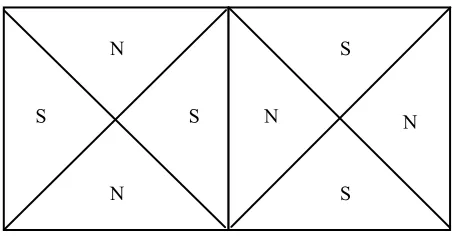
times the electrostatic force. This illustrates the case wherein two magnetic moments or magnetic dipole ad-join. When distance increases, the magnetic force according to likewise decreases. On a regular octa-hedron, with the edge serving as a boundary that divides the north and south poles, this on a regular octahedron, with the edge serving as a boundary that divides the north and south poles, this arrangement satisfies the two adjoining poles (Figure 5), this requires that the number
of edges of each vertical be an even number. Other regu-lar polyhedra cannot satisfy this condition.
r 3 r−
The sideways radius of the electron adsorptive sub-stance is em, and the lengthwise radius is . When the distance of two electrons is greater than a, the elec-trons have the action of both electrostatic force and magnetic moment. When the distance of two electron is near a, the magnetic force may be greater than the electrostatic force. When the distance of two electrons is less than a, the adsorptive substances are changed, and the electrostatic force is greater than the magnetic force. This property of the electron magnetic force pro-vides a basis for the model of the regular octahedron: if two electrons converge with the same velocity and direc-tion, the magnetic force can be equal to or greater than the electrostatic force.
S S
S N
[image:5.595.59.287.82.200.2]N N
Figure 5. Border upon distribution of north and south poles on regular octahedron.
The magnetic force is two times the electrostatic force, and it also appears in other occasions. The empirical formula of β stability line of atomic nucleus is[2]
2 3
1.98 0.0155 A Z
A
=
+ . (11) Expressing the ratio of the nucleon number A to the proton number Z,
2 3
2 3 1
1.98 0.0155 2
50 64
A A
A Z
= + ≈ − + . (12)
The first item explains that at close range, the nuclear force is twice the electrostatic force, the proton number is twice the electron number, 1/50 is caused by the interval of proton and electron. The second item explains that at long distance , the nuclear force according to decreases, the electrostatic force according to de-creases; When the nucleon number A is from 50 to 64, the nuclear force and the electrostatic force at far range are equal, and the atomic nucleus is most stable.
r r−3
2 r−
5. The Regular Polyhedron Configuration
The regular octahedron configuration is the only regular polyhedron in which the electron motions converge in the same direction. If allow the electrons converge in reverse direction, then all regular polyhedra satisfy this requirement. If converge in reverse direction, electrons move to a common edge at different times, there are not collision. It is reasonable to imagine that the electronic shell of the inert gases is at the second shell to outermost shell, and every shell is composed of a regular polyhe-dron. In each electronic shell, circles of electronic motion are faces of the regular polyhedron; electronic number is the faces number of the regular polyhedron. Two elec-trons of the first shell compose two parallel rings, with the electron moving in the same direction in a cylinder (Figure 6). The spins of two electrons are in the same
direction, adjoining north and south poles. They can ei-ther be the same or in reverse direction of the orbital an-gular momentum at one time, thus helium has two con-figurations. The electrons of each shell of the inert gases
electron spin
Figure 6. The double ring of same direction and parallel.
element composite configuration and the electron motion modes are as follows:
First shell: cylinder, same direction and parallel; Second shell: regular octahedron, converge at same
direction;
Middle shells: regular polyhedron, face numbers are 6,
12, 20, allow converge in reverse direction;
Outermost shell: regular octahedron, converge at the
same direction.
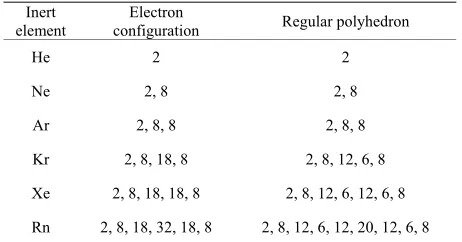
Thus the electron shell configuration of the inert gases element can be denoted by a row of the face number of regular polyhedron, inasmuch as it is in accordance with the electron configuration of periodic table of elements (Table 1). 18 is dodecahedron and hexahedron, 32 is
dodecahedron and icosahedron.
The orbital magnetic moment of the electron also en-genders the adsorptive substance. The speed of the same shell electrons is near equation, the electrons can share the adsorptive substance, via its transfer. The energy of each electron tends to equate, and the adsorptive sub-stance even increases the available disub-stance of the mag-netic force between electrons. The spin of atomic nucleus extends out and causes the first shell electrons to form a cylinder. For cylinder and regular octahedron, the elec-tron motions of the parallel plane are in the same direc-tion, forming a dipole, consistent with the spin polarity of the atomic nucleus. For hexahedron, dodecahedron and icosahedron, the electron motions of the parallel plane are in the reverse direction, forming a monopole, such as hexahedron with dodecahedron and hexahedron with icosahedron: these combinations can eliminate polarity. The inner shells of electrons are near the atomic nucleus, receive more adsorptive substances that are released by the nucleus, possess a higher negative charge density, and are at the accumulative position of the adsorptive substances. As such, the angular momentum of inner and outer shells is higher, shaping the regular polyhedron with more face numbers. The angular momentum of the middle shells is lower, shaping the regular polyhedron with lesser face numbers.
[image:5.595.311.538.88.170.2]Table 1. The regular polyhedra that are composed of inert gases electronic shell.
Inert element
Electron
configuration Regular polyhedron
He 2 2
Ne 2, 8 2, 8
Ar 2, 8, 8 2, 8, 8
Kr 2, 8, 18, 8 2, 8, 12, 6, 8
Xe 2, 8, 18, 18, 8 2, 8, 12, 6, 12, 6, 8
Rn 2, 8, 18, 32, 18, 8 2, 8, 12, 6, 12, 20, 12, 6, 8
6. The Cluster of Inert Gas Elements
The cluster of inert gas atoms can be described by mod-els represented by regular polyhedrons or cylinders. For the inert gas atoms Ar, Kr, Xe, clusters form according to the preferred magic numbers [3,4].
An explanation using a regular octahedron model can be described as follows: as atoms approach, two closer regular octahedrons have an edge superposed; conse-quently, two atoms share an edge. Each atom (one regu-lar octahedron) has twelve edges, so each atom can join with another twelve atoms. If twelve atoms are directly set on the edges of a regular octahedron, the resulting structure shows defective tightness. The orbital adsorp-tive substances on the edge are actually shared by two atoms and these adsorptive substances can undergo ex-cursion. To obtain a tight structure, in a regular octahe-dron, using a plane that passes through an edge and cut-ting a vertex with an appropriate angle (Figure 7), twelve
edges cut twelve times will result in a regular dodecahe-dron. If the atoms are then set at its pentagon center, in this way, the resulting structure is the tight, and is in agreement with the descriptions in the literature [4].
A Helium cluster [5] is different from other inert gas elements.
The explanation using the cylinder model is described below: because the helium atom is a cylinder, it can ar-range along the direction of a circle and the axis, to form different hexagonal structures, even two layer hexagons (Figure 8), the axes of two layers coincide with each
other.
7. The Magnetic Properties of Iron, Cobalt,
and Nickel
Under the frame of quantum mechanics, the origin of metallic ferromagnetism is an issue that is yet to be re-solved [6].
The magnetic properties of iron, cobalt, and nickel can be explained through the regular polyhedron electronic shell found in an atom. The regular polyhedron electronic-
Regular octahedron Regular dodecahedron Thirteen atoms
Figure 7. Ar, Kr, Xe cluster.
One atom Cylinder
One layer hexagon Seven atoms
Two layers hexagon
Figure 8. Helium clusters.
shells of iron, cobalt, and nickel are: 26 Fe 2, 8, 12, 3, 1 2, 8, 12, 2, 2 27 Co 2, 8, 12, 3, 2
28 Ni 2, 8, 12, 5, 1 2, 8, 12, 4, 2
All of these have a regular dodecahedron; this is the origin of the magnetic properties of iron, cobalt and nickel. The respective free or valence electrons of the outermost shells are 1, 2, 1 or 2, 2, 2; while those of the hypo-outer shell are 3, 3, 5 or 2, 3, 4. The third outer shells are all regular dodecahedrons. Given that hypo- outer shell cannot sufficiently form a whole frame. Thus, the hypo-outer shell and third outer shell form a frame of two shells together; the third outer shell of a regular do-decahedron is thereby fixed.
Meanwhile, the motions of electrons on regular do-decahedrons are divided into three cases:
1) On regular dodecahedron, electrons are separated into two hemispheres according to the directions of the electron circumferential motion (Figure 9). At the edges
that join the two parts, the directions of the electron mo-tion are the same; there are ten edges which converge with the same direction. Other edges converge from the opposite direction, thereby counteracting the magnetic effect. Ten edges that converge with the same direction engender an equivalent circular electrical current, pro-ducing magnetism in the process. Normally, μ is the magnetic moment of the entire regular dodecahedron. In ten pentagons with a total of ten edges, each edge has two electron paths, and μe is the magnetic moment of each electron, expressed as:
e
1
10 2 4
5 e
μ= × × μ = μ . (13)
2) On the regular dodecahedron of case 1, there is one pentagon each in the center of the two hemispheres; these are marked as A and B in Figure 10. As can be seen, one
[image:6.595.57.288.111.232.2]Figure 9. Electron motion and equivalent electrical current in a regular dodecahedron.
A
[image:7.595.65.283.81.364.2]B
Figure 10. Convergence of the two hemispheres; A, the op-posite direction and B, the same direction.
verges from the reverse direction:
e 2
μ= μ . (14) 3) Two pentagons in the center of the two hemispheres converge from the same direction as the other edges (Figure 11):
0
μ= . (15) If the efficient Bohr magneton numbers of iron, cobalt, and nickel [7] are expressed by
, , , respectively,
then:
Fe
B 2.219
n = Co
B 1.715
n = Ni
B 0.604 n =
Ni Co Fe
B : B : B 1: 3 : 4
n n n ≈ . (16) The radii of iron, cobalt, and nickel atoms are very
A
[image:7.595.60.285.404.519.2]B
Figure 11. Convergence from the same direction for both A and B.
propinquity; thus, the magnetic moment μe of each electron are deemed as equal in a regular dodecahedron.
All atomic structures of iron are case 1:
Fe 4 e
μ = μ . (17) A half atomic structure of cobalt is case 1, another half atom is case 2:
e e
Co e
4 2
3 2
μ μ
μ = + = μ . (18)
A half atomic structure of nickel is case 2, another half atom is case 3:
e
Ni e
2 0
2
μ
μ = + =μ . (19)
From Formulas (17)-(19), we gain:
Ni: Co: Fe 1: 3 : 4
μ μ μ = . (20) Formulas (16) and (20) are concordant.
Therefore the magnetic properties of iron, cobalt, and nickel can be explained by the regular dodecahedron electronic shell of an atom.
The atom radius of iron is , from
For-mula (2) and B e
9
0.126 10 m× −
2.219μ =4μ , in the regular dodecahe-dron shell, the electronic velocity is c 289.
8. The Thermodynamic Magneton Theory
The adsorptive substances found in atomic nuclei and electrons are defined as magnetic particles called mag-netons.
As a term, “magneton” is commonly used to define or explain a unit of magnetic moment, as in the case of the Bohr and nuclear magnetons, among others. However, in this article, a magneton also denotes a type of particle primarily characterized by a property of magnetism. The magneton is a circle that circumrotates with the speed of light, wherein the radius can change; there are polarities that correspond to the frequency and phase.
leased from the atomic nucleus (with more than one nu-cleon), the magneton radius and periodicity are not nec-essarily equal.
nucleus is released and then arranged into a circulative orbit of the electron, thereby forming an orbit positive magneton (Figure 12).
Meanwhile, just as there are attractions between the negative and positive magnetons, similarly, there are also attractions between the negative and orbit magnetons. The positive magnetons that are attracted by an electron first accumulate at two ends of the electron spin axis; from there, they form an impetus magneton. The impetus magneton may be integrated stepwise to the inner elec-trons, released out along the motion of the negative magneton of the electron occurring after break up. It can The negative magnetons engendered by an electron
have twenty petals and are attracted by electrons. When electrons move, they tend to release negative magnetons. These negative magnetons (1/20) form orbit negative magnetons, while others (19/20) turn into ray radiation. Some atoms do not have steady orbit negative magne-tons.
In this text, the orbit positive magneton is called an orbit magneton for short. The circulative orbit and veloc-ity of electrons determine the orbit magneton quantveloc-ity, which is capable of maintaining the redundant orbit magneton’s ability to transfer to another atom or trans-form into heat radiation even when orbit and velocity change. This means that the orbit magneton transforms into heat radiation when it does not have a containable orbit. After some orbit magnetons transform into heat radiation, an increase in electronic momentum will occur. Thus, the electronic orbit becomes capable of holding added magnetons, after which it can stop the process and then transform the magnetons into heat radiation. The frequency of radiation of the negative magnetons is gen-erally higher than the positive magnetons (Table 2).
pa
2
r
mo
2
r
If the perimeter and density of a magneton are m and, respectively, then its mass could be computed by
m . The relationship of the polarity periodicity of magneton mt, the polarity frequency
2πr
2πr D
N fm, and radius
are expressed as: m
r
m 2πm m
cf = r N t. (21) The polarity frequencies of a positive magneton in all static atomic nuclei are equal.
The magneton radius, periodicity, and the positive magnetons released from the proton are also equal. How-
[image:8.595.314.532.242.507.2]ever, in the case of positive magnetons, which are re- Figure 12. Positive magnetons of proton and orbit positive magneton at electron orbit.
Table 2. Magnetons.
Magneton Positive magneton Negative magneton Orbit magneton Negative orbit magneton
Polarity Positive Negative Positive Negative
Location Proton periphery Electron periphery Electron orbit eriphery Within electron orbit circle
Engendered by
(transform from) Atomic nuclei Electrons Positive magneton Negative magneton
Turn into radiation Heat low freq. Ray high freq. Heat low freq. Ray high freq.
Magneton radius proton 16
pm C 2.1031 10 m
r = = × − 13
em C 3.8616 10 m
r = = × −
m
r rm
Magneton orbit radius 16
pa 3.771 10 m
r = × − 16
ea 4.475 10 m
r = × −
mo
r rmo
[image:8.595.56.539.567.728.2]the large circle. Here, the polarity periodicity of the compound is the average value before the magnetons compound. If the radius of the compounded positive magneton is greater than the diameter of the negative magneton of an electron, then the compound positive magneton shall leave two ends of the electron spin axis and transfer in a parallel position to the side of the elec-tron’s negative magneton. This combination of com-pound positive magneton becomes the orbit magneton. The rules of interaction among positive, compound, and orbit magnetons are explained below (Figure 13):
1) If two orbit magnetons have equal polarity peri-odicities and radii, the spin axes are in superposition and the spin direction are the same, then there would be no force action; if the spin axes are in superposition but the spin direction is in reverse, then there would be an at traction. On the other hand, if the circles of two magne-tons border upon the same plane and the spin direction is the same, then there would be an attraction; in this case, the linear velocity at adjacent point is in reverse direc-tion.
2) If two orbit magnetons have equal polarity peri-odicities but unequal radii, their spin axes are in superpo-sition, and if the spin direction is the same, then there would be an attraction; but if the spin direction is in re-verse, then there would be a repulsion. If the circles of two magnetons border upon the same plane and the spin direction is in reverse, then there would be an attraction; in this case, the linear velocity at adjacent point is the same direction.
3) If two orbit magnetons have unequal polarity peri-
Rule 1
[image:9.595.63.282.509.715.2]Rule 2
Figure 13. Attraction of orbit magnetons.
orbit (Figure 12). The orbit direction with similar spin
directions and arrays would form into a single team or one with a reverse spin direction according to the radii (from large to small). If two magnetons form at the junc-tion and the radii are equal, then the largest or smallest in the team will separate. If the orbit magneton ring on the electron orbit forms 2, 4, 6 and even more teams (two teams at the very least) and the magneton spin directions of the two adjacent teams are in reverse, this will lead to a magnetic moment of zero at the exterior. In Figure 12,
the broken line separated two teams.
For the electronic shell of regular polyhedron, the orbit magneton distribute in the edge of regular polyhedron.
If the electronic motion does not periodically turn around, then the orbit magnetons would no longer form a ring so that the beginning would connect to the end. Be-side the electron, two teams of orbit magneton would form an olive shape (Figure 14).
When many atoms or molecules come in contact with each other, some parts of the action between electrons are processed via the orbit magnetons. If the orbit mag-netons maintain stable attraction, then the object would be in a solid state. The attraction of the orbit magnetons can decrease the distance between electrons as the elec-tron’s negative magneton show no apparent attraction. If the distance between electrons is shortened, this would cause a fraction of the orbit magnetons to be pushed out, leading to slippage between atoms or molecules; if this is the case, then the object is said to be in a liquid state. If most of the orbit magnetons are pushed out and the at-oms or molecules are also bounced out, then the object is said to be in a gaseous state.
[image:9.595.315.533.610.714.2]The attraction between the orbit magnetons is in direct ratio with the amount of magnetons. This is also related to the polarity periodicities and radii of such magnetons. In the gaseous state, the orbit magnetons that are pushed out when molecules come in contact with each other and bounce out become free positive magnetons. The bounced out molecules can also capture free positive
magnetons and may become orbit magnetons. The over-all velocity of the free positive magnetons is equal to zero. After the molecule captures the positive magnetons, the speed of the molecule would then be reduced. If molecules have same orbit magnetons, then their speeds are the same.
The action of molecules in the positive magnetons is separated into the force of the free positive magnetons
f and the force of the captured orbit magnetons F. If the attraction of molecules in the free positive mag-netons is f , the mass of the free positive magnetons is
M , and the acceleration is a, then we have:
f a
M
= (20)
If the attraction of molecules in the captured orbit magnetons is F; when captured, the attraction is dF, the mass is dM , and the acceleration is the same as the acceleration of the free positive magnetons a, then:
dF a Md f dM M
= = . (23)
In an equilibrium state, thef of every molecule would be equal. If the molecules with equal dM are consid-ered as the same kind, then F M
( )
is the distribution of the attraction according to the same kind of molecular total in M stated as:( )
d f d lnF M a M M f M
M
=
=
= . (24)On the basis of the inter-actional rules of orbit magne-tons, only the same kind of molecules may attract each other and push out the orbit magneton; in this situation, the system tends to increase as many different kinds of molecules as possible and capture the maximum positive magnetons.
When molecules bounce out, the work of repulsive force equals the negative work of attraction, expressed by the attraction F multiplied by the maximal radius of orbit magneton max. Meanwhile, the kinetic energy when molecules bounce out is equal to the work of the repulsive force,
r
k m
E = −Frax . (25) From Formulas (24) and (25), we derive:
k maxln
E = −fr M , and (26)
k max
E fr
M =e− . (27)
This is the relation of the free positive magnetons mass
M and the kinetic energy of molecular k. As com-pared with the Boltzmann factor
E
k
E kT
e− , we can see that
the Boltzmann constant is the attraction of molecules for the free positive magnetons
k
f . If it is constant in the equilibrium state, the temperature is the maximal
radius of orbit magneton , expressed as:
T
max r f
max T =r
min r
k= , and (28) . (29) The dimension of is work, the dimension of tem-perature is length, and the dimension of is force. From this relationship, we can say that the magneton theory can work well with thermodynamics.
kT
T k
The maximal radius of the impetus magneton is equal to the minimal radius of the orbit magneton min, and is also equal to the radius of the negative magneton on static electron em. The temperature defined by per-fect gas is a macroscopic and statistical quantity of multi- units (molecule); meanwhile, the temperature T of an area near zero K, that is equivalent to: in this area, there are almost no orbit magnetons of the outer shell that may lead to a shift out. Therefore when temperature nears zero K, the outer shell of most units will have not orbit magnetons; for the few units that have orbit magnetons in the outer shell, the radius of the orbit magneton will take a minimum value as expressed by:
r
T
r T
max em C
T =r = =r = . (30) In the outer shell of metal, electrons are far apart from the atomic nucleus, and the number of absorbed positive magnetons could be low such that these would not form into a fixed frame. In such a case, it can rely on the sec-ondary outer shell electrons so that it could be joined together; this is called the hypo-outershell. The outer shell electrons become free electrons in the frame inter-stice (a free electron has a small quantity of impetus magneton and has an initial kinetic energy 0). The action between the free electrons is similar to what is occurring in the gaseous state; also, if the free electron has the action of another item from the hypo-outer shell frame via free positive magneton, Formulas (22) and (25) can be changed to:
E 2 f a M = k 0
E −E =
i
2
k−E0=
. (31)
max
2Fr
− . (32) Using a coefficient denotinge the scale of two
item’s action, 0 , and from Formulas (24) and
(32), we derive: i ≤ ≤
maxln
E −ifr M, and (33)
(Ek E0)
− − e Ft = = max ifr
M =e . (34) Suppose e is the electron mass, e is the electron velocity, 0 is the initial velocity of electron, the mo-mentum of the action between the electron and hypo- outer shell frame is , and is the acting time:
m v
v
e
m v t
e e ln
(
Ek E0)
ifrmax m v fte e− − = − , (37)
2 2
e e e 0
e e max
1 1
2m v 2m v m v
ifr ft
−
= , and (38)
2 2
e 0
max e
2 v v
t ir
v
−
= . (39)
The electrical resistance of metal th
mostly comes from e action occurring between the electrons and the hypo- outer shell frame. It is derived via the transfer of free positive magnetons, electrical resistivity ρ is namely the acting time t, and the maximal radius of the orbit magneton rmax is the temperature T, which is treated i as the probability of all collision. Hence, the collision probability between electrons is Pc=i 2,
2 2
e 0
c e 4PTv
ρ = v
v
− . (40)
If r , then it is said t
co e 0
v <v , o
ctive s c
0
P =
The d
o be in a
super-ndu tate. irectional motion of the electron
can be maintained in the initial kinetic energy E0. Pc =0 is the non-collision superconductivity, and < the superconductivity when collision speed is less than the initial velocity.
When the temperature T is lower, consider two spe-cia
e 0
v v
l cases below:
1) If Pc and v0 are close to the constants, then
1
~ e
e
A T v
ρ − . v
(41)
As such, A1 is approximately consta m
nt. From For-ula (33) we d rive e T v~ e2, so
1 ~T T A
T
ρ −
. (42)
2) If and are close to the con of t
(43) When the temperature
A e v iv 0 v d
stants, the mass he ol e-shape orbit magnetons would be propor-tional to the square of the magneton radial; thus, theat-traction between electrons would be proportional with the collision probability, 2
c~
P T , leading us to the fol-lowing:
3 ~T
ρ
T is higher, then ve v0. ccording to the magneton interactional rule,
electrons attract each other but only if they have the same speed. If there is an increase in free electrons with dif-ferent speed levels, the range of speed would increase and the collision probability will decrease,
the free
( )
~ 1v
ρ e , so
. disport three segments; these are
to
du
ith a
rig
shown in Formulas (42) (44). For the expression ρ~T3 see also [8]
The high critical temperature superconductivity can be seen in non-collision supercon ctivity. To increase the critical temperature, the following methods are followed: 1)Release the free electrons from the atoms of multi-ple sorts.
2)The atomic nucleus can release the positive magne-tons with different periodicity, these positive magnemagne-tons can then form the orbit magnetons of multiple sorts.
3)Increase the speed range of the free electrons. 4)Restrict the motion range of the free electrons. 5)Decrease the density of the free electrons. In Method 2, the first requirement is an element w high melting point and the second is an element with low
idity.
In Formulas (26) to (29), the Boltzmann factor e−E kTk
is equal to the free positive magnetons mass M . In some liquids, M−1 can be viewed as a macro
amount referring to viscosity
scopic
η. In [9,10], Q RT
Ae
η = . (45) where Q is the activation energy, R is the molar gas constan , and t A is a constant. If one molecule is trans-formed many molecules, then k is transformed to
R, and Ek is transformed to Q. In these liquids, the viscosity
to
η is inversely proportion to the free positive
magneton ass
al s m M in the area
1 ~
:
M
η − . (46)
In [11-13], η =AeB RT
(
1 CeD RT)
+ , where A,B,C
n
and are co
tw
D nstants, then this
e positive magnetons.
is a case when there are
o types of fre Fermi distributio
is a case when there are two types of attractive particle, Bose distribution is a case when there are two types of repulsive particle.
There is a decrease in free positive magnetons in the process of transformation from liquid to solid state; Its part transform into the orbit magnetons Mo; if their total Mt=M M+ o, then E is a constant:
(
)
1t o
E M M
η= − − . (47) In the presence of orbit magnetons, similar particles can attract each other and molecules a
be
silicon ions can attract each other and form a group of silicon ions. There are electrostatic attractions between the groups of oxygen and silicon ions. The structure of a glass is formed when a large amount and space of groups of oxygen ions connect and form a net where a group of silicon ions are embedded.
The chemical reaction is regarded as that occurs the electronic transfer, because only the electron those sort and velocity are same attract each other, the course of el
agneton of electron formerly was circle. When two
the electromagnetic induction; fir
he relation of the spin axis w
ne to same di
ectron transfer from a sort of atom to another sort of atom, except electrostatic force require also satisfy two condition: first the electronic velocity is same, second is the mix of magneton: the magneton on electron come from several atomic positive magneton, form the orbit positive magneton on electron after mixed. The magne-ton mix also may be the change of magnemagne-ton supply, the source of positive magneton from a sort of atom change to another atom. The magneton mix also may the elec-tronic velocity go to equal. Usually the magneton mix easy in high temperature and pressure, and the electronic kinetic energy easy over the electrostatic force, the chemical reaction easy progress. In the situation of tem-perature and pressure are not change, the magneton mix becomes mostly factor that influence the chemical reac-tion.
9. Magneton and Electromagnetic Induction
The m
electrons approaching to a scope of distance, the magne-ton interact and being distorted, the circle plane occur bend; if the distance of two electrons are not changed anew, the bend of circle keep and are not change; at the farther position there is away the central electron, on the edge, the plane of magneton rotated a angle, the angle between circles become uneven. Formerly the magneton moving along circle with the velocity of light, this the tangent direction, the magneton is tangent with the cen-tral electron also, both spins keep be in mesh in certain phase; the circle of magneton swing in other direction when distortion, the advance speed is not speed of light in tangent direction, but is less than speed of light, the electron must moving backward and keep be in mesh. This backward motion of electron is the electromagnetic induction (Figure 15).
The motion and spin axis direction of electron incline to superposition when the electromagnetic induction. Two electrons appear
stly the magnetons of electrons attract each other, the spin axis of electrons incline to same direction, and then the magneton swing, the electron moving backward. Two conditions which the free electron can electromagnetic induction is also two sort swings: the swing of the spin axis of electron and the swing of magneton. The swing of
the spin axis cause the spin axis of electrons turning to same direction; the swing of magneton cause the electron that keep be in mesh with magneton moving backward. The electromagnetic induction is the change of the mag-netic force causing the swing of magneton of electron, the electron moving, this induction differs from the magnetic force (Figure 16).
Two relation of direction are reverse: the relation of the spin axis of electron with the act direction when elec-tromagnetic induction; and t
ith motion direction when thermal motion.
A motion electron comes into magnetic area; firstly the spin axis is turned, the turned place always got be-hind with interact point, the spin axis incli
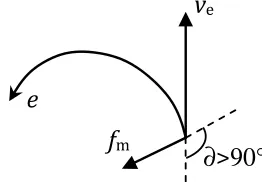
[image:12.595.316.528.361.680.2]rection with the electron of the back magnet, and then the magneton swing, the electron plus a motion that moving backward along the spin axis, and is the reverse of electron of the back magnet, it is close perpendicular to the motion direction, but is not completely perpen-dicular to the motion direction. A motion electron is af-fected by magnet, the force that effecting electron fm with
Figure 15. The swing of magneton.
c c
c
e
V = −c v
v c<
1) The spin axis of electron turning.
2) A revolving ring with velocity of light exists in electron.
3) The swing of revolving ring.
The momentums of instantaneous Lorentz force are not conservation, its action force and effect is perpen
itions above are momentums conservation.
ion, this explain also th
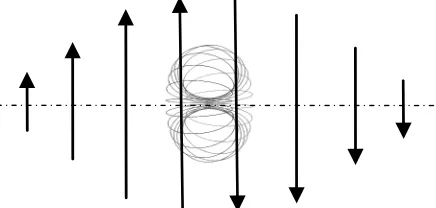
ngender voltage, an
ead circle changed, each part that lead
mov-in ons of these voltages
ar
tron, the pe
ct ratio, therefore the current to th
of graphite, three , these three ith the other
ther three edges is converged from reverse direc-tio
-dicular; the electromagnetism induction satisfies three cond
The delay and inertia of the electromagnetic induction are greater than the energy of ionizat
ree conditions above.
The electromagnetic induction can e
d engender current if there is a loop. When the area of an electric l
g engenders voltage, the directi
e same; the perimeter of circle changed simultaneity, the perimeter has difference, the voltage to the perimeter difference are in direct ratio, the current is that the pe-rimeter difference multiplies the amount of elec
rimeter difference to the amount of electron are in di-rect ratio, the area difference to the square of the perime-ter difference are in dire
e area difference are in direct ratio.
10. The Electronic Shell of Carbon
The electronic shell of the carbolic atom is 2, 4. Four electrons of the outermost shell formed a regular tetrahe-dron.
In the regular tetrahedron of atom of diamond, all four electrons converge from reverse direction; each atom is connected by superposition of vertex, that is share four vertexes, therefore each atom connect with other four atoms, and is symmetrical (Figure 18).
In the regular tetrahedron of atom electrons is converged from reverse direction electrons is converged from same direction w
one electron, in six edges of the regular tetrahedron, there is three edges of one face is converged from same direc-tion, o
n. Each atom is connected by superposition of three
v
ef
me
[image:13.595.314.530.350.488.2]∂
>
90°
Figure 17. A motion electron is affected by magnet.
hexagon.
The converged electron orbit has two sorts of the same or reverse direction from the rule of magneton attract each other: when converge from same direction, the magneton of same radius attract each other; when con-verge from reverse direction, the magneton of different radius attract each other. The negative magnetons attract each other when converge from same direction, cause the
elect ton
(Figure 20); the negative magnetons do not have attract
when converge from reverse direction, electron orbit the do not near mostly, and do not push out the orbit magne-ton (Figur
ron orbit close up, and push out the orbit magne
e 21). The electron of atom of diamond all are
converge from reverse direction, electrons of adjacent atom are also converge from reverse direction, therefore do not push out the orbit magneton, have some attraction, and equipoise with electrostatic force of nucleus, the electron orbit is most stable.
Figure 18. Diamond: four electrons converge from reverse direction.
[image:13.595.315.533.529.709.2] [image:13.595.104.235.624.715.2]Electron orbit
Orbit magneton Electron
Figure 20. Converge from same direction.
[image:14.595.60.285.74.569.2]Electron orbit
Figure 21. Converge from reverse direction.
1. The Helical Line Model of the Light
The structure of the light is a helical line. The axis of the light helix is same from the direction of motion of light. The direction of motion of light is its direction of travel or propagation direction.
1
β is the helix angle of the light helix, 45≤ ≤β 90
density is high; . The
wh
helix angle approach 45˚
if the light en the light density debases,
the helix angle increase, maximum approach 90˚, the helix almost become a straight line. The wavelength of light is the screw pitch of the helix. If the helix angle of the light helix is already 45˚ and the light density con-tinue to increase, then the screw pitch of the helix change
into short, that is the wavelength of light change into short (Figure 22).
Two planes that are parallel with axis cut symmetri-cally helix, split helix into three parts, the middle part is a polarized light; if remove the middle part, two remnant parts are also a polarized light.
The light in a magnetic field, the advance have a re-sistance; the subsequent part of the light helix has an act of pushing for the front part. In the act of resistance and pushing, the front part of the light helix comes into de-flection; the deflection of the front part leads the subse-quent part and comes into deflection. Therefore the light have a deflection in a magnetic field, the deflection of polarized light can easy be observed.
When ve an
act firs
d the gative
th velength
e circle of the positive magneton, th
a light come close and into an object, ha t with the magneton of object.
Compton Effect is the result of act of the light an negative magneton. When light get across the ne magneton, if the axis of the light helix and the spin axis of the negative magneton is superposition, then the helix has a repulsive force, the helix is expanded, the radii of the helix adds the radii of e negativemagneton, that is
Compton wa C of electron; the screw pitch of
the helix adds the perimeter of the negative magneton
C
, so the wavelength of light adds C.
The orbit positive magneton included two teams of positive magneton with reverse spin, when the light meets the orbit positive magneton, if the axis of the light helix is perpendicular to the circle of the positive mag-neton, then the light is reflected; if the axis of the light helix is parallel to th
en the light gets across the positive magneton, come into being refraction.
When the velocity of electron change, the radii of the negative magneton of electron decrease, the superfluous substance of the negative magneton become mostly the radiation of light, the few become the orbit negative magneton of electron. Along the straight line if count the frequency of light; along a circle if count the frequency of magneton. A light can have an act with the orbit nega-tive magneton that the frequency is same, and then is absorbed by the atomic nucleus, translate into the posi-tive magneton. The translation about the magneton and the radiation of light or heat express below:
The positive magneton on the atomic nucleus The orbit (positive) magnetons on the electron orbit The radiation of heat.
radiation of light, the orbit negative magneton.
The radiation of heat, the radiation of light + the orbit negative magneton with same frequency The positive magneton on the atomic nucleus.
When the magneton that mass is transform into th
m
e radiation of light of half periodic, the velocity of magneton become the velocity of light c, the released
kinetic energy is 1 2 2mc .
The light can separate and form again. The diffraction is that the part of light helix is obstructed. The diameter of the light helix is less a little than aperture, the light passing through immediacy if it is at the center of the aperture; the part is obstructed if the light helix is not at the center of the aperture, and change in the directions. The diffraction of twain gap is that the separate light fo
. If the diameter of a light helix is less several fold than another light, a light helix enter into the another light helix inside, the frequency of the com-bination light is add up, this is the comcom-bination of attrac-tion; if the diameter of a light helix is less a little than another light, the frequency of the combination light i reduc
ers of the
orbit, the positive and
ne s
attrac n, the electron will fall on the ot the supplement of the positive mag-ne
e atomic number is gr
ily on the nucleus and bring the nucleus change.
dron. on a
seri s. The electron has a
mag-rms again if these phase is same.
The light form again inside the object can explain the color combination
a
s ed, this is the combination of repulsion.
12. The Maximal Shell Numb
Electronic Shells
The negative magnetons on the electron have twenty; the positive magnetons on the atomic nucleus have twenty also, these positive magnetons release out and become the orbit magnetons in the electron
gative orbit magnetons change to po itive magnetons on the nucleus via action; in this cycle, the atomic nu-cleus release twenty positive magnetons each period.
Because the static tio
nucleus if have n
tons, the nucleus change to other nucleus by the action of the electron and nucleus. The number of the positive magnetons that the nucleus released has decided the maximal shell number of the electronic shells, twenty positive magnetons can support the maximal shell num-ber is ten layer, the electronic shells if the shell numnum-ber exceed ten layer, the electron fall easily on the nucleus, the nucleus is very unstable. If th
eater than 90, the electronic shells begin exceed ten layer, the most outer shell electrons already cannot form a whole frame, the electrons have no longer subdivide layer. If the atomic number is more, the electron fall
eas-forming the same shell electrons. The circle tracks of electrons motion are faces of polyhedron. The electronic number is the faces number of the regular polyhe The periodic table of elements is arranged based
es of regular polyhedron
netic outer layer and an electrostatic inner layer. The electron periphery has twenty-petal adsorptive substances, forming a big magnetism radius. If two electrons with the same velocity and direction converge, their adsorptive substances have the same rotational frequency and phase. The magnetic force is 2 times the electrostatic force; the existence of adsorptive substance causes the magnetic force greater than the electrostatic force. The magnetic properties of iron, cobalt, and nickel can be explained through the regular dodecahedron electronic shell. The electron orbit converge from reverse direction can ex-plain diamond. The behavior of the adsorptive substances is evolved into the magneton theory, and it can work well with thermodynamic. The free electrons do not have col-lision in high critical temperature superconductivity. In glass, the same ions will attract each other and can sepa-rately form an ion group of a similar type. The structure of the light is a helical line. The maximal shell numbers of the electronic shells are ten.
REFERENCES
[1] G. N. Lewis, Journal of the American Chemical Society, .
0.1021/ja02261a002 Vol. 38, 1916, pp. 762-785
http://dx.doi.org/1
[2] X. T. Lu, H. J. Wang and B. J. Yang, “Atomic Nucleus Physics,” Atomic Energy Press, Beijing, 1981, pp. 46-47. [3] O. Echt, K. Sattler and E. Recknagel, Physical Review
Letters, Vol. 47, 1981, p.1121.
http://dx.doi.org/10.1103/PhysRevLett.47.1121
[4] W. Miehle, O. Kandler, T. Leisner and O. J. Echt, Chemi-cal Physics,Vol. 91, 1989, p. 5940
[5] P. W. Stephens and J. G. King, Physical Review Letters, Vol. 51, 1983, pp. 1538-1541.
http://dx.doi.org/10.1103/PhysRevLett.51.1538
[6] G. S. Tian, “The Origin of Metallic Ferromagnetism,” In: 10000 Selected Pro s in Sciences, Physics, Science Press, Beijing, 2009, pp. 73-80.
[7] H. Stöcker, “Taschenbuch der Physik,” Verlag Harri, Deutsch, 1996.
[8] A. Chaiken, “Resistivity and specific Heat in Zero Ap-plied Magnetic Field for a Typical Superconductor,” 2005. http://en.wikipedia.org/wiki/File:Cvandrhovst.png [9] Y. I. Frenkel, “Kinetic Theory of Liquids,” Oxford
Uni-versity Press, Oxford, 1946.
[10] M. I. Ojovan, K. P. Travis and R. J. Hand, Journal of Physics: Condensed Matter, Vol. 19, 2007, Article ID:
415107.
http://dx.doi.org/10.1088/0953-8984/19/41/415107 [11] R. H. Doremus, Journal of Applied Physics, Vol. 92,
pp. 7619-7629. http://dx.doi.org/10.1063/1.1515132 2002, [12] M. B. Volf, “M to Glass,”Elsevier,
d W. E. Lee, Journal of Applied Physics,
athematical Approach
Vol. 95, 2004, pp. 3803-3810. Amsterdam, 1988.
[13] M. I. Ojovan an
Regular polyhedra (platonic solids) Cylinder
Tetrahedron Hexahedron, cube Icosahedron Dodecahedron Icosahedron
Figure
Faces 2 4 6 8 12 20
Edges 2 6 12 12 30 30
Vertices 4 8 6 20 12
Edges each face 1 3 4 3 5 3
Edges each vertex 3 3 4 3 5
Appendix 2
1 H 1
2 He 2 12 Mg 2, 8, 2
3 Li 1 13 Al 2, 8, 3
4 Be 2, 2
5 B 2, 3 15 P 2, 8, 5
6 C 2, 4 16 S 2, 8, 6
7 N 17 Cl 2, 8, 7
8 O 2, 6 18 Ar 2, 8, 8
9 F 2, 7 19 K 2, 8, 8, 1
10 Ne 20 Ca 2, 8, 8,
21 Sc 8, 3 2, 8, 8, 2, 1
22 Ti 8, 4 2, 8, 8, 3, 1
23 5 2, 8, 8, 4, 1
24 2, 8, 8, 3, 3
25 4, 3 2, 8, 8, 5, 2
, 3, 1 2, 8, 12, 2, 2
2, 3, 2
8, , 6
4 , 5, 2
4 , 1 2, 2
4 3
11 Na 2, 8, 1
2,
14 Si 2, 8, 4
2, 5
2, 8 2
2, 8, 2, 8,
V 2, 8, 8,
Cr 2, 8, 8, 4, 2 Mn 2, 8, 8, 26 Fe 2, 8, 12 27 Co 2, 8, 1
28 Ni 2, 8, 12, 5, 1 2, 8, 12, 4, 2
29 Cu 2, 8, 12, 6, 1 2, 8, 12, 4, 3
30 Zn 2, 8, 12, 6, 2
31 Ga 2, 8, 12, 6, 3 2, 8, 12, 8, 1
32 Ge 2, 8, 12, 6, 4 2, 8, 12, 8, 2
33 As 2, 8, 12, 6, 5 2, 8, 12, 8, 3
, 6,
34 Se 2, 8, 12 6 2, 8, 12, 8, 4
35 Br 2, 12 , 7 2, 8, 12, 8, 5
36 Kr 2, 8, 12, 6, 8 37 Rb 2, 8, 12, 6, 8, 1
8 Sr 2, 8, 12, 6, 8, 2 3
39 Y 2, 8, 12, 6, 8, 3
40 Zr 2, 8, 12, 6, 8, 4 2, 8, 12, 6, 8, 3, 1 41 Nb 2, 8, 12, 6, 8, 5 2, 8, 12, 6, 8, 4, 1
, 6, 8, 6 , 4, 2
42 Mo 2, 8, 12 2, 8, 12, 6, 8
2, 8,
43 Tc 12, 6, 8, , 3 2, 8, 12, 6, 8
44 Ru 2, 8, 12, 6, 8, , 3 2, 8, 12, 6, 8, 4,
46 Pd 2, 8, 12, 6, 8, 4, 4, 2
, 1 , 1 , 12, 6, 3 2, 8, 12, 6, 12, 6, 2, 1 , 2 , 2 , 2 , 2
8, 1
8, 2 8,
8, 2, 8, 12, 6, 12, 6, 8, 3, 1
8, 4 6, 12, 6, 8, 3, 2
8, 4 6, 12, 6, 8, 3, 3
8, 4
, 6, 8, 4 6, 12, 6, 8, 4, 2, 2
3, 2
12, 4, 2 6, 12, 6, 12, 3, 3
4, 3
, 4, 3, 2, 6, 12, 6, 2
12, 6, 3 , 6, 3, 12, 6, 3,
12, 6, 3, 2, 6, 12, 6, 4, 2
12, 6, 4,
, 6, 4, 2, 6, 12, 6, 4, 3, 1
6, 12, 6, 5, 4
12, 6, 6, 4 2, 8, 12, 6, 12, 6, 12, 6, 5, 5 12, 6, 6, 5 2, 8, 12, 6, 12, 6, 12, 6, 6, 4, 1 12, 6, 6, 4, 2 2, 8, 12, 6, 12, 6, 12, 6, 6, 3, 3 12, 6, 6, , 3
, 2
, , 2
, 2 2, 8, 12, 6, 12, 20, 8, 6, 5, 1
, 6, 2 2, 8, 12, 6, 12, 20, 12, 6, 4
, 6, 4, 2
, 1
, 8, 2, 8, 12, 6, 12, 20, 12, 6, 6, 2
2, 8, 12, 6, 12, 20, 12, 6, 8, 2, 2 , 1
, 1 2, 8, 12, 6, 12, 20, 12, 6, 8, 6
, 2 , 3
3,
2 , 3,
4, 6, 5, 6,
47 Ag 2, 8, 12, 6, 12, 6, 1 2, 8, 12, 6, 12, 4, 2 48 Cd 2, 8, 12, 6, 12, 6, 2 2, 8, 12, 6, 12, 4, 3 49 In 2, 8, 12, 6
50 Sn 2, 8, 12, 6, 12, 6, 4 2, 8, 12, 6, 12, 6, 2 51 Sb 2, 8, 12, 6, 12, 6, 5 2, 8, 12, 6, 12, 6, 3 52 Te 2, 8, 12, 6, 12, 8, 4 2, 8, 12, 6, 12, 8, 2 53 I 2, 8, 12, 6, 12, 6, 7 2, 8, 12, 6, 12, 6, 5 54 Xe 2, 8, 12, 6, 12, 6, 8
55 Cs 2, 12, 6, 12, 6, 8, 56 Ba 2, 8, 12, 6, 12, 6, 57 La 2, 12, 6, 12, 6, 8, 3 58 Ce 2, 12, 6, 12, 6, 8, 4
59 Pr 2, 8, 12, 6, 12, 6, , 1 2, 8, 12,
60 Nd 2, 8, 12, 6, 12, 6, , 2 2, 8, 12,
61 Pm 2, 8, 12, 6, 12, 6, , 3
62 Sm 2, 8, 12, 6, 12 , 3, 1 2, 8, 12,
63 Eu 2, 8, 12, 6, 12, 6, 8, 4,
64 Gd 2, 8, 12, 6, 12, 6, 2, 8, 12,
65 Tb 2, 8, 12, 6, 12, 6, 12,
66 Dy 2, 8, 12, 6, 12, 6, 12 1 2, 8, 12, 6, 1
67 Ho 2, 8, 12, 6, 12, 6,
68 Er 2, 8, 12, 6, 12, 6, 12 1
69 Tm 2, 8, 12, 6, 12, 6, 2
70 Yb 2, 8, 12, 6, 12, 6, 3 2, 8, 12, 6, 1
71 Lu 2, 8, 12, 6, 12, 6, 3
72 Hf 2, 8, 12, 6, 12, 6, 12 4 2, 8, 12, 6, 1
73 Ta 2, 8, 12, 6, 12, 74 W 2, 8, 12, 6, 12, 6, 75 Re 2, 8, 12, 6, 12, 6, 76 Os 2, 8, 12, 6, 12, 6,
77 Ir 2, 8, 12, 6, 12, 6, 4
78 Pt 2, 8, 12, 6, 12, 20, 8, 6, 4 2, 8, 12, 6, 12, 20, 8, 6, 2 79 Au 2, 8, 12, 6, 12, 20, 8, 6, 4 1 2, 8, 12, 6, 12, 20, 8, 6, 3 80 Hg 2, 8, 12, 6, 12, 20, 8, 6, 4
81 Tl 2, 8, 12, 6, 12, 20, 8, 6, 6, 1 2, 8, 12, 6, 12, 20, 8, 6, 4, 3 82 Pb 2, 8, 12, 6, 12, 20, 8, 6
83 Bi 2, 8, 12, 6, 12, 20, 8, 6, 6, 3 2, 8, 12, 6, 12, 20, 12, 6, 5 84 Po 2, 8, 12, 6, 12, 20, 12
85 At 2, 8, 12, 6, 12, 20, 12, 6, 4, 3 2, 8, 12, 6, 12, 20, 12, 6, 6 86 Rn 2 12, 6, 12, 20, 12, 6, 8
87 Fr 2, 8, 12, 6, 12, 20, 12, 6, 8, 1 88 Ra 2, 8, 12, 6, 12, 20, 12, 6, 8, 2 89 Ac 2, 8, 12, 6, 12, 20, 12, 6, 8, 3 90 Th 2, 8, 12, 6, 12, 20, 12, 6, 8, 4
91 Pa 2, 8, 12, 6, 12, 20, 12, 6, 8, 4 2, 8, 12, 6, 12, 20, 12, 6, 8, 5 92 U 2, 8, 12, 6, 12, 20, 12, 6, 8, 5
93 Np 2, 8, 12, 6, 12, 20, 12, 6, 8, 5 2, 8, 12, 6, 12, 20, 12, 6, 8, 4 94 Pu 2, 8, 12, 6, 12, 20, 12, 6, 12, 1 2, 8, 12, 6, 12, 20, 12, 6, 12, 4 95 Am 2, 8, 12, 6, 12, 20, 12, 6, 12, 3, 2
6, 1 , 8, 1 , 2, 2 , 3, 2 102 No 2, 8, 12, 6, 12, 20, 12, 2 3,