DOI: 10.1534/genetics.107.074278
Hybridization in Large-Bodied New World Primates
Liliana Corte´s-Ortiz,*
,1Thomas F. Duda, Jr.,*
,†Domingo Canales-Espinosa,
‡Francisco Garcı´a-Ordun˜a,
‡Ernesto Rodrı´guez-Luna
‡and Eldredge Bermingham
†*Museum of Zoology and Department of Ecology and Evolutionary Biology, University of Michigan, Ann Arbor, Michigan 48109-1079,†Smithsonian Tropical Research Institute, Panama City, Republic of Panama and
‡Instituto de Neuroetologı´a, Universidad Veracruzana, Xalapa 91000, Veracruz, Mexico Manuscript received April 6, 2007
Accepted for publication May 27, 2007
ABSTRACT
Well-documented cases of natural hybridization among primates are not common. In New World primates, natural hybridization has been reported only for small-bodied species, but no genotypic data have ever been gathered that confirm these reports. Here we present genetic evidence of hybridization of two large-bodied species of neotropical primates that diverged 3 MYA. We used species-diagnostic mitochondrial and microsatellite loci and the Y chromosomeSrygene to determine the hybrid status of 36 individuals collected from an area of sympatry in Tabasco, Mexico. Thirteen individuals were hybrids. We show that hybridization and subsequent backcrosses are directionally biased and that the only likely cross between parental species produces fertile hybrid females, but fails to produce viable or fertile males. This system can be used as a model to study gene interchange between primate species that have not achieved complete reproductive isolation.
H
YBRIDIZATION can be viewed as either a break-down of species boundaries that could eventually result in the loss of pure parental species or a creative force that can lead to the formation of new recombi-nant lineages (Arnold 1997; Dowling and Secor1997; Barton2001; Mallet2005; Arnoldand Meyer
2006). Regardless of which view is taken, studies of hybridization are crucial for understanding the basis of reproductive isolation and the origins of biodiversity (Coyne and Orr 2004). Hybridization among
meta-zoans has traditionally been viewed as an unusual event, but a variety of genetic studies in the past few decades have shown that this phenomenon is rather common, especially between closely related taxa (Mallet2005).
Among primates, natural hybridization occurs in at least 26 of233 Old World species (e.g., baboons, gue-nons, macaques, lemurs) in which hybridization occurs at intraspecific (Groves 1978; Lernould 1988),
in-terspecific (Phillipsconroyand Jolly1986; Samuels
and Altmann1986; Struhsakeret al. 1988; Watanabe
and Matsumura1991; Bynumet al. 1997; Evanset al.
2001; Wyner et al. 2002), and even intergeneric levels
(Dunbarand Dunbar1974; Jollyet al. 1997). Among
neotropical primates, only 8 of132 New World species have been suggested to form hybrids in the wild
(Coimbra-Filhoet al. 1993; Pereset al. 1996; Mendes
1997) and these include only small-bodied and very recently separated taxa. Furthermore, of the few re-ported cases of interspecific hybridization in the wild (Silvaet al. 1993; Mendes1997), the taxonomic status
of the species is questionable.
Here we present evidence of hybridization of two large-bodied neotropical primates,Alouatta palliataand
A. pigra. These are morphologically (Lawrence1933;
Smith1970), socially (Crockettand Eisenberg1987;
Treves 2001; Van Belle and Estrada 2006),
behav-iorally (Crockettand Eisenberg1987; Nevilleet al.
1988; Whitehead 1995), and genetically (Corte´ s
-Ortizet al. 2003) distinct howler monkey species that
diverged3 MYA (Corte´ s-Ortizet al. 2003).A. palliata
is currently found from southern Veracruz in Mexico through the central part of Guatemala and the southern part of Belize, continuing to the south through Honduras, Nicaragua, Costa Rica, Panama, and the Pacific coast of Colombia and Ecuador. On the other hand,A. pigra is confined to the Yucatan peninsula in Mexico, Belize, and the central and eastern part of Guatemala (Figure 1). AlthoughA. palliataandA. pigra
are allopatric in most of their range, Smith (1970)
reported an area of sympatry in the state of Tabasco, Mexico. Currently this area is highly deforested and only small patches of vegetation with various degrees of disturbance can be found. During a series of expedi-tions, we surveyed the area where sympatry had been reported and found troops with individuals of both
A. palliataandA. pigra(based initially on morphological
Sequence data for this article have been deposited with the EMBL/ GenBank Data Libraries under accession nos. DQ875611–DQ875741.
1Corresponding author:Museum of Zoology and Department of Ecology
and Evolutionary Biology, University of Michigan, 1109 Geddes Ave., Ann Arbor, Michigan 48109-1079. E-mail: [email protected]
characters), as well as individuals that possessed mor-phological features of both species. Using a multilocus approach, we present genetic data that show that these howler monkeys are hybridizing in Mexico.
MATERIALS AND METHODS
Blood and/or hair samples were collected fromA. palliata
and A. pigra individuals from sites in Tabasco, Mexico and other areas throughout Mexico (Figure 1). Genomic DNA was extracted using the DNeasy tissue kit (QIAGEN, Valencia, CA). Primers for eight microsatellite loci½Ap68 (Ellsworthand
Hoelzer 1998), Ap74 (Ellsworth and Hoelzer 1998),
PEPC8 (Escobar-Pa´ ramo2000), and MapPairs (Invitrogen,
Carlsbad, CA) loci D5S111, D6S260, D8S165, D14S51, and D17S804 were used to identify diagnostic alleles in each species and to identify hybrid individuals on the basis of the presence of these alleles. We used primers CB1-59and CB2-39
(Palumbi 1996) to amplify a region of the mitochondrial cytochrome b(cytb) gene and/or primers CO2-L and LCO-CO3-H (Corte´ s-Ortizet al. 2003) to amplify a fragment of the ATP-synthase 6 and 8 genes (ATPase). A fragment of the Y chromosome Sry gene was amplified using primers SW2 (Whitfield et al. 1993) and SRY (Moreira 2002). To
de-termine whether hybridization and subsequent crosses are directionally biased, we used a chi-square goodness-of-fit test to compare the observed frequencies of genotypes of hybrid individuals to those expected if all possible crosses among hybrids and backcrosses with parental species occur. We also estimated the probabilities of observing the detected geno-types on the basis of equal proportions of alleles/haplogeno-types in the parental species.
RESULTS AND DISCUSSION
We genotyped 104 individuals of A. palliataand A. pigraand putative hybrid individuals for the eight mi-crosatellite loci. These individuals include 40A. palliata
and 28A. pigraindividuals from outside of the putative hybrid zone and 36 individuals from within this zone (Figure 1). On the basis of the genotypes ofA. palliata
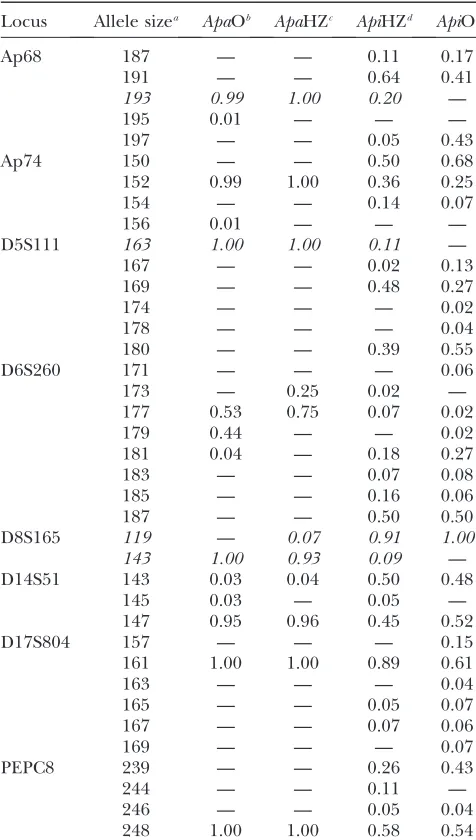
andA. pigraoutside of the zone, three loci contained alleles that were distinct for each species (Ap68, D5S111, and D8S185) (Table 1). Sequences of these alleles con-firmed that size differences are due to differences in the number of repeat units. The two species shared alleles at the other loci examined or potentially di-agnostic alleles occurred at low frequencies in one or the other species. Several alleles showed clines in allele frequencies through the hybrid zone. We also sequenced a 307-bp region of the mitochondrial cytb
gene and/or an 817-bp fragment of theATPase locus from the same 104 individuals listed above (GenBank accession nos. DQ875685–DQ875741 and DQ875611– DQ875672, respectively). Sequences from the two par-ental species have fixed differences at 14 sites for thecytb
fragment and 46 sites for theATPasefragment, and each locus showed5% sequence divergence among species. On the basis of these levels of sequence divergence,A. palliataandA. pigralikely separated3 MYA (Corte´ s
-Ortizet al. 2003).
In total, 23 individuals from the putative hybrid zone wholly possessed alleles of eitherA. palliata(n¼11) or
A. pigra(n¼12) and contained the respective species’ mitochondrial haplotype; this suggests that individuals of both parental species are nearly equally abundant within the hybrid zone. Thirteen other individuals were identified as hybrids on the basis of mitochondrial and microsatellite data (Table 2). The hybrid individuals in-cluded seven adult females, one infant female, and five adult males. Twelve individuals possessed microsatellite alleles, diagnostic of both parental species, although no individuals were F1hybrids (Table 2). The lack of F1’s may be because these individuals are ephemeral, or the hybrid zone is old, or it could reflect a low incidence of hybridization of pure parental forms (see Goodman
et al. 1999). All adult hybrids contained the mitochon-drial haplotype of A. pigra. The infant was the only hybrid that possessedA. palliata’s haplotype. The pre-sumed mother of this infant (based on genotypic data and the fact that the female was carrying the infant) was pureA. palliatabased on the genetic markers used here and her appearance and occurred with a hybrid male that was likely the father of this infant based on the genotypic evidence. Hybrid individuals occurred in fragmented habitats where the two species’ distribu-tions overlap and were members of ‘‘mixed troops’’ that contained individuals of both parental species and in some cases individuals with unique or intermediate morphologies (Figure 2).
We attempted amplifications of a region of the Sry
individuals from within the hybrid zone that were characterized as hybrids. Amplifications were success-ful only with genomic extractions of males; this and the fact that direct sequencing of amplification products yielded chromatograms without double peaks or other ambiguities strongly imply that the gene amplified occurs on the Y chromosome in these individuals. The sequences obtained from individuals outside of the hybrid zone were821 bp in length and showed fixed
differences at three sites among species (GenBank accession nos. DQ875673–DQ875684). All male hybrid individuals (n ¼5) possessed the Srygene of A. pigra
(Table 2).
If matings of hybrids are random and occur among all possible combinations of hybrids and parental species, we expect to find equal frequencies of the four possible genotypes of males and the two possible genotypes of females at the maternally inherited mitochondrial locus and the paternally inherited nuclear locus located on the Y chromosome of males. Although sample sizes are small, the chi-square goodness-of-fit tests suggest that the observed frequencies of males’ and females’ geno-types differed significantly from these expectations (Table 3). Moreover, probabilities of detecting 12 adult hybrids with the mitochondrial haplotype of A. pigra
(P¼2.4 3104), 12 hybrid individuals with the
mito-chondrial haplotype ofA. pigraplus 1 hybrid individual with the mitochondrial haplotype of A. palliata (P ¼ 1.63103), and all 5 hybrid males with theSrygene of
A. pigra(P¼3.13102) are low. These patterns imply
that the direction of hybridization and subsequent back-crosses is strongly biased. Only back-crosses betweenA. pigra
females or hybrid females carrying the mitochondrial haplotype of A. pigra and A. palliata males or hybrid males with theSrygene ofA. palliataoccur and give rise to female offspring (Figure 3). However, no male TABLE 1
Frequencies of alleles of microsatellite loci of populations ofA. palliataandA. pigrafrom outside and within the
putative hybrid zone (including hybrids)
Locus Allele sizea ApaOb ApaHZc ApiHZd ApiOe
Ap68 187 — — 0.11 0.17
191 — — 0.64 0.41
193 0.99 1.00 0.20 —
195 0.01 — — —
197 — — 0.05 0.43
Ap74 150 — — 0.50 0.68
152 0.99 1.00 0.36 0.25
154 — — 0.14 0.07
156 0.01 — — —
D5S111 163 1.00 1.00 0.11 —
167 — — 0.02 0.13
169 — — 0.48 0.27
174 — — — 0.02
178 — — — 0.04
180 — — 0.39 0.55
D6S260 171 — — — 0.06
173 — 0.25 0.02 —
177 0.53 0.75 0.07 0.02
179 0.44 — — 0.02
181 0.04 — 0.18 0.27
183 — — 0.07 0.08
185 — — 0.16 0.06
187 — — 0.50 0.50
D8S165 119 — 0.07 0.91 1.00
143 1.00 0.93 0.09 —
D14S51 143 0.03 0.04 0.50 0.48
145 0.03 — 0.05 —
147 0.95 0.96 0.45 0.52
D17S804 157 — — — 0.15
161 1.00 1.00 0.89 0.61
163 — — — 0.04
165 — — 0.05 0.07
167 — — 0.07 0.06
169 — — — 0.07
PEPC8 239 — — 0.26 0.43
244 — — 0.11 —
246 — — 0.05 0.04
248 1.00 1.00 0.58 0.54
a
Allele sizes are the sizes of the complete sequence of the microsatellite alleles and include both repeat and flanking re-gions. Diagnostic alleles are shown in italics.
b
ApaO,A. palliatafrom outside the putative hybrid zone. c
ApaHZ,A. palliatafrom within the putative hybrid zone. d
ApiO,A. pigrafrom outside the putative hybrid zone. e
ApiHZ,A. pigrafrom within the putative hybrid zone.
TABLE 2
Hybrid individuals in the area of species overlap that showed mixedA. palliataandA. pigracharacter states
Microsatellite locuse
IDa Sexb Phenotypec mtDNAd Ap68 D5S111 D8S165 Sryf
S096 F Apa i a/a a/a a/a NA
S098 M Api i a/i a/i a/i I
S154 M Api i a/i i/i i/i I
S155 F Api i a/i a/i i/i NA
S157 F Api a a/a a/i a/i NA
S161 F Apa i a/a a/a a/i NA
S162 F Apa i a/a a/a a/i NA
S164 F Api i a/i i/i i/i NA
S165 M Api i a/i i/i i/i I
S166 M Api i a/i a/i i/i I
S167 F Api i a/i i/i i/i NA
S182 M Api i i/i i/i a/i I
S183 F Api i i/i a/i a/i NA
aIdentification code.
bAll individuals except S157 were adults; S157 was an infant
still being carried by its presumed mother. c
Phenotype based on size and pelage coloration and tex-ture.Apa,A. palliata-like;Api,A. pigra-like individuals.
d
Mitochondrial haplotype. a,A. palliata; i,A. pigra. e
Identity of alleles for parental species at each diagnostic microsatellite locus. a,A. palliata; i,A. pigra.
f
hybrids with theSrygene ofA. palliata were observed and so, in accordance with Haldane’s rule (Haldane
1922), the data strongly suggest that the aforemen-tioned crosses fail to produce viable males. Further-more, on the basis of the low probability of detecting only the mtDNA haplotype of A. palliata in 12 adult hybrid individuals,A. palliatafemales andA. pigramales or hybrid males either mate infrequently or typically fail to produce viable offspring. Nonetheless, the genotypes of the hybrid infant and its suspected parents imply that
this infant (S157, Table 2) was produced from a backcross between a male hybrid (S154, Table 2) and a femaleA. palliata. This demonstrates that such matings occur and that female offspring are produced. However, because no adult females were observed with the mitochondrial haplotype ofA. palliata, we suspect that such crosses are uncommon or this infant is either infertile or will not survive to reproductive age.
We are currently investigating the potential role of morphological, behavioral, genetic, and cytogenetic differences as causes of the bias in direction of hybrid-ization of these species. This work should advance our understanding of the speciation process and origins of reproductive isolation among primates, as well as the role of hybridization in primate evolution (Arnold
and Meyer2006). Moreover, study of the presence of
hybrids in fragmented and intact forest tracts will reveal whether human-induced forest fragmentation has in-stigated hybridization by confining members of both species to small areas and limiting access to conspecific mates.
The Secretarı´a del Medioambiente y Recursos Naturales, Mexico, and the Autoridad Nacional del Ambiente, Panama, are gratefully acknowledged for providing the collecting, export, and import per-mits that made our research possible. This research was supported by the PROMEP Ph.D. scholarship no. UVER 98-11-019 and PROMEP 103.5/03/1154EXB-9 to L.C.-O., by the Instituto de Neuroetologı´a, Universidad Veracruzana. Financial support was also provided by the Smithsonian Molecular Systematics program and by the Museum of Zoology, University of Michigan.
LITERATURE CITED
Arnold, M. L., 1997 Natural Hybridization and Evolution. Oxford
University Press, Oxford.
Arnold, M. L., and A. Meyer, 2006 Natural hybridization in
pri-mates: One evolutionary mechanism. Zoology109:261–276. Barton, N. H., 2001 The role of hybridization in evolution. Mol.
Ecol.10:551–568.
Bynum, E. L., D. Z. Bynumand J. Supriatna, 1997 Confirmation
and location of the hybrid zone between wild populations of
Macaca tonkeanaandMacaca heckiin Central Sulawesi, Indonesia. Am. J. Primatol.43:181–209.
Figure3.—Possible outcomes of crosses betweenA. palliata
(Apa) andA. pigra(Api) males and females, according to the specific identification of mitochondrial and Y chromosome markers. See text for explanation.
Figure2.—General appearance ofAlouatta palliata,A. pigra,
and hybrid individuals. (A)A. palliatamale from within the hybrid zone; (B) hybrid male that occurred with anA. palliata
female and a hybrid female (note that males A and B be-longed to different neighboring groups); (C) hybrid male with mixed characteristics (size of body and hyoid bone sim-ilar toA. pigrabut note the light hairs in the flanks); (D)A. pigramale from outside the hybrid zone.
TABLE 3
Observed and expected frequencies of genotypes if all possible crosses among hybrids and backcrosses
with parental species are equally likely
Frequencies
Chi-square (d.f.)
Genotypea Expected Observed P-value
Males (n¼5)
aI# 1.25 0
15.0 (3) 1.83103
iI# 1.25 5
aA# 1.25 0
iA# 1.25 0
Females (n¼8)
a$ 4 1 4.5 (1) 3.43102
i$ 4 7
a
Lowercase letters refer to the mitochondrial haplotype of
Coimbra-Filho, A. F., A. Pissinattiand A. B. Rylands, 1993
Exper-imental multiple hybridism amongCallithrixspecies from eastern Brazil, pp. 95–120 inMarmosets and Tamarins: Systematic, Ecology and Behaviour, edited by A. B. Rylands. Oxford University Press,
Oxford.
Corte´ s-Ortiz, L., E. Bermingham, C. Rico, E. Rodrı´guez-Luna,
I. Sampaioet al., 2003 Molecular systematics and biogeography
of the Neotropical monkey genus, Alouatta. Mol. Phylogenet. Evol.26:64–81.
Coyne, J. A., and H. A. Orr, 2004 Speciation. Sinauer, Sunderland,
MA.
Crockett, C. M., and J. F. Eisenberg, 1987 Howlers: variations in
group size and demography, pp. 54–68 inPrimate Societies, edited by B. B. Smuts, D. L. Cheney, R. M. Seyfarth, R. W. Wrangham
and T. Struhsaker. University of Chicago Press, Chicago.
Dowling, T. E., and C. L. Secor, 1997 The role of hybridization
and introgression in the diversification of animals. Annu. Rev. Ecol. Syst.28:593–619.
Dunbar, R. I. M., and P. Dunbar, 1974 On hybridization between
Theropithecus geladaandPapio anubisin the wild. J. Hum. Evol.
3:187–192.
Ellsworth, J. A., and G. A. Hoelzer, 1998 Characterization of
mi-crosatellite loci in a New World primate, the mantled howler monkey (Alouatta palliata). Mol. Ecol.7:657–666.
Escobar-Pa´ ramo, P., 2000 Microsatellite primers for the wild brown
capuchin monkeyCebus apella. Mol. Ecol.9:107–108.
Evans, B. J., J. Supriatnaand D. J. Melnick, 2001 Hybridization
and population genetics of two macaque species in Sulawesi, Indonesia. Evolution55:1686–1702.
Goodman, S. J., N. H. Barton, G. Swanson, K. Abernethyand
J. M. Pemberton, 1999 Introgression through rare hybridization:
a genetic study of a hybrid zone between red and sika deer (ge-nusCervus) in Argyll, Scotland. Genetics152:355–371. Groves, C. P., 1978 Phylogenetic and population systematics of the
mangabeys (Primates: Cercopithecoidea). Primates19:1–34. Haldane, J. B. S., 1922 Sex-ratio and unisexual sterility in hybrid
animals. J. Genet.12:101–109.
Jolly, C. J., T. Woolley-Barker, S. Beyene, T. R. Disotelland J. E.
Phillips-Conroy, 1997 Intergeneric hybrid baboons. Int. J.
Primatol.18:597–627.
Lawrence, B., 1933 Howler monkeys of thepalliatagroup. Bull.
Mus. Comp. Zool.75:313–354.
Lernould, J. M., 1988 Classification and geographical distribution
of guenons: a review, pp. 54–78 inA Primate Radiation: Evolution-ary Biology of the African Guenons, edited by A. Gautier-Hion, F.
Bourliere, J. P. Gautierand J. Kingdon. Cambridge University
Press, Cambridge.
Mallet, J., 2005 Hybridization as an invasion of the genome.
Trends Ecol. Evol.2:229–237.
Mendes, S. L., 1997 Hybridization in free-rangingCallithrix flaviceps
and the taxonomy of the Atlantic forest marmosets. Neotrop. Primates5:6–8.
Moreira, M. A. M., 2002 SRY evolution in Cebidae (Platyrrhini:
Primates). J. Mol. Evol.55:92–103.
Neville, M. K., K. E. Glander, F. Braza and A. B. Rylands,
1988 The howling monkeys, genus Alouatta, pp. 349–453 in
Ecology and Behavior of Neotropical Primates, edited by R. Mittermeier,
A. B. Rylands, A. Coimbra-Filhoand G. B. A. Fonseca. World
Wildlife Fund, Washington, DC.
Palumbi, S. R., 1996 Nucleic acids II: The polymerase chain
reac-tion, pp. 205–247 inMolecular Systematics, edited by D. M. Hillis,
C. Moritzand B. K. Mable. Sinauer, Sunderland, MA.
Peres, C., J. L. Pattonand M. N. F.daSilva, 1996 Riverine barriers
and gene flow in Amazonian saddle-back tamarins. Folia Prima-tol.67:113–124.
Phillipsconroy, J. E., and C. J. Jolly, 1986 Changes in the
struc-ture of the baboon hybrid zone in the Awash National Park, Ethiopia. Am. J. Phys. Anthropol.71:337–350.
Samuels, A., and J. Altmann, 1986 Immigration of aPapio anubis
male into a group of cynocephalus baboons and evidence for a anubis-cynocephalus hybrid zone in Amboseli, Kenya. Int. J. Primatol.7:131–138.
Silva, B. T. F., M. I. C. Sampaio, H. Schneider, M. P. C. Schneider, E.
Montoyaet al., 1993 Protein electrophoretic variability in
Sai-miriand the question of its species status. Am. J. Primatol.29:
183–193.
Smith, J. D., 1970 The systematic status of the black howler monkey,
Alouatta pigraLawrence. J. Mammal.51:358–369.
Struhsaker, T. T., T. M. Butynskiand J. S. Lwanga, 1988
Hybrid-ization between redtail (Cercopithecus ascanius schmidti) and blue (C. mitis stuhlmanni) monkeys in the Kibale Forest, Uganda, pp. 477–497 inA Primate Radiation: Evolutionary Biology of the African Guenons, edited by A. Gautier-Hion, F. Bourliere, J. P. Gautier
and J. Kingdon. Cambridge University Press, Cambridge.
Treves, A., 2001 Reproductive consequences of variation in the
composition of howler monkey (Alouattaspp.) groups. Behav. Ecol. Sociobiol.50:61–71.
Van Belle, S., and A. Estrada, 2006 Demographic features of
Alouatta pigra populations in extensive and fragmented forest, pp. 121–142 in New Perspectives in the Study of Mesoamerican Pri-mates: Distribution, Ecology, Behavior, and Conservation, edited by A. Estrada, P. Garber, M. Pavelkaand L. Luecke. Kluwer
Ac-ademic Press, New York.
Watanabe, K., and S. Matsumura, 1991 The borderlands and
pos-sible hybrids between 3 species of macaques,M. nigra, M. nigres-cens, andM. heckiin the northern peninsula of Sulawesi. Primates
32:365–369.
Whitehead, J. M., 1995 Vox Alouattinae—a preliminary survey of
acoustic characteristics of long-distance calls of howling mon-keys. Int. J. Primatol.16:121–144.
Whitfield, L. S., R. Lovell-Badgeand P. N. Goodfellow, 1993 Rapid
sequence evolution of the mammalian sex-determining gene SRY. Nature364:713–715.
Wyner, Y. M., S. E. Johnson, R. M. Stumpf and R. Desalle,
2002 Genetic assessment of a white-collared x red-fronted lemur hybrid zone at Andringitra, Madagascar. Am. J. Primatol.67:51–66.