Privacy Preservation Approach Using Grid
Base Techniques for Mobile Users
Trupti Takale, Prof. Archana Jadhav
Department of Computer Engineering, Alard College of Engineering and Management, Pune, India
ABSTRACT: Location-based services (LBS) require users to continuously report their location to a potentially untrusted server to obtain services based on their location, which can expose them to privacy risks. Unfortunately, existing privacy-preserving techniques for LBS have several limitations, such as requiring a fully-trusted third party, offering limited privacy guarantees and incurring high communication overhead. In this paper, we propose a user-defined privacy grid system called dynamic grid system (DGS); the first holistic system that fulfills four essential requirements for privacy-preserving snapshot and continuous LBS. (1) the system only requires a semi-trusted third party, responsible for carrying out simple matching operations correctly. This semi-trusted third party does not have any information about a user’s location. (2) Secure snapshot and continuous location privacy is guaranteed under our defined adversary models. (3) The communication cost for the user does not depend on the user’s desired privacy level, it only depends on the number of relevant points of interest in the vicinity of the user. (4) Although we only focus on range and k-nearest-neighbor queries in this work, our system can be easily extended to support other spatial queries without changing the algorithms run by the semi-trusted third party and the database server, provided the required search area of a spatial query can be abstracted into spatial regions. Experimental results show that our DGS is more efficient than the state-of-the-art privacy-preserving technique for continuous LBS..
KEYWORDS: Location Based Service, Privacy Preserving, Spatial Cloaking, Peer-to-Peer, Dual-active.
I. INTRODUCTION
II.LITERATURESURVEY
The advent of high-speed wireless networks and the popularity of portable devices have fueled the development of mobile computing. Compared to traditional computing paradigms, mobile computing enables clients to have unrestricted mobility while maintaining network connection. The ability of users to move and identify their own locations opens up a new kind of information services, called location-dependent information services (LDISs), which produce the answer to a query according to the location of the client issuing the query . Examples of mobile LDISs include nearest object searching (e.g., finding the nearest restaurant) and local information access (e.g., local traffic, news, and attractions. The spatial property of location-dependent data introduces new problems for data caching research. First, the cached result for a query (e.g., the nearest restaurant) may become invalid when the client moves from one location to another. The maintenance of the validity of the cached data when the client changes location is called location-dependent cache invalidation. Second, the cache replacement policy on the client has to consider the sizes of the valid scopes p(hereinafter called valid scope areas) of the cached values. The valid scope of a data value is defined as the geographical area within which the data value is valid. When the valid scope of a data value is large, the chance for the client to issue the same query within the valid scope, thus generating a cache hit, is also large. As such, the cache replacement policy should try to retain the data value with pa larger valid scope area in the cache [1].
Owing to increasing demands from mobile users, Location-Based Services (LBSs) have received a lot of attention in recent years. Examples of queries for location-based services include “find the nearest gas station from my current location”, “find all the cinemas within 1 km radius”, “which buses will pass by me in the next 10 minutes?” and so on. While data objects in the first two examples are stationary, those in the last example are mobile. In this paper, we focus on queries issued by mobile users on relatively static data objects, because they are the most common kind of queries in LBSs. The movement of mobile clients presents many new research problems for location-dependent query processing there are several technical issues involved with the implementation of an LBS, which include locating the position of a mobile user, tracking and predicting movements, processing queries efficiently, and bounding location errors [2]. Consider a computing environment with a large number of location-aware mobile objects. We want to retrieve the mobile objects inside a set of user-defined spatial regions and continuously monitor the population of these windows over a time period. In this paper, we refer to such continuous queries as range-monitoring queries. Efficient processing of range-monitoring queries could enable many useful applications. similarly, we might want to track traffic condition pin some area and dispatch more police to the region if the number of vehicles inside exceeds a certain threshold. In such applications, it is highly desirable and sometime critical to provide accurate results and update them pin real time whenever mobile objects enter or exit the regions of interest. Unlike conventional range queries, a range-monitoring query is a continuous query. It stays active until it is terminated explicitly by the user. As objects continue to move, the query results change accordingly and require continuous updates. A simple strategy for computing range monitoring queries is to have each object report its position as it moves. The server uses this information to identify the affected queries, and updates their results accordingly. This simple approach requires excessive location updates, and obviously is not scalable. Each location update consists of two expenses - mobile communication cost and server processing cost. If a battery-powered object has to constantly report its location, the battery would be exhausted very quickly. It is well-known that sending a wireless message consumes substantially more energy than running simple procedures [3]. Mobile devices with computational, storage, and wireless communication capabilities (such as PDAs) are becoming increasingly popular. At the same time, the technology behind positioning systems is constantly evolving, enabling the integration of low cost GPS devices in any portable unit. Consequently, new mobile computing applications are expected to emerge, allowing users to issue location-dependent queries in a ubiquitous manner. Consider, for instance, a user (mobile client) in an unfamiliar city, who would like to know the 10 closest restaurants. This is an instance of a k nearest neighbor (kNN) query, where the query point is the current location of the client and the set of data objects contains the city restaurants. Alternatively, the user may ask for all restaurants located within a certain distance, i.e., within 200 meters [5].
assumptions about object movement and do not include mechanisms for maintenance of the query results (i.e., when the result expires, a new query must be issued). Recent research considers continuous monitoring of multiple queries over arbitrarily moving objects. In this setting, there is a central server that monitors the locations of both objects and queries. The task of the server is to report and continuously update the query results as the clients and the objects move. As an example, consider that the data objects are vacant cabs and the clients are pedestrians that wish to know their k closest free taxis until they hire one. [6]As the reverse case, the queries may correspond to vacant cabs, and each free taxi driver wishes to be continuously informed about his/her k closest pedestrians. Several monitoring methods have been proposed, covering both range and kNN queries. Some of these methods assume that objects issue updates whenever they move, while others consider that data objects have some computational capabilities, so that they inform the server only when their movement influences some query.
III. PROPOSED SYSTEM
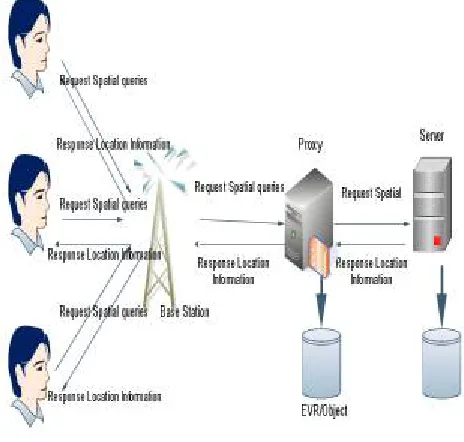
We propose a novel hybrid LBS technique that integrates location cloaking and private information retrieval. We have also implemented and evaluated our proposal to determine its practicality on resource-constrained hardware. The results show that users can achieve a good compromise between privacy and computational efficiency with our technique unlike all other existing LBS proposals.
Fig 1: Proposed System Architecture
ALGORITHMS
Step 1: Peer Search Step
1. Initially set number of peers required k=4, Area(A)=Amin// min area i.e search peers within min area. 2. Broadcast a request (containing ID of user U) to all neighboring peers.//req
3. Each peer generates a new record r that contains its ID, current location and a timestamp i.e. <p, (xp, yp), tp> 4. Send record r to user U. // r is result
If ( (NumPeer(List)<=k) && (Area(A) < Amax) ) For (i=0;i<=NumPeer(List);i++) get (i)th records
a. Expand the Area(A) by adding some constant value. b. Broadcast request to the peers.
c. Receive records from peers.
d. Update number of peers in List (i.e. k). End for
End if
If (NumPeer(List)=NULL) // if no peer found
a. Select the user as having the latest timestamp. End if
5. Send the records in List, k, location of user U, Area(A) and ID of peer having latest timestamp to central server(i.e. Location Anonymizing Server).
Step 2: Cloaked Area Step
1. If( NumPeer(List)>k)//i.e. is peers are found a. Select one peer records.
b. Show a region A previously defined before searching peer(to show that peer is within that region). 2. Else//if peers are not found
a. Set latest timestamp = ID of user U
b. Add some constant value to U’s latitude and longitude.
c. Determine region A=Amin//region will become min area previously defined in line 1 of algorithm 1.
End if
3. If( Area(A)>= Amin)
a. Return Area A as user’s blurred location information b. Also return location of peer having latest timestamp. 4. Else
a. Extend Area A by random distance.
b. Return Area A as user’s blurred location information c. Also return location of peer having latest timestamp. End if
Forward the request along with fake location information and bounded area to Location-based server.
MATHEMATICAL MODEL
Fu = {Requested user for data} Fm = {Data providers upto n} Fb = {FuˆFm}
Since,
Fm |Fm| NULL Failure Condition,
If (F[i] )
{ n[i]=null;
}// user not available in database authentication time Fu[i] = =NULL, Fm [i]|= =NULL
IV. RESULTS AND DISCUSSION
For the proposed system comparison we analyze the our work with some existing systems. The Searching technique might be affect to searching time complexity base on k-anonymity users. The given table 1 shows the comparative results of system
Cryptography Technique/ Algorithm
Data Size in MB
Encryption Time in Milliseconds
Decryption time in Milliseconds
IBE 100 254 265
Hashing 100 269 271
AES 100 310 305
Proposed 100 210 201
Table 1: Encryption technique comparison for proposed system
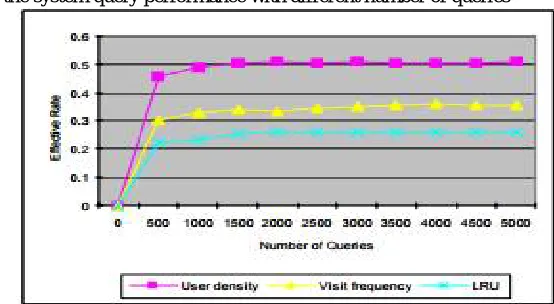
Here below graph show the system query performance with different number of queries
Fig 2: The cache hit ratio of the three cache replacement policies with increasing users query number.
V. CONCLUSION
In the given work, we proposed a dynamic grid system for providing privacy-preserving continuous LBS. Our DGS includes the query server and the service provider, and cryptographic functions to divide the whole query processing task into two parts that are performed separately by QS and SP, we give the survey of location-based privacy preserving. First, we summary the anonymity technologies, such as location k-anonymity, location obfuscation, location spatial cloaking, and Spatio-temporal cloaking. Then, we give the privacy attack models based on location server. Finally, we overview the privacy-aware location query processing.
REFERENCES
[1] D. Lee, B. Zheng, and W.-C. Lee, “Data Management in Location- Dependent Information Services,” IEEE Pervasive Computing, vol. 1, no. 3, pp. 65-72, July-Sept. 2002.
[2] B. Zheng, J. Xu, and D.L. Lee, “Cache Invalidation and Replacement Strategies for Location-Dependent Data in Mobile Environments,” IEEE Trans. Computers, vol. 15, no. 10, pp. 1141- 1153, Oct. 2002.
[3] B. Zheng and D.L. Lee, “Processing Location-Dependent Queries in a Multi-Cell Wireless Environment,” Proc. Second ACM Int’l Workshop Data Eng. for Wireless and Mobile Access, 2001.
[4] B. Zheng, J. Xu, W.-C. Lee, and D.L. Lee, “On Semantic Caching and Query Scheduling for Mobile Nearest-Neighbor Search,” Wireless Networks, vol. 10, no. 6, pp. 653-664, Dec. 2004.
[5] X. Gao and A. Hurson, “Location Dependent Query Proxy,” Proc.ACM Int’l Symp. Applied Computing, pp. 1120-1124, 2005. [6] X. Gao, J. Sustersic, and A.R. Hurson, “Window Query Processing with Proxy Cache.
[6] Bugra Gedik and Ling Liu. Location Privacy in Mobile Systems: A Personalized Anonymization Model. In Proceedings of the 25th International Conference on Distributed Computing Systems, pages 620–629, 2005.
[7] Gabriel Ghinita, Panos Kalnis, and Spiros Skiadopoulos. PRIVE: Anonymous Location-based Queries in Distributed Mobile Systems. In Proceedings of the 16th International Conference on World Wide Web (WWW), pages 371–380, 2007.
[8] Marco Gruteser and Dirk Grunwald. Anonymous Usage of Location-Based Services Through Spatial and Temporal Cloaking. In Proceedings of the First International Conference on Mobile Systems, Applications, and Services (MobiSys), 2003.
[9] Haibo Hu, Jianliang Xu, Wing Sing Wong, Baihua Zheng, Dik Lun Lee, Wang-Chien Lee. Proactive Caching for Spatial Queries in Mobile Environments. In Proceedings of the 21st International Conference on Data Engineering (ICDE), pages 403-414, 2005.