Comparative Study of M35 Concrete using
Marble Dust as Partial Replacement of
Cement and Fine Aggregate
Kapil Katuwal1, Arnav Duarah2, Manoj Kumar Sarma3, Motiur Rahman4, Puspanjali Sonowal5
U.G. Students, Department of Civil Engineering, Assam Engineering College, Guwahati, Assam, India 1, 2, 3,4
Assistant Professor, Department of Civil Engineering, Assam Engineering College, Guwahati, Assam, India5
ABSTRACT: Concrete is well known as a heterogeneous mixture of cement, water and aggregates. This paper helps to determine whether industrial wastes like marble dust can be satisfactorily used in concrete as a replacement of both cement and fine aggregate. The marble dust is added to M35 grade of concrete at 0%, 5%, 10%, 15%, and 20% partial replacement by weight of cement. The results obtained from compressive strength test after 7 days and 28 days are then evaluated. The same study has also been performed with marble dust as a partial replacement of sand (fine aggregate). Finally, the results obtained after partial replacement of cement and fine aggregate by marble dust are compared graphically. The idea is to achieve higher strength of concrete at an economical rate. Moreover, the use of industrial wastes like marble dust would also help to solve various environmental problems.
KEYWORDS: Concrete, marble dust, cement, fine aggregates, compressive strength.
I. INTRODUCTION
Concrete is a composite construction material comprising of broken stone or gravel, sand, cement and water. It is spread or poured into moulds to form a stone – like mass on hardening. In its simplest form, concrete is a mixture of paste and aggregate. Various materials are added such as marble dust, stone dust etc. to obtain concrete of desired property. The key to achieve a strong, durable concrete rests in the careful proportioning, mixing and proportioning of the ingredients.
Marble powder is produced from processing plants during the sawing and polishing of marble blocks and about 25% of the processed marble is turned into powder form. They are actually a by-product of marble sawing and shaping. Marble blocks are cut into smaller blocks in order to obtain the desired smooth shape. During the cutting process about 25% the original marble mass is lost in the form of dust.
The industry’s disposal of the marble powder material, consisting of very fine powder, today constitutes one of the environmental problems around the world. Leaving these waste materials to nature specifically can bring about ecological issue. Hence, the reuse of these waste materials is crucial for the safety of the environment. One of the logical means for reduction of the waste marble masses is by utilizing them in building construction. Waste marble powder can be used to improve the mechanical and physical properties of the conventional concrete. Moreover, the demand for cement is quite high in developing countries owing to rapid infrastructural growth which results in supply scarcity and increase in the cost of material. So, using these waste materials in the production of concrete also reduces the cost of construction.
II. LITERATURE REVIEW
increased waste marble powder (WMP) or waste marble granule (WMG) ratio resulted in increased workability and compressive strengths of the mortar and concrete.
A.A Aliabdo et al. (2013) [2] studied on the re-use of waste marble dust in the production of cement and concrete which showed the possibility of utilizing waste marble dust (MD) in cement and concrete production by discussing the properties of concrete contained marble dust as a cement replacement and as a sand replacement (cement addition).. It was observed that the higher values of marble dust decreases the C3A content compared to plain cement.
C Vaidevi et al. (2013) [3] found that the marble dust from marble processing is a waste which can be utilized. The study showed that marble wastes, which are in the dust form, could be used as cementitious material in concrete mixtures where they are available and the cost of construction is lower than ordinary concrete materials.
V. M. Sounthararajan et.al. (2013) [4] studied the effect of lime content in marble powder for producing high strength concrete. They found that the waste marble powder at 10% replacement by weight of cement improved the hardened concrete properties.
A study conducted by J Singh et al. (2015) [5] showed that the addition of marble dust as a replacement of cement in concrete improved its properties. The study showed that for up to 12% replacement of cement with waste marble, there is an increase in all mechanical properties.
III. METHODOLOGY
The compressive strength test was performed as per the specifications of IS: 516-1959. For this test, the mix calculations were performed as per the guidelines of IS: 10262-2009. Marble dust was used as a partial replacement of cement and fine aggregates at 5%, 10%, 15% and 20% by weight. The water cement ratio adopted was 0.5. At every percentage use of marble dust, a total of six cubes, three for testing after 7 days of curing and three for testing after 28 days of curing, were made. Three trials were also carried out without any replacement of cement and fine aggregates. Therefore, casting of 54 cubes were made in total. Blending of aggregates was also done. Finally, the results obtained after partial replacement of cement and fine aggregate by marble dust were compared.
Table 1 Specific gravity of Cement, CA, FA and Marble Dust
CEMENT 3.15
COARSE AGGREGATE 2.67 FINE AGGREGATE 2.63 MARBLE DUST 2.67
Table 1 gives the specific gravity of various components in concrete. It also gives the specific gravity of the marble dust used to partially replace cement and fine aggregates in concrete.
The cement used in the study was Ordinary Portland Cement (OPC-43).The normal consistency of cement was found to be 33%. The initial and final setting time were 48 minutes and 393 minutes respectively.
River sand and crushed sand were used in combination as fine aggregates, conforming to the requirements of IS: 383-1970. Fine aggregates used in the study conformed to Zone III as per IS: 383-383-1970.
IV. MIX DESIGN
The mix was then allowed to harden in the mould for a period of 24 hours, after which they were removed and placed in water for curing for the required duration of either 7 days or 28 days.
The cubes were taken out after the desired curing period and then placed in the compression testing machine, and properly aligned centrally on the base plate. Compressive load was then gradually applied, and the load at failure was obtained in each case from which the compressive strength of individual cubes was obtained.
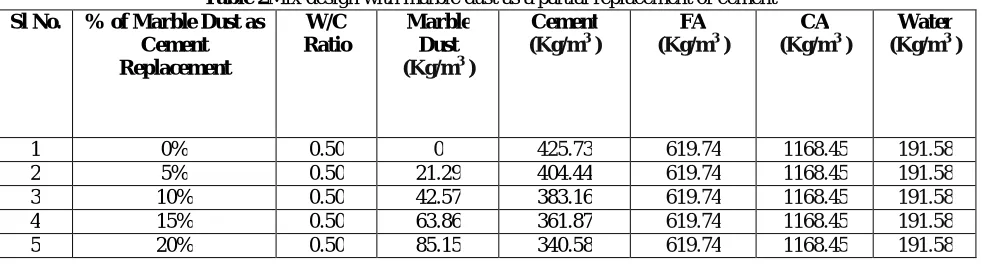
Table 2Mix design with marble dust as a partial replacement of cement
Sl No. % of Marble Dust as Cement Replacement
W/C Ratio
Marble Dust
(Kg/m3 )
Cement
(Kg/m3 )
FA
(Kg/m3 )
CA
(Kg/m3 )
Water
(Kg/m3 )
1 0% 0.50 0 425.73 619.74 1168.45 191.58
2 5% 0.50 21.29 404.44 619.74 1168.45 191.58
3 10% 0.50 42.57 383.16 619.74 1168.45 191.58
4 15% 0.50 63.86 361.87 619.74 1168.45 191.58
5 20% 0.50 85.15 340.58 619.74 1168.45 191.58
The results for mix proportion with 5%, 10%, 15% and 20% replacement of cement with marble dust are shown in Table 2.
Table 3Mix design with marble dust as a partial replacement of fine aggregate
Sl No.
% of Marble Dust as Fine Aggregate
Replacement
W/C Ratio
Marble Dust
(Kg/m3 )
Cement
(Kg/m3 )
FA
(Kg/m3 )
CA
(Kg/m3 )
Water
(Kg/m3 )
1 0% 0.50 0 425.73 619.74 1168.45 191.58
2 5% 0.50 31.03 425.73 589.19 1168.45 191.58
3 10% 0.50 62.07 425.73 558.61 1168.45 191.58
4 15% 0.50 93.17 425.73 527.99 1168.45 191.58
5 20% 0.50 124.33 425.73 497.30 1168.45 191.58
Table 3 shows the results for mix proportion with 5%, 10%, 15% and 20% replacement of fine aggregate with marble dust.
Table 4Compressive Strength results for normal concrete
Sl. No. Particular 7 days strength (N/mm2)
28 days strength (N/mm2)
1
Normal Concrete
32.44 45.33
2 31.78 45.56
Table 4 shows the compressive strength test results for concrete when none of its constituents have been partially replaced by marble dust. Three trials were carried out and the average of their results at the end of 7 days and 28 days were determined.
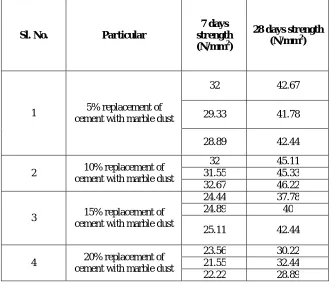
Table 5 Compressive strength results for concrete with partial replacement of cement with marble dust
Sl. No. Particular
7 days strength (N/mm2)
28 days strength (N/mm2)
1 5% replacement of cement with marble dust
32 42.67
29.33 41.78
28.89 42.44
2 10% replacement of cement with marble dust
32 45.11 31.55 45.33 32.67 46.22
3 15% replacement of cement with marble dust
24.44 37.78 24.89 40
25.11 42.44
4 20% replacement of cement with marble dust
23.56 30.22 21.55 32.44 22.22 28.89
Table 5 shows the compressive strength test results for concrete when one of its constituents (cement) is partially replaced with marble dust. Three trials were carried out for 5%, 10%, 15% and 20% replacement respectively and the average of their results at the end of 7 days and 28 days were determined.
Table 6Compressive strength results for concrete with partial replacement of fine aggregate with marble dust
Sl. No. Particular 7 days strength (N/mm2)
28 days strength (N/mm2)
1
5% replacement of fine aggregate with marble
dust
32.22 44.89
32.89 44
2 dust 32.67 44.89
3
15% replacement of fine aggregate with marble
dust
35.11 45.33 33.33 45.33 32.22 45.56
4
20% replacement of fine aggregate with marble
dust
32.89 44.44 32.44 44.89 32.44 44.44
Table 6 shows the compressive strength test results for concrete when one of its constituents (fine aggregate) is partially replaced with marble dust. Three trials were carried out for 5%, 10%, 15% and 20% replacement respectively and the average of their results at the end of 7 days and 28 days were determined.
V. RESULTS AND DISCUSSION
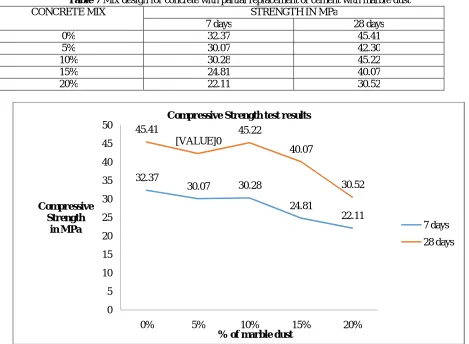
Table 7 Mix design for concrete with partial replacement of cement with marble dust CONCRETE MIX STRENGTH IN MPa
7 days 28 days
0% 32.37 45.41
5% 30.07 42.30
10% 30.28 45.22
15% 24.81 40.07
20% 22.11 30.52
Fig 1 Graphical representation of mix design with marble dust replacing cement 32.37
30.07 30.28
24.81
22.11 45.41
[VALUE]0
45.22
40.07
30.52
0 5 10 15 20 25 30 35 40 45 50
0% 5% 10% 15% 20%
Compressive Strength
in MPa
% of marble dust Compressive Strength test results
7 days
Table 7 and Fig 1 shows the average result of compressive strength test of concrete containing marble dust as a partial replacement of cement. The results were obtained for 7 days and 28 days, with concrete specimens containing marble dust with percentage ratios of 0%, 5%, 10%, 15% and 20% as partial replacements by weight of cement.
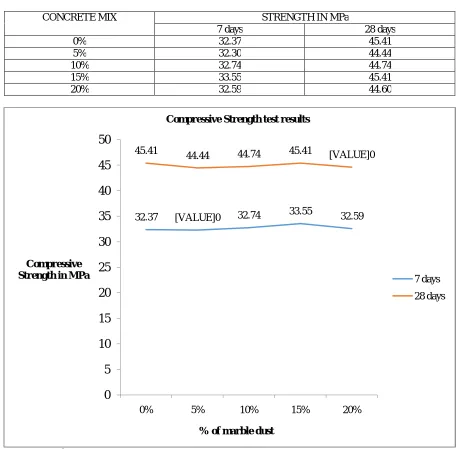
Table 8 Mix design for concrete with partial replacement of fine aggregate with marble dust
CONCRETE MIX STRENGTH IN MPa
7 days 28 days
0% 32.37 45.41
5% 32.30 44.44
10% 32.74 44.74
15% 33.55 45.41
20% 32.59 44.60
Fig 2 Graphical representation of mix design with marble dust replacing fine aggregate
Table 8 and Fig 2 shows the average result of compressive strength test of concrete containing marble dust as a partial replacement of fine aggregate. The results were obtained for 7 days and 28 days, with concrete specimens containing
32.37 [VALUE]0 32.74 33.55 32.59 45.41 44.44 44.74 45.41 [VALUE]0
0
5
10
15
20
25
30
35
40
45
50
0% 5% 10% 15% 20%
Compressive Strength in MPa
% of marble dust
Compressive Strength test results
7 days
Based on the experimental investigation concerning the compressive strength of M35 concrete, the following observations were made regarding the partial replacement of cement and fine aggregate by marble dust:
(a) Compressive strength increases at 10% replacement of cement by marble dust and 15% replacement of fine aggregate by marble dust.
(b) 10% replacement of cement by marble dust can be satisfactorily done as the compressive strength is greater than the target mean strength.
(c) We cannot decrease or increase the replacement of cement by 10% because it will give compressive strength lower than the target strength of M35 concrete.
(d) However the replacement of fine aggregate by marble dust by 5%, 10%, 15%, and 20% provides strength greater than target mean strength of M35 concrete. But in order to have maximum compressive strength we can adopt 15% replacement.
(e) Along with the compressive strength, the slump was also measured. Very low slump was obtained when marble dust was not used, and zero slump was obtained on partial replacement by marble dust. As the slump obtained is zero, suitable admixtures can be used in order to enhance the workability of concrete.
(f) Thus it will be economical to either replace cement by 10% with marble dust or adopt any of 5%, 10%, 15%, 20% replacement of fine aggregate by marble dust.
VI. CONCLUSION
From the study, it can be concluded that marble dust can be satisfactorily utilized as a constituent of concrete of grade M35 by using it as a replacement of cement at 10% of the total weight of cement and 15% of the total weight of fine aggregate. By comparing the results obtained from the study, it can be seen that 15% replacement of fine aggregate by marble dust gives slightly higher strength of concrete than 10% replacement of cement by marble dust. The use of 15% of marble dust as fine aggregates for M35 concrete will ensure that waste marble dust are put to large scale use, thus enabling reuse of waste materials instead of being dumped in landfills. The use of marble dust shall also help in reduction of the dependence on natural aggregates to a certain extent, thus providing time for their replenishment.
REFERENCES
[1] Rai B, Khan N, Abhishek H, Rushad T, Duggal S.K, “Influence of Marble Powder/Granules in Concrete mix”, International Journal of Civil And Structural Engineering, Vol. 1, Issue no. 4, pp. 827-834, 2011.
[2] Aliabdo A.A, Elmoaty A.E.M.A and Auda E.M., “Re-use of waste marble dust in the production of cement and concrete”, Construction using Building Materials, Vol. 50, pp. 28-41, 2014.
[3] Vaidevi C, “Study on Marble Dust as partial replacement of cement in concrete”, Indian Journal of Engineering, Vol .4, Issue no. 9, pp.14-16, 2013.
[4] Sounthararajan V. M and Sivakumar A, “Effect of the lime content in Marble Powder for producing High Strength Concrete”, ARPN Journal of Engineering and Applied Sciences, Vol. 8, Issue no. 4, pp. 260-264, 2013.