ABSTRACT
GRACE, MICHAEL C. Privilege Leakage in Practical Systems. (Under the direction of Xuxian Jiang and William Enck.)
The modern world places great reliance on computer systems. As the cost of processing power drops, many aspects of our daily life are now becoming “smart.” Computers used to take up a room, then an expensive piece of hardware upon a desk, and now are carried in the pockets of most people. This evolution obviously owes much to advances in hardware, but software has also played an important role: as additional layers of abstraction have been built up, it is easier than ever to develop software to do sophisticated tasks. Since computer systems today are networked, always-on, and contain valuable data, attackers are eager to use any gaps in their architecture to gain access to them. In this dissertation, we examine the ways in which privilege can be leaked through such architectural gaps in practical systems.
First, we deal with a class of memory safety issues within the Linux kernel. Most modern processor architectures use the concept ofmemory pages to manage memory, both to support virtual addressing and to enable page-level protection bits to describe the context in which each page should be used. Due to improper memory layouts within commodity kernels, a single page sometimes contains both executable code and writable data. An attacker can therefore use a memory write to inject their own code directly into kernel space, gaining its privilege. To address this problem, we propose using a security hypervisor to manage the kernel’s memory and enforce theW⊕Xproperty, which states that a given memory page can be either executable or writable, but not both at the same time. By efficiently emulating the older Harvard architecture, we can enforce a strict separation between code and data accesses even when pages contain both.
© Copyright 2017 by Michael C. Grace
Privilege Leakage in Practical Systems
by
Michael C. Grace
A dissertation submitted to the Graduate Faculty of North Carolina State University
in partial fulfillment of the requirements for the Degree of
Doctor of Philosophy
Computer Science
Raleigh, North Carolina
2017
APPROVED BY:
Ting Yu Matthias Stallmann
Xuxian Jiang
Co-chair of Advisory Committee
William Enck
DEDICATION
BIOGRAPHY
ACKNOWLEDGEMENTS
This dissertation was a long time in coming, and I have many people to thank for its successful completion – so many, in fact, that I quail at the thought of trying to name them all individually, for it is nearly certain that I will forget someone vitally important. Therefore, please forgive me if I mention only a very few people by name.
To begin with, I would like to thank my co-advisors: Dr. Xuxian Jiang and Dr. William Enck. Both exhibited great patience in dealing with my meandering focus (or lack of it!) through-out great portions of my graduate career, and I learned a great many things abthrough-out research, academia, and life along the way thanks to their efforts.
I would also like to thank my academic brothers and sisters: the many labmates that I worked alongside during this process. Writing this dissertation, it warmed my heart to cite the post-graduate work of many of them, and I wish them all continued success wherever they choose to apply their talents. To those that have not yet graduated: keep at it, if I can do it I am sure that you can!
I could not have completed this dissertation without the support of my colleagues at Sam-sung, a substantial number of whom also have work cited here. While I work in a product security capacity within a very results-oriented company, we clearly still have a strong dedica-tion to research. I would particularly like to thank my superior, Dr. Peng Ning, for not only tolerating but encouraging my occasional absences to work on this dissertation.
The Department of Computer Science I owe a further debt of gratitude. I count several of the faculty among the most important influences in my life, and the Office of Graduate Programs was very helpful in ensuring I completed all the many arcane rituals involved in graduating. However, it is perhaps unfair to stop there: I have spent a substantial portion of my life affiliated with North Carolina State University, and it has been a very beneficial association. I had many choices to consider when choosing a university, but I feel I could not have made a better one.
TABLE OF CONTENTS
List of Tables . . . vii
List of Figures . . . .viii
Chapter 1 Introduction . . . 1
1.1 Motivation . . . 2
1.2 Thesis Statement . . . 4
1.3 Contributions . . . 5
1.4 Dissertation Organization . . . 6
Chapter 2 Related Work . . . 7
2.1 Kernel Level Privilege Separation . . . 7
2.1.1 Advances in Kernel Attacks and Defenses . . . 7
2.1.2 Kernel Rootkit Detection . . . 8
2.1.3 Kernel Rootkit Prevention . . . 9
2.1.4 Protecting Userspace from the Kernel . . . 10
2.1.5 TLB Manipulation . . . 11
2.2 Application-Level Capability Leaks . . . 12
2.2.1 Early Desktop Leak Detection and Defense . . . 12
2.2.2 Early Work on Capability Leaks in Mobile Platforms . . . 12
2.2.3 Static Capability Leak Analysis in Android . . . 13
2.2.4 Static Information Leak Analysis in Mobile Platforms . . . 14
2.2.5 Framework-Level Permission System Refinements . . . 15
2.2.6 System-Wide Information Flow Monitoring on Android . . . 16
2.2.7 Application-Level Permission Policy Enforcement . . . 16
2.2.8 Studies of Android Firmware Customization . . . 17
2.3 Sub-Application Level Capability Leaks . . . 18
2.3.1 App Surveys . . . 19
2.3.2 Sub-Application-Level Capability Leak Defenses . . . 20
2.3.3 Privacy-Preserving Ad Delivery . . . 21
Chapter 3 Kernel-Level Privilege Separation . . . 22
3.1 Background . . . 22
3.2 Key Concepts . . . 25
3.2.1 Harvard Architecture . . . 25
3.2.2 Virtualization and Shadow Paging . . . 26
3.3 Design . . . 28
3.3.1 Page-Level Redirection forW ⊕X . . . 28
3.3.2 Mode-Sensitivity forW ⊕KX . . . 31
3.4 Implementation . . . 32
3.4.1 Page-Level Redirection . . . 33
3.4.2 Mode-Sensitivity Support . . . 34
3.6 Discussion . . . 38
3.7 Summary . . . 39
Chapter 4 Application-Level Capability Leaks. . . 40
4.1 Background . . . 40
4.2 System Design . . . 41
4.2.1 Explicit Capability Leak Detection . . . 43
4.2.2 Implicit Capability Leak Detection . . . 47
4.3 Implementation . . . 48
4.3.1 Control-Flow Graph Construction . . . 49
4.3.2 Capability Leak Detection . . . 50
4.4 Evaluation . . . 52
4.4.1 Results Overview . . . 53
4.4.2 Case Studies . . . 54
4.4.3 Performance Measurement . . . 58
4.5 Discussion . . . 59
4.6 Summary . . . 61
Chapter 5 Sub-Application-Level Capability Leaks. . . 62
5.1 Background . . . 62
5.2 Anatomy of an Ad-Supported App . . . 64
5.3 System Design . . . 67
5.3.1 Sampling Google Play . . . 67
5.3.2 Analyzing Ad Libraries . . . 69
5.3.3 Identifying Possible Risks . . . 70
5.4 Prototyping and Evaluation . . . 72
5.4.1 Overall Results . . . 73
5.4.2 Categorized Findings . . . 79
5.4.3 Performance Measurement . . . 82
5.5 Discussion . . . 82
5.6 Summary . . . 84
Chapter 6 Conclusion and Future Work . . . 85
LIST OF TABLES
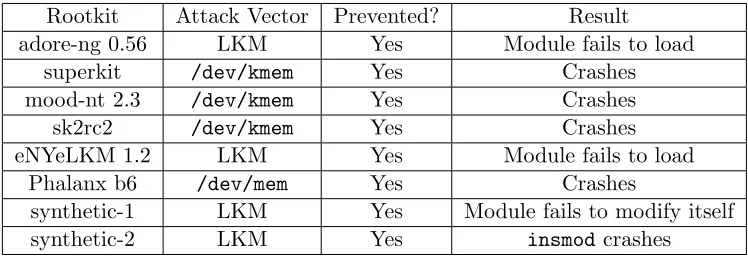
Table 3.1 Effectiveness of our system . . . 36
Table 3.2 Software configuration for performance evaluation . . . 37
Table 3.3 Application benchmark results. For make, lower is better; for Apache, higher is better. . . 37
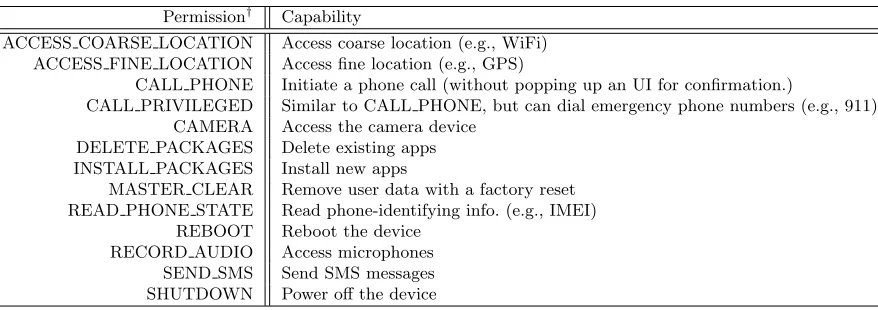
Table 4.1 The list of 13 representative permissions in our study . . . 51
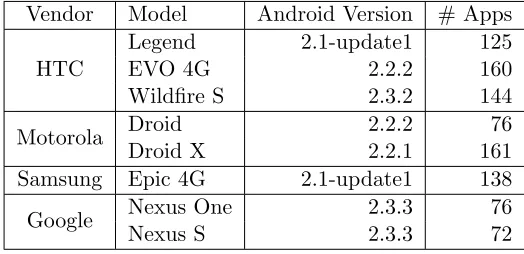
Table 4.2 Eight studied Android smartphones . . . 52
Table 4.3 Capability leak results of eight Android-based smartphones . . . 53
Table 4.4 Processing time of examined smartphone images . . . 59
Table 5.1 Permission protection levels in Android . . . 65
Table 5.2 The overall results from the top 50 representative ad libraries . . . 74
Table 5.3 The overall results from the remaining 50 ad libraries . . . 75
LIST OF FIGURES
Figure 3.1 The Harvard architecture . . . 25
Figure 3.2 Guest page table vs. shadow page table . . . 27
Figure 3.3 Page-level mode-sensitive redirection enables an efficient implementation of the Harvard architecture on top of x86. . . 29
Figure 3.4 Two shadow page tables: the user-mode page table and the kernel-mode page table share the same level-1 entries, but not top-level and level-2 entries. . . 35
Figure 4.1 Detecting external capability leaks with Woodpecker . . . 42
Figure 4.2 A discontinuity in the control flow introduced by the Android framework. 44 Figure 4.3 TheSEND SMS capability leak as a call graph. . . 56
Figure 5.1 Angry Birds’AndroidManifest.xmlfile . . . 64
Figure 5.2 Detecting internal capability leaks with AdRisk . . . 67
Figure 5.3 Popularity of the top 20 ad libraries in our study . . . 68
Figure 5.4 Number of ad libraries contained by each app . . . 76
Figure 5.5 Classes in the obfuscatedcom.mt.airadpackage . . . 77
Chapter 1
Introduction
The modern world places great reliance on computer systems. As the cost of processing power drops, many aspects of our daily life are now becoming “smart.” Computers used to take up a room, then an expensive piece of hardware upon a desk, and now are carried in the pockets of most people. This evolution obviously owes much to advances in hardware, but software has also played an important role: as additional layers of abstraction have been built up, it is easier than ever to develop software to do sophisticated tasks.
Another example presents itself in the choice of operating system kernel adopted by the Android project: Linux. Released in 1991 as a non-commercial, free open-source effort, its low cost and ease of modification ultimately led to grass-roots popularity with IT professionals. By 1999, over half of web domains used Linux [31], and by the present day that number is now approximately two thirds [29]. The tunable nature of the operating system also led to broad adoption in the field of high-performance computing: 291 of the top 500 fastest supercomputers by 2006 – merely six years after first appearing on the list – ran a variant of Linux, a number that has climbed to 498 today [23]. Due to its free nature, it is harder to accurately estimate the amount of backend business systems running Linux today, but the platform has clearly seen broad adoption in such roles across the world.
These two examples showcase the speed with which disruptive innovation can occur in software – even for software as fundamental as an operating system platform. Furthermore, the rapid adoption of a new paradigm in both these contexts was driven by buy-in from many different parties to collaboratively improve the software, to allow it to do new things and colonize new use cases. Given the number of architectural layers in such complex systems, however, it is natural to overlook implicit security assumptions when trying to cover new ground, or to have difficulty addressing new threat models using the existing architectural layout.
1.1
Motivation
Since computer systems today are networked, always-on, and contain valuable data, attackers are eager to use any gaps in their architecture to gain access to them. In the modern world, such access can be traded for financial or even ideological gain, by stealing data, setting up botnets to attack internet resources, or through simple vandalism.
To return to the previous examples, since the Linux kernel is used so broadly, vulnerabilities that effect it are big news. The recent “Dirty COW” flaw [13] attracted a lot of media attention because the vulnerability had gone undetected in the kernel for nine years, and was first brought to light by what appeared to be an active, in-the-wild exploitation campaign. Given the wide spread of the Linux kernel, and the data stored on so many network-connected information systems, the potential for damage was great – practically every Linux machine running at the time of discovery was theoretically vulnerable.
Memory safety issues account for a huge proportion of flaws within privileged components. Another memory safety vulnerability, stagefright [83], inspired similarly impressive headlines as media outlets claimed hundreds of millions of devices might be impacted. Stagefright was simply a series of mistakes within the native code that Android used to render media files. This code, executing at privilege, could be commandeered by an attacker who tricked the phone into rendering a malformed media file. While the issue was addressed swiftly by the Android community, Google’s retrospective about these events contained the worrying statistic that 85.9% of all the security-relevant bugs within the platform involved memory safety [117].
Google attempts to mitigate memory safety issues in Android by encouraging the use of a memory- and type-safe language, Java. Java is easy to develop in, especially with Google’s strong investment in rich tooling and automation; this allows users to easily extend and supplement the built-in functionality that ships with their smartphones. As a result, the Google Play Store currently allows users to choose from over 2.8 million apps [22]. Unsurprisingly, everyday people are increasingly relying on smartphones to manage their personal data. Inside the phone, we can find current (or past) geo-location information about the user [19], logs of placed and received calls, an address book with rich contact information, as well as cached emails and photos taken with the built-in camera. The type and the volume of information kept in the phone naturally leads to concerns [86, 87, 128, 194] about the safety of this private information, including the way it is managed and accessed.
To mediate access to personal information and certain sensitive phone functions, smart-phone platform vendors have explored a number of approaches. For example, Apple uses a vetting process through which each third-party app must be scrutinized before it will be made available in the app store. After installing an app, Apple’s iOS platform will prompt the user to approve the use of some functions at run-time, upon their first access. Analogously, Google defines a permission-based security model in Android by requiring each app to explicitly request permissions up-front to access personal information and phone features.
1.2
Thesis Statement
While they appear to be quite different issues, memory safety and capability leaks can be seen as simply the same general problem at a different level of granularity. Memory safety issues come from a system architecture that does not properly take into account the intent of a memory access, which allows an attacker to “trick” the system into corrupting its state. On the other hand, capability leaks involve an incomplete protection boundary around a privilege; for an external capability leak in Android, this is usually a missing permission check, while internal capability leaks involve a disconnect between the trust model of the permission system and the process boundary granularity at which it is enforced.
Summarizing this more succinctly, we derive the central thesis of this work:
Practical systems contain subjects at all levels (e.g., kernel, application, and sub-application) that reexpose privileged access to information and resources due to im-proper architectural organizations that are not dependent on functional requirements.
Viewed through this lens, both memory safety issues and capability leaks are part of the broader class of privilege leaks. In this dissertation, we explore these privilege leaks at each level of abstraction within a typical system, ultimately focusing on Android as an interesting example due to its focus on the framework and inter-process communication.
First, we deal with a class of memory safety issues within the Linux kernel. Most modern processor architectures use the concept ofmemory pages to manage memory, both to support virtual addressing and to enable page-level protection bits to describe the context in which each page should be used. Our work focuses on the x86 architecture, where the minimum page size is 4 kilobytes; this granularity means that sometimes memory with different intended purposes is allocated on the same page, which therefore over-privileges that page. When applied to an operating system kernel, this can result in a context where a page is mapped both writable and executable at the same time, allowing a memory safety problem to be used to inject code into kernel space. To address this problem, we propose using a security hypervisor to manage the kernel’s memory and enforce the W ⊕X property, which states that a given memory page can be either executable or writable, but not both at the same time. While operating system kernels now strive to conform to this property, the legacy architecture of Linux did not initially consider
We then turn our focus to a survey the landscape of a representative smartphone plat-form, Android, by developing tools and techniques to identify potential capability leaks. We identify two major sources of such vulnerabilities in the platform as it stands today: firmware customizations, which lead to external capability leaks, and embedded advertisement libraries, which correspondingly constitute internal capability leaks. The Android platform does not offer the user much recourse in addressing either problem; for example, many phones are sold in a “locked” configuration that prevents the user from modifying the firmware, yet carriers and manufacturers can be slow to port newer versions of Android to existing phones. Similarly, ad-supported apps rarely disclose what advertisement libraries they contain, or how those libraries use the access the user has granted to the app.
1.3
Contributions
This dissertation makes the following contributions:
We propose a hardware virtualization-based Harvard architecture, hvmHar-vard [98], to effectively protect commodity OS kernels from kernel code-injection attacks. Compared with contemporary approaches, our system achieves the most robust protection guarantees with far improved performance (under<5% overhead), without the need to modify the kernel.
We perform the first systematic evaluation of the impact of vendor customiza-tions on the security and privacy of Android smartphones [100]. Using a static analysis system, Woodpecker, we document and overcome several challenges in resolving the possible paths execution within an Android app can take. Our results indicated that of the thirteen privileged permissions we studied, eleven were leaked by at least one of the phones we tested. These findings were severe enough to be referenced in a Federal Trade Commission (FTC) action against one manufacturer [18].
1.4
Dissertation Organization
Chapter 2
Related Work
2.1
Kernel Level Privilege Separation
Due to the value inherent in holding the figurative “high ground,” i.e., the greatest privilege, within a system, there is a ceaseless arms race between exploit writers and those attempting to architect secure systems. When we put forward hvmHarvard, code injection attacks were a major vector. Kernels have since largely adopted W ⊕X, and thus attack techniques have evolved. While it is difficult to deny that attack techniques are based around misusing existing architectural mechanisms, it seems less obvious that manydefensive techniques are implemented by repurposing existing mechanisms in a unanticipated way.
2.1.1 Advances in Kernel Attacks and Defenses
As stated previously, since hvmHarvard was put forward, kernels have largely found ways to conform toW ⊕X; indeed, at the same time hvmHarvard was being written, Liakhet al.[120]
were finding ways to make the Linux kernel conform to the property.
It took longer to address so called “ret2usr” attacks. In such attacks, the kernel is tricked into accessing userspace memory in kernel mode. hvmHarvard additionally enforced a W ⊕
KX property, ensuring that the kernel could only execute its own code. However, eventually hardware support arrived; modern processors and kernels limit the kernels capability to access userspace memory via two bits (variously called either SMAP and SMEP [71] or PAN and PXN [41], depending on architecture). These mirror the much-older “supervisor” bit, in that when the processor is executing in supervisory (i.e., kernel) mode, either reads (for SMAP/PAN) or instruction fetches (for SMEP/PXN) will fault.
frame in a direct mapping of physical RAM (i.e., there is an identity map of all memory in the kernel’s virtual address space). It also maps physical frames into user processes, creating a double map “synonym” of the same physical frame in userspace. A memory corruption kernel exploit could use this synonym address to address userspace data through kernel mappings, overcoming protections such as SMAP, SMEP, PXN, and PAN. ret2dir can be thought of as a confused deputy attack, as the kernel is tricked to accessing userspace memory through kernel mappings. To solve this issue, Vasileios et al. propose enforcing exclusive ownership of pages (either userspace or kernel) by unmapping a page from Linux kernel direct mapping when assigning to userspace, removing capability of kernel to access it using its own mapping.
However, code-reuse attacks [53, 80, 154] still enable attackers to execute code at elevated privilege. These attacks stitch together existing code at either function or sub-function granu-larity to implement new, and arbitrary, functionality. The attacks work because the architecture has no inherent understanding of functional units larger than an instruction. Various defenses have been proposed to force execution to only take intended paths, but one line of research in particular fits with the theme of this dissertation: execute-only memory, which can be thought of as enforcing a R⊕X property over a memory region. By removing the capability of a piece of code to both read and execute a page, it prevents derandomization of code in address space; coupled with fine-grained randomization techniques, this makes executing unintended control flows unlikely to succeed due to the inability to predict where useful instructions will be placed. Different projects achieve this in different ways: XnR [47] uses a heuristic, disabling execut-ing after a threshold of reads; Readactor [73] uses compiler extensions to emit execute-only memory; Heisenbyte [166] and NEAR [178] are able to disallow execute after a single read, and NORAX [184] takes a binary instrumentation approach. CaSE [188] (Cache-Assisted Secure Execution) is a particularly interesting example, as it attempts to achieve code confidentiality on ARM processors by executing it within secure cache; the main memory never contains either the plaintext code to execute nor the key used to decrypt it, despite ARM not having explicit support for such a feature.
2.1.2 Kernel Rootkit Detection
discrepancies between an internal and external view of a system to detect the hiding behavior from rootkits. Taking a different approach, Lares [137] and its in-VM equivalent, SIM [155], attempt to create secure kernel hooks that can be used to monitor system events. In particular, SIM is capable of installing hooks into a virtualized guest that run code safelywithouthypervisor intervention. SIM uses the same Intel CR3 Target Value List feature that hvmHarvard does, but uses it to create a safe introspection environment instead of a new paging feature as in our system. HIMA [43] is an early ARM-based work, which uses the ARM TrustZone’s isolation from the “normal world” (i.e., the regular operating system) to place an introspection hypervisor. By preventing the kernel from performing some necessary management functions without HIMA’s direct involvement, the system can ensure it is scheduled periodically, limiting the amount of time that a rootkit can persist without being detected.
2.1.3 Kernel Rootkit Prevention
To move beyond detection, various researchers have proposed using a secure monitor to enforce properties on the operating system kernel. These are interesting in the context of our overall theme because these systems often wind up using features of the hardware architecture in an unanticipated way.
Livewire [96] is among the first in using virtualization techniques for this purpose, though the system mainly focuses on the protection of static kernel code and data structures. Secure Virtual Architecture (SVA) [75] takes a more radical approach, instead defining a virtual, low-level, typed instruction set suitable for executing all code on a system, including kernel and application code. SVA code is translated for execution by a virtual machine transparently, offline or online. Unfortunately, such a scheme incurs a fairly high performance overhead.
SecVisor [153] is a small security hypervisor that aims to securely enforce aW⊕Xguarantee over memory, but it requires modifying the OS kernel for the support. Also note that SecVisor implemented a similar KX paging mode to our own work, but its shadow page table implemen-tation uses a single page table per process, which leads to considerable performance overhead. Instead, the approach we took with hvmHarvard proposes two page tables. Further, with the CR3Target Value List hardware virtualization feature, our system allows a guest running under our system to switch between these two page tables without hypervisor intervention.
Fides [163] introduces the concept of Self-Protecting Modules, which allows isolating and protecting arbitrary modules of code from one another by using the hypervisor to place them in seperate memory spaces. It is important to note that this system works within both kernel and user space. Monolithic kernels definitionally suffer from implicit capability leaks, as often opaque, proprietary driver modules are loaded with the same privilege as all other kernel code; in this light, Fides seeks to stop such leaks without rearchitecting the entire kernel.
hvmHarvard uses Xen’s Shadow Paging mechanism in order to stay abreast of events in kernel space. Shadow Paging is an expensive and complicated mechanism, as it involves the hypervisor having to interpose on kernel page table updates in order to align them with its own view of memory. Accordingly, hardware virtualization extensions have been introduced to reduce this overhead. Wanget al.propose a security virtualization framework called SecPod [172] which uses these new extensions alongside a lightweight version of classical Shadow Paging in order to provide strong guarantees with much lower overhead.
Note that while the systems we have covered so far in this section have all been based upon the Intel and AMD architecture, the problems they are attempting to solve are not exclusive to those architectures. For example, only very recently have ARM processors developed robust hardware virtualization extensions. Being unable to place a monitor in a hypervisor, researchers instead turned to the ARM TrustZone, which to that point had primarily been used for Data Rights Management software. Two similar and contemporary systems, Realtime Kernel Protection [44] andSprobes[97], implement paravirtualized security hypervisors using
the TrustZone. In order to ensure that they can enforce guarantees on the kernel, without being able to trap events, these systems attempt to select a minimum set of invariants necessary in order to achieve good performance.
2.1.4 Protecting Userspace from the Kernel
Another set of works attempt to reinforce the boundary between the kernel and userspace by reducing the amount of trust placed in the kernel itself. For an early example, Proxos [165] uses virtualization to allow applications to route system calls to a private kernel of their choice.
goal of hvmHarvard is to protect the kernel from malicious user applications while Overshadow does the exact reverse.
Unfortunately, Overshadow’s use of encryption can make can it difficult to share information within the operating system itself. A set of more recent systems attempt to achieve more flexible isolation while simultaneously avoiding the performance overhead of encryption operations. For example, InkTag [106] attempts to instead verify the operating system as it operates on memory pages that are marked as sensitive. Virtual Ghost [74] instead uses compiler techniques to enforce control flow integrity guarantees to protect arbitrary “ghost memory” regions from the kernel, rather than virtualization and encryption; its goal is to make accesses to such memory inexpressible even without the benefit of a hypervisor. AppShield [65] uses hardware virtualization support, specifically Nested Page Tables/Extended Page Tables support, to isolate an applications address space such that all accesses from the kernel are blocked except those explicitly authorized by the application through system calls. OSP [68] attempts to achieve similar isolation of non-TrustZone, userspace applications on the ARM platform, protecting critical code sections from compromised kernels.
All of these systems are attempting to change one of the fundamental assumptions made by many commodity architectures and operating systems, which is that an operating system kernel must be able to access the memory and control the execution of userspace processes that it manages. In effect, the kernel itself, by virtue of its position, is the source of an implicit capability leak within all the userspace applications that it runs. Recent hardware support such as Intel SGX [69] is making this at least an architectural reality, though it remains to be seen how software will ultimately adapt.
2.1.5 TLB Manipulation
2.2
Application-Level Capability Leaks
As discussed in Chapter 1, capability leaks are a generalization of the confused deputy at-tack [104]. While the two surveys within this dissertation focus on the problem of capability leaks within Android, the problem is certainly not unique to the Android platform. For exam-ple, in 1999, Smith found that PC manufacturers bundled vulnerable ActiveX controls in their custom Windows installations [159], in an eerie echo of our own work. Similarly, our follow-on work with IoT systems shows them to be vulnerable to such attacks, being made up of multiple small systems communicating with one another with protocols that are unable to encapsulate the origin of a command at a sub-device level [79].
2.2.1 Early Desktop Leak Detection and Defense
To briefly summarize the some of the approaches that had been taken on other platforms before the rise of mobility, we look back at the desktop computer. A number of systems that target desktop apps have been developed to detect system-wide information flow or confine untrusted app behavior. For example, TightLip [185] treats a target process as a black box. When the target process accesses sensitive data, TightLip instantiates a sandboxed copy, gives fuzzed data to the sandboxed copy and runs the copy in parallel with the target for output comparison and leak detection. Privacy Oracle [113] applies a differential testing technique to detect the correlation or likely leaks between input perturbations and output perturbations of the application. Given the lack of clear application-level permissions to gate and identify sensitive accesses to information, these systems have to overcome additional challenges in order to determine the sensitivity of data; on the recent crop of mobile operating systems, this is a far easier problem to solve. Taking a different tack, system-level approaches such as Asbestos [170], HiStar [186], Flume [118], Process Coloring [110], and PRECIP [171] instantiate information flow at the process level by labeling running processes and propagating those labels based on process behavior. Again, due to the lack of robust permission systems within these desktop operating systems, this body of work attempts to label processes as sources of sensitive data, rather thanAPIs, a loss of some granularity; however, similar information-flow-based approaches have been applied to mobile operating systems, taking advantage of the additional semantics available there.
2.2.2 Early Work on Capability Leaks in Mobile Platforms
attacks; it proposes a means to allow apps to reason about the call-chain and data provenance of requests, which could be potentially helpful in mitigating such confused-deputy attacks. Nils [135] manually analyzed the HTC Legend’s system image looking for possible permission abuses, and uncovered several. In comparison to these previous efforts, the two surveys we will present both aim to systematically detect such gaps in the security model, enabling the problem to be studied at a greater scale.
Meanwhile, note that some Android malware such as Soundcomber [151] were developed by requesting certain Android permissions. Our results from Woodpecker show that these requests could be potentially avoided as the permissions might have already been leaked (e.g., as in the case of RECORD AUDIO).
Felt et al. [93] proposed the notion of permission re-delegation in the a generalized context applicable for both web and smartphone apps; we view the problem of permission re-delegation as a form of explicit capability leak, but distinct from implicit capability leaks (which do not make use of any public interface for permission inheritance).
Another related work, Stowaway [91], is designed to detect overprivilege in Android apps, where an app requests more permissions than it needs to function. The problem of overprivilege is certainly related to the kinds of issues we discover in our works: in AdRisk, we find that privileges not being used by the host app may be opportunistically leveraged by the libraries that it contains, while Woodpecker can instead be thought of as focusing on underprivilege in Android apps, where an action that should normally require a declared capability can be performed without requesting it.
2.2.3 Static Capability Leak Analysis in Android
Other systems have sought vulnerabilities in inter-process communication within and across apps using static techniques, similar to those employed by Woodpecker. ComDroid [66] looked for a variety of problems related to improperly permission-protected inter-process communica-tion on Android, looking at the top 100 most popular apps on the Android Market. This did uncover 13 cases in which activities could be improperly triggered by unauthorized third parties, but did not uncover any of the more serious issues Woodpecker was able to, presumably due a combination of the more-privileged nature of preloaded applications and the larger scope of our study. DroidChecker [62] performed a larger study of 1179 apps, but though the system only detected 6 true-positive external capability leaks. Meanwhile, chex [127] had a very similar
leaks by combining static analysis with a model checking approach; their evaluation discovered several combinations of apps that could be combined to actually (inadvertently) exploit such leaks.
ContentScope [192], on the other hand, studied a component type that other systems did not handle: ContentProviders. This study of 62,519 apps discovered that approximately 2.3% of them did not protect access to their internal databases, which either could lead to an indirect leak of sensitive data or to content-pollution attacks that could cause vulnerabilities within the app. DBDroidScanner [105] goes farther, attempting to additionally identify private database accesses – changes to internal app state via unprotected external interfaces other than the intended ContentProvider interface.
Finally, two systems deserve special mention, as they directly attempt to defend against external capability leaks. The first, AppSealer [187], uses static taint analysis to automat-ically patch apps that contain such component-hijacking vulnerabilities. The second,
Rop-pDroid [76], uses resource virtualization to prevent privilege escalations while preventing
crashes; instead of denying access to a resource that is considered too privileged to be re-turned to a given caller, a dummy resource is constructed for this purpose. This scheme can be thought of as similar to our work on hvmHarvard, as it too redirects accesses transparently based on their context.
2.2.4 Static Information Leak Analysis in Mobile Platforms
There have been a few works that have aimed to analyze mobile apps for information disclo-sure problems. One of the earliest, PiOS [86], is a representative example, which constructs a control-flow graph for an iOS app and then looks for the presence of information-leaking execu-tion through that graph. Specifically, PiOS tries to link sources of private informaexecu-tion to network interfaces, as iOS offered very few avenues for inter-app communication at the time.
Flow-Droid [42] aims to statically perform context, flow, field, object-sensitive and lifecycle-aware
taint analysis on Android apps, in order to be able to detect information flow problems without having to run an app; the challenges the authors faced led to a follow-on work,EdgeMiner[59],
2.2.5 Framework-Level Permission System Refinements
As alluded to in our discussion of desktop operating system works, the permission system itself, where an app contains a manifest that describes its capabilities, is a concept just recently coming into vogue in commodity OSes: for example, the same year that Android was released, Dragoni et al. proposed “Security-by-Contract” [81] to secure .NET mobile devices, arguing that code should not only be signed to validate the identity of the publisher, but should also have semantics about what it is supposed to do attached to it. However, deciding the proper amount of semantic information to include, as well as the way in which to use that information to protect the user, is non-trivial. Android’s initial design was to simply present the user with a list of all permissions requested by an app, highlighting the most dangerous ones, and ask for them to grant them all in order to install an app. To defend against both capability and information leaks in Android, a number of extensions to this permission system have been proposed.
For example, work by Chaudhuri et al. [63, 95] formalizes data flow on Android so that a data flow policy can be formally specified for an Android app, which can then be checked against the app code to ensure compliance. A SCanDroid system [95] has been accordingly developed to extract such specifications from the manifest file that accompanies such applications, and check whether data flows through the app are consistent with the specification. Note that SCanDroid requires accessing the app’s Java source code for the analysis, a difficult-to-meet requirement that many later systems are able to do without. Kirin [89] checks the manifest of apps that are being installed against a permission-assignment policy, blocking any that request certain potentially unsafe combinations. Saint [136] takes this approach a step further, by allowing app developers to constrain permission assignment at install-time and permission use at run-time. These systems have the disadvantage of either requiring app developer involvement or potentially blocking the installation of safe (if possibly overprivileged) apps, drawbacks which the another line of research attempted to resolve by looking at permission use and assignment more directly.
For example, MockDroid [50] allows privacy-sensitive calls to be rewritten to return “failure” results. Similarly, TISSA [194] protects user information by modifying the Android framework to support user-defined information disclosure policies; sensitive APIs can return false information under such a scheme instead of simply failing. AppFence [107] further refines this approach by adding taint-tracking, allowing yet more nuanced policies. Other systems try to add further expressivity to the permission system, such as Apex [134], which modifies the framework to allow permissions to be selectively granted and revoked at run-time.
“dangerous” permissions of an app, and then only at a group level, the new “Dynamic Per-missions” model does provide better visibility into the circumstances in which an app uses a permission compared to the previous “all or nothing” install-time model.
2.2.6 System-Wide Information Flow Monitoring on Android
As mentioned earlier, on desktop operating systems there had been some work on attempting to secure sensitive data by adopting policies that track data, rather than that gate access to APIs that expose that data. The line is a bit blurry; for example, XManDroid [55], has a similar intuition to QUIRE [82] – that provenance could be a useful additional dimension to the Android permission system – but goes a step further, proposing a policy enforcement mechanism built atop the Android framework with the express purpose of curbing confused-deputy attacks. This system tracks the provenance of a request, rather than tracking the data it contains. Bugiel et al. [56] later extend the same framework into the kernel; this line of research ultimately connected [58] to efforts to bring SELinux to Android [158], though sadly the commercialized version of SE for Android lacks these functions today.
However, other systems took a more pure approach to information flow tracking and policy management. TaintDroid [87] applies dynamic taint analysis to monitor information-stealing Android apps. Specifically, by explicitly modeling the flow of sensitive information through Android, TaintDroid raises alerts when any private data is going to be transmitted from the device. Other works have run the full gamut of dynamic analysis methods since: for example, DroidScope [182] similarly collects traces and tracks information flow using taint, but does it through virtualization; DroidInjector [90] has similar aims, but uses process injection through the standardptracemechanisms.
Aquifer [133] can be viewed as a direct descendant of some of the desktop works [170, 186, 118], as it customizes the Android framework to support decentralized information flow control (DIFC); apps can define export restrictions on their data, while still allowing intermediaries that form part of the same UI workflow to operate on that data. Weir [132] adds support for intermediaries that are background components, as well as the ability to define declassifiers, as in Flume [118].
2.2.7 Application-Level Permission Policy Enforcement
deprivilege the original app, forcing requests from it to travel through a policy-enforcement app. Meanwhile, Aurasium [181] and AppGuard [46] embed the monitoring code within the rewritten app, which retains privileges but has additional policy enforcement checks; these systems are robust so long as the checks are properly inserted, which can be a challenge given the difficulty in modeling control flow within Android apps.DroidForce[144] can be thought
of as an evolution of those previous two systems, as its inline monitoring code is injected based in part on the output of a static data flow analysis engine, and its policy decisions are managed by an external app across an entire system – which may permit blocking some libraries from exfiltrating private data, but might also block legitimate app functionality. Boxify [45] can be viewed as an extension of the authors’ previous work on AppGuard [46], using the Isolated Process (previously intended for Web browsers to isolate their JavaScript engines) to put the reference monitor out of context, preventing tampering with it and ensuring items not caught by the rewriting step are unable to act with privilege.
AppCage [193] and NJAS [51] are a bit different, as these systems that do not require altering the code of the app to be sandboxed; instead, that app runs within the context of another app, and system call interposition is used to ensure all inter-process communication events (among other privileged accesses) are caught by the monitor – including ones that originate from native code. In 2016, a follow-on survey from the group that produced NJAS [38] was used to gain insights into valid and invalid use of native code; from this, the authors derived a policy that could be used to enforce stricter sandboxing of native code while allowing 99.77% of legitimate apps to still run properly. As impressive as this body of work is, these systems treat the apps as a whole, without further differentiating any embedded libraries from the host app’s code; it is possible to use them to revoke permissions from apps that do not need them, but this is a trial-and-error process that may impair an app’s legitimate functionality.
2.2.8 Studies of Android Firmware Customization
Once our findings from Woodpecker were published, several follow-on works aimed to judge the true extent of the problem. One of the first was our own refinement of the techniques used by Woodpecker, called SEFA [179]. Like chex[127] and Covert [48], it added the ability to
IntentFuzzer [183], in contrast to previous work in this area, used a dynamic analysis tech-nique, by fuzzing the exposed interfaces of apps from both the Google Play store as well as the firmware of two smartphones. Their results indicated an approximately 5.6% prevalence of external capability leaks in apps from the Google Play store, compared to an even 10% among apps from the firmware that they tested.
Taking a different approach from these other works, DexDiff [130] evaluated firmware images statically, but by using graph isomorphism techniques to identify differences between a manu-facturer’s customized firmware and the corresponding Google baseline. This approach was not directly aimed at discovering capability leaks, but proved useful in detecting customizations that might have negative security and privacy; for example, DexDiff handily isolates the hooks that CarrierIQ [85] injects into phones for its controversial carrier-analytics functionality.
The last class of works surveyed firmware images, but looked for different kinds of capability leaks than what we sought with Woodpecker. ADDICTED [191] sought vulnerabilities in device drivers in four Android devices using dynamic analysis techniques, then performed a large-scale differential-analysis study of 2423 firmware images from around the world. The results indicated that privileges were being assigned incorrectly in many cases, for example allowing unprivileged apps to directly drive the camera or capture the contents of the screen. DroidRay [190] looked at another interesting class of firmware problems, namely maliciously customized firmware, looking for malware contained within firmware images using traditional techniques. Systems like Woodpecker and SEFA focused on major manufacturers’ official firmware, which can be assumed to lack malware due to the risk of reputational damage and the resources these companies can bring to bear; smaller makers may not enjoy such resources, and of course some customized firmware may have been put together with malicious intent. This study did find several issues, but neglected to look for any form of collusion attack or capability leaks; it appears that the issue of capability leaks in smaller OEMs and custom firmware remains incompletely studied today, despite the growth of Android in developing markets [15]. Finally, Harehunter [36] looked for “hanging attribute references” in vendor-customized firmware; these flaws constitute another form of external capability leak, one in which the privileges are granted to a subject by its name rather than the permissions that it holds. For example, we discovered that some tablet devices, not having phone functionality, lacked the Android dialer app; however, other privileged software expected it to be present, and would grant additional access to any package having the same name.
2.3
Sub-Application Level Capability Leaks
those efforts that directly touch on the issue of third-party code being included within the context of a host app, as well as the general problem of advertisements.
2.3.1 App Surveys
Encket al.[88] wrote thededDalvik decompiler to study around one thousand popular Android apps, and reported a number of findings about them, including the presence and impact of ad libraries. AdRisk studied one hundred thousand apps, which allowed us to systematically identify and assess a wider variety of ad libraries. For example, none of the libraries we discovered that feature dynamic code loading were included or reported earlier.
Another early study by Felt et al. [91] aimed to identify the amount of “overprivilege” in Android apps. (An overprivilege occurs when an app requests more permissions than it uses.) In particular, among 940 Android apps being studied, more than one third were found to be overprivileged. Given the permission-probing behavior we detected in existing ad libraries, it is possible that even more apps are requesting unnecessary permissions, which are then opportunistically being used by their embedded ad libraries. Dynamic code loading paints a yet more grim picture, as we found one ad library uploaded the permissions its host app was granted before downloading the code. Poeplauet al. [141] later looked exclusively for dynamic code loading in a sample of 1,632 popular apps, and discovered that 9.25% load external code insecurely – as do 16% of the top 50 free applications. They argue that the problem is severe enough to warrant a mandatory verification mechanism to check code integrity before it is dynamically loaded.
Another survey by Chin and Wagner [67] analyzed WebView vulnerabilities in a survey of 864 popular apps, finding that 40.6% contained a WebView associated with an ad library, and 10.8% (38) of the apps in their survey had an ad WebView capable of invoking Android code. The libraries they found responsible for this behavior confirmed our own results: all three were detected by AdRisk. However, as the survey focused on WebView use of any kind, they further discovered that WebViews allowed for several dangerous behaviors in core application code as well, as approximately 11% of developers appear to expose native app functionality to unauthenticated attackers on the web.
While the results of most of these surveys reconfirmed our initial findings, at least one relevant fact appears to have changed: the presence and prevalence of native code. Just last year, Afonso et al. [38] measured 1.2 million apps, finding that 446k potentially used native code – a far higher percentage than we observed in AdRisk, which may complicate matters of analysis and enforcement for future work. Indeed, the authors of FlexDroid[152] performed
2.3.2 Sub-Application-Level Capability Leak Defenses
Fortunately, another class of systems have been proposed to the address the problem of internal capability leaks within applications. Early works, such as AdSplit [156] and AFrame [189], move ad libraries out of the hosting app for isolation purposes, allowing the existing permission model to account for the different subject involved (i.e., distinct, lesser, permissions may be granted to the ad library alone). AdDroid [138] similarly moves advertising functionality out of the host app by introducing a new system service for this purpose.
The same intuition – move code of different provenance out of the app to achieve higher permission granularity – has been used in other contexts than simply ad libraries, highlighting the breadth of the problems posed by internal capability leaks. For example, LayerCake [147] extends the Android framework to allow different embedded principals to isolate their user interface components from one another; while ad libraries are one such principal mentioned in the paper, the work attempts to mitigate a different set of threats than those explored in AdRisk, such as clickjacking and ad fraud. Meanwhile, NativeGuard [164] isolates native third-party libraries, preventing a security problem in one from compromising the entire app. Our work exclusively focused on code written in Java; as native code is becoming more popular [38, 152], inevitably defenses must adapt to include it.
Instead of moving code out of the host app, a pair of works envision changing the Android framework to support finer-grained isolation, with the support of the developer. Compac [174] assigns each logical component within an app (e.g., an ad library) its own set of permissions, and tracks the provenance of each call to a permission-protected API. Unfortunately, it does not account for native code within each app, which could be used to circumvent its protections.
FlexDroid [152] aims to solve the same problem, but uses hardware-based fault isolation to
sandbox native third-party libraries, and additionally allows the app developer to specify a policy to deal with violations in any libraries contained in the host app. Case [195] removes
the dependence on operating system support; while the developer must still cooperate, Case
uses hooking to retrofit module-level isolation atop the existing Dalvik VM.
2.3.3 Privacy-Preserving Ad Delivery
More generally, researchers have explored ways to deliver targeted ad content without disclosing any private information to the advertiser or ad network. For example, Adnostic [168] addresses the online ads and allows for behavioral web advertising without giving behavioral information to the ad network (by using a dedicated Firefox browser extension to prevent unnecessary information disclosure). πBox [119] does this at the level of an app, sandboxing it such that any potentially private information it requests can first be anonymized. MoRePriv [78] puts
forward a system to allow privacy-preserving behavioral customizations for a variety of purposes, including ad delivery; LinkDroid [94], in a complementary move, extends the Android framework to try to measure the amount of privacy disclosure taking place and give users more options to control it.
MobiAd [103] instead approach by using a broadcast mode available to wireless providers to stream a large amount of tagged ad content that is then filtered by mobile devices. Privad [102] offloads ad selection to the client, but aims to do so in a way that is less disruptive to the existing industry model for ad networks; in particular, much emphasis (including a follow-on work [145]) is placed on preserving the auction mechanism by which advertisers compete for ad slots on the networks. These systems incorporate cryptographic billing to ensure that click-throughs are properly billed to the advertiser without compromising the consumer’s privacy, and without encouraging click fraud.
Chapter 3
Kernel-Level Privilege Separation
3.1
Background
Kernel rootkits are among the most insidious threats to computer security today. Embedding themselves within the operating system kernel, these rootkits enjoy unfettered access to the entire system and adopt various techniques to make themselves stealthy and “sticky,” thus preventing them from being detected and removed. Given the effectiveness of this approach, it is not surprising that there was been explosive growth in the number of new rootkit families in the years leading up to this work [33, 35]. Today, rootkits are often spoken about in the context of Advanced Persistent Threats, which couple them with a means of propagating themselves within a targeted network; these remain a major threat, being at the heart of major high-profile data breaches [27].
Due to the tempting position that the kernel occupies in most systems, it is often the center of a classical arms race. This work looks at a period of time when way in which the Linux kernel laid out its memory left it open to so-called “code-injection attacks,” where an attacker could inject their own into the kernel, then subsequently arrange for it to be executed. At that point, as the kernel does not have strong self-protection mechanisms, they would essentially have free reign over the entire system.
To avoid code-injection attacks, modern operating systems tend to hew to the W ⊕X
(“write XOR execute”) security property, which states that a given memory page can be either writable or executable, but not both at the same time. Linux took some time to fully comply with that property; some of our other work [120] resulted in eliminating the last remaining writable-and-executable memory pages. Even so, it is still possible to build kernels today that do not properly enforce the W ⊕X property.
code and data differently, such that it was not possible for a data access to refer to code, or for a branch instruction to target data. This hard separation of code and data was characteristic of theHarvard architecture, in contrast to the dominantvon Neumann architecturein use by most computer systems today, where code and data are both stored in the same memory system.
One possible solution to the problem of code injection, therefore, is to turn back the clock on computer architecture by emulating a Harvard architecture on a machine that is truly built according to the von Neumann model. NICKLE [146] took a software virtualization (i.e., binary translation) approach to emulate a Harvard architecture on x86, which essentially creates a separate memory space to reliably store authorized kernel code. By transparently redirecting kernel instruction fetches to the separate memory space, NICKLE is able to support unmodified kernels and guarantee their kernel code integrity, which effectively defeats most existing rootkits. However, the presence of a dedicated code memory and the need for transparent redirection of kernel instruction fetches require intercepting and redirecting every single kernel instruction execution, which unfortunately causes significant performance overhead.
Meanwhile, hardware virtualization extensions offer much greater efficiency, but existing works could only enforce W ⊕X on cooperating kernels, whose memory was already laid out in accordance to the property. For example, SecVisor [153] proposes a tiny security hypervisor that solely enforces theW⊕Xproperty on kernel memory pages. Given the profusion of legacy OS kernels that contain mixed kernel pages with both code and data [121, 122, 123], SecVisor modifies the kernel source code to make the OS kernel memory layout conform to the W ⊕X
property.
In this chapter, we introduce hvmHarvard, a hardware virtualization-based Harvard archi-tecture on x86 that can not only transparently support commodity OSs without modification, but also effectively reduce the performance overhead. Specifically, we observe that the high per-formance overhead of implementing a software-based Harvard architecture is mainly caused by instruction-levelinterception and redirection (of kernel instruction fetches) to the code memory. As such, we propose page-level redirection in hvmHarvard so that the performance overhead can be significantly reduced without unnecessarily sacrificing the security guarantee.
the Harvard architecture creation. With the separation of code memory and data memory, our Harvard architecture can naturally handle the mixed code and data pages in commodity OS kernels while still strictly enforcingW⊕X. In the meantime, we also observe that the majority of existing kernel memory pages are not mixed. As a result, there is no need for hvmHarvard to keep a shadow copy of these pages, nor does it need to intervene on instruction fetches from them. By doing so, no processing overhead will be incurred on these pages and no extra memory space will be wasted, as they no longer need to be shadowed [146].
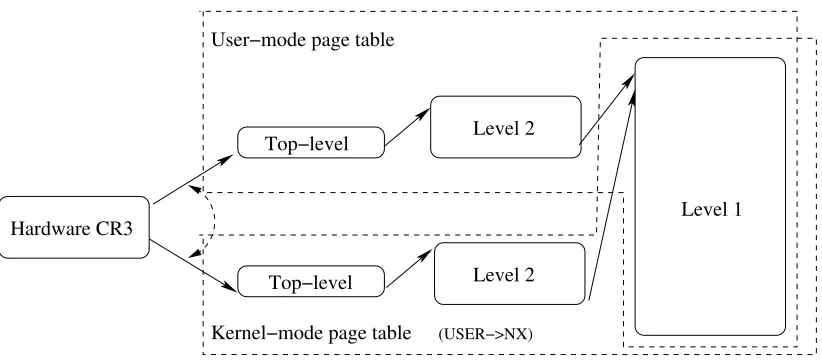
The second challenge stems from the need to performmode-sensitive page-level redirection since we are interested in redirecting kernel instruction fetches only. In other words, we need to first determine the current running mode and then decide whether the corresponding instruction fetch should be redirected or not. This imposes a strict requirement to intercept every mode-switching event (e.g., including system calls) in the redirection logic. Intercepting these events at the hypervisor will cause significant performance overhead. Our solution to this problem involves altering the guest’s view of memory at each privilege level (or mode): all of user memory becomes non-executable when a process is executing at the kernel mode, and vice versa. For brevity, we call this a mode-sensitive view (Section 3.3.2). During the normal operation of the guest, hvmHarvard does not intercept and mediate the change between different views of memory. Instead, our system injects trampoline code to switch between these two views of memory upon the mode-switching event inside the guest. The trampoline mechanism leverages an Intel hardware virtualization extension called the CR3 Target Value List (Section 3.3.2) to avoid being trapped by the hypervisor and to achieve better performance.
We have implemented a Xen [49]-based proof-of-concept prototype. The prototype can trans-parently support a number of commodity systems including legacy Red Hat 8.0 (with a Linux 2.4.18 kernel) and recent Ubuntu 9.04 (running Linux 2.6.30-5). Our evaluation shows that our system is effective in preventing eight kernel attacks (including six real-world rootkits and two synthetic attacks) against legacy OS kernels that do not have the W ⊕X support. Such protection is achieved with only a small performance overhead (i.e.,<5%). To summarize, this work makes the following contributions:
We propose a hardware virtualization-based Harvard architecture to effectively protect
commodity OS kernels from kernel rootkit attacks. Compared with existing approaches, our system can not only achieve a similar protection guarantee, but also significantly reduce the performance overhead suffered by previous approaches.
The first key technique in our approach is page-level redirection of instruction fetches,
The second key technique enables mode-sensitive redirection by redirecting only kernel
instruction fetches. In this way, we can effectively avoid hypervisor intervention in the guest’s mode-switching events. As these events occur frequently inside the guest, this technique also contributes to reducing the overall performance overhead.
Finally, we present a Xen-based system prototype. The evaluation results with the
pro-totype confirmed the practicality and effectiveness of our approach.
The rest of this chapter is structured as follows. First, we briefly describe necessary technical background on the Harvard architecture and hardware virtualization in Section 3.2. Our system design and implementation are then presented in Section 3.3 and Section 3.4, respectively. After that, we present the evaluation results in Section 3.5, which is followed by the discussion on possible limitations and their improvement in Section 3.6. Finally, we summarize the work in Section 3.7.
3.2
Key Concepts
In this section, we briefly review some key concepts that are essential to our system but may be unfamiliar to some readers: the Harvard architecture and shadow paging in virtualization. Readers with sufficient background can safely skip this section.
3.2.1 Harvard Architecture
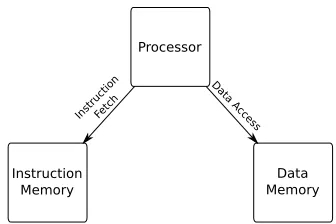
Figure 3.1: The Harvard architecture
Harvard architecture machine, data accesses and instruction accesses are treated as accessing totally distinct address spaces. From a security standpoint, this addressing scheme eliminates code injection attacks. For example, some buffer overflow attacks use an overlong memory copy operation to overwrite memory that will be executed as code. A pure Harvard architecture machine is not vulnerable to this class of attacks, as their addressing scheme does not allow code and data to be referred to interchangeably.
This work focuses on a widely deployed processor family, x86, which has a unified address space for main memory and is thus a von Neumann architecture. However, x86 processors typi-cally have separate caches for instructions and data. When executing from cache, the processor behaves like a Harvard architecture machine1. Only when main memory must be consulted does x86 look like a von Neumann architecture. This observation is the foundation of our page-level redirection technique for the creation of the Harvard architecture on top of x86 (Section 3.3.1).
3.2.2 Virtualization and Shadow Paging
Virtualization involves running a guest operating system in an environment that provides the illusion of complete access to a physical machine. All the resources used to construct such an illusory machine constitute a Virtual Machine (VM), while the software that maintains one or more VMs is known variously as a hypervisor or a Virtual Machine Monitor (VMM). The hypervisor is commonly considered to be part of Trusted Computing Base (TCB) as it is strictly isolated from the VMs it manages and is often much smaller than modern operating systems.
There are several ways to virtualize a guest operating system. Since our work is based on hardware virtualization, we focus on its operation here. In particular, based on certain processor extensions, hardware virtualization operates a “trap-and-emulate” model. When a guest OS wishes to perform a privileged operation, the hardware has two options: either it can handle the request based on the processor extension for hardware virtualization, or if that is not possible, it can pass control to the hypervisor for handling. Handling the latter case constitutes a goodly portion of the hypervisor’s workload and is typically an involved process.
Shadow paging is one such example. To better describe it, we first review how memory man-agement works on an un-virtualized machine. Recall that x86 supports two memory protection mechanisms: segmentation and paging. They protect memory in a similar way by essentially permitting a higher-privilege piece of software to put blinders on a lower-privilege program, thus restricting its view of memory to only those things it is supposed to be able to access. Since segmentation support is being phased out in the new 64-bit long mode, we focus on the paging protection mechanism. In essence, paging uses page translation tables, or page tables for short, to remap memory for a given process. Virtual addresses are translated into
physi-1
This hybrid architecture is known as a modified Harvard architecture; many processors with the caching
VA Guest CR3 GPA
MA Real CR3
Virtual Machine
Hardware
Guest Page Table
Shadow Page Table Synchronize
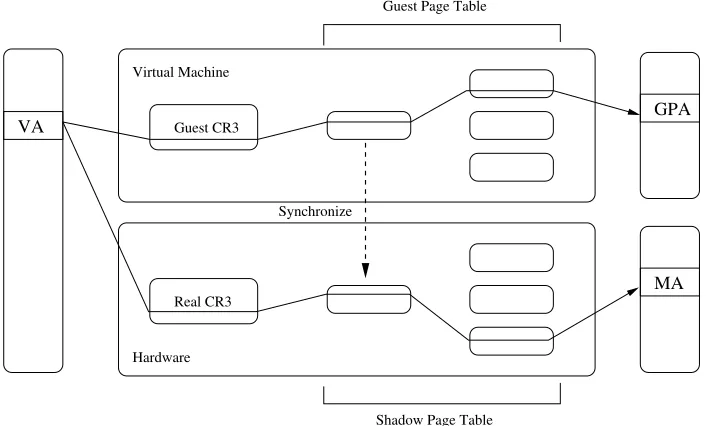
Figure 3.2: Guest page table vs. shadow page table
cal addresses by these tables. These tables are also used by the hardware to enforce certain permissions policies (e.g., NX [32]) on the types of accesses allowed.
Virtualization has not changed this picture of the process; it has merely added another layer underneath it. By leveraging paging, the hypervisor divides the machine’s memory into distinct logical machine memories. The guest OS in a VM then treats the memory it is given in the traditional way, dividing it up between the applications running in the guest. Under hardware virtualization, however, the OS itself does not know the real machine addresses that make up its allotted memory. With shadow paging, the hypervisor solves this problem by introducing an extra layer of indirection. In particular, a shadow table is created for a guest and maintained in the hypervisor. An unsuspecting guest OS kernel is allowed to maintain its own page tables, but they are not actually used by the hardware. Instead, the hypervisor marks these guest page tables read-only. Any attempt to write to them therefore generates a page fault, which is trapped by the hypervisor. The hypervisor, in turn, emulates the write request, eventually outputting the equivalent entry into the “real” page table used by the hardware. The guest can never see this real page table, which is assiduously kept synchronized with the one it can see – thus the name “shadow page table.”
into the real machine address (MA). The tables are kept synchronized by the hypervisor; this synchronization is represented by the dotted lines in the figure.
3.3
Design
In this work, we aim to develop a hardware virtualization-based Harvard architecture that can efficiently support unmodified legacy OS kernels and protect them from kernel rootkit attacks. Specifically, the presence of two distinct memory spaces for code and data in a Harvard architecture is useful for blocking code injection attacks and enforcing theW ⊕X property. In this work, we propose to take a step further by enforcing mode-sensitive W ⊕X, also known as W ⊕KX. Due to our focus on OS kernel protection, W ⊕KX requires that a user-level memory page will not be executable from the kernel mode and vice versa. Commodity hardware by default allows the execution of user-level memory pages at kernel privilege, which opens up “interesting” opportunities for kernel rootkit infection. As our defense, W ⊕KX is proposed to not only enforce W ⊕X, but also effectively block this infection vector.
Threat Model and System Assumption In this work, we assume an adversary model where attackers or kernel rootkits are able to exploit software vulnerabilities in an OS kernel to launch code injection attacks. Accordingly, we also assume kernel rootkits have the highest privilege level inside the victim VM (e.g., the root privilege in a UNIX system) and have full access to the VM’s memory space (e.g., through /dev/mem in Linux). However, the goal of a kernel rootkit is to stealthily maintain and hide its presence in the victim system; to do so, it will need to execute its own (malicious) code in the kernel space. We note that such a need exists in most kernel rootkits today, and we will discuss possible exceptions in Section 3.6.
In the meantime, our system assumes a trustworthy hypervisor as the necessary trusted computing base (TCB) to provide strict VM isolation. This assumption is shared by many other hypervisor-based security research efforts [84, 96, 111, 126, 177] and being hardened by existing hypervisor-protection solutions [131, 175]. We will discuss possible attacks (e.g., VM escape) in Section 3.6. With this assumption, we consider the threat from layer-below attacks launched from physical hosts outside of the scope of this work.2
3.3.1 Page-Level Redirection for W ⊕X
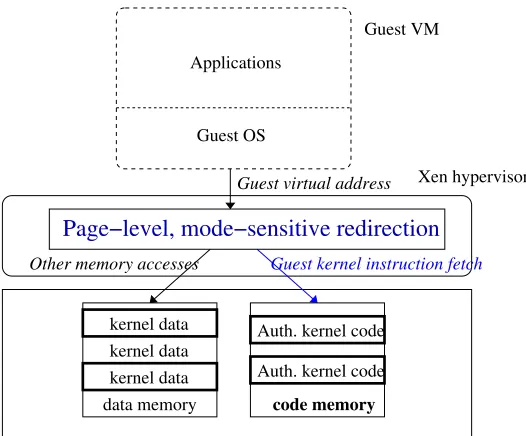
The central scheme of our approach is to efficiently create a Harvard architecture (Figure 3.3) on x86 by virtualizing one memory space for code and another for data. To achieve our goal, we observe the presence of separate TLBs for instruction fetches and data accesses. Note that each
2
Guest virtual address
data memory
Applications
Other memory accesses Guest kernel instruction fetch
code memory Auth. kernel code Auth. kernel code
Xen hypervisor Guest OS
Guest VM
kernel data kernel data kernel data
Page−level, mode−sensitive redirection
Figure 3.3: Page-level mode-sensitive redirection enables an efficient implementation of the Harvard architecture on top of x86.
TLB entry caches the translation result from a virtual address to a physical address. When a memory access or an instruction fetch occurs, the virtual address lookup will go through the corresponding TLB first. Should that TLB not contain an entry for the requested translation (called a TLB miss), the hardware walks through the page table entries in main memory to do the lookup, then constructs such an entry. As a result, from the TLB’s perspective, the hardware itself thinks in terms of two address spaces. However, in normal operation, these address spaces are kept synchronized and thus describe a unified memory space. Fortunately, to our benefit, there is no hardware requirement that this must be the case. In other words, to emulate a pure Harvard architecture, we can take advantage of these two TLBs by desynchronizing and loading them with two different page table entries for the same virtual address, thus creating two distinct memory spaces for code and data.