Epilepsy Disease Detection Using Artificial Neural
Network and MSE Optimization with GA
Jagriti Saini1, Dr. Maitreyee Dutta2
M.E. Student, Department of Electronics and Communication Engineering, NITTTR Chandigarh, India1
Professor, Department of Computer Science and Engineering, NITTTR Chandigarh, India2
ABSTRACT: Epilepsy is one of the most common neurological disorders that demand analysis of complicated Electroencephalogram waveforms for diagnosis. It is not possible to interpret information from these highly varying waveforms so experts often find it difficult to make a decision about whether the disease is present or not. Hence, it becomes quite essential to develop an automatic detection system that can work over complexities involved in EEG waveforms to predict a most appropriate solution. In this study, Artificial Neural Network is used to make analysis of EEG signals obtained from the Epileptic and healthy brain; further, Mean Square Error of the network is reduced with the help of Genetic Algorithm.
KEYWORDS: Electroencephalogram (EEG), Artificial Neural Network (ANN), Epilepsy, Genetic Algorithm (GA), Mean Square Error (MSE).
I. INTRODUCTION
Epilepsies are a specialized form of brain disorder spectrums that may range between acute to disabling and even to life threatening issues. Currently, around 65 million people throughout the world are suffering from this disease and in India, this count goes up to 12 million patients. A person who is affected with epilepsy face some disturbance in the normal brain activity and it may often lead to loss of consciousness, emotional swings, strange sensations, muscle spasms and behavioral changes [1]. The type of symptoms associated with disease and seizures usually vary from person to person. From long past, medical professionals are using detailed history of patient activities to identify and diagnose this disease but it could not lead to appropriate results as there are no definite symptoms caused by this disease. Another popular method is to analyze EEG waveforms but they are too complicated to be examined without any specialized tool. There are so many cases in history where the complex structure of EEG waveforms leads to a faulty diagnosis. As medical professionals deal with highly sensitive information so it is essential to use some reliable tools for complete analysis of signals obtained from human brain. All these conditions give rise to need of a Computer Aided Diagnosis (CAD) System for Epilepsy Disease Detection.
The modern Machine Learning approaches are capable enough to ensure accurate and highly reliable response for analysis of complex datasets. In this study, authors have worked on Artificial Neural Network due to its ability to follow self-adaption rule for input data and the highly organized structure that ensures quality performance for EEG signal analysis. One of the most commonly implemented architecture in the world of ANNs is feedforward Network. It is widely used for several applications like recognition, prediction, approximation and classification problems hence, in this study, FeedForward architecture is utilized to design CAD system for Epilepsy Detection. The proposed network consists of one input layer, one hidden layer, and one output layer. In order to improve detection accuracy of the network, authors have used efficient and most relevant 13 features that are extracted from EEG signals obtained from the healthy and epileptic patient.
optimization of Mean Square Error from both networks. The results obtained after several repeated measures reveal that GA has the power to improve accuracy for detection process as it leads to efficient reduction in MSE.
II. RELATED WORK
Several researchers till now have worked upon this application and they have developed various detection systems by incorporating different technologies [3]. Sadaat, N and Hossein, P (2011) developed an advanced approach for detection of epilepsy disease by using Dynamic Cascade Feed-Forward Neural Network classifier [4]. Vivek, N.P and Danial, G. (2013) defined epilepsy detection system with a combination of Artificial Neural Network and Multistage Non-Linear Pre-Processing Filter using LAMSTART [5]. Akshata, P et al. (2016) developed a Multi-Resolution Analysis based system in combination with Artificial Neural Network Classifier and Discrete Wavelet Transform [6]. Satchidananda, D et al. (2013) proposed an advanced seizure identification system by utilizing ensembles of RBFN (Radial Basis Function Network); authors in this study used Discrete Wavelet Transform to classify EEG waveforms [7]. Sema, A et al. (2012) developed an epilepsy detection system with the help of Artificial Neural Network and Particle Swarm Optimization [8]. Zainab, H et al. (2011) proposed a novel system for recognizing features of EEG signals obtained from the brain of an Epileptic and Healthy patient; authors in this study developed a high-performance system with a combination of wavelet transforms and Genetic Algorithm [9]. Bruno M et al. (1997) presented a method for automatic detection of slow wave complexities and 3Hz spike using Genetic Programming [10]. Hiram Firpi et al. (2007) designed a system for automatic detection of epileptic waveforms using Genetically Programmed Artificial Features [11]. Sabri Kocer et al. (2011) developed an epilepsy classification system by using a combination of Genetic Algorithm and Artificial Neural Network [12].
III. PROPOSED METHODOLOGY AND DISCUSSION
In this study, authors have worked upon data provided by University of Bonn, Germany. The dataset is divided into five different parts that represent a combination of signals obtained from the brain of a healthy subject, an epileptic patient with ictal and interictal state of seizures. It is arranged in form of S, F, N, O and Z database where each one of these contains 100 complex EEG segments having a total duration of 23.6 seconds. Out of these five sets, authors have utilized the only Z, F and Z set for development of Automatic Epilepsy Detection System.
Note that, these datasets have frequency range varying between 0.5Hz to 85Hz but as per the experts working in the field of Neurology, the valuable content resides only below 60Hz range. Hence, authors have applied de-noising FIR filter with a lower cut of frequency 60Hz to obtain the desired range of EEG signals. After this, essential features of this input raw data was extracted using wavelet transform. This study was carried on the basis of 13 most relevant features; the list includes Variance, Energy, Entropy, Mode, Median, Mean, Zero Crossing Rate, Min Amplitude, Max Amplitude, Signal to Noise Ratio, Mean Power, Coefficient of Variation and Standard Deviation [13]. All these features are normalized within -1 to +1 range because it is difficult for a FeedForward Network to process such a complex and highly variable EEG data as it is.
IV. EXPERIMENTAL RESULTS
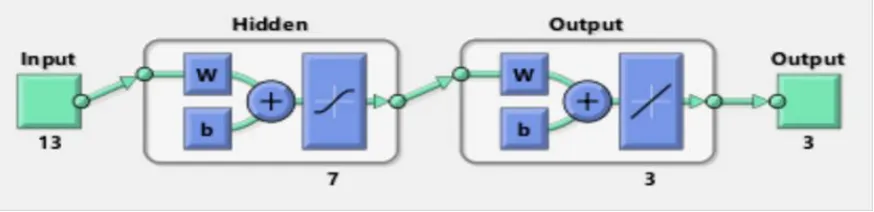
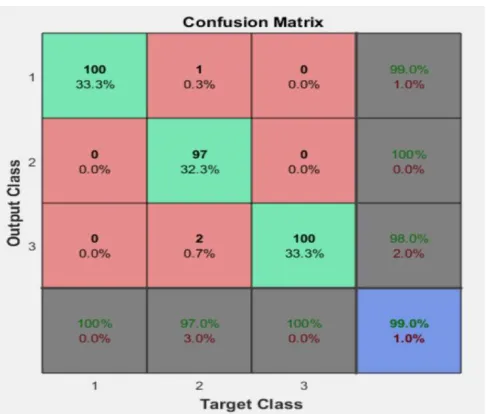
Proposed Epilepsy Detection system was implemented with the help of MATLAB 2015 software. The performance of the network with 13 input neurons, 7 hidden layer neurons, and 3 output layer neurons is demonstrated by a confusion matrix in Fig. 1.2 whereas Fig. 1.1 indicates the structure of the proposed ANN based epilepsy detection system. The performance of network was tested on the basis of 4 major parameters that are sensitivity, specificity, accuracy, and precision.
Fig. 1.1 Model of Artificial Neural Network for Epilepsy Disease Detection
Formula to calculate all these values from confusion matrix are give as below:
Accuracy = Sum of correct Classifications / Total Number of Classifications; Precision = TP / (TP + FP)
Sensitivity = TP / (TP + FN) Specificity = TN / (TN + FP)
Where;
TP = True Positive Predictions, FP = False Positive Predictions, FN = False Negative Predictions and TN = True Negative Predictions.
V. NEURAL NETWORK FOR EPILEPSY DISEASE DETECTION
This confusion matrix represents following results from proposed epilepsy detection system using Artificial Neural Network:
Overall Precision = 99% Overall Sensitivity = 99% Overall Specificity = 99.5% and
Overall Accuracy of Proposed Work = 99%
Fig. 1.2 Confusion Matrix Indicating Performance of Proposed Artificial
Table 1: Comparative Performance of ANN and GA for MSE optimization
Number of
Neurons in the
Hidden Layer
MSE Obtained from ANN
MSE Optimized by GA
3
8.313008567921784e-04
5.978946294360096e-04
7
6.050610856885620e-04
5.788889326771471e-04
9
3.020825474079820e-04
2.542542714501990e-04
20
0.001926583167804
0.001912440148122
31
7.536412089863313e-04
7.449932769683700e-04
40
0.003894753093081
0.003884914054647
51
0.002501209692900
0.001640769716925
The tests in Table 1 reflect the ability of GA to optimize MSE to a much better extent. For all adjustments of hidden layer neurons, this network provides noticeable reduction for Mean Square Error value.
V. CONCLUSIONS
The performance of Artificial Neural Network based CAD System for Epilepsy Detection was tested using Genetic Algorithm and major conclusions are as below:
REFERENCES
[1] Rajendra UA, Vinitha SS, Swapna G, Roshan MJ, Jasjit SS, “Automated EEG Analysis of Epilepsy: A Review”, Knowledge Based System Elsevier. Vol. 45, pp. 147–165. 2013.
[2] Md. Mijanur Rahman, Tania Akter Setu. “An Implementation for Combining Neural Networks and Genetic Algorithms”. International Journal of Computer Science and Technology. Vol. 6, No. 3, Page: 218-222. 2015.
[3] Jagriti, S. and Maitreyee, D, “An extensive review on computer aided system for epilepsy detection”, Network: Computation and Neural System, DOI: 10.1080/0954898X.2017.1325527. (Accessed 24 May 2017).
[4] Saadat N, Hossein P, “Patient-specific epileptic seizure onset detection algorithm based on spectral features and IPSONN classifier”, Communication Systems and Network Technologies. International Conference held at MIR Labs Thatipur; 2013 April 6–8; Gwalior, India: IEEE Publishers, pp. 186–190. 2013.
[5] Vivek NP, Danial G, “A Neural-Network-Based Detection of Epilepsy”, A Journal of Progress in Neurosurgery, Neurology, and Neurosciences [serial online]; 26[1]. Available: http://dx.doi.org/10.1179/016164104773026534 via the INTERNET. Accessed 2013 July 19.
[6] Akshata P, Srushti B, Veena D. (2016). ‘EEG signal classification into seizure and non-seizure class using discrete wavelet transform and artificial neural network’. International Journal of Innovative Research in Computer Communication Engineering (IJIRCCE). Vol. 4, pp. 14541– 14547.
[7] Satchidanada D, Alok GK, Sung CB. (2013), ‘Computer Systems-Biology and Bioinformatics (CSBio). 4th International Conference held at Yonsei Engineering Research Park, Yonsei University; 2013 November 7–9; Seoul, Korea: Procedia Computer Science Publishers. pp. 84–95. [8] Sema A, Gulay T, Hakan I. (2012) ‘EEG Signals Classification Using Hybrid Structure of ANN and PSO’, International Journal of Future
Computer Communication. Vol. 1, pp.170–172.
[9] Zainab H, Yanquing Z, Hamid ZS. (2011). Bioinformatics and Biomedicine Workshops (BIBMW). International Conference held at TBD Atlanta; 2011 November 12–15; Georgia, USA: IEEE Publishers. pp. 635–638.
[10] Bruno M, Alvaro L S, Heitor S L. (1997). Detection of Epileptic Events using Genetic Programming. Preceedings- 19th International Conference
– IEEE/EMBS October 30-November 2, 1997. Chicago, IL, USA.
[11] Hiram F, Erik GD, Javier E. (2007), ‘Epileptic seizure detection using genetically programmed artificial feature’, IEEE Transactions on
Biomedical Engineering. Vol. 54, pp. 212–224.
[12] Sobri Kocer, M. Rahmi Canal. (2011). Classifying Epilepsy Disease Using Artificial Neural Networks and Genetic Algorithm. Journal of Medical Systems. Vol. 35. Pp. 489-498.