ISSN(Online): 2319-8753 ISSN (Print): 2347-6710
I
nternational
J
ournal of
I
nnovative
R
esearch in
S
cience,
E
ngineering and
T
echnology
(An ISO 3297: 2007 Certified Organization)
Website:
www.ijirset.com
Vol. 6, Issue 3, March 2017
Detecting and Improving Distorted Fingerprints
using Rectification Techniques
Sandipan Paul, Vaibhav Dalvi, Aditya Chavare, Prof. Amruta Chitari
BE Students, Dept. of CSE, Dr.D.Y.Patil School of Engineering, Lohegaon, Pune, India
Assistant Professor, Dept. of CSE, Dr.D.Y.Patil School of Engineering, Lohegaon, Pune, India
ABSTRACT : Elastic distortion of fingerprints is one of the major causes for false non-match. While this problem affects
all fingerprint recognition applications, it is especially dangerous in negative recognition applications, such as watchlist and deduplication applications. In such applications, malicious users may purposely distort their fingerprints to evade identification. In this paper, weproposed novel algorithms to detect and rectify skin distortion based on a single fingerprint image. Distortion detection is viewed as a two-class classification problem, for which the registered ridge orientation map and period map of a fingerprint are used as the feature vector and a SVM classifier is trained to perform the classification task. Distortion rectification (or equivalently distortion field estimation) is viewed as a regression problem, where the input is a distorted fingerprint and the output is the distortion field. To solve this problem, a database (called reference database) of various distorted reference fingerprints and corresponding distortion fields is built in the offline stage, and then in the online stage, the nearest neighbor of the input fingerprint is found in the reference database and the corresponding distortion field is used to transform the input fingerprint into a normal one. Promising results have been obtained on three databases containing many distorted fingerprints, namely FVC2004 DB1, Tsinghua Distorted Fingerprint database, and the NIST SD27 latent fingerprint database.
KEYWORDS : Fingerprint, distortion, registration, nearest neighbor regression, PCA.
I. INTRODUCTION
ISSN(Online): 2319-8753 ISSN (Print): 2347-6710
I
nternational
J
ournal of
I
nnovative
R
esearch in
S
cience,
E
ngineering and
T
echnology
(An ISO 3297: 2007 Certified Organization)
Website:
www.ijirset.com
Vol. 6, Issue 3, March 2017
Fingerprint matcher is very sensitive to image quality, where the matching accuracy of the same algorithm varies significantly among different datasets due to variation in image quality. The difference between the accuracies of plain, rolled and latent fingerprint matching is even larger as observed in technology evaluations conducted by the NIST. Imaging sensor imperfections can be considered as a unique fingerprint identifying a specific acquisition device, enabling various important forensic tasks, such as device identification, device linking, recovery of processing history, detection of digital forgeries. The consequence of low quality fingerprints depends on the type of the fingerprint recognition system. A fingerprint recognition system can be classified as either a positive or negative system. In a positive recognition system, such as physical access control systems, the user is supposed to be cooperative and wishes to be identified. In a negative recognition system, such as identifying persons in watchlists and detecting multiple enrollments under different names, the user of interest (e.g., criminals) is supposed to be uncooperative and does not wish to be identified. In a positive recognition system, low quality will lead to false reject of legitimate users and thus bring inconvenience.The consequence of low quality for a negative recognition system, however, is much more serious, since malicious users may purposely reduce fingerprint quality to prevent fingerprint system from finding the true identity. In fact, law enforcement officials have encountered a number of cases where criminals attempted to avoid identification by damaging or surgically altering their fingerprints. Elastic distortion is introduced due to the inherent flexibility of fingertips, contact-based fingerprint acquisition procedure, and a purposely lateral force or torque, etc. Skin distortion increases the intra-class variations and thus leads to false non-matches due to limited capability of existing fingerprint.Matchers in recognizing severely distorted fingerprints. In Fig. 1, the left two are normal fingerprints, while the right one contains severe distortion. According to Veri- Finger, the match score between the left two is much higher than the match score between the right two. This huge difference is due to distortion rather than overlapping area. While it is possible to make the matching algorithms tolerate large skin distortion, this will lead to more false matches and slow down matching speed.
Fig.No 1 Sample Fingerprints
ISSN(Online): 2319-8753 ISSN (Print): 2347-6710
I
nternational
J
ournal of
I
nnovative
R
esearch in
S
cience,
E
ngineering and
T
echnology
(An ISO 3297: 2007 Certified Organization)
Website:
www.ijirset.com
Vol. 6, Issue 3, March 2017
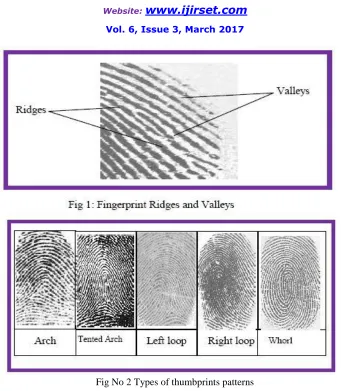
Fig No 2 Types of thumbprints patterns
A fingerprint is an impression of the friction ridges of all or any part of the finger. Fingerprint identification is the process of comparing questioned and known friction skin ridge impressions from fingers, palms, and toes to determine if the impressions are from the same finger. Among all the biometric techniques, fingerprint-based identification is the oldest method which has been successfully used in numerous applications. Everyone is known to have unique, immutable fingerprints.The science of fingerprint Identification stands out among all other forensic sciences for many reasons, including the following:
ISSN(Online): 2319-8753 ISSN (Print): 2347-6710
I
nternational
J
ournal of
I
nnovative
R
esearch in
S
cience,
E
ngineering and
T
echnology
(An ISO 3297: 2007 Certified Organization)
Website:
www.ijirset.com
Vol. 6, Issue 3, March 2017
man, Dr. Faulds not only recognized the importance of fingerprints as a means of identification, but devised a method of classification as well. Explanation of his classification system and a sample of the forms he had designed for recording inked impressions, to Sir Charles Darwin. Darwin, in advanced age and ill health, informed Dr. Faulds that he could be of no assistance to him, but promised to pass the materials on to his cousin, Francis Galton. Also in 1880, Dr. Faulds published an article in the Scientific Journal, "Nature" (nature). He discussed fingerprints as a means of personal identification, and the use of printers ink as a method for obtaining such fingerprints [14]. He is also credited with the first fingerprint identification of a greasy fingerprint left on an alcohol bottle. Later, Juan Vucetich made the first criminal fingerprint identification in 1892 .
Today, the largest AFIS repository in America is operated by the Department of Homeland Security's US Visit Program, containing over 63 million persons' fingerprints, primarily in the form of two-finger records (non-compliant with FBI and Interpol standards). Fingerprint identification is divided into four modules,
(i) Acquisition,
(ii) Preprocessing,
(iii) Feature extraction
(iv) Feature matching.
II. OBJECTIVE OF THE WORK
1. To design a system that will recognition and rectify the distortion for identification of error. 2. To detect the distortion area complete with high accuracy.
3. To rectify the distortion completely .in this process we need to detect the distortion type and then we need to correct the type distortion related error.
III. LITERATURE SURVEY
ISSN(Online): 2319-8753 ISSN (Print): 2347-6710
I
nternational
J
ournal of
I
nnovative
R
esearch in
S
cience,
E
ngineering and
T
echnology
(An ISO 3297: 2007 Certified Organization)
Website:
www.ijirset.com
Vol. 6, Issue 3, March 2017
ISSN(Online): 2319-8753 ISSN (Print): 2347-6710
I
nternational
J
ournal of
I
nnovative
R
esearch in
S
cience,
E
ngineering and
T
echnology
(An ISO 3297: 2007 Certified Organization)
Website:
www.ijirset.com
Vol. 6, Issue 3, March 2017
epidermis on the palmar (palm and fingers) or plantar (sole and toes) skin, consisting of one or more connected ridge units of friction ridge skin. Fingerprint identification (sometimes referred to as dactyloscopy) or palm-print identification is the process of comparing questioned and known friction skin ridge impressions (see Minutiae) from fingers or palms to determine if the impressions are from the same finger or palm. The flexibility of friction ridge skin means that no two finger or palm prints are ever exactly alike (never identical in every detail), even two impressions recorded immediately after each other. Fingerprint identification (also referred to as individualization) occurs when an expert (or an expert computer system operating under threshold scoring rules) determines that two friction ridge impressions originated from the same finger or palm (or toe, sole) to the exclusion of all others. And Fingerprint Identification has been used for centuries [9].Fingerprints are the most widely used biometric feature for person identification and verification in the field of biometric identification. Fingerprints possess two main types of features that are used for automatic fingerprint identification and verification: (i) global ridge and furrow structure that forms a special pattern in the central region of the fingerprint and (ii) Minutiae details associated with the local ridge and furrow structure. This paper presents the implementation of a minutiae based approach to fingerprint identification and verification and serves as a review of the different techniques used in various steps in the development of minutiae based Automatic Fingerprint Identification Systems (AFIS). The technique conferred in this paper is based on the extraction of minutiae from the thinned, binarized and segmented version of a fingerprint image. The system uses fingerprint classification for indexing during fingerprint matching which greatly enhances the performance of the matching algorithm. Good results (~92% accuracy) were obtained using the FVC2000 fingerprint databases [10].
IV. EXISTING SYSTEM APPROACH
In Existing system several challenging research problems, for example, recognizing low quality fingerprints. Fingerprint matcher is very sensitive to image quality as observed in the FVC2006, where the matching accuracy of the same algorithm varies significantly among different datasets
due to variation in image quality. The difference between the accuracies of plain, rolled and latent fingerprint matching is even larger as observed in technology evaluations conducted by the NIST. The consequence of low quality fingerprints depends on the type of the fingerprint recognition system. A fingerprint recognition system can be classified as either a positive or negative system. In a positive recognition system, such as physical access control systems, the user is supposed to be cooperative and wishes to be identified. In a negative recognition system, such as identifying persons in watchlists and detecting multiple enrollment under different names, the user of interest (e.g., criminals) is supposed to be uncooperative and does not wish to be identified. In a positive recognition system, low quality will lead to false reject of legitimate users and thus bring inconvenience. The consequence of low quality for a negative recognition system, however, is much more serious, since malicious users may purposely reduce fingerprint quality to prevent fingerprint system from finding the true identity. In fact, law enforcement officials have encountered a number of cases where criminals attempted to avoid identification by damaging or surgically altering their fingerprints.
V. PROBLEM STATEMENT
ISSN(Online): 2319-8753 ISSN (Print): 2347-6710
I
nternational
J
ournal of
I
nnovative
R
esearch in
S
cience,
E
ngineering and
T
echnology
(An ISO 3297: 2007 Certified Organization)
Website:
www.ijirset.com
Vol. 6, Issue 3, March 2017
VI. PROPOSED SYSTEM APPROACH
ISSN(Online): 2319-8753 ISSN (Print): 2347-6710
I
nternational
J
ournal of
I
nnovative
R
esearch in
S
cience,
E
ngineering and
T
echnology
(An ISO 3297: 2007 Certified Organization)
Website:
www.ijirset.com
Vol. 6, Issue 3, March 2017
VII. SYSTEM ARCHITECTURE
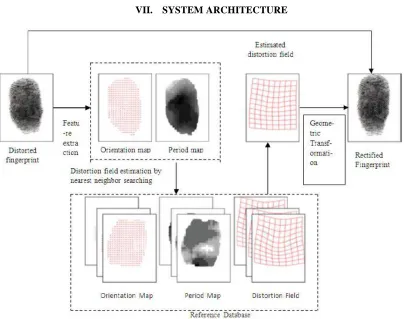
Fig. 3 Rectifying Distorted Fingerprints
Explanation
ISSN(Online): 2319-8753 ISSN (Print): 2347-6710
I
nternational
J
ournal of
I
nnovative
R
esearch in
S
cience,
E
ngineering and
T
echnology
(An ISO 3297: 2007 Certified Organization)
Website:
www.ijirset.com
Vol. 6, Issue 3, March 2017
1) Generation of Distorted Reference Fingerprint Database: To generate the database of distorted reference fingerprints, we use nref ¼ 100 normal fingerprints from FVC2002 DB1_A . The distortion fields are generated by uniformly sampling the subspace spanned by the first two principle components. For each basis, 11 points are uniformly sampled in the interval [2,2]. for an example of generating distortion fields and applying such distortion fields to a reference fingerprint to generate corresponding distorted fingerprints. For visualization purpose, only one reference fingerprint (the fingerprint located at the origin of the coordinate system) is used to generate the database of distorted reference fingerprints, and for each basis, five points are sampled. In practice, multiple reference fingerprints are used to achieve better performance.
2) Distortion Field Estimation by Nearest Neighbor Search: Distortion field estimation is equal to finding the nearest neighbor among all distorted reference fingerprints. The similarity is measured based on level 1 features of fingerprint, namely ridge orientation map and period map. We conjecture that distortion detection and rectification of human experts also relies on these features instead of minutiae. The similarity computation method is different depending on whether the upper core point can be detected in the input fingerprint. If the upper core point is detected, we translate the input fingerprint by aligning the upper core point to center point. Then we do a full search of u in the interval ½_30; 30 for the maximum similarity.
ISSN(Online): 2319-8753 ISSN (Print): 2347-6710
I
nternational
J
ournal of
I
nnovative
R
esearch in
S
cience,
E
ngineering and
T
echnology
(An ISO 3297: 2007 Certified Organization)
Website:
www.ijirset.com
Vol. 6, Issue 3, March 2017
ISSN(Online): 2319-8753 ISSN (Print): 2347-6710
I
nternational
J
ournal of
I
nnovative
R
esearch in
S
cience,
E
ngineering and
T
echnology
(An ISO 3297: 2007 Certified Organization)
Website:
www.ijirset.com
ISSN(Online): 2319-8753 ISSN (Print): 2347-6710
I
nternational
J
ournal of
I
nnovative
R
esearch in
S
cience,
E
ngineering and
T
echnology
(An ISO 3297: 2007 Certified Organization)
Website:
www.ijirset.com
ISSN(Online): 2319-8753 ISSN (Print): 2347-6710
I
nternational
J
ournal of
I
nnovative
R
esearch in
S
cience,
E
ngineering and
T
echnology
(An ISO 3297: 2007 Certified Organization)
Website:
www.ijirset.com
ISSN(Online): 2319-8753 ISSN (Print): 2347-6710
I
nternational
J
ournal of
I
nnovative
R
esearch in
S
cience,
E
ngineering and
T
echnology
(An ISO 3297: 2007 Certified Organization)
Website:
www.ijirset.com
ISSN(Online): 2319-8753 ISSN (Print): 2347-6710
I
nternational
J
ournal of
I
nnovative
R
esearch in
S
cience,
E
ngineering and
T
echnology
(An ISO 3297: 2007 Certified Organization)
Website:
www.ijirset.com
ISSN(Online): 2319-8753 ISSN (Print): 2347-6710
I
nternational
J
ournal of
I
nnovative
R
esearch in
S
cience,
E
ngineering and
T
echnology
(An ISO 3297: 2007 Certified Organization)
Website:
www.ijirset.com
Vol. 6, Issue 3, March 2017
IX.CONCLUSION
ISSN(Online): 2319-8753 ISSN (Print): 2347-6710
I
nternational
J
ournal of
I
nnovative
R
esearch in
S
cience,
E
ngineering and
T
echnology
(An ISO 3297: 2007 Certified Organization)
Website:
www.ijirset.com
Vol. 6, Issue 3, March 2017
FUTURE WORKS
Also our future work includes camera/projector lens distortion correction, to obtain more surrounding information and higher ridge depth precision of 3-D fingerprints. Furthermore, the same 3-D sensor may be used to capture face, hand and palm-print images and therefore is ideal for a fusion of comprehensive 3-D biometrics of humans.
REFERENCS
[1]Qinghai Gao, Xiaowen Zhang, “A Study of Distortion Effects on Fingerprint Matching ”Computer Science and Engineering 2012, 2(3): 37-42 .
[2] Abhijeet A. Urunkar, “Survey on fingerprint distortion detection &rectification ”, International Journal of Science, Engineering and Technology Research (IJSETR), Volume 5, Issue 2, February 2016[3]P.KrishnaSai, A.Dheeraj, “Recognition besides Adjustment of Inaccurate Fingerprints
Matching ”, International Journal of Research in Computer and Communication Technology, Vol 4, Issue 11, Nov- 2015.
[4] RAJESH PASHIKANTI, “A Novel Fake Fingerprint Minutia Matching Imaging Sensors Fabrication Materials”, ISSN 2319-8885 Vol.04,Issue.33, August-2015, Pages:6686-6691.
[5]Xuanbin Si, JianjiangFeng, Jie Zhou, “Detecting Fingerprint Distortion from a Single Image ”, IEEE December 2012.
[6]Cleopas Officer Angaye, Oluwole Charles Akinyokun and Gabriel BabatundeIwasokun, “EXPERIMENTAL STUDY OF MINUTIAE BASED ALGORITHM FOR FINGERPRINT
MATCHING”, CS & IT-CSCP 2013.
[7]Andrew W. SENIOR Ruud M. BOLLE, “Improved Fingerprint Matching by Distortion Removal”, IEICE TRANSACTIONS on Information and Systems Vol.E84-D No.7 pp.825-832, 2001.
[8]Xinjian Chen, JieTian, Senior Member, IEEE, and Xin Yang, “A New Algorithm for Distorted Fingerprints Matching Based on Normalized Fuzzy Similarity Measure”, IEEE TRANSACTIONS ON IMAGE PROCESSING, VOL. 15, NO.3, MARCH 2006.
[9]Yongchang Wang, Qi Hao, “Data Acquisition and Quality Analysis of 3-Dimensional Fingerprints”, Member, IEEE.