ISSN(Online): 2319-8753 ISSN (Print) : 2347-6710
I
nternational
J
ournal of
I
nnovative
R
esearch in
S
cience,
E
ngineering and
T
echnology
(An ISO 3297: 2007 Certified Organization)
Vol. 5, Issue 6, June 2016
Preparation and Characterization of
Nano-Composite Electroless Ni/Ag Coating as Solar
Absorber Panels
Seyed Shamsedin Hosseini Falehi1, Farideh Tabatabaei 2
P.G. Student, Department of Materials Engineering, Naghshejahan Institute of Higher Education, Iran1 Associate Professor, Department of Materials Engineering, Naghshejahan Institute of Higher Education, Iran2
ABSTRACT: The purpose of this paper is an investigation on nano-silver effect on the optical properties of nickel– phosphorus electroless coatings. Nano-composite Ni/Ag electroless coatings were deposited on aluminium (Al -1100) substrate. The phase analysis carried out by X-ray diffraction (XRD). Dispersion of nano-silver particles and chemical composition of the coatings investigated by field emission scanning electron microscopy (FESEM) and EDS, respectively. The results show that the composite coatings were high phosphorus and their microstructures were amorphous. Optical properties of the samples were obtained by using UV-Visible spectrophotometry (UV-VIS). The optical properties analysis of the obtained coatings revealed an absorption coefficient higher than ~99% in the ultraviolet and visible regions while emission coefficient decreased about 3% in the infrared region by adding nano-silver particles to the coatings. Therefore, nano-composite Ni/Ag electroless coating is a good candidate for using in solar absorber systems.
KEYWORDS: Composite, Coating, Solar cell, Ni(Nickel),Ag (Silver).
I. INTRODUCTION
ISSN(Online): 2319-8753 ISSN (Print) : 2347-6710
I
nternational
J
ournal of
I
nnovative
R
esearch in
S
cience,
E
ngineering and
T
echnology
(An ISO 3297: 2007 Certified Organization)
Vol. 5, Issue 6, June 2016
II. MATERIALS AND TEST PROCEDURE
A. PRODUCTION OF THE COATINGS
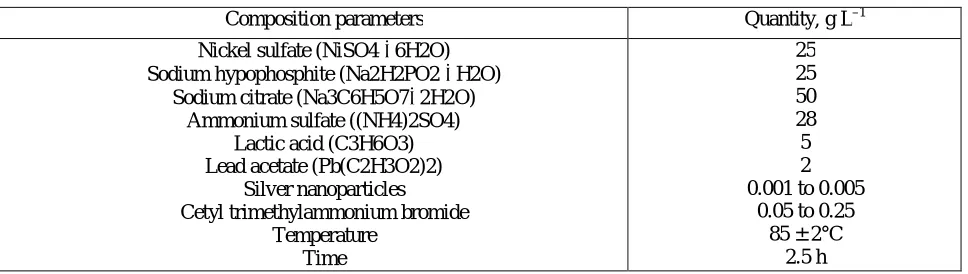
The samples of commercially aluminum (Al-1100) sheets were cut into 15*15*1 mm and cleaned them by several steps and procedures for surface preparation and applying the coating. After sanding and create a suitable surface, then chronologically, the samples were placed in aluminum degreasing solution for 4 minutes - caustic soda for 2 minutes - nitric acid for 1 minute - 4 minutes’ zincate (After all cleaning, steps were followed by careful rinsing with deionized water). In the following, the samples were coated according to table I:
Table I: Bath composition and electroless plating parameters
After the coating was applied with 15 μm/h deposition rate, blackening method was accomplished soaking of samples in 4 M nitric acid solution at 25 °C for 10 s.
B. CHARACTERIZATION
Field emission scanning electron microscopy (FESEM, Mira, 3-XMU) was employed for the detailed study of morphology. Additionally, Energy dispersive X-ray spectroscopy (EDS) and elemental mapping analyses were used to investigate the materials composition. X-ray diffraction was carried out using Asenware AW-XDM300 equipped with monochromator at 40 kV, 30 mA and CuKa radiation (λ=1.542 Å). The optical properties of the coatings, comprising absorption and emission were examined by the results of the spectrophotometer (Jasco model: V-670 and 6300). Also, the wavelength range Was determined 220–2200 nm for the reflection radiations.
III. TEST RESULTS AND DISCUSSIONS
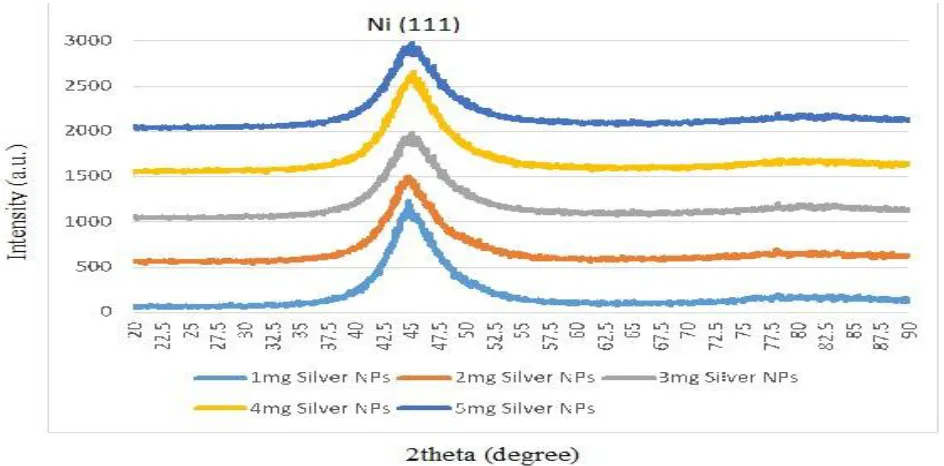
Figure 1 shows the X-ray diffraction patterns of Ni-P/Ag coatings including various silver nanoparticles (NPs). Since the X-ray diffraction is shown only the wide peak Ni (111), this indicates the presence an amorphous phaseand due to low silver content added the peak of silver not be able to see. Ni (111) has the highest intensity peak of the electroless Ni–P coatings deposited in all baths containing sodium hypophosphite as the reducing agent and sodium citrate or glycine as the complexion agent [9].
Composition parameters Quantity, g L–1
Nickel sulfate (NiSO4 ⋅ 6H2O) Sodium hypophosphite (Na2H2PO2 ⋅ H2O)
Sodium citrate (Na3C6H5O7⋅ 2H2O) Ammonium sulfate ((NH4)2SO4)
Lactic acid (C3H6O3) Lead acetate (Pb(C2H3O2)2)
Silver nanoparticles Cetyl trimethylammonium bromide
Temperature Time 25 25 50 28 5 2 0.001 to 0.005
0.05 to 0.25 85 ± 2°C
ISSN(Online): 2319-8753 ISSN (Print) : 2347-6710
I
nternational
J
ournal of
I
nnovative
R
esearch in
S
cience,
E
ngineering and
T
echnology
(An ISO 3297: 2007 Certified Organization)
Vol. 5, Issue 6, June 2016
Fig.1: XRD patterns of nanocomposite coatings Ni/Ag.
ISSN(Online): 2319-8753 ISSN (Print) : 2347-6710
I
nternational
J
ournal of
I
nnovative
R
esearch in
S
cience,
E
ngineering and
T
echnology
(An ISO 3297: 2007 Certified Organization)
Vol. 5, Issue 6, June 2016
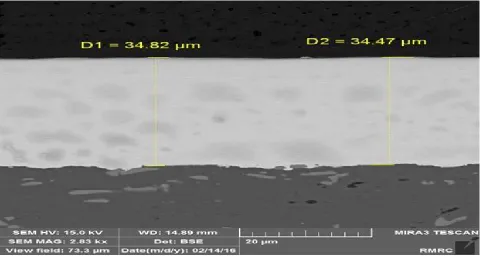
Fig. 2: FESEM micrographs of the Ni/Ag coatings morphology.
ISSN(Online): 2319-8753 ISSN (Print) : 2347-6710
I
nternational
J
ournal of
I
nnovative
R
esearch in
S
cience,
E
ngineering and
T
echnology
(An ISO 3297: 2007 Certified Organization)
Vol. 5, Issue 6, June 2016
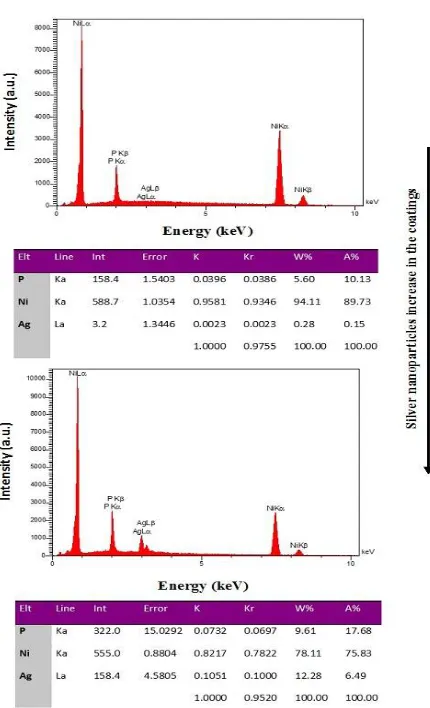
Fig. 4: Elemental mapping analysis of the coating surface.
EDS elemental analysis of Ni/Ag coatings, shown in Figure 2, prove the presence of Ni–P and silver NPs appeared in the spectrum.The low weight of silver NPs in the coatingscompared to added silver NPs can be due to the nano-size of particles that causes keeping them far away from the surface and also, for being a part of the added particles on the surface of samples. Basically, electroless coatings bath must be free of any impurities and secondary particles and nanoparticles as the second phase eventuate the bath decomposition since these particles will become the coating places to sit [13]. Absorbance and emittance of a selective solar absorber material are a result of various mechanisms, which depend on the chemical composition and structure of the material. The absorption, transmission and reflection in the absorber material can also be determined by physical effects such as intrinsic properties of the material, interference in a double layer (absorber-substrate), interference effects due to interchanging dielectrics and metals, geometrical trapping by surface roughness, and the size effect of metal particles in insulating matrix [3].solar selective absorbers must possess a high absorption coefficient in the ultraviolet and visible regions and a low emission coefficient in the infrared region [14].This leads to the following formal definitions. Solar absorbance (α) is broadly defined as a weighted fraction between absorbed radiation and incoming solar radiation (Isol), while thermal emittance(ε) is defined as a weighted fraction between the emitted radiation and the Planck blackbody distribution (Ip), and both can be determined in terms of
ISSN(Online): 2319-8753 ISSN (Print) : 2347-6710
I
nternational
J
ournal of
I
nnovative
R
esearch in
S
cience,
E
ngineering and
T
echnology
(An ISO 3297: 2007 Certified Organization)
Vol. 5, Issue 6, June 2016
ISSN(Online): 2319-8753 ISSN (Print) : 2347-6710
I
nternational
J
ournal of
I
nnovative
R
esearch in
S
cience,
E
ngineering and
T
echnology
(An ISO 3297: 2007 Certified Organization)
Vol. 5, Issue 6, June 2016
As shown in Figure 6, by increasing the silver NPs content from 1mg to 5mg, the emission coefficient decreased in the infrared region in order 7.77- 3.80- 3.20- 2.73- 1.22. While the relevant results of absorption coefficient in the UV-Visible region were higher than ~99.The ratio of solar absorbance to thermal emittance (ξ) is the basic parameter to determine a suitable absorber surface [15] that were increased respectively, and in the best condition was achieved 80.99 for the Ni-P/Ag coating with 5mg of the added silver NPs. While in the another investigation conducted by Fatemeh Ebrahimi and et al ξ was in the best sample about 5 [16]. In addition, the various compounds of absorber materials were studied by Aman Amri [17]. The results have been showed that the nickel oxide–alumina on the aluminium substrate with having ξ about 30 was the best solar absorber.
IV. CONCLUSION
1. Uniform distribution of Ag nanoparticles in the Ni-P/Ag coatings has been achieved.
2. With increasing the silver NPs in the solution, the percent of Ag in the coating was increased.
3. The solar absorption coefficient is raised in the ultraviolet and visible region until higher than 99% by adding silver NPs.
4. The solar emission coefficient reduced up to 1% in the infrared region by adding silver NPs to the coatings.
5. Considering the data obtained and related analysis, Ni-P/Ag with 5mg silver NPs introduce as the best candidate for the absorber panels.
REFERENCES
[1] Zhao, S., and Wäckelgård, E., The optical properties of sputtered composite of Al–AlN, Sol.EnergyMater.Sol.Cells 90, 2006.
[2] Pratesi, S., Sani, E., Optical and Structural Characterization of Nickel Coatings for Solar Collector Receivers, International Journal of Photoenergy, Volume 2014, Article ID 834128, 7 pages, 2014.
[3] Kennedy, C.E.,Review of Mid- to High-Temperature Solar Selective Absorber Materials, National Renewable Energy Laboratory, 2002, [4] Mehra, N.C., Sharma, S. K., Mater, J.,Effect of surface morphology on the optical response of solar-selective black nickel and black
nickel-cobalt coatings, Sci. Lett., vol 8, 1989.
[5] Wackelgard, E., Optical properties of solution-chemically derived thin film Ni–Al2O3 composites and Si, Al and Si–Ti oxides, Sol. Energy Mater, Sol. Cells 56, 1994.
[6] Aravinda, C.L., Parthasarathi, B., Jayaram, V., Sharma, A.K., Mayanna, S.M., Characterization of electrochemically deposited Cu-Ni black coatings, Materials research bulletin, 2002.
[7] Rafiee, A.,Metallic nanostructures effect on the efficiency of solar panels, The first international conference and exhibition on solar energy, 2014.
[8] He, M., Wang, Y., wang, H., A one-step sol–gel route derived Ag–CuO film as a novel solar selective absorber, Solar energy materials and solar cells, 2015.
[9] Liu,W.L., Hsieh, S.H., Tsai,T.K., Chen,W.J., WuS., Thin solid films, 510, 102–106, 2006. [10] Sorkhabi,H.A., Rafizadeh, S.H., Surf. Coat. Technol. 176, 318-326, 2004.
[11] Saxena, V., Uma Rani,R., Sharma,A.K., Surf. Coat. Technol. 201, 855–862, 2006.
[12] Johnson, C., Black electroless nickel surface morphologies with extremely high light absorption capacity, Metal Finishing, Vol 78, p 21-24, 1980.
[13] Balaraju,J. N., Rajam,K. S., Electroless deposition and characterization of high phosphorus Ni-PSi3N4 composite coatings, International journal of electrochemical society, Vol. 2, pp. 747 – 761, 2007.
[14] Agnihotri, O.P., and Gapta,B.K., Solar selective surfaces, New dehli, India, 1980.
[15] Duffie, J.A., Beckman,W.A., Solar engineering of thermal process, Wiley Interscience, New York, 1991.
[16] Ebrahimi, F., Influence of nanoporous aluminum oxide interlayer on the optical absorptance of black electroless nickel–phosphorus coating, Thin solid films, 2015.