Tidal dissipation in stars and fluid planetary layers
and its impact on the evolution of star-planet systems
P. Auclair-Desrotour1,2,a, S. Mathis2,b, and C. Le Poncin-Lafitte3,c
1 IMCCE, Observatoire de Paris, UMR 8028 du CNRS, UPMC, 77 Av. Denfert-Rochereau, 75014 Paris, France
2 Laboratoire AIM Paris-Saclay, CEA/DSM - CNRS - Universit´e Paris Diderot, IRFU/SAp Centre de Saclay, F-91191 Gif-sur-Yvette Cedex, France
3 SYRTE, Observatoire de Paris, UMR 8630 du CNRS, UPMC, 77 Av. Denfert-Rochereau, 75014 Paris, France
Abstract. Tidal dissipation in stars and planets is one of the key physical mechanisms that drive the evolution of planetary systems. It intrinsically depends on the nature of the tidal response of celestial bodies, which is directly linked to their internal structure and friction. Indeed, it is highly resonant in the case of fluids. In this work, we present a local analytical modeling of tidal gravito-inertial waves, which can be excited in stars and fluid planetary layers. This model allows us to understand the properties of their resonant dissipation as a function of the excitation frequencies, the rotation, the stratification, and the viscous and thermal properties of the studied fluid regions. Next, we introduce such a complex tidal dissipation frequency-spectra in a celestial mechanics numerical code to give a qualitative overview of its impact on the evolution of planetary systems. We consider the example of a two-body coplanar system with a punctual perturber orbiting a central fluid body. We demonstrate how the viscous dissipation of tidal waves can lead to a strongly erratic orbital evolution. Finally, we characterize such a non-regular dynamics as a function of the properties of resonances, which have been determined thanks to our local fluid model.
1 Introduction
Tidal dissipation in stars and planets is one of the key physical mechanisms that drive the evolution of planetary systems. In this context, [1] introduced the tidal quality factorQ, which is a general way to parametrize its strength in celestial mechanics. This dissipation is of great importance since it drives the secular orbital/spin evolution of stars, planets and satellites by converting the kinetic energy of tides into internal heating [2, 3]. However, the mechanisms driving tidal dissipation are not the same in solids and fluids. Indeed, [4, 5] show that theQfactor of solid bodies varies smoothly with the forcing frequency. This is not the case of fluid regions, in which a resonant response to tidal perturbations is obtained [6–9]. It leads to a strong variation of theQfactor as a function of the tidal frequency because of the viscous friction and thermal diffusion acting on fluid tidal waves and to an erratic evolution of the orbital dynamics [10].
This work focuses on the viscous friction applied on low-frequency tidal gravito-inertial waves. They constitute the tidal response of stars, of the external envelope of giant planets and of the fluid layers of rocky planets and satellites. Inertial waves are driven by rotation, gravity waves by
strati-a e-mail:
[email protected] b e-mail:
[email protected] c e-mail:[email protected] DOI: 10.1051/
C
Owned by the authors, published by EDP Sciences, 2015
/201
epjconf 51010 04 0
7KLVLVDQ2SHQ$FFHVVDUWLFOHGLVWULEXWHGXQGHUWKHWHUPVRIWKH&UHDWLYH&RPPRQV$WWULEXWLRQ/LFHQVHZKLFKSHUPLWV XQUHVWULFWHGXVHGLVWULEXWLRQDQGUHSURGXFWLRQLQDQ\PHGLXPSURYLGHGWKHRULJLQDOZRUNLVSURSHUO\FLWHG
fication, and their restoring forces are the Coriolis acceleration and the buoyancy respectively. Their characteristic frequencies are the inertial frequency 2Ω,Ωbeing the angular velocity of the body, and the Brunt-V¨ais¨al¨a frequencyNcorresponding to the radial variation of the specific entropy. Gravito-inertial waves result from their coupling in stably stratified rotating fluid regions. Because of their complexity, studying their dissipation by using a reduced local model is an interesting way to explore its behavior over a large domain of parameters [11, 12] and is complementary of works carried out with global models.
The aim of the present work is to propose such a method to investigate the dependence of tidal dissipation on fluid parameters. Using a fluid box in which rotation, stratification, viscosity and thermal diffusivity are taken into account, scaling laws describing the viscous friction applied on tidal waves are obtained. They are used to illustrate, through the concrete example of a planet-satellite system, how the quality factorQand the evolution of the orbital dynamics are linked to the fluid parameters [10].
y North
East x z
h Ω
θ xxx
y orthh
z
g
M
Fig. 1. Left:The local analytical model: a Cartesian fluid section of a rotating fluid bodyAtidally perturbed by a companionB.Right:A dissipation frequency-spectrum computed using the local model,ζbeing the energy dissi-pated by viscous friction per unit mass in the box over a rotation period. We have introduced the tidal frequency of the perturbation normalized by the inertial frequency (2Ω),ω=χ/2Ω, the Ekman numberEand the normalized thermal diffusivityK(see their definition in the text). In the case presented hereK=0 andA=N/2Ω=0, which means that the waves are purely inertial and viscously damped (top left blue zone in Fig. 2).
2 Hydrodynamical scaling laws
The model used here generalizes the local model presented in [7]. It considers a local section of a fluid region in a rotating celestial bodyA(of massMA) tidally perturbed by a companionB(of massMB). It is a rotating Cartesian box of side lengthLinclined with respect to the spin axis of the bodyΩby a colatidudeθ(Fig. 1, left). The coordinatezcorresponds to the radial direction,xandyto the azimutal and latitudinal ones respectively. In the box, the fluid is assumed to be homogeneous of densityρand to have a kinetic viscosityνand a thermal diffusivityκ. Three dimensionless control parameters are identified:A =(N/2Ω)2gives the nature of the waves (A 1 for inertial waves,A 1 for gravity ones), the Ekman number E = 2π2ν/ΩL2compares the term of viscous diffusion with respect to
the Coriolis one, andK =2π2κ/ΩL2is equivalent toEfor thermal diffusion. The Prandlt number
Pr =E/Kcompares the viscous and thermal diffusions (see Fig. 2).
Expanding physical quantities into Fourier series in time and space allows us to compute an ana-lytical expression for the energyζdissipated per unit mass by viscous friction over a rotation period (T = 2π/Ω). This gives access to the properties of the dissipation spectrum (Fig. 1, right), which has the shape of a batch of resonances located betweenω− andω+ given by [13]. Four asymptotic behaviors are identified. They are represented in Fig. 2 and illustrated by the corresponding spectra. Scaling laws for the viscous friction are derived analytically in each regime for the frequenciesωmn,
Fig. 2.Asymptotic behaviors of tidal gravito-inertial waves. Zones colored in blue and purple correspond to inertial waves, the two other ones to gravity waves ; zones colored in blue and red correspond to the case where viscous diffusion predominates over thermal diffusion, the two zones below corresponding to the opposite case.
the width at mid-heightlmnand heightHmnof resonances ({m,n} ∈Z∗2), the number of peaksNkc, the height of the non-resonant backgroundHbg(which corresponds to the so-called equilibrium tide) and the sharpness ratioΞ=H11/Hbgof the spectrum that gives the relative contrast between the principal {1,1}resonance and the background (Table 1).
Table 1.Scaling laws for the properties of the energy viscously dissipated for the different regimes (we define
A11 ≡ 2 cos2θandPr11 ≡ A/(A+A11)).Top left:Inertial waves dominated by viscosity.Top right:Gravity waves dominated by viscosity.Bottom left:Inertial waves dominated by heat diffusion.Bottom right:Gravity waves dominated by heat diffusion.Fis the amplitude of the forcing.
Domain AA11 AA11
PrPr11 χmn
2Ω ∝ √m2n+n2cosθ Nkc∝E
−1/2 χmn
2Ω ∝ √m2m+n2 √
A Nkc∝A1/4E−1/2
lmn∝E Hmn∝F2E−1 lmn∝E Hmn∝F2E−1
Hbg∝F2E Ξ∝E−2 Hbg∝F2EA−1 Ξ∝AE−2
PrPr11 χmn 2Ω ∝
n
√
m2+n2cosθ Nkc∝A
−1/2K−1/2 χmn 2Ω ∝
m
√
m2+n2 √
A Nkc∝A1/4K−1/2
lmn∝AK Hmn∝F2A−2EK−2 lmn∝K Hmn∝F2EK−2
Hbg∝F2E Ξ∝A−2K−2 Hbg∝F2EA−1 Ξ∝AK−2
3 Impact on tidal dynamics
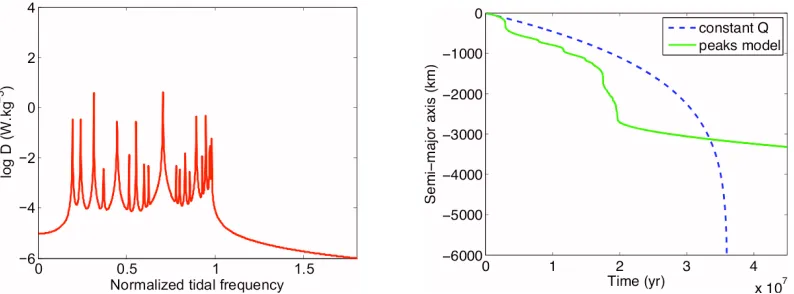
as in the case corresponding to Kaula’s constantQmodel [16], the satellite only comes nearer to it, jumping from a position to an other each times it meets a peak of resonance. Under some assumptions detailed in [10], the relative amplitude of a jumpΔa/acan be written as a function of the frequency ωp, of the width at mid-heightlpand of the sharpness ratioΞp=Hp/Hbgof a peak,
Δa a ≈2lp
3
√
2−11+ωp −1
Ξp−1
1 2.
(1)
Each of these characteristics are now given explicitly as functions of the parameters of the fluid,
A,EandKthanks to scaling laws obtained in Table 1.
Fig. 3. Left:A synthetical dissipation spectrum generated using the local model of the fluid box;Dis proportional toζcomputed forE = 10−5.Right:The corresponding evolution of the semi-major axisaof the fluid planet-satellite system as a function of time [10].
4 Conclusions
The properties of fluid tidal dissipation have a direct impact on the secular dynamics of planetary sys-tems. Indeed, dissipation resonances cause local rapid changes of orbital parameters, that are directly related to the properties of the corresponding peaks. In this context, our local model provides scaling laws that describe the evolution of the complex and resonant tidal dissipation as a function of fluid parameters. In a near future, our method could be extended to magnetized fluid regions. This will contribute to improve tidal dissipation modeling in studies of the dynamical evolution of planetary systems.
References
1. P. Goldreich, S. Soter, Icarus5, 375 (1966)
2. J. Laskar, G. Bou´e, A.C.M. Correia, A&A538, A105 (2012),1110.4565
3. E. Bolmont, S.N. Raymond, P. von Paris, F. Selsis, F. Hersant, E.V. Quintana, T. Barclay, ApJ
793, 3 (2014),1404.4368
4. M. Efroimsky, ApJ746, 150 (2012),1105.3936
5. F. Remus, S. Mathis, J.P. Zahn, V. Lainey, A&A541, A165 (2012),1204.1468
6. J.P. Zahn, A&A41, 329 (1975)
7. G.I. Ogilvie, D.N.C. Lin, ApJ610, 477 (2004),arXiv:astro-ph/0310218
8. G.I. Ogilvie, D.N.C. Lin, ApJ661, 1180 (2007),astro-ph/0702492
9. F. Remus, S. Mathis, J.P. Zahn, A&A544, A132 (2012),1205.3536
10. P. Auclair-Desrotour, C. Le Poncin-Lafitte, S. Mathis, A&A561, L7 (2014),1311.4810
11. G.I. Ogilvie, Journal of Fluid Mechanics543, 19 (2005),astro-ph/0506450
12. L. Jouve, G.I. Ogilvie, Journal of Fluid Mechanics745, 223 (2014),1402.2769
13. T. Gerkema, V.I. Shrira, Journal of Fluid Mechanics529, 195 (2005)
14. M. Efroimsky, V. Lainey, Journal of Geophysical Research (Planets) 112, E12003 (2007),
0709.1995
15. S. Mathis, C. Le Poncin-Lafitte, A&A497, 889 (2009)