† Corresponding author
DOI: 10.18488/journal.aefr/2015.5.5/102.5.757.765 ISSN(e): 2222-6737/ISSN(p): 2305-2147
© 2015 AESS Publications. All Rights Reserved. 757
TEST OF THE DAY OF THE WEEK EFFECT: THE CASE OF KUWAIT STOCK
EXCHANGE
Ahmad Mohammad Obeid Gharaibeh
1†--- Abdullah Ali Tami Swailem Al Azmi
21Ahlia University, Manama, Kingdom of Bahrain 2
Al Imtiaz Investment Group Company , State of Kuwait
ABSTRACT
This study examines the presence of the day-of-the-week effect anomaly in the Kuwait Stock Exchange (KSE) using Ordinary Least Square Method (OLS). The day-of-the-week effect is a
phenomenon that constitutes a form of anomaly of the efficient capital markets theory. According to this phenomenon, the average daily return of the market is not the same for trading days of the
week, as we would expect on the basis of the efficient market theory. This study investigates day of the week effect on the available data of daily returns on the weighted index in the Kuwait Stock
Exchange with the period from January 2002 to September 2011. The findings show that KSE exhibits positive returns on the first and the last day of the week with significant negative returns on the Second day of the Trading week.
© 2015 AESS Publications. All Rights Reserved.
Keywords:
Day-of-the-week effect, OLS, KSE, Efficient capital markets, Anomaly, Average daily return.Contribution/ Originality
This study is one of very few studies which have investigated the presence of the day-of-the-week effect anomaly in the Gulf Cooperation Council (GCC) countries in general and in the state of Kuwait in particular. The study uses new estimation methodology as the trading days in Kuwait changed from (Saturday-Wednesday) to (Sunday-Thursday) during the study period due to the change in the weekend in September 2007).
1. INTRODUCTION
Efficiency in the context of capital market has been defined in many ways, but the most common way has been defined in terms of what sort of information is available to market
Asian Economic and Financial Review
ISSN(e): 2222-6737/ISSN(p): 2305-2147© 2015 AESS Publications. All Rights Reserved. 758 participants, and how they handle that information. According to this view, an efficient capital market is one where prices of financial assets accurately reflect all information and quickly adjust to new information (Dimson and Mussavian, 1998). This definition is referred to as informational efficiency.
The securities markets in developing countries are considered to be less efficient because of their operating characteristics, such as size, market regulation, trading costs and nature of the investors. And also, different participants may have varying amounts and quality of information.
The day-of-the-week effect continues to be one of the interesting and debatable stock market anomalies to study because of the existence of significant day-of-the-week effects that would be very useful for developing profitable trading strategies. Investors could buy stocks on days with abnormally low returns and sell stocks on days with abnormally high returns.
While there were extensive researches conducted on the day-of-the-week effect on returns, it has been noticed that the average market return varies within a week and could be negative in the first or second trading day or at least be lower than the other trading days of the week. The reasoning presented by many researchers (mentioned in Section 2) for this phenomenon, is that the bad news are usually received at the weekend (Mehdian and Mark, 2001). These news pressurize the investors to sell on the coming first trading day. Moreover, the negative news spread fear in minds of the investors which leads to selling on first day of the week. It is also believed that the second trading day’s negative returns occur due to lag in spreading of news from matured markets to other market Aggarwal and Rivoli (1989). This is what makes the day-of-the-week market anomaly a topic for continuous study.
The objective of this paper is to investigate the day-of-the-week effect in the KSE. This paper is divided into the following sections. Section 2 presents the literature review of the day-of-the-week effect. Section 3 demonstrates an overview of KSE. Section 4 describes the database as well as the methodology employed in the paper. Section 5 shows the analysis of the results and Section 6 ends the report with the conclusion.
2.
LITERATURE
REVIEW
There is an extensive literature on day-of-the-week effect. Day-of-the-week effect has been a mystery since the late 1920’s where Kelly (1930) identified that the average daily return of the market is different for all trading days in a week, and that the returns on Monday in the markets of United States of America are negative.
Later, French (1980) observed negative average daily share returns for Monday in the period 1953-1977 on the New York Stock Exchange.
© 2015 AESS Publications. All Rights Reserved. 759 week leading to a selling action on the coming Monday (Mehdian and Mark, 2001). Reasons for the lower returns on Tuesday in certain stock markets are indicated towards lag in receiving information from USA’s market (Aggarwal and Rivoli, 1989).
The study on day-of-the-week effect on returns in the Kuwait stock market has been divided into three groups (Al-Mutairi, 2010). One group shows negative returns on the beginning of the week and positive returns on the last trading day. The second group shows right the opposite of the first group. However, the third group shows no effect on returns based on different days of the week. Cross (1973) studies the day-of-the-week effect for the period from 1953 to 1970 on the S&P 500 Index for the stock market returns. He found that the mean return on Monday was lower than the mean return on Friday. Solnik and Bounsquet (1990) conducted a study on the French Stock Exchange to find the day-of-the-week effect. They noticed that a strong negative return on Tuesday is existed. Similar studies (Barone, 1990) on the Italian Stock Market and Balaban (1995) on the Istanbul Stock Exchange proved the same results. Lakonishok and Smidt (1988) explore 90 years of the Dow Jones Industrial Average Index in the period 1897-1986. They observe persistent seasonality in Dow Jones Industrial Average Index returns confirming the day-of-the-week effect with Monday’s average returns being -0.14%. Dubouis and Louvet (1995) provide probably the most comprehensive study confirming the day-of-the-week effect. They examined eleven indexes from nine countries in the period 1969-1992. They found negative returns on Mondays, which are compensated by abnormal positive returns on Wednesday. Bayar and Kan (2002) sampled returns from nineteen countries and found that for the majority of the markets the day-of-the-week effects in the stock market returns existed on Tuesday and Wednesday. They found a weaker effect in the returns for Thursday and Friday. They also found that the volatility is highest on Monday and lowest towards the end of the week for most of the markets. Similarly, Rodriguez Werner (2012) examines the Day of the Week Effect for the main stock markets in Latin during the period, 1993-2007. Undertaking three different analyses, including GARCH models for the returns and volatility of daily returns by day of the week for the major stock market indexes in the region, he found significant evidence of a Monday Effect (lower than expected returns) or a Friday Effect (higher than expected returns) in many cases in the region.
On the other hand, another group has been able to present a complete opposite phenomenon, i.e. on the first day-of-the-week the returns are positive and negative on the last day (Al-Loughani and Chappell, 2001; Aly et al., 2004). Al-Loughani and Chappell (2001) used the price index of the KSE for a period of five years starting from January 1993 to December 1997 with GARCH model to inspect the day-of-the-week effect. They discovered that the average returns are higher on the first day in the trading week in the KSE.
© 2015 AESS Publications. All Rights Reserved. 760 significantly different from zero for the data used in the given period of 1998-2006. Furthermore, Berument Hakan and Dogan (2012) examine the stock market returns and volatility relationship using US daily returns from May 26, 1952 to September 29, 2006. The empirical evidence reported did not support the proposition that the return-volatility relationship is present and the same for each day of the week.
In the light of the literature review surveyed in this research, it has been noticed that studies on the day-of-the-week effect on various stock markets are inconclusive and this study will continue to understand and present the subject extensively and on a regional basis.
2.1. Kuwait Stock Exchange – An Overview
KSE started operating in 1961. Some common features of stock markets in this region are; smaller in size and fewer in companies listed with infrequent trading and lower turnover compared to matured/developed markets. Mostly, banking industry dominates the arena of stock exchanges. As of October 27, 2011, the number of listed companies on KSE was 210, with market capitalization of around Kuwaiti Dinar 29.85 billion. Stocks turnover reached almost half compared to last year same period as Table (1) exhibits.
Table-1. Trading indicators of KSE as of October 27, 2011
Trading Indicators Today’s
value
Day To Day Change
Day To Day % Chg. %
Average Daily Year To Date 2011
Average Daily Year To Date 2010
Volume (Million Shares) 165.85 1.69 1.03% 159.28 321.11 Value Traded (KWD Million) 24.22 1.51 6.66% 25.54 53.24
No. of Trades 2,585 (129.0) (4.75) 2,608 5,366
Source: Kamco (2011)
3.
RESEARCH
METHODOLOGY
This study uses daily returns for data on the KSE Market Index from 01.01.2002 to 30.09.2011. Due to the change in the weekend in September 2007, the trading days changed from (Saturday-Wednesday) to (Sunday-Thursday). Hence, the study uses the terminology of Day 1 to Day 5 with Day 1 denoting Saturday till Aug 2007 and Sunday from Sep 2007.
The study uses the daily returns on KSE Index, which is a capitalization weighted index. The index measures the performance (price movements) of all companies listed on KSE.
For the Research, unconditional logarithmic daily index returns were calculated by the formula denoted below:
……….… (1)
Where P t = Today’s’ index value
P t-1 = Index value at close of last trading day
R t = Return of KSE Weighted Index
© 2015 AESS Publications. All Rights Reserved. 761 t
t t
t t
t
t
b
D
b
D
b
D
b
D
b
D
R
1 1
2 2
3 3
4 4
5 5
…………... (2)Where Rtis the return at time t, D1t is a dummy variable with a value of “1” is given to a
Trading Day and 0 otherwise; D2t=1 if the day is a Trading Day 2 and 0 otherwise; and so on. The
ordinary least squares (OLS) coefficients b1 to b5 are the mean returns for Day 1 through Day 5,
respectively and εt denotes the random disturbance term. The hypothesis to be tested is:
5 4
3 2
1
0
:
b
b
b
b
b
H
……….... (3)If there is no day-of-the-week effect in mean returns, the coefficients are not significantly different from zero. F-statistic is used to test this hypothesis, that coefficients b1 through b5 would be identical. Rejection of the hypothesis implies that at least one of the five daily rates of return is not equal to the others. The day-of-the-week effect is also examined by checking significance of the coefficients b1 through b5. The existence of day-of-the-week effect will be confirmed when coefficient of at least one dummy variable is statistically significant (Brooks and Persand, 2001).
4. DATA AND ANALYSIS
Table 2 provides summary statistics for daily returns across the Trading days for different time periods starting from 01.01.2002 to 30.09.2011.
© 2015 AESS Publications. All Rights Reserved. 762 Table 2 shows significant negative returns for Day 2 - Sunday till 2007 and Monday after 2007. The same inference of significant negative returns on Day 2 is supported by negative skewness of the data. The overall mean return for Day 2 is negative which is not consistent with the Monday effect observed by empirical research findings in the US markets. The returns are lowest on Day 2 and highest on Day 4. The Volatility of the returns measured by the Standard deviation is also high on Day 2 and Day 4. The volatility is lowest on the last trading day. This is consistent with the findings of Aggarwal and Tandon (1994).
Table-3. F-Statistics Results
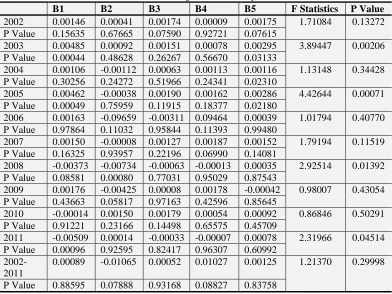
It is clearly seen from the Table 3 that mean returns are not significantly different across the overall period. However we observe in years 2003, 2005, 2008 and 2011, that there is some evidence in favor of the day-of-the-week effect. This is consistent with the findings in Table 4 where significant returns were observed in Day 2 and Day 4.
The results of the regression with dummy variables are given in Table 4 below:
Table-4. Results of the regression with dummy variables
B1 B2 B3 B4 B5 F Statistics P Value
2002 0.00146 0.00041 0.00174 0.00009 0.00175 1.71084 0.13272 P Value 0.15635 0.67665 0.07590 0.92721 0.07615
2003 0.00485 0.00092 0.00151 0.00078 0.00295 3.89447 0.00206 P Value 0.00044 0.48628 0.26267 0.56670 0.03133
2004 0.00106 -0.00112 0.00063 0.00113 0.00116 1.13148 0.34428 P Value 0.30256 0.24272 0.51966 0.24341 0.02310
2005 0.00462 -0.00038 0.00190 0.00162 0.00286 4.42644 0.00071 P Value 0.00049 0.75959 0.11915 0.18377 0.02180
2006 0.00163 -0.09659 -0.00311 0.09464 0.00039 1.01794 0.40770 P Value 0.97864 0.11032 0.95844 0.11393 0.99480
2007 0.00150 -0.00008 0.00127 0.00187 0.00152 1.79194 0.11519 P Value 0.16325 0.93957 0.22196 0.06990 0.14081
2008 -0.00373 -0.00734 -0.00063 -0.00013 0.00035 2.92514 0.01392 P Value 0.08581 0.00080 0.77031 0.95029 0.87543
2009 0.00176 -0.00425 0.00008 0.00178 -0.00042 0.98007 0.43054 P Value 0.43663 0.05817 0.97163 0.42596 0.85645
2010 -0.00014 0.00150 0.00179 0.00054 0.00092 0.86846 0.50291 P Value 0.91221 0.23166 0.14498 0.65575 0.45709
2011 -0.00509 0.00014 -0.00033 -0.00007 0.00078 2.31966 0.04514 P Value 0.00096 0.92595 0.82417 0.96307 0.60992
2002-2011
0.00089 -0.01065 0.00052 0.01027 0.00125 1.21370 0.29998
P Value 0.88595 0.07888 0.93168 0.08827 0.83758
© 2015 AESS Publications. All Rights Reserved. 763 The observations in Table 4 presented above are results based on OLS regression run on day returns in KSE. The observation period was Jan 2002 – Sep 2011 and used daily returns on the KSE Market Index. The study endeavors to examine whether there is a significant difference among daily returns based on days of trading. If there is no day-of-the-week effect in mean returns, the coefficients are not significantly different from zero. F-statistic is used to test the hypothesis that coefficients b1 through b5 would be identical. Rejection of the hypothesis implies that at least one of the five daily rates of return is not equal to the others. The hypothesis was rejected in year 2003, 2005, 2008 and 2011. The p-value in these years was lower than 0.05. So there was a clear evidence of day of the week effect in these years.
5. CONCLUSION
This paper has investigated the day-of-the-week effect on the KSE by examining the Index returns of more than nine years data. The results, based on the OLS analysis of trading days, indicate that there is a day-of-the-week effect in Kuwaiti Stock Exchange. This result is inconsistent with those of other Stock Exchanges as the first trading day shows positive returns. The Kuwait Stock Exchange exhibits positive returns on the first and the last day-of-the-week with significant negative returns on the second day of the Trading week. This confirms a study conducted by Al-Mutairi (2010) on inefficiencies in the Kuwait Stock market.
Further research studies can be conducted to test whether there is presence of day of the week effect based on individual securities. The data can also be tested on ARCH Models as the OLS method assumes homoscedasticity of data.
REFERENCES
Agathee, U., 2008. Day-of-the-week effects: Evidence from the stock exchange of mauritius (SEM).
International Research Journal of Finance and Economics, 17(July): 7-14.
Aggarwal, A. and K. Tandon, 1994. Anomalies or illusions?: Evidence from stock markets in eighteen
countries. Journal of International Money and Finance, 13: 83-106.
Aggarwal, R. and P. Rivoli, 1989. Seasonal and day-of-the-week effects in four emerging stock markets.
Financial Review, 24(4): 541-550.
Al-Loughani, N. and D. Chappell, 2001. Modeling the day-of-the-week effect in the Kuwait stock exchange:
A nonlinear GARCH representation. Applied Financial Economics, 11(4): 353-359.
Al-Mutairi, 2010. An investigation of the day-of-the-week effect in the Kuwait stock exchange. Research
Journal of Internatıonal Studıes, 16(September): 192-193.
Aly, H., S. Mehdian and M. Perry, 2004. An analysis of day-of-the-week effects in the Egyptian stock market.
International Journal of Business, 9(3): 302-308.
Balaban, E., 1995. Day-of-the-week effects: New evidence from an emerging market. Applied Economics
Letters, 2(5): 139-143.
© 2015 AESS Publications. All Rights Reserved. 764
Bayar, A. and O. Kan, 2002. Day-of-the-week effects: Recent evidence from nineteen stock markets. Central
Bank Review, 2(2): 77–90.
Berument Hakan, M. and N. Dogan, 2012. Stock market return and volatility: Day-of-the-week effect. Journal
of Economics and Finance, 36(2): 282-302.
Brooks, C. and G. Persand, 2001. Seasonality in Southeast Asian stock markets: Some new evidence on
day-of-the-week effects. Applied Economic Letters, 8(3): 155-158.
Cross, F., 1973. The behavior of stock prices on Fridays and Mondays. Financial Analysts Journal,
29(November/December): 67-69.
Dimson and Mussavian, 1998. A brief history of market efficiency. European Financial Management, 4(1):
91-193.
Dubouis, M. and P. Louvet, 1995. The day-of-the-week effect: The international evidence. Journal of Bankiny
and Finance, 20(9): 1463-1484.
Fama, E., 1965. The behaviour of stock market prices. Journal of Business Finance & Accounting, 38(1):
34-105.
French, K., 1980. Stock returns and the weekend effect. Journal of Financial Economics, 8(1): 55-69.
Kamco, 2011. Historical market index. Available from
http://www.kamconline.com/Temp/Reports/5571c86d-08a4-4c6a-9030-769a17d3162d.pdf [Accessed Oct 28 2011].
Kelly, F., 1930. Why you win or lose: The psychology of speculation. Boston: Houghton Mifflin.
Lakonishok, J. and S. Smidt, 1988. Are seasonal anomalies real? A ninety-year perspective. The Review of
Financial Studies, 1(4): 403-425.
Mehdian, S. and J.P. Mark, 2001. The reversal of the monday effect: New evidence from U.S. Equity markets.
Journal of Business Finance and Accounting, 28(7 & 8):1043-1065.
Rodriguez Werner, K., 2012. Day of the week effect in Latin American stock markets. Revista De Analisis
Economico – Economic Analysis Review, 27(1): 71-89.
Solnik, B. and L. Bounsquet, 1990. Day-of-the-week effect on the Paris bourse. Journal of Banking and
Finance, 14(2&3): 461-468.
Syed, A. and S. Perry, 2006. Day-of-the-week effects in emerging stock markets. Applied Economics Letters,
13(10): 621-628.
BIBLIOGRAPHY
Condoyann, L., J. O’Hanilon and C.W.R. Ward, 1987. Day-of-the-week effects on stock returns: International
evidence. Journal of Business Finance & Accounting, 14(2): 159-174.
Engle, R., 1993. Statistical models for financial volatility. Financial Analysts Journal, 49(1): 72-78.
Gibbons, M. and P. Hess, 1981. Day-of-the-week effects and asset returns. Journal of Business Finance &
Accounting, 54(4): 579-596.
Hussain, 2011. Day-of-the-week effect and stock returns: (Evidence from Karachi Stock Exchange-Pakistan).
Far East Journal of Psychology and Business, 3(1): 25-27.
© 2015 AESS Publications. All Rights Reserved. 765
Keim, D. and R. Stambaugh, 1984. A further investigation of the weekend effect in stock returns. Journal of
Finance, 39(3): 819-835.
Kuwait Stock Exchange, n.d. Kuwait stock exchange daily briefing. Available from
http://kse.com.kw/PORTAL/History/MarketIndex.aspx [Accessed Oct 1 2011].
Santemases, M., 1986. An investigation of the Spanish stock market seasonalities. Journal of Business,
Finance & Accounting, 13(2): 267- 276.
Wang, K., Y. Li and J. Erickson, 1997. A new look at the Monday effect.The Journal of Finance, 52(5):
2171-2186.