Article
1
A Bayesian Study of the Dynamic Effect of
2
Comorbidities on Hospital Outcomes of Care for
3
CHF Patients
4
Dimitrios Zikos1*, Stelios Zimeras2 and Neli Ragina3
5
1 College of Health Professions, Central Michigan University, Mount Pleasant, MI; [email protected]
6
2 Department of Mathematics, University of the Aegean, Karlovassi, Greece; [email protected]
7
3 College of Medicine, Central Michigan University, Mt. Pleasant, MI; [email protected]
8
* Correspondence: [email protected]
9
10
Abstract: Comorbidities can have a cumulative effect on hospital outcomes of care, such as the
11
length of stay (LOS), and hospital mortality. This study examines patients hospitalized with
12
Congestive Heart Failure (CHF), a life-threatening condition, which, when it coexists with a
13
burdened disease profile, the risk for negative hospital outcomes increases. Since coexisting
14
conditions co-interact, with a variable effect on outcomes, clinicians should be able to recognize
15
these joint effects. In order to study CHF comorbidities, we used medical claims data from CMS.
16
After extracting the most frequent cluster of CHF comorbidities, we: (i) Calculated, step-by-step, the
17
conditional probabilities for each disease combination inside this cluster (ii) Estimated the
18
cumulative effect of each comorbidity combination on the LOS and hospital mortality (iii)
19
Constructed (a) Bayesian, scenario-based graphs and (b) Bayes-networks to visualize results.
20
Results show that, for CHF patients, different comorbidity constructs have variable effect on the
21
LOS and hospital mortality. Therefore, dynamic comorbidity risk assessment methods should be
22
implemented for informed clinical decision making in any ongoing effort for quality of care
23
improvements.
24
Keywords: comorbidities; congestive heart failure; health informatics; Bayes networks, clustering,
25
risk assessment, clinical decision making
26
27
1. Introduction
28
In the recent years there is a high surge in the prevalence of chronic diseases with almost half
29
adults having two or more chronic diseases [1]. Chronic diseases not only necessitate medical care
30
and extensive use of healthcare resources, but also limit daily life activities and patient independence
31
[2]. When a patient has a condition, chronic or not, in addition to his/her primary diagnosis (Dx), this
32
disease is known as a comorbidity. Comorbidity is the presence of “a distinct additional clinical
33
entity” [3] and is not related to the index condition or a side effect or result of treatment [4].
34
Comorbidities may or may not be directly related to the primary diagnosis [5]. For instance, a patient
35
with a primary diagnosis of CHF may have hypertension (related condition) and chronic psoriasis
36
(unrelated condition). Comorbidities can lead to patient complications and may trigger the need for
37
hospitalization, oftentimes with a high risk for increased LOS, hospital-acquired conditions, and
38
hospital death [6-8]. Their existence is important to be taken into consideration by physicians, because
39
of their impact on the diagnosis, treatment, prognosis, and outcome [3].
40
Around 10,000 people in the United States turn 65 every day, and therefore there an anticipated
41
ongoing increase in the number of individuals with comorbidities [9]. Several studies confirmed that
42
chronic conditions appear together in clusters, as seen in the case of cardiovascular diseases [10-12,
43
14], while some clusters of comorbidities have been shown to have synergistic effect [13]. By
44
identifying the aforementioned clustered clinical homogenous patient subgroups, it can become
45
possible to develop better targeted and personalized interventions [2]. Treating patients for their
46
comorbidity composition, and not separately for each diagnosis in silo, may contribute to tackling
47
health problems more effectively, with improved coordination of care and integration of practice [9],
48
in line with a holistic and patient centered care approach. Clinical guidelines hardly address
49
comorbidities, and this can result in adverse events [10]. This emphasizes the importance of having
50
patient-focused management and an efficient user-defined comorbidity system to identify risk factors
51
and outcomes.
52
Researchers have studied outcomes and the prognosis in patients with multiple chronic diseases.
53
Age and at least two comorbidities were found to be strong predictors for the development of
54
hospital-acquired conditions (HAC), which in turn impact LOS negatively [15]. Nobili et al. found
55
the presence of comorbidity increases mortality risk and LOS [16]. In addition, according to Parappil
56
[17], patients with chronic obstructive pulmonary disease and comorbid diabetes have an increased
57
LOS and elevated risk of death. Prolonged LOS is associated with adverse outcomes among other
58
factors [18]. Because of all the aforementioned patient safety implications, it is critical for clinical
59
decision makers to take into consideration the synergistic effect of various comorbidity profiles.
60
Using large healthcare datasets to stratify chronic conditions can contribute to improving the
61
quality of care [9]. Health analytics methods, for instance, can be applied to study associations
62
between risk factors and chronic conditions [19]. A systematic understanding of interactions between
63
comorbidities can become possible with the support of data-driven technologies. These technologies
64
can contribute to understanding and then planning to reduce preventable adverse outcomes of care.
65
In this study we examine the effect of comorbidity constructs on the LOS and hospital mortality,
66
among elderly patients admitted to the hospital with a primary diagnosis of CHF, in the United
67
States. Annually, over a million admissions occur in the United States for CHF [20] with more than
68
6.5 million hospital days and an economic burden of $37.2 billion [21]. Elderly with CHF have five or
69
more comorbidities accounting for 40% of Medicare patients with high post-discharge mortality and
70
readmission rates [20-23]. When a primary Dx of CHF is accompanied by comorbidities, the patient
71
management and CHF treatment can become complicated: More than 30% of patients with CHF have
72
comorbidities that worsen during hospitalization. These patients present increased mortality risk [21,
73
24] and prolonged hospital LOS, among other adverse hospital outcomes of care. For CHF patients,
74
renal failure, COPD, diabetes, depression [22], hypertension, myocardial infarction, coronary artery
75
disease, atrial fibrillation, anemia, chronic liver disease, and sleep-disordered breathing [25-27] were
76
found to be predictors of LOS and hospital mortality.
77
While studies such as the aforementioned examine CHF comorbidities and their effect on
78
hospital outcomes, they were not designed to compare outcomes of care between different
79
comorbidity combinations. Also, existing studies do not examine the effect of a comorbidity on
80
outcomes, when it is added onto a pre-existing diseaseconstruct. The objective of this work is to study
81
the cumulative effect of comorbidities on the LOS and hospital mortality, for patients who have been
82
diagnosed with CHF. Firstly, we used partitional clustering to find the most frequent hospital
83
comorbidity construct (cluster) for patients with a primary diagnosis of CHF. We then extracted this
84
cluster and calculated cumulative conditional probabilities for all comorbidity combinations within
85
this cluster. These calculations served as the foundation for a visualized collection of directed acyclic
86
graphs and Bayes Networks that can be navigated to examine the cumulative effect of any CHF
87
comorbidity combination, on the two outcomes under study.
88
2. Materials and Methods
89
The research was conducted with a large medical claims dataset that was purchased from the
90
Centers for Medicare and Medicaid Services (CMS). This dataset includes a 5% sample of Medicare
91
hospital admissions that took place during the year 2014, includes 500,000 records and contains
92
information about the patient admission, patient demographics, the ICD-9-CM diagnoses (Primary
93
and Secondary), hospital-acquired conditions, hospital procedures, hospital charges and utilization
94
variables. Medicare datasets have been used in a variety of studies to determine patient needs,
suggest required services, and understand factors associated with negative outcomes. A variety of
96
similar large healthcare datasets have also been used to study the effect of clinical practice on health
97
outcomes [28], compare hospitals and their patient safety performance, and allow the in-depth study
98
of rare conditions [29].
99
Since this study examines comorbidities of patients hospitalized with a primary diagnosis of
100
CHF, we firstly filtered the data keeping only cases with a Primary diagnosis of CHF (ICD-9-CM:
101
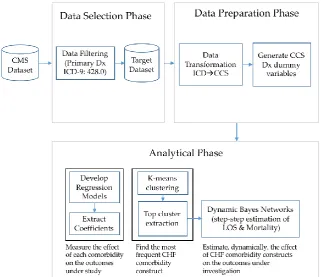
428.0). This is the target dataset that was used for the analysis and contains 26,000 records (Fig. 1,
102
Data Selection Phase).
103
The ICD codes (CHF comorbidities) were then grouped into Clinical Classification Software
104
(CCS) codes. CCS is a grouping developed by the Agency of Healthcare Research and Quality
105
(AHRQ) [30] to provide a meaningful clinical representation of diagnosis codes. CCS groups the
106
thousands of unique ICD codes into 285 exclusive clinical categories. To transform diagnosis
107
attributes from the ICD to the CCS coding system, a crosswalk, available at the AHRQ website was
108
used. With the diagnosis attribute transformation to CCS, the data dimensionality was significantly
109
reduced (285 dummy variables, one for each CCS code, instead of thousands of dummy ICD-9-CM
110
variables) and the risk data overfitting was significantly minimized, with one small trade-off being
111
small loss in diagnosis specificity (Fig. 1, Data Preparation Phase).
112
The data analysis includes two tasks (Fig. 1, Analytical Phase). Firstly, a coefficient analysis was
113
completed using appropriate regression methods. The LOS, being a continuous variable was
114
examined using Multiple Linear Regression. The study of hospital mortality, which is a dichotomous
115
response was completed with Binary Logistic Regression. Regression coefficients were extracted from
116
both models to find the CHF comorbidities associated with prolonged hospital day and high rates of
117
mortality. The second task is the step-by-step calculation of the cumulative effect of CHF
118
comorbidities on the LOS and hospital mortality. We decided to study contextually relevant CHF
119
comorbidities and not just any random combination of comorbidities. For this reason, we extracted
120
the most frequent CHF comorbidity set, by employing partitional clustering; for this frequent cluster
121
of CHF comorbidities, we estimated, in a modular manner, for every combination of comorbidities,
122
the mean LOS and hospital mortality, step by step, and visualized the constructs using directed
123
acyclic graphs and Bayes Networks. Figure 1 shows an overview of the study methodology.
124
125
126
Figure 1. Overview of the study methodology
3. Results
128
3.1. Descriptive Analysis: CHF Comorbidities with the longest LOS and highest hospital mortality
129
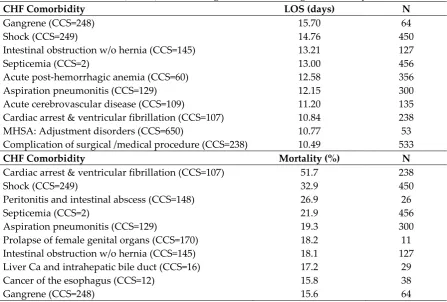
The average LOS and the mortality rate were calculated for every CHF comorbidity, to find the
130
ones with the highest LOS and hospital mortality rate. As shown on Table 1, CHF patients and a
131
secondary diagnosis of ‘gangrene’ (CCS=248), stay at the hospital, on average, 15.70 days. The second,
132
in order, diagnosis associated with a prolonged stay was found to be ‘shock’ (LOS=14.76 days),
133
followed by ‘intestinal obstruction’ (LOS=13.21 days). Regarding hospital mortality, for CHF patients
134
with a comorbidity of ‘cardiac arrest’, the mortality rate is 51.7%, followed by ‘shock’ (mortality
135
rate=32.9%) and ‘septicemia’ (mortality rate=21.9%). Table 1 shows the top ten CHF comorbidities
136
with the longest LOS and the highest rates of hospital death.
137
Table 1. Comorbidities (N > 10) with the longest LOS and the highest mortality rate
138
CHF Comorbidity LOS (days) N
Gangrene (CCS=248) 15.70 64
Shock (CCS=249) 14.76 450
Intestinal obstruction w/o hernia (CCS=145) 13.21 127
Septicemia (CCS=2) 13.00 456
Acute post-hemorrhagic anemia (CCS=60) 12.58 356 Aspiration pneumonitis (CCS=129) 12.15 300 Acute cerebrovascular disease (CCS=109) 11.20 135 Cardiac arrest & ventricular fibrillation (CCS=107) 10.84 238 MHSA: Adjustment disorders (CCS=650) 10.77 53 Complication of surgical /medical procedure (CCS=238) 10.49 533
CHF Comorbidity Mortality (%) N
Cardiac arrest & ventricular fibrillation (CCS=107) 51.7 238
Shock (CCS=249) 32.9 450
Peritonitis and intestinal abscess (CCS=148) 26.9 26
Septicemia (CCS=2) 21.9 456
Aspiration pneumonitis (CCS=129) 19.3 300 Prolapse of female genital organs (CCS=170) 18.2 11 Intestinal obstruction w/o hernia (CCS=145) 18.1 127 Liver Ca and intrahepatic bile duct (CCS=16) 17.2 29 Cancer of the esophagus (CCS=12) 15.8 38
Gangrene (CCS=248) 15.6 64
3.2. Analytical Phase-Task 1: Coefficient Analysis
139
3.2.1. Length of Stay
140
To estimate the effect of each individual CHF comorbidity on the hospital LOS, a multiple linear
141
regression model was created, with LOS being the dependent variable. All the CHF comorbidities
142
(dummy CCS variables) were inserted to the model as independent variables. The regression model
143
was found to explain the 30.7% of LOS variability (R2=0.307). The regression coefficients provided
144
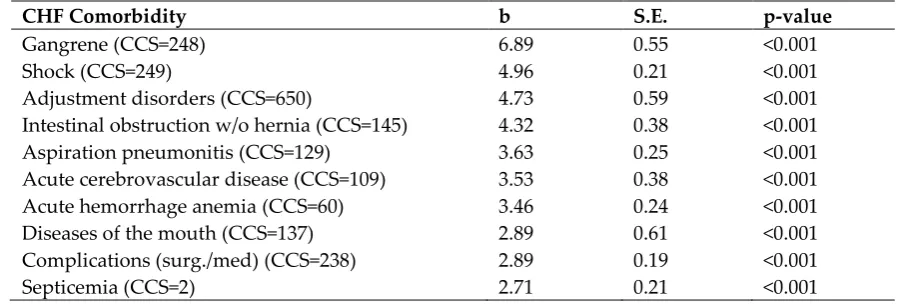
information about the strength of association between each CHF comorbidity and the LOS. The CHF
145
comorbidity ‘gangrene’ (CCS=248) was found to have the strongest effect on the LOS (b=6.89,
146
p<0.001): When a CHF patient develops ‘gangrene’ the LOS increases by almost 7 days. Similarly,
147
when a CHF patient develops ‘shock’, the LOS increases by almost 5 days (b=4.96, p<0.001). The
148
presence of the CHF comorbidity ‘adjustment disorders’ increases the LOS by almost 5 days (b=4.73,
149
p<0.001), while a CHF patient with ‘intestinal obstruction without hernia’ will have a LOS increase
150
of more than 4 days (b= 4.32, p<0.001). Table 2 presents the top ten CHF comorbidities with the
151
strongest association with the LOS.
152
Table 2. Coefficient analysis of the LOS using multiple linear regression
154
CHF Comorbidity b S.E. p-value
Gangrene (CCS=248) 6.89 0.55 <0.001 Shock (CCS=249) 4.96 0.21 <0.001 Adjustment disorders (CCS=650) 4.73 0.59 <0.001 Intestinal obstruction w/o hernia (CCS=145) 4.32 0.38 <0.001 Aspiration pneumonitis (CCS=129) 3.63 0.25 <0.001 Acute cerebrovascular disease (CCS=109) 3.53 0.38 <0.001 Acute hemorrhage anemia (CCS=60) 3.46 0.24 <0.001 Diseases of the mouth (CCS=137) 2.89 0.61 <0.001 Complications (surg./med) (CCS=238) 2.89 0.19 <0.001 Septicemia (CCS=2) 2.71 0.21 <0.001
3.2.2. Hospital Mortality Rate
155
To estimate the odds ratio of each individual CHF comorbidity for hospital death (dichotomous
156
outcome), a Multiple Binary Logistic regression model was created. All the CHF comorbidities
157
(dummy CCS variables) were inserted to the model as independent variables. The hospital death
158
indicator was the dependent variable of the model. This regression analysis was employed to
159
estimate the effect of the CHF comorbidities on the mortality rate, for hospitalized CHF patients.
160
According to findings, ‘cardiac arrest & ventricular fibrillation’ (CCS=107) has the strongest
161
association with the mortality rate (OR=30.50, p<0.001) with odds for hospital death increasing by 30
162
times. The CHF comorbidity ‘peritonitis & intestinal abscess’ (OR=14.42, p<0.001) and ‘genital organ
163
prolapse’ (OR=12.92, p<0.01) increase the odds for hospital death by 14 and by 13 times respectively.
164
Table 3 shows the top ten comorbidities with the strongest association with the hospital mortality.
165
Table 3. Coefficient analysis of mortality rate using binary logistic regression:
166
CHF Comorbidity O.R. S.E. p-value
Cardiac arrest & ventric. fibril. (CCS=107) 30.50 0.17 <0.001 Peritonitis & intestinal abscess (CCS=148) 14.42 0.63 <0.001 Prolapse female gen. organs (CCS=170) 12.92 0.87 0.004 Cancer of the esophagus (CCS=12) 10.03 0.54 <0.001 Cancer of the liver (CCS=16) 8.07 0.63 0.001 Shock (CCS=249) 6.72 0.15 <0.001 Gangrene (CCS=248) 4.04 0.50 0.006 Acute cerebrovascular disease (CCS=109) 3.55 0.32 <0.001 Intestinal obstruction w/o hernia (CCS=145) 3.15 0.32 <0.001 Respiratory failure; arrest (CCS=131) 2.76 0.08 <0.001
3.3. Analytical Phase-Task 2: Dynamic navigation of CHF comorbidity scenarios and their effect on outcomes
167
We started by extracting the most frequent CHF comorbidity cluster for a contextually relevant
168
study of the cumulative effect of CHF comorbidities on the LOS and the hospital mortality. To do
169
this, we used the Weka (https://www.cs.waikato.ac.nz/ml/weka/) implementation of k-means, a
170
partitional clustering algorithm. By plotting the within-cluster sum of square errors of the test set for
171
different k’s (number of cluster scenarios) we observed an error stability (line graph forms an ‘elbow’)
172
when k=7. According to the elbow criterion we proceeded with the parameter k=7 and generated
173
seven clusters, of which we extracted the most frequent one, for further study. Table 4 shows the
174
output of the simple k-means experiment. Each cluster represents comorbidities that frequently
175
coexist. The cluster that groups most of the instances and that we extracted for further study is Cluster
176
1. This cluster groups together the CHF comorbidities: ‘disorders of lipid metabolism’, ‘deficiency and
177
other anemia’, ‘hypertension with complications/secondary hypertension’, ‘coronary atherosclerosis and other
178
heart disease’, and ‘chronic kidney disease’.
Table 4. Clustering of CHF comorbidities using the k-means partitional algorithm
180
CHF Comorbidities Clustered
instances Cluster 1: ‘disorders of lipid metabolism’ (CCS=53), ‘deficiency and other anemia’ (CCS=59),
‘hypertension with complications and secondary hypertension’ (CCS=99), ‘coronary atherosclerosis and other heart disease’ (CCS=101), ‘chronic kidney disease’ (CCS=158)
7565 (29%)
Cluster 2: ‘fluid & electrolyte disorders’ (CCS=55), ‘nutritional endocrine; and metabolic disorders’ (CCS=58), ‘chronic obstructive pulmonary disease and bronchiectasis’ (CCS=127), ‘respiratory failure’ (CCS=131)
2181 (9%)
Cluster 3
‘essential hypertension’ (CCS=98) 4562 (18%)
Cluster 4
‘essential hypertension’ (CCS=98), ‘disorders of lipid metabolism’ (CCS=53), ‘coronary
atherosclerosis and other heart disease’ (CCS=101), ‘cardiac dysrhythmias’ (CCS=106) 5759 (22%) Cluster 5
‘cardiac dysrhythmias’ (CCS=106), ‘fluid & electrolyte disorders’ (CCS=55), ‘deficiency & other anemia’ (CCS=59), ‘hypertension with complications/secondary hypertension’ (CCS=99), ‘chronic kidney disease’ (CCS=158), ‘heart valve disorders’ (CCS=96), ‘pulmonary heart disease’ (CCS=103)
2098 (8%)
Cluster 6
‘deficiency and other anemia’ (CCS=59), ‘hypertension with complications and secondary hypertension’ (CCS=99), ‘chronic kidney disease’ (CCS=158), ‘coronary atherosclerosis and other heart disease’ (CCS=101), ‘chronic obstructive pulmonary disease and bronchiectasis’ (CCS=127), ‘respiratory failure; insufficiency; arrest (adult)’ (CCS=131), ‘diabetes mellitus without complications’ (CCS=49), ‘acute and unspecified renal failure’ (CCS=157)
2284 (9%)
Cluster 7
‘respiratory failure; arrest’ (CCS=131), ‘cardiac dysrhythmias’ (CCS=106), ‘fluid & electrolyte disorders’ (CCS=55), ‘essential hypertension’ (CCS=98), ‘screening & history of mental health & substance abuse’ (CCS=663)
1198 (5%)
181
The next step involves the estimation of the mean LOS and mortality rate for every different
182
combination inside Cluster 1 (CCS=53, CCS=59, CCS=99, CCS=101, CCS=158). For every combination,
183
new dummy variables were stored into the database to facilitate creation of conditional probability
184
tables on demand (Table 5). For instance, for the combination ‘lipid metabolism disorders’ (CCS=53)
185
and ‘deficiency and other anemia’ (CCS=59), a new variable will be generated, based on the condition:
186
IF CCS(53)=1 AND CCS(59)=1 AND CCS(99)=0 AND CCS(101)=0 AND CCS(158)=0
187
THEN [CCS(53) Λ CCS(59)] = 1
188
ELSE [CCS(53) Λ CCS(59)] = 0
189
This condition triggers the addition, to the dataset, of a new variable, with values of ‘1’ for
190
instances where {CCS53=1, CCS59=1, CCS99=0, CCS101=0, CCS158=0}. We then calculated, the mean
191
LOS, the mortality rate, and the 95% C.I of the means, for the ‘1’ cases, for all possible combinations
192
of the Cluster 1 contents (total=25 =32 combinations) and constructed conditional probability tables,
193
that show the cumulative effect of any comorbidity construct. The conditional probability tables were
194
also visualized with step-by step Bayesian graphs of comorbidity constructs, to better understand the
195
additive effect of CHF comorbidities on the two outcomes under study.
196
197
Table 5. Mortality rate and mean LOS for every CHF Comorbidity combiniation within Cluster 1
198
Combinations of CHF Comorbidities
N Mortality rate (%)
(95% C.I)
Mean LOS (days) (95% C.I)
59 898 4.34 (0.68-3.01) 5.54 (5.25-5.82) 59+99 42 2.38 (0.00-7.04) 6.71 (4.94-8.48) 59+99+101 34 2.94 (0.00-8.79) 6.18 (4.26-8.01) 59+99+101+158 1294 2.71 (1.82-3.58) 6.11 (5.77-6.45) 53 1598 2.37 (1.63-3.12) 4.26 (4.10-4.43) 53+99 95 0.00 (0.00-0.00) 4.63 (3.76-5.49) 53+99+101 144 1.38 (0.00-3.31) 5.50 (4.41-6.59) 53+99+101+158 2308 3.25 (2.52-3.97) 4.93 (4.74-5.12)
3.3.1. Directed acyclic graphs for comorbidity construct scenarios
199
After having estimated the LOS and mortality rate for the different combination constructs of
200
the cluster {metabolism disorders, anemia, hypertension with complications, coronary atherosclerosis, chronic
201
kidney disease}, results were visualized with directed acyclic graphs. The graphs show the apparent
202
change to the two outcomes of interest for different scenarios of comorbidity constructs. Each new
203
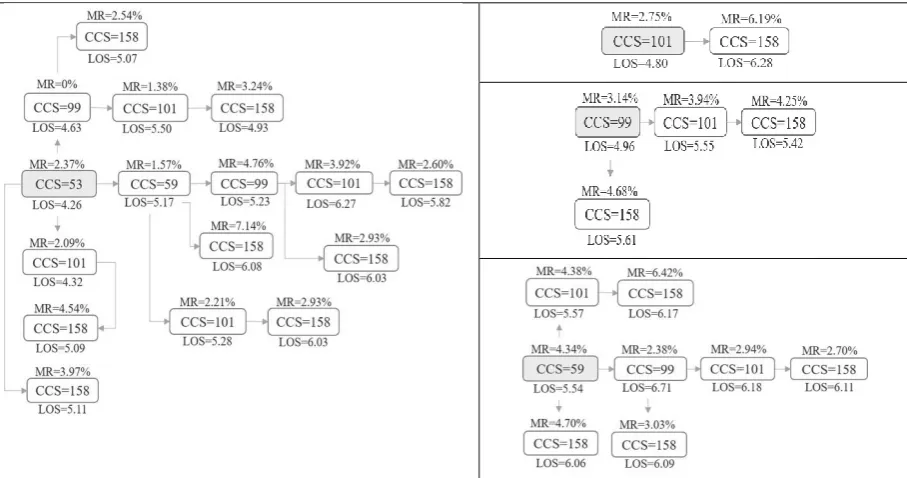
graph node represents an addition of a new diagnosis on top of the preceding one. The user can
204
follow any of the fifteen different paths, as shown in Fig. 2 and see the updated LOS and mortality
205
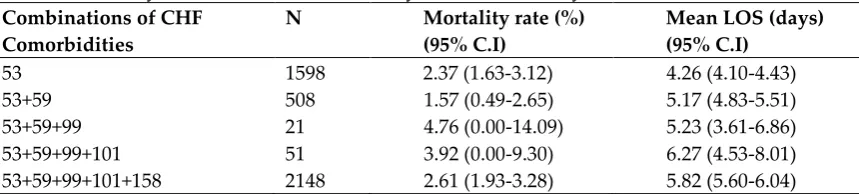
rate. In the majority of the paths, the mortality rate and the LOS increases as more CHF comorbidities
206
are added. Characteristically, for CHF patients who only have ‘disorders of lipid metabolism’
207
(CCS=53), the mean LOS is 4.26 days (95% C.I = 4.10-4.43). When ‘deficiency and other anemia’
208
(CCS=59) is added to the profile, the mean LOS increases to 5.17 days (95% C.I =4.83-5.51). When on
209
top of these two comorbidities, the patient is diagnosed with ‘hypertension with complications’
210
(CCS=99), the mean LOS further increases to 5.23 days (95% C.I = 3.61-6.86). Finally, new LOS increase
211
is observed with the addition of ‘coronary atherosclerosis’ (CCS=101), up to 6.27 days (95% C.I =
4.53-212
8.01). In the same manner, while the exclusive presence of ‘coronary atherosclerosis and other heart
213
disease’ (CCS=101) is associated with a mean mortality rate of 2.75%, when ‘chronic kidney disease’
214
(CCS=158) is added to this patient scenario, the mortality rate increases up to 6.19%.
215
216
Figure 2. Effects of comorbidity constructs on LOS and mortality rate
217
Interestingly, some comorbidities may have a different effect on outcomes, depending on the
218
preexisting disease set that the new diagnosis has been added onto. For instance, although the mean
219
LOS and the mortality rate both remain the same when ‘coronary atherosclerosis’ (CCS=101) is added
220
on top of ‘disorders of lipid metabolism’ (CCS=53), this is not the case when CCS=101 is added on top
221
of CCS=99 (hypertension with complications). Evidently, for patients with CHF, the ‘coronary
atherosclerosis’ and ‘hypertension with complications’ combination is a more severe ‘diagnosis
223
blend’ than that of ‘coronary atherosclerosis’ with ‘disorders of lipid metabolism’.
224
3.3.2. Bayesian Networks of CHF comorbidities
225
The second goal of task 2 was to construct Bayes Networks for CHF comorbidities included in
226
Cluster 1, for the dichotomous outcome ‘hospital death’. While we previously visualized all
227
combinations of comorbidity constructs, we now present a supervised representation of associations
228
between comorbidities and the ‘hospital death’, based on a trained Bayes Net model. Using Weka,
229
we developed a Bayes Network using the Simple Estimator, which estimates the conditional
230
probability tables of a Bayes network once the structure has been learned. We used a Genetic Search
231
algorithm with Markov blanket correction. The Markov blanket correction was applied to the
232
network structure, to enhance the information included in the values of the parents and children of
233
the network nodes.
234
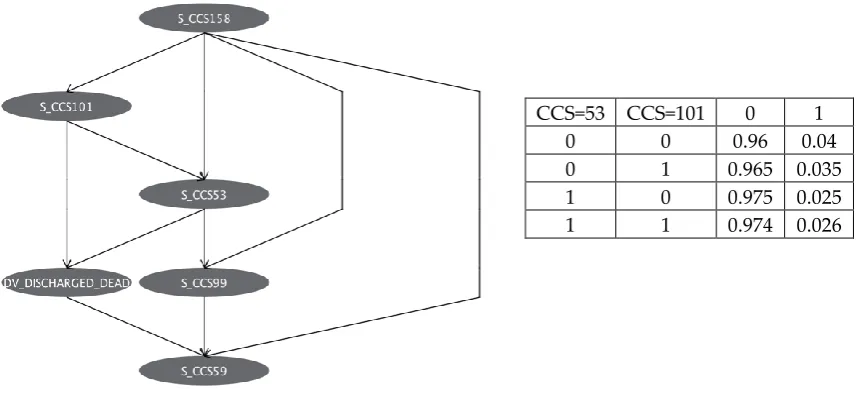
The top patent node of the trained Bayes Network is CCS=158 (chronic kidney disease). Its four
235
child notes are the four remaining comorbidities of Cluster 1 (most frequent CHF comorbidity group).
236
The outcome under investigation (hospital death) has two direct parent nodes: CCS=53 (lipid
237
metabolism disorders) and CCS=101 (coronary atherosclerosis and other heart disease). Fig. 3 shows
238
the network, as it was visualized by the Weka Classifier Graph Visualizer (left) and the probability
239
distribution table to the ‘hospital death’ node (right). While we hereby present the Bayes Network
240
for Cluster 1, similar Bayes Network graphs can be generated, following the same approach, for any
241
of the remaining CHF comorbidity clusters.
242
243
CCS=53 CCS=101 0 1 0 0 0.96 0.04 0 1 0.965 0.035 1 0 0.975 0.025 1 1 0.974 0.026
Figure 3: Left: Bayesian Network of CHF Comorbidities included in the most frequent cluster. Right:
244
Probability distribution table for the dependent variable ‘hospital death’
245
4. Discussion
246
This study examined the prevalence and cumulative effect of CHF comorbidities for elderly
247
patients with a primary diagnosis of CHF, using medical claims data. The study presented an in-
248
depth exploration of comorbidities for one of the most frequent reasons for hospitalization in the
249
United States and also introduced Bayes-based methods to understand the cumulative burden of
250
comorbidities on negative outcomes of hospital care.
251
A significant burden of comorbidity was observed in CHF patients with two or more
252
comorbidities. The most common CHF comorbidities associated with an increased LOS were found
253
to be ‘gangrene’, ‘shock’, ‘intestinal obstruction without hernia’, and ‘adjustment disorders’. Another
254
study that examined psychosocial factors and other comorbidities in CHF patients, also found that
‘adjustment disorders’ are associated with as increasing LOS and mortality rate [22, 31]. Regression
256
based coefficient analysis, showed that for an increase of 1 unit to value of the ‘gangrene’ variable
257
(change from ‘0’ to ‘1’), the LOS increases by 6.90 days (p<0.001). Similarly, other secondary Dx’s that
258
were found to be associated with and increased LOS were ‘shock’ (LOS=4.97, p<0.001) [33],
259
‘adjustment disorders’ (LOS=4.73, p<0.001), and ‘intestinal obstruction without hernia’ (LOS=4.33,
260
p<0.001). ‘Anemia’ in patients with CHF was also found to be associated with prolonged hospital stay
261
in a previous study [34], with findings similar to our current study.
262
As far as the mortality rate is concerned, we found that comorbidities associated with increased
263
mortality rate are the ‘cardiac arrest and ventricular fibrillation’, ‘acute cerebrovascular disease’ [32],
264
‘peritonitis and intestinal abscess’, ‘prolapse of female genital organs’, ‘shock’, and ‘cancer of the
265
esophagus’. Results of multiple binary logistic regression reveal that the CHF comorbidity ‘cardiac
266
arrest and ventricular fibrillation’ (CCS=107) is associated with a 30.5 increase to the odds for hospital
267
death. Other CHF comorbidities that were found to increase mortality risk are ‘peritonitis and
268
intestinal abscess’ (OR=14.4), ‘prolapse of female genital organs’ (OR=12.9), ‘cancer of the esophagus’
269
(OR=10.0), ‘shock’ (OR=6.721) [35], and ‘acute cerebrovascular disease’ (OR=3.559) [36]. In similar
270
studies the ‘acute myocardial infarction’, and ‘acute and unspecified renal failure’ diagnoses were
271
also found to be associated with a significant increase to the odds for hospital death, for patients with
272
a primary diagnosis of CHF [37, 38].
273
Several studies have shown that comorbidities have a significant impact on survival and LOS in
274
CHF patients, and our study results are in agreement. Our study shows that comorbidities can have
275
a variable effect of these outcomes, according to the comorbidity construct they belong to. We
276
therefore recognize the need for the development of comorbidity-specific software risk estimation
277
add-ons to existing clinical decision support systems that quantify the different risk levels for those
278
patients. This will facilitate data-driven, informed decision making and improved patient counseling.
279
The need for such systems and mechanisms have been discussed and recommended in the literature
280
[32] in an effort to assist physicians provide “individualized person-centered care” [31].
281
Our study and the “block-by-block” comorbidity construction approach is an effort to this
282
direction. It is imperative for physicians to recognize common comorbidities for their patients and
283
understand the effect of comorbidities on outcomes of care. As this work shows, for CHF patients,
284
different comorbidity constructs may have variable effect on the outcomes. Identifying the
285
prevalence and quantifying their cumulative effect for patients will provide evidence for informed
286
clinical decision making in any ongoing effort for improvements to the quality of care. There is more
287
research to be done in order to develop and provide comorbidity-specific recommender tools to
288
clinical decision makers and quality improvement specialists. The authors finally believe that
289
education and training of medical professionals and residents should utilize large healthcare
290
datasets, and assist future professionals in recognizing common comorbidities, and their effect on
291
critical outcomes of care.
292
Author Contributions: conceptualization, D.Z.; methodology, D.Z.; validation, D.Z., N.R. and S.Z.; formal
293
analysis, D.Z and S.Z.; resources, D.Z.; data curation, D.Z.; writing—original draft preparation, D.Z.; writing—
294
review and editing, D.Z. And N.R; visualization, D.Z.; supervision, D.Z.; project administration, D.Z.; funding
295
acquisition, D.Z.
296
Funding: This research was funded by the CENTRAL MICHIGAN UNIVERSITY FACULTY RESEARCH AND
297
CREATIVE ENDEAVORS (FRCE) GRANT, grant number 4830, 01/01/2019 – 06/30/2020, P.I: Dimitrios Zikos.
298
Conflicts of Interest: The authors declare no conflict of interest.
References
301
1. Centers for Disease Prevention and Control (2019). Chronic diseases in America. Accessed from
302
https://www.cdc.gov/chronicdisease/resources/infographic/chronic-diseases.htm
303
2. U.S. Department of Health and Human Services. Multiple chronic conditions—a strategic framework:
304
Optimum health and quality of life for individuals with multiple chronic conditions. Washington, DC.
305
December 2010. http://www.hhs.gov/ash/initiatives/mcc/mcc_framework.pdf.
306
3. Feinstein, A. R. (1970). The pre-therapeutic classification of co-morbidity in chronic disease. Journal of
307
Chronic Diseases, 23(7), 455–468.
308
4. Piccirillo, J. F., & Costas, I. (2004). The Impact of Comorbidity on Outcomes. ORL, 66(4), 180–185.
309
5. Jones, R. (2010). Chronic Disease and Comorbidity. The British Journal of General Practice, 60(575), 394.
310
6. Comlossy M. (2013). Chronic Disease Prevention and Management. National Conference of State
311
Legislatures; Denver, CO, USA: 2013. http://www.ncsl.org/documents/health/ChronicDTK13.pdf
312
7. Centers for Disease Control (2009). The Power of Prevention: Chronic Disease the Public Health Challenge
313
of the 21st Century. Available online: www.cdc.gov/chronicdisease/pdf/2009-Power-of-Prevention.pdf
314
8. Gijsen, R., Hoeymans, N., Schellevis, F. G., Ruwaard, D., Satariano, W. A., & van den Bos, G. A. M. (2001).
315
Causes and consequences of comorbidity: A review. Journal of Clinical Epidemiology, 54(7), 661–674.
316
https://doi.org/https://doi.org/10.1016/S0895-4356(00)00363-2
317
9. Tinker A. (2014). How to Improve Patient Outcomes for Chronic Diseases and Comorbidities.
318
online:
http://www.healthcatalyst.com/wp-content/uploads/2014/04/How-to-Improve-Patient-319
Outcomes.pdf
320
10. Buja, A., Claus, M., Perin, L., Rivera, M., Corti, M. C., Avossa, F. et al. (2018). Multimorbidity patterns in
321
high-need, high-cost elderly patients. PloS One, 13(12), e0208875–e0208875.
322
11. Goodman, R. A., Briss, P. A., Ling, S. M., Parrish, R. G., Salive, M. E., & Finke, B. S. (2015). Multimorbidity
323
Patterns in the United States: Implications for Research and Clinical Practice. The Journals of Gerontology:
324
Series A, 71(2), 215–220.
325
12. Schäfer, I., von Leitner, E.-C., Schön, G., Koller, D., Hansen, H., Kolonko, T. et al. (2010). Multimorbidity
326
patterns in the elderly: a new approach of disease clustering identifies complex interrelations between
327
chronic conditions. PloS One, 5Schäfer, (12), e15941–e15941.
328
13. Wolff J.L, Starfield B, Anderson G. (2002). Prevalence, expenditures, and complications of multiple chronic
329
conditions in the elderly. Arch Intern Med;162 (20):2269–2276.
330
14. Islam, M.M., Valderas, J. M., Yen, L., Dawda, P., Jowsey, T., & McRae, I. S. (2014). Multimorbidity and
331
comorbidity of chronic diseases among the senior Australians: prevalence and patterns. PloS One, 9(1),
332
e83783–e83783.
333
15. Wen, T., He, S., Attenello, F., Cen, S. Y., Kim-Tenser, M., Adamczyk, P. et al. (2014). The impact of patient
334
age and comorbidities on the occurrence of “never events” in cerebrovascular surgery: an analysis of the
335
Nationwide Inpatient Sample. Journal of Neurosurgery JNS, 121(3), 580–586.
336
16. Nobili, A., Licata, G., Salerno, F., Pasina, L., Tettamanti, M., Franchi, C. et al. (2011). Polypharmacy, length
337
of hospital stay, and in-hospital mortality among elderly patients in internal medicine wards. The REPOSI
338
study. European Journal of Clinical Pharmacology, 67(5), 507–519.
339
17. Parappil, A., Depczynski, B., Collett, P., & Marks, G. B. (2010). Effect of comorbid diabetes on length of stay
340
and risk of death in patients admitted with acute exacerbations of COPD. Respirology, 15(6), 918–922.
341
18. Wiler, J.L., Handel, D.A., Ginde, A.A., Aronsky, D., Genes, N. G., Hackman, J.L et al. (2012). Predictors of
342
patient length of stay in 9 emergency departments. The American Journal of Emergency Medicine, 30(9), 1860–
343
64.
344
19. Barrett, M. A., Humblet, O., Hiatt, R. A., & Adler, N. E. (2013). Big Data and Disease Prevention: From
345
Quantified Self to Quantified Communities. Big Data, 1(3), 168–175.
346
20. Ambrosy, A. P., Fonarow, G. C., Butler, J., Chioncel, O., Greene, S. J., Vaduganathan, M. et al. (2014). The
347
Global Health and Economic Burden of Hospitalizations for Heart Failure: Lessons Learned from
348
Hospitalized Heart Failure Registries. Journal of the American College of Cardiology, 63(12), 1123–1133.
349
21. Gheorghiade, M., Vaduganathan, M., Fonarow, G. C., & Bonow, R. O. (2013). Rehospitalization for Heart
350
Failure: Problems and Perspectives. Journal of the American College of Cardiology, 61(4), 391–403.
351
22. Braunstein, J. B., Anderson, G. F., Gerstenblith, G., Weller, W., Niefeld, M., Herbert, R., & Wu, A. W. (2003).
352
Noncardiac comorbidity increases preventable hospitalizations and mortality among medicare beneficiaries
353
with chronic heart failure. Journal of the American College of Cardiology, 42(7), 1226–1233.
23. Marti, C. N., Fonarow, G. C., Gheorghiade, M., & Butler, J. (2013). Timing and duration of interventions in
355
clinical trials for patients with hospitalized heart failure. Circulation. Heart Failure, 6(5), 1095–1101.
356
24. Abraham, W. T., Adams, K. F., Fonarow, G. C., Costanzo, M. R., Berkowitz, R. L., LeJemtel, T. H., … Wynne,
357
J. (2005). In-Hospital Mortality in Patients with Acute Decompensated Heart Failure Requiring Intravenous
358
Vasoactive Medications: An Analysis from the Acute Decompensated Heart Failure National Registry
359
(ADHERE). Journal of the American College of Cardiology, 46(1), 57–64.
360
25. Triposkiadis, F., Giamouzis, G., Parissis, J., Starling, R. C., Boudoulas, H., Skoularigis, J. et al. (2016)
361
Reframing the association and significance of co-morbidities in heart failure. European Journal of Heart
362
Failure, 18(7), 744–758.
363
26. Szwejkowski, B. R., Elder, D. H. J., Shearer, F., Jack, D., Choy, A. M. J., Pringle, S. D. et al. (2012). Pulmonary
364
hypertension predicts all-cause mortality in patients with heart failure: a retrospective cohort study.
365
European Journal of Heart Failure, 14(2), 162–167.
366
27. Scrutinio, D., Passantino, A., Guida, P., Ammirati, E., Oliva, F., Braga, S. S et al. (2016). Prognostic impact of
367
comorbidities in hospitalized patients with acute exacerbation of chronic heart failure. European Journal of
368
Internal Medicine, 34, 63–67.
369
28. Kucharska-Newton AM, Heiss G, Ni H, Stearns SC, Puccinelli-Ortega N, Wruck LM, et al. Identification of
370
Heart Failure Events in Medicare Claims: The Atherosclerosis Risk in Communities (ARIC) Study. J Card
371
Fail. 2016; 22(1):48–55.
372
29. Menis M, Forshee RA, Kumar S, McKean S, Warnock R, Izurieta HS, et al. Babesiosis occurrence among the
373
elderly in the United States, as recorded in large Medicare databases during 2006-2013. PLoS One. 2015;10
374
(10).
375
30. Healthcare Cost and Utilization Project. Clinical Classifications Software (CCS) for ICD-9-CM. Available
376
from: https://www.hcup-us.ahrq.gov/toolssoftware/ccs/ccs.jsp
377
31. Lawson, C.A., Solis-Trapala, I., Dahlstrom, U., Mamas, M., Jaarsma, T., Kadam, U.T., & Stromberg, A. (2018).
378
Comorbidity health pathways in heart failure patients: A sequences-of-regressions analysis using
cross-379
sectional data from 10,575 patients in the Swedish Heart Failure Registry. PLOS Medicine, 15(3), e1002540.
380
32. Kwok, C.S., Olier, I., Rashid, M., Mamas, M.A., Gale, C.P., Doherty, P. et al. (2016). Impact of co-morbid
381
burden on mortality in patients with coronary heart disease, heart failure, and cerebrovascular accident: a
382
systematic review and meta-analysis. European Heart Journal - Qual of Care and Clinical Outcomes, 3(1), 20–36.
383
33. Scott, E. C., Ho, H. C., Yu, M., Chapital, A. D., Koss, W., & Takanishi, D.M. (2008). Pre-Existing Cardiac
384
Disease, Troponin I Elevation and Mortality in Patients with Severe Sepsis and Septic Shock. Anaesthesia and
385
Intensive Care, 36(1), 51–59.
386
34. Young, J.B., Abraham, W.T., Albert, N.M., Gattis Stough, W., Gheorghiade, M., Greenberg, B.H. et al. (2008).
387
Relation of Low Hemoglobin and Anemia to Morbidity and Mortality in Patients Hospitalized with Heart
388
Failure (Insight from the OPTIMIZE-HF Registry). The American Journal of Cardiology, 101(2), 223–230.
389
35. Mebazaa, A., Tolppanen, H., Mueller, C., Lassus, J., DiSomma, S., Baksyte, G., Januzzi, J. (2016). Acute heart
390
failure and cardiogenic shock: a multidisciplinary practical guidance. Intensive Care Medicine, 42(2), 147–63.
391
36. Lee, D.S., Austin, P.C., Rouleau, J.L., Liu, P.P., Naimark, D., & Tu, J.V. (2003). Predicting Mortality Among
392
Patients Hospitalized for Heart Failure Derivation and Validation of a Clinical Model. JAMA, 290(19),
2581-393
87.
394
37. Krumholz, H. M., Chen, Y.-T., Vaccarino, V., Wang, Y., Radford, M. J., Bradford, W. D., & Horwitz, R. I.
395
(2000). Correlates and impact on outcomes of worsening renal function in patients ≥65 years of age with
396
heart failure. The American Journal of Cardiology, 85(9), 1110–1113.
397
38. Forman, D. E., Butler, J., Wang, Y., Abraham, W. T., O& Connor, C. M., Gottlieb, S. S. et al. (2004). Incidence,
398
predictors at admission, and impact of worsening renal function among patients hospitalized with heart
399
failure. Journal of the American College of Cardiology, 43(1), 61 LP-67.