IJEDR1504164
International Journal of Engineering Development and Research (www.ijedr.org)932
A Short-Term Load Forecasting Technique and
Analysis Using Artificial Neural Network
Shah Jainik Gopalkumar, Sweta Shah
PG Electrical Engineering, Professor, HOD, IITE, Indus University Electrical Department,
GTU, Ahmedabad, India.
________________________________________________________________________________________________________
Abstract - This paper proposes a neural network approach for forecasting short-team loads. The basic objective of short team load forecasting is to predict the near future load. This paper uses techniques for artificial neural network base short team load forecasting. Historical load data were obtained from SLDC (State Load Dispatch Centre) Gotri Baroda, Gujarat and weather data were obtained from online weather site for the same period to train neural network. It is trained using two layer feed forward neural network and tested error was calculated as MAPE (Mean Absolute Percentage Error) and with error of about 0.9592% this paper was successfully carried out.
________________________________________________________________________________________________________
I. INTRODUCTION
Short –Term Load forecasting is basically aimed at predicting system load with a leading time of one hour to seven day, which is necessary for adequate scheduling and operation of power systems. Thus, Load forecasting has also become an important component of energy brokerage systems. There is a 3-7% increase of load depends on the population growth, local area development, industrial expansion etc. [1].
Load forecasting is an important component of power system energy management system. Load forecasting means predicting the future load with the help of historical load data available. It is very important for the planning, operation and control of the power system. The accuracy of the forecast is crucial to any electric utility. Since in power system the next’s day power generation must be scheduled every day, day- ahead short- team load forecasting (STLF) is a necessary daily task for power dispatch. Its accuracy affects the economical operation and reliability of the system greatly. The short team forecast are not only needed for control and scheduling for power system but also used as input to load flow study or contingency analysis i.e. for load management program. The short team forecasting is also primarily used for the generation dispatch, capacitor switching, feeder reconfiguration, voltage control and automatic generation control (AGC) [3].
Short team load forecasting is the prediction of electrical load demand for a period varying from the next few minutes up to a week. Short team load forecasting plays a vital role in system operation and is the main source of information for all daily and weekly operations concerning generation commitment and scheduling. Short-team load forecast is also important for the economic and reliable operation of the power system. In order to achieve high forecasting accuracy and speed, it is required to know the factor that affects the load. Some of this factor is: the type and time of day, the weather conditions of the forecasting area, the season, etc. since most days have different load profiles, it is necessary to have a day type. Time of the day is an important factor in short team load forecasting. It is required to know the forecasting time of the day is different. Therefore, the relationships between this factors and the load demand need to be determined so that the forecast may be as accurate as possible.[4].
One of the major research areas in the field of electrical engineering which has been of great importance for many years is load forecasting. Load forecasting facilitates to maintain a balance between electricity supply and demand.[5]
II. METHODOLOGY A. Data
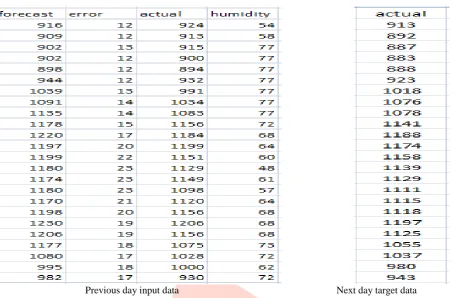
There are two set of data namely load profile data and weather data. Load data is obtained from SLDC- Gotri Baroda and to weather data is obtained from online website for same period. Load data consist one hourly measurement of load for period of year 2014. Weather data consist of only humidity. Data is arranged as shown in figure 1 to train a neural network.
IJEDR1504164
International Journal of Engineering Development and Research (www.ijedr.org)933
This fig .1 is the load cave of 1st January 2014 and fig 2 Error plot for 1st January 2014.Fig.1 Load curve of 1st January 2014
Fig 2 Error plot for 1st January 2014
IJEDR1504164
International Journal of Engineering Development and Research (www.ijedr.org)934
Fig.3 Load curve of 2nd January 2014Fig.4 Error plot for 2nd January 2014 C. Neural network training
Neural network training using training sets. The input variables to the neural network are:
Yesterday’s forecasted load
Yesterday’s temperature data
Yesterday’s actual load
Yesterday’s humidity data
ANN Modal for STLF
IJEDR1504164
International Journal of Engineering Development and Research (www.ijedr.org)935
Previous day input data Next day target dataThis all data is used for hourly data. The output of input layer. Hidden layer consist of 10 neurons with long sigmoid as activation function. The output of hidden layer is used as input for this layer. It consist of single neuron, with linier activation function From total number of samples 70% were used for training , 15% were used for validation and 15% were used for testing Neural network training tool is shown in figure Neural Network performance and regression plot and fit plot are shown in figure
IJEDR1504164
International Journal of Engineering Development and Research (www.ijedr.org)936
Fig 6. Neural Network regression plot
Fig 7. Neural Network fit plot
The best performance achieved for validation is at epoch 2. The R (correlation coefficient value) values for training, validation and testing are 0.98947, 0.96261 & 0.99995 respectively. The overall R value is 0.98597 resulting and very closes prediction.
III. RESULTS
IJEDR1504164
International Journal of Engineering Development and Research (www.ijedr.org)937
TABLE-II New Analysis forecast 2-1-2014
Fig 8. New forecast 2-1-2014
Result Analysis
The training process is based on the error produced by ANN. To determine the error, the absolute percentage error(APE) and the mean absolute percentage error(MAPE) are used,
Based on test results, APE and MAPE can calculated.
If calculated MAPE is higher than 3%, training must be done.
This process continues until all MAPE from test results are below 3%.
Before training 2-1-2014 the MAPE error is 3.9231%.
After training 2-1-2014 the MAPE error is0.9592%.
One Week Analysis
IV. CONCLUSION
IJEDR1504164
International Journal of Engineering Development and Research (www.ijedr.org)938
Artificial intelligence tools using to improve the forecasting result. It is very difficult to predict the load accurately using analytical methods. A neural network is the advanced approach for accurate short-team load forecasting. Short-team load forecasting is using Artificial intelligence method and error minimized.REFERENCES
[1] Ronak K Patel, Ankit V Gajjar, “ SHORT TERM LOAD FORECASTING USING ARTIFICIAL NEURAL NETWORK TECHNIQUE” ISSN (Online): 2347 - 4718Volume 1, Issue 9, and May-2014.
[2] Muhammad Usman Fahad and Naeem Arbab, “Factor Affecting Short Term Load Forecasting” Journal of Clean Energy Technologies, Vol. 2, No. 4, October 2014.
[3] Ankita Shrivastava1 and Arti Bhandakkar2 “Short- Term Load Forecasting Using Artificial Neural Network Techniques” ISSN: 2248-9622, Vol. 3, Issue 5, Sep-Oct 2013, pp.1524-1527.
[4] E. Banda K. A. Folly “Short Term Load Forecasting Using Artificial Neural Network”.
[5] Amera Ismail Melhum, Lamya abd allateef Omar, Sozan Abdulla Mahmood “Short Term Load Forecasting using Artificial Neural Network” ISSN: 2231-2307, Volume-3, Issue-1, March 2013.
[6] Sweta Shah, 2 H.N.Nagraja, 3J.K.Thatahagar, 4 Jugal Lotiya “Influencing Factors for Short Term Load forecasting” 2Director, IITE, Indus University, Ahmedabad-382115, India.