Mixed-Source Multi-Document Speech-to-Text Summarization
Ricardo Ribeiro INESC ID Lisboa/ISCTE/IST Spoken Language Systems Lab
Rua Alves Redol, 9 1000-029 Lisboa, Portugal [email protected]
David Martins de Matos INESC ID Lisboa/IST Spoken Language Systems Lab
Rua Alves Redol, 9 1000-029 Lisboa, Portugal [email protected]
Abstract
Speech-to-text summarization systems usually take as input the output of an automatic speech recognition (ASR) system that is affected by issues like speech recognition errors, disfluencies, or difficulties in the accurate identification of sentence boundaries. We propose the inclusion of related, solid background information to cope with the difficulties of summarizing spoken language and the use of multi-document summarization techniques in single document speech-to-text summarization. In this work, we explore the possibilities offered by pho-netic information to select the background information and conduct a perceptual evaluation to better assess the relevance of the inclusion of that information. Results show that summaries generated using this approach are considerably better than those produced by an up-to-date latent semantic analysis (LSA) summarization method and suggest that humans prefer summaries restricted to the information conveyed in the input source.
1 Introduction
News have been the subject of summarization for a long time, demonstrating the importance of both the subject and the process. Systems like NewsInEssence (Radev et al., 2005), News-blaster (McKeown et al., 2002), or even Google
c
2008. Licensed under the Creative Commons Attribution-Noncommercial-Share Alike 3.0 Unported li-cense (http://creativecommons.org/licenses/by-nc-sa/3.0/). Some rights reserved.
News substantiate this relevance that is also sup-ported by the spoken language scenario, where most speech summarization systems concentrate on broadcast news (McKeown et al., 2005). Nev-ertheless, although the pioneering efforts on sum-marization go back to the work of Luhn (1958) and Edmundson (1969), it is only after the re-naissance of summarization as a research area of great activity—following up on the Dagstuhl Sem-inar (Endres-Niggemeyer et al., 1995)—that the first multi-document news summarization system, SUMMONS (McKeown and Radev, 1995), makes its breakthrough (Radev et al., 2005; Sp¨arck Jones, 2007). In what concerns speech summarization, the state of affairs is more problematic: news sum-marization systems appeared later and still focus only on single document summarization (McKe-own et al., 2005). In fact, while text summarization has attained some degree of success (Hovy, 2003; McKeown et al., 2005; Sp¨arck Jones, 2007) due to the considerable body of work, speech summariza-tion still requires further research, both in speech and text analysis, in order to overcome the specific challenges of the task (McKeown et al., 2005; Fu-rui, 2007). Issues like speech recognition errors, disfluencies, and difficulties in accurately identi-fying sentence boundaries must be taken into ac-count when summarizing spoken language. How-ever, if on the one hand, recognition errors seem not to have a considerable impact on the summa-rization task (Murray et al., 2006; Murray et al., 2005), on the other hand, spoken language summa-rization systems often explore ways of minimizing that impact (Zechner and Waibel, 2000; Hori et al., 2003; Kikuchi et al., 2003).
We argue that by including related solid back-ground information from a different source less prone to this kind of errors (e.g., a textual source)
in the summarization process, we are able to duce the influence of recognition errors on the re-sulting summary. To support this argument, we de-veloped a new approach to speech-to-text summa-rization that combines information from multiple information sources to produce a summary driven by the spoken language document to be summa-rized. The idea mimics the natural human behav-ior, in which information acquired from different sources is used to build a better understanding of a given topic (Wan et al., 2007). Furthermore, we build on the conjecture that this background infor-mation is often used by humans to overcome per-ception difficulties. In that sense, one of our goals is also to understand what is expected in a sum-mary: a comprehensive, shorter, text that addresses the same subject of the input source to be summa-rized (possibly introducing new information); or a text restricted to the information conveyed in the input source.
This work explores the use of phonetic domain information to overcome speech recognition errors and disfluencies. Instead of using the traditional output of the ASR module, we use the phonetic transliteration of the output and compare it to the phonetic transliteration of solid background infor-mation. This enables the use of text, related to the input source, free from the common speech recog-nition issues, in further processing.
We use broadcast news as a case study and news stories from online newspapers provide the background information. Media monitoring sys-tems, used to transcribe and disseminate news, provide an adequate framework to test the pro-posed method.
This document is organized as follows: sec-tion 2 briefly introduces the related work; secsec-tion 3 presents a characterization of the speech-to-text summarization problem and how we propose to address it; section 4 explicits our use of phonetic domain information, given the previously defined context; the next section describes the case study, including the experimental set up and results; con-clusions close the document.
2 Related Work
McKeown et al. (2005) depict spoken language summarization as a much harder task than text summarization. In fact, the previously enumerated problems that make speech summarization such a difficult task constrain the applicability of text
summarization techniques to speech summariza-tion (although in the presence of planned speech, as it partly happens in the broadcast news domain, that portability is more feasible (Christensen et al., 2003)). On the other hand, speech offers possibili-ties like the use of prosody and speaker identifica-tion to ascertain relevant content.
Furui (2007) identifies three main approaches to speech summarization: sentence extraction-based methods, sentence compaction-extraction-based meth-ods, and combinations of both.
Sentence extractive methods comprehend, es-sentially, methods like LSA (Gong and Liu, 2001), Maximal Marginal Relevance (Carbonell and Goldstein, 1998), and feature-based meth-ods (Edmundson, 1969). Feature-based methmeth-ods combine several types of features: current work uses lexical, acoustic/prosodic, structural, and dis-course features to summarize documents from do-mains like broadcast news or meetings (Maskey and Hirschberg, 2005; Murray et al., 2006; Ribeiro and de Matos, 2007). Even so, spoken language summarization is still quite distant from text sum-marization in what concerns the use of discourse features, and shallow approaches is what can be found in state-of-the-art work such as the one pre-sented by Maskey and Hirschberg (2005) or Mur-ray et al. (2006). Sentence compaction methods are based on word removal from the transcription, with recognition confidence scores playing a ma-jor role (Hori et al., 2003). A combination of these two types of methods was developed by Kikuchi et al. (2003), where summarization is performed in two steps: first, sentence extraction is done through feature combination; second, compaction is done by scoring the words in each sentence and then a dynamic programming technique is applied to select the words that will remain in the sentence to be included in the summary.
3 Problem Characterization
Summarization can be seen as a reductive transfor-mationφthat, given an input sourceI, produces a summaryS:
S=φ(I),
wherelen(S) < len(I) andinf(S)is as close as possible of inf(I); len() is the length of the given input andinf()is the information conveyed by its argument.
Thus, we are computing S˜, which is a summary affected by the noise present inI˜:
˜
S=φ(˜I).
This means that
inf( ˜S)⊂inf(S)⊂inf(I), whereas
len( ˜S)≈len(S)<len(I).
Our argument is that using a similar reductive transformation ψ, where solid background infor-mation B is also given as input, it is possible to compute a summarySˆ:
ˆ
S =ψ(˜I, B), such that
inf( ˜S)⊂(inf( ˆS)∩inf(S))⊂inf(I), with
len( ˆS)≈len( ˜S)≈len(S)<len(I).
As seen in section 2, the most common method to perform these transformations is by selecting sentences (or extracts) from the corresponding in-put sources.
Thus, let the input source representation I˜be composed by a sequence of extractsei,
˜
I =e1, e2, . . . , en
and the background information be defined as a sequence of sentences
B =s1, s2, . . . , sm.
The proposed method consists of selecting sen-tencessiform the background informationBsuch
that
sim(si, ej)< ε∧0≤i≤m∧0≤j≤n,
withsim()being a similarity function andεan adequate threshold. The difficulty lies in defining the function and the threshold.
4 Working in the phonetic domain
The approach we introduce minimizes the effects of recognition errors through the selection, from previously determined background knowledge, of sentence-like units close to the ones of the news story transcription. In order to select sentence-like units, while diminishing recognition problems, we compute the similarity between them at the pho-netic level. The estimation of the threshold is based on the distance, measured in the phonetic
Feature Values
Type vowel, consonant Vowel length short, long, diphthong,
schwa
Vowel height high, mid, low Vowel frontness front mid back Lip rounding yes, no
Consonant type stop, fricative, affricative, nasal, liquid
[image:3.595.305.531.72.243.2]Place of articulation labial, alveolar, palatal, labio-dental, dental, velar Consonant voicing yes, no
Table 1: Phone features.
domain, between the output of the ASR and its hand-corrected version.
The selection of sentences from the background information is based on the alignment cost of the phonetic transcriptions of sentences from the input source and sentence from the background informa-tion. Sentences from the background information with alignment costs below the estimated threshold are selected to be used in summary generation.
4.1 Similarity Between Segments
There are several ways to compute phonetic simi-larity. Kessler (2005) states that phonetic distance can be seen as, among other things, differences between acoustic properties of the speech stream, differences in the articulatory positions during pro-duction, or as the perceptual distance between iso-lated sounds. Choosing a way to calculate phonetic distance is a complex process.
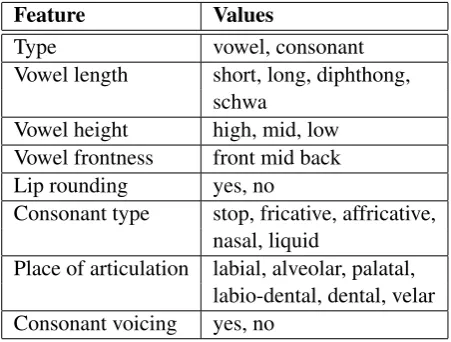
The phone similarity function used in this pro-cess is based on a model of phone production, where the phone features correspond to the articu-latory positions during production: the greater the matching between phone features, the smaller the distance between phones. The phone features used are described in table 1.
4.2 Threshold Estimation Process
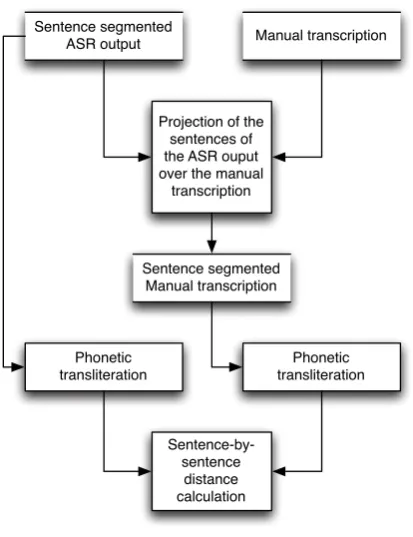
To estimate the threshold to be used in the sentence selection process, we use the algorithm presented in figure 1. The procedure consists of comparing automatic transcriptions and their hand-corrected versions: the output is the average difference be-tween the submitted inputs.
Phonetic transliteration
Phonetic transliteration Sentence segmented
ASR output Manual transcription
Projection of the sentences of the ASR ouput over the manual
transcription
Sentence segmented Manual transcription
Sentence-by-sentence
[image:4.595.78.285.187.456.2]distance calculation
Figure 1: Threshold estimation process.
The idea is that the phonetic distance between the automatic transcription and its hand-corrected version would be similar to the phonetic distance between the automatic transcription and the back-ground information. Even though this heuristic may appear naif, we believe it is adequate as a rough approach, considering the target material (broadcast news).
5 A Case Study Using Broadcast News
5.1 Media Monitoring System
SSNT (Amaral et al., 2007) is a system for selec-tive dissemination of multimedia contents, work-ing primarily with Portuguese broadcast news ser-vices. The system is based on an ASR mod-ule, that generates the transcriptions used by the topic segmentation, topic indexing, and ti-tle&summarization modules. User profiles enable the system to deliver e-mails containing relevant news stories. These messages contain the name
of the news service, a generated title, a summary, a link to the corresponding video segment, and a classification according to a thesaurus used by the broadcasting company.
Preceding the speech recognition module, an au-dio preprocessing module, based on Multi-layer Perceptrons, classifies the audio in accordance to several criteria: speech/non-speech, speaker seg-mentation and clustering, gender, and background conditions.
The ASR module, based on a hybrid speech recognition system that combines Hidden Markov Models with Multi-layer Perceptrons, with an av-erage word error rate of 24% (Amaral et al., 2007), greatly influences the performance of the subse-quent modules.
The topic segmentation and topic indexing modules were developed by Amaral and Tran-coso (2004). Topic segmentation is based on clus-tering and groups transcribed segments into sto-ries. The algorithm relies on a heuristic derived from the structure of the news services: each story starts with a segment spoken by the anchor. This module achieved anF-measure of 68% (Amaral et al., 2007). The main problem identified by the authors was boundary deletion: a problem which impacts the summarization task. Topic indexing is based on a hierarchically organized thematic the-saurus provided by the broadcasting company. The hierarchy has 22 thematic areas on the first level, for which the module achieved a correctness of 91.4% (Amaral et al., 2006; Amaral et al., 2007).
Batista et al. (2007) inserted a module for re-covering punctuation marks, based on maximum entropy models, after the ASR module. The punc-tuation marks addressed were the “full stop” and “comma”, which provide the sentence units nec-essary for use in the title&summarization mod-ule. This module achieved anF-measureof 56% andSER(Slot Error Rate, the measure commonly used to evaluate this kind of task) of 0.74.
Currently, the title&summarization module pro-duces a summary composed by the first n sen-tences, as detected by the previous module, of each news story and a title (the first sentence).
5.2 Corpora
Corpus Stories SUs Tokens Duration train 184 2661 57063 5h
[image:5.595.71.294.73.118.2]test 26 627 7360 1h
Table 2: Broadcast news corpus composition.
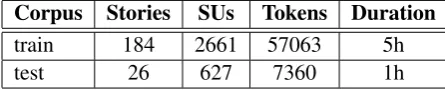
The broadcast news corpus is composed by 6 Portuguese news programs, and exists in two ver-sions: an automatically processed one, and a hand-corrected one. Its composition (number of stories, number of sentence-like units (SUs), number of to-kens, and duration) is detailed in table 2. To es-timate the threshold used for the selection of the background information, 5 news programs were used. The last one was used for evaluation.
The written newspaper corpus consists of the online version a Portuguese newspaper, down-loaded daily from the Internet. In this experiment, three editions of the newspaper were used, corre-sponding to the day and the two previous days of the news program to be summarized. The corpus is composed by 135 articles, 1418 sentence-like units, and 43102 tokens.
5.3 The Summarization Process
The summarization process we implemented is characterized by the use of LSA to compute the relevance of the extracts (sentence-like units) of the given input source.
LSA is based on the singular vector decomposi-tion (SVD) of the term-sentence frequencym×n
matrix,M. U is anm×nmatrix of left singular vectors;Σis then×ndiagonal matrix of singular values; and,V is then×nmatrix of right singular vectors (only possible ifm≥n):
M =UΣVT
The idea behind the method is that the decom-position captures the underlying topics of the doc-ument by means of co-occurrence of terms (the la-tent semantic analysis), and identifies the best rep-resentative sentence-like units of each topic. Sum-mary creation can be done by picking the best rep-resentatives of the most relevant topics according to a defined strategy.
For this summarization process, we imple-mented a module following the original ideas of Gong and Liu (2001) and the ones of Murray, Re-nals, and Carletta (2005) for solving dimensional-ity problems, and using, for matrix operations, the
GNU Scientific Library1.
5.4 Experimental Results
Our main objective was to understand if it is pos-sible to select relevant information from back-ground information that could improve the quality of speech-to-text summaries. To assess the valid-ity of this hypothesis, five different processes of generating a summary were considered. To bet-ter analyze the influence of the background in-formation, all automatic summarization methods are based on the up-to-date LSA method previ-ously described: one taking as input only the news story to be summarized (Simple) and used as base-line; other taking as input only the selected back-ground information (Background only); and, the last one, using both the news story and the back-ground information (Background + News). The other two processes were human: extractive (using only the news story) and abstractive (understand-ing the news story and condens(understand-ing it by means of paraphrase). Since the abstractive summaries had already been created, summary size was de-termined by their size (which means creating sum-maries using a compression rate of around 10% of the original size).
As mentioned before, the whole summariza-tion process begins with the selecsummariza-tion of the back-ground information. Using the threshold estimated as described in section 4.2 and the method de-scribed in section 4.1 to compute similarity be-tween sentence-like units, no background informa-tion was selected for 11 of the 26 news stories of the test corpus. For the remaining 15 news sto-ries, summaries were generated using the three au-tomatic summarization strategies described before. In what concerns the evaluation process, al-though ROUGE (Lin, 2004) is the most common evaluation metric for the automatic evaluation of summarization, since our approach might intro-duce in the summary information that it is not present in the original input source, we found that a human evaluation was more adequate to assess the relevance of that additional information. A percep-tual evaluation is also adequate to assess the per-ceive quality of the summaries and a better indica-tor of the what is expected to be in a summary.
We asked an heterogeneous group of sixteen people to evaluate the summaries created for the 15 news stories for which background information
0 20 40 60 80 100 120 Simple (News only)
Background only Background + News Human Extractive
Human Abstractive ns00
[image:6.595.71.291.69.259.2]ns01 ns02 ns03 ns04 ns05 ns06 ns07 ns08 ns09 ns10 ns11 ns12 ns13 ns14
Figure 2: Overall results for each summary cre-ation method (nsnnidentifies a news story).
was selected. Each evaluator was given, for each story, the news story itself (without background in-formation) and five summaries, corresponding to the five different methods presented before. The evaluation procedure consisted in identifying the best summary and in the classification of each summary (1–5, 5 is better) according to its content and readability (which covers issues like grammat-icality, existence of redundant information, or en-tity references (Nenkova, 2006)).
0% 10% 20% 30% 40% 50% 60% 70% 80% 90% 100%
ns00 ns01 ns02 ns03 ns04 ns05 ns06 ns07 ns08 ns09 ns10 ns11 ns12 ns13 ns14
Simple (News only) Background only Background + News Human Extractive Human Abstractive
Figure 3: Relative results for each news story (nsnnidentifies a news story; stack order is inverse of legend order).
Surprisingly enough (see figures 2 and 3), in general, the extractive human summaries were
[image:6.595.306.525.331.462.2]pre-ferred over the abstractive ones. Moreover, the summaries generated automatically using back-ground information (exclusively or not) were also selected as best summary (over the human created ones) a non-negligible number of times. The poor-est performance was attained, as expected, by the simple LSA summarizer, only preferred on two news stories for which all summaries were very similar. The results of the two approaches using background information were very close, a result that can be explained by the fact the summaries generated by these two approaches were equal for 11 of the 15 news stories (in the remaining 4, the average distribution was 31.25% from the news story versus 68.75% from the background infor-mation).
Figure 4 further discriminates the results in terms of content and readability.
0.00 0.50 1.00 1.50 2.00 2.50 3.00 3.50 4.00 4.50 5.00
Simple (News only)
Background only
Background + News
Human Extractive
Human Abstractive
[image:6.595.71.293.461.680.2]content readability
Figure 4: Average of the content and readability scores for each summary creation method.
informa-tive and indicainforma-tive styles of summary.
0.00 0.20 0.40 0.60 0.80 1.00 1.20
Simple (News only)
Background only
Background + News
Human Extractive
Human Abstractive
[image:7.595.72.292.95.228.2]content readability
Figure 5: Standard deviation of the content and readability scores.
Figure 5 presents the standard deviation for con-tent and readability scores: concerning concon-tent, automatically generated summaries using back-ground information achieved the highest standard deviation scores (see also figure 6 for a sample story). That is in part supported by some commen-taries made by the human evaluators on whether a summary should contain information that is not present in the input source. This aspect and the ob-tained results, suggest that this issue should be fur-ther analyzed, possibly using an extrinsic evalua-tion setup. On the other hand, readability standard deviation scores show that there is a considerable agreement in what concerns this criterion.
0.00 0.50 1.00 1.50 2.00 2.50 3.00 3.50 4.00 4.50 5.00
Simple (News only)
Background only
Background + News
Human Extractive
Human Abstractive
[image:7.595.73.292.483.635.2]Content (avg) Readability (avg) Content (stdev) Readability (stdev)
Figure 6: Average and standard deviation of the content and readability scores for one news story.
6 Conclusions
We present a new approach to speech summariza-tion that goes in the direcsummariza-tion of the integrasummariza-tion of text and speech analysis, as suggested by McKe-own et al. (2005). The main idea is the inclusion
of related, solid background information to cope with the difficulties of summarizing spoken lan-guage and the use of multi-document summariza-tion techniques in single document speech-to-text summarization. In this work, we explore the pos-sibilities offered by phonetic information to select the background information and conducted a per-ceptual evaluation to assess the relevance of the in-clusion of that information.
The results obtained show that the human eval-uators preferred human extractive summaries over human abstractive summaries. Moreover, simple LSA summaries attained the poorest results both in terms of content and readability, while human ex-tractive summaries achieved the best performance in what concerns content, and a considerably bet-ter performance than simple LSA in what concerns readability. This suggests that it is sill relevant to pursue new methods for relevance estimation. On the other hand, automatically generated summaries using background information were significantly better than simple LSA. This indicates that back-ground information is a viable way to increase the quality of automatic summarization systems.
References
Amaral, R. and I. Trancoso. 2004. Improving the Topic Indexation and Segmentation Modules of a Media
Watch System. In Proceedings of INTERSPEECH
2004 - ICSLP, pages 1609–1612. ISCA.
Amaral, R., H. Meinedo, D. Caseiro, I. Trancoso, and J. P. Neto. 2006. Automatic vs. Manual Topic Seg-mentation and Indexation in Broadcast News. In
Proc. of the IV Jornadas en Tecnologia del Habla. Amaral, R., H. Meinedo, D. Caseiro, I. Trancoso, and
J. P. Neto. 2007. A Prototype System for Selective Dissemination of Broadcast News in European
Por-tuguese. EURASIP Journal on Advances in Signal
Processing, 2007.
Batista, F., D. Caseiro, N. J. Mamede, and I. Tran-coso. 2007. Recovering Punctuation Marks for
Au-tomatic Speech Recognition. InProceedings of
IN-TERSPEECH 2007, pages 2153–2156. ISCA. Carbonell, J. and J. Goldstein. 1998. The Use of MMR,
Diversity-Based Reranking for Reordering
Docu-ments and Producing Summaries. In SIGIR 1998:
Proceedings of the 21st Annual International ACM SIGIR Conference on Research and Development in Information Retrieval, pages 335–336. ACM. Christensen, H., Y. Gotoh, B. Kolluru, and S. Renals.
2003. Are Extractive Text Summarisation
of the IEEE Workshop on Automatic Speech Recog-nition and Understanding, pages 489–494. IEEE. Edmundson, H. P. 1969. New methods in automatic
abstracting. Journal of the Association for Comput-ing Machinery, 16(2):264–285.
Endres-Niggemeyer, B., J. R. Hobbs, and K. Sp¨arck
Jones, editors. 1995. Summarizing Text
for Intelligent Communication—Dagstuhl-Seminar-Report 79. IBFI.
Furui, S. 2007. Recent Advances in Automatic Speech
Summarization. In Proceedings of the 8th
Confer-ence on Recherche d’Information Assist´ee par Or-dinateur (RIAO). Centre des Hautes ´Etudes Interna-tionales d’Informatique Documentaire.
Gong, Y. and X. Liu. 2001. Generic Text Summariza-tion Using Relevance Measure and Latent Semantic
Analysis. In SIGIR 2001: Proceedings of the 24st
Annual International ACM SIGIR Conference on Re-search and Development in Information Retrieval, pages 19–25. ACM.
Hori, T., C. Hori, and Y. Minami. 2003. Speech Sum-marization using Weighted Finite-State Transducers. InProceedings of the 8thEUROSPEECH - INTER-SPEECH 2003, pages 2817–2820. ISCA.
Hovy, E., 2003. The Oxford Handbook of
Compu-tational Linguistics, chapter Text Summarization, pages 583–598. Oxford University Press.
Kessler, B. 2005. Phonetic comparison
algo-rithms. Transactions of the Philological Society,
103(2):243–260.
Kikuchi, T., S. Furui, and C. Hori. 2003. Two-stage Automatic Speech Summarization by
Sen-tence Extraction and Compaction. In Proceedings
of the ISCA & IEEE Workshop on Spontaneous Speech Processing and Recognition (SSPR-2003), pages 207–210. ISCA.
Lin, C. 2004. ROUGE: A Package for Automatic
Evaluation of Summaries. In Text Summarization
Branches Out: Proceedings of the ACL-04
Work-shop, pages 74–81. ACL.
Luhn, H. P. 1958. The Automatic Creation of
Litera-ture Abstracts. IBM Journal of Research and
Devel-opment, 2(2):159–165.
Maskey, S. and J. Hirschberg. 2005. Comparing Lexi-cal, Acoustic/Prosodic, Strucural and Discourse
Fea-tures for Speech Summarization. In Proceedings
of the 9thEUROSPEECH - INTERSPEECH 2005,
pages 621–624. ISCA.
McKeown, K. R. and D. Radev. 1995. Generating
Summaries of Multiple News Articles. In SIGIR
1995: Proceedings of the 18thAnnual International ACM SIGIR Conference on Research and Develop-ment in Information Retrieval, pages 74–82. ACM.
McKeown, K. R., R. Barzilay, D. Evans, V. Hatzi-vassiloglou, J. L. Klavans, A. Nenkova, C. Sable, B. Schiffman, and S. Sigelman. 2002. Track-ing and SummarizTrack-ing News on a Daily Basis with Columbia’s Newsblaster. InProc. of the 2nd Inter-national Conference on Human Language Technol-ogy Research, pages 280–285. Morgan Kaufmann. McKeown, K. R., J. Hirschberg, M. Galley, and
S. Maskey. 2005. From Text to Speech
Summa-rization. In2005 IEEE International Conference on
Acoustics, Speech, and Signal Processing.
Proceed-ings, volume V, pages 997–1000. IEEE.
Mohri, M. 1997. Finite-State Transducers in Language
and Speech Processing. Computational Linguistics,
23(2):269–311.
Murray, G., S. Renals, and J. Carletta. 2005. Extractive
Summarization of Meeting Records. InProceedings
of the 9th EUROSPEECH - INTERSPEECH 2005,
pages 593–596. ISCA.
Murray, G., S. Renals, J. Carletta, and J. Moore. 2006. Incorporating Speaker and Discourse Features
into Speech Summarization. InProceedings of the
HLT/NAACL, pages 367–374. ACL.
Nenkova, A. 2006. Summarization Evaluation for Text
and Speech: Issues and Approaches. InProceedings
of INTERSPEECH 2006 - ICSLP, pages 1527–1530. ISCA.
Paulo, S. and L. C. Oliveira. 2002. Multilevel Annota-tion Of Speech Signals Using Weighted Finite State
Transducers. InProc. of the 2002 IEEE Workshop
on Speech Synthesis, pages 111–114. IEEE.
Radev, D., J. Otterbacher, A. Winkel, and S. Blair-Goldensohn. 2005. NewsInEssence: Summarizing
Online News Topics. Communications of the ACM,
48(10):95–98.
Ribeiro, R. and D. M. de Matos. 2007. Extractive Sum-marization of Broadcast News: Comparing
Strate-gies for European Portuguese. InText, Speech and
Dialogue – 10thInternational Conference. Proceed-ings, volume 4629 ofLecture Notes in Computer Sci-ence (Subseries LNAI), pages 115–122. Springer. Sp¨arck Jones, K. 2007. Automatic summarising: The
state of the art. Information Processing and
Man-agement, 43:1449–1481.
Wan, X., J. Yang, and J. Xiao. 2007. CollabSum: Ex-ploiting Multiple Document Clustering for
Collabo-rative Single Document Summarizations. InSIGIR
2007: Proc. of the 30thAnnual International ACM SIGIR Conference on Research and Development in Information Retrieval, pages 143–150. ACM. Zechner, K. and A. Waibel. 2000. Minimizing Word