Copyright © 2008 by the S-Cube consortium – All rights reserved.
The research leading to these results has received funding from the European Community's Seventh Framework Programme FP7/2007-2013 under grant agreement n° 215483 (S-Cube).
Title:
State of the Art Report, Gap Analysis of Knowledge on Principles,
Techniques and Methodologies for Monitoring and Adaptation of SBAs
Authors:
Salima Benbernou (UCBL), Luca Cavallaro (Polimi) Mohand Said
Hacid (UCBL), Raman Kazhamiakin (FBK), Gabor Kecskemeti
(SZTAKI)
,
Jean-Louis Poizat (INRIA), Fabrizio Silvestri (CNR), Maike
Uhlig (UniDue), Branimir Wetzstein (USTUTT)
Editor:
Salima Benbernou (UCBL)
Reviewers:
Manuel Carro (UPM)
Barbara Pernici (Polimi)
Identifier: Deliverable
#
PO-JRA-1.2.1
Type: Deliverable
Version: 1.0
Date:
10 July 2008
Status: Final
Class: External
Management Summary
The deliverable presents the state-of-the-art principles, techniques, and methodologies for the monitoring and adaptation of Service-Based Applications. The report also includes an overview of the different kinds of adaptation and monitoring principles and mechanisms, provides a classification of the existing approaches from the literature, and makes a comparison with the state-of-the-art approaches in other related areas of information systems.
Members of the S-Cube consortium:
University of Duisburg-Essen (Coordinator) – UniDue Germany
Tilburg University – Tilburg Netherlands
City University London – CITY U.K.
Consiglio Nazionale delle Ricerche – CNR Italy
Center for Scientific and Technological Research – FBK Italy
French Nat’l Institute for Research in Computer Science and Control – INRIA France
The Irish Software Engineering Research Centre – Lero Ireland
Politecnico di Milano – Polimi Italy
MTA SZTAKI – Computer and Automation Research Institute – SZTAKI Hungary
Vienna University of Technology – TUW Austria
Université Claude Bernard Lyon – UCBL France
University of Crete – UOC Greece
Universidad Politécnica de Madrid – UPM Spain
University of Stuttgart – USTUTT Germany
Published S-Cube documents
The S-Cube Deliverable Series
Vision and Objectives of S-Cube
The Software Services and Systems Network (S-Cube) will establish a unified, multidisciplinary, vibrant research community which will enable Europe to lead the software-services revolution, helping shape the software-service based Internet which is the backbone of our future interactive society.
By integrating diverse research communities, S-Cube intends to achieve world-wide scientific excellence in a field that is critical for European competitiveness. S-Cube will accomplish its aims by meeting the following objectives:
• Re-aligning, re-shaping and integrating research agendas of key European players from diverse research areas and by synthesizing and integrating diversified knowledge, thereby establishing a long-lasting foundation for steering research and for achieving innovation at the highest level.
• Inaugurating a Europe-wide common program of education and training for researchers and industry thereby creating a common culture that will have a profound impact on the future of the field.
• Establishing a pro-active mobility plan to enable cross-fertilisation and thereby fostering the integration of research communities and the establishment of a common software services research culture.
• Establishing trust relationships with industry via European Technology Platforms (specifically NESSI) to achieve a catalytic effect in shaping European research, strengthening industrial competitiveness and addressing main societal challenges.
• Defining a broader research vision and perspective that will shape the software-service based Internet of the future and will accelerate economic growth and improve the living conditions of European citizens.
S-Cube will produce an integrated research community of international reputation and acclaim that will help define the future shape of the field of software services which is of critical for European competitiveness. S-Cube will provide service engineering methodologies which facilitate the development, deployment and adjustment of sophisticated hybrid service-based systems that cannot be addressed with today’s limited software engineering approaches. S-Cube will further introduce an advanced training program for researchers and practitioners. Finally, S-Cube intends to bring strategic added value to European industry by using industry best-practice models and by implementing research results into pilot business cases and prototype systems.
Contents
1 Introduction 3
2 Monitoring 6
2.1 Preliminaries . . . 6
2.2 Classification of Monitoring Aspects . . . 7
2.2.1 Monitoring Task . . . 7
2.2.2 Specification of Monitoring Information . . . 9
2.2.3 Methodologies and Techniques for Monitoring Implementation . . . 9
2.3 Approaches to Monitoring of Service-Based Systems . . . 10
2.3.1 Monitoring Web Services and Service Compositions . . . 11
2.3.2 Business Activity Monitoring . . . 17
2.3.3 Process Mining . . . 20
2.3.4 Grid Monitoring . . . 23
2.4 Comparing Monitoring Approaches . . . 29
2.4.1 Monitoring Task . . . 29
2.4.2 Specification . . . 32
2.4.3 Implementation . . . 32
2.4.4 Related Works on Monitoring Information Systems . . . 33
2.5 Observations . . . 35
2.5.1 Research Challenges . . . 35
2.5.2 Research Perspectives . . . 36
3 Adaptation 38 3.1 Introduction . . . 38
3.2 Classification of Adaptation Concepts . . . 39
3.2.1 Adaptation Requirements . . . 39
3.2.2 Adaptation Strategies . . . 41
3.2.3 Implementation techniques for adaptation . . . 41
3.3 Related approaches to adapt in service-based application . . . 42
3.3.1 Semantic and Correctness for Adaptation . . . 42
3.3.2 QoS in the Adaptation . . . 43
3.3.3 Self-Adaptation and Self-healing Systems . . . 45
3.3.4 Adaptation in Service Interactions and Compositions . . . 46
3.4 Comparing adaptation approaches . . . 49
3.4.1 Adaptation requirements . . . 49
3.4.2 Strategies . . . 49
3.4.3 Implementation . . . 49
3.5 Related Work on Adaptation in Information Systems . . . 50
3.5.1 Adaptation in Component-Based Software Engineering . . . 51
3.5.2 Adaptation in Software Product Line Engineering . . . 53
3.6 Observations . . . 59 3.6.1 Key challenges . . . 59 3.6.2 Conclusion and research perspectives . . . 59
Chapter 1
Introduction
The advances in modern technology development and future technology changes dictate new chal-lenges and requirements to the engineering and provision of Service Based Applications. These appli-cations should become drastically more flexible; they should be able to operate and evolve in highly dynamic environments, being able to adequately react to various changes in these environments. In these settings, adaptability becomes a key feature of SBA as it provides a way for applications to continuously change itself in order to satisfy new requirements and demands dictated by the environ-ment.
The range of the possible changes that require application adaptation includes the changes in the infrastructural layer of the application, where the quality of service changes or service becomes unavailable; changes of the (hybrid) application context and location, where SBA should be able to replace one service by another possibly having other properties and parameters; changes of the user types, preferences, and constraints that require application customization and personalization as a means to adapt the application behavior to a particular user; changes in the functionalities provided by the component services that requires modifying the way in which services are composed and coor-dinated; changes in the ways the SBA is being used and managed by its consumers, which should lead to changes in the application requirements and the business processes implementing them. The ability of the application to adapt strongly relies on the presence of monitoring mechanisms and facilities. With monitoring we mean the methods and mechanisms that allow one to identify, detect, and even foresee the critical events and situations that occur in the SBA environment and that require the latter to change its configuration, behavior, presentation, etc. As these events occur at different functional layers of SBAs, namely the business process layer, the service composition layer, and the service infrastructure layer, there is a need for the cross-cutting monitoring techniques and methodologies for SBAs.
The life-cycle of adaptable SBAs1with respect to the adaptation and monitoring tasks consists of the following phases:
• identification and agreement on critical requirements and properties of the underlying SBA that should be continuously observed. This may include the relevant behavioral requirements, non-functional constraints, Key Performance Indicators (KPI), contextual properties, etc. • design of an observation model of the applications, i.e., specifying relevant monitoring
infor-mation using the corresponding notations and toolkits (design for monitoring). • deployment of monitors and sensors together with the underlying application.
• monitoring the relevant execution properties of the application instances. Such monitoring may be performed at run-time, in parallel with the application execution, or post-mortem, i.e., after the execution.
1as defined and presented in Deliverable PO-JRA-1.1.1 “State of the art report on software engineering design knowl-edge and Survey of HCI and contextual Knowlknowl-edge”
Figure 1.1: Adaptation and Monitoring Research
• identification of critical events and situations in accordance with the monitoring specification. These events may correspond to the contextual changes, violation of requirements and service-level-agreements (SLA), etc.
• identification of adaptation needs and requirements, that is, whether the application should be changed (adapted), and what part of the application is the subject to change.
• definition and selection of the corresponding adaptation strategy that aims to achieve the adap-tation need given the current operational state. Such strategy may be defined by the system integrator at design-time or automatically at run-time based on predefined policies and current situation.
• enactment of the adaptation strategy that, upon successful implementation, leads to a new ver-sion of the system. Such modification may change only a currently executed application in-stance or the whole application model.
• re-activation of the modified application in the current operational context. As a result, the application may be completely re-deployed, or the execution may continue from the previous state according to the new model.
Seen from a global perspective, the research activities on monitoring and adaptation may be rep-resented as in Fig 1.1. It relies on a number of key concepts, namely Monitoring Events, Monitoring Mechanisms, Adaptation Requirements and Objectives, Adaptation Strategies, and Adaptation Mech-anisms. These concepts identify the overall vision on the development and provision of adaptable and flexible service-based applications (SBA).
• Monitoring Mechanisms provide the actual realization of the methods for continuous observing and detecting relevant Monitoring Events; they identify the “How?” dimension of the monitor-ing process.
• Monitoring Events deliver the information about the application evolution and changes in the environment. These events define the “What?” dimension of the monitoring process: they are used to indicate whether the SBA is executed and evolves in a normal mode, whether there are some deviations or even violations of the desired or expected functionality.
• The events identified during the monitoring process carry the information about potential changes that the system and / or the underlying platform should perform in order to adapt to a new sit-uation. The relation between the monitoring events and the changes of SBA are defined by the
Adaptation Requirements and Objectives. These requirements identify the “What?” dimension of the adaptation process as they describe the goals and needs the adapted SBA should satisfy. • The Adaptation Strategies define the possible ways to achieve these requirements and needs
given the adaptation mechanisms made available (independently) in different functional layers of SBA. The adaptation strategies should guarantee coherent and integrated cross-layer man-agement of these adaptation techniques.
• The Adaptation Mechanisms provided at various functional SBA layers offer a means to actu-ally implement the adaptation strategies in integrated and coordinated manner.
The research on the problem of monitoring and adaptation of SBA is not performed in isolation; it is strongly related and relies upon the activities performed in other research areas. The research on engineering and design of SBAs provides approaches, principles, methods and notations for iden-tifying and describing relevant changes in the application and the corresponding events (design for monitoring), for defining and representing adaptation requirements and objectives (design for adapta-tion). State of the art in design and engineering SBAs, and, in particular, adaptable SBAs is presented in Deliverable PO-JRA-1.1.1. The research on the realization mechanisms for SBAs will provide var-ious tools that will be used to implement monitoring and adaptation activities at different functional layers. Deliverables PO-JRA-2.1.1, PO-JRA-2.2.1, and PO-JRA-2.3.1 present state of the art in real-ization mechanisms for business process management, for service composition and coordination, and for service infrastructure respectively.
These techniques will be used for the definition of the integrated, cross-layer monitoring and adaptation approaches. On the other side, the continuous evaluation and validation of the obtained research results will allow us to identify potential problems and gaps in the implementation of cross-layer approaches, and therefore to devise new requirements and challenges that should lead to the development of the new engineering principles and methods, and new realization mechanisms in the corresponding activities. In this survey we will study and review the relevant monitoring and adaptation approaches. We will provide a comprehensive classification of the corresponding concepts, principles, techniques, and methodologies; we will identify the overlaps between various research activities and reveal the gaps and problems that the research community should address in this area. The structure of the survey is organized as follows. Chapter 2 will present the classification and the state-of-the-art works in monitoring of service-based applications. Chapter 3 will provide a view on the adaptation problem and survey the relevant work in this area.
Chapter 2
Monitoring
2.1
Preliminaries
The term “monitoring” has been widely used in many disciplines and in particular in service-oriented design and engineering. Depending on a particular purpose of the designed system, on the role the monitoring process plays in the system life-cycle, and the kind of information being collected, the definition of the monitoring problem has different interpretations. In a broad sense, monitoring may be defined as a process of collecting and reporting relevant information about the execution and evolution of service-based applications. This general definition becomes more concrete and clear when the monitoring goals are considered. Monitoring may be used to discover problems in the application execution. In this case monitoring may be defined as a problem of observing the behavior of a system and determining if it is consistent with a given specification [1]. Monitoring may support the run-time optimization of a system, when the monitored quality of service properties of the involved services is used to drive resource allocations. It can also be used to detect relevant contextual changes and events in order to support context-driven run-time adaptation of SBA; to collect information relevant for the application evolution, such as, histories of adaptations, decisions made in different executions, in order to support the evolution and governance of SBA; perform business activity monitoring, etc.
Another relevant issue for the description of monitoring is what kind of data is being observed and reported, that is, the monitored information. In these regards one can consider monitoring of functional or non-functional properties, instance or class-based events, external or internal aspects, etc.
Finally, monitoring approaches used to address one or another monitoring problem, are imple-mented with the help of various monitoring techniques. These approaches and techniques vary on the basis of such aspects as the way the monitoring information is specified, degree of integration with the application, timing of collecting information and information sources.
A generic monitoring framework may be defined as follows. Following the definition proposed in [2], a monitor is a program that observes the execution of another program. The monitor is being defined and implemented on the basis of the monitoring specification that describes the properties and events to be observed. The actual information is being perceived and delivered to the monitor by a set of sensors. This information is being processed by the monitor in order to decide whether this information corresponds to the monitored event or property (e.g., certain quality-of-service (QoS) parameter value exceeded expected bound, a correctness requirement, is violated, or a relevant con-textual change has occurred). In this case the monitor reports the event to the associated event handler, which performs some associated action or merely writes the event to the corresponding application log.
In the following section we will give the more detailed classification of the monitoring problem and review the state of the art in the research on monitoring of service-based applications.
2.2
Classification of Monitoring Aspects
In the classification of the existing approaches to monitoring service-based applications, we will focus on the following aspects of the monitoring problem:(i)the monitoring task, i.e., what is the purpose of the monitoring activity within the life-cycle of the SBA and what kind of information is being observed; (ii) the specification of the monitoring information, that is, how the monitoring problem is modeled and how the monitoring instructions are specified; (iii) implementation methods and techniques exploited by the approach.
We remark that this classification is based on and extends the taxonomies suggested for the clas-sification of fault monitoring tools and approaches for software systems [1] and service-oriented ar-chitectures [3].
2.2.1 Monitoring Task
As we already discussed above, the monitoring approaches may be classified according to the mon-itoring task addressed by the approach. The monmon-itoring task aims at answering two key questions, namely “why monitor?” and “what to monitor?”.
Monitoring goals and objectives
For what concerns the goal of the monitoring activity, the approaches may be tailored to the following purposes identified in the literature.
• Fault monitoring addresses the problem of run-time analysis of the system correctness, i.e., checking the system execution and its parameters against certain specifications that distinguish “correct” and “failing” situations. This amounts, for example, to the run-time verification of certain behavioral or non-functional properties expected from the system, run-time confor-mance analysis, when the actual system traces is compared with the system specification, anal-ysis of service-level agreements, requirements analanal-ysis, etc.
• Monitoring is instrumental to perform the diagnosis and recovery (repair) of the identified faults, i.e., to identify the cause of the problem and drive the actions necessary to return the system to the “normal” execution.
• Monitoring of quality characteristics of the involved services and components is often used to instantiate and guide the optimization activities regarding resource allocation in grid computing. • In a similar way, monitoring of various contextual properties may be required in order to support dynamic adaptation of the application to the relevant change in its environment. Depending on the adopted definition of context, this may relate to the monitoring of service registries in order to discover new useful services or changes in the characteristics of the existing ones; monitoring of the run-time environment of the application, such as an underlying device or infrastructure; monitoring of the user-related characteristics (e.g., preferences or accessibility parameters); monitoring current location and time, etc.
• Business Activity Monitoring (BAM) provides near real-time monitoring of business activities, measurement of key performance indicators (KPIs), their presentation in dashboards, and auto-matic and proactive notification in case of deviations. A “business activity” thereby can be im-plemented as a service orchestration in a BPMS, or, more general, as part of a business process consisting of a series of activities implemented across workflow systems, enterprise resource planning (ERP) systems and legacy applications, possibly across organizational boundaries. The goal of BAM is to provide timely information about the status and the performance of business processes, and to proactively alert users if business rules are violated or KPI values deviate from target values.
• Monitoring activities may be also used to support the long-term adaptation of the service-based system, also referred to as evolution. In this case the evolutionary aspect speaks about mon-itoring of different data that represent certain trend in the execution of the process, i.e., the decisions taken, the relevant values of the process-related data, and the history of this informa-tion.
Relevant to this issue, is the concept of the stakeholder, which is interested in the monitoring activity [3]. Run-time analysis of various correctness properties over involved service amounts to the viewpoint of the service requester: the service should deliver the expected property. The analysis of SLA conformance may correspond to the third-party viewpoint, where the expectations and commit-ments of both the requester and provider are considered. Finally, the issues related to the application adaptations and optimizations correspond to the perspective of the service provider, who is willing to improve the system and to align it with the new situation and context.
Monitoring objectives may also be characterized by the aspect of the SBA model addressed by the activity. Many run-time approaches deal with the behavioral properties of the application, such as conformance to the abstract interaction protocol, various safety properties or complex temporal con-straints, and in certain cases quality of service parameters. Other approaches focus on the contextual information or business activity and management characteristics, such as business metrics and KPIs, security-related aspects, etc.
Monitoring Information
For what concerns the definition of the monitoring information, the following key issues may be considered: the kind of properties it represents (i.e., functional or non-functional, instance-based or aggregated), the occurrence and distribution of the information (internal or external, centralized or distributed, functional SBA layer).
Functional properties refer to the definition of service operations, their signatures and technical parameters (e.g., binding information), as well as to the behavioral specifications of the service-based applications, such as service composition models. The monitored properties, therefore, often reflect the functional requirements on the underlying system. These properties may refer to the run-time verification of functional and behavioral requirements, such as pre- and post-conditions on service calls, signature conformance, properties over the transmitted data, etc. Monitoring non-functional properties, on the other side, aims at measuring certain characteristics of the system [3]. The relevant non-functional properties that are subject of this quantitative analysis are availability, accessibility, performance, and reliability. The monitored properties may also be divided into instance-based, i.e., related to the current instance of the application (e.g., current instance of a composition), or aggregated (historical), where the property represents the accumulative information over the relevant property (e.g., average duration of the business process, or weighted number of times when the certain event occurred).
The location and distribution of the monitored information may be characterized in several di-mensions. First, the events may be internal to the application (e.g., internal faults, states changes), thus characterizing the application execution, or external (e.g., contextual), thus characterizing the ap-plication environment. Second, the information may depend on the collaboration paradigm adopted by the composition model of the application [3]. In case of orchestration-based compositions, the application, and therefore the monitor, is tailored to the centralized execution environment. In case of choreography-based applications, the components of the system act independently performing their own part of the business process. The information about the state of the application and the performed task is, therefore, distributed, thus requiring an extra effort for defining and performing overall mon-itoring activities. Finally, the monitored properties may refer to the information that corresponds to different functional layers of the service-based applications. Business activity monitoring addresses the information defined at the business process management layer. Monitoring of the QoS properties usually targets the infrastructural layer, where the services and underlying middleware protocols are
defined. The monitoring of behavioral properties and interactions corresponds to the composition layer, where the service composition and message exchanges are specified.
2.2.2 Specification of Monitoring Information
From the design perspective, an important aspect of the classification of the monitoring approaches refers to the ways the monitoring properties are specified. Even when dealing with the same kind of monitored information, the approaches may differ in the features of the specification language (e.g., formalism used and its expressiveness, modeling methodology), level of abstraction, interleaving with the application specification, etc.
An important aspect of the specification language is characterized by the set of monitoring prim-itives, on top of which the properties are specified. Depending on the kind of monitored data, these primitives may refer to various events (e.g., reception/emission of a message, faults, management op-erations), state/configuration predicates (execution point of the composition specification, values of the relevant parameters or variables), current configuration parameters (QoS metrics of the involved services), and so on. These primitives may be simple (such as, message reception) or structured (aggregated events, global configuration composition configuration).
Related to this is the abstraction level of the monitoring specification. Low-level specifications allow for monitoring very specific information related to a particular implementation language. High-level languages may be based on the business-High-level concepts and events, thus abstracting from the implementation-specific information and details.
The languages rely on different formalisms and modeling notations. Logic-based notations allow for specifying a property as a logical formula of a special form. Depending on the formalism and its expressiveness, these formulas may characterize only a state of a system at certain moment of time (e.g., in approaches that monitor pre- or post-conditions of the service invocations) or express properties over execution trace or its fragment (e.g., the approaches relying on temporal logics).
Another important aspect of the monitoring specification is how much this specification is inter-leaved with the application code. In many approaches the monitoring problem is described sepa-rately from the application specification in order to ensure separation of concerns in the development process. In some approaches, however, the information related to the monitoring is built into the application code. This is done, in particular, in certain adaptation approaches, where the monitored information is provided together with the event handler specification, so that the event detected while performing the corresponding application code immediately triggers the execution of the event han-dler.
2.2.3 Methodologies and Techniques for Monitoring Implementation
From the implementation perspective, monitoring approaches may be classified according to the fea-tures of the techniques and architecfea-tures exploited for the realization of the monitoring activity. In this report we do not aim to describe different implementation techniques and specific monitoring architectures in details, due to a very broad scope of the problems and solutions addressed in different SBA-related areas and the corresponding approaches. Instead, we will focus only on a selected set of aspects that characterize one or another approach both from the architectural and from the implemen-tation points of view. These aspects include methodology used to observe the relevant information, degree of invasiveness of the monitors and monitoring architecture with respect to the application and the platform, timing of information gathering, sources of the information and their placement, and adopted techniques specific to the presented approach.
There exist a number of the methodologies used within the monitoring approaches. In simulation-based approaches the monitoring property is automatically converted into a special program (automa-ton) that is being executed (simulated) in parallel with the monitored application. The state of this program is updated upon reception of a certain event. When the program reaches certain state that cor-responds to the violation/satisfaction of the monitored property, this fact is reported and the monitor
terminates. In event-based approaches the monitoring properties are explicitly associated to certain events (e.g., assertions, pre-/post-condition checks), and when the event is fired, the corresponding property is evaluated or metric variable is updated. Situation-based approaches, on the contrary, pe-riodically access the information sources and perform the evaluation on the basis of the currently available information.
The degree of invasiveness characterizes the monitoring approaches in two directions. First, it depends on the way the monitoring framework is integrated with the application architecture. In some approaches, monitoring facilities and sensors become (usually at deployment time) an inte-grated part of the application, and therefore abstract from the underlying infrastructure and platform. Other approaches, instead, make use of the platform and middleware APIs in order to observe relevant information, without affecting the realization of the application. Second, it depends on whether the monitors are executed synchronously with the application code, blocking it until the property evalu-ation is done, or asynchronously in a independent parallel thread, or even on another machine. The example of the first approach is the assertion checking, while the example of the second approach is contextual information gathering. The first approaches permits more operative reaction to the critical events, blocking the application until the handling is done. The second approach allows for better performance and scalability, since the execution of the application is independent from monitoring.
For what concerns the timing of information gathering, one can distinguish the approaches, where the monitoring information is updated immediately when the relevant events are triggered, and the post-mortem approaches, where the information is gathered after the events occur. This is the case, for instance, of many process mining approaches, where the monitoring activities are performed on the basis of event logs. It is possible also to consider the proactive monitoring, where special techniques are used to predict the future events, such as failures on the basis of the current situation and the historical information, i.e., on the basis of a certain “trend”.
The classification of the monitoring techniques may consider also the sources of information used to extract data and relevant events, i.e., the placement of the corresponding sensors. While applica-tion logs, context sensors, message queues, process containers, and the corresponding data storages are the typical sources of information, there exist approaches defining ad-hoc information reposi-tories. For example in [4] special reputation repositories are introduced and dynamically updated. The applications monitor the reputation values in order to suggest new service candidates with better reputation.
Finally, an important aspect for the implementation of the monitoring approaches, deals with the particular techniques adopted within the approach. A remarkable candidate is, for example, process mining, which is widely used for extracting from the process logs the patterns that describe the actual process in comparison to the process specification. Another important technique for implementing monitors is the aspect-oriented approach that allows for embedding the monitoring code without affecting the program and in many cases the platform code. Automated planning techniques are exploited in order to extract the monitor programs from the behavioral models of the involved services and complex property specification [5], taking into account non-determinism and partial observability of the composition behavior.
2.3
Approaches to Monitoring of Service-Based Systems
In this section we survey the state-of-the-art works in monitoring of service-based applications. We group the approaches according to the main characteristics of the research and application areas ad-dressed in the approaches. Section 2.3.1 presents the approaches and solutions towards monitoring different types of requirements and policies for Web services and service compositions. Section 2.3.2 presents the works in the area of business activity monitoring, where the focus is on the run-time analysis of business process characteristics and metrics. Section 2.3.3 also describes the process monitoring works, targeting, however, post-mortem monitoring, based on the analysis of various pro-cess execution logs. Finally, Section 2.3.4 presents the approaches and tools that aim to monitor grid
services and the corresponding grid architectures and infrastructures.
2.3.1 Monitoring Web Services and Service Compositions
In Web services and service compositions, wide range of run-time monitoring approaches address the problem of checking whether certain predefined properties are satisfied when the system is executed. Such properties may have different forms and target different monitoring objectives. Typical moni-toring scenarios include run-time verification of behavioral requirements (e.g., assertions, pre-/post-conditions, temporal requirements), conformance of the actual service execution to some predefined specifications (contracts, SLAs), correspondence to some expected characteristics (QoS bounds), etc. The results of the monitoring, i.e., identified deviations of the expected model of executions, may be used not only for signaling the anomalous behavior of the system, but also to activate some additional actions, which target the recovery to a normal execution (in case of identified requirements violation) or optimization of the system (e.g., in case of deviations of the service quality properties).
Assumption-based monitoring of service compositions [6, 5]
In [6, 5] the approach to monitoring of service compositions implemented in BPEL is presented. The main focus of the approach is the run-time checking of the assumptions under which the component services are supposed to participate to the composition, and the conditions that the composition is expected to satisfy. Moreover, the proposed approach aims at checking not only whether the property holds or not, but also at collecting statistical and timing information over such properties, as well as the aggregated historical information about such properties over all the instances of the given business process. In order to address the problem, the authors propose the specification framework and run-time monitoring environment that extends the standard BPEL engine with the monitoring and auditing capabilities. The devised architecture clearly separates the business logic of a web service from its monitoring functionality.
The specification framework relies on an expressive monitoring language, namely Run-Time Monitoring specification Language (RTML), that allows for expressing behavioral properties of ser-vice composition instances (e.g., payment should not start before acknowledgement is received), to-gether with the timing (e.g., duration of payment procedure) and statistical information (e.g., number of retries on negative acknowledgment), and of composition classes (e.g., total number of viola-tions or average number of retries). Apart from explicitly specified assumpviola-tions it is possible also to check whether the protocol associated to partner interactions is satisfied at run-time. Based on the monitoring specification and the composition model, the corresponding monitor program (in java) is generated using specific automata-theoretic techniques [5].
At run-time the monitor programs, deployed together with the composed services, run in parallel to them, observe their behavior by intercepting the input/output messages that are received / sent by the processes, and evolve on the basis of such event. When the state of the monitor that corresponds to a particular evaluation of the property is reached, the monitor signals misbehaviors or, more in general, information of interest. The run-time environment is implemented as an extension to a BPEL engine. The information is collected from the corresponding message queues and from the process manager in order to observe creation/termination of process instances. The results of the monitoring are presented through a special monitoring console.
The authors also demonstrate the applicability of the presented approach on a set of sophisticated examples, and perform the experimental evaluation of the performance of the monitor extraction and execution.
Monitoring conversational Web services [7]
In [7] the authors propose an approach to check at run-time that the actual behavior of a service conforms to the expected behavior of that service. Conversational services, whose behavior depends
on the local state resulting from client-service interaction, raise new challenges both to specification languages and to the way the actual behavior may be checked against the specification. Indeed, the behavioral specification should formally describe what the monitored service ought to do on behalf of its client, and includes not only the syntactic aspects but also the business logic of the service.
This paper explores a specification style that is based on algebraic representation of conversational web services. In this approach the service operations are classified into constructors (that create new data objects), observers (retrieve information on the data) and transformers. The algebraic speci-fication allows not only to specify pre- and post-conditions on the service operations, but also the conditions and axioms that give the semantic to the operations and make the specification state-based. The evaluation of the specification at run-time may be performed by symbolic execution (simulation). The authors present a term-rewriting schema that is needed for this execution.
The architecture of monitoring approach adopts an aspect oriented programming approach. As-pects are dynamically attached to BPEL engine to monitor service composition. AspectJ language is used to add monitoring facilities to ActiveBPEL. The solution in the paper extends the standard implementation of the ActiveBPEL engine with three main additional components: interceptor to in-tercept the execution of a process within the engine (using aspect oriented programming) in order to pass to the monitor the relevant information (i.e., about external interactions); a specification registry that contains the specifications, against which services are checked for conformance; and a monitor, which is the actual conformance checker. The monitor component is a wrapper for the evaluation of algebraic specifications. It keeps a machine-readable description of the state of the process instances and updates this description when the new information from the interceptor is received. The symbolic state is then evaluated and the result, representing actual information regarding the state of the con-versation is compared against the expected one. In case of mismatch, certain specific action may be performed (e.g., logging).
Smart monitors for composed services [8]
In [8] the authors proposed an approach towards monitoring of service compositions specified as BPEL processes against contracts expressed as assertions on service. In particular, the assertion defines the pre- and post-conditions on service invocations, and characterizes functional expectations of the correct service behavior.
The authors propose the process annotations as a way of specifying the contract assertions. These annotations are then automatically translated into the corresponding code extensions that interact with the dedicated monitor components in order to perform the assertion checking. In their proposal these monitors are web services themselves, which receive the instructions from the transformed process, perform the analysis and return the result to the executed process.
In order to implement the monitoring functionality, the authors present two complementary ap-proaches. The first one relies on the C#object-oriented language for specifying and implementing monitor specifications. In this approach, the assertions are expressed completely in this language, thus providing very expressive means for the specification. The corresponding monitor is then auto-matically generated in this language and deployed as a Web service. The approach is very flexible and expressive; however, it requires the process designer to work at a very low programming level.
The other approach relies on the use of CLIX, a rich and expressive XML-based assertion lan-guage, based on first-order logic, which supports, for instance, quantifiers. The implementation of the monitor in this case relies on wrapping the corresponding assertion processor as a Web service. The approach is less flexible, but benefits from high-level and declarative assertion specification language.
Dynamo [9, 10, 11]
In these works the authors extend and elaborate the ideas presented in previous approach ([8]). The main challenges for the new approach are:
• to enable “separation of concerns” in the design of monitoring specification so that new moni-toring rules are defined separately from the process itself;
• to come up with a well-defined and expressive language for the monitoring specifications; • to provide means for monitoring non-functional (QoS) properties of the services;
• to support the collection of the information from external sources; • to provide means for managing monitoring process;
• to devise and implement the corresponding architecture.
The authors propose an extended notation for specifying monitoring rules. Monitoring rules are defined explicitly and externally in a well-defined structured file. This separation allows different sets of rules to be associated with same process. The rules define the location, where the evaluation should be performed, and its type. For precondition and postcondition, location indicates the BPEL invoke activity, to which the rule is applied; for an invariant it indicates the BPEL scope; and in case of assertion it indicates any point of WS-BPEL process before the assertion should hold.
The monitoring expression is defined in WSCoL [9], the notation inspired by Java Modeling Language, which enables specifying expressions over the process variables and supports set of built-in functions, logical and mathematical operators, and quantification. Furthermore, the language is extended with the facilities to obtain data from external information sources, if they are defined as Web services. It provides the necessary constructs to define both functional and non-functional constraints and properties.
Besides, the monitoring rules provide parameters to govern the degree of monitoring at run-time: such as validity time frame, priority, set of certified providers for which monitoring may be omitted.
The monitoring rules are deployed together with the process through a weaving procedure, i.e., parsing monitoring rules and adding specific WS-BPEL activities to process in order to achieve dy-namic monitoring. At run-time the modified process interacts with the proxy service, namely rule manager, which is responsible for processing the monitoring management instructions, processing monitor configuration, obtaining information from external data sources, evaluating monitoring ex-pressions, and interacting with the actual services (instead of the original process). If some constraints are not met, monitoring manager is responsible to inform BPEL process.
In [11] the authors extend this work for what concerns the kind of properties the approach can monitor. The extended specification language, namely Timed WSCoL now allows for specifying temporal properties over the events that occur during the process execution. In these regards, the approach is close to the one proposed in [5, 6]. In particular, the authors present classical linear tem-poral operators (always, sometime, until) and specific operators to express a property over restricted time window (within, between, count). Differently to the previous approach, the monitoring of these temporal properties is asynchronous, and performed by a new dedicated component called WSCoL Analyzer. This analyzer is executed in parallel with the execution of a process, and receives the rele-vant event through a dedicated publish/subscribe mechanism. Similarly to [5, 6], the automata-based algorithms are used to devise the monitor for a dedicated temporal property.
In [10] the authors show how this approach may be integrated with the WS-Policy framework. The work concentrates on the effective policies that represent the properties of a Web service deployed on a particular server and invoked by a specific user. Once effective policies are derived, services should be monitored at run-time to guarantee that they offer the service levels stated by their associated policies.
Monitoring for diagnosis [12]
In [12] the authors present a monitoring approach for the purpose of diagnosis of failures in service-based systems. While in most existing approaches fault recovery actions are associated to the observ-able effects of the occurred problems, it is necessary for a system to adequately react to their causes.
In the context of composite service-based systems, the goal of the diagnosis is “to identify the service responsible for the problem, the faulty activities, and the other services involved in failure”.
The presented approach deals with a particular case of the system diagnosis, namely consistency-based diagnosis, where the goal is to assign certain behavioral model to the components and observe its consistency with respect to the real execution. Furthermore, the authors present an approach to the diagnosis-aware fault handling, where the global hypothesis on the occurred problem drives the recovery actions within the application components.
The proposed solution relies on a distributed architecture, where each component service is as-sociated with the corresponding local diagnoser, which interacts with the service through a special diagnosis interface. Such diagnoser collects the local information regarding the actions executed by its service and the messages it interacts with the other services, and derives local hypothesis about the problem and the other involved services. This hypothesis is then transferred to the global diagnoser component that is in charge of requesting other local diagnosers in order to collect the most complete information regarding the occurred problem. The global hypothesis, identified in this way, represents the cause of the problem and may be used to drive the fault handling. The latter is achieved by making the local fault handling diagnosis-aware, i.e., taking into account the hypothesis in the definition of the recovery actions.
The diagnosis information allows not only identifying the cause of the occurred problem, but also enables more accurate and coordinated recovery management. An intelligent local fault handling scheme proposed in the approach, as demonstrated and validated through an example of a composed business service, permits the resolution of a problem, not within the service, where it was observed, but within a component that caused the problem.
Monitoring privacy-agreement compliance [13]
In [13] Benbernou et al. address the problem of run-time monitoring of compliance of the privacy agreement defining the users privacy rights and their possible handling by the service provider. This problem goes beyond the traditional access control management and defines the necessity to face the usage control management of the private user information.
The proposed solution presents the privacy agreement model, where the requirements on the management and handling of the privacy data are specified, together with the approach for run-time compliance monitoring. The privacy properties are given in the form of data-rights (authorized oper-ations) and data-obligations (required actions) together with their validity frames, and specified in the extended WS-Agreement specification. The set of privacy requirements, privacy units, and typical misuse scenarios are defined based on these properties. The formalism adopted for the representation of the privacy units and misuse relies on linear temporal logic. For the monitoring purpose, privacy units are transformed into state machine representation that correspond to the evolution of the privacy data management and define both correct and incorrect usage of this data.
The monitoring framework incorporates three main ingredients, namely requirements specifica-tion, privacy unit observer and monitor. The requirements specification is transformed into the corre-sponding privacy unit state machines, which at run-time evolve in parallel with the service execution. The monitor collects the information about the privacy data use from the service logs, and updates the status of the privacy unit observer accordingly. The latter reports the violations of the privacy requirements when a specific failure state of the corresponding state machine is reached.
The proposed framework relies on clear and simple model of privacy agreements, while the un-derlying requirements model relies on a comprehensive formalism for the representation of correct usage of private information. The run-time monitoring approach exploits automated techniques for the extraction and execution of monitor programs.
Requirements monitoring based on event calculus [14, 15, 16]
In [14, 15, 16] the authors approach the problem of monitoring service-based systems for confor-mance to a set of behavioral requirements. In particular, the works address the ability to represent and monitor complex and expressive properties that deal with events, states, timing constraints and relations, etc. Furthermore, there is a need to refer not only to functional but also to non-functional characteristic of the system, as dictated by the necessity of the run-time compliance checking between the actual behavior and the service-level agreement specifications [16].
In their approach the authors address the above problems by providing a formal specification framework for expressing complex requirements and SLAs, and a monitoring framework for run-time checking of these properties. The formal specification relies on the adapted version of the event calculus, a first-order logic-based formalism that allows expressing complex properties over events, fluents, and timestamps. The events and fluents in their notation refer to simple operations invo-cations, valuations of internal and external variables, built-in functions and operators, etc. In [16] this notation is adapted in order to reflect the SLA properties in the WS-Agreement notation. The monitoring process relies on automated extraction of the special templates that represent the formulas in event calculus, and updating them with the recorder and derived events. The reasoning schema, the derivation of events and run-time analysis are based on the inference rules in the corresponding first-order logic formalization of the calculus.
The monitoring framework was implemented as a toolkit for monitoring service compositions specified in BPEL. The logs generated by the process engine were used to identify the events and update the corresponding formula templates in the monitors. In order to evaluate and validate the presented approach, the authors set up a comprehensive benchmark with many test and generated events based on a simple case study parametrized by the frequency of events and the scale of the involved components.
Monitoring security patterns [17, 18]
In [17, 18] the authors address the problem of monitoring important security properties of service-based systems. While the static analysis techniques are widely used to check the security properties at design-time, the run-time verification of these properties and the assumptions, under which these properties were shown to hold, is still required.
In order to tackle with this problem the authors propose to use the techniques described by the previous framework in order to define and monitor basic security properties, namely confidentiality -the absence of unauthorized disclosure of information; integrity - -the absence of unauthorized trans-formations of the state of a system; and availability - the readiness of a system to provide a correct service. These properties are defined using the special patterns modeled as event calculus properties, which allows monitoring security properties even for non-expert users.
Performance monitoring for utility computing [19]
In [19] Farrel et al. deals with monitoring of service-level agreements defining formal contract on the service provision between the service customer and provider. The presented solution addresses the domain of utility computing, where providing resources with certain quality characteristics is the cornerstone aspect.
Similarly to [14, 16], the presented approach exploits the event calculus as an underlying formal-ism. However, the way the contracts are designed and managed is different. The contracts are defined on the basis of a contract pattern (which obligations hold initially, which are initiated and terminated during the contract, which events and when occur), which is then axiomatized using the event calcu-lus. Then, the effects of critical events on the contract state/evolution are defined. The authors present a monitoring architecture and an analyzer to manage contract life-cycle, their analysis and reporting, as well as a visualizer to represent the results of the SLA monitoring.
Planning and monitoring execution with business assertions [20]
In [20] Lazovik et al. apply monitoring to a framework, where the user requests are used to dynam-ically customize and execute standard business processes. Such customization aims at satisfying the user constraints and requirements to the execution of a standard business process, parametric to the set of available concrete services participating in the process. These services, however, as well as their composition, should satisfy certain domain business rules, referred to in the framework as assertions. In this approach the authors propose an architecture, where the planning-based adaptation of the business process is interleaved with the execution and monitoring of the process and the correspond-ing assertions. The adaptation requests are specified in a XSRL query language that defined functional constraints and preferences of the user. The assertions are specified in the assertion language XSAL, which allows for defining the behavioral policies on the execution of process activities in the domain. Using these specifications and the process model, the framework tries to exploit various providers, in order to better satisfy the query, taking into account the domain assertions. While executing the adapted process, the framework monitors the relevant events and if the violation of the plan or asser-tion is detected, tries to dynamically modify the plan taking into account new situaasser-tion and asserasser-tions.
Automated SLA monitoring [21]
In this work the authors address monitoring Service-Level Agreements (SLA), which represent certain form of a contract between service provider and consumer regarding such issues as performance, reliability, security, cost. This problem is made difficult by several factors. First, there is a need to present SLA in precise and unambiguous way. Second, due to distributed and multi-party nature of service-based systems, the relevant measurements should be done in a distributed way.
The proposed solution addresses these difficulties as follows. First, the authors present a formal-ized notation for specifying generic SLA, applicable also to the service-based systems. The main ingredients of the SLA specification refer to clauses, which define the measured parameter, on which side it is measured, upon which event it should take place, and the instructions for evaluation of the values. Second, the authors propose instrumentation facilities in order to collect the necessary data. At the service level this is done using special proxies that intercept messages and perform their evalua-tion. At the business process level the process logs (or database) are used to collect information about internal process activities. Third, a comprehensive service-level monitoring engine is proposed to carry out the management of the monitoring tasks. The engine performs the coordination of monitor-ing actions, raises and terminates new monitor instances accordmonitor-ing to the duration periods as specified in SLA, associates the monitored information with the monitored objects, and so on. The engine also supports distributed monitoring, if the measurements should be performed both at the consumer and provider side. In this case the measured information is being exchanged via specific measurement exchange protocol, supported by the engine. The implementation of the engine comes also with the management and audition facilities.
WSLA [22]
In [22] a framework for the specification and monitoring of service-level agreement is presented. The goal of the framework is to provide an expressive yet flexible model of QoS contracts and a run-time framework for their measurements and violation detection.
The WSLA framework defines a language for the specification of contract information that allows for describing the parties involved in the agreement (including third parties supporting the monitor-ing/audition process), the relevant quality of service characteristics, as well as the ways to observe and measure them, and the obligations and constraints imposed on these characteristics. The char-acteristics may refer both to simple and to complex metrics, which define composite properties of simple ones (e.g., aggregation, percentage, etc.). The measurement directives facilitate the definition of the means used to observe and analyze the relevant information, making the architecture and the approach flexible and easily extendable.
The WSLA architecture includes several components to provide the facilities for the deployment, measurement, and management of contract information. The actual monitoring is performed by the SLA compliance monitors that collects the measurements and probes from the provider and support-ing parties, performs the evaluation of obligations and detects their violations.
Cremona [23]
In [23] Ludwig et al. propose an architecture and implementation for creation, management and mon-itoring service-level agreements represented as WS-Agreement documents. WS-Agreement specifi-cation provides a standardized way of defining contractual information between service provider and customer, and originates in the field of grid computing. It allows the clients to specify the required levels of service quality properties, the providers to derive the corresponding resource requirements and to drive the decisions on the requests. On the client side it is necessary also to provide facilities to monitor and control the actual correspondence of the resource quality and the negotiated contract specification.
The Cremona architecture and a toolkit propose a framework for all the aspects in the WS-Agreement management. Cremona provides a layered model for definition, creation, negotiation, binding, and monitoring of contracts. The monitoring module is not only used to observe and detect contract violations, but also to predict future violations and to engage corrective actions in advance. The monitoring facilities come also with the management interfaces that allow the customers to track the current situation and to take agreement-level actions (e.g., change provider).
Colombo [24]
In [24] the authors propose a platform for developing, deploying, and executing service-oriented ap-plications and system that incorporates the tools and facilities for checking, monitoring, and enforcing service requirements expressed in WS-Policy notations. WS-Policy notations define the quality-of-service assertions that can be attached to a particular quality-of-service, operation, or a message type. The concrete assertions are defined in a certain domain-specific language, e.g., Transactions or WS-Security that define the properties of the transaction protocols and security characteristics respectively. Apart from checking the compliance of policies at deployment-time, it is necessary to verify them at run-time, when, e.g., service invocations calls/bindings take place or messages are sent/received.
The Colombo platform comes with the module that manages the policy assertions. Apart from evaluating the assertions attached to particular service-related entity, the framework provides means for policy enforcement, e.g., it may approve the delivery of a message, reject the delivery, or defer further processing.
2.3.2 Business Activity Monitoring
Business Activity Monitoring (BAM) provides near real-time monitoring of business activities, mea-surement of key performance indicators (KPIs), their presentation in dashboards, and automatic and proactive notification in case of deviations. A “business activity” thereby can be implemented as a service orchestration in a BPMS, or, more general, as part of a business process consisting of a series of activities implemented across workflow systems, ERP systems and legacy applications, possibly across organizational boundaries. BAM is based on event processing. Events have to be gathered from different kinds of applications which are not necessarily implemented as services: process en-gines, ERP systems, databases, legacy applications. Not all of these applications support publishing of events natively, so often adapters have to be implemented which extract events from these appli-cations. BAM tools subscribe to these events and typically use Complex Event Processing (CEP) technology, which enables them to process high volumes of underlying technical events to derive higher level business events. A rule engine calculates KPI values based on business events and sends
notifications. Events and KPI values are typically stored in a data warehouse of the BAM tool, which is queried by the dashboard component for visualizing the KPI values.
Query-based business process monitoring [25]
In [25] Beeri et al. propose an approach to the monitoring of business processes specified in BPEL. While the goal of the monitoring approach is similar to many other proposed approaches, the specific focus of the approach is different. In particular, the authors try to address the following monitoring de-sign and implementation issues: the monitor specification should target the same level of abstraction as the original process; the monitoring activity should take into account the specific features of the underlying process models; the monitors should be deployed and executed in the same environment as the original process, without putting additional requirements on that environment.
For these purposes the Business Process Monitoring (BP-Mon) system is presented. In order to specify the monitoring properties, a high level intuitive graphical query language is proposed that allows users to visually define monitoring tasks. BP-Mon queries consist of two main ingredients: execution patterns that should be matched against the actual execution traces, and report specification generated from these matches. The patterns represent the composite events as partial control flow specifications, where the elements specify the activities that should appear in the critical execution. Additionally, the query contains the definition of the time window (period and interval), in which the query should be evaluated, and the condition to restrict set of matched executions. When the query is matched, the report is populated and emitted. The report represents a parametric XML pattern, which is instantiated when the pattern is matched. Two reporting modes are provided: a local one, where an individual report is issued for each process instance and a global one that considers all the instances.
To perform the run-time analysis, a specific pattern matching algorithm is proposed. The algo-rithm tries to greedily simulate the pattern to match events as early as possibly and backtracking on failure. A report is issued as soon as a match for the pattern is identified.
The system is implemented as follows. A BP-Mon query is compiled into a BPEL process spec-ification, whose instances perform the monitoring task, which is translated into an executable code to be run on same BPEL engine as the monitored business process. An additional component, dis-patcher, is used to listen to the events on the process activities, and forward them to the query process instance. An important feature of the approach is that it does not target a particular monitoring goal. Indeed, the reports provide just the required values, and therefore may be used for various purposes regarding BPEL processes.
Model-driven development of monitored process [26]
In [26] Momm et al. deal with the problem on how to develop automated SOA-based business pro-cesses with integrated monitoring information for process controlling. Automated BPEL-based busi-ness processes are often developed in a top-down manner, starting with a visual notation of the process (e.g. in BPMN) and then translating the visual model into an executable BPEL process model. If the BPEL process is to be monitored, then also process metrics have to be specified during process de-velopment.
The presented solution utilizes a model-driven approach to developing monitored business pro-cesses. The authors have created a metamodel which allows modelling of process performance met-rics (PPIs) based on BPMN process elements. The BPMN process model with the corresponding PPI model is transformed to a BPEL process model which contains additional activities for publishing events needed for the calculation of the PPIs. These events are sent to an external monitoring tool by invoking its Web service interface. For measuring the duration of the activity, for example, two additional BPEL invoke activities would be inserted, before and after the activity, respectively. These activities would invoke corresponding operations on the monitoring tool.
The benefit of the approach is that events needed for monitoring are automatically determined and corresponding activities for event publishing are automatically generated. The authors demonstrate
the approach based on a case study in the context of the management of examinations.
Model-driven development for BPM [27]
In [27] Chowdhary et al. deal with the problem on how to develop and deploy monitoring solutions in an efficient manner. Monitoring solution consists of different artifacts which have to be created: a monitor model which evaluates KPIs based on incoming events and sends notifications; a database schema which stores KPI values and allows efficient querying; dashboard views.
The presented solution introduces a model-driven approach to development of business process monitoring solutions. The authors have created a business performance management metamodel for modelling of monitoring tasks in a platform-independent way. The Business Performance Manage-ment (BPM) metamodel contains concepts such as “Metric”, “Business Event”, “Situation”, “Busi-ness Action”, etc. The user can create such models using UML. The BPM Model is transformed to two intermediate models: an observation model and a data warehouse model. The observation model captures information for the monitoring tool on how metrics are to be computed and which actions to take in certain situations. The data warehouse model deals with storage of metrics, and their visualization in dashboards. Both intermediate models can be adapted if needed. Finally, they are transformed to deployable code.
The benefit of the model-driven approach to creation of monitoring solutions is that much of the code can be fully generated. The approach has been implemented as part of the corresponding IBM Toolset (Rational Tooling for UML modelling, WebSphere Application Server, DB2).
Probing and monitoring WS-BPEL processes [28]
In [28] Roth et al. deal with the problem on how to extract events from a BPEL process in order to enable auditing in an interoperable way. The BPEL specification does not specify how the execution of the BPEL process should be logged in an audit trail. Each BPEL engine vendor implements a different event model and auditing mechanism. Thus, a monitoring tool would have to provide adapters for each BPEL engine it wants to support.
The presented solution extends a BPEL process model definition with special auditing activities which log state changes to an external monitoring web service. The extended BPEL process does not use any proprietary elements and is BPEL standard compliant. Therefore, the extended BPEL process can run on any process engine and send events to the monitoring tool. First, the authors introduce five different strategies for auditing BPEL processes: (i) instrumentation of web service requests of the BPEL process on protocol level and (ii) on application server level, (iii) utilizing the auditing service of a process engine used for enacting the BPEL process, (iv) using probes in the operational systems that track state changes of the business process, or (v) including the auditing mechanism as a partner within the BPEL process. They employ the fifth strategy and show how to transform a BPEL model into an auditable model which can be used for process monitoring purposes. For every audited activity, a new scope is created which hosts and executes all the necessary steps for pre- and post-auditing. For the monitoring service which is invoked by the extended BPEL process, an interface is presented. Finally, the authors propose some extensions to the BPEL specification for supporting their approach.
The benefit of the approach is that the extended BPEL process does not use any proprietary elements and is BPEL standard compliant. Therefore, the extended BPEL process can run on any process engine and send events to the monitoring tool. The authors have implemented a prototype consisting of a tool which extends a BPEL process adding auditing activities and a monitoring service which is invoked by the BPEL process at process execution time.





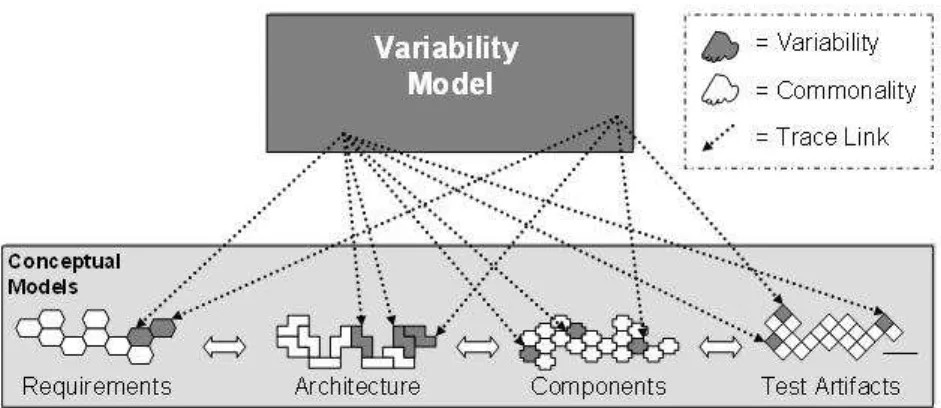
![Figure 3.4: SPLE Framework (simplified version of the one in [115])](https://thumb-us.123doks.com/thumbv2/123dok_us/10132605.2914206/57.892.195.719.124.590/figure-sple-framework-simplified-version.webp)