Volume 3, No. 3, May-June 2012
International Journal of Advanced Research in Computer Science
RESEARCH PAPER
Available Online at www.ijarcs.info
ISSN No. 0976-5697
Low-dimensional shape index using color feature for Content-based image retrieval
Rohini H. Kale
Postgraduate Student, Department of Computer Sci. & Engg Sipna College of Engineering & Technology, Amravati
Amravati., MS, India [email protected]
Dr.S.A. Ladhake Principal,
Sipna College of Engineering & Technology, Amravati Amravati., MS, India,
Abstract: A low-dimensional shape based indexing technique is used for achieving efficient and effective retrieval performance. This paper present a simple index based on shape features of regions that are segmented out of images based on color. A new shape similarity measure conforming to human perception is applied and shown to be effective. Low-level visual features like color, shape, texture, etc are being used for representing and retrieving images in many Content-Based Image Retrieval systems. Generally such methods suffer from the problems of high dimensionality leading to more computational time and inefficient indexing and retrieval performance.
Images are segmented to obtain homogeneous color regions that are dominant and similar images form an image cluster stored in a hash structure. Each region within an image is then indexed by a region-based shape index. The shape index is invariant to translation, rotation and scaling. The retrieval performance is studied and compared with that of a region-based shape-indexing scheme.
Keywords: Content-Based Image Retrieval, low-dimensional, Color based image.
I. INTRODUCTION
The past few years have seen many advanced techniques evolving in Content- Based Image Retrieval (CBIR) systems and proven to be very useful in many fields to browse and search very huge image databases [19]. Applications like art, medicine, entertainment, education, manufacturing, etc. make use of vast amount of visual data in the form of images. This envisages the need for fast and effective retrieval mechanisms in an efficient manner.
A major approach directed towards achieving this goal is to use low-level visual features of the image data to segment, index and retrieve relevant images from the image database. Recent CBIR systems based on features like color, shape, texture, spatial layout, object motion, etc., are cited in [1, 2]. Of all the visual features, color is the most dominant and distinguishing one in almost all applications. The approach is to segment out prominent regions in the image based on color and pick out their features.
In a typical CBIR, features related to visual content such as shape, color, and texture are first extracted from a query image, the similarity between the set of features of the query image and that of each target image in a DB is then computed, and target images are next retrieved which are most similar to the query image. Extraction of good features which compactly represent a query image is one of the important tasks in CBIR.
CBIR is a technique that utilizes the visual content of an image, to search for similar images in large-scale image databases, according to a user’s interest. The CBIR problem is motivated by the need to search the exponentially increasing space of image and video databases efficiently and effectively. The visual content of an image is analyzed in terms of low-level features extracted from the image.
A fairly new branch in information retrieval is content based image retrieval (CBIR). CBIR is, as the name implies,
the science of how we can index and retrieve images based on its contents. The reason for this being a new science is probably due to increased hardware performance, which had made it possible to use images on a much larger scale than before. An image consists of different materials than textual documents. Textual documents consists of terms, phrases and, with some extensions; hyperlinks.
Low-level visual features like color, shape, texture, etc are being used for representing and retrieving images in many Content-Based Image Retrieval systems. Such methods suffer from the problems of high dimensionality leading to more computational time and inefficient indexing and retrieval performance. So, here focus on a low-dimensional shape based indexing technique for achieving efficient and effective retrieval performance. This report present a simple index based on shape features of regions that are segmented out of images based on color. A new shape similarity measure conforming to human perception is applied and shown to be effective. Region-oriented segmentation techniques use not only color information but also the pixel relationships to partition an image into some regions, which are usually continuous. Hence our hierarchical region segmentation bases on region growing segmentation [17].
773
II. LITERATURE REVIEW
a. Literature on CBIR- Current CBIR systems such as
IBM's QBIC [3] allow automatic retrieval based on simple characteristics and distribution of color, shape and texture. But they do not consider structural and spatial relationships and fail to capture meaningful contents of the image in general. Also the object identification is semi-automatic. The Chabot project [4] integrates a relational database with retrieval by color analysis. Textual meta-data along with color histograms form the main features used. Visual SEEK [5] allows query by color and spatial layout of color regions. Text based tools for annotating images and searching is provided. A new image representation that uses the concept of localized coherent regions in color and texture space is presented by Chad Carson et al. [6]. Segmentation based on the above features called ``Blobworld'' is used and query is based on these features. Some of the popular methods to characterize color information in images are color histograms, color moments [8] and color correlograms [9]. Though all these methods provide good characterization of color, they have the problem of high-dimensionality. This leads to more computational time, inefficient indexing and low performance. To overcome these problems, use of SVD [7], dominant color regions approach [10, 11] and color clustering [12] have been proposed.
b. Shape-base d CBIR- Shape is an important feature for
perceptual object recognition and classification of images. Shape description or representation is an important issue both in object recognition and classification. Many techniques such as chain code, polygonal approximations, curvature, fourier descriptors, radii method and moment descriptors have been proposed and used in various applications. Recently, techniques using shape measure as an important feature have been used for CBIR. Features such as moment invariants and area of region have been used in [3,13], but do not give perceptual shape similarity. Cortelazzo used chain codes for trademark image shape description and string matching technique. The chain codes are not normalized and string matching is not invariant to shape scale. Jain and Vailaya [5 proposed a shape representation based on the use of a histogram of edge directions. But these are not normalized to scale and computationally expensive in similarity measures. Mehrotra and Gary [15] used coordinates of significant points on the boundary as shape representation. It is not a compact representation and the similarity measure is computationally expensive. Jagadish’s proposed shape decomposition into a number of rectangles and two pairs of coordinates for each rectangle are used to represent the shape. It is not rotation invariant.
c. A region- based shape representation and indexing
scheme that is translation, rotation and scale invariant is proposed by Lu and Sajjanhar [16]. It conforms to human similarity perception. They have compared it to Fourier descriptor model and found their method to be better. But, the images database consists of only 2D planar shapes and
they have considered only binary images. Moreover, shapes with similar eccentricity but different shapes are retrieved as matched images. Our aim is to extend this method on color images and also to improve efficiency and effectiveness in retrieval. We segment out color image regions from images using dominant colors [11] and apply shape indexing to retrieve images based on shape features. Our shape indexing feature and similarity measure is different and shown to be effective in retrieval compared to the measure used in [16].
III. COLOR AND SHAPE FEATURES
The initial step in our approach is to segment images into regions based on dominant colors [11]. Image regions thus obtained after segmentation are used as input to the shape module. The region-based shape representation proposed in [16] is modified to calculate the shape features required for our proposed shape indexing technique and similarity measure. It is simple to calculate and robust. We show that the retrieval effectiveness is better compared to the method in [16].
A. Color segmentation approach:
To segment images based on dominant colors, a color quantization in RGB space using 25 perceptual color categories is employed [11]. From the segmented image one can find the enclosing minimum bounding rectangle (MBR) of the region, its location, image path, number of regions in the image, etc., and all these are stored in a metafile for further use in the construction of an image index tree.
B. Color Space Categorization:
The entire RGB color space is described using a small set of color categories that are perceptual to humans. This is summarized into a color look-up table as depicted in table 1. A smaller set is more useful since it gives a coarser description of the color of a region thus allowing it to remain same for some variations in imaging conditions. The taken a table of 25 perceptual colors chosen from the standard RGB color palette table 1.
Table I. Color look-up table
C. Color matching and region selection:
The method relies on the fact that boundaries where perceptual color changes occur must be found before any cluster in color space can be interpreted as corresponding to a region in image space. The RGB color space is partitioned into subspaces called color categories. The perceptual color of a pixel can be specified by the color category into which it maps.
The procedure below segments the image into regions according to their perceived color. It involves mapping all pixels to their categories in color space, and grouping pixels belonging to same category. A color will be selected from 25 predefined colors which is very near to image pixel color and it will be stored as new color pixel in the image. Using p the image pixel value and C the corresponding entry in the color table, Color distance Cd is calculated using Euclidean distance formula and is as specified in the equation below:
Region marking is done on updated image. A boundary rectangle is drawn on each dominant region selected. The area of boundary rectangle is used in determining normalized area of dominant region. Then the location of the region is determined. Image path, number of regions present, each region’s information like color, normalized area and location are stored in a meta-file for further processing. This file information is used for constructing Image index tree. When the search engine is initiated, index tree is constructed.
D. Steps involved in segmentation and boundary detection:
Read the image and creates an image array that contains the RGB components of each pixel in the image.
a. For each pixel in the image do:
a) Search color-look-up-table for the nearest color by finding the distance between the pixel color (I) and the color in the color-lookup-table (C) using the distance formula D given below.
b) Assign RGB components of color look-up table to the pixel whose distance D is minimum. Determine color response of each color in modified image and store them in frequency table. Sort the frequency table in descending order.
Determine the first occurrence of a pixel that has the same RGB value as in the sorted frequency table.
Assign the pixel location to horizontal and vertical seeds viz: iseed, jseed.
Following iseed and jseed, mark the entire region using 8-connected neighboring region growing method.
Obtain (x,y) co-ordinates of boundary of marked region. Determine normalized size r(R) of bounding rectangle using:
Where x1, x2, y1, y2 are x and y coordinates of bounding rectangle and if the Normalized size r(R) > T only then
consider the region as dominant region, where T is a threshold for dominance.
b. Repeat steps 3 to 7 till three dominant regions are
found:
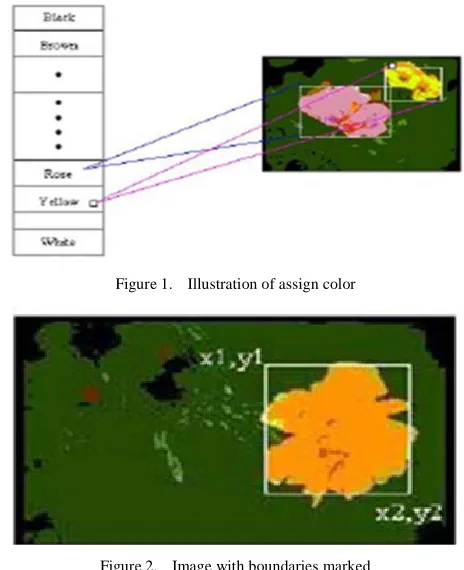
The illustration of segmentation and boundary detection is shown in figure 1 and figure 2.
Figure 1. Illustration of assign color
Figure 2. Image with boundaries marked
Finding location of the region- The image space is divided into 9 sub locations. The approximate position of the region is determined. User can specify the location of the region in his query to retrieve the images from the database. The classification is according to a location map containing 9 regions of the image space. An illustration of find location is shown in figure 3.
Figure 3. Illustration of find location
775
Determine four corners of the location named as “center” in location map using
X1 = imgwidth/3, & Y1 = imgheight/3
X2 = 2 * imgwidth/3, & Y2 = imgheight/3 X3 = imgwidth/3, & Y3 = 2 * imgheight/3 X4 = 2 * imgwidth/3, & Y4 = 2 * imgheight/3
Determine the approximate position of the region by comparing coordinates of the bounding rectangle with the above coordinates.
The extracted dominant region features viz., color, area and location are stored in a sequential file. Image database is constructed by processing all images off-line as this saves query-processing time. When a query is made based on an example image, only the example image is processed for extracting region features.
IV. SHAPE REPRESENTATION
A. Definitions of terminology:
a. Major axis:
It is the straight line segment joining the two points on the boundary farthest away from each other (in case of more than one, select any one).
b. Minor axis:
It is perpendicular to the major axis and of such length that a rectangle with sides parallel to major and minor axes that just encloses the boundary can be formed using the lengths of the major and minor axes.
c. Basic rectangle:
The above rectangle formed with major and minor axes as its two sides is called basic rectangle.
d. Eccentricity:
The ratio of the major to the minor axis is called eccentricity of the region.
e. Centroid/Center of gravity:
A single point of an object/region towards which other objects/regions are gravitationally attracted. For 2D shapes, the coordinates (Xc,Yc) of the centroid are defined as:
Where (x,y) are pixel coordinates and f(x,y) is set to 1 for points within or on the shape and set to 0 elsewhere.
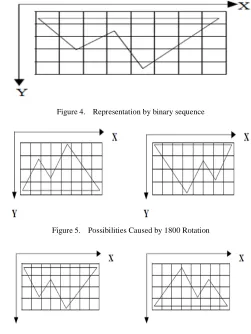
Basic idea- Given a shape region, a grid space consisting of fixed-size square cells is placed over it so as to cover the entire shape region as shown in figure 4. We assign a "1" to cells with at least 25% of pixels covered and "0" to each of the other cells. A binary sequence of 1's and 0's from left to right and top to bottom is obtained as the shape feature representation. For example, the shape given in figure 4 can be represented by a binary sequence 11111111 11111110 01111110 00001100 00000000.
The smaller the grid size, the more accurate the shape representation is and more the storage and computation
requirements. The representation is compact, easy to obtain and translation invariant. Hence, a scale and rotation normalization is carried out to make it invariant to scale and rotation.
B. Rotation normalization-
The purpose of rotation normalization is to place shape regions in a unique common orientation. Hence the shape region is rotated such that its major axis is parallel to the x-axis. There are still two possibilities as shown in figure 5 caused by 180o rotation. Further, two more orientations are possible due to the horizontal and vertical flips of the original region as shown in figures 6 respectively. Two binary sequences are needed for representing these two orientations. But only one sequence is stored and at the time of retrieval we can account for these two sequences.
Figure 4. Representation by binary sequence
Figure 5. Possibilities Caused by 1800 Rotation
Figure 6. Possibilities Caused by horizontal and vertical flips.
C. Scale normalization:
To achieve scale normalization, we proportionally scale all the shape regions so that their major axes have the same length of 96 pixels.
D. Shape index:
both the row and column totals of the 8x8 grid and store them as our shape index, which is more robust and gives a better perceptual representation to the coverage of the shape. A suitable shape similarity measure using this index is employed for matching images at query time.
V. INDEXING SCHEME AND RETRIEVAL PROCESS
A. Unique Shape Index:
For each color region processed above, we compute the shape descriptor as follows:
a. Compute the major and minor axes of each color region. b. Rotate the shape region to align the major axis to X-axis to achieve rotation normalization and scale it such that major axis is of standard fixed length (96 pixels). c. Place the grid of fixed size (96x96 pixels) over the
normalized color region and obtain the binary sequence by assigning 1's and 0's accordingly.
d. Using the binary sequence, compute the row and column total vectors. These along with the eccentricity form the shape index for the region
B. Querying:
Given a query image, we apply the same process on the query image to obtain the color and shape features. The shape matching module supports Query-by-example. Based on color, the query image is segmented to obtain homogeneous regions. Then the shape descriptors of these regions are used to find matching images in the image database to retrieve the final images that match on the shape features. The query process is as follows:
a. The query image is processed to obtain a segmented image giving at most three dominant regions.
b. For each region in the query image, the shape representation of each region is evaluated. To take care of the problem of 180o rotation and vertical and horizontal flips, we need to store 4 sets of the shape index.
c. Compare the shape index of regions in the query image to those in the list of image database matching on shape index.
d. Regions with only matching eccentricity within a threshold (t) are compared for shape similarity.
e. The matching images are ordered depending on the difference in the sum of the difference in row and column vectors between query and matching image.
C. Similarity Measure:
Let R and R' represent the row vectors of test image and query image respectively. Similarly, C and C' represent the column vectors of the test image and query image respectively. The similarity measure is computed as follows:
a. Calculate the row and column vectors of all regions segmented out in the query image.
b. Find the row and column difference between query image regions and regions in the image to be tested using the equation:
Where Rd and Cd are the row and column differences between the test image and query image region, Ri and Ci are the ith bit of row and column vectors in image and R'i and C'i are the ith bit of row and column vectors in the query image.
c. If (Rd + Cd) < T (threshold), then the images match. The shapes features of the segmented regions are used to obtain a unique shape index for each region in every image. In the query phase, image regions of query image are segmented out using color and then similar images are retrieved on the basis of shape index.
The retrieval performance is measured using recall and precision, as is standard in all CBIR systems. Recall measures the ability of retrieving all relevant or similar items in the database. It is defined as the ratio between the number of relevant or perceptually similar items retrieved and the total relevant items in the database. Precision measures the retrieval accuracy and is defined as the ratio between the number of relevant or perceptually similar items and the total number of items retrieved.
VI. CONCLUSION
A shape based low-dimensional indexing technique has been implemented. Images are segmented into dominant regions based on perceptually similar color regions using a color quantization technique. Such segmented out regions are stored in a hash structure as similar image clusters. Shape features of these regions are used to prune the retrieval of images from a sample image database.
The shape representation is based on a grid-based coverage of the region that is normalized to achieve invariance in scale, rotation and size. The index is a robust one. Our proposed index based on row and column vectors and the related similarity measure is shown to provide an efficient and effective retrieval performance.
VII. REFERENCES
[1]. Gudivada,. V. N. and Raghavan, V. V., 1995, Special issue on content-based image retrieval systems - guest eds., IEEE Computer, Vol. 28, No. 9, pp. 18-22.
[2]. Marsicoi, M. De., Cinque, L. and Levialdi, S., 1997, Indexing pictorial documents by their content: a survey of current techniques, Image and Vision Computing, Vol. 15, No. 2, pp. 119-141.
[3]. Flickner, M., 1995, Query by image and video content: the QBIC system, IEEE Computer, Vol. 28, No. 9, pp. 23-32.
[4]. Ogle, V. E. and Stonebaker, M., 1995, Chabot: Retrieval from a relational database of images, IEEE Computer, Vol. 28, No. 9, pp. 40-48.
777
[6]. Carson, C., 1997, Region-based image querying, Workshop on Content-based Access to Image and Video libraries, CAIVL'97.
[7]. Hafner, J., 1995, Efficient color histogram indexing for quadratic form distance functions, PAMI, Vol. 17, No.7, pp. 729-736.
[8]. Stricker, M. and Dimai, A., 1996, Color indexing with weak spatial constraints, Proceedings of SPIE Storage and Retrieval of Still Image and Video Databases IV, pp. 29-40.
[9]. Huang, J., 1997, Image indexing using color correlograms, Proceedings of CVPR, pp. 762-768.
[10]. Zhang, H.,1995, Image retrieval based on color features: an evaluation study, Proceedings of SPIE, pp. 212-220.
[11]. Ravishankar, K. C., Prasad, B. G., Gupta, S. K. and Biswas, K. K., 1999, Dominant Color Region Based Indexing Technique for CBIR, Proceedings of the International Conference on Image Analysis and Processing, ICIAP'99, Venice, Italy, pp. 887-892.
[12]. Wan, X. and Kuo, C. J., 1998, A multi-resolution color clustering approach to image indexing and retrieval, Proceedings of ICASSP.
[13]. Mohamad, D., Sulong, G. and Ipson, S. S., 1995, Trademark Matching using Invariant Moments, Second Asian Conference on Computer Vision, 5-8 Dec., Singapore.
[14]. Jain, A. K. and Vailaya, A., 1995, Image Retrieval using Color and Shape, Second Asian Conference on Computer Vision, 5-8 Dec., Singapore, pp. 529-533.
[15]. Mehrotra, R. and Gary, J. E., 1995, Similar-Shape Retrieval in Shape Data Management, IEEE Computer, Vol. 28, No. 9, pp. 57-62.
[16]. Lu, G. and Sajjanhar, A., 1999, Region-Based Shape Representation and Similarity Measure Suitable for Content-Based Image Retrieval, Multimedia Systems, No. 7, pp. 165-174.
[17]. Fuh, Chiou-Shann, Cho, Shun-Wen and Essig, Kai, 2000, Hierarchical Color Image Region Segmentation for Content-Based Image Retrieval System, IEEE-Transactions On Image Processing, VOL. 9, NO. 1, pp.156-162.
[18]. Chun, Young Deok , Kim, Nam Chul and Jang, Ick Hoon, 2008, Content-Based Image Retrieval Using Multiresolution Color and Texture Features, IEEE-Transactions On Multimedia, Vol. 10, No. 6, pp. 1073-1083.