Biometric Door Lock System Using MQTT
Protocol
Hingolikar Smita Chandulal 1, Patange A.D 2
P.G. Student, Department of Electronics & Telecommunication Engineering, Shri Shivaji Institute of Engineering &
Management Studies, Parbhani, India1
Department of Electronics & Telecommunication Engineering (HOD), Shri Shivaji Institute of Engineering &
Management Studies, Parbhani, India2
ABSTRACT: Security has dependably been a major concern for the family units and the office environment, and for this concern different methodologies are set up to address this issue. The vast majority of the real door lock security frameworks have a few loopholes which could be separated to access the desired places, and it makes a concern for a safe way of life and appropriate workplace. Also, terrorism and unauthorized access to places have turned into a major issue now-a-days, and there is a requirement for a protected framework to avoid unauthorized access to particularly in shared access condition. With this thought, an outline and model of a biometric fingerprint based door lock system has been presented in this paper. Biometric frameworks, for example, fingerprint provides tools to authorize dependable logs of framework exchanges and ensure a person's right to privacy. The RFID card based door lock components can easily be compromised when the RFID card is stolen, therefore for offices with shared access require biometric based secure framework. In the proposed framework, fingerprints of the authorized clients are enlisted and checked to give access to an office that is utilized by numerous clients. A client can likewise be removed and another client can be enrolled in the framework. We have executed a centralized control framework from where we can control who can go into in which rooms and who can't.
KEYWORDS: Fingerprint, Bio-metric device, Fingerprint sensor, Security System, Door Lock, Authorization.
I. INTRODUCTION
Now a day’s office/professional workplace security is a major risk looked by each person when far from home or at the home. With regards to security systems, it is one of the essential concerns in this busy competitive world, where human can't discover approaches to give security to his secret things physically. Rather, He finds an elective arrangement which gives better, dependable and atomized security. This is a period where everything is associated through system, where anybody can get hold of data from any place around the globe. In this chances of one's data being hacked are a significant issue. Because of these dangers it's imperative to have some sort of individual ID to get to one's own particular information. Now a day's personal identification is turning into a vital issue all around. Among standard individual ID strategies we mostly see secret key and identification cards procedures. But, it is easy to hack password now and identification cards may get lost, in this way making these strategies very problematic. There are sure circumstances which are exceptionally irritating like when a man keeps himself out of his home or office or he leaves his key inside or here and there when a criminal just breaks the lock and takes everything. These sorts of circumstances dependably inconvenience individuals who utilize manual door locks with keys.
smart cards. That is the point at which our framework, fingerprint based lock framework becomes an integral factor. Our plan is implemented to give better securities as clients needn't bother with any kind of keys or cards that frequently get lost. If somebody's fingerprint is approved in the framework he would not confront any kind of delay to go into a room. Fingerprint acknowledgment is one of the most secure framework because finger impression of one individual never co-ordinates with the others. In this manner unauthorized access can be limited by planning a lock that stores the fingerprints of at least one authorized clients and open the lock when a match is found. Bio-metrics authorization proves to be one of the best traits because the skin on our palms and soles exhibits a flow like pattern of ridges on each fingertip which is unique and permanent. This makes fingerprint a unique identification for everybody. The prominence and unwavering quality on fingerprint scanner can be effectively speculated from its utilization in late hand-held gadgets like cell phones and workstations.
II. RELATEDWORK
Fingerprint sensor gets the fingerprint images, checks the uniqueness of each print read by the sensor and compares it to the one stored in its module or local system database. If match is found then door will be open & client get message on android device (using MQTT protocol). A wide variety of systems needs unfailing personal recognition methods to either confirm or determine the identity of an individual requesting their services. The purpose of such methodologies is to ensure that the view services are accessed only by a valid user and no one else. Examples of such application comprise secure access to buildings, computer systems, laptops, cellular phones, and ATMs. In the non presence of strong personal recognition schemes, these systems are susceptible to the wiles of an impostor. Biometric detection or, simply, biometrics refers to the automatic recognition of persons based on their physiological and/or behavioral character. By using biometrics, it is possible to authenticate or set up an individual’s identity based on “who she is,” rather than by “what she possesses” (e.g. an ID card) or “what she remembers” (e.g. a password) [1].
Fingerprint checking has been effectively used by law enforcement for more than a century. The expertise is now discovering many other applications such as identity management and access control. The authors describe an automated fingerprint recognition system and identify key challenge and investigate opportunities in the field [4].
Perhaps the most significant application of correct personal detection is securing limited access systems from malicious attacks. Among all the presently employed biometric techniques, fingerprint recognition systems have expected the most attention due to the long history of fingerprints and their wide use in forensics. It deals with the issue of selection of an optimal algorithm for fingerprint matching in order to design a system that matches required specifications in performance and accuracy. Two competing algorithms were compared against a common database using MATLAB simulations [5].
As for the grassfire spot checking algorithm, it has been initially presented for spot checking in 2-DE. There exist many things in frequent between spot checking in 2-DE and minutiae based fingerprint matching. So, the grassfire algorithm is considered to be applied and work well for minutiae-base fingerprint matching. The grassfire spot checking methodology is described in detail with several literatures related to spot checking in 2-DE. An experiment is performed to present algorithm’s potential possibilities for the field of minutiae-based fingerprint matching. Only position information is used to match minutiae. From the result, nonetheless, can find out it shows great outcome [13].
III.PROPOSEDSYSTEM
allow for large-scale recognition involving millions of identities [1]. This is a perfect solution for defending one from the hassle of stolen/lost key or an illegal entry.
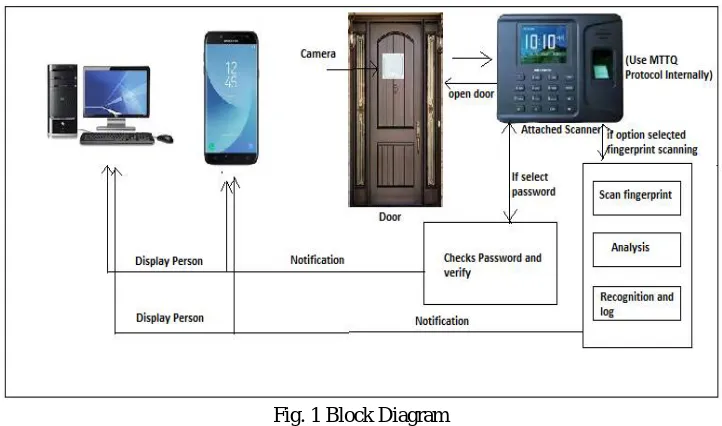
A. Fingerprint based Door Lock: Our proposed fingerprint based lock system is a consistent and very secure lock that will not only make sure safer surroundings but also ease way of life. This system can prove very helpful in housing building, large offices, and universities and so on. Because it offers the effectiveness to add more patterns to the system. Users do not need to develop many systems from scratch. They can simply use our fingerprint lock system because fingerprint scanning is more precise and cost effective method. It is also secure because fingerprint replication is virtually not possible. as well, we have also used password verification system for safety purpose to ensure access to not enrolled people.
Fig. 1 Block Diagram
B. Fingerprint Identification: Fingerprints are one of many forms of biometrics, used to identify persons and validate their identity. The investigation of fingerprints for checking purpose generally requires the comparison of numerous features of the print pattern. These include patterns, which are aggregate character of ridges, and minutia points, which are unique features found within the patterns. It is also essential to know the arrangement and properties of human skin in order to effectively employ some of the imaging technologies [2]. Minutiae and patterns are very important in the investigation of fingerprints since no two fingers have been shown to be the same [8]. There three normal designs of fingerprint ridges are the arch, loop, and whorl. A fingerprint detection system can be used for both authentication and recognition. In authentication, the system matches an input fingerprint to the enrolled fingerprint of a exact user to decide if they are from the same finger (1:1 match).
In identification, the system matches an input fingerprint with the prints of all enrolled users in the record to conclude if the person is already known under a duplicate or false identity (1:N match). Detecting many registrations, in which the same user has multiple credentials such as a passport under different names, need the negative detection functionality of fingerprints. When it came to designing the lock, we wanted to achieve ease in terms of the whole lock itself as well as in the inside mechanism. The lock will be hanging on the wall next to the entrance that will comprise a fingerprint sensor. We have added a buzzer system to inform the usage of the machine and a keypad that can be used to insert a password to allow access in case of the fingerprint bearer is not present. An additional switch is added to the system so that people from the inside can unlock the door.
IV.IMPLEMENTATIONDETAILS
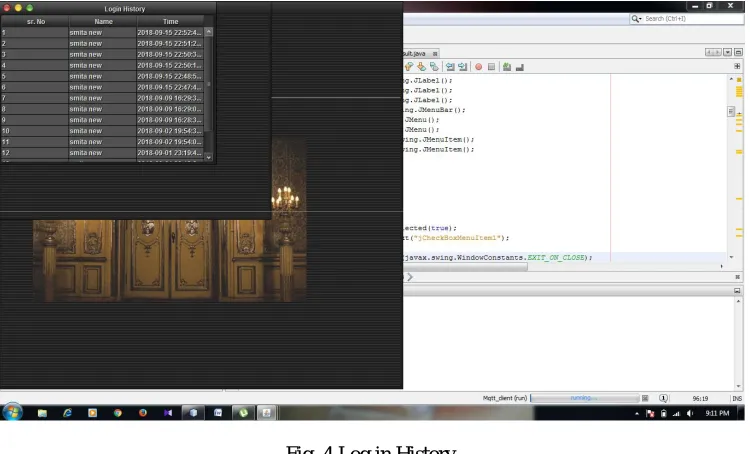
This system is implemented in Java. Which requires JDK 1.8 and Development Environment is Netbeans 8.2. VNC viewer is used for Raspberry pi for handing the python code. All devices are connected to Raspberry pi via linking cable. Fingerprint scanner is used to get finger prints of user and verify based on that. Second approach is password based if authenticated successfully system will open the door. And all notification will be shown on desktop and android device. System is implemented and experimented; shows the efficiency in the result.
Fig.2 System Connection
Fig. 4 Log in History
V. CONCLUSIONANDFUTUREWORK
The plan and execution of fingerprint based lock system is adaptable and flexible. This door locking system is relatively practical than the accessible secure system in the traditional market. Our unique finger impression based lock system has high precision rate and quick to perceive fingerprints which enable consistent integration with the clients and gives more tightly security. In our nation, private and government associations are particularly worried about security. Numerous organizations are occupied with utilizing this sort of locking component yet the system which is accessible have high establishment cost. Because of this extreme cost, numerous little firms can't bear the cost of such systems. Remembering the establishment cost we wanted to build up a framework that ought to be reasonable to both large and little firms. This design can be enhanced by more intensive improvement and extra features, for example, more lock can be added to the system. In this manner we don't have to spend such a great amount for only one lock if this can be utilized to control a few doors. A system to save prints without the utilization of a PC could have been made, however it will require a larger number of parts than the ones we utilized. To maintain security properly, the keypad should be set inside the security room. A system for batteries could likewise be made or even sun powered controlled. One of the fundamental points of interest of this system is its flexibility. A few different systems can be implemented with this framework. The framework is extremely secure. Fingerprints are special and the sensor can recognize the vast majority of the prints during testing. It gives more greater control to access to limited places. There are a few drawbacks of this framework, for example, this framework is costly for a single door and furthermore that it relies upon power. A power failure will make it unworkable. In that case, we can, interface the system with an IPS or add rechargeable batteries to the framework.
REFERENCES
1. Anil K. Jain, Arun Ross and Salil Prabhakar,“An Introduction to Biometric Recognition”, IEEE Transactions on Circuits and Systems for Video Technology, Special Issue on Image and Video Based Biometrics, Vol. 14(1), January, 2004.
2. Mrs. S. Mali, Mr. J. A. Shaikh, “Fingerprint based authentication and security system using GSM and GPS technology”, International Journal of Engineering Trends and Technology (IJETT) – Volume 45 Number March 2017.
3. R. P. Wildes. Iris recognition: an emerging biometric technology. Proceedings of the IEEE, vol. 85, no. 9, pp. 1348-1363, September, 1997 4. Anil K. Jain, Jianjiang Feng and Karthik Nandakumar. Matching Fingerprints. IEEE Computer, 43(2), pp. 36-44, February, 2010.
6. Zevdin Pala and Nihat Inanc. Smart Parking Applications Using RFID Technology. 1st Annual RFID Eurasia, Istanbul, 2007, pp. 1-3. 7. D. Vinod kumar and M R K Murthy. Fingerprint Based ATM Security by using ARM7. IOSR Journal of Electronics and Communication
Engineering(IOSRJECE), Volume 2(5), October 2012, PP 26-28..
8. Raffaele Cappelli, Alessandra Lumini, Dario Maio and Davide Maltoni. Fingerprint Image Reconstruction from Standard Templates. IEEE Trans. Pattern Analysis and Machine Intelligence, 29(9), pp. 1489-1503. September 2007.
9. Ross J. Anderson. Security Engineering: A Guide to Building Dependable Distributed Systems, 2nd edition, 2008.
10. Fernando L. Podio. Personal authentication through biometric technologies. Proceedings 2002 IEEE 4th International Workshop on Networked Appliances (Cat. No.02EX525), Gaithersburg, MD, 2002
11. Yu-Chih Huang. Secure Access Control Scheme of RFID System Application. Fifth International Conference on Information Assurance and Security, China, 2009.