ADU-GYAMFI, KWAKU. External Multiple Representations in Mathematics Teaching. (Under the direction of Karen S. Norwood.)
An emerging theoretical view on mathematical learning is that utilizing multiple representations in mathematical instruction will empower students during problem
solving and at the same time help students develop deeper understanding of mathematical relationships and concepts. However not everyone in the mathematics education
community shares this view point; some researchers have argued that utilizing multiple representations in mathematics instruction will impair rather than help students to
develop understanding of mathematical relations and concepts. The purpose of the review was to examine and ascertain information from available studies on multiple
representations and to assess whether evidence obtained from the studies supported or refuted the assertion that utilizing multiple representations in mathematics teaching enabled students develop deeper understanding of mathematical relationships and problem solving success.
EXTERNAL MULTIPLE REPRESENTATIONS IN MATHEMATICS TEACHING
by
KWAKU ADU-GYAMFI
A thesis submitted to the Graduate Faculty of North Carolina State University
in partial fulfillment of the requirements for the Degree of
Master of Science
MATHEMATICS EDUCATION
Raleigh 1993
APPROVED BY:
________________________________ _________________________________
BIOGRAPHY
Kwaku Adu-Gyamfi was born to Dr and Mrs Adu-Gyamfi on May 7th, 1971 at Mampong Ashanti (a town in Ghana). He completed his secondary education at Prempeh College in Kumasi (Ghana). He earned his undergraduate degree at the university of Cape Coast where he obtained a Bachelor of Science degree in mathematics and a diploma in education.
TABLE OF CONTENTS Page LIST OF FIGURES………...
I. INTRODUCTION………
Representations ………
Translation ………...
Problem Solving ………... Understanding ………... Multiple Representations ……… Purpose of Review ………
II. LITERATURE REVIEW ………...
Problem Solving ……….... Understanding ……… Representations………...
Multiple Representations………
III. DISCUSSION AND CONCLUSION ……….
Summary ………
Problem solving ……….
TABLE OF CONTENTS (continued)
Page Limitations of the Review ………..
Recommendation ………...
IV. LIST OF REFERENCES ………
47 47
LIST OF FIGURES Page
1.1 Examples of external representations (symbolic, graphical, tabular representations) ………..
1.2Different representations of the linear function, f(x) = 2x-8
………. 5
INTRODUCTION
Reform in the field of mathematics education is deeply rooted in finding ways of empowering students to learn to do mathematics (Thomasenia, 2000). Learning or doing
mathematics involves not only manipulating mathematical symbols; it involves
coordinating and interpreting mathematical relationships and situations using specialized
language, symbols, graphs, or other representations; it also involves clarification of problems, deduction of consequences and development of appropriate tools (National Research Council, 1989). An emerging theoretical view on mathematical learning is that
utilizing multiple representations to make connections between graphical, tabular, symbolic and verbal descriptions of mathematical relationships and mathematical
problem situations during teaching and learning will empower and at the same time help students develop understanding of mathematical relationships and concepts (Hiebert & Carpenter, 1992; Kaput, 1989; National Council of Teachers of Mathematics, NCTM,
2000; Porzio, 1999).
“Multiple representations” (as used in this review) can be defined as, “external
mathematical embodiments of ideas and concepts to provide the same information in more than one form” (Ozgun-Koca, 1998, p.3). For example the concept of rate of change can be viewed as “difference quotients, as slopes of graphs in the coordinate plane, or as
formal algebraic derivatives” (Porzio, 1999, p.1) also, a linear function can be viewed as a set of ordered pairs, a correspondence in a table or a mapping, a graph, or an algebraic
the graph of the function, the table of values corresponding to the function, or from the algebraic relation of the function.
Multiple representations have been a recurring theme in reform curricula. As far
back as the early 1920’s, the National Committee on Mathematical Requirements of the Mathematics Association of America in their reorganization of mathematics report of
1923 recommended that students develop the ability to understand and use different representations to solve algebraic and geometric problems (Bidwell & Clason, 1970, pp. 403-407). During the early 1960’s, Dienes’(1960) suggested that mathematical concepts
and relations be presented in as many different forms as possible in order for students to obtain the mathematical essence of an abstraction (multiple embodiment principle).
Dienes contended that using a variety of representations to develop mathematical concepts maximized students learning.
In the late 1980’s, The National Council of Teachers of Mathematics (NCTM,
1989) published “Curriculum and Evaluation Standards for School Mathematics”, in which they identified multiple representations as one of the key components in the curriculum that needed to be emphasized during the teaching and learning of
mathematics. They noted that students who were able to translate within and among multiple representations of the same problems or of the same mathematical concepts
would have flexible tools for solving problems and a deeper appreciation of the
consistency and beauty of mathematics (NCTM, 1989). Driscoll (1999) in a similar vein contends that fluency in linking and translating among multiple representations of
In the recently published “Principles and Standards for School Mathematics” (NCTM, 2000) there is a call for all students to be able to:
• create and use representations to organize record and communicate mathematical
ideas;
• select, apply and translate among mathematical representations to solve problems;
• use representations to model and interpret physical, social, and mathematical
phenomena; (NCTM, 2000, p.67)
Over the years, different researchers have acknowledged the significance and
importance of multiple representations in school mathematics (Kaput, 1989; Brenner, 1997; Porzio, 1999). Dufour-Janvier, Berdnaz and Belanger (1987) argue that multiple representations needs to be used in mathematics instruction because they are an inherent
part of mathematics, they can give multiple concretizations of a concept, and can help decrease certain difficulties students have during problem solving. Mayer & Hegarty
(1996 as cited in Brenner et al., 1997) suggests that mathematics teaching and learning should proceed through four stages: a) using a single representation; b) using more than one representation; c) making links between the different representations; d) integrating
and flexibly switching among the different representations.
Opponents of multiple representations however argue that the use of multiple
representations in teaching will not enhance students understanding of concepts but rather may impair their understanding and limit their problem solving ability (e.g. Tabachneck, Leonardo & Simon, 1994). Thus, there is a need for research evidence to support or
develop a better understanding of concepts and enables them become better problem solvers.
Definition of key terms
In this section, an explanation of some of the key terms likely to be encountered in the review is given.
Representations
Before the term “multiple representations” can be explained, a description of what
representation(s) is (are) must be given. Representations are means by which individuals make sense of situations (Kaput, 1989). They may be a combination of something written
on paper, something existing in the form of physical objects, or a carefully constructed arrangement of ideas in ones’ mind. Representations could be classed as either external or internal.
External representations refer to the physically embodied, observable
configurations such as graphs, equations and tables (Goldin & Kaput 1996). Examples of
external representations include verbal representations (written words), graphical representations (Cartesian graphs), algebraic or symbolic representations (equations expressing the relationship between two or more quantities), pictorial representations
(diagrams or drawings) and tabular representations (table of values) among a host of others. External representations enable us to talk about mathematical relations and
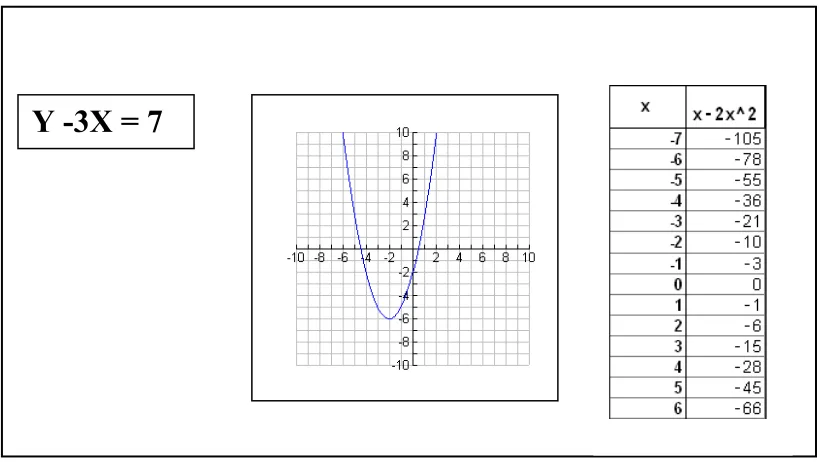
Y -3X = 7
reasoning (Zhang, 1997). External representations are easily accessible to observation by any one with suitable knowledge and can be easily exhibited or communicated to other people (Fig 1.1 shows some of the examples of external representations).
Fig 1.1 Examples of external representations (equation, graph, table)
Internal representations are mental images corresponding to internal formulation of what we see around us (reality). They are the knowledge and structure in memory
(Zhang, 1997). They refer to possible mental configurations of individuals (learners or problem solvers) which are constructed (arrived) by them from the observation of
behavior (including verbal and mathematical behavior) (Goldin & Kaput, 1996). Internal
representations cannot be easily shown or communicated to other people they can only be inferred based on the production of external representations. For example, the only way
Both internal and external representations act hand in hand during teaching and learning to facilitate understanding of concepts. For example, when a student draws a diagram or writes a formula to describe what he or she is thinking, the external
representations (diagrams) used by the student can be thought of as representing his or her internal representations. Similarly when a student formulates a mental picture of
operations described in an arithmetic formula, the internal representations (mental picture) of the student may be thought of as representing the external representation (arithmetic formula) produced by the student. It is this two-way interaction between
internal and external representations that helps promotes understanding and development of mathematical concepts (Zhang, 1997). For the purpose of this review the term
representations would be limited to its’ external category.
Translation
“Translation” is a term that derives from the idea of multiple representations. Translation refers to the psychological processes involved in going from one form of representation to another, for example in going from an equation to a graph and vice
versa (Janvier, 1987). A translation always involves two forms of representations (e.g. graphs and tables or equations and tables).
Driscoll (1999) notes that:
• One characteristic of a successful problem solver is his or her ability to translate
• Translating among tables, equations, and graphs for functions (multiple
representations of functions) makes it possible for students to understand some
key connections among respectively, arithmetic, algebra and geometry (Davis, 1987 as cited in Driscoll, 1999).
• Translating among different representations for functions makes it
possible for students to construct a more integrated meaning for key
concepts such as slopes and intercepts (Eisenberg, 1992 as cited in Driscoll,
1999).
Research indicates that one's ability to translate within and among different
representations of mathematical concepts is essential in developing ones mathematical and problem solving competence (Lesh, 1979; Bell, 1979 as cited in Janvier, 1987). Dreyfus and Eisenberg (1996) argue that flexibility in translating across representations is
a hallmark of competent mathematical thinking. Proponents of multiple representations argue that by using multiple representations in instruction, students will be exposed to
different representations of mathematical concepts and as a result gain the ability to translate within and among the different representations and use these translations as a means to facilitate their mathematical understanding and problem-solving ability.
Greeno and Hall (1997) suggest that mathematics problem-solving competency depends on one's ability to think in terms of different representational systems and
translate among the different representations during problem solving. Researchers like Cifarelli (1989) contend that capable problem solvers "construct appropriate problem representations in problem solving situations, and use these representations as aids for
suggestions give an indication of a link between problem solving success and representations.
Problem Solving
Problem solving as defined by Polya (1945) is the process whereby an individual
engages in a search for the means to attain a clearly conceived but not immediately attainable end. Problem solving has been identified as an important part of doing
mathematics. NCTM (1980) in Agenda for Action indicated that problem solving should be a focus of school mathematics. In recent years, NCTM (1989, 2000) notes that
centering mathematical instruction on problem solving can help all students learn key
concepts and skill within mathematical contexts. Despite all the importance ascribed to problem solving in mathematics, it continues to be an area of great difficulty and failure
for most students.
Driscoll (1999) argues that in order for students to be successful during problem solving, they need to develop problem representation skills along side their symbolic
manipulation skills. Problem representation skills as noted by Brenner et al. (1997) includes skill at constructing and using mathematical representations in words, graphs,
tables, and equations, it also includes skill at selecting and using representations in solving problems. Symbolic manipulation skills on the other hand include skill at being able to carry out arithmetic and algebraic procedures during problem solving situations
(Brenner et al. 1997). Mathematical instruction have over the years focused more on students symbolic manipulation skills at the expense of their problem representation
order for students’ to eliminate their difficulties and achieve success during problem solving, the instruction they experience should help them build up both problem representation and symbolic manipulation skills.
Understanding
The term “understanding” has a lot of different interpretations and meanings. For the purpose of this review, we shall adopt the notion of understanding proposed by Behr, Lesh & Post. Behr, Lesh & Post (1985 as cited in Janvier, 1987) argue that a student who
understands an idea is one who can recognize the idea in a variety of different
representations; can flexibly manipulate the idea within given representations; and can
translate the idea from one representation to another.
For example, a student who understands how the inputs of given functions relates to their outputs is one who can:
• Recognize the relation between inputs and outputs in the graphs of the
functions, the tables of the functions and the equations (formal algebraic
relation) of the functions.
• Obtain the outputs corresponding to given inputs using the graphs, the
tables and equations of the functions.
• Form tables of inputs and outputs using only the graphs of the functions or
equations of the functions and vice-versa.
In this context, understanding is characterized by the development and
forging of connections within and between different representations of the same mathematical idea or concept.
Multiple Representations
As already defined, multiple representations entails the use of different
representations (e.g. graphs, tables, equations, diagrams) at the same time. For the purpose of this review, using multiple representations in teaching will entail at least two processes, they are:
• representing relationships or concepts in more than one way;
• translating within and among the different representations to develop
understanding;
For example in using multiple representations to teach the concept of linear functions:
• Different representations of functions (e.g. graphs, tables, and equations) may be
used to illustrate some of the key features of functions such as; how input is related to output in the equation, graph or table of a function; how to get the domain or range of a function from a table, graph or equation of the function.
• Connections between the different representations can then be made by translating
within and among the different representations. For example; finding the equation
of a given function using it’s graph, or it’s table; determining the maximum value of a given algebraic function by using the graph or table of the function; using the
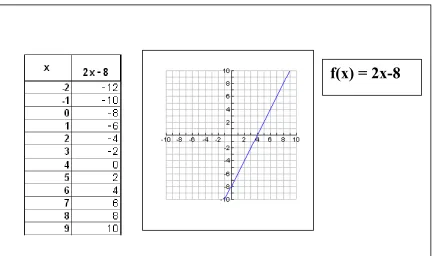
Fig 1.2 gives an illustration of the idea of multiple representations of the same concept (linear functions).
Fig 1.2 Multiple representations of the linear function, f(x) = 2x-8
Different researchers have identified potential advantages of multiple
representations in mathematics instruction. Kirler & Hirsch (1998) argue that multiple representations are advantageous because they provide students with multiple ways of
looking at and understanding concepts and facilitate “cognitive linking of
representations” (p. 1). De Jong et al (1998) contend that multiple representations need to
be used in mathematics instruction because, the information that students learn has varied characteristics and that the use of representations in sequence would be beneficial for the learning process. They also argue for the use of multiple representations in instruction
because, the possession and coordinated use of multiple representations of concepts has been seen as an indication of understanding or expertise with the concept.
Dufour-Janvier, Berdnarz & Belanger (1987) argue that the use of multiple
representations in instruction may enable students to construct their knowledge of concepts based on the diverse representations of the concept given. They further argue
that using multiple representations in instruction will help students to reject a representation in favor of another (with reasons), pass on from one representation to another knowing the limitations and effectiveness of each one and select appropriate
representations for solving given problem situations.
These potential advantages identified with the use of multiple representations
have led proponents of multiple representations (e.g. Hiebert & Carpenter, 1992; Porzio, 1999) to the view that using multiple representations in instruction would enable learners to benefit from the properties of each representation and lead them to a deeper
understanding of mathematics. Not everyone however shares these views; critics of multiple representations argue that students face difficulties even when working with one representation of a relation or concept, thus using multiple representations in instruction
would end up compounding rather than easing their difficulties.
Purpose of review
In Ghana, where I attended school from childhood through to completing my undergraduate degree, the type of instruction I received was one which emphasized the
imparter of knowledge. Students were required to develop expertise in the use of the preferred representation in order to succeed in the mathematics classrooms.
In the course of my years of study in the United States, I experienced some
methods of instruction that were quite different from what I was accustomed to in Ghana. Some of these included the use of technology to enhance mathematics teaching and
learning, the use of open-ended exploration or activities in developing mathematical understanding, and the use of classroom discourse in developing mathematical
understanding. The common underlying factor in all these modes of instruction was the
use of multiple representations. Coming from a background where mathematical instruction is centered on expertise in the use of a single or teacher preferred
representation, this represented a new and intriguing experience for me. My experiences with multiple representations has however shown me that using multiple representations in instruction has its advantages and its’ inherent disadvantages.
The purpose of this review is to investigate the impact the use of multiple representations (in mathematics teaching) will have on students in their ability to solve mathematical problems and in their understanding of mathematical relationships and
concepts. The main question this review will seek to address is:
• Does utilizing multiple representations in mathematics instruction help students
CHAPTER TWO
REVIEW OF RELATED LITERATURE
Studies on multiple representations were obtained from published and unpublished research articles (e.g., journal articles), doctoral dissertations, and
publications in the library. These studies formed the basis of the review. Because of the distinctly diverse scope of some of these studies, there was the need to select only those
studies conforming to the focus of the review.
The first criterion used for the selection was to include only those studies (on multiple representations) dealing with either “problem solving “or “understanding” in
mathematics (or both) and drop studies dealing with other aspects of multiple representations. The second criterion used was to select only those studies providing
evidence to either support or oppose the use of multiple representations (as opposed to traditional methods) in instruction. Thus, studies finally selected for inclusion in the review were mostly studies examining the effect the use of multiple representations in
instruction will have on students in their success during problem solving or in their understanding of mathematical relations and concepts. This chapter provides a
description of the selected studies.
The chapter is divided into two main sections. These sections are further divided into a series of subsections. The divisions and subdivisions were done with the focus of
the review and the nature of selected studies in mind. The reason for these divisions and subdivisions was to structure and place studies in such a way that the overall structure of
effect of multiple representations on problem solving success and understanding of mathematics relations and concepts).
The first section (titled, “problem solving”) investigates the impact the use of
multiple representations in mathematics instruction would have on students during problem solving tasks. The second section (titled, “understanding”) investigates whether
(or not) using multiple representations in mathematics instruction (as opposed to a traditional method of instruction) helps students develop a better understanding of mathematical relations and concepts.
The second section is further divided into two subsections, namely
“representations” and “multiple representations”. These subdivisions were done based on
the nature of the available studies. The “representations” subsection analyzes studies assessing students understanding of mathematical relations and concepts and also looks at studies dealing with students’ preference for representations and factors contributing
these preferences. The “multiple representations” subsection looks at studies comparing students’ achievement level (mathematical understanding) in treatment (classes
incorporating the use of multiple representations in instruction) and control (classes
incorporating a traditional method of instruction) groups.
Problem Solving
One comment often heard in mathematics classrooms is “I can’t do word
problems, this comment is quickly followed by “Once I know the equation, the problem
representation or strategy (i.e., symbolic manipulation skills). Thus, students have trouble when problem situations do not readily conform to these strategies (representations). Different studies have examined ways of helping students develop competency and
success during problem solving.
Mcglinn (1990) investigated the impact of diagrams (pictorial representations) on
students’ problem solving success. A test consisting of four-math word problems was administered (in the form of a pre-test and later on in the form of a post-test) to 23
freshmen in two sections of a college developmental math class. Students in both sections
were instructed on the pre-test to solve the given problems using any method of their choice and to show all work (diagrams and/or computations). On the post-test, however
students in one of the sections were assigned treatment. These students were instructed to use diagrams (pictorial representation) as part of their solution scheme while students in the other section (control group) were instructed as on the pre-test to solve the problems
using any method of their choice.
On comparing pre-and posttest scores for students in the two sections, the researcher observed that, students’ voluntarily used drawings with 25% of the problems
and worked approximately 32% of the problems correctly on the pretest. On the post-test, however, the researcher observed that the treatment group recorded a significant mean
improvement of 1.0 on their scores. The researcher observed that students in the
treatment group worked more of the problems correctly, than students did in the control group. Mcglinn concludes that encouraging students to use pictorial representations in
Cai (2000) suggests that success during problem solving is not only a matter of being able to use pictorial representations. Cai (2000) analyzed and compared the
responses of 311 sixth grade Chinese students and 232 sixth-grade United States students
on a task involving the arithmetic average algorithm. The study was designed to
determine whether students’ success during problem solving situations was dependent on
the type of representations they used in solving the problems. Students were required to show their work and explain their solution method to three tasks given to them to solve. Two of these tasks assessed their procedural knowledge (e.g. given the numbers 12, 5, 6,
7, 8 what is the average of these numbers) and conceptual understanding of the arithmetic average algorithm (e.g. if you are given three numbers 5, 7, 9 what is the fourth number
needed to in order to obtain an average of 8). The last task consisting of ten open-ended problems assessed their problem solving ability.
The researcher observed that majority of the Chinese students used algebraic
(symbolic) representations in solving the given tasks while most of the American students used pictorial and or verbal representations. Analysis of students’ work revealed that a larger percentage of United States students (31%) than Chinese students (6%) incorrectly
answered the questions given in the tasks. A larger percentage of Chinese (67%) than United States students (42%) provided correct answers for the given tasks (p < 0.01).
On the whole, students who used algebraic representations in solving the given tasks (irrespective of their nationality) performed significantly better than those using pictorial representations (p < 0.001), and than those using verbal representations (p <
(2000) concludes that students’ ability to pick appropriate representation (problem representation skill) for solving given problem situations is essential to their success during problem solving.
Brenner, Herman, Ho & Zimmerman (1999) compared the results of a sample of American sixth graders (271 students) to three samples of Asian (Chinese, Japanese and
Taiwanese) sixth graders (624 students) on an achievement test. The study was designed to determine whether the “well documented” success of Asian students during problem solving were due in part to their representational fluency (competency or flexibility in
using multiple representations of mathematics relationships and concepts) (Brenner, Herman, Ho & Zimmerman 1999). Students were asked to complete the computational
part of a two-part mathematics achievement test (made up of a computational part (item) and a corresponding representational part (item)) and then to judge whether each
representational item was a correct or incorrect representation for the corresponding
solution items.
The researchers observed that the Asian sample outscored their American
counterparts on all of the items (representational and solution). On the solution items, the
researchers observed that the American sample had about 34% of the problems correct while their Asian counterparts had about 70% correct. On the representational items, the
American sample had about 10% of the problems correct while their Asian counterparts had about 41.3% correct. The research results based on the analysis provided by the researchers indicated that the Asian sample displayed greater competence in solving the
samples to their flexibility or competency in using different representations of mathematics relationships and concepts (representational fluency).
The researchers noted that the Asian samples demonstrated greater flexibility in
moving within and among different representations than their American counterparts and this accounted for their success during problem solving. Brenner, Herman, Ho &
Zimmerman (1999), conclude that students who are flexible in their use of multiple representations of relations are necessarily successful problem solvers.
Tchoshanov (1997) conducted a pilot experiment with Russian high school
students’ on trigonometric problem solving and proof. Participants were put into three comparison groups. The first comparison group (“symbolic representational group”) was
instructed on trigonometric problem solving and proof using a traditional algebraic approach (using symbolic representations). The second comparison group
(“visual/pictorial representational” group) was taught using only visual representations.
The third and final comparison group (“multiple-representational” group) was taught using a combination of the different representations (symbolic and visual representations) incorporating translations among the different representations. A task involving
trigonometric problem solving and proof was then assigned to students in each of the three groups.
The researcher observed that students in the representational group out scored students in the other groups on the given tasks; they scored 26% higher than the visual groups and 43% higher than the symbolic groups. On analyzing students’ work, the
representations in solving the given problem. Students in the “multiple-representational” group on the other hand were observed to be using both visual and symbolic
representations in their solution process. The researcher attributed the success of students
in the multiple-representational group to their access to and ability to use different representations in their solution process. Tchoshanov (1997) suggests that, students be
taught using a combination of different representations since any intensive use of only one particular type of representation will not necessarily help them achieve problem solving success.
Maccini & Ruhl (2000) implemented an instructional sequence utilizing multiple representations on three secondary students with learning disabilities. These students had
a full scale IQ score ranging from 70-104 and were all in 8th grade in a public middle school in central Pennsylvania (Maccini & Ruhl, 2000). Students’ were first given a pre test and then exposed to the instructional sequence after which they were given a posttest
(these students had already received a traditional method of instruction in the areas covered by both the pre and posttests and were not successful). The sequence was made up of three levels namely; (a) concrete level (here students manipulated physical objects
to represent mathematics problems), (b) semi-concrete level (students at this level made pictorial representations of the problem), (c) abstract level (at this level, students used
mathematical symbols to represent and solve problems).
The researchers observed that on the pre-test, participants had difficulties selecting and applying effective problem solving strategies. They had low accuracy in
improved on their general problem solving strategies; their representations became more thorough and accurate, their mean percent accuracy increased from 36.7% to 96.7%; they were able to select appropriate representations for solving problems and used more
accurate plans for setting up the problem situation and carrying out the solution process. The researchers conclude that difficulties encountered by learning disabled students
during problem solving (problem representation and solution execution) may be reduced and to some extent eliminated with the use of an appropriate instructional strategy that gives students access and ability to use different representations of relations and
concepts.
Brenner et al (1997) developed and implemented a unit of reform curriculum that
incorporated the use of multiple representations (to foster connections between algebraic concepts) on 128 students in six pre algebra classes at three junior high schools in southern California. Students were placed into two groups, a treatment group (which
employed the unit reform curriculum) of 72 students and a control group (which used traditional instructional design emphasizing symbolic manipulation) of 56 students. A pre-test followed by a post-test (at the end of instruction) were administered to each of
the students in the two groups. These tests were made up of three parts, namely; the equation solving part (test), which assessed students symbolic manipulation skill; the
word problem part (test), created to assess students ability to calculate numerical answers to 2-step and in depth problems; the word problem representation part (test), designed to assess students ability to create and coordinate multiple representations of relationships.
treatment group (i.e., from 65% to 69%), p < 0.01. On the word problem and in-depth word problem test, the pretest to posttest gains for the treatment group (i.e., from 62% to 76%) did not differ significantly from the gain of the control or comparison group (i.e.,
59% to 71%). On the problem representation test, the treatment group showed significant gains (i.e., from 34% to 46% correct) than did the control group (i.e., from 29% to 33%),
p < 0.01. Also on the in-depth problem solving test, the treatment group produced a greater pretest to posttest gain (i.e., from 34% to 65%) than did the control group (i.e., from 34% to 25%) in creating appropriate representations (e.g., tables, graphs or
equations) to help understand the problem, p < 0.01.
The researchers observed that when compared to students in the control group,
students in the treatment groups exhibited more skill with diverse problem
representations and demonstrated enhanced problem-solving success. Brenner et al. (1997) conclude that the use of multiple representations in instruction may enable
students develop problem representation skills, and as a result achieve success during problem solving.
The studies by Mcglinn (1998) and Cai (2000) indicate that students success or
failure during problem solving is to some extent dependent on their choice of
representation for solving given problems (problem representation skill). Montague &
Applegate, (1993) argue that students’ difficulty during mathematical problem solving is more of a problem representation problem than a problem solution (symbolic
manipulation) problem.
representations of relations and concepts are better equipped to succeed during problem solving. These findings support the assertion made by Lesh, Post, & Behr (1987) that good problem solvers are sufficiently flexible in their use of a variety of different
representations.
The results of the various studies give an indication as to how incorporating the
use of multiple representations in instruction will influence students’ in their ability to solve mathematical problems. An observation made in all these studies was that none of them gives evidence to suggest that utilizing multiple representations in instruction will
make students achieve lower scores during problem solving (than what they will normally achieve under a traditional method of instruction).
Understanding
Representations
Traditional mathematics classrooms have indirectly stressed memorization of facts and advocated for expertise in the use of a single or teacher-preferred
representations. In such classrooms, mathematical understanding is measured by
expertise in the use of a single or teacher preferred representation in given problem situations. In the advent of recent reform initiatives in mathematics, this view of
understanding no longer holds true.
Ball (1990) conducted a study involving 19 prospective elementary and secondary school teachers. This study was designed to assess their subject matter knowledge of the
fractions (e.g., ⅔ ÷ ⅛) and division with algebraic equations. In each context, participants were required to explain or to generate an appropriate representation for solving the given problems.
Study results showed that only 26% of the participants were able to generate appropriate representations for solving the division problems, another 26% generated
representations that did not correspond to the context of the division problems (especially the division by fraction problem) while 48% of the teacher candidates could not generate any representations at all. Ball (1990) argues that participants experienced difficulties
because their knowledge of the division concept was founded more on expertise in the use of the symbolic representation of the concept than on an understanding of the division
concept; thus for majority of them their notion of the division concept was based on incomplete representations, mainly supported by rote memorization (Ball, 1990).
In a 2000 study, Knuth analyzed students understanding of functions based on the
connection they made between algebraic and graphical representations of the concept. Participants in the study were students (284) enrolled in a college preparatory
mathematics course in a suburban high school. Students were given 10 problems on
functions (each problem was presented in two formats; an algebraic representation format and a graphical representation format) to solve. They were required to solve each of the
given problems using either of the two representations after which they were required to furnish an alternative solution method (using the other representation).
The researcher observed that students were more reliant on algebraic
for each of the problems solved, the remaining 83% had difficulties coming up with an alternative solution method. Knuth (2001) suggest that the failure of the students to come up with an alternative solution method was due to their over reliance on algebraic
representations; to most of the students, the graph appeared to be unnecessary or even irrelevant in finding a solution. The researcher attributed students’ difficulties to the lack
of connection they made between equations and graphs of functions (Knuth, 2000). Knuth (2000) advocates that, an important aspect of developing a robust understanding of the notion of functions means not only knowing a representation for use during problem
solving situations but also being able to move flexibly between different representations of functions (in different translation directions).
Hitt (1998) examined errors committed by learners when confronted with the concept of functions. Participants (n=30) were students beginning a postgraduate course in mathematics education. A series of fourteen questionnaires assessing different aspects
of the function concept (e.g. graphs of functions, sub-concepts like domain, image) were administered to participants. Questionnaires included some of the basic representations (e.g. graphical, tabular, and symbolic representations) likely to be encountered when
studying functions. These questionnaires assessed their (participants) understanding of the different representations of functions, their ability to identify different representations
of functions and to translate within and among the different representations during the solution of a problem.
The researcher observed that the misconceptions held by participants about the
function concept were due in part to their limited knowledge about the different
the participants believed that once a curve had an algebraic expression (symbolic representation) then it had to be a function irrespective of whether or not it satisfied the properties of functions (like passing the vertical line test). Hitt (1998) observed that
participants also had difficulties identifying some of the sub-concepts of functions (e.g. domain, and range) in the different representations of functions (e.g., only 16% of the
participants correctly identified the domain from a graphical representation of a function). In addition, definitions of function held by most of the participants were based mainly on the idea of correspondence or a set of ordered pairs. This according to the researcher
accounted for their inability to define a continuous function in any other way than with a single algebraic expression and to construct a rule for a piece wise continuous function
(Hitt, 1998).
Billing & Klanderman (2000) examined the difficulties college students
experienced when creating and interpreting graphs of functions in which speed is one of
the variables. Nineteen college students all pre-service elementary or middle school teachers’ participated in the study. Participants spent a total of four weeks examining and interpreting different qualitative graphs set in a variety of different contexts. They
submitted a number of different written assignments for assessment purposes during the four-week unit and in addition were asked a variety of questions that involved
interpreting qualitative graphs on both an in-class midterm and a take home final exam. Students’ solution constituted the data used for the study.
Analysis of the data obtained indicated that participants experienced difficulties as
between average speed and instantaneous speed and tried to combine both as they created speed graphs. They also confused distance and speed as they interpreted or created graphical representations. In addition, participants (pre-service teachers) had trouble as
they interpreted what the slope symbolized in a variety of graphical settings. They faced obstacles as they interpreted the meaning of the slope in distance and speed situations and
as they connected their knowledge of symbolic or tabular representations of slope with its graphical representation. The researcher attributed students’ difficulty to their inability to make connections between the graphical representations of functions (e.g. speed) with
other representations in different settings.
Tom & Russell (2001) investigated whether students’ choice of representation in
solving mathematical problems depended on tax complexity. Students (112 grade 6 students) in an Australian primary school in a large metropolitan area participated in this study over a three-year period. Participants were asked to solve 20 mathematical
problems (10 of these problems were rated as easiest and were labeled “Test A” whiles the other ten were rated as most difficult and were labeled “Test B”). Students’ were asked to indicate on a questionnaire, the methods they used to solve each problem. If the
solution method used by students involved a diagram (a pictorial representation), or a graph (graphical representation), the response was classified as visual; otherwise the
response was classified as non-visual (e.g. Symbolic representations).
Of the 112 student who participated in the study, the researcher observed that less than 20% used visual methods in the easier “Test A” than in the more difficult “Test B”.
difficult test. Approximately 10% of the students used the same number of visual responses in the two tests.
Students were more likely to use visual methods than non-visual methods to
complete difficult problems. In contrast, non-visual methods were used in less difficult situations. The researchers attributed study results to the influence of task difficulty on
students’ choice of representations. Tom & Russell (2001) advocates that students be exposed to both non-visual (symbolic) representations of concepts or relations and visual representations of concepts and relations.
Ozgun-Koca (1998) investigated students’ attitudes, strategies and preference in choosing a representation type for solving given mathematical problems. Sixteen students
from a remedial class at a mid-western university participated in the study. Participants experienced an instructional unit that exposed them to different types of representations (graphical, symbolic/equations, and tables). Students were observed and interviewed
while they worked on a four-part activity assessing their preference and competence in using the different representations (graphical, symbolic, tabular representations)
emphasized in class. They were also observed during one class period in which they used
a technology tool in solving given mathematical problems. A “likert scale questionnaire” (Ozgun-Koca, 1998, p.7) based on student observations and interviews conducted by the
researcher was then administered to participants. These interviews constituted data for the study.
Results indicated that even though participants acknowledged that mathematics
representations. The researcher observed that students comfort with a particular representation type influenced their choice of that representation during problem
situations; about 75% of the participants were comfortable with algebraic representations
(equations); 6% of the participants were comfortable with graphs; while 19% of the participants favored the use of tables. The technology tool also influenced students’
choice of representation during the problem solving exercise (25% of the students liked to use equations when using technology while 44% preferred to use graphs).
Ozgun-Koca (1998) attributed research results to students’ previous knowledge
and experience with the different representations noting that students with positive (comfortable) experiences with a particular representation were more likely choose that
representation during problem solving. The researcher concludes that in order for
students to gain experience and competency in using different representations of concepts and be able to select the representation that is meaningful to them in understanding and
solving given problem situations, they need to experience instruction that provides an environment with different representations instead of favoring a single or particular representation (Ozgun-Koca, 1998).
Piez & Voxman (1997) designed a study in which twenty students from a graphing-calculator calculus class were given instruction (on quadratic inequalities)
incorporating the use of multiple representations (graphical, symbolic, numerical representations). Students were required to use any representation of their choice in solving problems on quadratic inequalities given to them. The researcher observed that of
representations, six chose graphical representation and one student chose to work using both a graphic and symbolic representation.
The researchers through interviews with the students found that, students who
used symbolic representations in solving the problems chose these representations because they found it easy to understand and less time consuming. These students
disliked tables, graphs because they found it to be time consuming, and too complicated. Those who used graphical representations in solving the problems based their choice on the reason that graphical representations helped them to understand and see what they
were doing during the problem solving process. These students complained that other representations (like symbolic, numerical representations) did not give them such leeway.
Students who used both symbolic and graphical representations in solving the problem claimed to have used one representation for solving the problem and the other for checking to see if their solution made sense in the context of the problem.
These studies show that the practice of exposing students to a single or teacher-preferred representation of mathematical relations and concepts do not necessarily help students develop an understanding of the concept. Niemi (1996) argues that students’
being able to use a single or a teacher-preferred representation in problem situations involving a concept do not necessarily mean that they understand the concept. Dienes
(1971) argues that the fact students compute correct answers when learning how to do particular types of mathematics problems does not necessarily mean that they are building a foundation of understanding conducive to learning new mathematical
emphasize graphical representations whenever appropriate, and pose tasks that require translations from one representation to another (e.g., from graphs-to-equations and vice-versa). The studies also indicate that students’ do prefer particular representations type
and that these preferences greatly influence their understanding of mathematical relations (and concepts) and their ability to apply their understanding in problem situations.
Multiple Representations
Crammer, Post & delMas (2000) examined and contrasted the achievement of 827
students using a traditional curriculum (Commercial Curricula) (emphasizing proficiency with symbolic manipulation of fractions) with the achievement of 839 students using the
rational number project curriculum (RNP) (which incorporated the use of multiple representations in developing understanding of fractions). Participants were fourth and fifth graders from a suburban school district south of Minneapolis. Data obtained from
student interviews and the results of a written test (post test and a retention test) given to the participants after instruction were used to assess the impact of the two curricula. The interviews identified differences in students thinking about fractions. The written tests
assessed students understanding of fractions in six different strands; fraction concepts, fraction equivalence, fraction order, operations, estimation, and transfer.
Results from student interviews showed that the RNP students solved tasks involving fractions (e.g., order and estimation tasks) by building on their constructed mental images of fractions, whereas the traditional curriculum students relied heavily on
scores on the posttest (n= 63 as opposed to n=53 for the traditional students) and retention test (n=58 as opposed to n=49 for the traditional students) (Crammer, Post & delMas, 2000). Subscale analysis of the posttest and retention test by the researchers
showed that the RNP students showed a stronger conceptual understanding of fractions. They were better able to judge the relative sizes of two fractions (order) and used this
knowledge to estimate sums or differences. They were also better able to transfer their understanding of fractions to tasks not directly taught to them (Crammer, Post & delMas, 2000).
Aviles (2001) compared the mathematical performance of students in two classes of a college algebra course at a private university in Puerto Rico. Students in the first
class (treatment group) were taught using a curriculum on linear functions that incorporated the use of multiple representations (symbolic, graphic and tabular
representations) enhanced with the use of technology while students in the second class
(control group) used a traditional curriculum on linear functions emphasizing expertise in the use of symbolic representations. A pre- and post test instrument designed to asses students’ understanding of linear functions was administered to students at the beginning
(two weeks after initial instruction) and at the end of the study respectively.
The researcher observed that the control group exhibited a significantly higher
achievement (p<.05) than the experimental group at the beginning of the study; the control group demonstrated significant (p<.05) achievement in content knowledge of linear functions (e.g. slopes, and graphs), than the treatment group. Aviles (2001)
technology (spreadsheet) (treatment group) demonstrated higher achievement levels than did students in the control group.
On the post-test however, the researcher observed that students in the treatment
group recorded a significant gain (p<.05) in achievement (from pre to post-test) on content areas like slopes and graphs. However, on comparing students score in this area
(slopes and graphs of linear functions) for the two groups (treatment and control groups) the researcher observed no significant (p>.05) difference between the two groups. On knowledge and understanding of different representations of linear functions (e.g.
symbolic, tabular and verbal), the treatment group demonstrated significant differences (p<.05) in achievement than the control group.
The data obtained from the study suggested that using multiple representations (supported by the use of an appropriate technology tool) in instruction led to greater (achievement) gain in understanding than the traditional instructional method. Aviles
(2001) concludes that incorporating multiple representations in instruction serve to promote a better understanding of linear functions than the traditional instructional method, which emphasizes symbolic (algebraic) representations.
Rich (1995) explored the effect of multiple representations and dynamically linked multiple representations curriculum on the learning and retention of calculus
concepts (e.g. derivates) in three high school calculus classes. Participants were students from three regularly scheduled classes; a control (traditional calculus) class with 20 students; a multiple representations class with 21 students; a dynamically linked multiple
math test). Participants were given a posttest, one week after instruction on the concepts of derivatives followed one week later by a surprise retention test (a parallel form of the posttest) and an interview about the concepts learned.
Results from the posttest showed that no significant differences existed between students in the three classes. On the retention-test, however the researcher observed that
significant differences existed between the control and the multiple representations groups. The researcher observed that students in the multiple representations classes showed significantly higher retention ability than students in the traditional class. The
results indicated that students instructed with multiple representations tended to show larger effects at the one-week retention posttest than at the immediate posttest. Rich
concludes that incorporating the use of multiple representations in mathematics
instruction will help students in their retention of mathematical relations and concepts. Porzio (1995) examined and compared the effects of three different approaches to
calculus on students’ abilities to use and understand connections between numerical, graphical and symbolic representations when solving calculus problems. Participants were undergraduate students chosen from three calculus courses at a large Midwestern
University. One course (MA151) with 40 students used a traditional approach to calculus instruction (emphasizing the use of symbolic representations to present concepts and
solve problems). The second course (MA151G) with 24 students was similar in content to MA151 but with emphasis on the use of symbolic and graphical representations
(generated by means of a graphics calculator). The third course (MA151C) with 36
connections between the different representations or between concepts and procedures (Porzio, 1995). Data for assessing the impact of the different curricula were obtained from classroom observations, pre and posttest scores and student interviews.
The researcher observed that the MA151C students were better able to use and to recognize and make connections between different representations than the other
students. Students in MA151G were proficient at using graphical representations, these students however had troubles using symbolic representations and recognizing and making connections between graphical and symbolic representations. Students in MA151
were the least proficient in using graphical representations and had the most difficulty recognizing and making connections between different representations.
Porzio concludes that an instructional approach that emphasizes the use of multiple representations of concepts and that includes opportunities for students to solve problems specifically designed to explore or establish connections between
representations has the greatest impact on students in their ability to understand and make connections between different representations of concepts.
A study by Moseley & Brenner (1997) exposed 27 students experiencing their
first formal pre-algebra instruction to two types of curricula; a traditional curriculum and a multiple representations based pre-algebra curriculum. The study was designed to
assess the impact of the two curricula on students understanding and ability to work with algebraic relations (e.g., variables and notations). Participants were placed in two main groups, a treatment group and a control group. Students in the treatment group (n=15)
representations of algebraic relations (e.g., variables and notations). While students in the control group (n=12) experienced a traditional method of instruction; emphasizing
equation solving (symbolic manipulation skills) and solving word problems. A pre-and
posttest designed to asses students expertise in word problems (one-step and two-step problems), graphic based problems (perimeter and area problems) solving was
administered to participants (in the form of an interview). The researcher to assess the impact of the two curricula used a paired t-tests comparison between pre and posttest scores.
Research results indicated that students using the multiple representations
curriculum (treatment group) were more likely to show signs of algebraic reasoning than
their traditionally (control group) taught peers. The researchers observed that on the word problem portion of the tests (pretest and posttest), students in the treatment group showed substantial differences from pretest to posttest; they produced significant differences on
both the one-step problem, (p<.05) and the two step problem (p<.05), students in the control group on the other hand showed minimal improvement. On the graphic based problems, the treatment group produced significant gains; on the perimeter problem
(p<.05) and the area problem (p<.05). The control group also showed significant gains from pretest to posttest on the perimeter problem (p < .05), but did not with the area
problem (p > .05) (Moseley & Brenner, 1997). The researchers noted that students using the multiple representations curriculum were able to perform operations on algebraic relations and include them as part of their sense making skills while students using the
representations can make substantial differences in the ways that students conceptualize algebraic relations (variables and their notations) (Moseley & Brenner, 1997).
The results of all these studies illustrate the potential of multiple representations
in promoting students understanding of mathematical relations. These studies show that incorporating the use of multiple representations in mathematics instruction affects
CHAPTER THREE
DISCUSSION AND CONCLUSION
The purpose of this review was to determine whether (or not) utilizing multiple representations in mathematics instruction helped students achieve a deeper
understanding of mathematical relations and concepts and to assess whether research available lend credence to the assertion that, utilizing multiple representations in
mathematics instruction helps students develop a better understanding of mathematical relations and concepts. This chapter discusses the findings, conclusions and implications of the studies looked at in chapter two.
The chapter is composed of three sections. The first section summarizes and analyzes the review in the light of the research question posed in chapter one. The second
section discusses some limitations found in the review. The last and final section of the review gives recommendations for future studies.
Summary
The review was based on published and unpublished studies dealing with the use
of multiple representations in mathematics instruction. The review by way of these studies sought to assess the impact instruction incorporating the use of multiple
representations would have on students in their understanding of mathematical relations
and their success during mathematical problem solving.
Findings derived from the studies in chapter two suggested that, incorporating the
concepts. These findings together with a discussion of the studies leading to them will be reported in this section under two subsections, namely; “problem solving” and
“understanding”. Findings in relation to problem solving would be found under the
“problem solving” subsection while findings dealing with students understanding of mathematical relations and concepts will be found in the “understanding” subsection. The
final part of the section (titled, “conclusion”) would attempt to answer the research question using the findings from the review.
Problem Solving
Under problem solving, the bulk of the evidence from the studies looked at indicated that
students experiencing instruction incorporating the use of multiple representations
exhibited superior performance on problem solving tasks.
The finding is supported by studies by Cai (1998), Brenner, Herman, Ho &
Zimmerman (2000), Tchoshanov (1997), Maccini & Ruhl (2000) and Brenner (1997). In the study by Cai (1998), a sample of Chinese 6th graders and American 6th graders were used. Students in the different samples differed in their mathematical achievement and
the type of mathematical instruction received. Cai (1998) did a comparison of students scores with their representation on a given task assessing their problem solving ability
and their knowledge of arithmetic averages. Cai’s study though similar in general design and sample type to the study by Brenner, Herman, Ho & Zimmerman’s study, differed in sample size. The study done by Cai (1998) showed that students’ ability to select and use
A strong point of the study by Cai (1998) was that even though the two samples were distinctly different, the type of sample students belonged to didn’t really account for their individual score on the given tasks. Some notable weak points associated with the
questions used on the task and the way data from the study were interpreted were
identified in the study. Curriculum effect, based on the type of curriculum experienced by
participants in the different samples was not accounted for in the study, either as a controlled variable or in the interpretation of the result of students work. This effect though ignored in the study could have contributed in a way to the results obtained in the
study (rather than the interpretation purported by the study).
Also, the questions used on the tasks to establish the link between students
representation usage and their problem solving success catered more to students with skill in using algebraic representations. The structure of these questions created a bias in favor of students with skill in using algebraic representations. This bias could have accounted
for the results obtained from the study (rather than the interpretation suggested by the study). Also the number and type of questions used on the tasks on arithmetic averages didn’t give a good indication as to whether students choice of representations in
(successfully) completing the tasks were based on the appropriateness of the representations for the tasks or their ease of use.
In the study by Brenner, Herman, Ho & Zimmerman (2000) some of the flaws and limitations discovered in Cai’s study were found to be improved upon. One of the merits of the study by Brenner, Herman, Ho & Zimmerman (2000) was that the task used
concepts. Also in the discussion of the results of the study, curriculum effect (an effect not considered by Cai) was considered as a probable cause for the outcomes obtained. Brenner, Herman, Ho & Zimmerman (2000) in their interpretation of the results
concluded that students demonstrating flexibility in their use of multiple representations necessarily demonstrated greater success or achievements during problem solving. A
weak point in the study was that it focused strictly on rational numbers as a result some of the study’s findings might not necessarily be true in other areas of mathematics knowledge.
Studies by Tchoshanov (1998), Maccini & Ruhl (2000) and Brenner et al (1997) provided evidence to suggest that incorporating the use of multiple representations in
mathematics instruction helped students achieve problem-solving success. Observable differences among these studies pertained to sample types, sample sizes, criteria used to select students for the studies, and how data for the study was obtained.
Tchoshanov’s study was different from the other two studies by virtue of the reason that it was based on a one test (only a post test) design, and participants were placed in three different groups. The main distinction between Maccini & Ruhl’s study
and the other studies was that the study employed a one group only sample design (where all participants were placed in a single group). In Brenner et al.’s study, the difference
was that the results obtained from the study were interpreted based on pretest to post test gain for students in the different groups.
In assessing the different studies and their reliability, Tchoshanov’s study was the
with uncontrolled variables). The study by Maccini & Ruhl (2000) was the next to the least reliable study by virtue of the reason that, the studies basis was on data obtained from tests (pre and posttest) and course materials already covered before by the
participants. As a result, the interpretations purported by the study could be argued as not being true (e.g. findings may have been due to the reason that students took the tests or
covered the materials a second time and not because multiple representations were incorporated in instruction).
The study by Brenner et al. (1997) was the most reliable among the three different
studies. Some limitations were however found in the study by Brenner et al; these limitations arose because findings from the study were based on pretest to posttest gains
for students within the different groups; no comparison of students scores (pretest scores and posttest scores) were done across the different groups. Thus, evidence provided by the study gave no indication as to whether students experiencing a multiple
representations type instruction performed better than students experiencing traditional instruction did.
Understanding
Finding 1 Students’ inability to understand the different representations of a given
mathematical relation and the connection between them contributes to their difficulty in
understanding the relation.
The study by Ball (1990), Knuth (2000), Hitt (1998), and Billing & Klanderman