Scholarship at UWindsor
Scholarship at UWindsor
Electronic Theses and Dissertations Theses, Dissertations, and Major Papers
2011
Pre-service teacher perceptions of and experiences with the
Pre-service teacher perceptions of and experiences with the
implementation of inquiry based science teaching
implementation of inquiry based science teaching
Rebecca Reaume
University of Windsor
Follow this and additional works at: https://scholar.uwindsor.ca/etd
Recommended Citation Recommended Citation
Reaume, Rebecca, "Pre-service teacher perceptions of and experiences with the implementation of inquiry based science teaching" (2011). Electronic Theses and Dissertations. 109.
https://scholar.uwindsor.ca/etd/109
This online database contains the full-text of PhD dissertations and Masters’ theses of University of Windsor students from 1954 forward. These documents are made available for personal study and research purposes only, in accordance with the Canadian Copyright Act and the Creative Commons license—CC BY-NC-ND (Attribution, Non-Commercial, No Derivative Works). Under this license, works must always be attributed to the copyright holder (original author), cannot be used for any commercial purposes, and may not be altered. Any other use would require the permission of the copyright holder. Students may inquire about withdrawing their dissertation and/or thesis from this database. For additional inquiries, please contact the repository administrator via email
PRE-SERVICE TEACHER PERCEPTIONS OF AND EXPERIENCES WITH THE IMPLEMENTATION OF INQUIRY BASED SCIENCE TEACHING
by
Rebecca Reaume
A Thesis
Submitted to the Faculty of Graduate Studies through Education
in Partial Fulfillment of the Requirements for the Degree of Masters of Education at the
University of Windsor
Windsor, Ontario, Canada
2011
ii
Pre-Service Teacher Perceptions of and Experiences with the Implementation of Inquiry Based Science Teaching
by
Rebecca Reaume
APPROVED BY:
______________________________________________________ Dr. J. Wu, External Reader
Department of Electrical and Computer Engineering
_______________________________________________________ Dr. G. Salinitri, Internal Reader
Faculty of Education
_______________________________________________________ Dr. G. Zhou, Advisor
Faculty of Education
_______________________________________________________ Dr. C. Greig, Chair of Defense
Faculty of Education
iii AUTHOR’S DECLARATION OF ORIGINALITY
I hereby certify that I am the sole author of this thesis and that no part of this thesis has
been published or submitted for publication
I certify that, to the best of my knowledge, my thesis does not infringe upon anyone‟s
copyright nor violate any proprietary rights and that any ideas, techniques, quotations, or any
other material from the work of other people included in my thesis, published or otherwise, are
fully acknowledged in accordance with the standard referencing practices. Furthermore, to the
extent that I have included copyrighted material that surpasses the bounds of fair dealing within
the meaning of the Canada Copyright Act, I certify that I have obtained a written permission
from the copyright owner(s) to include such material(s) in my thesis and have included copies of
such copyright clearances to my appendix.
I declare that this is a true copy of my thesis, including any final revisions, as approved
by my thesis committee and the Graduate Studies office, and that this thesis has not been
iv ABSTRACT
For many years, students have experienced passive learning in an environment where
teachers instruct by lecturing information. Using open ended semi-structured interviews, this
study investigated pre-service science teachers‟ perspectives of inquiry based teaching and their
experiences with implementing it. The majority of the teachers interviewed were not familiar
with inquiry before they began their bachelor of education, yet all participants‟ perceptions were
initially or grew to be very positive regarding this style of teaching. Due to a lack of familiarity
and time, teachers attempted this route to develop positive student experiences with consistent
barriers and lack of support. Findings from one interviewee who had learned through inquiry
show that exposure through one‟s own education can ease the implementation of inquiry based
teaching. This indicates a need for more support from all levels of education and earlier
v DEDICATION
This is dedicated to my daughter Vivian who motivated me along my thesis journey as I watched
her grow in her first year of life. Your milestones and smiles motivated me to work with great
focus so that I could spend the remainder of each day joyfully with you. It is amazing to watch
your natural inquisition as you grow and I look forward to always nurturing your desire to find
vi ACKNOWLEDGEMENTS
Thank you to Dr. George Zhou for your leadership and encouragement throughout the
completion of my thesis. I am ever so grateful for having been in the right place at the right time
which led to our initial conversations and ultimately a far more rewarding experience in my
masters program. I am very fortunate to have had the opportunity to work alongside you. I
would like to express my thanks and gratitude to my second reader, Dr. Geri Salinitri for
enthusiastically coming on board and providing insight. I would also like to thank Dr. Jonathan
Wu for agreeing to be my external reader. I appreciate your time and help in my work. I feel
great appreciation for my family and friends. Your support in countless ways has made this
journey possible.
I wish to specifically thank my parents Susan and Richard Cook and my husband‟s
parents Chris and Dave Reaume, for all your love, support and help with my daughter Vivian
while I worked on my thesis. I owe great gratitude to you as I would not have been able to work
so diligently if it wasn‟t for Vivian being in your loving hands.
Finally, thank you to my husband Matthew Reaume, for your strong belief in me over the
past two years and always. I am blessed every day by your support, encouragement, patience and
vii
TABLE OF CONTENTS
AUTHOR‟S DECLARATION OF ORIGINALITY iii
ABSTRACT iv
DEDICATION v
ACKNOWLEDGEMENTS vi
I. INTRODUCTION 1
Research questions 4
Theoretical Framework 5
II. LITERATURE REVIEW 9
Collaboration through Inquiry and Argument 9
Global Movement towards Inquiry 13
Approaches to Inquiry Based Science Teaching 15
The Enhancement of Student Experiences Through Inquiry 19
Challenges to the Implementation of Inquiry Based Teaching 21
The Importance of Teacher Knowledge and Professional Development 23
III. METHODOLOGY 26
Research Design 26
Participants 28
Recruitment Process 29
Ethics Concern 30
Data Collection and Instrument 31
viii
Scope and Limitation 32
IV. FINDINGS 34
Jeff 34
Alex 37
Amelia 41
Vincent 44
Charles 46
Anthony 50
Matt 53
Jay 56
Laura 58
Wendy 60
V. DISCUSSION 65
Own Educational Experiences 65
Perceptions of Inquiry 68
Evidence of Effectiveness 74
Challenges Faced while Implementing Inquiry 79
Improvement: Both Personal and for the Faculty 84
VI. CONCLUSIONS 88
Overview of the findings 88
Implications 89
Conclusions 92
ix
APPENDIX A: Recruitment Letter 103
APPENDIX B: Letter of information for consent to participate in research 104
APPENDIX C: Consent to participate in research 106
APPENDIX D: Consent for audio taping 109
APPENDIX E: Pre-service teacher interview guide 110
VITA AUCTORIS 111
1 CHAPTER I: INTRODUCTION
Science education has the power to facilitate the development of critical thinkers and
independent learners. This however, has not typically been the outcome of science schooling in
the history of its existence. To be literate in science is to have the ability to make sense of how
the world works and to have a genuine understanding of scientific principles. The American
Association for the Advancement of Science as well as the National Research Council share a
common goal of making all science learners scientifically literate (AAAS, 1989; NRC, 1996).
These two professional associations have been pushing education reform towards inquiry based
science programs for over two decades now, but relentlessly, efforts face the reality of challenges
in the successful implementation of such programs.
As stated in the National Science Education Standards, inquiry is a „multifaceted activity
that varies in structure and guidance (NRC, 1996). It is characterized by five essential features,
including the engagement of learners by questioning, evidence for proof, the development of
subsequent explanations, evaluation of alternative explanations and justification of findings
(NRC, 1996; Kazempour, 2009; Varma, Volkmann & Hanuscin, 2009). This learning cycle
holds experience as a central strategy for teaching science and is fuelled by the abilities to
identify, develop, revise, plan, conduct, communicate and defend (NRC, 1996). Before further
exploration into inquiry based teaching, it is important to understand why the push for
educational reform has been so strong.
Text books have traditionally focused on memory and learning answers rather than
exploration and critical thought. The ability to argue with evidence and understand the nature of
2
highlighted as a major resource to facilitate exploring, taking wrong turns, testing, collecting and
doing things over rather than simply covering curriculum (Nelson, 1999).
Before the 21st century, US high school students scored the lowest in science and math
knowledge out of 41 nations, at the Third International Mathematics and Science Study (TIMSS)
(Nelson, 1999). This international study of education is considered to be the most important in
the 1990s, and the only comparative survey of education on such a large scale. The goal of
TIMSS was to identify what leads to high achievement by thorough analysis of textbooks,
curriculum guides, teaching practice and student results (Notices of the AMS, 1996). The low
American scores only proved what had been known for quite some time already, creating a
renewed push for the progress of educational reform.
The AAAS founded the Project 2061 in 1985, to help educators focus on important
knowledge for the next generation. It outlines the knowledge, skills and attitudes that facilitate
the development of scientific literacy in its foundation report, Science for All Americans
(Nelson, 1999). As a companion to this report, in 1993, Benchmarks for Science Literacy was
published to provide guidelines for what students should be able to do in science, math and
technology from k-12. These are the foundations of Project 2061‟s continual efforts to reform
instruction and assessment (AAAS: Programs, 2011). They are not proposed curriculums, but
rather guidelines to help write or improve existing curriculum.
The vision of Project 2061 is philosophically backed by two educational perspectives.
First is to structure science teaching and learning around knowledge, skills and attitudes that
students should master by the end of grade 12. Second, is to create a student centered and student
3
connections are made through the union of these two perspectives, facilitated by the careful
approach of the teacher (AAAS: Blueprints Online, 1998).
A focus on teachers‟ work in the implementation of inquiry based learning is important to
maintain. In order to get students to take ownership of their learning and acquire an inherent
interest, a teacher's beliefs, background and pedagogical skills need to be in line to facilitate an
effective reasoning process in students. The teacher must first have strong comprehension of
scientific content and practices. This background can then be transformed into meaningful
activities and instructional strategies, where relevant knowledge is available to students.
Instruction and evaluation can advance understanding and guide facilitation of student learning.
Reflection should be an ongoing aspect of teacher involvement and can help to improve self
efficacy. This process can lead to new comprehensions of teaching and learning and encourage
an overall shift to successful implementation of inquiry based learning (Shulman, 1987).
Understanding pre-service teachers‟ ideas about and experiences with implementing
inquiry based teaching is crucial, since these are the teachers that will lead the future facilitation
of scientific literacy. Many new and experienced teachers did not learn through inquiry, but
rather through passive learning (Friesen & Jardine, 2010). As one has the natural tendency to do
as one was taught, it has proven to be a challenge for teachers to shift to facilitating inquiry
based classrooms (Potvin & Dionne, 2007). Ideally, this experience should start in one‟s
elementary years, but the reality is that our education system is faced with preparing teachers to
implement inquiry learning, who have had little or no such experiences. Adding to this issue, is
the loss of interest that students experience with the traditional way in which science is taught
(Batagiannis, 2007). In order to engage them and bring them into the learning process, inquiry
4
Many qualitative studies (Nelson, 2001; Kazempour, 2009; Berns & Swanson, 2000;
Church, 2010; Palombi & Jagger, 2008; Panasan & Nuangchalerm, 2010) have been conducted
on inquiry based teaching and its effectiveness, but taking an in depth look at direct experiences
of pre-service teachers can help to identify what can be done differently to ease its
implementation.
The purpose of the proposed project is to understand how pre-service teachers experience
inquiry based science teaching in high school, and to identify how this experience could
potentially be improved. Since inquiry based science teaching has been promoted by a number
of science associations, but not been well implemented in the classroom, it has become a
significant issue in teacher preparation (Kazempour, 2009; Church, 2010; Sadler & Klosterman,
2009; Richardson & Liang, 2008; Ruiz-Primo, Li, Tsai & Schneider, 2008). Future teacher‟s
ability to implement inquiry based science teaching is important and therefore the investigation
of pre-service teacher‟s experiences is a valuable action.
Research Questions
1. What are pre-service teacher‟s perceptions of inquiry based teaching in the high school
science classroom?
2. What are pre-service teacher‟s experiences with implementation of inquiry based
teaching in the high school science classroom?
This study will provide participants an opportunity to reflect upon their developing
teaching practice, which is an important aspect of personal growth. The findings from this study
will be informative to all teachers since they can learn from this study about the implementation
5
program designers as it will provide feedback on teacher‟s experiences with implementing
inquiry based teaching.
Theoretical Framework
Constructivism is the theoretical framework which drives the importance of this
qualitative study. It is essential for students to take an active role in their learning by having
teachers identify what they already know through inquisition. This in turn can lead the direction
of learning and instruction. Teachers ideally become the facilitators of learning as students build
their own understanding through experience and reflection (Kazempour, 2009). The
constructivist theory gives meaning to learning environments by starting lessons off with
identifying what students know. Both project based and inquiry based learning encourage
students to construct knowledge through problem solving and experimentation. This helps
students to build belief in themselves and their ability to be independent learners. As students
take more initiative in their learning, they are more likely to take initiative in other areas of their
life (Hodson, 2008).
Historically, science education development was backed by behaviourism, where
educational systems for the first half of the 20th century were largely influenced by Edward
Thorndike‟s Transfer of Learning theory. This theory was not intended by Thorndike to be
applied to the classroom, but was done so by others. Thorndike believed “that behaviour could
be learned as long as the task was practiced enough and the learning had positive consequences”
(Llewellyn, 2002, p.41). A continuous cycle of teachers as products of the educational system
has allowed the work of early behaviourists to dominate ideas behind classroom instruction for
6
Informed educators have been trying to change the way that science is taught for many
years now. Learners are more likely to construct an idea that builds on prior knowledge rather
than agree with the view point of the teacher. The strength of prior knowledge discourages the
view that learning is transmission of knowledge and encourages that view that learning is
conceptual change (Roschelle, 1995; Kazempour, 2009; Varma et al, 2009; Panasan &
Nuangchalerm, 2010).
The core ideas that are the foundation of constructivism have been clearly stated by
constructivists Dewey, Piaget and Vygotsky. Reflective experience, development of schemata
and social interaction are the three areas which drive the historical perspectives of constructivism
and link them to support for inquiry based teaching (Roschelle, 1995).
John Dewey (1859-1952) believed that a learner involved in a challenging experience can
by the action of inquiry, transform prior knowledge. Such a transformation can restructure
thoughts and perceptions of the way the world works. For inquiry to occur, time and space are
necessary provisions, in order to allow for pondering and explorations (Roschelle, 1995; Concept
to Classroom, 2004). It is not something that takes place in one‟s mind, but rather through direct
engagement with the world and others.
Jean Piaget (1896-1980) proposed that learners‟ knowledge moves through four stages of
maturity, including sensi-motor, preoperational, concrete operational and formal operational. As
children move through the stages, each step up provides more constructs with which the learner
can make sense of new experiences. Prior knowledge is considered to be structural schemata and
is reformulated to constitute knowledge as one moves through the stages of cognitive growth
7
Vygotsky (1896-1934) emphasized the role of social interaction in the transformation of
prior knowledge. He wrote about how structure came from culture and how learners have the
ability to imitate and model through observation. With negotiation and provision of support to
promote learning, experienced individuals can guide learning. These supports can be gradually
removed as students develop their own learning skills and knowledge (Daniels, 1996).
Vygotsky‟s Zone of Proximal Development (ZPD) identifies two levels of student ability to
solve problems. Students have some skills to perform tasks independently and lack some skills
that can only be learned through assistance from another student or adult (Llewellyn, 2005).
Each of the three constructivists, Dewey, Piaget and Vygotsky focused on a particular
aspect that together, make up the theory behind inquiry based teaching. As an implication to the
constructivist learning theory, the learning cycle is a key teaching strategy.
This five stage cycle is a teaching strategy consistent with constructivist theories on how
learning can unfold. The first stage sets out to generate student curiosity and interest by engaging
students by science questions. This questioning is meant to encourage responses which reveal
what students know or think about the topic. In Stage two, through exploration, students work
together, interact and act as consultants to one another as they receive redirection from the
teacher where needed. This stage leads to evidence that will direct them in their next step. In the
third stage students are encouraged to explain concepts and definitions based on their exploration
and in their own words. In the elaboration stage, students identify alternate explanations, and
apply learned concepts and skills in new situations. Finally, through evaluation, students
communicate and justify their findings with an opportunity to assess their own learning and
8
The learning cycle is directly related to understanding how we learn and provides an
example of a careful thought out process that can be facilitated for the successful implementation
of inquiry. The learning cycle is therefore relevant to the topic studied as it provides a guide of
the steps that need to be carried out in order to lead a student to an inquiry learning experience.
Following the guided steps in the learning cycle does not ensure that inquiry will be successfully
implemented, however the steps do demonstrate the application of the constructivist learning
theory to this method of teaching. Constructivism is composed of the transformation of prior
knowledge, cognitive growth through construct building and the importance of social interaction
in the process of learning. The components of this framework, alongside the learning cycle,
emphasize the strategic approach that needs to be taken in inquiry based teaching. It is not a
simple process to bring a student through these stages, and there are many variables that make
each student‟s journey unique and challenging. The goal of this research is to find out if and how
pre-service teachers were able to bring the constructivist learning theory into their classrooms.
Through interviews, the researcher can identify whether steps toward constructivism and inquiry
based teaching were evident in the pre-service teachers‟ classrooms. In order to ultimately
identify what could be done to better facilitate the implementation of inquiry based teaching, it is
important to look at pre-service teachers‟ perceptions of and experiences with such
9 CHAPTER II: LITERATURE REVIEW
Collaboration through Inquiry and Argument
An educational approach driven by learners‟ questions describes the starting point for
inquiry based teaching. Focus on a process of sense making, rather than attaining the right
answer is the key aspect involved in movement towards this type of teaching. For many years,
students have commonly experienced passive learning in an environment where teachers instruct
by lecturing information. This does little for the development of cognitive, technological and
social skills which are necessary for scientific literacy in 21st century science.
Any teacher who has really tested his or her effectiveness by checking students‟
understanding of concepts faces a startling dilemma. Teaching science in a
constructivist mode is slower and involves discussion, debate, and the recreation of ideas.
Rather than following previously set steps, the curriculum in a constructivist classroom
evolves, depends heavily on materials, and is determined by the children‟s questions. Less
„stuff‟ will be covered, fewer „facts‟ will be remembered for the test, and progress will
sometimes be exceedingly slow. It is definitely a process of uncovering rather than
covering (Watson & Kopnicek, 1990, p.10).
Inquiry. Inquiry is an approach that needs to be well thought out and carefully
administered. There are many different perceptions of inquiry based learning and teaching in
existence in the reviewed literature. Booi (2011) associates inquiry based learning with critical
thinking and the development of active and responsible students. This responsibility transcends
in the classroom as well as in society and is accompanied by an ability to effect change in an
10
school setting, they are more likely to bring these skill sets to their own lives, separate from
school.
Gibson‟s (2011) perception of inquiry based teaching emphasizes the importance of
making student material relevant to them. In certain science topics, it is possible to achieve this
through outside education. Provision of this learning environment not only helps students to
connect to their learning, but also encourages the development of collaborative work. Successful
inquiry based teaching produces students who are confident, connected and actively involved in
their learning. The implementation of inquiry based teaching can help to promote student interest
and facilitate existing student interest for the positive growth and development of student
attitudes and values (Stotter & Gillon, 2010).
Teacher flexibility and the ability to adjust teaching according to student needs are
highlighted as important parts of implementing inquiry by Nielson, Triggs, Clarke & Collins
(2010). A thought out plan is helpful for teacher strategies, but the many variables that can occur
need to be considered beforehand. A teacher‟s willingness to adapt to both expected and
unexpected occurrences is helpful in successfully implementing inquiry based teaching
according to these researchers.
Inquiry is a discovery process that both the student and teacher become involved in. As a
teacher facilitates a student in identifying, reasoning and building on prior thoughts, the process
of inquiry has begun (Goodenough, 2004). This is a process that occurs naturally in young
children and should continue to take place with lifelong learners (Annonymous, 2009). Teachers
who hold expertise in their subject area have an easier time encouraging this student experience
to continue. Chorney (2009) identifies the importance of this expertise in the implementation of
11
transfer knowledge in both common and challenging situations. Expertise is associated with
experience but should also be related to the tendency to search for new methods of teaching
familiar topics. Teachers with less confidence in their subject matter will be more likely to
create a passive learning environment lacking in probing questions.
Appropriate questioning can provide instructional scaffolding to advance student thinking
to assist them in climbing the “cognitive ladder” (Chin, 2007, p.837). This movement towards
higher levels of knowledge and understanding can be encouraged with affirming teacher
responses and reiteration of student comments. These approaches, as well as feedback are
important parts of guiding a learner to higher thought level (Chin, 2007). It is important for
teachers to have a solid understanding of subject matter in order to ask appropriate probing
questions to facilitate integration of a student‟s concepts into the larger picture. Developing an
understanding of how the world in science works requires critical thinking, logic and reasoning
skills. These actions can lead to explanations based on evidence from activities and an
understanding of the work that scientists do (Hammerman, 2006).
Research has shown that problem solving and reasoning are processes that are much
more effectively played out in collaboration rather than individually (Branch, 2003; Chin, 2007;
Church, 2010; Kazempour, 2009; Meister, 2010; Nelson, 2001; Palombi & Jagger, 2008;
Wakelyn, 2008; Zhou, Xu, & Wu, 2006). If there is an issue to resolve, naturally if possible,
more than one person involved in addressing it would be beneficial. Many societal systems are
based on people working together to result in a greater collection of intellectual and material
resources. Inquiry as well as argumentative discourse, provides an individual with the experience
12 Argument. In the scientific world, argument is the main component of scientist‟s work.
Arguments between scientists have the power to change ideas. These arguments exist through
publications, conferences and informal occasions (Zhou, Xu, & Wu, 2006). Scientists themselves
have internal arguments as they change their ideas based on theories, new evidence, personal
insights and thoughts. This process of argument fuels the creation of new frameworks in place of
old frameworks in science development and therefore takes a „central position‟ (Zhou, 2010).
Through argument, students are required to provide evidence for their ideas and be convinced via
evidence before accepting new ideas proposed by other students and teachers. This approach
places the student and the teacher at the same level, a relationship characterized by persuasion
for acceptance of new ideas. This requires collaboration and takes time to understand others‟
ideas while remaining readily able to changes one‟s own opinion if felt necessary. This parallels
the goals of constructivist science teaching with reconstruction of knowledge by students through
presenting and defending ideas (Kuhn, 2005).
The differences in student preconceptions provide opportunities for argument, similar to
the experience of scientists with different ideas. This process of conceptual change begins with a
question or a problem. The initial approach of the teacher is very important as it helps to identify
where students are at and allows the teacher to move forward after realizing student
preconceptions. Once student ideas are probed, students need the opportunity to predict results or
interpret available information. This can be done first independently and then in groups. It is up
to the teacher to then create cognitive conflict. In this stage of argument, students become clear
on their own ideas and begin to wonder about other students‟ conceptions. Pointing out
limitations and the inability of some ideas to be applied to other areas of science can encourage
13
Through experimentation and inquiry based activities the construction of student
scientific notions is facilitated by the teacher. Allowing students to come up with notions leads
them to a more genuine understanding than a direct explanation would give them. Following
experimentation, students are more likely to challenge notions as they have been a part of the
discovery process. This is accompanied by thorough discussions to enhance student
understanding while providing the opportunity for them to defend their ideas. Finally, evaluation
encourages acceptance of the outcome and the ability to apply ideas to new problems (Zhou,
2010).
This process facilitates the teachers attempt to break down students less acceptable ideas
in a socially interactive environment and replace them with new visions in the establishment of
scientific notions (Zhou, Xu, & Wu, 2006). Students come to school with their own ideas and it
is through collaborative inquiry and argument that teachers have the best chance of identifying
those preconceptions (Nelson, 1999). Identification of prior thoughts, whether or not accurate, is
the key to beginning the process of implementing inquiry based science teaching across North
America as well as internationally.
Global Movement towards Inquiry
Creating inquiry based learning opportunities takes time, patience and risk, while helping
students to develop skills needed for life. The benefits of learning how to cope with problems
and deal with changes can help to develop adult scientific literacy across all nations. Branch
(2003) emphasizes the importance of reflection in the inquiry process and its ability to lead to the
development of lifelong learners in the province of Alberta. Many of the studies reviewed
(Windschitl, 2003; Windschitl, Ryken, Tudor & Koehler, 2007; Sadler & Klosterman, 2009;
14
inquiry based teaching in North American school systems. Osbourne and Dillon (2008) identify
the same focus in Europe, to develop more inquiry based science teaching. Projects have been
developed to:
provide secondary school teachers in Germany with tools to change their pedagogical
approach to science teaching in the secondary school. The focus of these projects
has been primarily on pedagogy and not on transferring the content itself. Such
inquiry based approaches are seen as providing children with opportunities to use
and develop a wider range of skills such as working in groups; more extended
opportunities to explore their written and oral expression; and more open-ended,
problem solving experiences all in the belief that it will enhance student motivation
and attainment. Some evidence does exist that these have been effective and it is
these projects which are central to the recent report calling for a transformation in the
pedagogy of science teaching in Europe (Osbourne & Dillon, 2008, p. 22).
On a global level, the International Baccalaureate (IB) is an educational foundation that
strives to develop intellectual, personal, and social skills to live and learn in this fast changing
world. The IB high school diploma program is offered in 140 countries and is rooted in the
process of inquiry. IB science aids in the development of cognitive strategies such as critical
thinking skills, intellectual inquisitiveness and interpretation (International Baccalaureate, 2011). It
is a requirement of each 2 year IB science program (Biology, Physics, Chemistry, Environmental
Science) that each student throughout grades 11 and 12 carries out a set number of self designed
investigations. These investigations are inspired by classroom discussions and questioning
periods, and supported by the provision of numerous materials so as to not limit the students‟
15
The Educational Policy Improvement Center completed a study to show that Students
around the world who complete the IB diploma high school program are better prepared for
success in colleges and universities due to development of cognitive skills. Conley lead the study
and concluded that “it‟s not enough for students to study content in isolation; they must use their
content knowledge to solve problems, make conjectures and inferences, and think deeply about
the big questions of the disciplines” (International Baccalaureate, 2009). The IB program is
continuing to develop in many international schools around the world due to its success in
aligning the development of scientific strategies to the way that real scientists work, thus
preparing students for success in the advancing 21st century.
Approaches to Inquiry Based Science Teaching
Inquiry software. The use of technology has been an added resource in aiding students
and teachers in the development of the expertise of inquiry. Reflective assessment is a main
focus in the Web of Inquiry website that was created for teachers to share and evaluate
implemented inquiry assignments, and for students and researchers to complete and reflect on
science inquiry projects (Shimoda, 2006).
Studies have shown that the introduction of software which incorporates models of
inquiry processes to assist students in research can facilitate metacognitive development (White,
Frederiksen, Frederiksen, Eslinger, Loper, & Collins, 2002). Understanding how one learns can
lead to greater success in learning through the constructivist approach. While the four key
processes to metacognition for successful learning are planning, reflecting, revising and
monitoring, the importance of reflective self assessment on learning outcomes is emphasized in
research regarding inquiry based teaching implementation (Branch, 2003; Eslinger, 2002; Marks
16
Inquiry Island, a group of software „advisors‟, was created to help students with research
projects. Advisors such as Investigator, Reflector, Reviser, and Assessor, suggest goals and
strategies to guide students in understanding their learning process and reflect on and improve
their work. This software has been successful in helping students learn about inquiry and self
reflection (White et al, 2002; White et al, 1999) and goes hand in hand with connecting science,
technology and society (STS).
Making connections with science. Science, technology, society and environment
education (STSE) is necessary for education to produce literate citizens. Scientific literacy can
be described by the ability to make decisions and take an active part in discussions about new
and ongoing developments in science and technology and their possible impacts. Science
lessons, especially chemistry, have the tendency to be highly content driven with minimal
personal relevance and achievement in higher order cognitive skills (Marks & Eilks, 2008). In
the absence of relevance, low motivation in students is likely to arise.
An 8 year participatory action research project to implement STSE oriented teaching
proved to be successful by an increase in student interest, communication, reflection and
evaluation of controversial issues (Marks & Eilks, 2008). An example series of STSE lesson
plans used in this action research project, are on the topic of shower gels, detergents and
fragrances. Their scientific properties were identified and the social controversy of artificial
musk fragrances was addressed, as they are hormone-activating and possibly carcinogenic. The
potential health effects of these products create social and environmental concerns, increasing
student tendency to relate to these lessons. The health effect issues point to a need for change
17
more openly critical as they found it relevant to human lives, promoting scientific literacy
overall.
The greatest province wide attempt at changing the focus of learning in science from
concept knowledge to the ability to understand science in relation to technology and sociology
(STS) took place first in Alberta (Blades, 2000). A greater emphasis was eventually placed on
environmental impacts, creating a push for science, technology, society and environment
education (STSE). Blades (2000) reports that re-orienting science education toward a STSE
approach presented many challenges as teachers were used to delivering information from a set
curriculum or text book. Some of the challenges that arise come from the need for a
multidisciplinary approach. Collecting information that is historical, economical, political and
environmental takes time and resources, two aspects of teaching that are not naturally plentiful
(Pedretti & Forbes, 2000). Without teacher background in delivering an STSE approach in
science, these challenges will arise, but regardless, the benefits persevere.
This approach to science education encourages students to become connected to societal
issues, inspired by current resources, while developing decision making skills. Understanding the
impact of science on everyday life encourages students to become responsible citizens who have
the ability to problem solve when addressing issues. Blades (2000), Jenkins (1992) and Smith
(1993) support that in order to achieve these student abilities, science education needs to go
beyond the learning of theories and facts. It is much more valuable to learn about weather
patterns in the context of global warming than to be presented with facts of how weather is
produced. Science though an STSE approach provides a more meaningful learning experience
while encouraging the development of critical confident thinkers who have attained well
18 A balance between content and process. There is an ongoing debate as to which is the
most effective approach to teaching, a focus on content or a focus on process. Inquiry based
science teaching is characterized by a change in emphasis relating to this debate. A greater
emphasis needs to be on guiding students, continual assessment and providing opportunities for
discussion. This change in emphasis does not omit the necessity of content coverage, therefore a
balance of the two needs to be attained. Science teaching requires on one end of the spectrum,
knowledge gained by readings and lectures, and on the other end of the spectrum exploration
through inquiry. A shift in emphasis towards inquiry has been in question for many years, as
described by Watson & Kopnicek:
Do we cover the material, knowing full well that what we cover will be understood
superficially at best--- accommodated, but not assimilated? Or do we forget about
coverage and work to help children test their untutored conceptions against the real
world through challenging questions, predictions, and experiments, knowing that we
will be sacrificing breadth for the sake of depth? (Watson & Kopnicek, 1990, p.11).
Effective inquiry based science education aims to achieve the understanding of concepts,
learning the process of inquiry, and the development of independent, responsible learners. This
achieved balance of content and process varies with each unique teacher and his or her own
methods. This variable is accompanied by the diversity of learners, communities and whole
school systems (Foundations, n.d). Educators need to understand their own learning processes
and the needs of their classrooms in order to work towards consistency in the implementation of
inquiry based science teaching.
Achieving teacher consistency. Construction of explanations is an essential aspect of
19
classrooms that strive to be inquiry based are successful (Foundations, n.d). Beyond student
engagement in activities and thinking processes, there needs to be an „epistemic goal‟ where one
understands their acquisition of knowledge and some part in the nature of science (Ruiz, Li, Tsai
& Schneider, 2008). Ruiz et al (2008) found in their analysis of students‟ written explanations
that instructional inquiry practices varied greatly from teacher to teacher, leading to a clear
inconsistency of student results. They highlighted a need to find ways to improve teacher
practice in the implementation of inquiry based science teaching. Although beneficial to improve
this practice at any point in ones career, it would be most ideal to begin this improvement at the
pre-service teacher level. Science educational reform has been aided by the development of
inquiry software, incorporation of society and technology in lessons, a shift towards an emphasis
on exploration and the goal to reach more teacher consistency. There is a common purpose to all
of these approaches, which is to facilitate positive experiences for all students.
The Enhancement of Student Experiences Through Inquiry
If a student has learned about time management, independent learning and group
interaction skills, they have experienced science in a positive way. Palombi and Jagger‟s (2008)
research reports that these experiences cause changes in student attitudes to learning science.
Experiencing inquiry based science learning can lead to enthusiasm, bringing students in touch
with the wonder that science is. A student from Palombi and Jagger‟s research describes this
well:
I enjoyed this lab. It allowed us to apply the knowledge we have gained about the
nature of cells to design our own experiment. This knowledge gave us better
understanding of what occurred in our experiment. This lab made us think about
20
labs we get step by step instructions of procedures so it‟s easy to thoughtlessly
follow directions. With this lab, the instructions were our own; therefore we had to
understand why and how every step was to be taken. We learned responsibility in
this lab. We learned to rely on each other (Palombi & Jagger, 2008, p.31).
Traditional science labs do not help students understand what real scientists do. An end
result is expected, and a correct answer is sought out (Nelson, 2001). With inquiry based
learning, there is less concern about the end result and data and interpretations can be right or
wrong. The traditional student focus on finding the right answers needs to incorporate the fact
that hypotheses in the scientific world are often wrong, leading to further questioning and
investigation. Getting students closer to this process delivers a more authentic scientific
experience.
When students have an active role in their learning process where teachers tap into their
prior knowledge through questioning, students are set up to construct their own understanding
through first hand experiences (Kazempour, 2009). Developing curiosity about the natural world
is aligned with human nature‟s inclination to wonder why.
Spending time with children from infancy and beyond is a strong reminder of this natural
curiosity. Their tendency to touch, listen, ask, and explore are examples of the inquiry that brings
us all through many years of development. Learning through inquiry provides students with the
opportunity to make decisions on their own, including what questions to ask, what materials to
use, how to organize data and whether or not to accept a conclusion (Dyasi, n.d.). This process
leads to feedback from their own investigation and from their teacher and peers (Chin, 2007).
With each new inquiry based science learning opportunity, students gain more knowledge and
21
are gained, students can better use inquiry for their development. The cognitive scaffolding that
teachers provide through questioning and guidance becomes less and less necessary as students
gain more confidence in their own abilities (Dyasi, n.d.; Chin, 2007). This outcome is very
transferable to a student‟s life outside of the classroom and a key characteristic of an adult who is
scientifically literate.
Not only does inquiry contribute to learners‟ intellectual development, but also to their
social development (Meister, 2010; Dyasi, n.d.). The collaborative approach provides
experience that is also very applicable to success in adulthood. The skill of working well with
others leads to the ability to work positively with family, friends and coworkers. Such
interpersonal skills are invaluable to the scientifically literate adult. Facilitating this experience
means creating a rich physical and social learning environment in which new
questions, explorations, and investigations can arise, and in which every step is not
dictated. In such contexts, he or she allows the children time for trials, repetition,
and mistakes, and creates a balance between adult guidance and time for children to
be guided by their own questions, predictions, and explorations (Dyasi, n.d., p
30-31).
Inquiry based teaching is consistent with the nature of science and ideal for student cognitive
development, but its implementation does not occur without challenges.
Challenges to the Implementation of Inquiry Based Teaching
There are a number of barriers to the successful implementation of inquiry based science
teaching. Kazempour (2009) pointed out in his study of 3 science teachers taking part in a 2
week inquiry based professional development workshop, that there is a general perceived lack of
22
prepare their students for exams, and therefore a push to cover all material. At the fault of these
barriers, Kazempour (2008) identifies a lack of support at the colleague and administration level,
a lack of resources and of flexibility.
Administrators need to play an active role in encouraging a shift in emphasis towards
inquiry learning rather than a focus on content coverage. At the colleague level, a common
interest in inquiry based teaching can be fostered by sharing ideas, discussing frustrations,
obstacles and successes in its implementation (Meister, 2010; Berns & Swanson, 2000). Sadler
and Klosterman (2009) studied the evolving perspectives of beginning science teachers and their
experiences with inquiry, to find very few teachers who could implement inquiry based teaching
effectively. One teacher in particular, Oscar, stands out in their study as he was significantly
successful in this endeavour. This teacher had colleagues and an administrator who also valued
inquiry based teaching, expressed a strong commitment to self improvement and experienced
positive effects from mentoring.
There is a general lack in North America of teacher familiarity with and ability to
implement inquiry based teaching. Although there is a large drive for reform, the fact that many
teachers did not encounter this type of learning in their own education, makes it more difficult
for them to bring it into their own practice (Kazempour, 2009). Not only do these barriers exist
at the teacher level, but they may also exist at the student‟s level.
When students come to class with misconceptions, it can be challenging to work them
beyond a way of thinking that they may have had for many years. Watson and Kopnicek (1990)
report on a common stubbornness in students with inaccurate preconceptions. Students will
refuse to admit their errors in thinking and will look for ways to adjust old ideas before
23
A new way of thinking alongside new vocabulary can present an even greater barrier.
Students vary in terms of memory, skill acquisition and reasoning ability, all factors that may
affect their capacity to incorporate new knowledge to existing ways of thought. A teacher can
promote new ways of thinking by making connections that allow students to identify with the
material (Watson & Kopnicek, 1990). The greater the teacher‟s science expertise, the greater his
or her ability will be to make a variety of connections, reaching a greater number of students.
The Importance of Teacher Knowledge and Professional Development
Teachers‟ knowledge about science, the learning process, students and effective teaching
all influence their classroom instructional practices. In order to engage students with inquiry,
teachers themselves must have a clear understanding of the processes in science and the way real
scientists construct knowledge. Nelson (2001) describes three categories of teacher knowledge
that are important in order to be scientifically literate, and thus an effective teacher. First is
disciplinary content knowledge and second is knowledge about teaching and learning. Third is
pedagogical content knowledge which is a combination of the first two. As teachers gain
experience, they deepen their level of pedagogical content knowledge, characterized by a greater
understanding of facts, concepts, organizing principles and of the nature of science. Teachers
with less content knowledge naturally have less confidence in the classroom. These teachers tend
to be more controlling, question less and stick more to the textbook. In order for students to have
an authentic learning experience with opportunities for questioning, designing and being critical,
a teacher with a strong background in the discipline who is up to date on current research is
better prepared (Nelson, 2001). A better prepared teacher in this sense will be more positively
24
An individual‟s knowledge of teaching and learning can be positively changed through
effective professional development. Techniques for implementing inquiry based science
teaching need to be modelled in professional development programs (Kazempour, 2009). Such
teacher involvement in the learning process makes it easier for teachers to implement inquiry
based teaching into their own practice, by providing firsthand experience with inquiry based
activities and discussion with ongoing reflection.
Kazempour (2009) reports on the importance of professional development occurring over
a long period of time in order to change teacher views and practices. Research shows (Baker,
Lewis, Watts, Perkins, Uysal, Wong, Beard & Lang, 2009; Wakelyn, 2008) that professional
development for the implementation of inquiry based science teaching leads to teachers asking
more analytical and interpretive questions, and attaining a greater understanding of the nature of
science, which in turn leads to the development of scientifically literate students. Although
teachers can benefit from professional development at any point in their career, pre-service
education programs are in a position to have a significant impact on teachers in the school
setting.
Pre-service teacher education programs that integrate practical inquiry exercises with
theoretical study can have an impact on ones eventual teaching. Pre-service teacher self-efficacy
is predicted by factors including the length at which science was taught, their education level and
is related to a greater ability to engage in activity based instruction (Richardson & Liang, 2008).
Through administration of a methods inquiry based course for pre-service science teachers,
Richardson & Liang (2008) found that such experience can increase pre-service teacher self
25
Other research (Sadler & Klosterman, 2009; Varma et al, 2009; Church, 2010) supports
that prior research experience, observations of project oriented classrooms, collaborative
relationships in schools and ongoing reflection can all attribute to a pre-service teacher‟s
transition to a successful first year of implementing inquiry based science teaching.
The incorporation of guided inquiry into educational environments builds critical
thinking skills and a sense of purpose, leadership and service. Scientific inquiry has only recently
become highlighted as having an important role in pre-service teacher preparation. Because of
this, training teachers‟ understandings of inquiry based science teaching is not clearly known. It
is valuable to „dig deep and find out what is going on‟ (Varma et al, 2009) with the experience of
pre-service teachers to identify what can be done to better prepare future teachers for success in
26 CHAPTER III: METHODOLOGY
In this chapter, the research approach is described as well as the methods used. This
section is organized first under the subheading of research design. Following this is a section on
participants and then coverage of the process through which data was recruited. Ethics concerns
are then addressed and the data collection and instrument are explored. The approach to data
analysis is explained and finally the scope and limitations of the study are presented.
Research Design
This study was guided by exploratory qualitative research, to investigate and understand
pre-service teachers‟ perceptions of and experiences with the implementation of inquiry based
science teaching. One of the major reasons that researchers do qualitative studies is to gain
understanding and familiarity with a phenomenon one is interested in (Berg, 2001). When a
researcher has exposure to a topic before approaching existing literature, the approach is likely to
better allow one to formulate their own ideas about why or how something is happening. The
researcher in this case, has taught science in 4 different high school settings, ranging from a
comprehensive school to a privileged school. In the latter school, the International Baccalaureate
program was taught, which takes on an inquiry approach. These opportunities in teaching have
given the researcher a personal background of experience related to the research topic, better
enabling the formation of ideas.
Qualitative exploration provides an opportunity for a researcher to access „unquantifiable
facts about the actual people researchers observe and talk to (Berg, 2001, p.7). Berg goes on to
describe that „exploratory qualitative techniques allow researchers to share in the understandings
27
lives‟ (Berg, 2001, p.7). Researchers using this technique are able to examine how people make
sense of themselves and of certain situations.
There are advantages to using qualitative exploration because of the benefits of using
open-ended questions and probing. Both of these techniques give participants the opportunity to
respond freely without any influence. Exploratory qualitative research has the ability therefore to
find answers that are meaningful to the participant while being naturally rich in personal
experience. The researcher also has the ability to probe participant responses to attain deeper and
more explanatory responses. It is the researcher‟s task during exploratory research to listen
carefully during data collection, so that they may ask the appropriate questions to encourage
elaboration. These methods lead to an overall greater pool of data for the researcher to analyse
and explore.
Following transcription of data collection, the exploratory design is characterized by data
analysis steps of coding to create a picture of what is going on. Initial coding is the development
of categories by segmenting information attained through qualitative data collection. Secondly, a
main category can be brought to the center and emerging subthemes can be identified for each
category. Finally, identifying interrelationships of all categories helps to develop the discussion,
leading to a significant conclusion
This procedure provides researchers with clear steps to follow in analysis of their data
and is commonly used in education. The constructivist design targets the views, values, beliefs,
feelings, and assumptions of participants rather than attempting to describe actions. By
identifying emerging themes in the qualitative data, a close look can be taken at reoccurring
challenges in the implementation of inquiry based science teaching and what could be done to
28
help to get qualitative data for an in-depth understanding of their thoughts and experiences with
inquiry based teaching. The reason for choosing this design is that qualitative interviews allow
the researcher the unique opportunity to directly address the issues under investigation and the
participants to share their perspectives.
Participants
The study was conducted at the Faculty of Education in a Canadian comprehensive
university. Any students registered in its physics, chemistry or biology teachable classes could
take part in the study. Teacher education in Canada requires that each candidate has two subjects
that they can teach at the intermediate/ senior level. They are prepared to teach these two
subjects in high schools after taking a sufficient number of related courses in their undergraduate
degree. At the point in which 10 volunteers came forward to take part in the study, there were at
least two students per teachable science class. Of the 10 people involved in the study, there were
three females and seven males. There were six individuals with a physics teachable, four with a
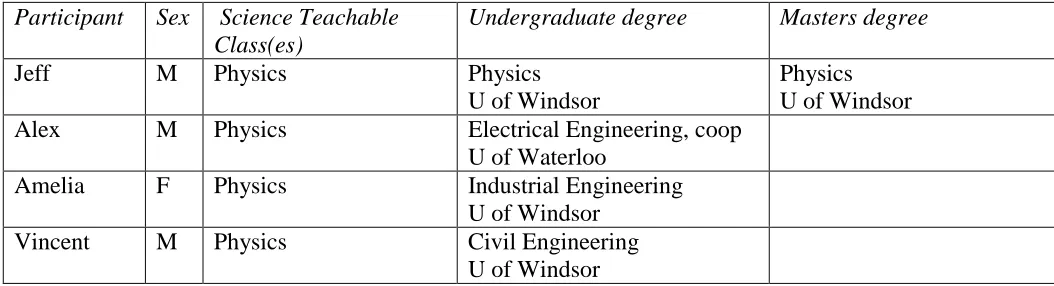
chemistry teachable and two with a biology teachable. As shown in Table 1.0, nearly half of the
participants have completed a masters degree in the area of their undergrad, creating a pool of
very intelligent and motivated participants.
Table 1.0 Participants
Participant Sex Science Teachable
Class(es)
Undergraduate degree Masters degree
Jeff M Physics Physics U of Windsor
Physics U of Windsor Alex M Physics Electrical Engineering, coop
U of Waterloo
Amelia F Physics Industrial Engineering U of Windsor
29
Charles M Physics Mechanical Engineering Overseas
Mechanical Engineering Overseas, repeated at McGill University Anthony M Physics General Science
U of Windsor Matt M Biology and Chemistry Biochemistry, Bio
specialization U of Western
Jay M Biology and Chemistry Biochemistry with Thesis U of Windsor
Laura F Chemistry Biochemistry with Thesis U of Windsor
Biochemistry U of Windsor Wendy F Chemistry Biochemistry
Overseas
Biochemistry U of Windsor
Recruitment Process
The objective was to recruit pre-service teachers who could report on their perceptions of
and experiences with the implementation of inquiry based science. The appropriate professors
(of physics, biology and chemistry teachable courses) were approached by the researcher and
permission was sought out to visit their class for the recruitment of participants. During these
visits at the end of scheduled classes, the researcher introduced inquiry based teaching and the
research objective to identify what could be done to improve the success rate of its
implementation in high school science classrooms. Class members were asked to volunteer for
this study by participating in guided interviews. They were ensured that due to the involvement
of human subjects, the researcher had received approval from the research ethics board to go
forward with the project. The pre-service teacher recruitment script was administered and
included a brief outline of the push for educational reform. The script provided details of the
approximate length of the interviews and important information to inform a potential
participants‟ decision. This included that the interviewee would be asked about his or her ideas
30
ensured that that the interview would be kept confidential and that students would receive a more
detailed letter of information about the project and participants if they were interested in taking
part.
Once a student‟s initial intention to participate in the study was expressed, an interview
schedule was set up. Potential participants showed interest in volunteering to be interviewed by
emailing the researcher or by offering their email address during the class visit and then
responding to an email from the researcher. Pre-service teachers could also indicate their
willingness to take part by directly volunteering during the researcher‟s class visit. Once
interview times were set up at the convenience of the participants, interviews took place in an
available room, according to the interview time, at the faculty of education, University of
Windsor.
Ethics Concern
Since this study involves human subjects, the issue of ethics must be recognized.
Although the participants have low vulnerability due to the nature of the study, any risk to them
was minimized by maintaining their confidentiality and ensuring they knew that they could
withdraw at any point during the data collection.
A consent form for participation and an audio recording consent form were signed just
before the interviews started. With the participants‟ permission, the interviews were audio-taped
by the researcher for data analysis. The initial interviews took anywhere from 20 minutes to 55
minutes, averaging approximately 30 minutes. The seven follow up interviews averaged 10
minutes. Although the interview participants exposed themselves to the researcher during this
time, their identification information was removed in the transcription of interview data and once
31 Data Collection and Instrument
Data were collected through semi-structured individual interviews with pre-service
science teachers. The goal of this was to explore their perceptions of and experiences with the
implementation of inquiry based teaching in their placements. The pre-service teacher interview
guide assisted the researcher during the initial interviews in exploring the participants‟
educational background, work experience and perceptions of inquiry based teaching. It went on
to identify how the participants themselves learned in high school, if not through inquiry. The
second half of the interview aimed to discover how the participant approached the
implementation of inquiry based teaching in their practicum. Specific examples were sought out
and assessment of whether or not they were successful was discussed. This was followed by
discussing challenges that students faced and what could be done differently in their own
education for a future improvement in the implementation of inquiry based teaching. Participants
were first interviewed after their second teaching placement, so they were provided with some
time to get familiar with inquiry based teaching.
Follow up interviews were conducted, where possible, to identify any changes in
perceptions or new valuable experiences after the student‟s third placements. New examples of
how they implemented inquiry based teaching were asked for and whether or not they were
successful was discussed. The interview guide consisted of ten set open-ended questions,
allowing the participants to respond freely, without influence of the researcher‟s ideas. There
were 7 participants out of 10 who took part in follow-up interviews. Only 6 of the questions
were applicable to these interviews, some of which focused on a change in perceptions and
32 Data Analysis
Interview data collected from the semi-structured interviews was analysed according to
the systematic design strategy as set out by Strauss and Corbin in 1990 (Creswell, 2008). After
transcription of the audio-taped interviews, the researcher looked at all data collected and formed
categories of information pertaining to pre-service teacher perceptions of and experiences with
the implementation of inquiry based science teaching. These include own educational
experiences, perceptions, evidence of inquiry effectiveness, challenges and improvements. This
open coding sets the stage for the second phase of coding, where the researcher chose subthemes
to be discussed, which occurred within each category. Finally, by selective coding, the researcher
identified existing relationships and emerging patterns between the categories and subthemes.
This qualitative data analysis process was ongoing from the point of the first interview and
beyond the last interview until the researcher was able to extract ample meaning from the data.
Scope and Limitations
Since pre-service teachers were interviewed regarding their practice in the classroom, the
results are based on participants‟ word rather than observed actions. There are reported
inconsistencies between what new teachers say they do and what they actually do in the
classroom (Sadler & Klosterman, 2009). Similarly, participants in this study may have tended to
report more or less success of their implementation of inquiry based teaching, because they may
either desire a greater experience or feel modest about their success. This could in turn create
inconsistencies in the emerging themes. Another limitation is that this study examines
pre-service teachers‟ perceptions of and experiences with inquiry based teaching within the context
of the university where this study took place in 2011. It is important to not over generalize the
33
University do not speak for all pre-service science teachers from other universities. However,
this study will provide an avenue to attain a greater understanding of what is going on with the