University of Windsor University of Windsor
Scholarship at UWindsor
Scholarship at UWindsor
Electronic Theses and Dissertations Theses, Dissertations, and Major Papers
12-20-2018
Efficient Computation and FPGA implementation of Fully
Efficient Computation and FPGA implementation of Fully
Homomorphic Encryption with Cloud Computing Significance
Homomorphic Encryption with Cloud Computing Significance
Qiang Zeng
University of Windsor
Follow this and additional works at: https://scholar.uwindsor.ca/etd
Recommended Citation Recommended Citation
Zeng, Qiang, "Efficient Computation and FPGA implementation of Fully Homomorphic Encryption with Cloud Computing Significance" (2018). Electronic Theses and Dissertations. 7609.
https://scholar.uwindsor.ca/etd/7609
This online database contains the full-text of PhD dissertations and Masters’ theses of University of Windsor students from 1954 forward. These documents are made available for personal study and research purposes only, in accordance with the Canadian Copyright Act and the Creative Commons license—CC BY-NC-ND (Attribution, Non-Commercial, No Derivative Works). Under this license, works must always be attributed to the copyright holder (original author), cannot be used for any commercial purposes, and may not be altered. Any other use would require the permission of the copyright holder. Students may inquire about withdrawing their dissertation and/or thesis from this database. For additional inquiries, please contact the repository administrator via email
Efficient Computation and FPGA Implementation of Fully
Homomorphic Encryption with Cloud Computing
Significance
by
Qiang Zeng
A Thesis
Submitted to the Faculty of Graduate Studies
through Electrical and Computer Engineering
in Partial Fulfillment of the Requirements for
the Degree of Master of Applied Science at the
University of Windsor
Windsor, Ontario, Canada
2018
c
Efficient Computation and FPGA Implementation of Fully
Homomorphic Encryption with Cloud Computing Significance
by Qiang Zeng
APPROVED BY:
H. Hu
Department of Mechanical, Automotive & Materials Engineering
C. Chen
Department of Electrical and Computer Engineering
H. Wu, Advisor
Department of Electrical and Computer Engineering
AUTHOR’S DECLARATION OF ORIGINALITY
I hereby certify that I am the sole author of this thesis and that no part of this thesis has been published or submitted for publication.
I certify that, to the best of my knowledge, my thesis does not infringe upon anyones copyright nor violate any proprietary rights and that any ideas, techniques, quotations, or any other material from the work of other people included in my thesis, published or otherwise, are fully acknowledged in accordance with the standard referencing practices. Furthermore, to the extent that I have included copyrighted material that surpasses the bounds of fair dealing within the meaning of the Canada Copyright Act, I certify that I have obtained a written permission from the copyright owner(s) to include such material(s) in my thesis and have included copies of such copyright clearances to my appendix.
ABSTRACT
Homomorphic Encryption provides unique security solution for cloud computing. It ensures not only that data in cloud have confidentiality but also that data processing by cloud server does not compromise data privacy. The Fully Homomorphic Encryp-tion (FHE) scheme proposed by Lopez-Alt, Tromer, and Vaikuntanathan (LTV), also known as NTRU(Nth degree truncated polynomial ring) based method, is considered one of the most important FHE methods suitable for practical implementation.
In this thesis, an efficient algorithm and architecture for LTV Fully Homomorphic Encryption is proposed. Conventional linear feedback shift register (LFSR) structure is expanded and modified for performing the truncated polynomial ring multipli-cation in LTV scheme in parallel. Novel and efficient modular multiplier, modular adder and modular subtractor are proposed to support high speed processing of LFSR operations. In addition, a family of special moduli are selected for high speed com-putation of modular operations. Though the area keeps the complexity of O(N n2)
with no advantage in circuit level. The proposed architecture effectively reduces the time complexity fromO(N logN) to linear time,O(N), compared to the best existing works.
DEDICATION
To my loving parents:
Father: Heping Zeng
ACKNOWLEDGMENTS
I would like to express my faithful gratitude to everyone who helped me. First of all, I appreciate my parents’ deep love and full support, as well as the encouragement and financial support from them. Without them, I could not overcome all difficulties and accomplish my study.
Furthermore, I am quite grateful to my supervisor Dr. Huapeng Wu from de-partment of Electrical and Computer Engineering at University of Windsor. He has instructed me throughout my research and this thesis. As one of best teachers I have ever had, Dr. Wu impressed upon me that a brilliant teacher edifies students in matters far beyond those in books and academy. His extensive knowledge and logical thinking are invaluable; without his elaborate and constructive comments on my research, this thesis could be impossible.
I thank my friends, Ruiqing Dong, Liyuan Liu, Xiaolin Duan, Siyu Zhang and Pengzhao Song. They gave me their help and time during the adversity of my study. Ultimately, I hope to show my appreciation to the faculties of Electrical and Computer Engineering at University of Windsor since their efforts during my study for the master degree. Furthermore, I pretty appreciate the financial support from the University of Windsor and my supervisor Dr. Huapeng Wu.
TABLE OF CONTENTS
AUTHOR’S DECLARATION OF ORIGINALITY iii
ABSTRACT iv
DEDICATION v
ACKNOWLEDGEMENTS vi
LIST OF TABLES x
LIST OF FIGURES xi
LIST OF ALGORITHMS xii
LIST OF ACRONYMS xiii
1 INTRODUCTION 1
1.1 Motivation . . . 1
1.2 Contribution . . . 5
1.3 Organization of the Thesis . . . 5
2 MATHEMATICAL PRELIMINARIES 7 2.1 Truncated Polynomial Ring . . . 7
2.1.1 Ring . . . 7
2.1.2 Truncated polynomial ring . . . 8
2.2 LTV Fully Homomorphic Encryption . . . 12
2.2.1 Parameter sets . . . 13
2.2.3 Evaluation . . . 16
3 HOMOMORPHIC ENCRYPTION AND CLOUD SECURITY 18 3.1 Homomorphic Encryption . . . 18
3.1.1 Patially Homomorphic Encryption . . . 20
3.1.2 Somewhat Homomorphic Encryption . . . 21
3.1.3 Fully Homomorphic Encryption . . . 21
3.2 LTV Fully Homomorphic Encryption . . . 25
3.3 Homomorphic Properties . . . 27
3.4 Cloud Computing and Homomorphic Encryption . . . 30
3.4.1 Security threat . . . 33
3.4.2 Application of security system . . . 34
3.4.3 FHE scheme over cloud: a scenario . . . 36
4 AN OVERVIEW OF RECENT RELATED WORKS 39 5 PROPOSED ARCHITECTURE FOR FULLY HOMOMORPHIC ENCRYPTION 44 5.1 LFSR Based Structure . . . 45
5.1.1 Linear Feedback Shift Register . . . 45
5.1.2 Proposed truncated polynomial ring multiplier . . . 46
5.2 Mersenne Number for Moduli . . . 48
5.3 Modular Adder . . . 51
5.4 Modular Subtractor . . . 55
5.5 Modular Multiplier . . . 58
6 COMPLEXITY ANALYSIS AND FPGA IMPLEMENTATION 66 6.1 Complexity Analysis . . . 66
6.2.1 Implementation results . . . 68 6.2.2 Implementation comparison . . . 69
7 CONCLUSIONS 74
7.1 A Summary of Contributions and Significance . . . 74 7.2 Possible Future Works . . . 75
REFERENCES 76
LIST OF TABLES
4.1 Truncated polynomial ring multiplier performance in [1] . . . 43
5.1 Regsiter Contents . . . 49
5.2 A list of some known Mersenne prime . . . 50
5.3 Selected parameter sets . . . 51
5.4 An adder performance comparison . . . 52
5.5 A comparison of different prefix adders[2] . . . 53
5.6 Truth table for Modular subtractor module . . . 57
5.7 Formation of the partial products . . . 61
5.8 Truth table for Booth Encoder(BE) . . . 61
5.9 Truth table for Booth Selector(BS) . . . 62
6.1 Modules used in proposed architecture . . . 66
6.2 Space complexity for each module . . . 67
6.3 Time complexity for each module . . . 67
6.4 Space complexity of proposed multiplier inRq[x] . . . 67
6.5 Time complexity comparison . . . 68
6.6 FPGA results for the proposed system . . . 69
6.7 Cryptosystem implementation types and comparison . . . 71
6.8 Implementation speed comparison . . . 72
LIST OF FIGURES
2.1 Encryption process for LTV FHE . . . 15
3.1 An overview of HE applications . . . 19
3.2 An overview of FHE timeline . . . 22
3.3 Cloud computing applications . . . 30
3.4 Cloud service delivery model . . . 32
3.5 Cloud security scheme model . . . 35
3.6 FHE over cloud: a scenario . . . 37
5.1 Linear Feedback Shift Register . . . 46
5.2 LFSR Based LTV FHE Architecture . . . 48
5.3 General structure of prefix adder . . . 53
5.4 Prefix adder logic operators and implementation . . . 55
5.5 Parallel prefix structure with n=8 . . . 56
5.6 Modular 2n−1 subtractor . . . . 56
5.7 Modular 2n−1 subtractor submodule . . . . 57
5.8 Implementation of Booth Encoder(BE) . . . 61
5.9 Implementation of Booth Selector(BS) . . . 62
5.10 Modular Multiplier . . . 63
5.11 Multiplication Partial Product Generation(MPPG) . . . 64
LIST OF ALGORITHMS
LIST OF ACRONYMS
F P GA Field Programmable Gate Array
Z The set of integers
Q The set of rational numbers R The set of real numbers
Rq Polynomial ring taken moduloq
Z[x] the set of polynomial of arbitrary degree with integer coefficients
q Integer coefficient modulo
R A polynomial ring
N The degree of a polynomial
R Ring
χ Discrete Gaussian distribution LFSR Linear Feedback Shift Register
m message encoded as polynomial (plaintext)
LTV Lopez-Alt, Tromer, and Vaikuntanathan cryptosystem c Encryption result represented as polynomial (ciphertext) HE Homomorphic Encyption
RSA Ron Rivest, Adi Shamir, and Leonard Adleman public key cryptosystem LWE Learning with error problem
R-LWE Ring-Learning with error problem SVP Shortest vector problem
NTRU Nth degree truncated polynomial ring cryptosystem BE Bit Encoder
1
INTRODUCTION
1.1
Motivation
Internet is a worldwide electronic network providing access to millions of informational resources. The ubiquity of Internet proves that it plays an indispensable role in our daily life. Internet has revolutionized the computer and communication world like nothing before. While telegraph, telephone, radio, and computer had set stage for the unprecedented integration of capabilities, subsequent medium as wireless handheld electronic devices such as smartphone, tablet, PDA, wearable tech, are also in need of internet for next generation and future world.
With the rapid increase in the amount of Internet information and data in recent years, the processing and computing ability of current information technology infras-tructure has also grown simultaneously. As of September 2018 there were over 1.8 billion web servers in the world reported estimated and reported by Netcraft[3]. Ac-cording to data and marketing services company IDC, scale of Internet data is going to reach 63ZB by 2025[4]. One of the reasons why web data grow rapidly is that they are increasingly stacked up by low budget and numerous number of devices such as mobile devices, cameras, radio-frequency-identification(RFID) readers and wireless sensor networks. These small Internet of Things devices capable of information sens-ing and data processsens-ing provide great convenience and unlimited contents for people to access from anywhere at anytime.
To deal with the explosively growing amount of data, Internet communication bandwidth and capability of Internet based data processing are being expanded and optimized. Researchers at Bell labs have reached Internet speed of over 100 petabit
With that said, people nowadays have growing needs for access of more data contents and higher amount of information along with the development of technologies such as video of 4K resolution and VR games.
When people are using their mobile phones and wearable gadgets, they also re-quire to have access to worldwide resourses and powerful computational ability to cope with their data on handheld devices. That is when the concept of cloud computing inevitably came to draw public’s attention in early 2000s[6]. In the history of net-work technology and communication engineering development, computing paradigm transformed from massing big load of work for large processor scheme, to distributed assignment processing scheme based on computer network, to demand processing cloud computing scheme recently. Cloud computing virtualizes and integrates service resources on Internet and has specialist responsible for coordination, management and maintenance, while clients are not necessarily knowledgeable about the internal realization of cloud. Therefore, cloud computing is a brand new effective computing paradigm.
Recent development in cloud computing field demonstrates that such a system providing massive computation and remote data management service has brought us into a revolutionary digital era. Cloud service has become a major source for personal users and enterprises when requesting a reliable system to deal with their data, usually sensitive and private. The cloud offers numerous advantages in costs and functionality with huge potential and while it is gaining rapidly rising popularity, on the other hand it also raises grave questions of cloud security and data confidentiality, since data stored in the cloud could be vulnerable to snooping by the cloud provider or even by other cloud clients[7].
enables scaling up and down resources allocated to service based on current service demands. These two properties increase the attackers’ interests in continually finding and taking advantage of the existing vulnerbilities for the cloud computing model. When transfering processing data of user to a third party, it is essential to be aware the responsibility associated with data privacy and compliance and bond a trust con-nection between user and cloud provider when exploiting benefits of reduced costs, easy maintainance and reprovisioning of resources.
Because cloud computing is distributed, the location of data stored is sometimes unknown, different user could share storage or computing resources, which might compromise the security and expose the information to other user in the same cloud model. When the data is tranfered to the cloud, standard encryption methods are used to secure the operations and the storage of data. The conventional security idea is to encrypt the data before sending it to cloud provider while handing over private key to the server to decrypt data before performing the calculations as requested by the user, the assumption that the cloud provider is trustworthy might affect the confidentiality and privacy of data stored in the cloud.
What is unique about cloud security is that clients or users demand security against cloud provider or server. Since the cloud service provider could be any third party company or enterprise, users intend to keep the data private and manage to not compromise sensitive information to cloud server. Therefore, a new strategy or countermeasure is required to provide solutions for the exclusive cloud security problem.
provider correctly processed the data as requested under the premise of not knowing the content of user data, as well as receiving the finantial support from user.
The termhomomorphism appeared first time in history from paper by Rivest,Adleman and Dertouzous[8] as a possible solution to computation on encrypted data and re-mained encrypted the whole process. This innovative approach is called homomorphic encryption. Since then, countless research works towards homomorphic encryption piled up as trending in cryptography. Homomorphic encryption provides a novel way to allow computation performed on encrypted data without having access of any por-tion of plain text. Homomorphic encryppor-tion scheme offers a unique security measure working decently against possible attacks and well suited with the exclusive features of cloud computing.
In order to achieve practical homomophic encryption scheme, high speed and ef-ficient algorithm and implementation are demanded. Since the proposal of first plau-sible Fully homomophic Encryption scheme were given by Graig Gentry[9], numer-ous papers and researchs were introduced aiming the efficient realization of different method of fully homomorphic encryption system. This paper explore one of the most researched and practical fully homomophic schemes, LTV[10] proposed by Lopez-Alt, Tromer and Vaikuntanathan, and present an efficient architecture and FPGA imple-mentation of the scheme. In addition, cloud computing system with application of fully homomophic encryption is discussed.
1.2
Contribution
The contributions of this thesis are summarized below:
Conventional linear feedback shift register (LFSR) structure is expanded and mod-ified for computation of the truncated polynomial ring multiplication in LTV cryp-tosystem. The proposed structure enables parallel computation while keeps compact and pipelined structure. In addition, a set of unique moduli were chosen to be used in the computation of modular operations. Calculation speed is much increased results from the highly efficient modulo computation introduced by the proposed moduli. Novel and efficient modular multiplier, modular adder and modular subtractor are proposed for high speed processing of LFSR operations. While parallel prefix adder structure provide efficient modular addition, Booth algorithm are used to perform modular multiplication. Our proposed architecture and algorithm provides better time complexity of linear time O(N) compared to existing works in the literature, while maintain more or same space complexity. Time and sapce complexity of our work are analyzed and presented in details. Comparison of FPGA implementation performance and results of other related works are also given.
1.3
Organization of the Thesis
of several existing related works on LTV Fully Homomorphic Encryption scheme is scrutinized. Chapter 5 presentsf our proposed work for LTV Fully Homomorphic En-cryption scheme. In this chapter, an LFSR based multiplier architecture is proposed to perform polynomial multiplication in set Rq[x]. Besides, proposed modular adder,
2
MATHEMATICAL PRELIMINARIES
This chapter first introduces truncated polynomial ring, as the mathematical back-ground of LTV Fully Homomorphic Encryption scheme. Then, an overview of LTV Fully Homomorphic Encryption system is given, which includes key generation, en-cryption, decryption and evaluation. The parameter sets selection for LTV Fully Homomorphic Encryption is also discussed.
2.1
Truncated Polynomial Ring
2.1.1 Ring
Definition A Ring is a non-empty set R together with binary operations + and ·
defined on R with two mappings:
+ : R×R →R, (a, b)7→a+b · :R×R →R, (a, b)7→a·b
such that addition operation satisfies:
Additive associativity: a+ (b+c) = (a+b) +c, for a, b, c, ∈R. Additive communitivity: a+b=b+a, for a, b ∈ R.
Additive identity: There is an identity element e in R such that for all a ∈ R,
a+e=e+a =a.
Additive inverse: For a ∈ R, there exists an inverse element a−1 ∈ R such that
a+a−1 =a−1+a =e.
Also multiplication operation satisfies:
Multiplicative associativity: For a, b, c∈R, we have a·(b·c) = (a·b)·c. Distributivity: a·(b+c) = a·b+a·c, and (a+b)·c=a·b+b·c. Examples of ring are populous and here is a few of them:
matrix addition and matrix multiplication for collection of matrices over some ring
R form a matrix ring; Modulo 2 arithmetic on 0,1 is a two element commutative ring with identity. More generally, for addition and multiplication modulo n on
0,1, ..., n−1 considered, we also get a commutative ring with identity; Polynoimials
with real coefficients form a commutative ring with identity under the usual addition and multiplication.
2.1.2 Truncated polynomial ring
Consider the polynomial ring that contains all the polynomials with degree up to a certain value N − 1 taken modulo φ(x) = xN + 1 and with integer coefficients.
This is called truncated polynomial ring (with integer coefficients) and denoted by
R[x]/(xN + 1). Leta(x), b(x)∈R[x]/φ(x):
a(x) =a0 +a1x+...+aN−1xN−1 (1)
b(x) =b0 +b1x+...+bN−1xN−1 (2)
We must able to add and multiply elements of R[x]/φ(x) so that the axioms defining a ring hold true.
Here are some basic properties of truncated polynomial ring:
• Equality
Ifa(x)a0+a1x+...+aN−1xN−1 andb(x) =b0+b1x+...+bN−1xN−1 are in ring R , then a(x) =b(x) stands if and only ifai =bi, for every integeri≥0.
In other words, two polynomials are declared to be equal if and only if their corresponding coefficients are equal.
• Addition
both in ring R, then:
a(x) +b(x) =c0+c1+...+cN−1xN−1 (3)
Where
ci =ai+bi, for each 0≤i≤t.
To elaborate, definition of addition of two polynomila in polynomial ring is to add two polynomial by adding their coefficients and collecting terms. To add 1 +x and 3−2x+x2 we consider 1 +x as 1 +x+ 0x2 and add, according to the given definition, to obtain as their sum 4−x+x2.
The multiplication defined for R should be more complicated.
• Multiplication
if a(x) =a0+a1x+...+aN−1xN−1 and b(x) = b0+b1x+...+bN−1xN−1 , then
a(x)b(x) =c0+c1+...+cN−1xN−1 (4)
where
ct =± m
X
i=0
t−i
X
j=0
aibj =±atb0±at−1b1±at−2b2±...±aobt,0≤t≤N −1 (5)
This definition explain the multiplication in polynomial ring is to multiply two polynomial by multipliying out the symbols formally, use the relation xαxβ =
xα+β. The kth coefficient ck is simply the dot product of the coefficients of a
and the coefficients of b except that coefficients of b are listed in reverse order and are rotated aroundk positions.
Example: Let
b(x) = 2 +x2+x3
Thus
c0 =a0b0 = 1·2 = 2,
c1 =a1b0+a0b1 = 1·2 + 1·0 = 2,
c2 =a2b0+a1b1+a0b2 = (−1)·2 + 1·0 + 1·1 =−1, c3 =a3b0+a2b1+a1b2+a0b3 = 2,
c4 =a4b0+a3b1+a2b2+a1b3+a0b4 = 0,
c5 =a5b0+a4b1+a3b2+a2b3+a1b4+a0b5 =−1, c6 =a6b0+a5b1+a4b2+a3b3+a2b4+a1b5+a0b6 = 0, c7 =c8 =...= 0.
According to definition of multiplication rules,
(1 +x−x2)(2 +x2+x3) =c0+c1x+c2x2+...c6x6
= 2 + 2x−x2+ 2x3−x5.
The multiplication of polynomial ring is commutative and it has a unit element.
• Inverse
The inverse modulo q of a polynomiala(x) is a polynomial b(x) with the prop-erty that
a(x)·b(x) = 1 mod q
It can be also written as:
Not every polunomial has an inverse modulo q in the ring, but it is easy to determine if a(x) has an inverse or not, or to compute the inverse if it exists. For example:
TakeN = 7, q = 11, a(x) = 3 + 2x2−3x4+x6.
The inverse of a(x) mod q is
b(x) =−2 + 4x+ 2x2+ 4x3−4x4+ 2x4+ 2x5−2x6
Since
a(x)·b(x) = (3 + 2x2−3x4+x6)·(−2 + 4x+ 2x2+ 4x3−4x4+ 2x4+ 2x5−2x6) =−10 + 22x+ 22x3−22x6
= 1 modulo 11
• Modular Operations
f(x) mod P(x) means “the remainder of (f(x)÷P(x))” .
– It can be denotedf(x) =a(x)P(x)+b(x), where the degree ofb(x) is lower than that of P(x), then f(x) mod P(x) = b(x).
– Polynomial division: (f(x)÷P(x)) to obtain the remainder. Example:
1. Let f(x) = x8+ 1, P(x) =x3+x2+ 1
f(x)mod P(x) =x8+ 1 mod x3+x2+ 1 = 6x2−3x+ 5
2. Let f(x) = x10 , and P(x) =x2+x+ 1
f(x) mod P(x) = x10 mod x2+x+ 1 =x
and the quotient is x8−x7+x5−x4 +x2−x.
Truncated polynomial ring is the algebra primitive that LTV Fully Homomorphic Encyprion defined over with. The truncated polynomial ring, which is denoted as
R = Z[x]/(xn + 1) in the literature. N is a prime number. In this notation, Z[x]
represent the set of polynomials of arbitrary degree with interger coefficients and
xn+ 1 is the modulo that the polynomial is taken. It can be seen that the set of R
contains all the polynomials with integer coefficients of degree up to N−1.
In addition to the limitation for the degree on polynomial in the truncated poly-nomial ring, another particular restrain is also requested for LTV Fully Homomophic Encryption scheme. The elements in truncated polynomial ring R for LTV Fully Homomorphic Encryption scheme can be viewed as degree N polynomials with the coefficients taken modulo of prime numberq, which demonstrate that all integer coef-ficients for the LTV truncated polynomial ring are supposed to be coming from range [0, q].
So LTV Fully Homomorphic Encryption system works in the truncated polynomial ring R taken modulo xN + 1 and q, which is expressed by Rq =Zq[x]/(xn+ 1).
2.2
LTV Fully Homomorphic Encryption
2.2.1 Parameter sets
For LTV Fully Homomorphic Encryption to be both secure and correct, concrete sets of parameter need to be chosen carefully. An proven secure range of required param-eters sets and values of selection for determined security level is shown below[11]:
• An integer N, fixN to be power of two.
• An integer p, fix p= 2. This choice provides a useful message space and cause the least possible expansion on the noise.
• Set χ to be the discrete Gaussian distribution DZN,r, for some standard
de-viation r > 0. Elements can be efficiently drawn from this distribution and moreover.
• With N a power of two and a degree N polynomial φ(x) = xN + 1, the noise
distribution can be spherical and the worst case reduction still hold[12].
• Set r = p2N/π, so that ring-LWE is as hard as lattice problem in the worst case[12].
• Choose a prime q ∈ [dN6ln(N),2dN6ln(N)], such that q ≡ mod 2N. For
d = 25830, correctness of the scheme can be guaranteed. Experimentally, less aggressive and lower value ofd is obtained.
The parameters N, q, χ are public. The message space for the LTV Fully Homo-morphic Encryption scheme is M = 0,1 and all the operations are performed in the ringRq =Zq[x]/(φ(x)). We associateZqwith the set{− bq/2c, ...,bq/2c}throughout
the thesis, to satisfy the absence of wrap round error.
2.2.2 Encrption
The LTV Fully Homomorphic Encryption scheme is parametrized by a prime number
coef-ficients are all at most q in absolute value. All operations in this scheme take place in the ring Rq =R/qR.
• KeyGeneration
Sample bounded polynomial f0,g ←χ
Set f := 2f0 + 1 so that f ≡ 1(mod 2). If f is not invertible in Rq, re-sample
f0.
Compute the public key as:
Kpub :=h= 2gf−1 ∈Rq. (6)
Set secret key as:
Kpri:=f ∈R. (7)
For all τ ∈ {0, ...,blogqc}, samplesτ, eτ ← χ.
Compute γτ =hsτ + 2eτ + 2τf ∈ Rq.
Set evaluation key as:
Keva = (γ0, ..., γblogqc)∈ Rqdlogqe (8)
The public key h, counterpart secret key f and evaluation key are acquired through above steps.
• Encryption(Kpub, m)
Kpub :=h= 2gf−1 ∈Rq , Kpri :=f ∈R
Sample polynomials s, e←χ. Output the ciphertext
c:=hs+ 2e+m∈Rq (9)
1.Parameter sets
2.Key Generation
3.Encryption
5.Decryption
User
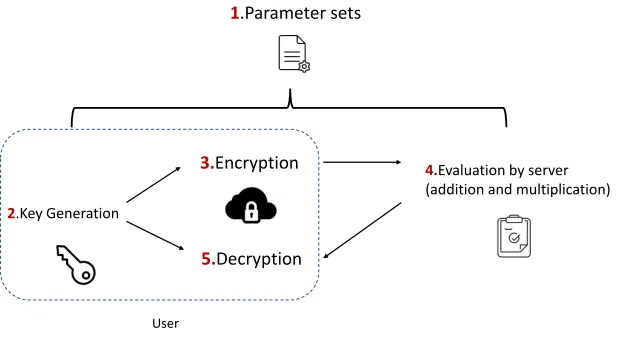
4.Evaluation by server (addition and multiplication)
Fig. 2.1: Encryption process for LTV FHE
When above two steps are done, ciphertext is computed and output as polyno-mial c.
• Decryption(sk, c) Output
µ=f c∈Rq (10)
m0 :=µ (mod 2) (11)
Decrypted messagem is obtained after the success completion of above compu-tations.
Decryption works because:
f c (mod q) =f(hs+ 2e+m) (mod q) = 2(gs+ef) +f m(mod q) = 2(gs+ef) +f m
2.2.3 Evaluation
In this section we show how to homomorphically add and multiply two elements. Given two cihpertextsc1,c2, there are a series of different public keys connected with
each ciphertext. Public keys will be represented as K1, K2 respectively.
• Evaluation addition
– Two ciphertexts c1 and c2 are encrypted by the corresponding public key
sets K1,and K2.
– Output ciphertext:
cadd =c1+c2 ∈ Rq (12)
– Output the set Kadd=K1∪K2 as its corresponding public key set.
• Evaluation multiplication
– Given two ciphertexts c1 and c2 with corresponding public key set K1, K2, computing ciphertext ˜c0 = c1 · c2 ∈ Rq ,and let K1 ∩ K2 = {Kpubi1, ..., Kpubir}
– IfK1∩K2 =∅, let cmult = ˜c0.
– Otherwise forj ∈= [r] and τ ={0, ...,blog qc }, define ˜cj−1,τ so that
˜
cj−1 =
blog qc
X
τ
˜
cj−1,τ2τ (13)
is binary representation for ˜cj−1
– Parse
Kevaij = (rij,0, ..., rij,blog qc) (14)
let
˜
cj =
blog qc
X
τ=0
˜
– Output cmult = ˜c as encryption of product of messages, output the set
3
HOMOMORPHIC ENCRYPTION AND CLOUD
SECURITY
This chapter introduce the concept of homomorphic encryption. In fact, all different homomophic attempts can be generally categorized under three types of schemes with respect to the allowed times of operations and supported type(s) of operations on the encrypted data as Partially Homomorphic Encryption, Somewhat Homomophic Encryption and Fully Homomorphic Encyption. The research timeline and history of homomorphic encryption methods are given, as well as the important corresponding homomorphic properties.
Cloud computing security in modern society is analyzed. Solutions to cloud secu-rity based on applications of homomorphic encryption are discussed. Illustrations of specific encyption process scheme that are applied in cloud computing scenario are also presented.
3.1
Homomorphic Encryption
Homomorphic encryption is divided into three categories: Partially Homomorphic Encryption(PHE), Somewhat homomorphic encryption (SWHE) and Fully Homo-morphic Encryption(FHE) scheme. Partially HomoHomo-morphic Encryption support only one type of operation with a unlimited time of usages. While Somewhat Homomor-phic Encryption allow some type of computations such as addition or multiplication operations carried on cipher text with a limited number of time, Fully Homomor-phic Encryption supports securely unlimited time of arbitrary computations over encrypted data without decrypting the data[9].
Cloud Computing
Electronic Voting Financial Transaction
Medical records
Data mining
Electronic Cash Encrypt with Homomorphic encryption
User
Data secure even with untrusted cloud
HE enables cloud to perform directly on encrypted data of client.
Fig. 3.1: An overview of HE applications
The idea of Homomorphic Encryption problem was first mentioned by Rivest, Adleman[8] in 1978 with an alternative term of privacy homomorphism. The open problem maintained a mirage for over 30 years since then and have been known to be the“holy grail” of cryptography[13]. The construction and solution of such scheme seemed to be even more impractical until Stanford PhD thesis proposed by Gentry[9] was theoretically achieved in 2009.
There was an appreciable amount of homomorphic encryption schemes introduced during this period: unpadded RSA[14] or ElGamal encryption scheme [15] and cryp-tography of Goldwasser-Micali[16], Benaloh [17], Paillier[18], Damgard[19] and Regev [20] [21]. The examples given above allow computation either one type of operation or limited numner of operations such as addition or multiplication on cipher texts.
learning-with-error (LWE) or ring-learning-with-learning-with-error (RLWE) problems.
3.1.1 Patially Homomorphic Encryption
PHE schemes are often seen in particular application of electronic-voting or private information retrieval. But the application of PHE method is restricted in terms of the type of homomorphic evaluation opertions. In orther words, it can only be used in some certain scenarios with only addtion or multiplication operation are required. RSA is one of the representative public key cryptography systems introduced by Rivest, Shamir, and Adleman[14] in 1978. Its security is based on hard problem of large prime factorization. Using the term ‘privacy homomorphism’ for the first time in history, the paper showed the homomorphic property over only multiplication, where
E(m1*m2) can be directly evaluated by usingE(m1) and E(m2) without decrypting
them first. Apparently RSA does not support homomorphism of addition, thus it is classified as partially homomorphic encrytion.
Given RSA public key (N, h) and two plaintextm1, m2, the multiplication of two
ciphertext returns a computed multiplication in the encrypted domain as follows:
Enc(m1)×Enc(m2) = (mh1 mod N)×(m
h
2 mod N)
= (m1× m2)h mod N
=Enc(m1×m2)
(16)
In 1985, based on original Diffie-Hellman key exchange algorithm, a new public key encryption scheme called Elgamal were proposed by Taher Elgaml[15], which is based on the hard mathmetic problem of discrete logarithm. The Elgamal cryptosystem is multiplicatively homomorphic and not satisfy addtitive homomorphism.
improve-ment of Paillier system.
The Pailleir scheme [18] is limited to only additive homomorphism. Given the public key (N, h), a random number (r1, r2) and two plaintext m1 and m2, the
mul-tiplication of two ciphertexts returns a computed addition in the encrypted domain as follows:
Enc(m1)×Enc(m2) = [(gm1 ·rN1 )×(gm2 ×r
N
2 )]mod N
2
= [(gm1+m2)(r
1r2)N]mod N
=Enc(m1+m2)
(17)
3.1.2 Somewhat Homomorphic Encryption
There were SWHE researched before and after first FHE scheme came out in 2009. Some major SWHE methods were used as stepping stone towards practical FHE, while some were proposed with performance associated with FHE scheme.
BGN, one of the most significant SWHE, was introduced by Boneh-Goh-Nissim[26] in 2005. The hardness of the scheme is based on subgroup decision problem. Homo-morphism over addition and multiplication are satisfied but further operations are not supported.
Sander[27] described a SWHE scheme supported a limited depth circuit evaluation on a semi group, and Kawachi’s proposal[28] allow additive homomorphism.
3.1.3 Fully Homomorphic Encryption
Second generation homomorphic cryptosystem Early homomorphic
cryptosystem(First Generation)
First FHE by Gentry: lattice based cryptography
Cryptosystem over the integers
BGV—The Brakerski-Gentry-Vaikuntanathan cryptosystem
Scale-invariant cryptosystem
LTV——NTRU-like Homomorphic Encryption By Lopez-Alt, Tromer, and Vaikuntanathan Cryptosystem
GSW–The Gentry-Sahai-Waters cryptosystem 2009
2010
2011
2012
2012
2013
Fig. 3.2: An overview of FHE timeline
afterwards indulged in creating new FHE system and improve Gentry’s innovation from 2009. Most of the later efforts are generally based on the blueprint provided by Gentry himself, that is, Gentry proposed a conventional framework for other re-searchers to follow his basic design. Diagram 3.2 shows the history of development of FHE researches.
Several new techniques that were developed starting 2011 led to the development of much more efficient Fully Homomorphic Cryptosystems. These include:
• Lattice based FHE
Gentry’s first Fully Homomorphic Encryption, also known as ideal lattice based FHE scheme, uses ideal lattice to make huge breakthrough from SWHE struc-ture. An SWHE can only evaluate ciphertext homomorphically for limited number of times. When dealing with a certain amount of calculations on ci-phertext, decryption process is not available to retrieve the original message accurately.
of homomorphic operations to be performed on ciphertext, which iterate works for unlimited time. In this way, the scheme become fully homomorphic encryp-tion.
The bootstrapping process basically works as follow: first the homomorphic decryption of the noisy ciphertext removes the noise, then the new homomorphic encryption introduces new small noise to the ciphertext. The ciphertext is now like just encrypted. Further homomorphic operations can be computed on this fresh ciphertext until reaching to a threshold again. This is where FHE become impractical for its noticeably computation cost and result in a major drawback for Fully Homomorphic Encryption.
A noticeable number of following FHE methods were presented to improve Gen-try’s original work. Gentry himself introduced a advanced key generation al-gorithm in [29] which improved the initial proposal’s security level based on a quantum worst case reduction problem since the former one’s key generation algorithm is used for a particular purpose only and the generation of an ideal lattice with a good basis is left without a solution[30]. Another probabilistic decryption algorithm with lower multiplicative degree, which is the aquare root of previous decryption circuit degree, was gived by Stehle and Steinfeld[31]. In addition, a new FHE scheme, which is a variant of Gentry’s scheme was intro-duced in[32]. This scheme uses smaller ciphertext and key sizes than Gentry’s scheme without sacrificing the security. Alternative works [33] [34] [35]focused on the optimizations in the key generation algorithm in order to implement the FHE efficiently.
• FHE over integers
En-cryption. The new proposed approach is over the integer and the hardness of the method is based on Approximate Greatest Common Divisor(AGCD), with the primary motivation behind the scheme having conceptual simplicity. The paper[36] provide a way for transforming existing symmetric version of HE to asymmetric HE scheme, which states that the scheme is a public key encryption system.
While the relatively complex components of structure based on ideal lattice is replaced by a uncomplicated architecture over integers, the simplicity at-tained trade off for computation cost. A few following optimization works[37] [38][39]concentrate on decreasing size of public keys.
Some subsequent methods for FHE schemes over integers are proposed too. Scale invariant FHE over the integers [40], a new scheme with integer plaintexts[39], a new SWHE scheme for computing arithmetic operations on large integer numbers without converting them into bits[41], a new symmetric FHE without bootstrapping[42], a new FHE for non binary message space[43]. All Schemes mentioned above improved FHE over the integers scheme in their own way.
• LWE based FHE
lattice problem which is not efficiently breakable in polynomial time by quantum algorithm and considered more efficient for practical applications and stronger security level than original LWE problem.
Brakerski and Vaikuntanathan[44] constituted a SWHE scheme using efficient feature of ring-LWE make it one step closer to practical FHE with Gentry’s basic bootstrapping and squashing techniques, because ring-LWE is regarded as better performance than LWE scheme. A leveled FHE scheme without us-ing bootstrappus-ing method was provided in [22], in respond to the fact that bootstrapping process cost too much computation resource to finish. In Brak-erski’s new scale invariant Fully Homomorphic Ecryption scheme, noise grows linearly with evaluation of homomorphic operation instead of exponentially and the scheme is based on hard problem of GapSVP. Some notable modifications include [45] reducing overhead of key switching and faster evaluation of homo-morphic operations and [46] using relinearization to improve efficiency.
In addition, some later proposal [23],[24],[25] are introduced to extend the per-formance and achieved better optimization results.
3.2
LTV Fully Homomorphic Encryption
Rq = Z[x]/(xN + 1) where N is power of 2, while in NTRUEncrypt cryptosystem
the base algebra structure is polynomial ring Rq =Z[x]/(xN −1) where N is prime.
Third, more aggressive parameter sets provide higher security level and more complex computation to support fully homomorphism.
One of the unique features of LTV Homomophic Encryption scheme is the multikey homomorphism for two party computation. Let (h1, f1) and (h2, f2) be two different
public and secret key sets. Let c1 =h1s1+ 2e1+m1 and c2 =h2s2+ 2e2+m2 be two
ciphertexts encrypted under public key h1 and h2 respectively. The computation of
ciphertexts that decrypted to sum and the product of m1 and m2. Using the secret
key f1 ·f2 the ciphertext cmult = c1 ·c2 and cadd = c1+c2 can be decrypted to the
product and the sum ofm1 and m2 respectively.
The multikey homomorphism properties for two party computation is shown below using joint secret key set k1, k2.
• Multikey Homomorphism over addition
f1f2(c1+c2)(mod 2) = 2(f1f2(e1+e2) +f2g1s1+f1g2s2) +f1f2(m1+m2)(mod 2)
= 2eadd+f1f2(m1+m2)
=m1+m2(mod 2)
(18)
• Multikey Homomorphism over multiplication
f1f2(c1c2)(mod 2) = 2(2g1g2s1s2+g1s1f2(2e2+m2) +g2s2f1(2e1+m1)
+f1f2(e1m2+e2m1+ 2e1e2)) +f1f2(m1m2)(mod 2)
= 2emult+f1f2(m1m2)
=m1m2(mod2)
(19)
In other words, joint secret key f1f2 can be used to decrypt cadd = c1 +c2 and cmult =c1·c2. We can extend this argument to any combination of operations, with
ciphertexts encrypted under multiple public keys. It is also seen that multikey ho-momoprhic operation increase noise more than a single key homomorphic evaluation. However,m1+m2 andm1m2 can still be recovered correctly using the joint obtained
secret key sincef, g, s, eare all sampled from bounded ditributionχ. In other words, the decryption part works well if the noise parameterseadd and cmult are smaller than
[− bq/2c,bq/2c].
3.3
Homomorphic Properties
Letc1 andc2 be two ciphertexts. When two messagesm1 andm2 are both encrypted
by the shared secret key f, the homomorphic properties could be expess as:
• Addition
Define the sum of two ciphertexts as:
cadd =c1+c2
For the additive homomorphic property, we have:
f·cadd mod 2 = f(c1+c2) mod2
=f·c1+f ·c2 mod 2
=µ1+µ2 mod 2
=m1+m2 mod 2
=m1+m2
(20)
• Multiplication
Define the product of two ciphertext as:
cmult =c1 · c2
For multiplicative homomorphic property, we have:
f2·cmult mod 2 =f2·(c1 ·c2) mod 2
= (f ·c1)·(f ·c2) mod 2
=µ1·µ2 mod2
=m1·m2 mod 2
=m1·m2 mod 2
(21)
So that the product of two ciphertext can be decrypted as product of two plaintexts or messages with multiplicative homomorphic property.
• Addition and multiplication From
f = 2f0 + 1 we get
f ≡1 mod 2
Then
fk·m mod 2 =m (22)
One of the main challenges for extension of Somewhat Homomorphic Encryp-tion to Fully Homomoprhic EncrypEncryp-tion is the management and control of noise. This is often the reason why fully homomorphic encryption schemes are con-sidered less efficient. Noise grows linearly with addition operations and while exponentially with multiplication operations. As long as the noise remains be-low a certain threshold, the message will be recovered without failure. However, if the magnitude of growing noise after each operation is over a certain level, it is hard to obtain the correct result of homomorphic encryption operation, which also affects the security and homomorphism. The importance of this trade off between noise level and security becomes significant and apparent when consid-ering the homomorpic properties of the scheme.
• Relinearization
The product ciphertext is supposed to be multiplied with the secret key for k
times in order to decrypt a product of k ciphertext. The depth of the circuit will have to be kept track of, which is somehow turned out to be complex if the circuit is complicated.
Relinearization enable multiplying the result ciphertext by secret key only for one time, which make it possible to decrypt arbitrary combination of opera-tions including addiopera-tions and multiplicaopera-tions of the ciphertext. Evaluation key introduced in Section 2.2.3 is used in this process.
• Modulus reduction
Fig. 3.3: Cloud computing applications
applying the process.
3.4
Cloud Computing and Homomorphic Encryption
Cloud computing is another evolution in information technology after the presence of computer and Internet. According to NIST[48], cloud computing is a model for enabling convenient, on demand network access to a shared pool of configurable computing resources(e.g, networks, servers, storage, applications, and services) that can be rapidly provisioned and released with minimum management effort or service provider interaction. Nowadays we see cloud as a set of solutions integrating multi-ple technology and corresponding application. It incorporate distributed computing, virtualization, grid computing, load balance and parallel computing into information ecosystem. The application of cloud technology enable every enterprise and personal user to make better and faster use of advanced information technology. The Graph 3.3 shows cloud computing technique connect differenct devices and terminal together.
economic scale and high scalability, it also expose certain latent threat in security aspect due to its technical features. Based on the different service categorization that cloud computing provides, it is classified as three basic service delivery modes:
• IaaS( Infrastructure as a Service):
Cloud provider deploy technique such as virtualization on fundamental platform to coordinate infrastructure construction and improve utilization. Users are able to get access to a virtual server (an IaaS provider), bypassing the time and effort they contribute on establishing their own data centers or deploying services. IaaS provide function of pay-as-you-go and mensurable resource pool in heterogeneous resources environment, while satisfy user demand and fully utilize hardware resources. Amazon web service’s elastic computer cloud, also known as EC2, is a typical example for IaaS platform.
• PaaS(Platform as a Service):
PaaS provides enterprise development, operation interface and environment for companies to realize self service and thus achieve unified service on platform level. Cloud provider give customers platform and every business service they need to build, dispatch and manage application of their own, omitting the pro-cess of installing platforms and supporting environment on client side. PaaS lies on top of IaaS hierarchy. Not only does it focus on integration of underlying hardware resource, it is also required to accommodate platform environment for tenants to implement developing and debugging applications. Therefore, the security issue of PaaS is definitely a major concern for providers. Google Apps and Microsoft Azure are most famous PaaS provider.
• SaaS (Software as a Service) :
SaaS providers deliver applications hosted on the cloud infrastructure as Inter-net based service for end users. While it take full advantage of utilizing lower level resources, it is supposed to provide clients with customized application service through deploying one or several software environment as well. Despite the merits of operational efficiency and reduced costs, enterprises often ponder on applying it into practice in term of the obscurity between security level and data storage. SalesForce CRM is one of the prominent example of SaaS supplier.
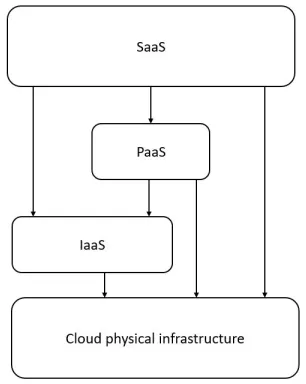
Fig. 3.4: Cloud service delivery model
Each service type is based on distinct implementation layer, as shown in Figure 3.4 [49]. It can be seen from the figure that service resources provided by upper level service provider, such as SaaS service, are able to set up service resource indepen-dently. Also SaaS application developer can accommodate them on other leased PaaS platforms.
3.4.1 Security threat
Multiple categories of security threat over cloud computing system are listed below:
1. Privileged user access: With user data stored in server from cloud service provider, processing data out of reign of user per se boost security risk to some extent since administrator of service operator might have permission to access and process of data.
2. Compliance: Cloud computing operator has obligation in supporting third party institute to offer censorship of accuracy and security level. The security of data will be threatened if some service provider turn down external audit and safe authentication.
3. Data location: Cloud computing clients have no knowledge of the location where data store at.
4. Data segregation: All users under cloud computing environment process their data in shared pool of system. Total data safety requires not only encryption, but also data segregation.
5. Data recovery: Providers are supposed to back up entire data chunk, in order to recover user data shortly after occurrence of physical catastrophe and artificial vandalism.
6. Investigative support: With multiple users data stored as a group, it will be difficult to investigate when delinquent behaviors happens.
7. Long term viability: Service providers are not supposed to go bankrupt in terms of avoiding influencing user data stability and sustainability.
managers for setting and monitoring policies to evaluate information and sup-port customer staff to understand how to safely and reliably use their product.
3.4.2 Application of security system
With all users data stored on cloud, they lost absolute control over their private in-formation on the fly. Therefore, cloud service provider must pledge secure and strong guarantee to ensure authenticity, integrity and confidentialitty of those contents. In order to do that, encryption over the data being transmitted and saved is inevitable essential.
The homomorphism of Fully Homomorphic Encryption can perform any proces-sion to sensitive data after encrypting original message without leaking contained private information. Performing Fully Homomorphic Encryption algorithm on pro-cessing data with enciphering bring us reliable safety measure during cloud compu-tation. To put it in another way, encrypting sensitive data before synchronizing local data to boost data security level. Even if these data were stolen, malicious users only retrieve cipher text after encryption. One can not work out the plain text without keys where processed by users instead of cloud side. Meanwhile, with the help of homomorphism of Fully Homomorphic Encryption, cloud will possess the ability to process cipher text data. The defects in wasting resources and low efficiency of tra-ditional operations can thus be avoided. while normal encryption approaches need to sent cipher data to user terminal, eventually transmit data back to cloud side on decryption operation performed on them by users.
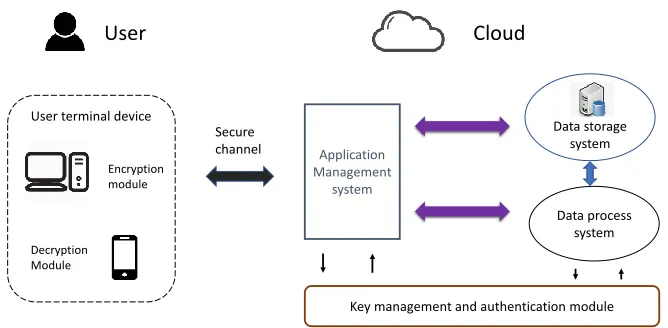
A data security scheme constructed by cloud computing based on Fully Homo-morphic Encryption is consist of user terminal and cloud side as shown in Figure 3.5.
User Cloud
User terminal device
Encryption module
Decryption Module
Application Management
system
Secure channel
Data process system Data storage
system
Key management and authentication module
Fig. 3.5: Cloud security scheme model
conditions for users to implement information transactions through cloud computing system login program. Users are also responsible for submitting user request over the cloud, encrypting and decrypting user private data, uploading and downloading cipher text.
The works by cloud include application managing system, data processing system, data storage system, key management and authentication module. Most important one of all is application manage system, which is obliged to coordinate process user requests. For example, basic order over inquiry for encryption key or user authen-tication is delivered to key management and authenauthen-tication module, assignment for computation upon raw data is handed over to data process system.
Below are specific steps for the scheme:
1. User access to cloud: After receiving user requests, application manage system repost user information to key mange and authentication module, where a pair of symmetry key based on user information from certain algorithm is generated afterwards to bind user information and key together before finally encrypted and stored. Application manage system send key pairs to users via safe channel. 2. User encrypt data on client terminal with keys, transmit encrypted cipher text data towards cloud side. Application manage system store them in storage system on receiving those data.
3. When user need to use the data, application manage system extract data back to user from storage system upon receival of user requests before users obtain the data, decrypt it and apply it for practical usage.
4. With the feature of Fully Homomorphic Encryption algorithm, data process system perform direct retrieval in cipher text database for encrypted key words when operations of data searching is needed.
5. It then deliver cipher text data retrieved to users, who will have access to it after decryption without decrypting entire cipher database before retrieval. The method discussed saves time, boost benefits for users and reduce system cost.
3.4.3 FHE scheme over cloud: a scenario
This scenario use Fully Homomorphic Encryption which has wide applications in various fields:
𝐸𝑛𝑐 𝑎 , 𝐸𝑛𝑐 𝑏 , 𝑓()
Evaluates Enc a , Enc b
homomorphically with 𝑓()
𝑓(𝐸𝑛𝑐 𝑎 , 𝐸𝑛𝑐 𝑏 )
Recover
𝑓 𝑚 = 𝐷𝑒𝑐(𝐸𝑛𝑐 𝑓 𝑚 )
Cloud Client
Using a cryptosystem based on Fully homomorphic encryption
Fig. 3.6: FHE over cloud: a scenario
(2) Data process: Fully Homomorphic Encryption scheme let user and trusted third party perform process operations directly on cipher text data, with absence of original data. Having the computation results in hands, users start to decrypt and thus retrieve data processed.
For example, in medical or health care information system, electronic prescriptions are all stocked on cloud server in the format of cipher text. Sometimes hygiene de-partment need to know distribution of geographic location and age from patients with some particular diseases in certain areas for emergency measure taken against public sanitation safety issue. Ciphered electronic prescription is handed over to professional data process service business partner for desired correct data when decrypted after dealing with results.
(3) Cipher text search: cipher text retrieving method can perform searching di-rectly towards cipher data based on Fully Homomorphic Encryption technology. Not only search privacy and retrieval efficiency can be assured and boosted, addition and multiplication computation can be perform on data searched without amending corresponding plain text as well.
An example of homomorphic operation between user and cloud is illustrated in Figure 3.6.
functionf(), it compute homomorphic operationf(Enc(a), Enc(b)) without knowing actual contents of a or b using evaluation addition or evaluation multiplication.
4
AN OVERVIEW OF RECENT RELATED WORKS
In this chapter we briefly review the existing related works in the past few years. In 2012, Lopez-Alt, Eran Tromer, and Vinod Vaikuntanathan[10] first proposed LTV Homomorphic Encryption scheme. They use the NTRUEncrypt, one of the earliest attempts towards encryption based on latiice problem, to obtain a practical Fully Homomorphic Encryption scheme with several differences from original NTRU-Encrypt.
In 2014, two years following proposal by Lopez-Alt, et al[10], LTV homomorphic encryption is implemented in software complied C environment by K.Rohloff [50]. This method relied on the manipulation of very large integers so that the system was both secure and capable of supporting the evaluation of sufficiently large circuits. Prior implementations designs, for the most part, reckon on single threaded execu-tion on commoditary CPU due to difficulty of lack of native support for multi-thread execution with underlying software libraries. This case in addition to the inherent computational cost of secure computing using known SWHE and FHE schemes, pre-vented the practical use of SWHE and FHE.
Encryp-tion implementaEncryp-tion provide at least an order of magnitude improvement in runtime as compared to recent publicly known evalution results of other software implemen-tation.
Another work by Dai [51] in 2014 proposed a GPU optimized library to support Fully homomorphic Encryption. Despite the active advances witnessed 5 years af-ter Gentry’s first proposed plausible Fully Homomorphic Encryption scheme and 2 years after the introduction of LTV Fully Homomorphic Encryption scheme, FHE still has not sufficiently prepared to directly benefit public. Motivated by some main bottlenecks concentrated on practical FHE, this paper build a large polyno-mial arithmetic library optimized for NVIDIA GPU to support Fully Homomorphic Encryption scheme. In the experiment, a server equipped with Intel Xeon E5-2609 running @2.5GHz, 64 GBytes of memory, and a NVIDIA GeForce GTX 690 running @915MHz with 3072 stream processors and 4 GBytes of memory are used.
To realize the large polynomial arithmetic library, they convert polynomial with large coefficients using Chinese Remainder Theorem(CRT) into many polynomial with small coefficients, and then carry out modular multiplication in the residue space using custom developed Discrete Fourier Transform based library. The library is further extended to support the homomorphic evaluation operations and Number Theoretical Transform(NTT) is utilized to realize large polynomial arithmetic. This method demonstrated significant speedups over previous reported results. Additional conclusion is drawn that the efficiency is limited by the memory of the target GPU. Hence, even greater speedup may be achieved simpley by moving to GPU with more memory.
in circuit level. The accelerator introduced is connected via a fast PCIe interface to a CPU platform to provide homomorphic evaluation service to any application that needed to support computations. A number theoretical transform based multiplier architecture capable of effciently handling very large polynomials is introduced. The gap between what is currently available on a CPU and what is practical in real life is somehow too far to consider software only solutions. This trigger researchers to study the use of alternative platforms such as graphic processing units (GPU) and re-configurable logic such as FPGAs. What is more, even further domain specific ASIC designs to accelerate homomorphic evaluations.
The main contributions of the paper are FPGA architecture presented to acceler-ate LTV FHE scheme and FPGA device connected to PC with high speed interface. This architecture may be considered as implementation of an external FHE acceler-ator that will speedup homomorphic evaluations taking place on a CPU. AES block cipher is used as an accelerator to homomorphic evaluation synthesized for the Xilinx Virtex 7 family. Efficiency of large polynomial computation is improved on different platforms as similar CPU and GPU implementations.
In 2016, an FPGA based computation accelerator as part of a homomorphic en-cryption processing unit co-processor was designed to implement key computation application [53]. In this paper, advanced designing and an FPGA based computa-tion accelerator are implemented as part of a homomorphic encrypcomputa-tion processing unit co-processor. This hardware accelerator technology improves the practicality of computing on encrypted data by reducing the computational bottleneck of lattice encryption primitives that support homomorphic encryption scheme.
arith-metic such as ring addition, ring subtraction and ring multiplication. The paper focus on experimental performance analysis on LTV Fully Homomorphic Encryption scheme, instantiating this capability in a Xilinx Virtex-7 FPGA that can attached to a host computer through either a PCI express port or Ethernet. They experimentally compare performance with reference software implementation of the CRT and iCRT bottleneck on a commodity CPU.
Anothe paper [62] provide a new potential of FPGAs for speeding up homomor-phic encryption operations. In this work, a functional FPGA implementation of ho-momorphic encryption multiplication operation of large polynomials inZq[x]/(xN+1)
whose ring dimension is determined byN which is a positive integer of form 2k. While
the paper use NTT algorithm to perform polynomial multiplication, which has time complexity ofO(N logN), it demonstrate architecture space complexity ofO(N n2). It
also provide results and performance measurement of implementation equipped with Xilinx Spartan 6 LX100 FPGA.
A paper published in 2017 [1] proposed a software/hardware co-designed accel-erator implemented through a high level synthesis flow to accelerate homomorphic computation. They demonstrated a large modular polynomial multiplier configurable in both degree and coefficients size, as well as proposed a modular polynomial reducer based on polynomial with general form allowing optimization in the homomorphic context.The hardware part implements the product of large coefficients in RNS do-main, and the schoolbook multiplication algorithm at polynomial level resulting in complexity ofO(N2) in terms of time andO(n2) in terms of area. The designing and implementation of the modular multiplier which integrates a multiplier on polynomial with large coefficients and large degree with fast software computation are based on the FPGA underlying computation accelerator.
Table 4.1: Truncated polynomial ring multiplier performance in [1] N n Platform # Register Latency(µs)
512 32 XC7V585T 102 66.41 1024 26 Spartan 6 114 69.1
φ(x) = xN + 1 where N is power of 2. The interface between hardware and software
5
PROPOSED ARCHITECTURE FOR FULLY
HOMOMORPHIC ENCRYPTION
This chapter gives a comprehensive presentation and explanation of our proposed work. We put our minds into optimizing the process of encryption part where the operations are performed on user side in the cloud computing model since the genera-tion of public keys and secret keys are precomputed. Thus the calculagenera-tions performed by the server including evaluation or more, are beyond our focus.
A novel variant of LFSR arithmetic architecture is proposed to implement LTV Fully Homomorphic Encryption. Conventional LFSR structure is expanded and mod-ified for performing the truncated polynomial ring multiplication in Rq[x].
The specific part we are going to concentrate on is the encryption equation
c = hs+ 2e+m where ciphertext c is derived from public key h, message m and sample polynomial s, e. The efficiency of LTV system is significantly impacted by the speed of multiplication of truncated polynomials with high degree and large co-efficients. Taking the advantage of parallelism for computation of multiplication in LTV Fully Homomorphic Encryption scheme, our proposed work based on LFSR structure reduced the time complexity of quasi-linear time O(N logN loglogN) in [52]
and O(N logN) in [62] to linear time O(N) for polynomial multiplication, which is
beneficial with large value of degreeN.
As for the large integer multiplication, we then proposed to choose Mersenne number q to further speedup the modular multiplication. The special moduli sets, including 2n+ 1,2n, 2n−1,etc, which have drawn much more attention than normal
moduli when constructing modular adders and modular multipliers, offers a great time reduction on modular reduction when performing modular multiplications as well as modular additions.
are proposed for high speed processing of LFSR operations. We leverage to select parallel prefix structure which provide efficient modular addition over other popular adders. What is more, booth parallel multiplier are used to perform modular mul-tiplication with reduced number of partial products during which the accumulation process taking place.
5.1
LFSR Based Structure
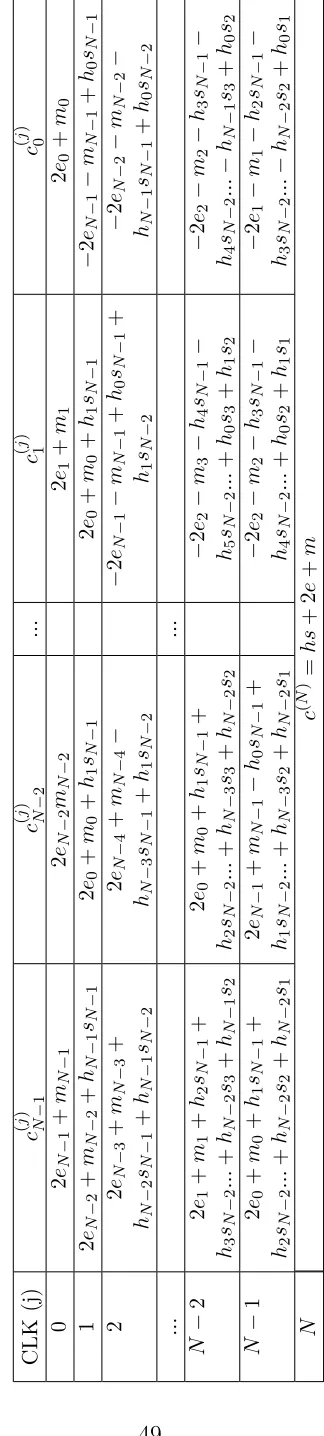
In this section, firstly basic knowledge is introduced about LFSR(Linear Feedback Shift Register) and its applications. Then the proposed LFSR based architecture is presented to realize truncated polynomial ring multiplication in encryption part of LTV Fully Homomorphic Encryption scheme. The details about the proposed archi-tecture is explained with given algorithm and a archiarchi-tecture complexity analysis. A table of register contents is shown for better understanding of how the multiplication works in the LFSR-like multiplier system.
5.1.1 Linear Feedback Shift Register
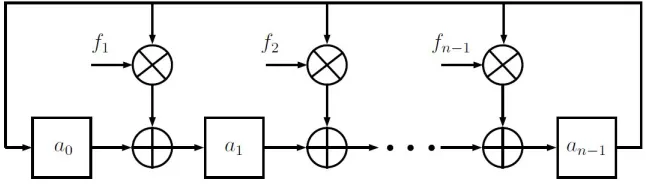
LFSR (Linear Feedback Shift Register) is an elegant way to generate long pseudo-random sequences with most applications in pesudo-pseudo-random numbers, fast digital counters, and cryptography which has cryptographically strong properties and un-complicated hardware implementation advantages. An LFSR consisted of clocked storage elements(flip-flop) and a feedback path. The number of storage elements rep-resent the degree of LFSR, while feedback network computes the input for the last flip-flop as XOR-sum of certain flip-flops in the shift register.
The stream value of outputs generated by registers and logic arithmetic is de-pendent on its previous state with maximum length of 2N −1 when initial state as
non-zero value, where N is highest degree of characteristic polynomial.
Fig. 5.1: Linear Feedback Shift Register
by characteristic polynomial f(x). which is represented as:
f(x) =fNxN +fN−1xN−1+...+f1x1+ 1 (23)
In figure 5.1, a L
refers to an adder, aN
refers to a multiplier and represents a register. Assume that registers are initially loaded with coefficients of polynomial
A(x) = (a0, a1...aN−1), a shift to right operation of LSFR is equivalent to performing A(x)×x mod f(x), where x is root of characteristic polynomial f(x).
5.1.2 Proposed truncated polynomial ring multiplier
The polynomial multiplication and addition in LTV Fully Homomorphic Encryption scheme is taken modulo xN + 1, a modification of original LFSR is designed to
ac-commodate the truncated polynomial ring computation.
Specifically, original LFSR can complete the operation without substantial mul-tiplication because the polynomial coefficients always have value from {−1,0,1} as ternary polynomial. In our case, however, the coefficients integer has much larger range of values in {0, q−1}.
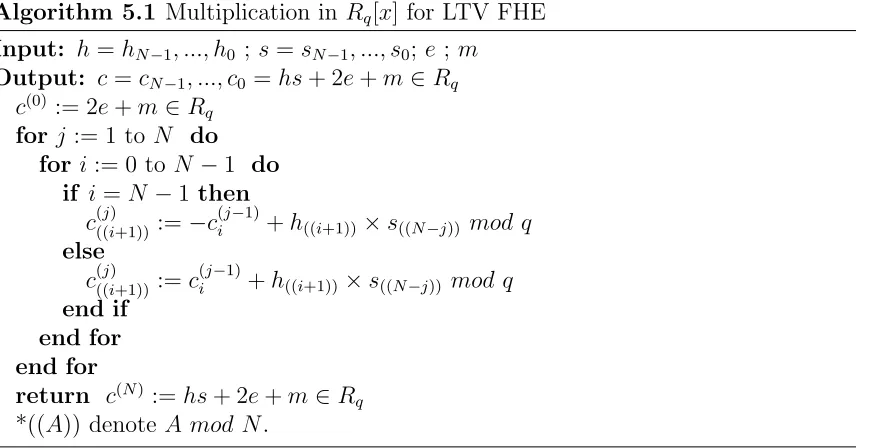
The contents of registers are initialized as integer coefficients of polynomial 2e+m, let values of register be c(j),(j is from 0 to N)in clock cycle N, contents of each
register is denoted asc(Nj)−1, cN(j−)2, ..., c(1j), c(0j). Specific steps to perform the truncated polynomial ring multiplication is shown in Algorithm 5.1.
Algorithm 5.1 Multiplication in Rq[x] for LTV FHE
Input: h=hN−1, ..., h0 ; s=sN−1, ..., s0; e ;m
Output: c=cN−1, ..., c0 =hs+ 2e+m∈Rq
c(0) := 2e+m∈R
q
for j := 1 to N do for i:= 0 to N −1 do
if i=N −1then
c(((ji)+1)) :=−ci(j−1)+h((i+1))×s((N−j)) mod q
else
c(((ji)+1)) :=ci(j−1)+h((i+1))×s((N−j)) mod q
end if end for end for
return c(N) :=hs+ 2e+m∈Rq
*((A)) denote A mod N.
as one of the sample polynomials, and 2e(x) +m(x) comprised of sample polynomial and message polynomial, each with N coefficients.
Because truncated polynomial rings in LTV Fully Homomorphic Encryption scheme are taken modulo xN + 1, there are arithmetic scenarios of both addition and
sub-traction in this computation, in other words, either positive or negative value of multiplication result could be added to next round of operation.
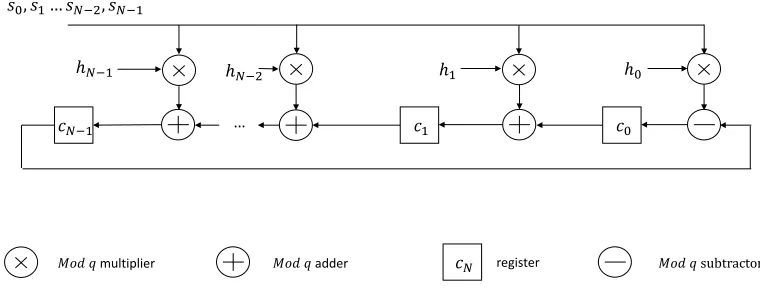
Based on above algorithm, an LFSR originated architecture to perform LTV Fully Homomorphic Encryption scheme polynomial multiplication in Rq[x] is proposed as
Figure 5.2.
In this structure, it is required to lay out N − 1 modular q adders, 1 modu-lar q subtractor, N modular q multipliers and N registers. Each register can store value of [log2q] bits length. The arithmetic of modular multiplication and mod-ular addition are performed in modmod-ular q multiplier and modular q adder, which also cause noticeable time delay and will be introduced in next section. Regis-ters c = (cN−1, cN−2, ..., c1, c0) are initially loaded with coefficients of polynomial