ABSTRACT
LIN, YUN-MEI AMY. Effect of Preheating Temperature, Early Incubation Temperature, and Different Turning Frequency, on Embryonic Development and Broiler Performance. (Under the direction of Dr. John T. Brake).
Effect of Preheating Temperature, Early Incubation Temperature, and Different Turning Frequency, on Embryonic Development and Broiler Performance
by
Yun-mei Amy Lin
A thesis submitted to the Graduate Faculty of North Carolina State University
in partial fulfillment of the requirements for the degree of
Master of Science
Poultry Science
Raleigh, North Carolina 2012
APPROVED BY:
_______________________________ ______________________________ J. T. Brake, Chair C.R Stark
ii
DEDICATION
iii
BIOGRAPHY
iv
ACKNOWLEDGEMENTS
v
TABLE OF CONTENTS
Page
L
IST OF TABLES .………...……….……….………. viiiL
IST OF FIGURES ……….……….……….... xvL
IST OF ABBREVIATIONS ..……….... xviI
NTRODUCTION .……….……….. 1L
ITERATURE REVIEW ..……….. 3Effects of Preheating .………..… 3
Effects of Incubation Temperature ………..……… 6
Effects of Turning …..……….……….… 9
Yolk Sac Membrane (YSM)………..………... 11
Chorioallantoic Membrane (CAM)……..……….……….….. 12
Factors Affecting Chick Length ………. 14
Factors Affecting Yolk Sac Absorption ...………..………. 14
Parallel Research Results ………….……….……… 15
vi Page
M
ATERIALS AND METHODS ...………...… 34Experiment I. Replication 1……… 11 ……….………... 34 Experiment I. Replication 2 ..…………...……….. 36
Experiment II. Replication 1 .…………...……….. 36
Experiment II. Replication 2 ……….. 38
Experiment III ...……..………... 39
Experiment IV. Incubation……….. 40
Experiment IV. Sampling ……… 41
Experiment IV. Broilers ………. 42
R
ESULTS AND DISCUSSION .………...…..………... 47Experiment I. Replication 1 and 2 ….….………... 47
Experiment II. Replication 1 and 2………. 51
Experiment III ...………... 60
Experiment IV. Incubation………. 67
Experiment IV. Broilers ………. 73
vii Page
O
VERALL DISCUSSION AND CONCLUSIONS ………. 164Ventilation ……...……….. 164
Primordial Germ Cells (PGCs) ………... 165
Chick Quality Evaluation ………... 166
Preheating and Embryo Development……….... 166
Conclusions………. 167
References ………... 170
viii
LIST OF TABLES
………...………
Page
Literature Review
Table LR-1A. The effect of Control, Preheating, Manipulation, and
PreManipulation treatments on body weight at 0 d and 35 d, relative carcass yield, and relative organ weights of female broiler chickens at 35 d of age in
Experiment A ………..……….. 20
Table LR-2A. The effect of Control, Preheating, Manipulation, and
PreManipulation treatments on body weight at 0 d and 35 d, relative carcass yield, and relative organ weights of male broiler chickens at 35 d of age in
Experiment A ……….………... 21
Table LR-1B. The effect of Control, Preheating, Manipulation, and
PreManipulation on body weight at 0 d and 35 d, relative carcass yield, and relative organ weights of female broiler chickens at 35 d of age in Experiment
B .….……... 22 Table LR-2B. The effect of Control, Preheating, Manipulation, and
PreManipulation treatments on body weight at 0 d and 35 d, relative carcass yield, and relative organ weights of male broiler chickens at 35 d of age in
Experiment B ……….……….………... 23
Results: Experiment I
Table I-1. Effect of 24 or 96 daily turning frequency to E18 at 38.1°C (100.5°F) initial incubation temperature1 on initial egg weight and embryonic
development at E14 in two replications of Experiment I……….……….. 49
Table I-2. Effect of 24 or 96 daily turning frequency to E18 at 38.1°C (100.5°F) initial incubation temperature1 on chick body weight, absolute and relative yolk sac weight, yolk free body weight, and chick length at hatching in two
ix
Results: Experiment II
Table II-1. Effect of 24 or 96 daily turning frequency to E15 of incubation at 37.5°C (99.5°F) initial incubation temperature1 on initial egg weight, egg weight
loss, and embryonic development in two replications of Experiment II ………… 54 Table II-2. Effect of 24 or 96 daily turning frequency to E15 of incubation, at
37.5°C (99.5°F) initial incubation temperature1 on chick body and yolk sac weight, yolk free body weight, and chick length at hatching in two replications of
Experiment II ...……… 55
Table II-3. Effect of 24 or 96 daily turning frequency to E3, E9, and E15 of incubation, followed by 24 daily turning frequency to E18 of incubation at 37.5°C (99.5°F) initial incubation temperature1 on initial egg weight and
embryonic development in second replication2 of Experiment II .……….……… 56 Table II-4. Effect of 24 or 96 daily turning frequency to E3, E9, and E15 of
incubation, followed by 24 daily turning frequency to E18 of incubation at 37.5°C (99.5°F) initial incubation temperature1 on chick body and yolk sac weight, yolk free body weight, and chick length at hatching in second
replication2 of Experiment II………...……… 58
Results: Experiment III
Table III-1. Effect of incubation at 38.1°C (100.5°F) to E3 or 37.5°C (99.5°F) and 96 n/d turning frequency on initial egg weight, egg weight loss, absolute and relative embryo and yolk sac weights, and embryo length at E14 in
Experiment III………... 62
Table III-2. Effect of 96 daily turning frequency to E15 or E18 of incubation followed by 24 daily turning frequency to E18 with an incubation temperature of 38.1°C (100.5°F) to E3 or 37.5°C (99.5°F) on chick body and absolute and
relative yolk sac weights, and chick length in Experiment III ………. 63 TABLE III-3. Effect of 96 daily turning frequency to E15 or E18 of incubation
followed by 24 daily turning frequency to E18 of incubation temperature at 38.1°C (100.5°F) to E3 or 37.5°C (99.5°F) on chick body and absolute and
x
Results: Experiment IV
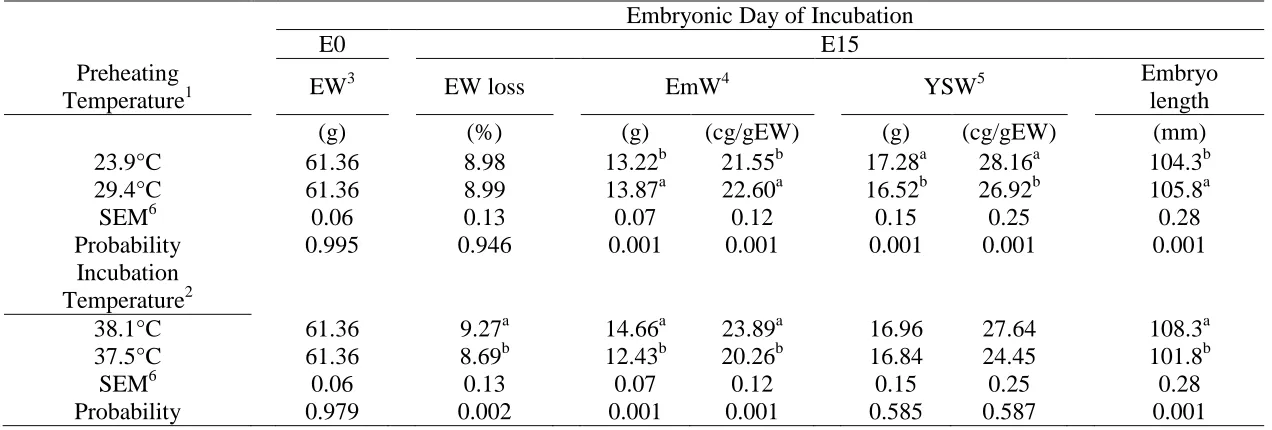
Table IV-1. Egg weight, egg weight loss, absolute and relative embryo weight, absolute and relative yolk sac weight, and embryo length from chick embryos as influenced by preheating temperature, incubation temperature, daily turning frequency, and preheating temperature by incubation temperature, incubation temperature by daily turning, preheating temperature by daily turning, and incubation temperature by daily turning by preheating temperature interactions
at E15 in Experiment IV ...……….………... 84
Table IV-2. Effect of preheating temperature, incubation temperature, daily turning frequency, and preheating temperature by incubation temperature, incubation temperature by daily turning, preheating temperature by daily turning, and incubation temperature by daily turning by preheating temperature interactions on chick body weight, and yolk free body weight (YFBW), and absolute and relative yolk sac weight, and chick length from hatched chicks at
E21 in Experiment IV ……… 88
Table IV-3. Yolk sac membrane (YSM) vasculature from E5 to E8 as influenced by preheating temperature, incubation temperature, daily turning frequency, and the interactions of preheating temperature by incubation
temperature, incubation temperature by daily turning, preheating temperature by daily turning, and incubation temperature by daily turning by preheating
temperature in Experiment IV.………..……. 92
Table IV-4. Chorioallantoic membrane (CAM) vasculature from E7 to E10 as influenced by preheating temperature, incubation temperature, daily turning frequency, and the interactions of preheating temperature by incubation
temperature, incubation temperature by daily turning, preheating temperature by daily turning, and incubation temperature by daily turning by preheating
temperature in Experiment IV.……….. 96
Table IV-5. Body weight of female broiler chickens as affected by preheating temperature, incubation temperature, daily turning frequency, and preheating temperature by incubation temperature, incubation temperature by turning frequency, preheating temperature by turning frequency, and incubation temperature by turning frequency by preheating temperature interactions in
xi Table IV-6. Percentage mortality (deaths) of female broiler chickens as
affected by preheating temperature, incubation temperature, daily turning frequency, and preheating temperature by incubation temperature, incubation temperature by turning frequency, preheating temperature by turning frequency, and incubation temperature by turning frequency by preheating temperature
interactions in Experiment IV ……… 104
Table IV-7. Adjusted feed conversion ratio (AdjFCR) of female broiler chickens as affected by preheating temperature, incubation temperature, daily turning frequency, and preheating temperature by incubation temperature, incubation temperature by turning frequency, preheating temperature by turning frequency, and incubation temperature by turning frequency by preheating
temperature interactions in Experiment IV………. 107 Table IV-8. Feed intake of female broiler chickens as affected by preheating
temperature, incubation temperature, daily turning frequency, and preheating temperature by incubation temperature, incubation temperature by turning frequency, preheating temperature by turning frequency, and incubation temperature by turning frequency by preheating temperature interactions in
Experiment IV……… 111
Table IV-9. Body weight of male broiler chickens as affected by preheating temperature, incubation temperature, daily turning frequency, and preheating temperature by incubation temperature, incubation temperature by turning frequency, preheating temperature by turning frequency, and incubation temperature by turning frequency by preheating temperature interactions in
Experiment IV……… 114
Table IV-10. Percentage mortality (deaths) of male broiler chickens as affected by preheating temperature, incubation temperature, daily turning frequency, and preheating temperature by incubation temperature, incubation temperature by turning frequency, preheating temperature by turning frequency, and incubation temperature by turning frequency by preheating temperature interactions in
xii Table IV-11. Adjusted feed conversion ratio (AdjFCR) of male broiler chickens
as affected by preheating temperature, incubation temperature, daily turning frequency, and preheating temperature by incubation temperature, incubation temperature by turning frequency, preheating temperature by turning frequency, and incubation temperature by turning frequency by preheating temperature
interactions in Experiment IV………... 120
Table IV-12. Feed intake of male broiler chickens as affected by preheating temperature, incubation temperature, daily turning frequency, and preheating temperature by incubation temperature interaction, incubation temperature by turning frequency, preheating temperature by turning frequency, and incubation temperature by turning frequency by preheating temperature interactions in
Experiment IV……… 123
Table IV-13. The effect of preheating temperature, incubation temperature, daily turning frequency, and interactions of preheating temperature by incubation temperature, incubation temperature by turning frequency, preheating temperature by turning frequency, and incubation temperature by turning frequency by preheating temperature on absolute carcass yield of female
broiler chickens at 35 d of age in Experiment IV……….. 126 Table IV-14. The effect of preheating temperature, incubation temperature,
daily turning frequency, and interactions of preheating temperature by incubation temperature, incubation temperature by turning frequency, preheating temperature by turning frequency, and incubation temperature by turning frequency by preheating temperature on relative carcass yield of female
broiler chickens at 35 d of age in Experiment IV…….………. 129 Table IV-15. The effect of preheating temperature, incubation temperature,
daily turning frequency, and interactions of preheating temperature by incubation temperature, incubation temperature by turning frequency, preheating temperature by turning frequency, and incubation temperature by turning frequency by preheating temperature on absolute carcass yield of male
xiii Table IV-16. The effect of preheating temperature, incubation temperature,
daily turning frequency, and interactions of preheating temperature by incubation temperature, incubation temperature by turning frequency, preheating temperature by turning frequency, and incubation temperature by turning frequency by preheating temperature on relative carcass yield of male
broiler chickens at 35 d of age in Experiment IV……….. 135 Table IV-17. The effect of preheating temperature, incubation temperature,
daily turning frequency, and interactions of preheating temperature by incubation temperature, incubation temperature by turning frequency, preheating temperature by turning frequency, and incubation temperature by turning frequency by preheating temperature on absolute carcass yield of female
broiler chickens at 49 d of age in Experiment IV……….. 138 Table IV-18. The effect of preheating temperature, incubation temperature,
daily turning frequency, and interactions of preheating temperature by incubation temperature, incubation temperature by turning frequency, preheating temperature by turning frequency, and incubation temperature by turning frequency by preheating temperature on relative carcass yield of female
broiler chickens at 49 d of age in Experiment IV……….. 141 Table IV-19. The effect of preheating temperature, incubation temperature,
daily turning frequency, and interactions of preheating temperature by incubation temperature, incubation temperature by turning frequency, preheating temperature by turning frequency, and incubation temperature by turning frequency by preheating temperature on absolute carcass yield of male
broiler chickens at 49 d of age in Experiment IV.……….. 144 Table IV-20. The effect of preheating temperature, incubation temperature,
daily turning frequency, and interactions of preheating temperature by incubation temperature, incubation temperature by turning frequency, preheating temperature by turning frequency, and incubation temperature by turning frequency by preheating temperature on relative carcass yield of male
xiv Table IV-21. Body weight and absolute and relative (g/100g BW) weights of
tissues and organs from female broiler chicks as influenced by preheating temperature, incubation temperature, daily turning, and interactions of
preheating temperature by incubation temperature, incubation temperature by daily turning, preheating temperature by daily turning, and incubation
temperature by daily turning by preheating temperature at 35 d of age in
Experiment IV……… 150
Table IV-22. Body weight and absolute and relative (g/100g BW) weights of tissues and organs from male broiler chicks as influenced by preheating temperature, incubation temperature, daily turning, and interactions of
preheating temperature by incubation temperature, incubation temperature by daily turning, preheating temperature by daily turning, and incubation
temperature by daily turning by preheating temperature at 35 d of age in
Experiment IV………... 153 Table IV-23. Body weight and absolute and relative (g/100g BW) weights of
tissues and organs from female broiler chicks as influenced by preheating temperature, incubation temperature, daily turning, and interactions of
preheating temperature by incubation temperature, incubation temperature by daily turning, preheating temperature by daily turning, and incubation
temperature by daily turning by preheating temperature at 49 d of age in
Experiment IV……… 156
Table IV-24. Body weight and absolute and relative (g/100g BW) weights of tissues and organs from male broiler chicks as influenced by preheating temperature, incubation temperature, daily turning, and interactions of
preheating temperature by incubation temperature, incubation temperature by daily turning, preheating temperature by daily turning, and incubation
temperature by daily turning by preheating temperature at 49 d of age in
xv
LIST OF FIGURES
………...………
Page
Literature Review
Figure LR-1A. Hatching progression of the four treatments in Experiment A………. 18 Figure LR-1B. Hatching progression of the four treatments in Experiment B……….. 19
Materials and Methods
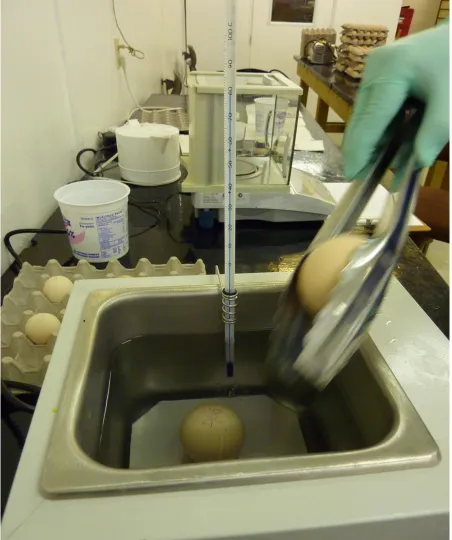
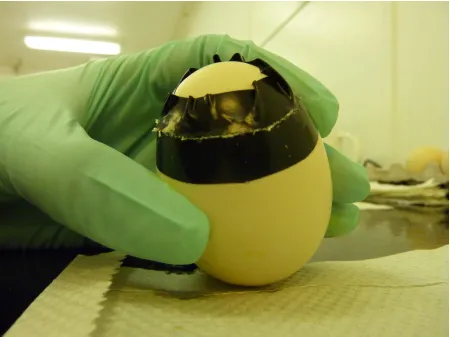
Figure MM-1. Eggs in individual pedigree bags with its tag during transfer………… 35 Figure MM-2. Water bath for boiling eggs………... 44 Figure MM-3. Tape around the egg and cut between the tape……….. 45 Figure MM-4. The yolk sac membrane (YSM) and chorioallantoic membrane
xvi
LIST OF ABBREVIATIONS
AdjFCR Adjusted feed conversion ratio, corrected for mortality
BW Body weight
C Celsius
CAM Chorioallantoic membrane
cm Centimeter
cg Centigram
d Day
E Embryonation
EW Egg weight
Em Embryo
EmW Embryo weight
F Fahrenheit
g Gram
h Hour
min Minute
RH Relative humidity
wk Week
1
INTRODUCTION
3
LITERATURE REVIEW
6 compared two different lengths of preheating before incubation, 4 h or 24 h at 37.8°C, and found the hatching time and embryo development between the preheating treatments to not differ. However, preheating had a beneficial effect on the hatchability of long stored eggs (Proudfoot, 1966; Reijrink, 2010). Meijerhof (1994) collected eggs from flocks of two ages (37 wk and 59 wk) and preheated the eggs at 27°C for 16 h compared with preheating at 20°C for the same period. The author suggested that hatchability of eggs from younger hens was not significantly influenced by pre-warming while the hatchability of eggs from older birds was significantly reduced by preheating at 27°C. Mayes and Takeballi (1984) concluded that pre-warming improved viability and hatchability when low storage temperatures were used. No beneficial effects were reported when eggs were stored for a short period at 15° to 16°C.
11 eggs. Elibol and Brake (2004) reported E0 to E2 and E3 to E8 to be the most critical periods for turning of commercial broiler hatching eggs with respect to early and late embryonic deaths, respectively. This suggested that different periods of early development were ultimately responsible for different stages of longer term embryonic development. Caldwell and Cornwell (1975) believed that egg turning was involved in redistribution of the heat from the brood patch of the hen. However, turning was found to still be required in force-draught incubators where temperature gradients did not normally exist within individual eggs (Drent, 1975). The common explanation for the necessity of turning has been that it prevented the adhesion of the embryo to the inner egg shell membrane during early development (Eycleshymer, 1906; New, 1957; Drent, 1975; Freeman and Vince, 1974; Skutch, 1967; Wilson, 1991). Wilson and Wilmering (1988) showed that cessation of turning at E10 of incubation decreased hatchability but that no effect was observed when cessation of turning occurred after E16. Tona (2005) concluded that egg turning was required during incubation until E12, but should not be stopped until after E15. Likewise, Deeming (2009) mentioned that there was no evidence to suggest that the absence of turning after E15 had any negative effect on chicken embryonic development or hatchability.
12 performed a supportive role. During the first week of incubation, the YSM was described as floating on the yolk but eventually grew around and enclosed the entire yolk (Romanoff, 1960). The YSM not only played a major role in the transport of nutrients from the yolk to the chick embryo (Yadgary et al., 2011) but was also a site for the production of blood and synthesis of specific proteins. During the first few days of development, nutrients have been shown to move to the tissues from the yolk and egg shell by simple diffusion. Following development of circulatory tissues, chick embryos received nutrients and hormones from the yolk by the blood stream in a transport scheme much as would an adult bird. Therefore, blood and blood vessels in the YSM were formed before vessels developed in the embryo body (intraembryonic vessels) and were continuously changing with the stage of embryo development throughout incubation (Romanoff, 1960). The YSM has been found to function in a manner similar to the placenta in mammalians, as both tissues provided nutrients to the embryo. On the other hand, Haller (1758) observed that the endoderm of the YSM was continuous with the gut endoderm and was an extension of the intestine, which differed from the placenta. Other than nutrients, the yolk has also been reported to contain many hormones that can modulate the growth of the embryo (Hayward et al., 2004). Therefore, the development of the YSM could be described as controlling both yolk sac absorption and ultimately contributing to the quality of the hatched chicks.
14 The CAM has been found to assume the role of oxygen transport as the capacity of the YSM diminished (Romanoff, 1960; Etches 1996).
Factors Affecting Chick Length. Although Deeming (2005) doubted the usefulness of chick length as a meaningful indicator of chick quality, many researchers have suggested chick length to be a convenient way to determine chick quality (Wolanski et al., 2003; Decuypere and Bruggeman, 2007; Reijrink, 2010). Studies by Wolanski et al. (2003; 2007) showed that chick length at hatching was positively correlated with breeder strain. Kampula (2004) confirmed this and reported that egg size could influence chick length. Incubation processes that optimally supply the needs of the chicken embryo have also been reported to favorably influence chick length (Hill, 2001; Reijrink and Molenaar, 2008). Embryos subjected to high incubation temperature (Reijrink and Molenaar, 2008) exhibited a lower yolk free body mass (YFBM), shorter chick length, and open navels (Lourens et al., 2005, 2007; Hulet et al., 2007; Leksrisompong et al., 2007). The negative effect of prolonged egg storage on chick length was evident when storage time was increased (Reijrink, 2010). Reijrink (2010) also investigated preheating, where the eggs were preheated for 4h or 24 h and concluded that preheating affected embryonic mortality during the first 2 d of incubation of stored eggs; however chick quality including chick length was not affected.
15 between the amount of residual yolk and the YFBM were contrary. Several investigations have shown that yolk sac weight increased with the flock age (Suarez et al., 1997; Vieira and Moran, 1998; Sklan et al., 2003; Hamidu et al., 2007) while Wolanski et al. (2006) reported highly significant positive correlations between yolk sac weight and day-old chick weight for a number of breeder lines and ages. However, Nangsuay et al. (2011) later commented that in those trials, the correlation was due to egg size, not flock age. Therefore, in their subsequent study, eggs from two breeder flock ages were separated, and then divided into small and large egg categories. The results confirmed that the influence was through egg weight, irrespective of yolk availability and absorption. Finkler et al. (1998) conducted a series of experiments that manipulated egg quality by removing 20% of the albumen or yolk content from eggs prior to setting. It was interesting that although the yolk sac weight decreased in the yolk manipulation treatment at E20 of incubation, the YFBW did not differ between treatments.
Parallel Research Results. The following experiments were also funded by BARD as part of the same grant as the present data, and had a similar experimental design as Experiment IV of the present thesis. Both Experiments A and B were conducted by the research team at The Volcani Center in Israel, headed by Dr. Shlomo Yahav.
16 weighed between 62 g and 67 g were randomly assigned to one of 4 treatments. Eggs were stored for 1-2 d prior to setting.
Experiment B. Experiment B was conducted in summer (June, 2010). The Cobb 500 broiler breeder flock was at the age of 39 wk when the eggs were collected. The eggs that weighed between 59 g and 73 g were randomly divided into the 4 treatments. Eggs were stored for 9 d prior to setting. For both experiments 180 eggs was assigned to each of the following four treatments: Control – no preheating (stored at 18°C) with 37.5°C incubation temperature; Preheating - preheating at 30.2°C for 12 h with 37.5°C incubation temperature; Manipulation – no preheating (stored at 18°C) with 38.1°C incubation temperature from E0 to E5, followed by 37.5°C; PreManipulation – preheating at 30.2°C for 12 h with 38.1°C incubation temperature from E0 to E5, followed by 37.5°C. The eggs were incubated in 2 automatic incubators (Type 65Hs, Masalles, Barcelona, Spain). Turning frequency was 24 n/d to E18 of incubation. Hatching period, hatchability, and BW data were collected during and at hatching. At 35 d, BW, carcass parts, and organ weights were measured.
18
Figure LR-1A. Hatching progression of the four treatments in Experiment A.
0%
10%
20%
30%
40%
50%
60%
70%
80%
90%
100%
470
480
490
500
510
520
Per
centage
of
chi
ck
s hatched
Time of incubation (h)
19
Figure LR-1B. Hatching progression of the four treatments in Experiment B.
0%
10%
20%
30%
40%
50%
60%
70%
80%
90%
100%
478
485
492
499
506
513
520
527
Per
centage
of
chi
ck
s hatched
Time of incubation (h)
Control
Preheating
Manipulation
20
Table LR-1A. The effect of Control, Preheating, Manipulation, and PreManipulation treatments on body weight at 0 d and 35 d,
relative carcass yield, and relative organ weights of female broiler chickens at 35 d of age in Experiment A.
Body Weight Carcass Parts and Organs
Treatment Preheating Temperature
Incubation
Temperature 0 d 35 d
Fat pad
Pectoralis
Major + Minor Heart Wattles Ovary
(g) (g/100 g BW)
Control1 18.0°C 37.5°C 47.0 1781.0b 2.2 18.9b 0.46 0.024b 0.020
Preheating2 30.2°C 37.5°C 47.6 1830.0a 2.3 19.6a 0.46 0.025b 0.020
Manipulation3 18.0°C 38.1°C 47.7 1827.0a 2.3 19.5a 0.45 0.032a 0.020
PreManipulation4 30.2°C 38.1°C 47.2 1852.0a 2.3 19.4a 0.45 0.028ab 0.020
a,b
Means in a column that possess different superscripts differ significantly (P ≤ 0.05).
1
Eggs were not preheated, and incubated at 37.5°C.
2
Eggs were preheating at 30.2°C for 12 h prior to setting, and incubated at 37.5°C from E0 to E5.
3
Eggs were not preheated, and incubated at 38.1°C from E0 to E5.
4
21
Table LR-2A. The effect of Control, Preheating, Manipulation, and PreManipulation treatments on body weight at 0 d and 35 d,
relative carcass yield, and relative organ weights of male broiler chickens at 35 d of age in Experiment A.
Body Weight Carcass Parts and Organs
Treatment Preheating Temperature
Incubation
Temperature 0 d 35 d
Fat pad
Pectoralis
Major + Minor Heart Wattles Testes
(g) (g/100 g BW)
Control1 18.0°C 37.5°C 47.2 2071.4c 1.9 19.1 0.51 0.037b 0.015b
Preheating2 30.2°C 37.5°C 47.1 2103.0bc 1.9 19.1 0.50 0.044a 0.018a
Manipulation3 18.0°C 38.1°C 47.6 2170.0a 1.9 19.3 0.50 0.044a 0.018a
PreManipulation4 30.2°C 38.1°C 47.6 2166.0ab 1.8 19.4 0.50 0.054a 0.020a
a-c
Means in a column that possess different superscripts differ significantly (P ≤ 0.05).
1
Eggs were not preheated, and incubated at 37.5°C.
2
Eggs were preheating at 30.2°C for 12 h prior to setting, and incubated at 37.5°C from E0 to E5.
3
Eggs were not preheated, and incubated at 38.1°C from E0 to E5.
4
22
Table LR-1B. The effect of Control, Preheating, Manipulation, and PreManipulation on body weight at 0 d and 35 d, relative
carcass yield, and relative organ weights of female broiler chickens at 35 d of age in Experiment B.
Body Weight Carcass Parts and Organs
Treatment Preheating Temperature
Incubation
Temperature 0 d 35 d
Fat pad
Pectoralis
Major + Minor Heart Wattles Ovary
(g) (g/100 g BW)
Control1 18.0°C 37.5°C 46.8 1764.9b 2.2 19.2b 0.39 0.026b 0.023
Preheating2 30.2°C 37.5°C 47.2 1789.0a 2.2 20.0a 0.40 0.031ab 0.022 Manipulation3 18.0°C 38.1°C 47.3 1833.5a 2.2 20.0a 0.40 0.030ab 0.022
PreManipulation4 30.2°C 38.1°C 47.0 1788.7a 2.2 19.6ab 0.39 0.036a 0.022
a,b
Means in a column that possess different superscripts differ significantly (P ≤ 0.05).
1
Eggs were not preheated, and incubated at 37.5°C.
2
Eggs were preheating at 30.2°C for 12 h prior to setting, and incubated at 37.5°C from E0 to E5.
3
Eggs were not preheated, and incubated at 38.1°C from E0 to E5.
4
23
Table LR-2B. The effect of Control, Preheating, Manipulation, and PreManipulation treatments on body weight at 0 d and 35 d,
relative carcass yield, and relative organ weights of male broiler chickens at 35 d of age in Experiment B.
Body Weight Carcass Parts and Organs
Treatment Preheating Temperature
Incubation
Temperature 0 d 35 d
Fat pad
Pectoralis
Major + Minor Heart Wattles Testes
(g) (g/100 g BW)
Control1 18.0°C 37.5°C 47.1 2080.2c 1.8 19.2b 0.40 0.051 0.017b
Preheating2 30.2°C 37.5°C 46.8 2132.3a 1.8 19.4a 0.41 0.054 0.020a
Manipulation3 18.0°C 38.1°C 47.4 2099.5b 1.8 19.6a 0.41 0.053 0.019a
PreManipulation4 30.2°C 38.1°C 47.4 2165.4a 1.8 19.8a 0.41 0.059 0.019a
a-c
Means in a column that possess different superscripts differ significantly (P ≤ 0.05).
1
Eggs were not preheated, and incubated at 37.5°C.
2
Eggs were preheating at 30.2°C for 12 h prior to setting, and incubated at 37.5°C from E0 to E5.
3
Eggs were not preheated, and incubated at 38.1°C from E0 to E5.
4
24
REFERENCES
Arora, K. L., and I. L. Kosin. 1966. Changes in the gross morphological appearance of the chicken and turkey blastoderms during preincubation storage. Poult. Sci. 45:819-825.
Afşar, A., O. Elibol, and J. Brake. 2007. The effect of flock age and egg storage period on organ development and broiler performance. Poult. Sci. 86 (Suppl. 1): 404.
Asmundson, V. S. 1947. Time held prior to incubation and hatchability of turkey eggs. Poult. Sci. 26:305–307.
Ates, C., O. Elibol, and J. Brake. 2004. The effect of storage period of eggs on hatching time and broiler performance. 4 pages in Proc. XXII World’s Poult. Cong. (on CD), 8-13 June, Istanbul, Turkey.
Baggott, G.K., D. C. Deeming, and G. V. Latter. 2002. Electrolyte and water balance of the early avian embryo: effects of egg turning. Avian and Poult. Biol. Rev. 13(1): 105-119.
Barri, A., C.F. Honaker, J.R. Sottosanti, R.M. Hulet, and P.A. McElroy. 2011. Effect of incubation temperature on nutrient transporters and small intestine morphology of broiler chicken. Poult. Sci. 90:118-125.
Becker, W. A., and G. E. Bearse. 1958. Pre-incubation warming and hatchability of chicken eggs. Poult. Sci. 37:944-948.
Becker, W. A. 1960. The storage of hatching eggs and the post-hatching body weights of chickens. Poult. Sci. 39:588-590.
Becker, W. A. 1963. Length of preincubation storage of turkey eggs and its effects on body weight. Poult. Sci. 42:1356–1359.
Benton, C.E., and J. Brake. 2001. Effect of presence of a blastoderm on albumen height and pH of broiler breeder eggs. Poult. Sci. 80:955-957.
Brake, J., T. J., Walsh, C. E. Benton, Jr., J. N. Pettite, R. Meijerhof, and G. Penalva. 1997. Egg handling and storage. Poult. Sci. 76:144-151.
Brake, J., and S. Yahav. 2011. Responses of poultry to environmental challenges. Ch. 17, pages 309-335 in Environmental Physiology of Livestock. B. Collier, ed. Wiley-Blackwell Publications, IA, USA. (In press).
25 Brannan, K. E. 2008. Effect of early incubation temperature and late incubation conditions
on embryonic development and subsequent broiler performance. M.S. Thesis, The Graduate School, North Carolina State University, Raleigh, NC.
Byerly, T.C., and M.W. Olsen. 1936. Certain factors affecting the incidence of malpositions among embryos of the domestic fowl. Poult. Sci. 15: 163-168.
Byng, A. J., and D. Nash. 1962. The effect of egg storage on hatchability. Br. Poult. Sci. 3:81-87.
Caldwell, P. J., and G.W. Cornwell. 1975. Incubation behavior and temperatures of the mallard duck. The Auk. 92:706-731.
Card, L.E. 1926. Incubator eggs turned first six days hatch well. Rept. Illinois Agric. Expt. Stat. 39:78.
Christensen, V. L., M. J. Wineland, G. M. Fasenko, and W. E. Donaldson. 2001. Egg storage effects on plasma glucose and supply and demand tissue glycogen concentrations of broiler embryos. Poult. Sci. 80:1729–1735.
Decuypere, E. 1979. Effect of incubation temperature patterns on morphological, physiological and reproduction criteria in Rhode Island Red birds. Agricultura, 27:65-68.
Decuypere, E., and H. Michels.1992. Incubation temperature as a management tool: A review. World’s Poult. Sci. J. 48:28-38.
Decuypere, E., and V. Bruggeman. 2007. The endocrine interface of environmental and egg factors affecting chick quality. Poult. Sci. 86:1037-1042.
Deeming, D.C., K. Rowlett, and K. Simkiss. 1987. Physical influences on embryo development. J. Exp. Zool. Suppl. 1: 341-345.
Deeming, D.C. 1989. Characteristics of unturned eggs: critical period, retarded embryonic growth and poor albumen utilization. Brit. Poult. Sci. 30: 239-249.
Deeming, D. C. 2005. Yolk sac, body dimensions and hatching quality of chicks, ducklings, and poults. Br. Poult. Sci. 46:560-564.
26 Elibol, O., M. Turkoglu, S. D. Peak and J. Brake. 2002. Malpositions induced by the absence
of turning during early incubation can be reduced by turning eggs four times hourly thereafter. Poult. Sci. 81:(Suppl. 1):125.
Elibol, O., S. D. Peak, and J. Brake. 2002. Effect of flock age, length of egg storage, and frequency of turning during storage on hatchability of broiler hatching eggs. Poult. Sci. 84: 945-950.
Elibol, O., and J. Brake. 2003. Effect of frequency of turning from 3 to 11 days of incubation on hatchability of broiler hatching eggs. Poult. Sci. 82: 357-359.
Elibol, O., and J. Brake. 2004. Identification of critical periods for turning broiler hatching eggs during incubation. Br. Poult. Sci. 45: 631-637.
Elibol, O., M. Turkoglu, and J. Brake. 2004. Optimum turning of broiler hatching eggs during storage and incubation. 6 pages in: Proc. XXII World’s Poultry Congress (on CD), 8-13 June, Istanbul, Turkey.
Elibol, O., and J. Brake. 2006. Effect of egg turning angle and frequency during incubation on hatchability and incidence of unhatched broiler embryos with head in the small end of the egg. Poult. Sci. 85: 1433-1437.
Elibol, O., K.U. Sariyuz, and J. Brake. 2006. Optimum turning of broiler hatching eggs during incubation. Proc. 12th European Poultry Conference, 10-14 September, Verona, Italy. World’s Poult. Sci. J. 62 (Suppl.): 538.
Elibol, O., and J. Brake. 2008. Effect of egg weight and position relative to incubator fan on broiler hatchability and chick quality. Poult. Sci. 87: 1913-1918.
Etches, R., J. M. John, and A. M. V. Gibbins. 1995. Behavioural, physiological, neuroendocrine and molecular responses to heat stress. Pages 31-65 in Poultry Production in Hot Climates. N. Daghir, ed. CAB International, Wallingford. Eycleshymer, A. C. 1907. Some observations and experiments on the natural and artificial
incubation of the egg of the common fowl. Biol. Bull. 12: 360-374.
Fasenko, G. M., F.E. Robinson, R.T. Hardin, J.L. Wilson. 1992. Variability in pre-incubation embryonic development in domestic fowl. 2. Effect of duration of egg storage period. Poult. Sci. 71:2129-2132.
27 Fasenko, G.M., F.E. Robinson, J.C. Segura, J.J.R. Feddes, and C.A. Ouellette. 2002. Long
term hatching egg storage alters the metabolism of broiler embryos. Poult. Sci. 80 (Suppl. 1):62.
Fasenko, G. M. 2007. Egg storage and the embryo. Poult Sci. 86:1020-1024.
Finkler, M. S., J. B. Van Orman, and P. R. Sotherland. 1998. Experimental manipulation of egg quality in chickens: Influence of albumen and yolk on size and body composition of near-term embryos in a precocial bird. J. Comp. Physiol. B 168:17-24.
Freeman, B.M., and M.A. Vince. 1974. Development of the Avian Embryo. Chapman and Hall, London.
French, N. A. 1997. Modeling incubation temperature: The effects of incubator design, embryonic development, and egg size. Poult. Sci. 76: 124-133.
Funk, E. M., and J. F. Forward. 1953. The effect of angle of turning eggs during incubation on hatchability. 599 Research Bulletin of the Montana Agricultural Experimental Station.
Funk, E. M., and J. F. Forward. 1960. The relation of angle of turning and position of the egg to hatchability of chicken’s eggs. Poult. Sci. 39:784-785.
Güçbilmez, M., O. Elibol, and J. Brake. 2009. Effect of rate of preincubation temperature increase on hatchability of broiler hatching eggs. Poult. Sci. Abstracts, p. 47 on CD and at www.poultryscience.org.
Hamidu, J. A., G. M. Fasenko, J. J. R. Feddes, E. E. O’Dea, C. A. Ouellette, M. J. Wineland, and V. L. Christensen. 2007. The effect of broiler breeder genetic strain and parent flock age on egg shell conductance and embryonic metabolism. Poult. Sci. 86:2420-2432.
Havenstein, G. B., P. R. Ferket, and M.A. Qureshi. 2003. Growth, livability, and feed conversion of 1957 versus 2001 broilers when fed representative 1957 and 2001broiler diets. Poult. Sci. 82: 1500-1508.
Hays, F. A., and C. Nicolaides. 1934. Variability in development of fresh-laid hen eggs. Poult. Sci. 13:74-80.
28 Hill, D. 2001. Chick length uniformity profiles as a field measurement of chick quality?
Avian and Poult. Biol. Rev. 12:188.
Hodgetts, B. 1999. Incubation and hatching. Page 53 in The Poultry Production Guide. K. Naheeda, ed. Elsevier International, Doetichem, the Netherlands.
Hulet, R. M. 2007. Managing incubation: Where are we and why? Poult. Sci. 86:1017-1019. Hulet, R., G. Gladys, D. Hill, R. Meijerhof, and T. El-Shiekh. 2007. Influence of egg shell
embryonic incubation temperature and broiler breeder flock age on posthatch growth performance and carcass characteristics. Poult. Sci. 86:408-412.
Hutt, F. B., and A. M. Pilkey. 1930. Studies in embryonic mortality in the fowl. IV. Comparative mortality rates in eggs laid at different periods of the day and their bearing on theories of the origin of monsters. Poult. Sci. 9:194-203.
Insko, Jr., W. M. 1949. Physical conditions in incubation. Pages 210-243 in The Fertility and Hatchability of Chicken and Turkey Eggs. L.W. Taylor, ed., John Wiley and Sons, Inc., London.
Joseph, N.S., A. Lourens, and E.T. Moran, Jr. 2006. The effect of suboptimal eggshell temperature during incubation on broiler chick quality, live performance, and further processing yield. Poult. Sci. 85:932-938.
Kaltofen, R.S. 1961. The effect of fertility rate and frequency of turning on embryonic mortality during artificial incubation. Anim. Breeding Abstr. 29:106-107.
Kirk, S., G.C. Emmans, R. McDonald, and D. Arnot. 1980. Factors affecting the hatchability of eggs from broiler breeders. Br. Poult. Sci. 21:37-53.
Kosin, I. L. 1950. A relationship between the length of storage and incubation periods in Broad Breasted Bronze eggs. Poult. Sci. 29:620-621.
Kosin, I. L., and E. St. Pierre. 1956. Studies on pre-incubation warming of chicken and turkey eggs. Poult. Sci. 35:1384-1392.
Nangsuay, A., Y. Ruangpanit, R. Meijerhof, and S. Attamangkune. 2011. Yolk absorption and embryo development of small and large eggs originating from young and old breeder hens. Poult. Sci. 90:2648-2655.
29 Leksrisompong, N. 2005. Effect of temperature during incubation and brooding on broiler
chickens. M. S. Thesis. The Graduate School. North Carolina State University, Raleigh, NC.
Leksrisompong, N., H. Romero-Sanchez, P. W. Plumstead, K. E. Brannan, and J. Brake. 2007. Broiler incubation. 1. Effect of elevated temperature during late incubation on body weight and organs of chicks. Poult. Sci. 86:2685-2691.
Lourens, A. 2001. The importance of air velocity in incubation. World Poult. Magazine 17(3): 29-30.
Lourens, A., H. Van den Brand, R. Meijerhof, and B. Kemp. 2005. Effect of eggshell temperature during incubation on embryo development, hatchability, and posthatch development. Poult. Sci. 84:914-920.
Lourens, A., H. Van den Brand, M. J. W. Heetkamp, R. Meijerhof, and B. Kemp. 2007. Effects of eggshell temperature and oxygen concentration on embryo growth and metabolism during incubation. Poult. Sci. 86:2194-2199.
Lundy, H., 1969. A review of the effects of temperature, humidity and gaseous exchange environment in the incubator on the hatchability of the hen’s eggs. Pages 143-176 in The Fertility and Hatchability of the Hen’s Egg. T.C. Carter and B. M. Freeman, ed., Oliver and Boyd, Edinburgh, UK.
Mather, C. M., and K. F. Laughlin. 1976. Storage of hatching eggs: The effect on total incubation period. Br. Poult. Sci. 17:471-479.
Mayes, F.J., and M.A. Takeballi. 1984. Storage of the eggs of the fowl (Gallus domesticus) before incubation: a review. World’s Poult. Sci. J. 40:131-140.
Meijerhof, R. 1992. Pre-incubation holding of hatching eggs. World’s Poult. Sci. J. 48:57-68. Meijerhof, R., and G. van Beek. 1993. Mathematical modeling of temperature and moisture
loss of hatching eggs. J. Theor. Biol. 165:27-41.
Meijerhof, R., J. P. Noordhuizen, and F. R. Leenstra. 1994. Influence of pre-incubation treatment on hatching results of broiler breeder eggs produced at 37 and 59 weeks of age. Br. Poult. Sci. 35, 249-257.
30 Michels, H., R. Geers, and S. Muambi. 1974. The effect of incubation temperature on
pre- and posthatching development in chickens. Br. Poult. Sci. 15:517-523. New, D.A.T. 1957. A critical period for the turning of hen’s eggs. J. Embryo. Exper.
Morphol. 5: 293-299.
Okur, N., S.U. Sariyuz, M. Turkoglu, O. Elibol, J. Brake. 2008. The effect of egg storage period and turning frequency during incubation on fertile hatchability, hatchling organ weights, and broiler performance. Poult. Sci. 87 (Suppl. 1): 163.
Ö zlü, S., K. U. Sariyuz, O. Elibol, and J. Brake. 2008a. Effect of continuous turning during incubation on embryonic mortality and hatchability of broilers. Proc. Incubation and Fertility Research Group. Moorfield's Hospital, London, UK, 3-4 September.
Ö zlü, S., K. U. Sariyuz, O. Elibol, and J. Brake. 2008b. Effect of continuous turning during incubation on early embryonic mortality and hatchability of broilers. World’s Poult. Sci. J. 64 (Suppl. 2): 588.
Proudfoot, F. G. 1965. The effect of film permeability and concentration of nitrogen, oxygen, and helium gases on hatching eggs stored in polyethylene and Cryovac bags. Can. J. Anim. Sci. 44:120-121.
Proudfoot, F. G. 1966. Hatchability of stored chicken eggs as affected by daily turning during storage and prewarming and vacuuming eggs enclosed in plastic with nitrogen. Can. J. Anim. Sci. 46:47-50.
Proudfoot, F.G., H. W. Hulan, and K. B. Mcrae. 1981. The effect of transferring hen eggs from turning to stationary trays after 13 to 20 days of incubation on subsequent hatchability and general performance. Poult. Sci. 60:302-306.
Reijrink, I.A.M. 2010. Storage of hatching eggs- Effects of storage and early incubation conditions on egg characteristics, embryonic development, hatchability, and chick quality. Ph.D. Thesis, Wageningen University, the Netherlands.
Renema, R. A., J. J. R. Feddes, K. L. Schmid, M. A. Ford, and A. R. Kolk. 2006. Internal egg temperature in response to preincubation warming in broiler breeder and turkey eggs. J. Appl. Poult. Res. 15:1-8.
Rudnick, D. 1944. Early history and mechanics of the chick blastoderm: A Review. The Quat. Rev. Biol.19:187-212.
31 Romanoff, A. L. 1935. Influence of incubation temperature on the hatchability of eggs,
post-natal growth and survival of turkeys. J. Agri. Sci. 25:318-325.
Romanoff, A. L. 1936. Effects of different temperature in the incubator on the prenatal and postnatal development of the chick. Poult. Sci. 15:311-315.
Romanoff, A. L. 1960. The Avian Embryo. John Wiley and Sons, Inc. New York.
Scott, H. M. 1933. The effect of age and holding temperature on hatchability of turkey and chicken eggs. Poult. Sci. 12:49–54.
Scott, T.A., and F.G. Silverside. 2000. The effect of storage and strain of hen on egg quality. Poult. Sci. 79: 1725-1729.
Shafey, T. M. 2004. Effect of lighted incubation on embryonic growth and hatchability performance of two strains of layer breeder eggs. Br. Poult. Sci. 45:223-229.
Sittman, K., H. Abplanalp, and C. F. Myerdick.1971. Extended storage of quail, chicken and turkey eggs. 1. Hatchability and embryonic mortality. Poult. Sci. 50:681-688.
Skutch, A. F. 1967. Life histories of Central American highland birds. Pub. No. 7 Nuttall Ornithol. Club, Cambridge, Massachusetts, USA.
Sklan, D., S. Heifetz, and O. Halevy. 2003. Heavier chicks at hatch improves marketing body weight by enhancing skeletal muscle growth. Poult. Sci. 82:1778-1786.
Suarez, M. E., H. R. Wilson, F. B. Mather, C. J. Wilcox, and B. N. McPherson. 1997. Effect of strain and age of the broiler breeder female on incubation time and chick weight. Poult. Sci. 76:1029-1036.
Sykes, A. H. 1991. An introduction to the history of incubation. Pages 297-303 in Avian Incubation. S. G. Tullet, ed. University Press, Cambridge, UK.
Taylor, L. W., and C. A. Gunns. 1939. Development of the unincubated chick embryo in relation to hatchability of the egg. Proc. 7th World's Poult. Cong.188-190.
Tona, K., F. Bamelis, B. De Ketelaere, V. Bruggeman, V. M. B. Moreas, J. Buyse, O. Onagbesan, and E. Decuypere. 2003. Effects of egg storage time on spread of hatch, chick quality, and chick juvenile growth. Poult. Sci. 82:736–741.
32 Tona, K., V. Bruggeman, O. Onabgesan, F. Bamelis, M. Gbeassor, K. Mertens, and E.
Decuypere, 2005. Day old chick quality: Relationship to hatching egg quality, adequate incubation practice and prediction of broiler performance. Avian and Poult. Biol. Rev. 16: 109-119.
Tullet, S. G., and D.C. Deeming. 1987. Failure to turn eggs during incubation: Effects on embryo weight, development of the chorioallantois and absorption of albumen. Br. Poult. Sci. 28: 239-249.
Vieira, S. L., and E. T. Moran, Jr. 1998. Eggs and chicks from broiler breeders of extremely different age. J. Appl. Poult. Res.7:392-402.
Whitehead, C. C., M. H. Maxwell, R. A. Pearson, and K. M. Herron. 1985. Influence of egg storage on hatchability, embryonic development, and vitamin status in hatching broiler chicks. Br. Poult. Sci. 26:221–228.
Willemsen, H., N. Everaert, A. Witters, L. De Smit, M. Debonne, F. Verschuere, P. Garain, D. Berckmans, E. Decuypere, and V. Bruggeman. 2008. Critical assessment of chick quality measurements as an indicator of posthatch performance. Poult. Sci. 87:2358-2366.
Wilson, H. R., and R. F. Wilmering. 1988. Hatchability as affected by egg turning in high density plastic egg flats during the last half of incubation. Poult. Sci. 67:685-688. Wilson, H. R. 1991. Inter-relationships of egg size, chick size, posthatching growth and
hatchability. World’s Poult. Sci. J. 47:5-20.
Wolanski, N. J., E. J. Luiten, R. Meijerhof, and A. L. Vereijken. 2003. Yolk utilisation and chick length as parameters for embryo development. Avian and Poult. Biol. Rev. 15:233-234.
Wolanski, N. J., R. A. Renema, F. E. Robinson, V. L. Carney, and B. I. Fancher. 2006. Relationship between chick conformation and quality measures with early growth traits in males of eight selected pure or commercial broiler breeder strains. Poult. Sci. 85:1490–1497.
Wolanski, N. J., R. A. Renema, F. E. Robinson, V. L. Carney, and B. I. Fancher. 2007. Relationships among egg characteristics, chick measurements and early growth traits in ten broiler breeder strains. Poult. Sci. 86:1784-1792.
33 Yahav, S. 2009. Alleviating heat stress in domestic fowl – different strategies. World’s Poult.
Sci. J. 65:719-732.
Yassin, H., A. G. J. Velthuis, M. Boerjan, J. van Riel, and R. B. M. Huirne. 2008. Field study on broiler eggs hatchability. Poult. Sci. 87:2408-2417.
34
MATERIALS AND METHODS
35
36 154 chicks from each turning treatment and length was measured on 30 chicks from each turning treatment.
Experiment I. Replication 2. Hatching eggs were obtained from Ross 344 male x Ross 708 female broiler breeders housed as in Replication 1. The eggs were collected for 2 d at 59 wk of age. All freshly laid eggs were weighed and numbered individually and 250 pairs of weight-matched eggs were identified. Other eggs were used to fill the trays and to obtain hatchability data. One egg of each pair with the same weight (±0.1g) was assigned to each of the two turning treatments. The eggs were stored for 2 d and preheated and incubated as in Replication 1. At E14 of incubation, 29 pairs of eggs with live embryos from each turning treatment were randomly selected and necropsied to determine embryo length and weights of the egg, embryo, yolk sac, and fluids as in Replicate 1. The remaining pairs of eggs were turned to E18 before transfer to hatching baskets in individual pedigree bags. At E21, chick BW, yolk sac weight, and chick length were measured on 209 pairs of chicks from each turning treatment. For both replicates in Experiment 1 were single factorial designs: 2 turning frequencies (24 n/d or 96 n/d). Each egg was an experimental unit. TTEST procedure of SAS Institute (2008) was used to compare variable means between the two turning treatments. Means were considered statistically different at P<0.05.
39 number of chicks hatched was recorded every 12 h along with the individual chick BW at that time. At E21 (pull), chick BW, YFBW, and chick length were measured on 35 chicks from each turning treatment. The general lineal model of SAS Institute (2008) was used to analyze the variables and differences among means were partitioned by LSMEANS. Means were considered statistically different at P<0.05.
40 daily (96X) to E18, or to E15 followed by turning once hourly (24X) to E18. The turning angle was 45° at both directions. At E14 of incubation, 15 weight-matched pairs of eggs from each treatment were randomly selected and necropsied to determine embryo length, and weights of the egg, embryo, and yolk sac. The remaining eggs were turned to E18 before transfer to hatching baskets in individual pedigree bags. At E21, chick BW, yolk sac weight, heart weight, gizzard weight, yolk free body weight, and chick length were measured on 48 pairs of chicks equally representing the four treatments. The general lineal model of SAS Institute (2008) was used to analyze the variables and differences among means were partitioned by LSMEANS. Means were considered statistically different at P<0.05.
41 Following preheating, incubators were operated at an air temperature of either 38.1°C (100.5°F) or 37.5°C (99.5°F) until E5 (120 h) of incubation. The temperature of 37.5°C (99.5°F) employed from E5 to E9 was then gradually decreased from 37.3°C to 37.1°C (99.2°F to 98.8°F) from E10 to E14, 37.0°C to 36.4°C (98.6 to 97.5°F) from E15 to E18, and 36.1°C (97.0°F) to hatching. The turner of the setters were set to turn 45° in both directions and turn either 24 times daily (24 n/d) or 96 times daily (96 n/d) to E15 and followed by 24 n/d daily turning to E18. At E18 eggs were transfer to hatching baskets in individual pedigree bags. Thus, the experimental design was two preheating temperatures x 2 E0-E5 temperatures x 2 turning frequencies to E15.
44
45
46
Figure MM-4. The yolk sac membrane (YSM) and chorioallantoic membrane (CAM)
47
RESULTS AND DISCUSSION
Experiment I. Replications 1 and 2. The effects of turning frequency to E18 in Experiment I when the incubation temperature to E3 was 38.1°C on egg weight loss and embryo traits at E14 are depicted in Table I-1. Initial egg weight differed in the first replication but this was not the case in the second replication where care was taken to weight-match pairs of eggs. As might be expected, embryo weight was greater at E14 for the larger eggs in the 96 n/d turning treatment in the first replication but no other differences were observed. However, both absolute and relative embryo weights were again increased at E14 by the 96 n/d turning frequency in the second replication even although initial egg weight was identical. This would suggest that the effect on embryo weight observed in the first replication was independent of initial egg weight and that 96 n/d turning increased early embryo growth rate in general as Wilson (1991) reported that 96 n/d was the optimum turning rate. Turning eggs 96 times daily has been found to favor eggs from older flocks as in each second replicate and also appeared to work best when stopped by E14 (Elibol and Brake, 2003; Elibol et al., 2004; 2006). No differences were observed in the other parameters measured.
49
Table I-1. Effect of 24 or 96 daily turning frequency to E18 at 38.1°C (100.5°F) initial incubation temperature1 onembryonic development at E14 in two replications of Experiment I.
Embryonic Day of Incubation
E0 E14
Turning Replication2 EW3 EW loss EmW4 YSW5 Embryo Length
(n/d) (g) (%) (g) (cg/gEW) (g) (cg/gEW) (mm)
24 1 56.73b 8.5 16.03b 28.28 12.79 22.59 113.2
96 1 57.69a 9.1 16.71a 29.00 13.31 23.04 113.9
SEM6 0.33 0.51 0.21 0.42 0.44 0.75 0.73
Probability 0.045 0.423 0.025 0.227 0.410 0.673 0.506
24 2 66.21 7.8 13.69b 20.69b 20.13 30.44 108.1
96 2 66.22 8.2 14.52a 21.97a 19.47 29.38 108.3
SEM6 0.50 0.27 0.16 0.28 0.77 1.14 0.78
Probability 0.992 0.260 0.001 0.002 0.543 0.514 0.852
a,b
Means in a column within each replicate that possess different superscripts differ significantly (P ≤ 0.05).
1
Eggs were preheated at room temperature (23.9°C; 75°F) for 12 h prior to setting and maintained at 38.1°C (100.5°F) to E3 of incubation.
2
Breeder flock was 34 wk of age for replication 1 and 59 wk of age for replication 2.
3
Egg weight (EW).
4
Embryo weight (EmW) on an absolute and relative basis.
5
Yolk sac weight (YSW) on an absolute and relative basis.
6
Standard error of mean (SEM) for n=30 eggs.
7
50
Table I-2. Effect of 24 or 96 daily turning frequency to E18 at 38.1°C (100.5°F) initial incubation temperature1 on chick body weight, absolute and relative yolk sac weight, yolk free body weight, and chick length at hatching in two replications of Experiment I.
Embryonic Day of Incubation E21 (Hatched)
Turning Replication2 BW3 Chick Length YFBW4 YSW5
(n/d) (g) (mm) (g) (g) (cg/gBW)
24 1 40.63 169.8b - - -
96 1 40.53 173.5a - - -
SEM6 0.154 0.384 - - -
Probability 0.643 0.004 - - -
24 2 47.97 182.3b 42.44 5.53 11.42
96 2 47.73 185.2a 42.45 5.28 11.49
SEM7 0.30 0.38 0.26 0.12 0.45
Probability 0.570 0.001 0.976 0.147 0.911
a,b
Means in a column within each replicate that possess different superscripts differ significantly (P ≤ 0.05).
1
Eggs were preheated at room temperature (23.9°C; 75°F) for 12 h prior to setting and maintained at 38.1°C (100.5°F) to E3 of incubation.
2
Breeder flock was 34 wk of age for replication 1 and 59 wk of age for replication 2.
3
Body weight (BW).
4
Yolk free body weight (YFBW).
5
Yolk sac weight (YSW) on an absolute and relative basis.
6
Standard error of mean (SEM) for n=154 chicks in BW and n=30 in chick length.
7
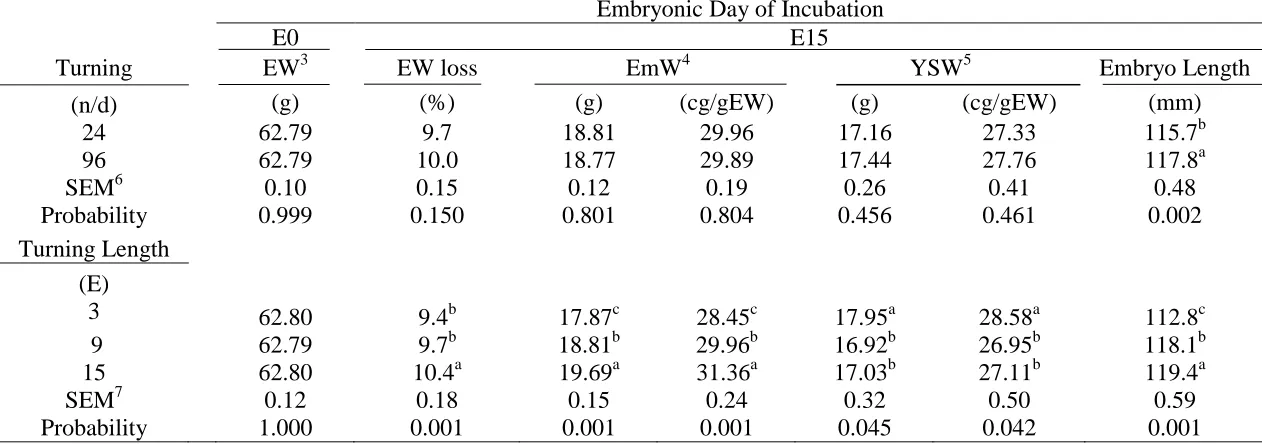
51 Experiment II. Replications 1 and 2. The effects of turning frequency to E15 of incubation when the incubation temperature to E3 was 37.5°C on egg weight loss and embryo traits at E15 in Experiment II are shown in Table II-1. This experiment differed from Experiment I in terms of initial temperature from E0 to E3 and turning length. Experiment I was incubated at 38.1°C to E3 of incubation and turned to E15 of incubation while Experiment II was incubated at 37.5°C only and turned to E18 of incubation. Egg weight loss was increased by the 96 n/d turning treatment in the older flock eggs, which have generally poorer albumen quality (Kirk et al., 1980; Walsh, 1993; Meijerhof, 1994; Brake at al., 1997), of the second replicate only while E15 embryo length was increased by the 96 n/d turning frequency in both replicates. The lack of effect of turning frequency on embryo weight at E15 in this experiment as compared to Experiment I suggested that the effects of the 38.1ºC initial egg temperature of Experiment I predominated while the effects of turning on embryo length predominated in the presence of 37.5°C. No other significant effects were observed.
52 temperature had a predominant effect. There were no significant effects on other variables measured.
53 showed that turning more frequently (96 n/d) to E15 accelerated weight loss, i.e. oxygen uptake, but that this did not increase embryo weight or affect YSW. Furthermore, change in turning conditions at an earlier stage of embryonic development had a negative effect on nutrient assimilation and growth of the embryo.
54
Table II-1. Effect of 24 or 96 daily turning frequency to E15 of incubation at 37.5°C (99.5°F) initial incubation temperature1 on
egg weight loss, andembryonic development in two replications of Experiment II.
Embryonic Day of Incubation
E0 E15
Turning Replication2 EW3 EW loss EmW4 YSW5 Embryo Length
(n/d) (g) (%) (g) (cg/gEW) (g) (cg/gEW) (mm)
24 1 59.79 9.3 19.58 32.80 15.28 25.56 108.3b
96 1 59.79 9.4 19.94 33.38 14.41 24.13 112.9a
SEM6 0.58 0.24 0.28 0.46 0.39 0.66 0.87
Probability 0.998 0.827 0.366 0.378 0.125 0.129 0.001
24 2 62.80 9.9b 19.72 31.41 16.76 26.70 117.8b
96 2 62.79 10.9a 19.65 31.31 17.29 27.52 120.9a
SEM7 0.18 0.33 0.19 0.32 0.49 0.76 0.63
Probability 0.982 0.036 0.821 0.842 0.447 0.450 0.001
a,b
Means in a column within each replicate that possess different superscripts differ significantly (P ≤ 0.05).
1
Eggs were preheated at room temperature (23.9°C; 75°F) for 12 h prior to setting and maintained at 37.5°C (99.5°F) to E3 of incubation.
2
Breeder flock was 38 wk of age for replication 1 and 51 wk of age for replication 2.
3
Egg weight (EW).
4
Embryo weight (EmW) on an absolute and relative basis.
5
Yolk sac weight (YSW) on an absolute and relative basis.
6
Standard error of mean (SEM) for n=27 eggs.
7
55
Table II-2. Effect of 24 or 96 daily turning frequency to E15 of incubation, at 37.5°C (99.5°F) initial incubation temperature1 on
chick body and yolk sac weight, yolk free body weight, and chick length at hatching in two replications of Experiment II. Embryonic Day of Incubation
E21 (Hatched)
Turning Replication2 BW3 Chick Length YFBW4 YSW5
(n/d) (g) (mm) (g) (g) (cg/gBW)
24 1 43.83 176.7a - - -
96 1 43.25 175.3b - - -
SEM6 0.28 0.42 - - -
Probability 0.143 0.018 - - -
24 2 46.04 180.1 38.82 4.82 11.02
96 2 45.51 178.3 38.87 4.41 10.15
SEM7 0.24 1.22 0.19 0.18 0.39
Probability 0.117 0.308 0.858 0.123 0.119
a,b
Means in a column within each replicate that possess different superscripts differ significantly (P ≤ 0.05).
1
Eggs were preheated at room temperature (23.9°C; 75°F) for 12 h prior to setting and maintained at 37.5°C (99.5°F) to E3 of incubation.
2
Breeder flock was 38 wk of age for replication 1 and 51 wk of age for replication 2.
3
Body weight (BW).
4
Yolk free body weight (YFBW) on an absolute and relative basis.
5
Yolk sac weight (YSW) on an absolute and relative basis.
6
Standard error of mean (SEM) for n=115 chicks.
7
56
Table II-3. Effect of 24 or 96 daily turning frequency to E3, E9, and E15 of incubation, followed by 24 daily turning frequency to
E18 of incubation at 37.5°C (99.5°F) initial incubation temperature1 on embryonic development in second replication2 of Experiment II.
Embryonic Day of Incubation
E0 E15
Turning EW3 EW loss EmW4 YSW5 Embryo Length
(n/d) (g) (%) (g) (cg/gEW) (g) (cg/gEW) (mm)
24 62.79 9.7 18.81 29.96 17.16 27.33 115.7b
96 62.79 10.0 18.77 29.89 17.44 27.76 117.8a
SEM6 0.10 0.15 0.12 0.19 0.26 0.41 0.48
Probability 0.999 0.150 0.801 0.804 0.456 0.461 0.002
Turning Length (E)
3 62.80 9.4b
17.87c 28.45c 17.95a 28.58a 112.8c
9 62.79 9.7b 18.81b 29.96b 16.92b 26.95b 118.1b
15 62.80 10.4a 19.69a 31.36a 17.03b 27.11b 119.4a
SEM7 0.12 0.18 0.15 0.24 0.32 0.50 0.59
Probability 1.000 0.001 0.001 0.001 0.045 0.042 0.001
a-c
Means in a column within each replicate that possess different superscripts differ significantly (P ≤ 0.05).
1
Eggs were preheated at room temperature (23.9°C; 75°F) for 12 h prior to setting and maintained at 37.5°C (99.5°F) to E3 of incubation.
2
Breeder flock was 51 wk of age.
3
Egg weight (EW).
4
Embryo weight (EmW) on an absolute and relative basis.
5
Yolk sac weight (YSW) on an absolute and relative basis.
6
Standard error of mean (SEM) for n=117 eggs.
7
57
Table II-3 (continued). Effect of 24 or 96 daily turning frequency to E3, E9, and E15 of incubation, followed by 24 daily turning
frequency to E18 of incubation at 37.5°C (99.5°F) initial incubation temperature1 onembryonic development in second replication2 of Experiment II.
Embryonic Day of Incubation
E0 E15
Turning Turning Length EW EW loss EmW YSW Embryo Length
(n/d) (E) (g) (%) (g) (cg/gEW) (g) (cg/gEW) (mm)
24 3 62.79 9.6b 18.16cd 28.92c 17.86 17.86 111.9
24 9 62.79 9.5b 18.56bc 29.56bc 16.86 26.86 117.5
24 15 62.80 9.9b 19.72a 31.41a 16.76 26.70 117.8
96 3 62.80 9.3b 17.58d 27.99d 18.04 28.73 113.7
96 9 62.79 9.8b 19.07b 30.37b 16.98 27.03 118.8
96 15 62.79 10.9a 19.65a 31.31a 17.29 27.52 120.9
SEM8 0.17 0.26 0.21 0.34 0.45 0.71 0.83
Probability 1.000 0.039 0.040 0.038 0.888 0.889 0.563
8
58
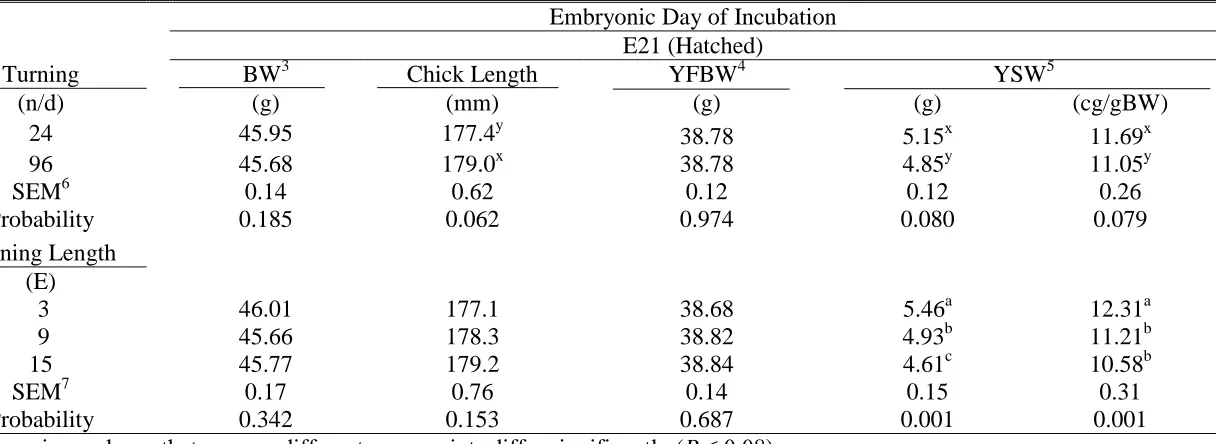
Table II-4. Effect of 24 or 96 daily turning frequency to E3, E9, and E15 of incubation, followed by 24 daily turning frequency to
E18 of incubation at 37.5°C (99.5°F) initial incubation temperature1 on chick body and yolk sac weight, yolk free body weight, and chick length at hatching in second replication2 of Experiment II.
Embryonic Day of Incubation E21 (Hatched)
Turning BW3 Chick Length YFBW4 YSW5
(n/d) (g) (mm) (g) (g) (cg/gBW)
24 45.95 177.4y 38.78 5.15x
11.69x
96 45.68 179.0x 38.78 4.85y 11.05y
SEM6 0.14 0.62 0.12 0.12 0.26
Probability 0.185 0.062 0.974 0.080 0.079
Turning Length (E)
3 46.01 177.1 38.68 5.46a 12.31a
9 45.66 178.3 38.82 4.93b 11.21b
15 45.77 179.2 38.84 4.61c 10.58b
SEM7 0.17 0.76 0.14 0.15 0.31
Probability 0.342 0.153 0.687 0.001 0.001
x,y
Means in a column that possess different superscripts differ significantly (P ≤ 0.08).
a-b
Means in a column that possess different superscripts differ significantly (P ≤ 0.05).
1
Eggs were preheated at room temperature (23.9°C; 75°F) for 12 h prior to setting and maintained at 37.5°C (99.5°F) to E3 of incubation.
2
Breeder flock was 51 wk of age.
3
Body Weight (BW).
4
Yolk free body weight (YFBW).
5
Yolk sac weight (YSW) on an absolute and relative basis.
6
Standard error of mean (SEM) for n=105 chicks.
7