• No results found

A Feasibility Study on the application of Stream Architectures for Packet Processing Applications

N/A
N/A
Protected

Academic year: 2020

Share "A Feasibility Study on the application of Stream Architectures for Packet Processing Applications"

Copied!
105
0
0

Loading.... (view fulltext now)

Full text

(1)

ABSTRACT

RAI, JATHIN. A Feasibility Study on the application of Stream Architectures for Packet processing applications (Under the direction of Dr. Gregory T. Byrd)

(2)

A Feasibility Study on the Application of Stream

Architectures for Packet Processing Applications

by

JATHIN SANOOR RAI

A thesis submitted to the Graduate Faculty of

North Carolina State University

in partial fulfillment of the

requirements for the Degree of

Master of Science

ELECTRICAL ENGINEERING

Raleigh

2003

Approved by

______________________

Dr. Gregory T. Byrd, Chair of the Advisory Committee

(3)

BIOGRAPHY

Jathin Rai completed his 4-year Bachelor of Engineering (B.E.) at RV College of

Engineering, Bangalore in Oct 2000. He worked in Wipro Technologies for a year, and

then joined the Electrical and Computer Engineering department at North Carolina State

University for a Masters degree in Aug 2001. As a part of his research work he has been

(4)

ACKNOWLEDGEMENTS

It has been an immensely rewarding experience to work on my thesis and I have learnt a great deal from it. I owe a lot of gratitude to the people who helped me accomplish this task and would like to thank them.

I would firstly like to thank my advisor, Dr. Gregory T. Byrd for his invaluable guidance. His recommendations and suggestions during our weekly meetings were mainly responsible for the timely completion of my thesis. His natural knack for solving any problem is truly inspiring. Dr Byrd is also the one who taught me the fundamentals of parallel processing, which lay the foundations of my thesis work. I will always be grateful to him for giving me this wonderful opportunity.

I am highly obliged and grateful to Dr. Yannis Viniotis for taking time off his schedule to help me make the forwarding engine a lot more scalable and generic to different routing schemes. His suggestion about adding another module to the forwarding engine has added a lot of depth to my thesis.

I would like to thank Dr. Eric Rotenberg profusely for introducing me to this amazing world of computer architecture. His enthusiasm for this field is infectious and it got me hooked on to computer architecture in the first place.

(5)

I faced a huge problem while trying to obtain the input traces to run the experiments and would like to thank John Streck and John Burton from the NC State Networking Department, who helped me tremendously by getting the traces from the NC State Router. I really do appreciate their efforts.

I want to thank Yukuen Lai who helped me in finding routing tables and traces for my experiments, for which I am very grateful. I would also like to thank Parna for proofreading my thesis and coming up with a lot of valuable suggestions to improve it. She has been of great help throughout the course of my thesis work and I am very grateful for it. I am also very grateful to Karthik, my television, and all my other roommates who kept me going during the course of my thesis work.

(6)

CONTENTS

LIST OF FIGURES ... vii

LIST OF TABLES... ix

1. INTRODUCTION ... 1

1.1 Focus of the Thesis ... 1

1.2 Problem Definition... 1

1.3 Contribution of the Thesis ... 5

1.4 Overview of the Following Chapters... 6

2. BACKGROUND AND RELATED WORK ... 7

2.1 Need for Network Processors ... 7

2.2 Stream Programming Model... 8

2.3 Imagine Stream Architecture ... 9

2.4 Network Applications (Table Lookup)... 11

2.5 Related Work ... 12

3. IPv4 FORWARDING ALGORITHM... 14

3.1 Overview... 14

3.2 Generation of the Trie Data Structure... 14

3.3 Searching the Trie Data Structure... 15

3.4 Factors influencing the choice of the Algorithm ... 16

4. IMAGINE ARCHITECTURE... 18

4.1 Architectural Overview... 18

4.2 Host Interface... 20

4.3 Stream Controller... 21

4.3.1 Modules of the Stream Controller... 22

4.4 Stream Register File (SRF)... 23

4.5 Memory System... 24

4.5.1 Modes of Operation ... 25

4.5.2 Memory System Organization ... 26

4.6 Microcontroller ... 27

4.6.1 Architecture... 28

4.7 Arithmetic Clusters ... 30

(7)

5. DESIGN AND IMPLEMENTATION DETAILS... 33

5.1 IP Forwarding Engine ... 33

5.1.1 Stream Program ... 33

5.1.2 Kernel Programs ... 40

5.2 Bit Extraction Engine... 50

6. EXPERIMENTS AND RESULTS... 59

6.1 Measurement of Imagine Metrics ... 60

6.1.1 Varying the size of the input stream (buffer)... 61

6.1.2 Varying the number of clusters... 73

6.1.3 Cluster Statistics for the Forwarding Kernel ... 83

6.1.4 Statistics for the Hardware Bit Extractor ... 86

6.2 Measurement of Performance for different Packet Traces ... 87

6.2.1 Measurement of Performance Metrics... 88

6.2.2 Maximum Sustainable Throughput of the Forwarding Engine ... 90

6.3 Comparison of throughput with other implementations ... 90

7. CONCLUSION AND FUTURE WORK ... 92

(8)

LIST OF FIGURES

Figure 2.1 Data Flow for a sample stream application ... 8

Figure 2.2 High Level Block Diagram of the Imagine Architecture [8] ... 10

Figure 4.1 Block Diagram of the Imagine System [16]... 19

Figure 4.2 Block Diagram of the Host Interface [16]... 20

Figure 4.3 Block Diagram of the Stream Controller [16]... 22

Figure 4.4 Block Diagram of the Memory System [16] ... 26

Figure 4.5 Block Diagram of the Microcontroller [16] ... 28

Figure 4.6 Arithmetic Cluster [16]... 31

Figure 5.1 Data Flow of the Forwarding Engine ... 33

Figure 5.2 Data flow of the Stream Program... 34

Figure 5.3 Code segment to generate input stream... 36

Figure 5.4 Code segment for Indexed stream access... 37

Figure 5.5 Data flow for the pipelined version of the Stream program... 38

Figure 5.6 Code segment for pipelining the program ... 39

Figure 5.7 Data flow of the initialization kernel... 40

Figure 5.8 Code segment for populating SRAM table ... 41

Figure 5.9 Data flow of the forwarding kernel ... 43

Figure 5.10 Code segment from forwarding kernel... 44

Figure 5.11 Code segment for calculating sum of 1s... 46

Figure 5.12 Code segment for conditional stream operations ... 47

Figure 5.13 Code segment for supplying packets to idle clusters... 48

Figure 5.14 Code segment to find the number of unprocessed packets... 49

Figure 5.15 Imagine Architecture with the hardware bit extraction engine ... 51

Figure 5.16 Architecture of the bit extraction engine ... 52

Figure 5.17 Data flow of the bit extraction engine ... 53

Figure 5.18 Code segment displaying the stream read logic ... 54

Figure 5.19 Code segment implementing the extraction operation ... 55

Figure 5.20 Code segment displaying the status check for stream write... 56

Figure 6.0 Memory Hierarchy of the proposed Imagine Architecture ... 59

Figure 6.1 Measurement of the Execution Time ... 61

Figure 6.2 Measurement of the DRAM Bandwidth... 63

Figure 6.3 Measurement of the SRF Bandwidth ... 66

Figure 6.4 Measurement of the LRF Bandwidth ... 67

Figure 6.5 Measurement of the LRF Bandwidth ... 69

Figure 6.6 Measurement of the Distribution of the Execution Time (Maximum)... 70

Figure 6.7 Measurement of the Distribution of the Execution Time (Average)…………70

Figure 6.8 Measurement of the Distribution of the Execution Time (Minimum) ... 71

Figure 6.9 Measurement of the Execution time (Maximum) ... 73

Figure 6.10 Measurement of the Execution time (Average)... 74

Figure 6.11 Measurement of the Execution time (Minimum) ... 74

Figure 6.12 Measurement of the Reduction in Execution time ... 76

Figure 6.13 Measurement of the reduction in kernel execution time ... 77

(9)

Figure 6.15 Measurement of the DRAM Bandwidth (Average) ... 78

Figure 6.16 Measurement of the DRAM Bandwidth (Minimum)... 79

Figure 6.17 Measurement of the SRF Bandwidth (Maximum) ... 80

Figure 6.18 Measurement of the SRF Bandwidth (Average) ... 80

Figure 6.19 Measurement of the SRF Bandwidth (Minimum)... 81

Figure 6.20 Measurement of the LRF Bandwidth (Maximum)... 81

Figure 6.21 Measurement of the LRF Bandwidth (Average) ... 82

Figure 6.22 Measurement of the LRF Bandwidth (Minimum)... 82

Figure 6.23 Functional Units’ Occupancy ... 84

Figure 6.24 Functional Units’ Occupancy (Block 1)... 86

Figure 6.25 Execution Time of the Hardware Bit Extractor... 86

Figure 6.26 Execution Time Characteristics... 88

(10)

LIST OF TABLES

(11)

1. INTRODUCTION

1.1 Focus of the Thesis

Network processor design is still in its infancy, which has resulted in a variety of architectures being proposed and tried out. Designs employing superscalar, chip multiprocessing (CMP) [1], simultaneous multithreading (SMT) [1] and very long instruction word (VLIW) [1] techniques have been developed. This thesis looks at the inefficiencies in the current architectures used and the feasibility of trying out Stream architecture for packet processing tasks. The main objective of the thesis is to measure the performance of packet processing tasks, in particular, the IP forwarding task, on a generic stream architecture.

1.2 Problem Definition

(12)

Network Processors like the Cisco Toaster [1], Intel IXP 1200 [1] and the Motorola C Port [1] employ MIMD architectures for enhanced throughput. While the Cisco Toaster arranges all its processing elements in a pipelined fashion, the Intel IXP 1200 consists of multiple processing elements working independently with the help of shared co-processors to process different packets.

(13)

Also, in the current designs, multiple co-processors access shared data structures. Since these co-processors operate independently of each other, the presence of intricate synchronization logic is required to guarantee correct execution. Since every co-processor that acts on packet data has to be able to access the packet memory, the memory interconnect becomes quite complicated. This directly relates to the complexity of the design itself and affects the scalability of the network processor to larger configurations.

Packet processing is an inherently data-parallel task and is well suited to architectures that exploit such parallelism. A set of packets can be considered to be a stream of data with each packet being an individual element of the stream, whose processing is independent of another packet. To a large extent the microengines perform the same processing functions on packets streaming through the switch, indicating that a stream processor operating on the SIMD paradigm would be well suited. SIMD architecture has a few inherent advantages, which could be used in the networking processing domain such as:

(14)

¾ Decreased instruction count and reduced dynamic instruction bandwidth requirement compared to MIMD.

¾ Lower power dissipation than current MIMD designs. [2]

(15)

without going to the memory. This reduces the number of trips to the memory, thereby increasing performance and decreasing latency.

The above said inefficiencies limit the flexibility and increase the complexity of the network processor. We propose to eliminate the co-processors and implement their functionality in software running on the microengines themselves, thereby increasing the flexibility and decreasing the complexity of the system as a whole. We also intend to overcome the performance degradation seen by conventional SIMD machines by using the conditional and predicate constructs provided by the Stream programming model.

1.3 Contribution of the Thesis

The thesis looks into the implementation of an IP forwarding algorithm proposed by Franzon et al. [5], on a stream architecture, which is based on the stream programming model. The processor used to simulate the performance of the IP forwarding algorithm is the Imagine processor built by Dally et al. [6]

(16)

A separate bits extraction module has also been integrated with the forwarding engine, in an effort to make it generic and support various routing schemes, from destination address routing to Layer 4 switching.

1.4 Overview of the Following Chapters

(17)

2. BACKGROUND AND RELATED WORK

2.1 Need for Network Processors

The bandwidth explosion of recent years have made it mandatory for networks to provide high throughput for bandwidth-hungry and computationally intensive applications like Voice over IP (VoIP) and Peer-to-Peer (P2P). In addition to high throughput, they also need to provide the flexibility to support new protocols and applications. The previous popular system implementations emphasized on either performance or flexibility, but not both. To satisfy the performance requirements, the trend was to build custom hardware, in the form of ASICs (Application Specific Integrated Circuits), to implement the protocols. However the flexibility requirement demanded programmable solutions like general purpose processors (GPPs), which allowed the implementation of the protocols in software but did not provide enough performance. The above two solutions did not meet all the requirements, so other implementations were looked at which could provide a combination of both performance (comparable to an ASIC) and flexibility (comparable to a GPP). FPGAs solved this problem to a certain extent by providing a device that can be reprogrammed at the gate level, but the most popular solution was the ASIP (Application Specific Integrated Processor), which provided processors with instruction sets specialized for a particular application domain.

(18)

domain by having software as a major part of the system, which allows network equipment to easily adapt to changing standards and applications. Other benefits of NPs include a faster time to market as compared to an ASIC.

The above advantages in programmability and in-the-field upgradeability have resulted in network processors becoming more popular than fixed function ASICs for network routers and switches.

2.2 Stream Programming Model

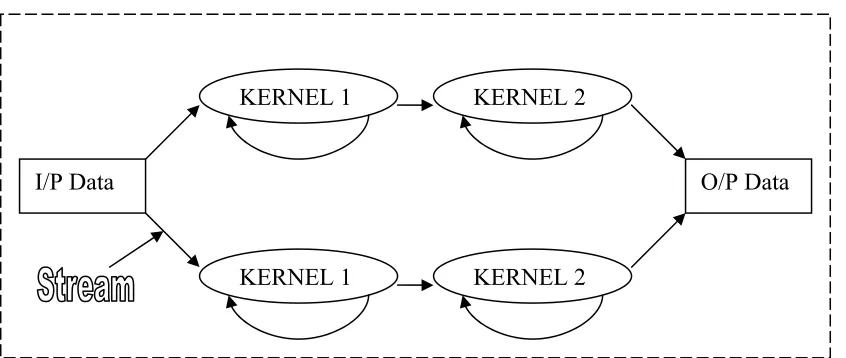
The Stream programming model [7] expresses all data as streams. These streams are sent to kernels, which are responsible for the computation. A stream of data is a collection of similar data i.e. a collection of records. A kernel consumes a set of input streams, performs computation and produces a set of output streams. The stream program is responsible for sending the input streams to the kernels, invoking the kernels, and storing the output streams generated by the kernels. Figure 2.1 demonstrates the data flow for a sample stream application.

Figure 2.1 Data Flow for a sample stream application KERNEL 1

I/P Data

KERNEL 2

KERNEL 2 KERNEL 1

(19)

The Stream programming model is different from conventional vector operations, since it supports the compound stream operations, wherein a kernel reads an element from its input stream(s) and computes a series of arithmetic operations and appends the results to output streams, which are transferred back to the register file. In contrast, conventional vector operations perform a single arithmetic operation on each vector element and store the results back in the vector register file after each operation.

The Stream programming model exposes the inherent parallelism in applications like packet processing so that they can be exploited by the stream architecture. This helps in maintaining high performance densities, in spite of providing programmability.

2.3 Imagine Stream Architecture

(20)

Figure 2.2 High Level Block Diagram of the Imagine Architecture [8]

(21)

2.4 Network Applications (Table Lookup)

The Networking Applications fall under different categories, some of which are related to identifying routing protocol standards in the different layers. Other deal with the Security and Quality of Service (QoS) related applications. Security related applications lend themselves to the stream architecture by being computationally intensive and hence can be performed efficiently using this architecture. On the other hand routing applications like IPv4, MPLS, etc., tend to be more memory intensive, thereby making the implementation on a stream architecture using the stream programming model more challenging. The forwarding applications essentially consist of the table lookup operation, which forms the most crucial part of the implementation.

The table lookup kernel is the actual action of looking up data based on a key. The data structures and algorithms used are dependent on the type of lookup (one-to-one or many-to-one) required and the size of the key. For ATM and MPLS, this field is quite small and the mapping is one-to-one, so often only one lookup is required. However, for IPv4 and IPv6 routing, the large address field and longest prefix matching (LPM) requirement make it impossible to find the destination address in one memory access. Therefore, trees are used to efficiently store the address table and multiple lookups are required.

The constraints of a table lookup algorithm are:

(22)

¾ to perform insertion and deletion of entries in the same order of complexity as the search

¾ to scale well, in order to be adopted for IPv6 ¾ to support longest prefix matching

¾ to provide efficient memory utilization

¾ to support broadcast and multicast capabilities

¾ to be easily realizable in hardware for optimal performance

Since IPv4 is the most widely used protocol for Layer 3 routing and involves the most amount of processing time as compared to other switching schemes like MPLS, a forwarding algorithm designed for IPv4 has been used as a case study for this thesis. The implementation has been made generic to incorporate other switching schemes by integrating a bit extraction module.

2.5 Related Work

(23)

approach, which minimizes the weakness of SIMD architectures to control flow variations. Performance measurements of an IP forwarding algorithm on different architectures has been conducted by Crowley et al. [11]. They simulated the algorithm on different architectures like SMT and CMP machines and tested the performance of these architectures.

(24)

3. IPv4 FORWARDING ALGORITHM

3.1 Overview

The forwarding algorithm proposed by Mehrotra et al., which is used in this study,

employs a trie-based scheme, wherein the routing table information is compacted enough

to be stored in the on-chip SRAM of a modern day processor (around 512 KB to 1 MB).

The table containing the next-hop values is stored in the DRAM. Other trie-based

forwarding algorithms require multiple hits to the DRAM, to traverse through the

different levels of the trie-structure (stored in the DRAM), and obtain the next-hop

address. This algorithm completes the above arduous task with equivalent number of

reads to the SRAM table (contains path information used to traverse the trie) and 1

DRAM access. The DRAM and the SRAM tables are constructed from the multi-way trie

structure, which is generated from the routing table entries.

3.2 Generation of the Trie Data Structure

The algorithm [5] for building the trie data structure is given below:

Step 1: Each entry from the routing table is read and stored in a list.

Step 2: The list is sorted in an ascending order.

Step 3: The root node is created and each of the child node pointers are initialized to

Default Next Hop.

Step 4: Each entry from the list is read, and each level of the trie is traversed using log2_M

(25)

addresses are updated accordingly and bit expansion is performed on every entry when

the number of bits is less than log2M.

The depth of the trie is equal to No of Address bits/log2_M, where M is the degree of the

trie. Once the trie is built, the compact SRAM data structure can be constructed by doing

a breadth-first traversal on the trie. The SRAM table is built by storing a 1 or 0 for every

node of the trie, depending on whether it has child nodes or not. Correspondingly, each of

the child nodes will be represented by either 1 or 0 in the SRAM table, based on whether

if it has child nodes or not. Thus, only the leaf nodes of the trie structure will be

represented by 0’s in the SRAM table. The SRAM table encodes N child nodes with a

single bit, thereby achieving high compaction with respect to the DRAM table.

3.3 Searching the Trie Data Structure

The route lookup is done in two stages. The first stage involves only SRAM lookups

using log2M bits of the address to index into each level of the SRAM table. Every level of

the SRAM is traversed until the longest path corresponding to the address is determined

from the bit-pattern stored (i.e. until it reaches a 0). The information from the SRAM

yields the row and column address of the DRAM table, where the corresponding

next-hop address is stored. A single DRAM access is then made to obtain the next-next-hop

address. The algorithm [5] is explained below:

Step 1: The start pointer is initialized to the first M-bit pattern in the SRAM data

(26)

Step 2: The first log2M _ bits of the address are read. For a 4-way trie this would mean 2

bits and for a 16-way trie, 4 bits of the address.

Step 3: These address bits are used as the offset in the M-bit pattern from the start

pointer.

Step 4a: If the bit indicated by the offset is 1, then the start pointer is moved to the next

level. The position of the start pointer is calculated by computing the sum of all the

previous 1’s in the level and multiplying it by M. Steps 2-4 are repeated.

Step 4b: If the bit indicated by the offset is 0, then the search terminates. The total

number of 1’s before and including the parent 1 (the 1 that led to the 0) gives the DRAM

table row number containing the next hop address.

3.4 Factors influencing the choice of the Algorithm

Various trie-based schemes have been proposed, like the Patricia scheme [12], which

focuses on reducing long way branches by skipping the bit by bit traversal for branches,

having only one possible outcome. This scheme, however, has the disadvantage of

backtracking and other schemes [13, 14, 15] were implemented to overcome this

problem. However, the best scheme of the lot had a minimum of D memory accesses for

each packet, where D is the depth of the trie.

The binary-based schemes involve a lot of arbitrary memory references for each

packet, thereby making it non-conducive for stream architectures. Stream architecture

performs the best when the ratio of computation to memory access is high. Other

networking applications, like encryption, are computationally intensive, whereas

(27)

operations. Furthermore, our specific stream architecture (Imagine) is based on the SIMD

programming model, wherein arbitrary references to memory from the kernels are not

allowed. This makes the implementation of the above routing algorithms very difficult. A

more feasible and efficient implementation would require algorithms with sets of

computation, which takes advantage of the parallel hardware provided by Imagine,

interleaved with organized memory references. These memory references can take

advantage of vector primitives (i.e. indexed memory operation) for high DRAM

throughput.

The forwarding algorithm used in this study has several advantages:

• Guarantees one memory access to obtain the next-hop address. This memory access

can be performed very efficiently for multiple packets at a time using the indexed

stream operation provided by stream architectures.

• Tolerable variance in the amount of execution time taken to calculate the row and

column address for each packet, thereby enabling the use of SIMD programming

model. The variance in the number of SRAM levels traversed by each packet can be

countered with the help of conditional stream operations provided by the stream

programming model.

• High computation requirement of the algorithm, which is tailor-made for the Imagine

stream architecture. Franzon et al. [5] chose a hardware implementation of the

algorithm, in an effort to satisfy the computation requirement. This however, limits

(28)

4. IMAGINE ARCHITECTURE

4.1 Architectural Overview

Imagine is a high performance stream-based processor targeted at computationally intensive applications. The block diagram of the Imagine architecture is given in Figure 4.1. The main components are as below:

¾ There are eight VLIW computation clusters arranged in a SIMD array. The clusters execute identical code, as they are controlled in a SIMD fashion. The clusters can communicate with each other, in order to permute or broadcast data.

¾ The main area of storage for frequently used data is provided in the form of a general purpose stream register file (SRF), which helps in reducing the number of memory accesses. The SRF serves as the staging area for data that is used by the other units like the clusters, the network, and the memory system.

¾ The memory system of Imagine is interleaved across multiple internal memory banks connected to off-chip DRAMs, designed to allow multiple streaming memory accesses for high bandwidth throughput.

(29)

¾ The Imagine chip is controlled by a host processor, which issues commands via a stream controller and communicates the control and status information to Imagine through Imagine’s control and status registers.

(30)

4.2 Host Interface

The host interface acts as the connection between the host processor and the Imagine processor. All interactions between the host processor and the Imagine core occur via the host interface. The high level block diagram showing the connectivity of the host interface to the host processor and Imagine is shown in Figure 4.2.

Figure 4.2 Block Diagram of the Host Interface [16]

The list of tasks performed by the host interface is as follows:

• Read scoreboard status to determine the number of issue slots that is free/occupied.

• Transfer of stream controller instructions from the host processor to Imagine.

• Transfer of stream data.

• Read from the stream controller register file.

• Read and write to memory controller control registers.

• Write to network interface control register.

(31)

Specific tasks like sending a stream instruction to Imagine is accomplished by a combination of reads and writes to this address space. Reads and writes to any memory location can be accomplished i.e. presented on the data in the same clock cycle as the request command or the next clock cycle, depending on a configuration switch.

4.3 Stream Controller

The Stream Controller is responsible for determining when to issue and execute stream instructions. It has over all control over the other modules and decides the dataflow between them. The stream controller sequences the instructions and chooses them for issue based on two criteria:

¾ Resource Dependencies: The resource dependencies indicate the availability of the hardware resources required to execute the stream instruction. This dependency is taken care of by generating a mask, which indicates the various resources needed by the instruction. Once the instruction is issued, the mask will indicate the hardware resources, which are currently being used to execute that instruction.

(32)

instruction queue is used to indicate all the instructions that have to complete before the current instruction can be issued. The issue dependency bitmask is used to indicate all the instructions that have to be at least issued before the current instruction can be issued.

Figure 4.3 Block Diagram of the Stream Controller [16]

4.3.1 Modules of the Stream Controller

1. Scoreboard

The scoreboard is used to keep track of all the dependencies of each instruction on other instructions in the instruction queue and also maintain a list of the hardware resources the instruction needs.

2. Issue Unit

(33)

3. SCTRF

The SCTRF is a general purpose register file, which is accessed by stream instructions to transfer data between the stream controller and other modules.

4.4 Stream Register File (SRF)

The Stream Register File (SRF) acts as the source and destination for data to and from memory and also serves as a staging area, where streams are generated to be sent to or received from the arithmetic clusters. The SRF consists of 32K words organized as 1024 32-word blocks, with each block comprising of 8 banks containing 4 words each. Therefore every word can be thought of as having a three part address BLOCK.WORD.BANK where BLOCK identifies one of the 1024 blocks, WORD identifies one of four words per bank in this block, and BANK identifies one of the eight banks of the file.

The SRF supports 22 streams of data to the clients mentioned in Table 4.1, with each stream having its dedicated registers and stream buffer.

(34)

The stream buffer is 64-word, organized as two word buffers. The SRF transfers 32-word block to one of the half-buffers in a single cycle, which is emptied by the clients (i.e. Arithmetic Clusters (8 words at a time), microcode store (1 words at a time) etc). In an event where both half-buffers are free a flow control is invoked on the client indicating there is no data available. In case of a write operation, the producer fills up the half buffers and once the 32nd word is written, the half-buffer is written to the SRF.

The stream buffers dedicated to the memory system act as Reorder Buffers and are different from the other stream buffers in the sense that in case of memory loads into the SRF the buffers receive the data out of order with a 6 bit index to place the data into the correct location in the 64 element stream buffer.

4.5 Memory System

The memory system provides a high bandwidth connection to the off-chip DRAM for efficient memory operations. The reasons it is able to deliver such high performance and bandwidth are listed below:

¾ Allow several memory accesses to be active simultaneously

¾ Each access stream uses its own address generator to generate a stream of accesses ¾ All stream loads returns to its own dedicated reorder buffer

¾ Memory system is interleaved across multiple internal memory banks, each of which can reorder accesses to its own external bank of DRAM chips

(35)

Table 4.2 Memory System Parameters [16]

4.5.1 Modes of Operation

The three types of addressing modes supported by Imagine are as follows:

¾ Stride mode: A constant stride is provided, which indicates the distance between the start of consecutive recordsand the record length indicates the number of consecutive elements in the record.

¾ Bit-reversed mode: In this mode records are accessed with an increment of STRIDE << ALIGN, using bit-reversed addition, where STRIDE must be set to a bit-reversed 8 for the given stream length and ALIGN is the base 2 logarithm of the distance between adjacent records.

(36)

4.5.2 Memory System Organization

Figure 4.4 Block Diagram of the Memory System [16]

Address Generators: The address generators generate a stream of addresses along with the control information with the help of memory stream control registers, which is then sent to the memory banks. Since there is a dedicated bus from each address generator to each memory bank, requests can be sent to any of the memory banks but only a single request may be sent to each memory bank every cycle. In an event there are multiple accesses to the same memory bank, only one request can be sent and the others must be stalled.

(37)

corresponding stream buffer in the form of a reply packet, which contains an index field and the data. The index field is used by the reorder buffer to store the data in order in case it arrives out of order. The memory bank can return data every cycle, in an event it has data to return.

4.6 Microcontroller

(38)

4.6.1 Architecture

Figure 4.5 Block Diagram of the Microcontroller [16]

Microcode Store: The microcode store holds the microcode instructions, which are issued to the arithmetic clusters. It consists of 1024 entries with each entry 512 bits wide. The microcode store is supplied with the microcode instructions by the SRF through a dedicated stream buffer with a bandwidth of 1 word per cycle.

Microcontroller Register File (UCRF): The UCRF is used to store the microcontroller variables that are used in the execution of the microcode on the arithmetic clusters. The microcontroller variables can be used to

(39)

¾ hold data needed to be broadcast to all clusters ¾ data passed from one microprogram to another ¾ data passed to/from the host interface

Stream Buffer Control: The Stream Buffer Control is responsible for generating signals that enable the transfer of data from the stream buffers in accordance with the communication protocol employed. This logic is active during the stream read and stream write operations of the kernels. This module also generates a status signal indicating if one or more of the stream buffers are full/empty. With the help of this signal the control unit will stall the execution of the microprogram until the SRF services the stream buffers.

Control Unit: The control unit decodes and executes the portion of the microcode instruction word, which is relevant to the microcontroller. The microcontroller inspects the op for the communication unit, since it might be the one that needs to supply the data from the UCRF and broadcast it on the intercluster communication bus. In the other case, it might need to read the data from the bus and store it in the UCRF. The control unit also responds to the control signals sent by the host interface. The signals can cause the microcontroller to take the following actions:

¾ read value from register in the UCRF and send it to host interface ¾ write register in the UCRF with the value from the host interface

(40)

¾ continue program execution after the microcontroller has been stalled by a SYNCH operation in a microprogram

4.7 Arithmetic Clusters

The Arithmetic Clusters form the integral part of the Imagine system since it is responsible for the efficient execution of the microcode instructions. There are 8 arithmetic clusters that form the computation core of the Imagine system, arranged in a SIMD array. The clusters respond to the same microcode instruction issued by the microcontroller and act on different sets on data.

4.7.1 Cluster Functional Units

A table describing the number of functional units along with the latency information is shown in Table 4.3.

Unit Type Quantity Latency Pipelined?

ALU

(arithmetic/shift)

3 4 (float), 2 (int), 1

(Logical)

Yes

MUL 2 4 Yes

DIV/SQRT 1 16/17(float

div/sqrt), 22/23 (int div/mod)

2 ops can be in flight

simultaneously

COMMUNICATION 1 1 Yes

SCRATCHPAD 1 1 Yes

Table 4.3 Functional units of the Clusters [16]

(41)

consists of a variety of functional units that are interconnected by a set of busses. The arithmetic cluster has an internal data path width of 32 bits.

Figure 4.6 Arithmetic Cluster [16]

ALU Unit: The ALU unit is a fully pipelined two-input, one-output unit that supports various addition/subtraction/bitwise logic and comparison operations. For a list of the various operations supported by the ALU unit refer to the appendix.

MUL Unit: The MUL unit is a fully pipelined two-input, one-output unit that supports various multiplication operations. For a list of the various operations supported by the MUL unit refer to the appendix.

(42)

stage then no other divide or square root operation can be issued for these n cycles. Similarly if an operation spends n cycles in the post-process stage then no other divide or square root operation can complete for these n cycles. For a list of the various operations supported by the DIV/SQRT unit refer to the appendix.

SCRATCHPAD Unit: The Scratchpad unit is a three-input one-output unit. The unit takes in the read address, write address and write data. In case of a conditional read or write operation it takes in another parameter from the jukebox unit. The Scratchpad unit can execute an unconditional read and write in the same cycle. The instruction set of Imagine provides for combined read and write SP operations, which complete both a read and a write in the same cycle. For a list of operations supported by the Scratchpad unit refer to the appendix.

The Scratchpad unit is essential for conditional input and output operations, since it serves as a staging area for the distribution/collection of records to/from the clusters depending on the condition code in the case of a conditional input/output.

(43)

5. DESIGN AND IMPLEMENTATION DETAILS

5.1 IP Forwarding Engine

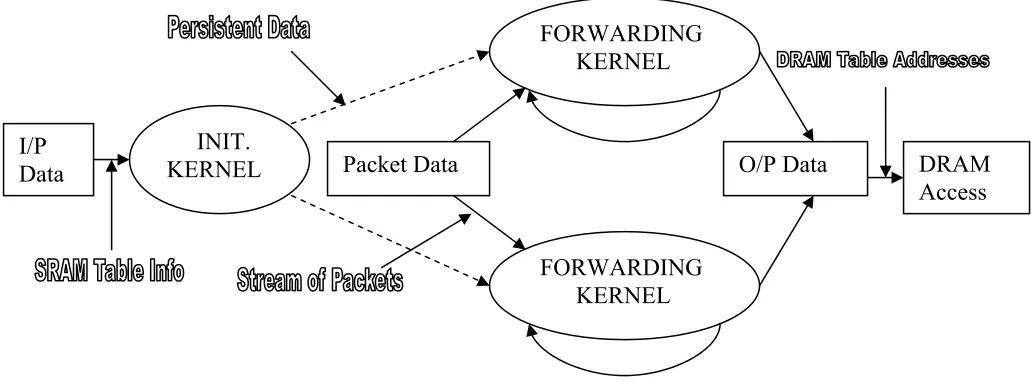
The role of the IP Forwarding module is to find the next hop address for every packet arriving at the router, based on a table of next hop entries stored in the DRAM. The unit of data (i.e. a record) being consumed by the forwarding engine is the extracted 32 bits of the packet header plus some control information populated by the bit extraction engine. The data flow of the forwarding engine is shown in Figure 5.1.

Figure 5.1 Data Flow of the Forwarding Engine

5.1.1 Stream Program

The Stream Program defines the data flow between the kernels. It is responsible for setting up the input to each kernel and collecting the outputs of the kernel. The basic data flow of the stream program is shown in Figure 5.2.

FORWARDING KERNEL

I/P Data

INIT. KERNEL

FORWARDING KERNEL

Packet Data DRAM

(44)

1. Un-pipelined Version

Figure 5.2 Data flow of the Stream Program Define Input & Output

Streams START

Call Initialization Kernel

Generate Input Stream for Forwarding Kernel

Begin Loop

Call Forwarding Kernel

DRAM Access

Generate Input Stream for Forwarding Kernel

End Loop

(45)

The data flow corresponds to the un-pipelined version of the stream program, wherein every call is done sequentially and no software pipelining is employed. The basic steps in the data flow as shown in Figure 5.2 are explained below.

Define Input and Output Streams: The first step in the generation of the stream program is to define every input and output stream the stream program is either going to send to the kernels or collect from them. The definition includes the size of the stream and the type of the stream. The type of the stream gives information on whether the stream is of fixed size, variable size, variable start and end index, etc. [17].

Kernel Calls: Kernel Calls are similar to the way functions are called in C. The input and output parameters have to be provided, which in this case will be the input and output streams.

(46)

Figure 5.3 Code segment to generate input stream

The input stream is generated by means of a streamcopy operation, which allows copying of one stream to another. Only a subset of the main input packet trace is copied at a time (i.e. size of the input stream – No. of unprocessed packets). The index into the main input packet trace is maintained by a pointer (uc_ptr), which is a microcontroller variable indicating the number of packets, which have already been processed. The number of unprocessed records in the output stream of the previous kernel call is given by the microcontroller variable (uc_length).

(47)

condition restricts the amount one can increase the size of the input stream to the forwarding kernel, thereby limiting the size of the input packet buffer in an actual implementation. The code segment implementing the indexed stream access is shown in Figure 5.4.

Figure 5.4 Code segment for Indexed stream access

Dram_table is the data stream stored in the DRAM that contains the next hop addresses. The stream dram_row is the index stream obtained from the forwarding kernel, which holds the row and column addresses. The keyword im_fixed is specified for the

(48)

2. Pipelined Version

Figure 5.5 Data flow for the pipelined version of the Stream program Define Input & Output

Streams START

Call Initialization Kernel

Generate Input Stream for Forwarding Kernel

Begin Loop

Call Forwarding Kernel

Generate Input Stream for Forwarding Kernel

End Loop

STOP Call Forwarding Kernel

(49)

The un-pipelined data flow resulted in a sequential memory access, which degrades performance. The optimization pipelined stream program as shown in Figure 5.5 counters this problem by applying software pipelining techniques, wherein the DRAM access of the previous iteration is done in parallel with the kernel call and the stream generation of the current iteration. The code segment implementing the pipelining optimization is shown in Figure 5.6.

Figure 5.6 Code segment for pipelining the program

(50)

5.1.2 Kernel Programs

The kernels are responsible for the actual implementation of the functionality of the application with the help of computational clusters.

5.1.2.1 Initialization Kernel

The initialization kernel initializes and populates all the data structures, which will be used by the forwarding kernel. The input to the initialization kernel will be provided by the table generation unit, which is responsible for building the SRAM and DRAM tables based on the routing table entries. The table generation operation is normally handled by a general microprocessor. The reason a separate kernel is implemented for the initialization and population of data structures is to avoid the redundant task of filling up the persistent data structures. The data-flow of the initialization kernel is shown in Figure 5.7.

Figure 5.7 Data flow of the initialization kernel Initialize the Data

Structures in all clusters START

Populate the data structure for the SRAM table and communicate it to all clusters

(51)

Initialize the Data Structures in all clusters: The data structures, which have constant values and are only read and not written, by the forwarding kernel are populated in the initialization kernel. These data structures are declared persistent to indicate to the VLIW scheduler that the scope of the data structures is across kernels.

Populate the data structure for the SRAM table and communicate it to all clusters: The values of the SRAM table are given as input to the initialization kernel, which is provided in the form of a stream. When a transfer of the stream is done from the stream buffer to the clusters, every cluster receives one record out of eight records, such that each cluster will receive records with a stride of 8. Hence each cluster will have every 8th location in its local SRAM table filled. The code segment describing this operation is given in Figure 5.8.

Figure 5.8 Code segment for populating SRAM table

(52)

Another implementation would have been to use conditional streams to send all the SRAM table values to one cluster and then communicate the table to all the other clusters. Conditional stream transfer is slower than an unconditional stream transfer, since a condition has to be checked for every element in the stream. The second method would be to broadcast the same record to all clusters, but the simulator does not support this option. The only way of doing this is to replicate the records in the input stream thereby increasing the size of the input stream and reducing the performance. Thus, the first implementation was opted for, due to performance benefits.

5.1.2.2 Forwarding Kernel

(53)

Figure 5.9 Data flow of the forwarding kernel START

Begin Loop

STOP

Update Level information based on whether bit is 1 or 0

Calculate Sum of 1s and populate the corresponding fields in the output stream

Calculate row and column address of DRAM table for processed packets

Push processed packets to the output stream

Supply idle clusters with packets from input stream

End Loop

Cal. No. of unprocessed packets and push them to the output stream

(54)

Index into the SRAM table with the level information and the extracted four bits of the

destination address: The four bits of the destination address and the level information (i.e. the level of the SRAM the packet needs to access next) encoded in the packet information are used to access the appropriate node in the appropriate level of the SRAM. Since two dimensional arrays are not supported by the simulator, all the levels of the SRAM are stored in a single array with the base location of each level stored in a different array. Using eight different arrays for eight different levels would not be feasible, since at any given point of time each cluster could be operating on a different level. Since it is a SIMD mode of operation, the level information from the eight arrays would have to be transferred to a common variable, which would result in quite a few

select operations. By using one array for all levels, we eliminate the unnecessary select

operations. The code segment explaining this optimization is given in Figure 5.10.

Figure 5.10 Code segment from forwarding kernel

In the above code the value of lvl_temp, which indicates the level of the SRAM table the packet is currently operating on, has been computed earlier in the program. The array

(55)

benefits in the way of less space required and reduced iteration count while calculating the sum of 1s.

Update Level Information based on whether bit is 1 or 0: The packet has finished processing only when it encounters a 0 when indexing the SRAM table, based on 4 bits of its destination address. The level information needs to be updated this early in execution since, in the event the packets are processed (i.e. reached a zero), they need to be masked from the other operations like sum of 1s which will be performed for the unprocessed packets. Since it is a SIMD mode of operation, clusters, which have processed packets, do have to execute these instructions, but care is taken to see that register file and memory state is not corrupted as a result of these instructions.

Calculate the Sum of 1s and populate the corresponding fields in the output stream: The sum of 1s is needed to determine the row and column address in the DRAM table. It is also used as an index to the SRAM node in the next level. Hence the Sum of 1s needs to be calculated for every packet at every level. Sum of 1s calculation is a very important step in the implementation of this algorithm and needs to be performed very efficiently in order to achieve high throughput. In an effort to get it running as fast as possible certain optimizations have been employed.

(56)

all possible combinations of eight bits. Four scratchpad reads are needed to obtain the sum of 1s for one SRAM location (i.e. two SRAM table nodes), which improves performance dramatically as compared to a software implementation using a shifter and an adder.

2. The effect of computing sum of 1s for sixteen bits at a time is achieved by replicating the table and storing it in either two scratchpads or a single scratchpad with two read ports. Thus, two simultaneous eight-bit reads can take place. The main disadvantage of this method would be the increase in the number of read ports. Since there are eight clusters, eight new read ports need to be added, resulting in a substantial increase in area. The code segment describing the operation of calculating the sum of 1s with the help of two scratchpad reads is shown in Figure 5.11.

Figure 5.11 Code segment for calculating sum of 1s

As a result of the dependencies in the shift operations before the scratchpad reads, the VLIW scheduler will not schedule both the scratchpad reads in the same cycle and hence they might not occur completely in parallel.

(57)

unrolling techniques provided by the scheduler are applied to optimize the sum of 1s calculation for 128 bits. This optimization increases the load on the table generation and update unit. It is based on the assumption that routing table updates are not very frequent, and during a routing table update the forwarding engine can be executing simultaneously with the stale routing table.

Calculate row and column addresses of DRAM table for processed packets: Once the packets are processed, the cumulative sum of 1s of all the levels traversed by the packet is used to calculate the row address of the DRAM table. The row address calculation is a minor step in the overall process and can be achieved with the help of a single shift operation. The DRAM table is stored in the DRAM as records containing only 1 field of 8 bits, as a result of which, no column calculation is required.

Push processed packets to the output stream: The processed packets are pushed to the output stream using the conditional stream operations. Packets from all eight clusters are tested for a condition, and only those packets that pass the condition are pushed into the output stream. The code segment implementing the conditional stream operations is shown in Figure 5.12.

Figure 5.12 Code segment for conditional stream operations

(58)

Supply idle clusters with packets from input stream: The processing time of each packet depends on the number of levels it traverses. Thus, the hardware utilization suffers as a result of some of the clusters being idle while the others are processing packets due to the difference in the processing times of each packet. The Stream programming model provides a solution to this problem in the form of conditional streams, wherein all the idle clusters can be replenished with packets once they are done processing. At the end of every iteration, packets, which are processed, are pushed to the output stream, and new packets are sent to the clusters that have processed the packets, thereby keeping all the clusters busy at any given point of time. The code segment performing this optimization is shown in Figure 5.13.

Figure 5.13 Code segment for supplying packets to idle clusters

(59)

Calculate the number of unprocessed packets and push them to the output stream: There are a few unprocessed packets at the end of the loop when all the packets from the input stream are exhausted. The unprocessed packets will be less than the number of clusters and hence it would be a waste of resources if they are processed, since the cluster utilization would be very low. It would make more sense to send them with the next set of packets. The number of unprocessed packets needs to be calculated since Imagine allocates space in the SRF for the records in multiples of eight and hence all streams need to be flushed such that they are multiples of eight. This will result in the stream having a few invalid records. The number of unprocessed packets is calculated by each cluster sending information on whether it has an unprocessed packet to cluster 0 and cluster 0 summing up the total number of unprocessed packets. The code implementing this method is shown in Figure 5.14.

Figure 5.14 Code segment to find the number of unprocessed packets

(60)

5.2 Bit Extraction Engine

(61)

Figure 5.15 Imagine Architecture with the hardware bit extraction engine

The bit extraction engine is provided with a dedicated set of resources and hence its task can be done in parallel with the IP forwarding task. The hardware bit extractor comprises of a read stream unit, the bit extractor module, and the write stream unit as shown in Figure 5.16.

Stream Register File S

D R A M

Hardware Bits Extraction Engine

Arithmetic Clusters (8) Stream

Controller Host Processor

Microcontroller

(62)

Figure 5.16 Architecture of the bit extraction engine

The bit extractor module has currently been implemented with a throughput of one packet/cycle, but this parameter is configurable and can be changed by modifying the machine description file. The throughput of the hardware bit extractor is not of real concern, as long as it is below the execution time of the forwarding kernel. The hardware bit extractor module takes approximately 22 cycles per packet (extraction (1 cycle) + stream overhead (21 cycles)), which is less than the time taken by the forwarding engine (~ 50 cycles), making the performance of the hardware module inconsequential.

The logic flow of the hardware bit extractor is as shown in Figure 5.17. Read Stream

Unit

Bits Extractor Module

(63)

Figure 5.17 Data flow of the bit extraction engine Constructor () – Set up the streams from/to the

hardware module START

Evaluate () – Called every cycle by Imagine

{

1. Read the stream into the local data structure when the stream is ready and set the appropriate signals 2. Perform the bits extraction computation when the input is ready (1 Word/cycle)

3. Write into the output stream if the data is ready and set appropriate signals

4. Parse the control signals from the Host processor

}

(64)

Constructor () – Set up the stream to/from the hardware module: The constructor of the hardware bit extractor performs the task of setting up the input and output data stream to/from the stream buffer (dedicated to this hardware module). The actual implementation involves storing the stream in two data structures (to_hwbitsext_str [] (to store input streams) and from_hwbitsext_str [] (to store output streams)). The data for the output streams is populated by the hardware bit extractor in the evaluate function.

Read the stream into the local data structure: The hardware bit extractor reads the stream from the stream buffer, when the stream is readable and ready, into the hardware module. The data from the stream is transferred to a temporary local data structure, wherein the data can be manipulated by the extractor logic. The code implementing this stream read logic is shown in Figure 5.18.

Figure 5.18 Code segment displaying the stream read logic

(65)

once it reaches the end of the stream. The read_busy is set during the course of this transfer and is reset once the EOS flag is set.

The bit extraction engine takes as input along with the stream of packet headers two control signal from the host processor indicating the start and stop index of the 32 bits which have to be extracted. The 32 bits of data that needs to be extracted will depend on the type of routing employed and can be configured based on the requirements.

Bit extraction computation: The throughput of the extractor module is configurable and will be set according to the speed of the hardware used in an actual implementation. The read stream unit, bit extractor module and the write stream unit are arranged in a pipeline fashion, such that the computation of the current packet is done in parallel with the read of the next packet header. The processing is on the fly, wherein processing of data need not wait until the whole stream (a sequence of packet headers) is transferred, which will result in better throughput and less delay. The computation has a throughput of one packet/cycle. The code implementing the extraction operation is shown in Figure 5.19.

Figure 5.19 Code segment implementing the extraction operation

(66)

fields but this could be made configurable. The above piece of code is executed only when the whole packet header is read in by the read stream unit and the computation will be done concurrently with the read of the next packet header. The extracted bits are stored in the data structure out, which is used by the last stage in the pipeline, the write stream unit, to populate the output stream in parallel with the other stages.

Write the stream: The write stream unit is the last stage in the pipeline responsible for transfer of data from the hardware module to the stream buffer. The data transfer is done in parallel with the other stages of the pipeline. Once the computation for a packet has been performed and stored in the vector out, it is transferred to the output stream

from_hwbitsext_str. The transfer of the data from the hardware module to the stream buffer is initiated only when the stream buffer is ready and is stopped once all the data has been transferred from the vector out. The code implementing the status check of the data transfer operation is shown in Figure 5.20.

(67)

The signal sready is used to check if the stream buffer is ready and the cready signal is used to check if the previous write was successful. The end of stream transfer is signaled by raising the EOS flag of the output stream high. The EOS flag is raised if it satisfies the condition that all the elements of the data structure out have been transferred to the output stream.

Parsing the control signals from the host processor: The host processor is responsible for scheduling ops on the hardware module. The control signals indicate the operation to be performed by the hardware module. When the bit extraction operation is invoked on the hardware bit extractor, appropriate actions, like setting the appropriate signals and starting the stream for reading, are taken. Specifically the tasks entail starting and stopping the input stream and setting and resetting the active signal for the bit extractor, read_busy and write_busy signals for the data streams.

(68)

Changes in the Simulator: In an effort to incorporate this in the architecture, certain changes were needed in the simulator, some of which are categorized below:

• The host processor needs to be able to schedule operations on the hardware kernel,

so these operations need to be defined.

• The status and control signals that are sent and received by the hardware kernel

must be defined and initialized in the Imagine constructor and the stream controller module. Also, the streams of data that the hardware bit extractor uses need to be defined and initialized as an outbound or inbound stream depending on the direction of the stream.

• The number of input and output streams and the respective connection to their

dedicated stream buffers need to be defined in the machine description file. Also, the throughput and latency parameters are defined in the machine description files. • The hardware bit extractor needs to be instantiated, and the evaluate function of the

hardware needs to be called every cycle by Imagine.

• Code required to do the SRF negotiation and setting and resetting of control signals

(69)

6. EXPERIMENTS AND RESULTS

Experimental Configuration

The architectural configuration of the Imagine processor adopted to run the experiments is listed below:

-- 8 to 16 Clusters

-- 6 ALUs per cluster (3 Adders 2 Multipliers and 1 divider) -- 256 Word Scratchpad

-- 32KB SRAM -- 128 KB SRF -- 4 DRAM Banks

-- 2ns system clock (500 MHz)

Memory Hierarchy of the proposed Imagine Processor

Figure 6.0 Memory Hierarchy of the proposed Imagine Architecture ARITHMETIC

CLUSTERS (8)

SRF

MEMORY SYSTEM

(70)

6.1 Measurement of Imagine Metrics

The measurements of different Imagine metrics have been conducted for synthetic packet traces by varying certain key parameters. The synthetic packet traces have been constructed for the MAE West Routing table, which is from a backbone router. There are three traces, which have been constructed in an effort to identify and observe the performance of the architecture under different input scenarios. The three traces are classified as below:

1. Maximum: The trace termed as maximum consists of packets that would hit all the levels of the SRAM table, to obtain the row and column address of the DRAM table. The trace has been constructed to demonstrate the maximum execution time of the engine (i.e. minimum throughput) and is the worst-case scenario.

2.Average: The average trace consists of packets that hit all the routing table entries at least once. This trace is randomly constructed satisfying the only criterion that every entry in the routing table is hit at least once. The traces were constructed manually and it represents the average case scenario, in between the worst case and the best case.

3. Minimum: The minimum case identifies the best-case scenario and consists of packets that will hit only 1 level of the SRAM table to obtain the row and column address of the DRAM table.

The packet traces used for the following experiments are synthetic traces and are not a representation of the real world traces. Certain assumptions have been made regarding the traces

(71)

2. The packet buffer is assumed to fill up at the exact time the forwarding engine has finished computation. The waiting time as a result of the forwarding engine finishing computation before the packet buffer can be filled up has not been simulated.

6.1.1 Varying the size of the input stream (buffer)

The results have been collected by varying the size of the input stream to the forwarding kernel. This parameter determines the size of the ingress packet buffer in an actual implementation and plays an important role in the design of a Network processor.

6.1.1.1 Execution Time Characterization

Figure 6.1 Measurement of the Execution Time

Analysis: The execution time metric has been calculated as a ratio of the total number of cycles to the total number of packets processed. The execution time has been expressed in terms of clock cycles, to make it independent of clock speed. It indicates the number of cycles required to calculate the next hop address for a packet. The execution time is

Execution Time Characterization

0 20 40 60 80 100

32 64 128 256 512 1024 2048

Size of Input Stream (# of packets)

(72)

divided as the time taken to calculate the row and column address of the DRAM table and the time taken to access the next hop address stored in the DRAM. Compiler techniques like software pipelining at the stream level are used to hide the sequential memory access, with the processing of the next set of packets. These techniques will be useful only under the assumption that it is a constant arrival packet rate as stated above. With a variable packet rate, the input stream buffer might not be full when the memory operations for the previous set of packets are taking place. This will expose the latency of the DRAM operation and also result in inefficient utilization of the hardware resources.

The throughput measurement is done with varying size of input streams in an effort to simulate the effect of the size of the input queue on the throughput of the forwarding engine. The trend of the curve as observed in Figure 6.1 is to decrease with the increase in the size of input stream, and then dip to a minimum. A further increase in the size of the input stream results in the execution time increasing slightly.

(73)

The throughput is not badly affected by the memory stalls because the sequential memory access for the most part is hidden by kernel computation. The best throughput will occur when the sequential memory access is completely hidden by computation, but this is not possible because of the dependencies and the differences in the execution time of the modules.

All three curves have an initial big dip in the throughput, once they get rid of the short stream effects and then settle down to almost constant level. The execution times reach the lowest processing time when all parts of the execution can be overlapped to a large extent leading to efficient utilization of the hardware.

6.1.1.2 DRAM Bandwidth Characterization

Figure 6.2 Measurement of the DRAM Bandwidth

Figure 6.2 Measurement of the DRAM Bandwidth

Analysis: The DRAM bandwidth has been calculated as a percentage of the total number of DRAM operations (Loads and Stores) to the total number of cycles spent for the

DRAM Bandwidth Characterization

0 0.5 1 1.5 2

32 64 128 256 512 1024 2048

Size of Input Stream ( # of packets)

(74)

packet trace. Hence, the DRAM throughput measurement gives an indication of how much throughput was needed from the DRAM to sustain the performance of the application. The algorithm demands only one DRAM access per packet, thereby not putting too much stress on the memory system.

The results obtained confirmed the fact that the application does not push the memory system to the limit, since a lot of the processing time is spent in the kernel. This reduces the percentage of the execution time spent on memory operations, thereby reducing the throughput. The trend for the DRAM bandwidth as shown in Figure 6.2 is to increase gradually, as the size of the input stream is varied, and then remain almost constant after attaining a peak.

(75)

time resulting in stalls, thereby decreasing the total execution time. The DRAM throughput curve starts straightening out and remaining constant.

(76)

6.1.1.3 SRF Bandwidth Characterization

SRF Bandwidth Characterization

0 0.5 1 1.5 2 2.5 3 3.5

32 64 128 256 512 1024 2048

Size of Input Stream (# of packets)

B andw idt h ( G B /s ec ) Maximum Average Minimum

Figure 6.3 Measurement of the SRF Bandwidth

Analysis: The SRF bandwidth has been characterized as the ratio of number of SRF read and writes to the total execution time taken to complete the application. The application suffers from low SRF utilization, since there are not very frequent data transfers between the SRF and the kernel. The execution time is dominated by the kernel processing time and hence, the peak SRF bandwidth is never reached.

(77)

6.1.1.4 LRF Bandwidth Characterization

LRF Bandwidth Characterization

0 20 40 60 80 100 120 140 160

32 64 128 256 512 1024 2048

Size of Input Stream ( # of packets)

B andw idt h ( G B /s ec ) Maximum Average Minimum

Figure 6.4 Measurement of the LRF Bandwidth

(78)

The trend of the curves as shown in Figure 6.4 for the LRF bandwidth increases with the increase in the size of the input stream initially, and then remains almost constant after a certain threshold. Also, as expected the utilization of the LRF for the minimum case is very low. The packet trace has been built such that every packet will go through only one level, thereby decreasing the utilization of the LRF. On the other hand, the maximum case records the highest LRF utilization for the obvious reasons.

Figure

Figure 2.1 Data Flow for a sample stream application
Figure 2.2 High Level Block Diagram of the Imagine Architecture [8]
Figure 4.2 Block Diagram of the Host Interface [16]
Figure 4.3 Block Diagram of the Stream Controller [16]
+7

References

Related documents