LEACH-I Algorithm for WSN
Monika1, Sneha Chauhan2, Nishi Yadav3
B.Tech VIII Semester, Dept. of Computer Science & Engineering, Central University, ITGGV, Bilaspur,
Chhattisgarh, India1,2
Assistant Professor, Dept. of Computer Science & Engineering, Central University, ITGGV, Bilaspur, Chhattisgarh,
India 3
ABSTRACT: Wireless Sensor Network helps in monitoring various kinds of environment by sensing the physical phenomenon.Our major focus lies on increasing the network lifetime so that the battery need not to be replenished soon. Clustering sensor nodes is an effective technique for achieving this goal. In this work, we introduce an energy efficient clustering algorithm for sensor networks based on the LEACH protocol. LEACH (Low Energy Adaptive Clustering Hierarchy) is one of popular cluster-based structures, which has been widely proposed in wireless sensor networks. The proposed protocol LEACH-I (Improved LEACH algorithm) have aided facility that it reduces the consumption of the network resource as compare to LEACH algorithm in each round. The proposed protocol is simulated and the result shows a significant reduction in network energy consumption as compared to LEACH. Our major focus is based on maximizing node-degree that is defined as the number of alive nodes that lie within the transmission range of a given node is more as compare to LEACH algorithm
KEYWORDS: WSN;TDMA;LEACH;LEACH-I; NODE DEGREE; ENERGY EFFICIENT
I. INTRODUCTION
Wireless sensor network is a network of small and low power sensor nodes having limited memory. These sensor nodes are deployed to monitor physical or environmental conditions such as temperature, sound, vibration, pressure, motion or pollutants. Each network has at least one base station where these sensor nodes send their data which they collect by sensing. A sink or base station acts like an interface between users and the network. One can retrieve required information from the network by injecting queries and gathering results from the sink [4].
As we know that WSN consists of tiny sensor nodes which are equipped with limited energy [14]. The lifetime of a WSN depends on how fast the energy of the sensor nodes is consumed. Research is being done to control the utilization of energy by the network. In Fig 1 hierarchical sensor network is shown where group of sensor nodes sense the information from environment and send it to the sink or base station where the data is collected and aggregated and through internet the information is made available to the user [1].
Fig1. Hierarchical wireless sensor network
CLUSTERING
The hierarchical based routing protocol which is a cluster based protocol , is the best protocol to reduce the useful
energy consumption. [1]. Clustering is the task of grouping a set of objects in such a way that objects in the same group
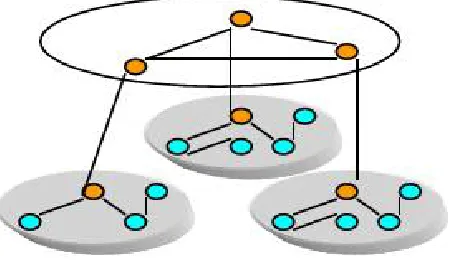
In WSN , nodes are grouped into clusters and each cluster has a cluster head. The nodes in a cluster do not directly communicate with base station instead they send their data to the cluster head and then the cluster head send the aggregated data to the base station. The following Fig 2 shows a clustered WSN in which three clusters are formed and each cluster is having a cluster head [11].
Fig 2. Structure of clustered wireless sensor network
LEACH is one of the widely used dynamic clustering protocol. In the following section, we will describe all the protocols developed for reduction in energy consumption and their disadvantages.
II. RELATED WORK
A. LEACH( Low-Energy Adaptive Clustering Hierarchy)
LEACH, is an energy-conserving routing protocol for wireless sensor network, was proposed by Heinzelman , Chandrakasan and Balakrishnan [10].In LEACH, sensor nodes form clusters and the cluster heads act as routers to the sink. This will save energy since the transmissions will only be done by Cluster Heads(CHs) rather than all sensor nodes. Optimal number of CHs is estimated to be 5% of the total number of nodes [7]. In LEACH protocol selection of cluster head is done in two phases.
1. Setup Phase
During the setup phase each node generates a random number between 0 and 1. If the random number is smaller than the threshold value then that node becomes CH. The threshold value is calculated based on the following equation [1] that is given below:-
Here p is the desired percentage of cluster heads and r is the current round, G is the group of nodes that has not been the CHs in the last rounds. The sensor node that is selected as a CH in previous round is not selected in the next rounds until all other nodes in the network becomes cluster heads.
2. Steady Phase
In the Fig 3, sensor nodes are grouped to form clusters and each cluster is having a Cluster Head. The cluster head collects data from the nodes of its cluster and then it send the aggregated data to the base station. The nodes in the cluster do not directly communicate with the base station [1].
Fig 3: LEACH Aggregation Algorithm
ADVANTAGES OF LEACH PROTOCOL
One of the advantages of LEACH is that it is completely distributed and does not require global knowledge of network. LEACH achieves over seven times more reduction in energy dissipation compared to direct communication and four to eight times as compared to the minimum transmission energy routing protocol. Leach employs dynamic clustering which increases lifetime of the system [8].
DISADVANTAGES OF LEACH PROTOCOL
In LEACH, the cluster heads are randomly selected using a random number and not on the basis of residual energy which is the biggest disadvantage of LEACH. The set up phase does not guarantee that the nodes are evenly distributed among the cluster heads. LEACH protocol may lead to unbalanced energy distribution due to random selection of cluster head [5]. LEACH assumes that all sensor nodes have sufficient power to reach the base station as in LEACH algorithm, in the given formula there is no energy factor included, this would restrict the nodes having energy constraint [2].
B. LEACH - C
LEACH-Centralized (LEACH-C) is an extension of LEACH which is proposed by Balakrishnan, Chandrakasan and Heinzelman [9]. All the nodes send their energy details to the base station and then the base station transmits its result of which nodes are selected as a cluster head. The base station chooses cluster head based on the remaining energy of
the nodes. Leach –C performance degrades when the energy charge for communicating with the base station is more
than the energy cost for cluster head formation.
C. K-LEACH
K-LEACH is an improved leach protocol which is proposed by Parul Bakaraniya and Sheetal Mehta. K-LEACH uses K- Medoids clustering algorithm in the first round during the set-up phase for cluster formation. The cluster head is selected based on the Euclidean distance at nearer or at the center of the cluster. From the second round onwards the node nearest to the first round cluster head is selected as CH and so on [8].
D. EELEACH-C
III. PROBLEM IDENTIFICATION
Our proposed algorithm is an improvement over the existing LEACH, LEACH-C, and K-LEACH algorithms. LEACH algorithm due to its probabilistic nature is not much efficient in cluster formation. It might choose a node as cluster head whose remaining energy is not sufficient to sustain the cluster and thus lead nodes dying earlier. LEACH-C improves LEACH by taking into account the remaining energy of the nodes and comparing with the threshold average energy. But it too suffers from the problem of uniform distribution of cluster heads. K-LEACH uses K-Medoids algorithm to choose a central node as a cluster head. Our proposed algorithm eliminates the probability factor of LEACH. It takes into consideration node-degree, remaining battery level and distance from base-station as criteria for selection of node as cluster head.
IV. PROPOSED ALGORITHM
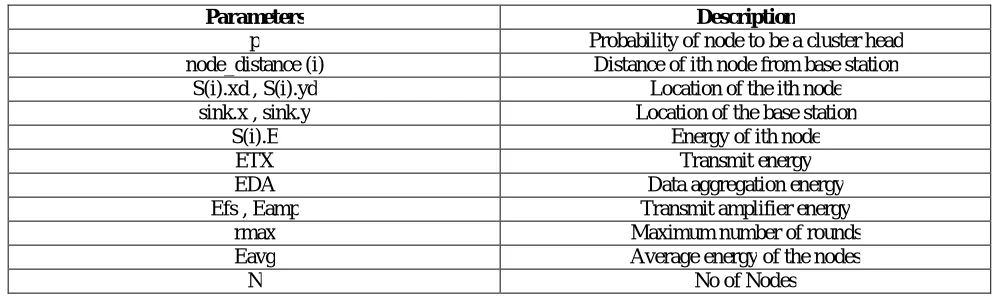
In this paper, we will modify the existing LEACH algorithm. Especially, we add one more factor about the characteristic of a sensor node into the evaluation formula, such that the nodes chosen as cluster heads may have a better behavior in homogenous sensor networks than those without the additional factor. The degree of a node is computed based on its distance from others. A node x is considered to be a neighbor of another node y if x lies within the transmission range of y. Transmission range is the average distance of the all the nodes from the base-station. The parameter defined in the proposed algorithm is defined in Table 1.
Table 1: Various parameters used in the algorithm
Parameters Description
p Probability of node to be a cluster head
node_distance (i) Distance of ith node from base station
S(i).xd , S(i).yd Location of the ith node
sink.x , sink.y Location of the base station
S(i).E Energy of ith node
ETX Transmit energy
EDA Data aggregation energy
Efs , Eamp Transmit amplifier energy
rmax Maximum number of rounds
Eavg Average energy of the nodes
N No of Nodes
Cluster Head Selection Formation Algorithm
Step-1: Create Sensor Network Model. Step-2: Assign initial energy to sensor nodes.
Step-3: Sort the nodes based on the distance from Base station using Bubble Sort in increasing order. To calculate node-distance from Base-Station the given formula is used:-
node_distance (i) = √ ((S(i).xd-(sink.x))^2+(S(i).yd-(sink.y))^2)
Step-4: For round=1 assign cluster heads based on minimum distance from the base-station
No of Cluster Heads for round-1= (p*n). Decrease the energy of the nodes chosen as cluster head by the formula as mentioned below by checking the conditions:-
S(i).E=S(i).E- ( (ETX+EDA)*(4000) +
Emp*4000*(node_distance(i)*node_distance(i)*node_distance(i)*node_distance(i) )); else
S(i).E=S(i).E- ( (ETX+EDA)*(4000) + Efs*4000*( node_distance (i)* node_distance(i) ));
Step-5: For the next round r =1:1: rmax If (S(i).E >=Eavg) then
i = nominee_clusterhead //nominated for cluster-head selection Calculate node-degree of the chosen nominee for cluster heads
If (node_degree>=avg_degree)
If the neighbourhood of the nominee cluster head is not a cluster head then
i=cluster head //cluster-head selected Step-6: Dead node: if (S(i).E = 0) then
Dead=i //ith node dies
n=n-dead //n: decrease no of alive nodes Step-7: Goto step-5
Step-8: End
SIMULATION RESULT:
A few reasonable assumptions of the network model are made based on [13] and they are:
There exists only one base station and it is fixed at a far distance from the sensor nodes.
The sensor nodes are homogeneous and energy constrained with uniform energy.
Sensor nodes are immobile and all nodes are able to reach BS.
The RAM size for each node must be sufficient enough to store the distance of the node from BS.
The base station is situated at the centre of the area space.
Clusters and nodes are static.
Normal nodes transmit directly to their respective cluster heads within a particular cluster.
The simulation is done using MATLAB. Let us assume the homogenous sensor network with 100 sensor nodes are randomly distributed in the 100m*100m area. The base station is located at the center (50, 50). We have set the minimum probability for becoming a cluster head (minimum probability) to 0.1 and initially energy given to each node is 0.5. The desired parameters are shown in Table 2.
TABLE 2: Simulation Parameters
Parameters Values
No. of nodes 100
Sink(base station) at(50,50)
Electric energy (Eelec ) 70nJoul
Transmit amplifier energy (Eamp) 120pJoul
Node Distribution Random
Data Aggregation Energy, EDA 5nJoul
Initial Energy, E0 0.5
Fig 4. Randomly distributed homogenous wireless network Fig 5: Cluster Heads distribution in homogenous wireless network
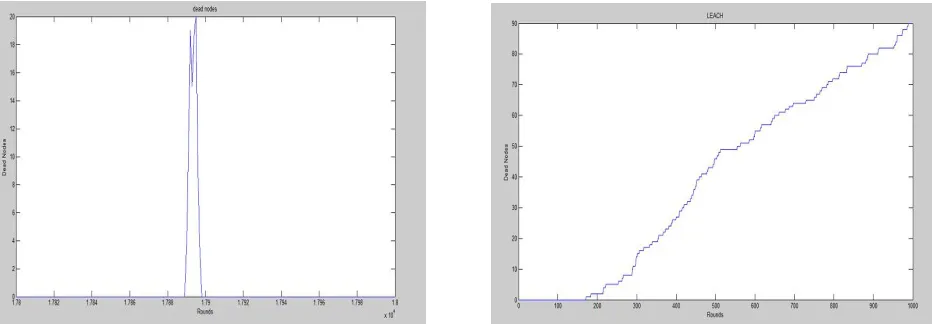
Fig 6: Dead nodes vs Rounds in LEACH-I and LEACH
46 47 48 49 50
100 200 300 400 500 600 700 800 900 1000
Remaining Energy vs Rounds
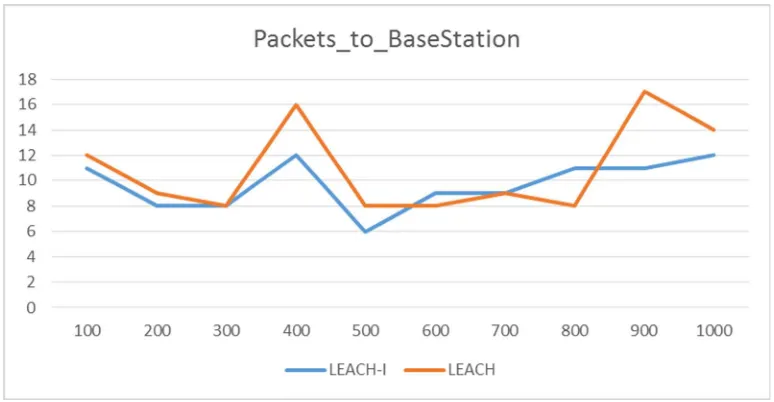
Fig 8: No of packets send to Base-Station vs Rounds
In Fig 4, a network consisting of randomly distributed sensor nodes is shown.In Fig 5, selected cluster heads in a random round is displayed. It is quite clear from the Fig 5 that the cluster head selection is uniformly distributed. In this algorithm nodes die much later that is after 18000 rounds and this shows that our algorithm is more energy efficient than LEACH as shown in Fig 6.Then in Fig 7 the graph is plotted for energy remaining after 1000 rounds for both LEACH-I and LEACH.LEACH-I proves to be better as more energy is remaining after the 1000 rounds. Number of packets sent to the base station by the selected cluster head is also shown in the Fig 8 which is much higher in LEACH-I as compare to LEACH algorithm.
V. CONCLUSION
This paper presents a comparison between LEACH and proposed algorithm LEACH-I (Improved LEACH algorithm). In wireless sensor networks, power consumption is an important factor for network lifetime. In this paper, the simulation result shows that the remaining energy of the sensor network and the number of dead nodes after 1000 rounds in 100mts*100mts environment using MATLAB. We have proposed an improved clustering algorithm LEACH-I based on the LEACH algorithm with additional constraints for selection of cluster heads in stationary wireless sensor networks. Experimental results have shown that the proposed algorithm behaves better than LEACH and LEACH-C on wireless sensor networks for long system lifetime. The CH selection considers residual energy of the node, the distance of the node from the BS and the number of rounds in which the node has not become CH and the node-degree which results in the minimization of energy consumption in the WSN. This is because our proposed algorithm improves LEACH protocol by improving the CH selection algorithm. Simulation results shows that our proposed algorithm exhibits better performance than LEACH with respect to the number of alive nodes and energy consumption, with number of rounds as compare to LEACH algorithm.
REFERENCES
[1] Sarbjeet Kaur, Ravi Gupta, “Deploying an Optimized LEACH-C Protocol for Wireless Sensor Network,” International Journal of Advanced Research in Computer Science and Software Engineering, vol.5, issue 7, July 2015.
[2] Gopi Saminathan Arumugam, Thirumurugan Ponnuchamy, “EE-LEACH: development of energy-efficient LEACH Protocol for data gathering in WSN, “Arumugam and PonnuchamyEURASIP Journal on Wireless Communications and Networking(2015).
[3] Lalita Yadav, Ch. Sunitha, “Low Energy Adaptive Clustering Hierarchy in Wireless Sensor Network (LEACH), “Lalita Yadav et al, / (IJCSIT) International Journal of Computer Science and Information Technologies, Vol. 5 (3) , 2014, 4661-4664.
[4] Leena Y.Barai, Mahendra A. Gaikwad, “Performance Evaluation of LEACH Protocol for Wireless Sensor Network, “International Journal of Innovative Research in Advanced Engineering (IJIRAE) Volume 1 Issue 6 (July 2014).
[6] Nikita Sehgal, Gurwinder Kaur, “Improved Cluster Head Selection Using Enhanced LEACH Protocol, “International Journal of Engineering and Innovative Technology (IJEIT) Volume 3, Issue 3, September 2013.
[7] Himanshi, Shruti Vashist, M.K.Soni, “Study of Wireless Sensor Network Using LEACH Protocol, “International Journal of Innovative Technology and Exploring Engineering (IJITEE), Volume-3, Issue-2, July 2013.
[8] Parul Bakaraniya, Sheetal Mehta, “K-LEACH: An improved LEACH Protocol for Lifetime Improvement in WSN,” International Journal of Engineering Trends and Technology (IJETT) – Volume 4 Issue 5- May 2013.
[9] A. Ahmad, K. Latif, N. Javaid, Z. A. Khan, U. Qasim, “Density Controlled Divide-And-Rule Scheme For Energy Efficient Routing In Wireless Sensor Networks,” arXiv:1303.6573v1 [cs.NI] 26 Mar 2013.
[10] Meena Malik, Dr. Yudhvir Singh, Anshu Arora, “Analysis of LEACH Protocol in Wireless Sensor Networks,” International Journal of Advanced Research in Computer Science and Software Engineering, Volume 3, Issue 2, February 2013.
[11] Mortaza Fahimi Khaton Abad P, P , Mohammad Ali Jabraeil Jamali, “Modify LEACH Algorithm for Wireless Sensor Network,” IJCSI International Journal of Computer Science Issues, Vol. 8, Issue 5, No 1, September 2011.
[12] M. J. Handy, M. Haase, D. Timmermann, “Low Energy Adaptive Clustering Hierarchy with Deterministic Cluster-Head Selection,” Fourth IEEE Conference on Mobile and Wireless Communications Networks, Stockholm, erschienen in Proceedings,World Scientific Publishing Co. Pte. Ltd., September 2002.
[13] Surbhi Sharma, Sarvesh Singh, “Study of LEACH Protocol for Wireless Sensor Network, “International Journal of Innovative Computer Science & Engineering, Vol 2, issue 3,July-August 2015.
[14] Nishi Yadav, PM Khilar,“Hierarchical adaptive distributed fault diagnosis in Mobile ad hoc network using clustering” International Conference on Industrial and Information Systems (ICIIS), IEEE Conference,July2010 Pages7-12.
[15] Kavita Tandon, Neelima Mallela, Nishi Yadav“Novel Approach for Fault Detection in Wireless Sensor Network” International Journal of Computer Science and Information Technologies (IJCSIT), Vol. 5 (2). 2014, 2191-2194
BIOGRAPHY
MONIKA is B.Tech Student of Computer Science & Engineering, Central University, ITGGV, Bilaspur, and Chhattisgarh, INDIA
SNEHA CHAUHAN is B.Tech Student of Computer Science & Engineering, Central University, ITGGV, Bilaspur, and Chhattisgarh, INDIA