Ensuring Data Security in Cloud by Using
Erasure Code Method
Mandar D.Shinde1, Ashish K. Patel2, Rajesh B. Vishwakarma3, Wilson A. Waghmare4 ,
Prof. Umesh Talware5
UG Students, Dept. of Information Technology, Dhole Patil College of Engineering, Pune, Maharashtra, India1,2,3,4
Assistant Professor, Dept. of Information Technology, Dhole Patil College of Engineering, Pune, Maharashtra, India5
ABSTRACT:Cloud storage service is collection of storage servers, its provide storage service on internet. In third party cloud server stored data may cause serious concern. There is some limit of functionality of storage service as to save data confidentially use encryption scheme but few operations are supported over the encrypted data. Distributed storage system which have no centralized author their using is very challenging. We define proxy re-encryption scheme with erasure code help for secure data. To store data secularly and for easily retrieval distributed storage system support efficiently and the user can forward data to another user without retrieving back. Proxy encryption scheme support encoding operation over encrypted massage and it was main technical operation as well as forwarding data as encrypted massage. We suggest to determine copies of massage which is send to the storage server, distributed storage service stored data on storage server and key server which is work independently. These define parameters allow more flexibility adjustment between number of storage server and robustness.
KEYWORDS: Decentralized erasure code, proxy re-encryption, threshold cryptography, secure storage system.
I. INTRODUCTION
ISSN(Online) : 2320-9801
ISSN (Print) : 2320-9798
I
nternational
J
ournal of
I
nnovative
R
esearch in
C
omputer
and
C
ommunication
E
ngineering
(An ISO 3297: 2007 Certified Organization)
Vol. 4, Issue 4, April 2016
storage server and forwarding encrypted massage to another user. In distribution service challenging work is to storage servers have to meet all requirement like data robustness, data security and data functionality which is help for the improve integrity encoding, encryption and forwarding massage. Our proposed system meets the requirements the storage servers independently create encoding or encrypted massage and key server perform partially decryption. In our studies we consider the system in a more general setting than previous works. This setting allows more flexible adjustment between the number of storage servers and robustness.
II. LITERATURE SURVEY
We briefly review distributed storage systems, integrity checking mechanisms and proxy re encryption schemes.
2.1 Distributed storage system
In the recent year, a user can access the storage devices via network connection the Network-Attached Storage (NAS) and the Network File System (NFS) provide extra storage devices over the network with improvement in scalability, security, efficiency, robustness. Storage server can work efficiently as there is no any centralize authority access the stored data effectively. Make replica of each massage and stored it on different server it was best method of provide robustness against the server failure. Hence this method is costly as Z replicas result in Z time Expansion. A massage will be encoded and encrypted in codeword symbol and it will store on each storage server. A storage server failure is modeled as an erasure error of the stored codeword symbol. Random linear codes support distributed encoding, that is, each code word symbol is independently computed. The massage will be stored in blocks and then each storage server can combine the all blocks linearly with randomly chosen coefficient. And store codeword symbols and co efficient. In [6] Author define that robustness and confidentiality issues by presenting a secure decentralized erasure code for the networked storage system. Storage service in their system consist key server which contain cryptograph key share and work in distributed key.in their system massages can encoding then encrypted which stored in storage server and to retrieve massage key server van decrypt massage partially.
2.2 Proxy Re-Encryption scheme
In Proxy encryption scheme by using re-encryption key a proxy server can transfer a cipher text under public key to another pubic key. The server doesn’t know the plaintext at the time of transformation. In 16 author define that some proxy re-encryption schemes and applied them to the sharing function of secure storage systems. In their work, messages are first encrypted by the owner and then stored in a storage server.
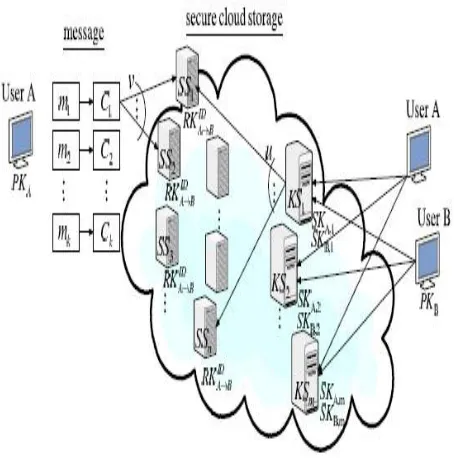
When user want to access his massage from storage server then he send re-encrypted key for the encrypted massage and storage server can decrypt massage for the authorised user. Hence system can help for the access data securely and forwarding to another user. Our work further integrates encryption, re-encryption, and encoding such that storage robustness is strengthened. The cloud work as intermediate of storage server and proxy server. Once a user desires to share his messages, he sends a re-encryption key to the storage server. When approved user send massage then storage server can encrypted and encoding the massage. Their secularly stored data on storage server, it will be support forwarding to another user confidentiality. In key private proxy re-encryption scheme storage server encrypted the massage so proxy server cannot verify this massage. With key attribute proxy server provide high security on proxy server.
2.3 Integrity checking Functionality
Fig. 1. A general system model of our work.
III.PROPOSED SYSTEM
In In system we define re-encryption system with attribute key. The distributed storage server support to robust and secure data storage and retrieval the data, user forward his data to another user without access back. In [11] defined by using cryptographic model to share secure data user can confidently secure data. In [10] explain erasure code base system it was decentralized code base system user can
ISSN(Online) : 2320-9801
ISSN (Print) : 2320-9798
I
nternational
J
ournal of
I
nnovative
R
esearch in
C
omputer
and
C
ommunication
E
ngineering
(An ISO 3297: 2007 Certified Organization)
Vol. 4, Issue 4, April 2016
Fig.2: A storage system with random linear coding over exponents
System Recovering is when main storage server failed to retain data then user retrieve data from the key server. Key sever decrypted partially data.
IV.EXPERIMENTAL RESULTS
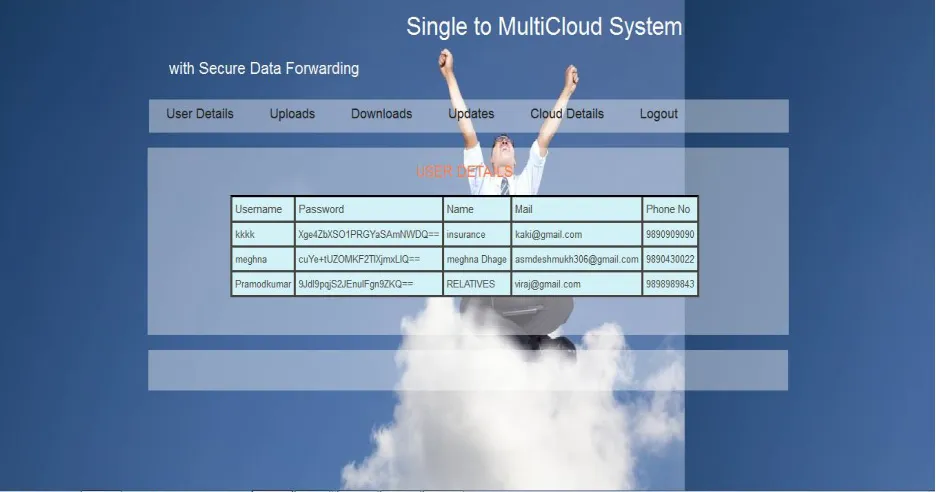
Fig 5. User Details
ISSN(Online) : 2320-9801
ISSN (Print) : 2320-9798
I
nternational
J
ournal of
I
nnovative
R
esearch in
C
omputer
and
C
ommunication
E
ngineering
(An ISO 3297: 2007 Certified Organization)
Vol. 4, Issue 4, April 2016
.
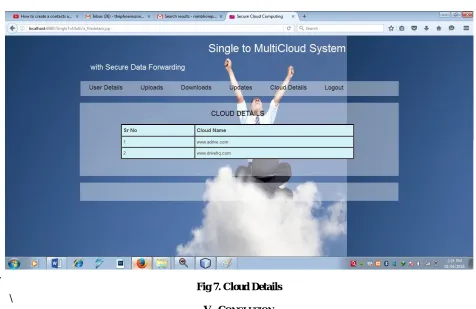
Fig 7. Cloud Details
\
V. CONCLUSION
In this paper, we studied the cloud sever where data can be stored on storage server and key server. We integrate a newly proposed threshold proxy re-encryption scheme and erasure codes over exponents. In distributed storage system proxy encryption scheme support system setup, data storage, data forwarding and partially decrypted. To decrypt a message of k blocks that are encrypted and encoded to n codeword symbols, each key server only has to partially decrypt two codeword symbols in our system. We define secure and robust cloud server. Data will be stored on storage server and key server, we can forward data to another user both server are work independently and decrypt data partially. The key server work as access node for providing front end layer as traditional file interface. Our storage server highly computable provide secure and robust data. In our studies storage server stored data in encrypted format with codeword symbol and with using key storage server massage can decrypt and when user want to forward massage to another user he can easily forward it from storage server.
REFERENCES
1. J. Kubiatowicz, D. Bindel, Y. Chen, P. Eaton, D. Geels, R. Gummadi, S. Rhea, H. Weatherspoon, W. Weimer, C. Wells, and B. Zhao, “Oceanstore: An Architecture for Global-Scale Persistent Storage,” Proc. Ninth Int’l Conf. Architectural Support for Programming Languages and Operating Systems (ASPLOS), pp. 190- 201, 2000.
2. P. Druschel and A. Rowstron, “PAST: A Large-Scale, Persistent Peer-to-Peer Storage Utility,” Proc. Eighth Workshop Hot Topics in Operating System (HotOS VIII), pp. 75-80, 2001.
3. A. Adya, W.J. Bolosky, M. Castro, G. Cermak, R. Chaiken, J.R. Douceur, J. Howell, J.R. Lorch, M. Theimer, and R. Wattenhofer, “Farsite: Federated, Available, and Reliable Storage for an Incompletely Trusted Environment,” Proc. Fifth Symp. Operating System Design and Implementation (OSDI), pp. 1-14, 2002.
4. A. Haeberlen, A. Mislove, and P. Druschel, “Glacier: Highly Durable, Decentralized Storage Despite Massive Correlated Failures,” Proc. Second Symp. Networked Systems Design and Implementation (NSDI), pp. 143-158, 2005.
5. Z. Wilcox-O’Hearn and B. Warner, “Tahoe: The Least-Authority Filesystem,” Proc. Fourth ACM Int’l Workshop Storage Security and Survivability (StorageSS), pp. 21-26, 2008.
7. D.R. Brownbridge, L.F. Marshall, and B. Randell, “The Newcastle Connection or Unixes of the World Unite! ,” Software Practice and Experience, vol. 12, no. 12, pp. 1147-1162, 1982.
8. R. Sandberg, D. Goldberg, S. Kleiman, D. Walsh, and B. Lyon, “Design and Implementation of the Sun Network Filesystem,” Proc. USENIX Assoc. Conf., 1985.
9. M. Kallahalla, E. Riedel, R. Swaminathan, Q. Wang, and K. Fu, “Plutus: Scalable Secure File Sharing on Untrusted Storage,” Proc. Second USENIX Conf. File and Storage Technologies (FAST), pp. 29- 42, 2003.
10. S.C. Rhea, P.R. Eaton, D. Geels, H. Weatherspoon, B.Y. Zhao, and J. Kubiatowicz, “Pond: The Oceanstore Prototype,” Proc. Second USENIX Conf. File and Storage Technologies (FAST), pp. 1-14, 2003.
BIOGRAPHY
Mr. MandarD. Shindepursuing his Degree Course in Bachelor of Engineering from Dhole Patil College of Engineering, Pune, Maharashtra, India
Mr. Ashish K. Patelpursuing his Degree Course in Bachelor of Engineering from Dhole Patil College of Engineering, Pune, Maharashtra, India
Mr. Rajesh B. Vishwakarmapursuing his Degree Course in Bachelor of Engineering from Dhole Patil College of Engineering, Pune, Maharashtra, India
Mr. Wilson A. Waghmarepursuing his Degree Course in Bachelor of Engineering from Dhole Patil College of Engineering, Pune, Maharashtra, India