ISSN(Online): 2320-9801 ISSN (Print): 2320-9798
I
nternational
J
ournal of
I
nnovative
R
esearch in
C
omputer
and
C
ommunication
E
ngineering
(An ISO 3297: 2007 Certified Organization)
Vol. 4, Issue 4, April 2016
Comparative Study on Various Techniques of
DOA Estimation of Source Target for
Underwater Application
Nagaraj
Student, Dept. of ECE, TOCE, Visvesvaraya Technological University, Banglore, India
ABSTRACT: Source direction of arrival (DOA) estimation is one of the challenging problems in many applications. Such applications can be seen in wireless communications, radar, radio astronomy, sonar and navigation. The resolution of a source direction of arrival estimation can be enhanced by an array antenna system with innovative signal processing. Super resolution techniques take the advantage of array antenna structures to better process the incoming waves. These techniques also have the capability to identify the direction of multiple targets. This paper investigates performance of the DOA estimation algorithms namely; MUSIC and ESPRIT on the uniform linear array (ULA) in the presence of white noise. The performance of these DOA algorithms for a set of input parameters such as number of snapshots, number of array elements, signal-to-noise ratio are investigated. The simulation results showed that the resolution of the DOA techniques MUSIC and ESPRIT improves as number of snapshots, number of array elements, signal-to-noise ratio and separation angle between the two sources are increased.
KEYWORDS: Direction of Arrival; Estimation of Signal Parameters via Rotational InavarianceTechnique(ESPRIT) ; Array Signal Processing; ULA.
I. INTRODUCTION
In the last decades, accurate determination of a signal direction of arrival (DOA) has received considerable attention in radar system and communication of military and commercial applications. Wireless communications, radar, radio astronomy, sonar, navigation, tracking of various targets are a few examples of many possible applications. For example, in commercial applications it is necessary to identify the direction of an emergency cell phone call in order to dispatch a rescue team to the proper location. One example of defense applications it is to identify the direction of a possible treads . In wireless mobile communication, the main objective of direction-of-arrival (DOA) estimation is to use the data received at the base-station sensor array to estimate the directions of the signals from the desired mobile users as well as the directions of interference signals. The results of DOA estimation are then used to adjust the weights of the adaptive beamformer, so that the radiated power is maximized towards the desired users, and radiation nulls are placed in the directions of interference signals.
One of the most promising techniques for increasing the capacity in the third generation cellular is the adaptive array smart antenna. The smart antenna technology is based on antenna arrays where the radiation pattern is altered by adjusting the amplitude and relative phase on the different elements. If several transmitters are operating simultaneously, each source creates many multipath components at the receiver and hence receive array must be able to estimate the angles of arrival in order to decipher which emitters are present and what are their angular.
There are several methods to estimates the number of incidents plane waves on the antenna arrays and their angle of incidence. The various DOA estimation algorithms are Bartlett, Capon, Min-norm, MUSIC, and ESPRIT. But MUSIC and ESPRIT algorithms are high
II. RELATED WORK
ISSN(Online): 2320-9801 ISSN (Print): 2320-9798
I
nternational
J
ournal of
I
nnovative
R
esearch in
C
omputer
and
C
ommunication
E
ngineering
(An ISO 3297: 2007 Certified Organization)
Vol. 4, Issue 4, April 2016
operating. The directions of Signal Of Interest(SOI) and interferers are obtained using a direction-of-arrival (DOA) estimation algorithm. DOA estimations can be then used by the array to design the adaptive beam former in such way as to maximize the power radiated towards the Signal Of Interest and to suppress the interference. In summary, the successful design of adaptive array smart antenna depends highly on the performance of DOA estimation algorithm. In the design of adaptive smart antenna for mobile communication the performance of DOA estimation algorithm depends on many parameters such as number of mobile users and their space distribution , the number of array elements and their spacing, the number of signal samples and SNR.
Conventional methods also called classical methods which first compute a spatial spectrum and then estimate DOAs by local maxima of the spectrum. Hence high angular resolution subspace methods such as MUSIC and Modified MUSIC algorithms are most widely used.
III.PROPOSED ALGORITHM
A. Design Considerations:
Data formulation for ESPRIT and MUSIC.
Covariance matrix.
Eigen value and Eigen matrix.
Signal and noise subspace.
Direction of arrival scanning.
B. Description of the Proposed ESPRIT Algorithm:
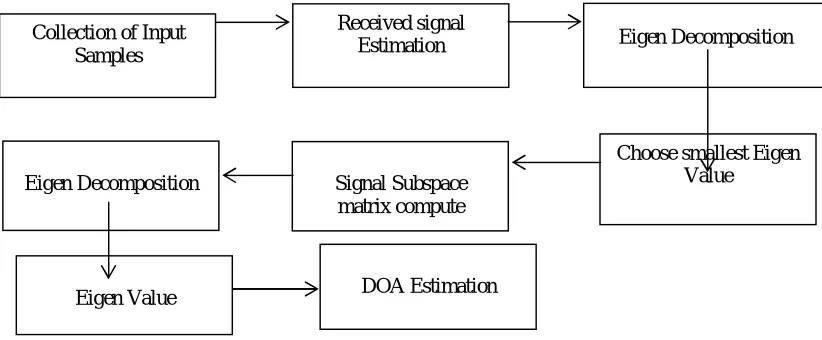
ESPRIT stands for Estimation of Signal Parameters via Rotational Invariance Techniques which is another subspace based DOA estimation algorithm. It does not involve an exhaustive search through all possible steering vectors to estimate DOA and dramatically reduces the computational and storage requirements compared to MUSIC
Fig 1: Block diagram of ESPRIT
C. Mathematical model ofESPRIT Algorithm:
Step 1: 1. Collection of samples & covariance:
=
∑
.
eq. (1)Step 2: Eigen decomposition:
=
⋀
eq. (2) Where E is diagonal matrix of the corresponding vectorCollection of Input Samples
Received signal
Estimation Eigen Decomposition
Choose smallest Eigen Value
Signal Subspace matrix compute Eigen Decomposition
ISSN(Online): 2320-9801 ISSN (Print): 2320-9798
I
nternational
J
ournal of
I
nnovative
R
esearch in
C
omputer
and
C
ommunication
E
ngineering
(An ISO 3297: 2007 Certified Organization)
Vol. 4, Issue 4, April 2016
Step 3: Smallest Eigen value is given by taking the minimum of step 2 Step 4: Subspace matrix is given as:
=
1
2
3
4
eq. (3)Step 5: DOA is given as:
=
( ) eq. (4)D. Description of the Proposed MUSIC Algorithm:
MUSIC is an acronym which stands for Multiple Signal classification. It is high resolution subspace DOA technique which gives the estimation of number of signals arrived, hence their direction of arrival. The algorithm is based on exploiting the Eigen structure of input covariance matrix. The incident signals are somewhat correlated creating non diagonal signal correlation matrix. The algorithm is used to describe Experimental and theoretical techniques involved in determining the parameters of multiple wave fronts arriving at an antenna array from measurements made on the signal received at the array elements. MUSIC deals with the decomposition of covariance matrix into two orthogonal matrices, i.e., signal-subspace and noise-subspace. Estimation of DOA is performed from one of these subspaces, assuming
Fig 2: Block diagram of MUSIC
E. Mathematical model ofMUSIC Algorithm:
The steps of the algorithm are summarized as follows:
Step 1: Collect input samples Xk , k = 0... N -1 and estimate the input covariance matrix.
=1 .
Step 2: Perform Eigen decomposition on .
= Λ
Where Λ= diag { , , … ,} are the Eigen values and E=diag{ , , … ,}are the
corresponding Eigen vectors of
Step 3: Estimate the number of signals from the multiplicity K, of the smallest eigenvalue as equation
M -K
Step 4: Compute the MUSIC spectrum by the following eq (5).
( ) =
( ) ( )
( ) ( )
Step 5
:
Find the largest peaks of ( ) to obtain estimates of the Direction -Of- Arrival.Input Sample Collection Covariance Estimation Eigen Decomposition
Eigen Value Computation Eigen Vector Computation
Number of signal estimation using minimum eigen value
MUSIC Spectrum Computation
Find the largest peak from the spectrum
ISSN(Online): 2320-9801 ISSN (Print): 2320-9798
I
nternational
J
ournal of
I
nnovative
R
esearch in
C
omputer
and
C
ommunication
E
ngineering
(An ISO 3297: 2007 Certified Organization)
Vol. 4, Issue 4, April 2016
IV.SIMULATION RESULTS
We analysed the performance of DOA estimation with various source positions and different noise levels where ESPRIT andMUSIC algorithm implemented. We tried to show the peak graph of array geometries mentioned above, and gained a general view of the graph which will be used in further data analysis. In all the analysis, it is assumed that the same number of sensors used is unless mentioned otherwise.
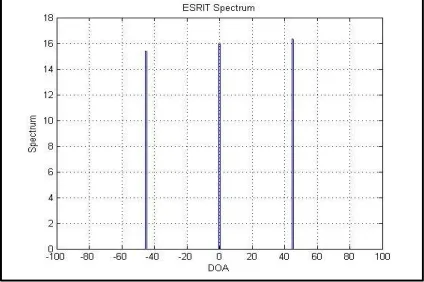
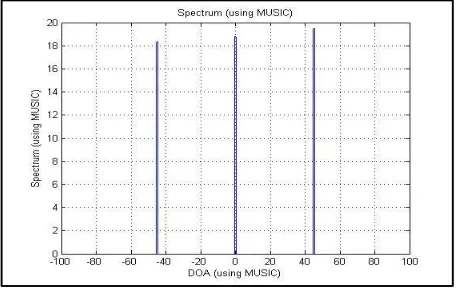
A coded simulation has been carried out to evaluate ESPRIT and MUSIC. In the simulation, we assume that three uncorrelated narrow band signals impinges on a linear array antenna at angles of arrivals , 0 and 45 . The three signals are assumed to have power of 1W, 1.5W and 2W, the number of sources considered is N=12. The detected signals computed using Modified MUSIC algorithm against angles are shown in the following figures for different conditions.It is obvious that the detected peaks indicating the DOAs of the three signals typically agree with the incident signals.
ESPRIT SIMULATION RESULTS:
DOA of Signals:Below graph represents arrival of signals with noise, highest peaks represents the arrival of incoming signal and other lower peaks represents noise in the environoment.
Fig.3.DOA of Signals with noise of ESPRIT
ISSN(Online): 2320-9801 ISSN (Print): 2320-9798
I
nternational
J
ournal of
I
nnovative
R
esearch in
C
omputer
and
C
ommunication
E
ngineering
(An ISO 3297: 2007 Certified Organization)
Vol. 4, Issue 4, April 2016
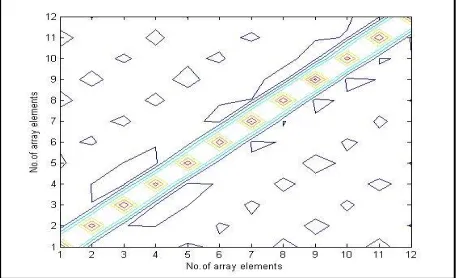
Spatial covariance: In case of spatial covariance as the number of array elements increases noise also increases as shown in below graph
Fig. 5. Spatial covariance of Matrix
Coherent spectrum: In coherent spectrum as pseudo spectrum increases the angle in degree also increase, hence the accuracy also increases.
Fig 6. Coherent Spectrum
DOA Estimation: This graph represents the Final DOA Estimation the peaks in this graph represents arrival of the incoming signals.
ISSN(Online): 2320-9801 ISSN (Print): 2320-9798
I
nternational
J
ournal of
I
nnovative
R
esearch in
C
omputer
and
C
ommunication
E
ngineering
(An ISO 3297: 2007 Certified Organization)
Vol. 4, Issue 4, April 2016
SIMULATION OF MUSIC:
DOA of signals: In case of MUSIC, below graph represents arrival of signals with noise, highest peaks represents the arrival of incoming signal and other lower peaks represents noise in the environoment.
Fig.8.DOA of Signals with noise of MUSIC
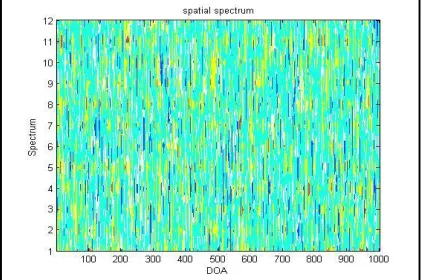
Spatial spectrum: Below graph is used to represent the present in the surrounding environment. As the distance between array elements increases noise also increases.
Fig. 9. Spatial spectrum of MUSIC
Spatial covariance: In case of MUSIC spatial covariance is as the number of array elements increases noise also increases as shown in below graph
ISSN(Online): 2320-9801 ISSN (Print): 2320-9798
I
nternational
J
ournal of
I
nnovative
R
esearch in
C
omputer
and
C
ommunication
E
ngineering
(An ISO 3297: 2007 Certified Organization)
Vol. 4, Issue 4, April 2016
Coherent spectrum: In MUSIC coherent spectrum is as pseudo spectrum increases the angle in degree also increase, hence the accuracy incoming signal also increases.
Fig 11. Coherent Spectrum
DOA Estimation: This graph represents the Final DOA Estimation using MUSIC algorithm the peaks in this graph represents arrival of the incoming signals.
Fig. 12. DOA Estimation using MUSIC spectrum
V. CONCLUSION AND FUTURE WORK
The ESPRIT uses the Eigen values and eigen vectors of the signal and noises to estimate the direction of arrival of the incoming signals. It becomes easier to separate the signals from noise as the Eigen vectors for signal and noise subspace are orthogonal to one another. It works efficiently when the signals that are being incident on the array of sensors are noncoherent. Efficiency of this estimation algorithm can be improved by increasing the inter element spacing, increasing the number of antenna sensors, number of snapshots and improving the incidence angle difference between the incoming signals.
REFERENCES
[1] Ioannides, P; Ballanis, C.A.; ―Uniform Circular Arrays for Smart Antennas,‖, Antennas and Propagation Magazine, IEEE, vol.47, no.4, pp.
192-206, Aug 2005.
ISSN(Online): 2320-9801 ISSN (Print): 2320-9798
I
nternational
J
ournal of
I
nnovative
R
esearch in
C
omputer
and
C
ommunication
E
ngineering
(An ISO 3297: 2007 Certified Organization)
Vol. 4, Issue 4, April 2016
[3] Ohira, T. , "Analog smart antennas: an overview," Personal, Indoor and Mobile Radio Communications, 2002. The 13th IEEE International
Symposium on , vol.4, no., pp. 1502- 1506 vol.4, 15-18 Sept. 2002
[4] Butler J., and Lowe R., ―Beam-Forming Matrix Simplifies Design of Electronically Scanned Antennas,‖ Electronic Design, pp. 170-173,
April 12, 1961.
[5] Kobayashi, O., Ohira, T., and Ogawa, H., ―A novel butler matrix based beam forming network architecture for multiple antenna beam
steering‖, IEICE Trans. Electronics, E82-C, 7, pp. 1195-1201, July 1999.
[6] Gaubatz, D.A., "FFT-Based Analog Beamforming Processor," 1976 UltrasonicsSymposium , vol., no., pp. 676- 681, 1976.
[7] M. S. Bartlett, "Periodogram analysis and continuous spectra," Bio-metrica, vol. 37, no. 1/2, pp. 1-16, Jun. 1950.
[8] Capon, J. , "High-resolution frequency-wavenumber spectrum analysis," Proceedings of the IEEE , vol.57, no.8, pp. 1408- 1418, Aug. 1969.
[9] Schmidt, R., "Multiple emitter location and signal parameter estimation," Antennas and Propagation, IEEE Transactions on , vol.34, no.3, pp.
276- 280, Mar 1986.
[10] Roy, R., and Kailath, T., "ESPRIT-estimation of signal parameters via rotational invariance techniques," Acoustics, Speech and Signal Processing, IEEE Transactions on , vol.37, no.7, pp.984-995, Jul 1989
BIOGRAPHY