University of Windsor University of Windsor
Scholarship at UWindsor
Scholarship at UWindsor
Electronic Theses and Dissertations Theses, Dissertations, and Major Papers
10-19-2015
Real Time Predictive Speed Analysis for High Speed Rail Collision
Real Time Predictive Speed Analysis for High Speed Rail Collision
Test
Test
Xian Jian Jiang
University of Windsor
Follow this and additional works at: https://scholar.uwindsor.ca/etd
Recommended Citation Recommended Citation
Jiang, Xian Jian, "Real Time Predictive Speed Analysis for High Speed Rail Collision Test" (2015). Electronic Theses and Dissertations. 5441.
https://scholar.uwindsor.ca/etd/5441
This online database contains the full-text of PhD dissertations and Masters’ theses of University of Windsor students from 1954 forward. These documents are made available for personal study and research purposes only, in accordance with the Canadian Copyright Act and the Creative Commons license—CC BY-NC-ND (Attribution, Non-Commercial, No Derivative Works). Under this license, works must always be attributed to the copyright holder (original author), cannot be used for any commercial purposes, and may not be altered. Any other use would require the permission of the copyright holder. Students may inquire about withdrawing their dissertation and/or thesis from this database. For additional inquiries, please contact the repository administrator via email
Real Time Predictive Speed Analysis for High
Speed Rail Collision Test
By
Xian Jian Jiang
A Thesis Submitted to the Faculty of Graduate Studies through Computer Science in Partial Fulfillment of the Requirements for the Degree of Master of Science at
the University of Windsor
Windsor, Ontario, Canada
2015
Real Time Predictive Speed Analysis for High Speed Rail Collision Test
by
Xian Jian Jiang
APPROVED BY:
_______________________________________________________
Dr. Guoqing Zhang Department of Mechanical, Automotive and Materials Engineering
_______________________________________________________
Dr. Arunita Jaekel School of Computer Science
_______________________________________________________
Dr. Dan Wu, Advisor School of Computer Science
Author’s Declaration of Originality
I hereby certify that I am the sole author of this thesis and that no part of this
thesis has been published or submitted for publication.
I certify that, to the best of my knowledge, my thesis does not infringe upon
anyone’s copyright nor violate any proprietary rights and that any ideas, techniques,
quotations, or any other material from the work of other people included in my thesis,
published or otherwise, are fully acknowledged in accordance with the standard
referencing practices. Furthermore, to the extent that I have included copyrighted
material that surpasses the bounds of fair dealing within the meaning of the Canada
Copyright Act, I certify that I have obtained a written permission from the copyright
owner(s) to include such material(s) in my thesis and have included copies of such
copyright clearances to my appendix.
I declare that this is a true copy of my thesis, including any final revisions, as
approved by my thesis committee and the Graduate Studies office, and that this
thesis has not been submitted for a higher degree to any other University or
Abstract
In a real train collision test, a train locomotive needs to be propelled on a straight,
guided path, to a particular speed, at which time the train locomotive is released to
coast down towards a barrier where it is required to crash at a desired speed. The
current control of the release speed and location is based on theoretical data and
previous experience which leads to less accuracy in the actual crash speed. In this
research work, the goal is to make improvements in a typical real train collision test
that will help obtain a more accurate crash speed and release location by controlling
the force release precisely. The contribution of this research work is to implement a
solution to simulate the behavior of the propulsion system, and trigger an algorithm
to calculate the required release speed and location more accurately and quickly.
Dedication
This thesis is dedicated to my wife who has supported me all the way since the
beginning of my studies.
Acknowledgements
First of all, I would like to express my deep and sincere gratitude to my
supervisor, Dr. Dan Wu, for his invaluable guidance and advices, for his enthusiastic
encouragement and his great patience to me. Without his help, the work presented
here would not have been possible.
A very special thanks goes out to Mr. Roland Vander Straeten of Anemoi
Technologies Inc. Mr. Roland Vander Straeten is the one specialist who truly made
a difference in my life. It was under his tutelage that I developed the current
application software and became interested in the state-of-the-art test facilities. He
provided me with direction, technical support and became more of a mentor and
friend, than an employer.
I would also like to thank my external reader, Dr. Guoqing Zhang, and my
internal reader, Dr. Arunita Jaekel, for spending their precious time to review this
thesis and putting down their comments, suggestions on the thesis work.
Finally, I am very grateful for experts of Anemoi Technologies Inc., Jessica
Zheng, Mike Doiron, Slawek Ciurzynski and Bruce Hu. During these two years’
study, they gave me great and solid support whenever I met any kind of problems.
They always share their valuable knowledge and experiences with me. This is the
TABLE OF CONTENTS
AUTHOR’S DECLARATION OF ORIGINALITY ... iii
ABSTRACT ... iv
DEDICATION ... v
ACKNOWLEDGEMENTS ... vi
LIST OF TABLES ... ix
LIST OF FIGURES ... x
Chapter 1 Introduction ... 1
1.1 Introduction of High Speed Rail... 1
1.2 Brief History of HSR ... 2
1.3 Safety Issues and Technology ... 4
1.4 Motivation ... 6
1.5 Contributions ... 6
1.6 Guide to the Thesis ... 8
Chapter 2 Background Knowledge ... 10
2.1 Regression Analysis ... 10
2.1.1 Simple Linear Regression ... 11
2.1.2 Multiple Linear Regression ... 14
2.1.3 Quadratic Relationship between Dependent and Independent Variables . 16 2.1.4 Calculation of Regression Coefficients ... 17
2.1.5 Correlation Coefficient - R² ... 18
2.2 Test Phases ... 20
2.3 Test Facility ... 21
2.4 Vehicle Motion Analysis ... 23
2.5 Sample Data Sheet ... 25
Chapter 3 Proposed Solution - RTPSA ... 29
3.1 Limitation of Existing Methods ... 29
3.2 Objective ... 29
3.3 Design Principles ... 30
3.3.1 Real-Time ... 30
3.3.2 Predictive ... 32
3.3.3 Simulation ... 33
3.4 System Architecture ... 34
3.5 Software Structure ... 35
3.6 Main Process ... 38
3.6.1 The Generation of Simulated Data Stream ... 39
3.6.2 Program Logic in Implementation ... 39
3.7 Coefficients Calculation Module ... 41
3.7.1 How to Calculate the Regression Coefficients ... 42
3.7.2 Program Logic in Implementation ... 44
3.8 Coast-Down Simulation Module... 45
3.8.1 How to Simulate the Coast-Down Behavior? ... 46
3.8.2 Program Logic in Implementation ... 48
3.9 Propulsion Simulation Module ... 49
3.9.1 How to Simulate the Last Period of Propulsion Phase? ... 50
3.9.2 Program Logic in Implementation ... 52
3.10 Control/Release Module ... 53
3.10.1 How to Find the Release Speed and Location? ... 53
3.10.2 Program Logic in Implementation ... 54
3.11 Summary ... 55
4.1 The Demonstration Program ... 57
4.2 Standalone Version of Software ... 58
4.3 Running Time ... 60
4.4 Run with Different Set of Data ... 61
4.5 Run with Different Values of Crash Speed ... 62
4.6 Run with Different Values of Barrier Location ... 62
4.7 𝑹² with Different Speed ... 63
4.8 𝑹² with Different Error Ratio ... 64
4.9 Coast-down Distance with Different Propulsion Forces ... 65
Chapter 5 Conclusion and Future Work ... 67
5.1 Conclusion ... 67
5.2 Future Work ... 68
BIBLIOGRAPHY ... 69
LIST OF TABLES
3.1 Leading Time Calculation .………..………...51
4.1 Run with Different Set of Data...………...61
4.2 Run with Different Values of Crash Speed………....……….62
4.3 Run with Different Values of Barrier Location………...……...63
4.4 𝑅²for Speed of 60kph..………...…...………...63
4.5 𝑅²for Speed of 80kph………..……….………...63
4.6 𝑅²for Speed of 120kph………..….………..…………...64
4.7 𝑅²for Speed of 150kph..………...64
4.8 𝑅²for Different Error Ratios………...64
LIST OF FIGURES
1.1 Deadly Collision ……..……….4
2.1 Data Distribution of Lean Body Mass and Muscle Strength………...11
2.2 Simple Linear Regression - Straight Line….……….……… 12
2.3 Different Fitted Lines for A Set of Data……..……….……… 13
2.4 Vertical Distance vs Perpendicular Distance………14
2.5 Propulsion–Release Force–Coast Down ……….………21
2.6 Train and Track…...……….………22
2.7 Building Housing the Rigid Wall……….…………22
2.8 Rigid Wall………..……….…………22
2.9 Sample Data 1……….………25
2.10 Sample Data 2……….………26
3.1 Small Intervals of Propulsion Curve………….………31
3.2 Start and End Points for Simulations………...………33
3.3 System Architecture………...………35
3.4 Software Structure……….…….………36
3.5 Intersection Point………...…….………38
3.6 The Format of Simulated Data Stream…….………39
3.7 Main Process of 𝑅𝑇𝑃𝑆𝐴………41
3.8 End Point for Data Collection ……….………43
3.9 Program Logic of Coefficients Calculation………45
3.10 Time-Equal Intervals for Coast-Down Simulation………47
3.11 Coast-Down Curves ……….………48
3.12 Program Logic of Coast-down Simulation ……….………49
3.13 Start Point for Propulsion Simulation ……….………50
3.14 Program Logic of Propulsion Simulation …………...………53
3.15 Program Logic of Control and Release Processing……..………55
4.1 Screen Shot of Demonstration Program…………..………58
4.3 Output Screen of the Standalone Version….……..………60
4.4 Screen Shot of Console - Running Time …………..………60
4.5 Maximum Propulsion Force = 60,000………..………66
4.6 Maximum Propulsion Force = 70,000………..………66
Chapter 1 Introduction
1.1 Introduction of High Speed Rail
The global high speed rail (HSR) network is one of the great feats of modern
engineering, and proves to be one of the best forms of transportation ever
invented. The global HSR network is rapidly expanding across continents world
wide - delivering fast, efficient mobility to numerous nations every day [35].
HSR is currently in operation in more than twenty countries (including the UK,
France, Germany, Belgium, Spain, Italy, Japan, China, Korea, and Taiwan)
[34]. HSR is under construction in more than ten countries (including China,
Spain, Saudi Arabia, France, and Italy). In the meantime, it is in development in
another fourteen countries (including Turkey, Qatar, Morocco, Russia, Poland,
Portugal, South Africa, India, Argentina, and Brazil). In Japan, HSR has been in
operation for fifty years carrying more than nine billion passengers without a single
fatality [31].
HSR delivers many layers of economic benefits. It is one of the solutions to
rising gas prices. HSR delivers fast, efficient transportation so riders can save time,
energy, and money. It is reliable and operates in almost all weather conditions
[12]. HSR is not subject to congestion, so it operates on schedule every day without
delay - especially during rush hour and peak travel times.
HSR stimulates the revitalization of cities by encouraging high density,
mixed-use real estate development around the stations [35]. It also fosters economic
integrated regions that can then function as a single stronger economy. HSR can
generate more job opportunities to labor markets and offers workers a wider network
of employers to choose from. It also encourages and enables the development of
technology clusters with fast and easy access between locations. In the meantime, it
also expands tourism markets while increasing tourists spending.
1.2 Brief History of HSR
High-speed trains were first introduced in the early 19th century when British
engineers developed the steam railroad locomotives [1]. These locomotives were the
beginning of a long era in which various technologies were pursued in order to
achieve higher speeds coupled with operating and fuel efficiencies. Steam
propulsion gave maximum speeds of about 160kph (100mph) in the early 20th
century. Test speeds of 209kph (130mph) were attained by using diesel-electric and
electric propulsion in the 1930s and 1940s. This change in technology provided
slightly improved performance and fuel efficiency, but it was not until the 1960s that
breakthroughs in suspension, train–track dynamics, and other factors permitted an
increase in train speeds.
On November 1st, 1965, the Japanese introduced, as part of the regular train
schedule, a standard-gauge railway service that reached the maximum speed of
209kph (130mph) [31]. The average speed of the train was 166kph (103mph). The
Pennsylvania railroad developed the “metro-liners” by placing traction motors on
each axle [33]. That train achieved the maximum speed of 251kph (156mph) in
Princeton, New Jersey, in May 1967. Only a decade ago, “metro-linerlike” coaches
pulled by AEM-7(Asea Electro Motive 7000hp) locomotives operating at speeds of
up to 201kph (125 mph) in service were the only relatively high-speed rail systems
in the United States [35]. At present, high-speed rail trains regularly operate in Japan,
France, Germany, and other countries worldwide in service, at speeds between 240
(bullet train) between Osaka and Tokyo for more than thirty years [31].
The French initiated high-speed service between Paris and Lyon with the TGV
(Train à Grande Vitesse - French high speed train) in 1981 [32]. The latest French
TGV trains operate in service on several lines (about 25% of the lines are dedicated
to their use) connecting Paris with Brussels, London (under the British Channel,
called the Eurostar), and cities of the Atlantic and Mediterranean coasts. The TGV
achieves peak speeds of 320kph (200mph) and has been tested at a sustained speed
of 515kph (330mph). Similarly, the Germans operate their own ICE
(Inter-City-Express Train) all over the country (using mainly non-dedicated lines).
HSR in China may refer to any commercial train service in China with an
average speed of 200kph (124mph) or higher [29]. By that measure, China has the
world's longest HSR network with over 11,028 km (6,852 mi) of track in service as
of December 2013, including the world's longest line, the 2,298 km (1,428 mi)
Beijing–Guangzhou High-Speed Railway.
Since high-speed rail service in China was introduced on April 18th, 2007, daily
ridership has grown from 237,000 in 2007 to 1.33 million in 2012, making the
Chinese high-speed rail network the most heavily used in the world [34]. China's
high-speed rail network consists of upgraded conventional railways, newly built
high-speed passenger designated lines (PDLs), and the world's first high-speed
commercial magnetic levitation (maglev) line. Nearly all high-speed rail lines
and rolling stock are owned and operated by the China Railway Corporation, the
national railway operator formerly known as the Railway Ministry. The Shanghai
Maglev Train is owned and operated by Shanghai's city government [29].
China's early high-speed trains were imported or built under technology transfer
components and built indigenous trains that can reach operational speeds of up to
380kph (240mph).
1.3 Safety Issues and Technology
As the speed of trains becomes faster and faster, the severity of accidents can
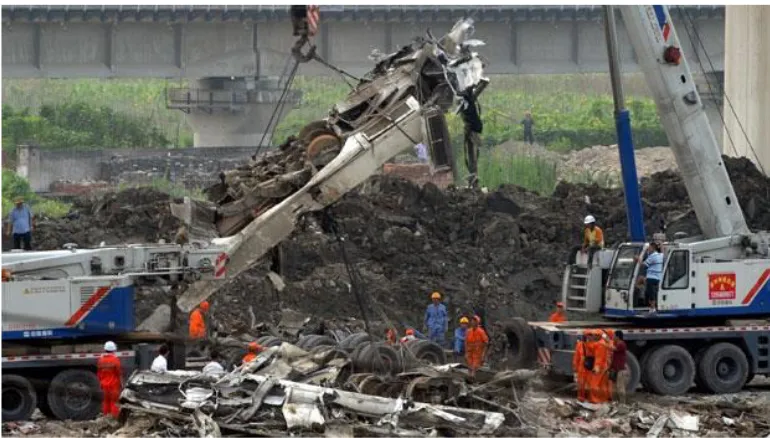
be disastrous. In the city of Wenzhou, China on July 24th, 2011, a deadly collision
happened and over forty people were killed in this accident. It was caused when one
train, struck by lightning, lost power and a second train crashed into its back [11].
Figure 1.1 shows the rescue effort.
Figure 1.1 Deadly Collision. Source: CBC NEWS
Another accident happened in Bulgaria on July 12th, 2014. A long distance
passenger train derailed at Kaloyanovets station, killing the driver and injuring
fourteen others. The train passed through turnouts set to diverging track at 104kph.
A large part of the research regarding high speed ground transportation systems
has focused on safety issues [36]. Many of these issues deal with crash tests and car
While train collisions are extremely rare occurrences, when one happens, heavy
casualties are almost unavoidable. For this reason, many European countries and the
USA have developed design methods to minimize damage in the event of a train
collision [37]. Moreover, in an effort to improve train crashworthiness, these
countries have developed safety guidelines for passenger trains. One aspect of such
efforts is to apply design to the car and make it crushable, thereby absorbing energy
[38]. Those techniques include improved crashworthiness cab car and locomotive
structural designs [5, 6], improved crashworthiness coach car structural designs [7],
and a variety of interior occupant protection strategies [8]. Since the setup of real
train collision test facility requires massive amounts of time and expense, such a
technique was rarely used before. Therefore, simulation methods are particularly
important in the train collision testing field. So far, crashworthiness has been
assessed using four modeling techniques. The first is to sequentially analyze and
evaluate the partial structure of a train by using a 3D finite element modeling
techniques [1]. The second is to analyze the crushing characteristics of the entire
train by applying the crushing characteristics obtained from the first technique to a
1D train model [2]. The third is to use a 2D modeling technique to estimate
overriding [3]. The fourth is a technique to predict the behavior of an entire train by
using a 3D multi-body dynamics model [10]. Although these methods have been
efficiently applied in computer system without much difficulty, they have many
restrictions in terms of their ability to predict the nonlinear collision behavior that
occur in an actual collision [39]. In other words, the aforementioned evaluation
methods all have the shortcoming that they cannot consider interactions sequentially
occurring among each component, suspension, bogie and the body [40].
As a matter of fact, the most ideal technique providing the highest reliability in
predicting collision behavior is to use a real train collision [41]. Another main
purpose of doing the real train collision test is to validate the simulation code because
it is much cheaper to run the computer code than crashing an actual train. In the
of this thesis are highlighted, and the structure of the remaining chapters are outlined.
1.4 Motivation
The most ideal technique providing the highest reliability in predicting collision
behavior is to use a real train collision, but this does requires massive amounts of
time and expense [41]. In the real train collision test, a train locomotive needs to be
propelled on a straight, guided path, to a particular speed, at which time the train
locomotive is released to coast down to a crash barrier where it is required to crash
at a desired speed. That propulsion could be in the form of a cable pulling the train
inside a laboratory setting or another locomotive pushing the test object along a long
train track. The current control of the release speed and the release location is based
on theoretical data and previous experience which leads to less accuracy in
controlling the actual crash speed. The resistance forces, including inertia, friction
and aerodynamic resistance forces, are playing important roles and significantly
influence the behavior of both propulsion and coast-down movement. And due to
the lack of a mechanism to collect the real-time data to calculate the resistance force
along the test, the current release speed and location is only roughly estimated.
Inaccuracy of crash speed means the waste of great deal of time and money. The
motivation in this thesis is to design and implement a solution to simulate the
performance data from the propulsion phase, and trigger an algorithm to calculate
the release speed and location more accurately and quickly. The critical works in
this solution are to implement a proper mathematical model to describe and analyze
the behavior of resistance force, calculate the regression coefficients quickly,
simulate the coast-down process and find the release speed and location precisely.
1.5 Contributions
This thesis is concerned with the problem of mathematical models to analyze
behavior. The contributions of this thesis are as follows.
The primary contribution of this thesis is that a regression analysis data model
is applied to analyze the data set obtained from industry experts that is used to
calculate and estimate the real time performance of the testing vehicle, such as forces,
acceleration, [pulling cable] motor torque, speed and location. In a real testing
environment, such data will be collected in a real time basis through an array of
sensors. After the calculation based on the provided data set, a new data set is
obtained describing the relationship between resistance force and speed. The least
squares method is then applied to calculate and determine the regression coefficients
which in turn leads to a best fit function of resistance to describe the behavior of the
new obtained data set. This resistance function will be used later on to predict the
performance of resistance force for coast-down movement as well as for the
propulsion behavior.
The second important contribution is that a practical approach is designed and
implemented to simulate the coast-down behavior. The coast-down movement starts
at the release location where the propulsion force is released and it ends at the
position of collision between the test vehicle and the barrier. There are several
difficulties in such a simulation. For example, the location and speed of the start
position of coast-down are unknown and the whole coast-down movement is a
varying acceleration motion. In order to solve this problem, a reverse analysis is
designed and provided in this research. The coast-down simulation is done by
calculating the speed and location at each time stamp starting from the end position
of the coast-down movement instead of the start position, because the speed and
location for the end position, which means the crash speed and location of barrier,
are predefined and known.
of the design and development are presented, such as system architecture, software
structure, design principles, program logic and flows chart. This software application
is part of the overall control system (Facility Control System) in a real test facility.
The data-feed interface in this application can be easily modified to adapt to the real
interface to measuring sensors. This software can also be customized as a standalone
tool to let the users be able to change and manipulate different parameters to simulate
different scenarios.
1.6 Guide to the Thesis
This thesis is organized as follows.
Chapter 2: Background Knowledge. This chapter provides an introduction to the subject that the proposed method builds upon. The theory of regression analysis will
be reviewed at first. Multiple linear regression and least squares method are
specifically emphasized, since they are the core and foundation of the proposed
approach. After the introduction of regression analysis, the idea of real train collision
test and some major concepts will be explained.
Chapter 3: Proposed Solution - 𝑹𝑻𝑷𝑺𝑨. The proposed method is presented and explained in this chapter which covers the major contribution of this thesis to fulfill
this research work. The software developed is called 𝑅𝑇𝑃𝑆𝐴 (Real Time Predictive
Speed Analysis). The definition of the problem is described in the beginning of this chapter, followed by objective and design principles of the proposed approach. Then,
system architecture and software modules will be introduced in detail. After reading
this chapter, readers will be able to understand the advantages of the proposed
method and the implementation details in this research work.
presented, together with explanation and analysis of the result tables. This leads to
the conclusion in following chapter.
Chapter 2 Background Knowledge
This chapter provides the background knowledge on which the proposed
method is based. The theory of regression analysis will be reviewed which includes
simple linear regression, multiple linear regression, the calculation of regression
coefficients and the correlation coefficients. After that, test phases, typical setup in
a real train collision test, an in-depth knowledge of the vehicle motion and sample
data sheet will be introduced.
2.1 Regression Analysis
Regression analysis is a statistical technique for the investigation of
re-lationships between variables [13]. Usually, the investigator seeks to ascertain the
causal effect of one variable upon another—the effect of a price increase upon
demand, for example, or the effect of changes in the money supply upon the inflation
rate [19]. To explore such issues, the investigator assembles data on the underlying
variables of interest and employs regression to estimate the quantitative effect of the
causal variables upon the variable that they influence. The investigator also typically
assesses the “statistical significance” (correlation coefficient) of the estimated
relationships, that is, the degree of confidence that the true relationship is close to
the estimated relationship [20].
The goal of regression analysis is to determine the values of parameters for a
function that cause the function to best fit a set of data observations provided.
2.1.1 Simple Linear Regression
In its simplest form, linear regression shows the relationship between one
independent variable 𝑋 and a dependent variable 𝑌, as in the formula below:
𝑌 = 𝑎0+ 𝑎1𝑋 + 𝑢 (2.1)
The magnitude and direction of that relationship are given by the slope parameter𝑎1,
and the status of the dependent variable 𝑌 when the independent variable 𝑋 is 0 is
given by the intercept parameter 𝑎0. An error term 𝑢 captures the amount of
variation not predicted by the slope and intercept terms [14].
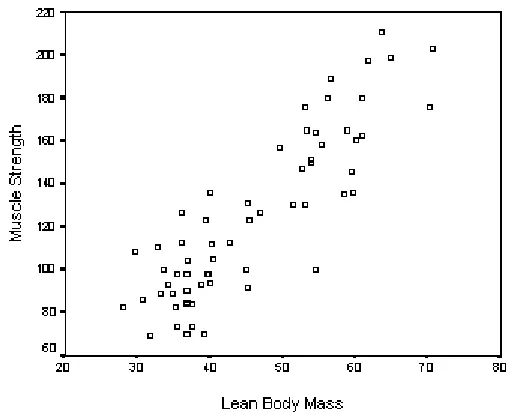
An example of simple linear regression is the relationship between muscle
strength against lean body mass. Figure 2.1 shows a data distribution about them.
Figure 2.1 Data Distribution of Lean Body Mass (kg) and Muscle Strength
(kg/cm²). Source: [46]
The 𝑋-axis in Figure 2.1 represents lean body mass while the 𝑌-axis represents
muscle strength. Each small square is a pair of data of (𝑥, 𝑦). By observing Figure
relationship isn't perfect because it's easy to find two people where the one with more
lean body mass is the weaker, but in general strength and lean body mass tend to go
up and down together. When two variables are displayed in a scatterplot and one can
be thought of as a response to the other (here, lean body mass produces strength),
standard practice is to place the response on the vertical (or 𝑌) axis. The names of
the variables on 𝑋 and 𝑌 axes vary according to the field of application. Some of
the common usages are as follows.
X-axis Y-axis
independent dependent predictor predicted
carrier response
input output
The association between lean body mass 𝑋 and muscle strength 𝑌 looks like
it could be described by a straight line shown in Figure 2.2.
Figure 2.2 Simple Linear Regression - Straight Line. Source: [46]
The data (each small square) are pairs of independent and dependent variable
values {( 𝑥𝑖, 𝑦𝑖): 𝑖 = 1, … , 𝑛}. The fitted function could be written as
ŷ = 𝑏0+ 𝑏1𝑥 (2.2)
and 𝑏1 are regression coefficients. The residuals are the differences between the
observed and the predicted values {( 𝑦𝑖− ŷi): 𝑖 = 1, … , 𝑛}.
There are two primary reasons for fitting a regression function to a set of data.
The first is to describe the data and the second is to predict the dependent variable
value from the independent variable value. The method of calculation for the fitted
regression function will be introduced in Section 2.1.4 and the rationale behind the
way the regression line is calculated is best seen from the point-of-view of prediction
[21]. A line gives a good fit to a set of data if the points are close to it. Figure 2.3
shows that there could be many different lines to fit the data set. Where the points
are not tightly grouped about any lines, a line gives a good fit if the points are closer
to it than to any other lines. For predictive purposes, this means that the predicted
values obtained by using the line should be close to the values that were actually
observed, that is, the residuals should be small. Therefore, when assessing the fit of
a line, the vertical distances of the data points to the line are the only distances that
matter. Perpendicular distances are not considered because errors are measured as
vertical distances, not perpendicular distances. Figure 2.4 shows the relationship
among observed value, predicted value and vertical distance.
Figure 2.4 Vertical Distance vs Perpendicular Distance. Source: [46]
2.1.2 Multiple Linear Regression
In simple linear regression, there is only one major influencing factor as
independent variable to explain the changes of one dependent variable. In the real
world, the dependent variable changes are often affected by several important factors,
then two or more impact factors as independent variables are used to explain the
changes in the dependent variable, which is known as multiple regression. When the
relationship between multiple independent variables and the dependent variable is
linear, the regression analysis is called multiple linear regression [22].
The general form of multiple linear regression is as follows.
𝑌 = 𝑎0+ 𝑎1𝑋1+ 𝑎2𝑋2+ ⋯ + 𝑎𝑛𝑋𝑛+ 𝑢, (2.3)
where 𝑌 represents the dependent variable, 𝑋𝑖 , 𝑖 = 1, … , 𝑛 are the independent
Same as simple linear regression, multiple linear regression has similar practical
uses. Most applications fall into one of the following two broad categories:
If the goal is prediction, or forecasting, or reduction, linear regression can be
used to fit a predictive model to an observed data set of (𝑥, 𝑦) values. After
developing such a model, if an additional value of 𝑋 is then given without
its accompanying value of 𝑌, the fitted model can be used to make a
prediction of the value of 𝑌.
Given a variable 𝑌 and a number of variables 𝑋1, … , 𝑋𝑝 that may be related
to 𝑌, linear regression analysis can be applied to quantify the strength of the
relationship between 𝑌 and the 𝑋𝑗, 𝑗 = 1, … , 𝑝., to assess which 𝑋𝑗 may
have no relationship with 𝑌 at all, and to identify which subsets of the
𝑋𝑗 contain redundant information about 𝑌.
One of the major objectives to study multiple linear regression model is to find
the fitted function to best describe the data distribution, and then it can be used for
prediction [25]. When the number of independent variables is two, the multiple
linear regression has the general form as follows,
𝑌 = 𝑎0+ 𝑎1𝑋1+ 𝑎2𝑋2+ 𝑢 (2.4)
where 𝑌 represents the dependent variable, 𝑋1 and 𝑋2 are the independent
variables, 𝑎0 , 𝑎1 and 𝑎2 are parameters and 𝑢 is the amount of variation. The
fitted function for this general form can be written as
ŷ = 𝑏0+ 𝑏1𝑋1+ 𝑏2𝑋2 (2.5)
where ŷ is the predicted value of the response obtained by using the equation, and
𝑏0, 𝑏1, 𝑏2 are regression coefficients. It is obvious that the fitted function will be
known if the regression coefficients are determined. So the problem of finding the
deal with a quadratic relation between the independent and dependent variables into
the multiple linear regression model. And right after that the calculation of regression
coefficients will be explained in detail.
2.1.3 Quadratic Relationship between Dependent and
Independent Variables
When the dependent variable has a quadratic relation with one independent
variable, its general form can be written as
𝑌 = 𝑎0+ 𝑎1𝑋 + 𝑎2𝑋² + u, (2.6)
where 𝑌 represents the dependent variable, 𝑋 is the independent variable,
𝑎0 , 𝑎1 and 𝑎2 are parameters and 𝑢 is the amount of variation.
For example, a data set of pairs of independent 𝑋 variable values and
dependent 𝑌 variable values {(𝑥𝑖, 𝑦𝑖) ∶ 𝑖 = 1, … , 𝑛} are obtained in a particular
application, and it is known that 𝑌 has the quadratic relationship with 𝑋. Can we
apply the multiple linear regression model to this data set and find its fitted function?
The answer is yes. By observing equation (2.6) and substituting 𝑋 with 𝑋1 ,
𝑋2with 𝑋2, the equation (2.6) can be re-written as
𝑌 = 𝑎0+ 𝑎1𝑋1+ 𝑎2𝑋2+ 𝑢. (2.7)
Equation (2.7) shows that the dependent variable 𝑌 has the linear relationship with
independent variables𝑋1and 𝑋2. The relationship expressed in equation (2.7) has
the same meaning as in equation (2.4). So, by substituting the independent variables,
multiple linear regression can be applied to analyze the quadratic relationship.
The above method is a standard procedure in statistic research. Detail
explanation about quadratic relationship in multiple linear regression analysis can
2.1.4 Calculation of Regression Coefficients
The method of least squares is a standard approach to calculate the regression
coefficients. "Least squares" means that the best fit function minimizes the sum of
the squares of the errors (the vertical distance or deviation) made in the results of
every single deviation (( 𝑦𝑖− ŷ𝑖): 𝑖 = 1, … , 𝑛. , 𝑛 is the number of samples). A
mathematical procedure for finding the best-fitting curve for a given set of points is
done by minimizing the sum of the squares of the deviations ( ∑𝑛 ( 𝑦𝑖− ŷ𝑖)2
𝑖=1 )
[26].
In practice, the sum of the squares of the vertical deviations 𝑉² of a set of 𝑛
data points is defined as
𝑉2(𝑏0, 𝑏1, … , 𝑏𝑛) ≡ ∑[ 𝑦𝑖− 𝑓( 𝑥𝑖, 𝑏0, 𝑏1, … , 𝑏𝑛)]2 𝑛
𝑖=1
,
from a fitted function 𝑓. (𝑏0, 𝑏1, … . , 𝑏𝑛) are regression coefficients in 𝑓. The
data are pairs of independent and dependent variable values {(𝑥𝑖, 𝑦𝑖) ∶ 𝑖 = 1, … , 𝑛}.
According to the definition of "least squares", the minimum of sum of squares of
errors needs to be found for its best fit function. The condition for 𝑉² to take the
minimum value is that
∂(𝑉2)
∂𝑏𝑖 = 0
for 𝑖 = 0, … , 𝑛.
For a simple linear fitted function 𝑓(𝑥, 𝑏0, 𝑏1) = 𝑏0+ 𝑏1𝑥
𝑉2(𝑏0, 𝑏1) ≡ ∑[ 𝑦𝑖− (𝑏0+ 𝑏1 𝑥𝑖)]2 𝑛
𝑖=1
∂(𝑉2)
∂𝑏0
= −2 ∑[ 𝑦𝑖− (𝑏0+ 𝑏1 𝑥𝑖)] = 0
𝑛
𝑖=1
∂(𝑉2)
∂𝑏1 = −2 ∑[ 𝑦𝑖− (𝑏0+ 𝑏1 𝑥𝑖)] 𝑥𝑖 = 0.
𝑛
𝑖=1
These lead to the equations
𝑛𝑏0 + 𝑏1∑𝑛𝑖=1 𝑥𝑖 = ∑𝑛𝑖=1𝑦𝑖 (2.8)
𝑏0∑𝑛𝑖=1𝑥𝑖 + 𝑏1∑𝑛 𝑥𝑖² =
𝑖=1 ∑ 𝑥𝑖 𝑦𝑖 𝑛
𝑖=1 . (2.9)
coefficients 𝑏0 and 𝑏1 are obtained. [27]
Similarly, by applying the same approach, for a multiple (with two independent
variables) linear fitted function 𝑓(𝑥1 , 𝑥2 , 𝑏0 , 𝑏1 , 𝑏2 ) = 𝑏0 + 𝑏1 𝑥1 + 𝑏2 𝑥2 ,
𝑉²(𝑏0 , 𝑏1 , 𝑏2 ) ≡ ∑𝑛 [ 𝑦𝑖 − (𝑏0 + 𝑏1 𝑥1𝑖 + 𝑏2 𝑥2𝑖 )]²
𝑖=1 .
Let
∂(𝑉2) ∂𝑏0 = 0,
∂(𝑉2) ∂𝑏1 = 0,
∂(𝑉2) ∂𝑏2 = 0.
These lead to following three equations.
∑𝑛𝑖=1𝑦𝑖 = n𝑏0 + 𝑏1∑𝑖=1𝑛 𝑥1𝑖 + 𝑏2∑𝑛𝑖=1𝑥2𝑖 (2.10)
∑𝑛𝑖=1𝑥1𝑖𝑦𝑖 =𝑏0∑𝑛𝑖=1𝑥1𝑖+ 𝑏1∑𝑛𝑖=1𝑥1𝑖² + 𝑏2∑𝑛𝑖=1𝑥1𝑖𝑥2𝑖 (2.11)
∑𝑛 𝑥2𝑖𝑦𝑖 =
𝑖=1 𝑏0∑𝑛𝑖=1𝑥2𝑖 + 𝑏1∑𝑛𝑖=1𝑥1𝑖𝑥2𝑖 + 𝑏2∑ 𝑥2𝑖² 𝑛
𝑖=1 (2.12)
By solving above system of equations (2.10), (2.11) and (2.12), the value of
regression coefficients 𝑏0 ,𝑏1 and 𝑏2 are obtained [27].
If the independent variables are more than two, the least squares method works
in the same way. In this research work, least squares method for one and two
independent variables are applied. The least squares method is a standard procedure
in statistic research. Detail explanation about least squares method in the calculation
of regression coefficients can be found in [45].
2.1.5 Correlation Coefficient -
R
²
Variance is a characteristic (or parameter) of a set of data, or a series of
answers. It is the sum of the squared differences between each value and the mean
Let 𝑥𝑖 ∶ 𝑖 = 1, … , 𝑛 denote the values of sample data, 𝜇 is the mean of all
values, 𝑁 is the number of values and 𝑉 is variance. Then
𝑉 = 1
𝑁 ∑ [ 𝑥𝑖− 𝜇 ]² 𝑛
𝑖=1 .
Variance is frequently partitioned into two categories. One is able to be attributed to
a specific condition (explained) and another one is assigned to other unmeasured
conditions (unexplained). This division is frequently referred to as "explained
variance" and "unexplained variance" [47].
𝑅² is a statistical measure of how close the data are to the fitted regression
function [18]. It is also known as the correlation coefficient. The definition of 𝑅²is
fairly straight-forward. It is the percentage of the response variable variation that is
explained by a linear model. Or:
𝑅² =Explained variation
Total variation . (2.13)
For the general form of multiple linear regression
𝑌 = 𝑎0+ 𝑎1𝑋1+ 𝑎2𝑋2+ ⋯ + 𝑎𝑛𝑋𝑛, (2.14)
𝑌 represents the dependent variable, 𝑦𝑖 is the value of 𝑌, 𝑋𝑖 , 𝑖 = 1, … , 𝑛 are the
independent variables, and 𝑎𝑖 , 𝑖 = 0, … , 𝑛 are parameters. The explained variation
for the above general multiple linear regression form is the regression sum of squares.
Let 𝑆𝑆𝑅 denote the regression sum of squares. Then
𝑆𝑆𝑅 = ∑𝑛 (ŷ𝑖− 𝜇)²
𝑖=1 ,
where ŷ𝑖 is the modeled values, 𝜇 is the mean of all the original value of 𝑦𝑖. The
total variation for this general multiple linear regression form is the total sum of
squares. Let 𝑆𝑆𝑇 denote the total sum of squares. Then
𝑆𝑆𝑇 = ∑𝑛 (𝑦𝑖− 𝜇)²
𝑖=1 ,
where 𝑦𝑖 is the original data value, 𝜇 is the mean of all the original value of 𝑦𝑖.
So the equation (2.13) for 𝑅² can be re-written as follows,
𝑅2= 𝑆𝑆R
𝑆𝑆T
or
𝑅2= 1 − 𝑆𝑆𝐸
where
𝑆𝑆𝐸 = ∑ (𝑦𝑖− ŷ𝑖)² 𝑛
𝑖=1 .
𝑆𝑆𝐸 is also called the sum of squared errors.
𝑅² is always between 0 and 100%:
0% indicates that the model explains none of the variability of the response
data around its mean.
100% indicates that the model explains exactly all the variability of the
response data around its mean.
The above method is a standard procedure in statistic research. Detail
explanation about the calculation of 𝑅² can be found in [45].
2.2 Test Phases
Basically, the whole testing process in a typical real train collision test can be
divided into two major phases, propulsion phase and coast-down phase. In
propulsion phase, a test vehicle is pulled by a propulsion cart and accelerated on the
guided track to a designated high speed in a very short time and then the test vehicle
is released from the propulsion cart. From this time on, since the test vehicle is
separated from the propulsion cart, it will coast down towards the rigid wall (or a
barrier) and hit the rigid wall eventually. The crash speed is measured accurately
which is one of the most important indicators for the whole testing. For some special
purposes, a barrier (e.g. a car) will be placed close to the rigid wall and to be crashed
into the test vehicle.
Under the real test conditions, the test vehicle is not released right away when
it reaches the designated speed, it will maintain a certain speed for some time and
get released at designated location and speed. In this paper, we only discuss the
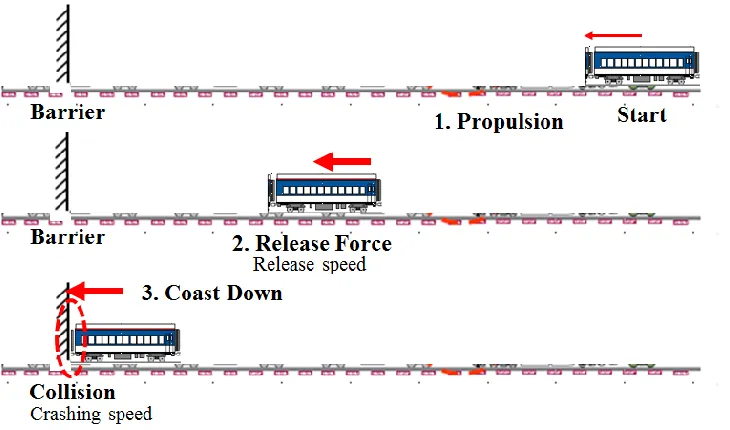
and location. In Figure 2.5, it shows that the test vehicle is started from the
right-hand side along a guided track. It will be propelled to a certain speed to release the
propulsion force. After the propulsion force is released, the test vehicle will coast
down towards the barrier (losing speed because of the resistance force), which could
be a rigid wall or a car. The crash speed is the speed, at which the test vehicle hits
the barrier. The crash speed is a very important indicator for test facilities in this
industry and it will be measured according to industry standard.
Figure 2.5 Propulsion – Release Force – Coast Down.
2.3 Test Facility
A real train collision test could be a train to truck or car, train to a rigid wall or
train to train. In the test facility involved, it will be train to rigid wall and train to
Figure 2.6 Train and Track. Source: Anemoi Technologies Inc.
The rigid wall is built inside a building with well-designed protection facilities.
The building is shown in Figure 2.7 which is located at the other end of the track.
And in Figure 2.8, it shows the rigid wall inside the building. This rigid wall is built
with huge concrete base designed for high-speed collision test.
Figure 2.7 Building Housing the Rigid Wall. Source: Anemoi Technologies
Inc.
The whole testing process will be done in about 15 to 30 second. A powerful
electric motor and a specially-made pulling drum will be used in providing the
propulsion force. A powerful braking drum will also be used to brake the propulsion
system or the vehicle after the release, in the case of emergency. The highest required
crash speed in the test facility in this research is a record high of 150kph for a
15000kg vehicle.
2.4 Vehicle Motion Analysis
During the propulsion phase, a test vehicle needs to be propelled on a straight,
guided track, to a particular speed 𝑉𝑟 (release speed), at which time the test vehicle
is released to coast down towards a barrier where it is required to crash at a speed of
𝑉𝑐 (crash speed). The distance between the start of the propulsion and the crash
barrier is known. The difference between 𝑉𝑟 and 𝑉𝑐 is dependent on the
coast-down distance (which itself is dependent on where the test vehicle is released from
the propulsion mechanism) and the resistance forces during the coast-down, such as
friction (both between wheels and rail and also train-internal friction such as bearing
frictions etc.) and aerodynamic force.
In general, the equation of motion is
𝐹 − 𝑅 = 𝑀 ∗ 𝐴, (2.15)
where 𝐹 is the propulsion force, 𝑅 is the resistance force, 𝑀 is the mass of
vehicle, and 𝐴 is the vehicle acceleration. Mass 𝑀 can be measured and it is
constant. Propulsion force 𝐹 is controlled and measured. The propulsion
acceleration 𝐴 changes but it can be measured during the propulsion phase.
Resistance force 𝑅 is the sum of friction and aerodynamic force. Friction is
constant which can be defined by coefficient of friction and mass. Aerodynamic
force 𝑅ae can be defined as follows
𝑅ae = 𝑐𝑣 +1
2𝑆𝜌𝐶𝑑𝑣², (2.16)
density, 𝐶𝑑 is train drag coefficient and 𝑣 is the speed. Because we do not know
in advance what those parameters in equation (2.16) are, such as 𝜌, 𝐶𝑑,etc., it is
impossible to obtain the value of 𝑅ae by using equation (2.16). But by observing
equation (2.15), when 𝐹, 𝑀 and 𝐴 can be measured, the resistance 𝑅 is the only
unknown variable and can be calculated by equation (2.15). This is the fundamental
reason why regression analysis is needed in this research. And the knowledge of how
to use multiple linear regression analysis model to deal with the quadratic
relationship between dependent variable and independent variables is already
introduced in Section 2.1.3.
For the coast-down movement, since the propulsion force is released,
𝐹 = 0.
Because resistance 𝑅 has the quadratic relationship with speed 𝑣, the regression
function of resistance 𝑅 can be expressed in a general form as follows,
𝑅 = 𝑏0+ 𝑏1𝑣 + 𝑏2𝑣², (2.17)
where 𝑏0, 𝑏1, 𝑏2 are regression coefficients. According to equation (2.15) and
(2.17), we have
𝐴 = 𝑑𝑣
𝑑𝑡= − 𝑅 𝑀= −
(𝑏0+𝑏1𝑣+𝑏2𝑣²)
𝑀 . (2.18)
Therefore, for coast-down movement, the acceleration 𝐴 can be calculated by
equation (2.18) once regression coefficients 𝑏0, 𝑏1 and 𝑏2 are determined.
Thus, during the propulsion phase, speed 𝑣, propulsion force 𝐹 and
acceleration 𝐴 need to be measured so that the actual propulsion performance could
be continually extrapolated over a very short time. Based on the performance data
(speed 𝑣 , acceleration 𝐴 and propulsion force 𝐹 ) collected, the value of resistance
force 𝑅 can be calculated using equation (2.15). The values of speed 𝑣 and
resistance force 𝑅 form a set of data, {(v, R)}, describing the relationship between
speed 𝑣 and resistance force 𝑅. Then, following the discussion of regression
analysis model in Section 2.1, the quadratic regression analysis model will be
and speed 𝑣 is the independent variable. By applying the least squares method
discussed in Section 2.1.3 and 2.1.4, the regression coefficients 𝑏0, 𝑏1, 𝑏2 in
equation (2.17) can be calculated and determined. Then the regression function of
𝑅 is determined. This resistance function 𝑅 is critical in the simulation of
coast-down movement and the calculation of release speed and location.
2.5 Sample Data Sheet
Figure 2.9 Sample Data 1. Source: Anemoi Technologies Inc.
Figure 2.9, part of the sample data sheet, is provided by Anemoi Technologies
Inc. This data set is used in the design stage to estimate and simulate the propulsion
performance, such as propulsion force, speed and acceleration, in order to better
design the whole mechanism. In the real test facility, the propulsion performance
data will be collected in a real time manner using sensors. There are 209 rows of
records in this data sheet from the speed of zero to speed of 150kph.
calculated. Actual data is the one output from the propulsion system, or the data
applied in theory. It can’t be obtained exactly in reality due to mechanical
deviations. Measured data is the one collected from the sensors placed along the
track or installed on the propulsion cart. Calculated data is the one by calculation
based on other known data. The columns in this data sheet are 𝑣 of speed, 𝐹𝑎 of
actual force, 𝐹𝑚 of measured force by sensor, 𝑅𝑎 of actual resistance, 𝐴𝑎 of
actual acceleration, 𝐴𝑚 of measured acceleration by sensor and 𝑅𝑐 of
calculated resistance.
Figure 2.10 shows another part of sample data sheet which explains the formula
to estimate actual force 𝐹𝑎, measured force 𝐹𝑚, actual resistance 𝑅𝑎, actual
acceleration 𝐴𝑎, and measured acceleration 𝐴𝑚.
Figure 2.10 Sample Data 2. Source: Anemoi Technologies Inc.
As shown in Figure 2.10, 𝐹𝑎, cell 𝐷8, is simulated by a quadratic function of
speed 𝑣 , the expression of 𝐹𝑎 can be written as
𝐹𝑎= 𝑐0+ 𝑐1𝑣 + 𝑐2𝑣², (2.19)
where 𝑐0, 𝑐1and 𝑐2 are coefficients. The value of 𝑐0, 𝑐1and 𝑐2 are set in the cell
𝐷3, 𝐷4 and 𝐷5. Considering the mechanical deviations between the actual and
measured data, the value of 𝐹𝑚, cell 𝐸8, is the addition of 𝐹𝑎 and variance of
errors, following the equation
𝐹𝑚 = 𝐹𝑎− 𝑀𝑎𝑥(𝐹𝑎) ∗ 𝐸1+ 2 ∗ 𝑅𝐴𝑁𝐷() ∗ 𝑀𝑎𝑥(𝐹𝑎) ∗ 𝐸1, (2.20)
where 𝐸1 is an error ratio for 𝐹𝑎 that is used to describe the noise of initial
is ranged from 0 to 1, and 𝑀𝑎𝑥(𝐹𝑎) is the maximum value among all the data values
of 𝐹𝑎. According to the sample data provided in Figure 2.10, 𝑅𝑎, cell 𝐹8, is also
estimated by using a quadratic function of speed 𝑣, its expression can be written as
𝑅𝑎 = 𝑑0𝑀𝐺 + 𝑑1𝑀𝐺𝑣 + 𝑑2𝑣², (2.21)
where 𝑑0, 𝑑1and 𝑑2 are coefficients, M is the mass of test vehicle, and G is the
gravity acceleration (G=9.81). The value of 𝑑0, 𝑑1 and 𝑑2 are set in the cell
𝐺2, 𝐺3 and 𝐺4. The value of M is set in the cell 𝐺5. According to equation (2.15),
the actual acceleration 𝐴𝑎, cell 𝐺8, can be obtained by
𝐴𝑎 = 𝐹𝑎−𝑅𝑎
𝑀 . (2.22)
The value of 𝐴𝑚, cell 𝐻8, is the addition of 𝐴𝑎 and variance of errors, following
the equation of
𝐴𝑚 = 𝐴𝑎(1 − 1
2𝐸2+ 𝑅𝐴𝑁𝐷()𝐸2), (2.23)
where 𝐸2 is an error ratio for 𝐴𝑚 with its value set in the cell 𝐻6. The value of
𝑅𝐴𝑁𝐷() is ranged from 0 to 1 as well.
The last field, cell 𝐼7, in the sample data sheet of Figure 2.10 is 𝑅𝑐, the
calculated resistance force. According to equation (2.15), 𝑅𝑐 can be obtained
by
𝑅𝑐 = 𝐹𝑚− 𝑀 ∗ 𝐴𝑚. (2.24)
Eventually, after implementing the logic and formulas in the developed software
based on the data sheet of Figure 2.9 and Figure 2.10, a data set of pairs of speed 𝑣
and 𝑅𝑐, {(𝑣, 𝑅𝑐)} , is obtained which describes the characteristics of the relationship
between speed and resistance force. This data set {(𝑣, 𝑅𝑐)} will be applied later on
to determine the regression coefficients for a fitted regression function that can be
used to predict the behavior of resistance force.
In this research, the actual data is used only to help estimate the measured data,
so that a simulated data set can be generated. In the real collision test environment,
the measured data will be obtained from various sensors. In the following sections
as 𝐹𝑎, 𝐹𝑚, 𝐴𝑎 and 𝑅𝑐, are no longer used. Only the capital letter will be used to
express the measured value or the calculated value for each variable. For example,
𝐹 means the measured force, 𝑅 means the calculated resistance, 𝐴 means the
measured acceleration and 𝑀 means the measured mass.
Chapter 3 Proposed Solution -
RTPSA
In this chapter, details of the proposed approach will be introduced. The
software developed is called 𝑅𝑇𝑃𝑆𝐴 – Real Time Predictive Speed Analysis.
3.1 Limitation of Existing Methods
In a real collision test facility, the propulsion system is the key component. It is
a group of mechanical and electrical machinery and equipment and it needs to be
calibrated before putting it into operation. To-date such calibration was based on
theoretical data and past experience. But during the test, resistance forces, such as
friction resistance force and aerodynamic resistance force, play an important role
influencing the behavior of test vehicle movement. Resistance forces vary all the
time and are subject to the speed of test vehicle, wind speed and direction,
temperature and humidity. So every test is different. When the propulsion system is
calibrated using old data or parameters, it leads to less accuracy in terms of the
release speed and location, and the crash speed as well. The essence of 𝑅𝑇𝑃𝑆𝐴 is
that the most up-to-date calibration information can be derived from studying in real
time the actual propulsion behavior during the actual test. In order to do this, an
efficient algorithm needs to be in place to calculate and predict the movement
behavior of test vehicle during propulsion. This algorithm also needs to work in a
real-time manner to monitor and control all the activities along the test.
3.2 Objective
The proposed approach in this research work is to address the issues discussed
by implementing a new design for a real collision test facility. A simulated data set
is generated and used to describe the performance in propulsion phase. The quadratic
regression analysis model is applied in this implementation to predict the behavior
of resistance force and simulate the movement of the test vehicle. The proposed
software works in a real-time manner and provides a more accurate release location
and speed for the overall control system to fulfill the actual force release.
3.3 Design Principles
There are three design principles for the proposed approach in this thesis. They
are real-time, predictive, and simulation.
3.3.1 Real-Time
During the propulsion phase, the propulsion performance (speed, acceleration
and propulsion force) are measured on a real-time basis, instead of using old data
and past experience, so that the actual performance could be continually extrapolated
in a very short period of time. This lets the software calculate the regression
coefficients 𝑏0, 𝑏1, 𝑏2for resistance function (2.17) by inserting this into equation
(2.15) and measuring 𝐹 and 𝐴 (𝑀 is known). And this approach leads to better
accuracy in the prediction of resistance force behavior which is the key factor
influencing the overall performance.
In this research work, a data set (stream) is generated simulating the behavior
of propulsion phase in a real-time manner. When generating the simulated data
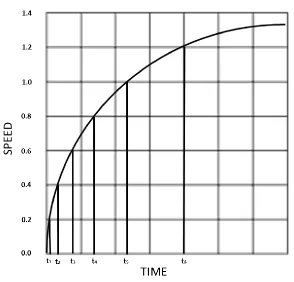
stream, as shown in Figure 3.1, the whole propulsion phase is divided into many
small intervals of speed. The X-axis in Figure 3.1 is time and Y-axis is speed. Each
interval has the same speed difference of 0.2m/s. For each of the small speed
resistance 𝑅 (Eq. (2.24)) are all calculated following the rules and formulas
discussed in Section 2.5.
Figure 3.1 Small Intervals of Propulsion Curve
Meanwhile, each small interval is treated as constant acceleration motion. By
applying the constant acceleration motion formulas, the time length, distance and
location can be calculated. For example, for interval 𝑖 , let 𝑣i0 denote the start speed,
𝑣it denote the end speed, 𝐴 denote the acceleration, 𝑡 denote the time spent, 𝑆𝑖0
denote the start location, and 𝑆𝑖𝑡 denote the end location, then
𝑣it= 𝑣i0+ 𝐴𝑡, (3.1)
𝑆𝑖𝑡 = 𝑆𝑖0+ 𝑣i0𝑡 +1
2𝐴𝑡². (3.2)
From equation (3.1), we have
𝑡 =𝑣it− 𝑣i0
𝐴 . (3.3)
Since 𝑣it and 𝑣i0 are known for each interval, and acceleration 𝐴 can be obtained
by equation (2.23), so from equation (3.3), time 𝑡 can be obtained. By substituting
Eventually, a data set of details of propulsion performance is obtained after the
calculation. Specifically, a data set {(𝑣, 𝑅)} of pairs of speed 𝑣 and resistance 𝑅
is obtained which describes the characteristics of the relationship between speed and
resistance force. This data set of speed and resistance {(𝑣, 𝑅)} will be applied later
on to determine the regression coefficients for a fitted regression function that can
be used to predict the behavior of resistance force. In conclusion, the whole
propulsion phase is monitored and described in detail. The design of small interval
makes it possible to monitor the whole propulsion behavior in a real-time manner.
3.3.2 Predictive
The prediction capability in 𝑅𝑇𝑃𝑆𝐴 software is based on the real-time
performance data that comes from the propulsion phase. One of the results of
simulated data stream is a data set of pairs of speed 𝑣 and resistance force 𝑅,
{(𝑣, 𝑅)}. As discussed in Section 2.4, 2.5 and 2.1.3, resistance force 𝑅 has the
quadratic relationship with the speed 𝑣 and multiple linear regression model can be
applied to the quadratic relationship after the substitution of independent variables.
The general form of the fitted regression function can be written as
𝑅 = 𝑏0+ 𝑏1𝑣 + 𝑏2𝑣², (3.4) same as (2.17)
where 𝑏0, 𝑏1, 𝑏2 are regression coefficients. By applying the least squares method
introduced in Section 2.1.4 into the data set {(𝑣, 𝑅)}, the regression coefficients
𝑏0, 𝑏1, 𝑏2 are calculated. With the determination of regression coefficients 𝑏0, 𝑏1, 𝑏2,
the fitted regression function of resistance 𝑅 (Eq. (3.4)) will be used to predict the
equation of motion during the coast down period, as well as for the last period of
propulsion phase. Details of the simulation for the last period of propulsion phase
will be introduced in section 3.3.3 and 3.9.
As discussed earlier, resistance force 𝑅 plays an important role in the whole
test phases. With the in-time prediction of resistance force 𝑅, details of the behavior
that makes it possible to calculate and find the release speed and location.
3.3.3 Simulation
Simulation technique is needed and implemented in 𝑅𝑇𝑃𝑆𝐴 because the
algorithm needs to be triggered to calculate and provide the release location and
speed to the control system before the test vehicle actually reaches the release point.
A leading time of 1-2 second is required for the control system to activate the actual
force release. Simulation is a practical way to do this work.
There are two movement phases that need to be simulated in order to figure out
the release location and release speed, the last period of propulsion and the
coast-down movement.
Figure 3.2 Start and End Points for Simulations. F: Calculate Regression Coefficients; G: Use Regression Coefficients to Calculate Coast-down Behavior
Backwards
As shown in Figure 3.2, the 𝑋-axis is location while the 𝑌-axis is velocity. The
𝐵 the propulsion force is released and the coast-down phase starts at position 𝐵
right away. Position 𝐷 is the end of coast-down movement where the test vehicle
hits the barrier. During propulsion, when test vehicle reaches position 𝐶, the
algorithm is used to calculate the release location and release speed. The movement
from 𝐶 to 𝐵 is called the last period of propulsion in this research. By observing
Figure 3.2, point 𝐵 is the release point and it is the intersection of 𝐶𝐵 and 𝐵𝐷.
Therefore, in order to figure out the release location and release speed at position 𝐵,
the function of line 𝐶𝐵 and the function of line 𝐵𝐷 must be known. Simulation
technique is the choice in this research. With the simulation of movements of
coast-down 𝐵𝐷 and the last period of propulsion 𝐶𝐵, it becomes possible, at position 𝐶,
to calculate the release location and release speed.
Details on how to do these two simulations are introduced in Section 3.8.1 and
Section 3.9.1.
3.4 System Architecture
In a real test facility, physically, there are an array of sensors to measure the
performance, such as propulsion force, acceleration, speed, location, temperature,
humidity, wind speed and direction. They are installed on the propulsion cart which
pushes the test vehicle, along the guided track and in the building. Sensors are
connected to an IP network and controlled by an overall control system, which is
called Facility Control System (FCS). PLC (Programming Logic Controller)
controllers and DeviceNet/Ethernet converters are also used to help convert signals
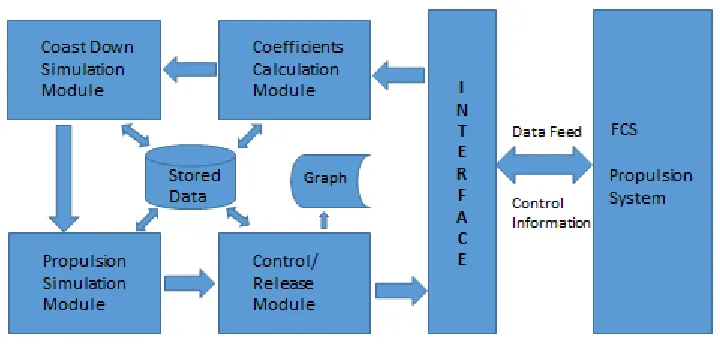
and do the preliminary calculation. Figure 3.3 shows an overall system architecture
Figure 3.3 System Architecture. Source Anemoi Technologies Inc.
In Figure 3.3, the Facility Control System (FCS) is the core which is installed
in a database server located at top left of the figure. All the activities are controlled
by FCS. Data interface is designed and used by FCS to collect real-time data from
sensors, PLCs and VFD (Vary Frequency Device). Command interface is designed
and used by FCS to send control command to PLCs, VFD and sensors. All the
equipment, such as DB server, main control monitors, administrative work stations,
VFD, PLC controllers and many different sensors, are connected in a high speed
Ethernet network. Most of the sensors are connected into Ethernet through PLCs.
Some special sensors are connected through Ethernet converters, such as radar speed
sensor and laser distance sensor. 𝑅𝑇𝑃𝑆𝐴 is part of FCS and used to collect the
performance data in a real-time manner from sensors during propulsion phase and
provide input to FCS to actually control the force release.
3.5 Software Structure
The 𝑅𝑇𝑃𝑆𝐴 software works in a real-time manner. It has a main process and
four modules.
![Figure 2.2 Simple Linear Regression - Straight Line. Source: [46]](https://thumb-us.123doks.com/thumbv2/123dok_us/1397316.1172429/24.595.162.379.459.629/figure-simple-linear-regression-straight-line-source.webp)
![Figure 2.3 Different Fitted Lines for A Set of Data. Source: [46]](https://thumb-us.123doks.com/thumbv2/123dok_us/1397316.1172429/25.595.186.407.553.731/figure-different-fitted-lines-set-data-source.webp)
![Figure 2.4 Vertical Distance vs Perpendicular Distance. Source: [46]](https://thumb-us.123doks.com/thumbv2/123dok_us/1397316.1172429/26.595.114.486.179.424/figure-vertical-distance-vs-perpendicular-distance-source.webp)