Implementation of Context Aware Vehicular
Handover Algorithm for Service Continuity in
Heterogeneous Wireless Network
Shweta A. Ramteke1, Prof. H. A. Bhute2
PG Student, Department of Computer Engineering, Sinhgad College of Engineering, Vadgaon (BK), Pune, India1
Assistant Professor, Department of Computer Engineering, Sinhgad College of Engineering, Vadgaon (BK),
Pune, India2
ABSTRACT:In this era of wireless revolution, when a mobile terminal is moving with a vehicular speed then service continuity is a crucial issue. For service continuity handover mechanism are mainly used. The nomadic users are demanding access to the wireless networks at anytime and anywhere. With the number of wireless access technologies are growing, it is expected to be ABC. It is more challenging that the switching of network between vertical handover must be seamless. This paper presented an overview of vertical handover and proposes an algorithm context aware vehicular handover algorithm with MIH framework, which considers the various factors, such as the surrounding context, application requirements, user preferences, and the different available wireless networks to improve user’s quality of experience. This algorithm is expected to select the best candidate network as per the user preferences considering multiple context for seamless connectivity.
KEYWORDS: Vertical handover, Handover management process, MADM algorithm, Context-aware vehicular handover algorithm.
I. INTRODUCTION
Now a days, every mobile phone containing several communication interfaces such as WiFi, UMTS, BT and even more WiMax. With the combined use of such resources end users demand short messages towards online multimedia sessions. To meet these new end users demandsand to improve their quality of experience (QoE), connectivityshould be provide the guaranteed quality of service (QoS).Many communication technologies offer solutions that differin aspects such as coverage, data rate, frequency, and modulation.The heterogeneity of such technologies, rather than beinga pitfall for the nomadic user, should be seen as an advantage,since vehicles on move can make the most out of the diversewireless technologies to maintain continuous communicationwhile journeying from one location to another. From a wireless communication point of view, the contexts of a mobile with a vehicular speed are highly dynamic and mobile phone must be able to deal with heterogeneity through context awareness and VHO capability. Innomadism, a user traverses number of available networks thatmight contain cellular or wireless data networks, usually knownas heterogeneous wireless networks. These networks offer variousservices from email to live video streaming depending upon theircapacity and nature. During this traversing procedure, a userswitches among different networks to satisfy his/her needs interms of quality of service. . An event takingplace whenever a mobile node moves from one wireless cellto another, changing the connection with the first base stationand getting attached to the second one this process is knownas handover.This process is generally categorized as horizontal, verticalhandover[2].
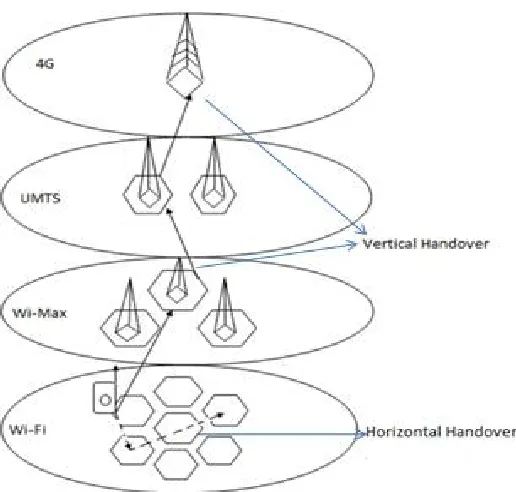
1) Horizontal Handover: When a mobile node (MN) moves between two cells using the same technology, then
this kind of handover process is defined as horizontal handover.
For example, mobile node moving from one Wi-Fi network to another Wi-Fi network then this handover is horizontal handover.
For example, mobile node moving from Wi-Fi to WiMax, WiMax to UMTS, and UMTS to 3G network, then this handover is vertical handover.
Following figure1,shows the horizontal and vertical handoverprocess:
Fig 1.The horizontal and vertical handover process
Horizontal handover process is simpler than vertical handover process because it contains same networks but vertical handover process is a complex one but it is more essentialbecause in many cases networks are different. Therefore it required successful switching between different available networks. In fact, because of the diverse characteristics of different access technologies the vertical handover is asymmetric and requires a lot of information from the available networks. The type of required information and even its treatment vary from one network to another and even the possibility to access this information may be possible with a specific network and not with the other. This point has to be deeply studied in order to have an idea about the possibility and the complexity of inquiring our required information to perform vertical handover decision.
Two of the major challenges in vertical handover management are seamlessness and automation aspects in network switching. These particular requirements can refer to theAlways Best Connected concept, of being connected in the best possible way in an environment of multiple access technologies, according to policies (expressed by rules based on parameters such as network conditions or user preferences). For that, a handover management technique must choose the appropriate time to initiate the handover and the most suitable access network.
A. Vertical handover Process :
To support seamless mobility when a mobile station moves within a heterogeneous wireless network, VHO (Vertical Handover)necessity estimation and decision to select a best targetnetwork are two important aspects of the overall mobilityframework. The handover necessity estimation is important inorder to keep the unnecessary handover and their failures at alow level.
Handover management process consists of following 3 steps: 1) Handover information gathering phase
3) Handover execution phase
Following figure shows the handover management procedure.
Fig.2: The handover management procedure
1) Handover information gathering phase: The handoverinformation gathering phase collects not only networkinformation, but also information about the rest of thecomponents of the system such as network properties,mobile devices, access points, and user preferences.
2) Handover decision phase: The handover decision phaseis one of the most important process during the handover.Based on the gathered information, this phase isin charge of deciding when and where to trigger thehandover. When decision refers to the precise instant intime to make the best handover, while the where refersto selecting the best network fulfilling our requirementsfor
the switching. To ensure the service continuity thedecision regarding handover is to be taken appropriately.If there are number of wireless network available thenit needs to consider the different attributes such asbandwidth, packet loss, data rate etc, which helps togives the service continuity for the number of application requirement. For this purpose multi attribute decisionmaking algorithm (MADM) is used which considers themultiple attribute to select the wireless network.
3) Handover execution: This phase performs the handoveritself; and to performing the handover, this phase shouldalso guarantee a smooth session transition process.
II. LITERATURE SURVEY
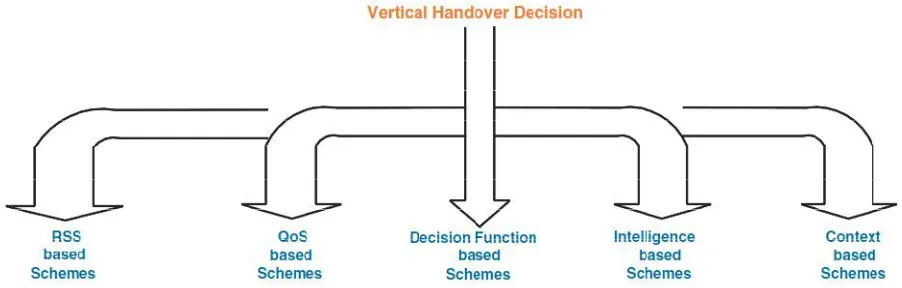
According to the recent trends, a lot of research work is dedicated on providing seamless handover for uninterrupted service continuity.Our main focus is on the vertical handover decision making process in heterogeneous wireless network as this is the heart of the handover process and crucial aspects of any handover mechanism.
Fig 3: Vertical handover decision schemes
1.RSS based scheme: In RSS based decision algorithms [3],[4],[5] RSS of the current attachment point is compared with the RSS of the other available networks for making a handover decision. In these schemes, criterion for making the handover decision is typically based on the RSS value. Other criteria might also be used but generally, they are for assisting the handover procedure and not directly involved in the handover decision making process. RSS is an unavoidable factor when designing a decision scheme. But, it is observed in that only RSS is not sufficient to make handover decisions in heterogeneous wireless environments because the RSS of heterogeneous wireless networks cannot be compared directly, and also, RSS cannot reflect the network conditions adequately.
2. QoS based scheme: Authors in[6],[7], proposes a new definition of the softer VHO in contrast to the existing one along with an algorithm for heterogeneous wireless systems to support the discussion. This definition takes into consideration the network conditions like user mobility, available bandwidth and application type. The proposed definition mainly focuses on the best effort service in the UMTS networks using different mobility scenarios. The proposed algorithm improves the overall throughput for a softer handover however, other aspects of the QoS like handover delay, packet loss, etc. seem to be totally ignored in all scenarios.
3. Decision function based scheme: Handover decision and proper network selection becomes amulti-criteria decision making (MCDM) problem that involves a number of parameters and complex trade-offs between conflicting criteria.Author Maroua Drissi [8] studied the use of Multiple Attribute Decision Making(MADM) used to choose the best network from available networks. Authors compared handover decision algorithms: MEW, SAW and TOPSIS in terms of end-to-end delay andpacket loss using two available networks WLAN and Wimax. Result shows that TOPSISand SAW maintained almost the same performance for the conversational and streamingclasses. While MEW provides the lowest end to- end delay for the Interactive class asdid TOPSIS for the background Class. Although TOPSIS has the best performance inconversational and streaming classes. In [9], a performance comparison between four VHO decision algorithms, namely, MEW, SAW, TOPSIS, and GRA, was proposed. All these four algorithms allow different attributes to be included for VHO decision. Comparative results show that MEW, SAW, and TOPSIS provide similar performance to the four traffic classes. GRA provides a slightly higher bandwidth and a lower delay for interactive and background traffic classes.
4. Network Intelligence based scheme: The concept of networkintelligence comes when we want to tackle the issue of information visibility and considerthe real-time network traffic. A fuzzy logic based scheme for handoverdecision making in, [10] and [11] haveused a large number of parameters as context information todesign their autonomic oriented approach, like QoS, cost, userpreferences, service type, battery level, etc.
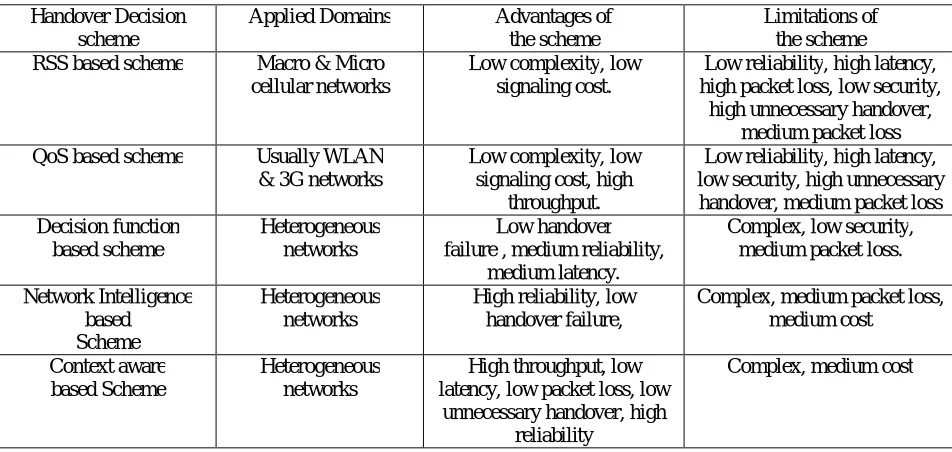
Table 1: vertical handover schemes and their advantages and limitations
Handover Decision scheme
Applied Domains Advantages of
the scheme
Limitations of the scheme
RSS based scheme Macro & Micro
cellular networks
Low complexity, low signaling cost.
Low reliability, high latency, high packet loss, low security,
high unnecessary handover, medium packet loss
QoS based scheme Usually WLAN
& 3G networks
Low complexity, low signaling cost, high
throughput.
Low reliability, high latency, low security, high unnecessary handover, medium packet loss Decision function
based scheme
Heterogeneous networks
Low handover failure , medium reliability,
medium latency.
Complex, low security, medium packet loss.
Network Intelligence based Scheme
Heterogeneous networks
High reliability, low handover failure,
Complex, medium packet loss, medium cost
Context aware based Scheme
Heterogeneous networks
High throughput, low latency, low packet loss, low
unnecessary handover, high reliability
Complex, medium cost
CONTEXT-AWARE VEHICULAR HANDOVER ALGORITHM
Context-aware vehicular handover algorithm, which is anenhanced VHDA, that takes into consideration the surroundingcontext, different available types of wireless networks such as WiFi, WiMax, UMTS and LTE, networkingelements information, geolocation features, user preferences, and application requirements,to select the most suitable CN. This algorithm makesuse of services provide by the IEEE 802.21 standard (MIH). Concerning the decisionmakingprocess,Context-aware vehicular handover algorithmuses the MADM algorithmsuch as AHP and GRA tofairly evaluate the candidates and choose the most suitableone that meets the multiple requirements.
A.Media Independent Handover (MIH) :
The main purpose of IEEE 802.21 is to provide a homogeneous function interface between heterogeneous network technologies without service interruption, hence improvinguser experience of mobile terminals. Much functionalityrequired to provide session continuity depend on complexinteractions that are specific to each particular technology. MIH service protocol whose purpose is to provide a homogeneous function interface between heterogeneous network technologies.Its real implementations are on operating systems, smart phones, and tablet devices. Context aware vehicular handover algorithm uses the services provided by the MIH framework.
The basic services offered by the MIH are:
1. Media-independent event service (MIES): The MIES detects the changes in the lower layers, e.g.,changes in
the physical channel conditions. The MIHF notifiesevents occurring in the lower layers to the MIH users (MIHUs) whenever they are requested. The MIES covers events such as statechange events (link up, link down, link parameter changes), predictiveevents (link going down), and network-initiated events (load balancing and operator preferences).
2. Media Independent Information Service (MIIS): The MIIS allowsthe MIHF to discover its network
environment by gathering information that the upper layers use to make decisions. The information elements refer to the list of available networks, location of PoA, operator ID, roaming partners, cost, security, QoS, PoA capabilities, and vendor-specific information.
3. Media Independent Command Service (MICS): Finally, the MICS allows the MIHU to take control over the
decides whether to switch from one PoA to another. The commands allow the handover entity not only to execute the handover but to set different parameters in the lower layer elements as well.
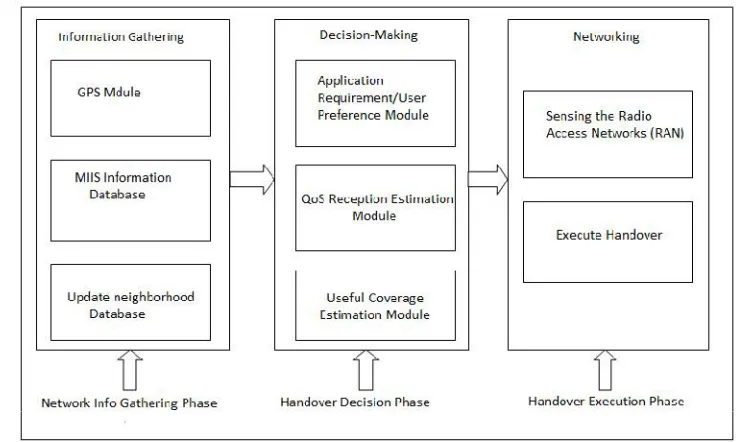
Following are the different component of the context-awarevehicular handover algorithm: 1) Information Gathering Module
2) Decision-Making Module 3) Networking Module
Fig. 4: Context aware vehicular handover algorithm
1) Information Gathering Module:
a) GPS Module: Navigation route calculation andgeolocation calculation.
b) Neighborhood Database: The database stores theinformation of current and soon-to-be-reachedneighborhoods. The information retrieved fromMIIS database.
c) Depending on frequency the neighborhood beingupdated.
2) Decision-Making Module:
1. Application Requirements and User Preferences Module:
We have defined user profilesto classify the user preferences.Each profile considers both application requirements and theuser’s budget.
a. Maximum Performance: Under this profile, the VHDA always selects the best performing network among all
thepossible choices, regardless of the associated cost.
b. Streaming: The VHDA is optimized to choose those networks that offer not only high throughput but also low
packet loss ratio.
c. Conversational: Similar to the streaming profile, this profile considers a low packet loss ratio as an
importantfactor, but in this profile, a low latency per packet is also critical when choosing a CN. Throughput is not so significant, and neither is cost.
d. Minimum cost: This profile is based on the user’s budget, and it considers the price that user is willing to pay
as the most important factor in the decision-making process. If the user budget is low, the cheapest network available will be always the best choice.
a. Throughput: the minimum throughput required by the application;
b. Latency per packet: the maximum latency that the application is able to tolerate;
c. Packet loss ratio: the losses that the application can tolerate;
d. Price per MB: the price that the user is willing to pay for the service.
2. QoS Reception estimation Module: The UCT is the time that mobile spends within coverage area of a cell while able to obtain peak data rate from that cell. This time may vary due to several issues such as UCT may vary due to QoS fluctuation at the edge of the cell. To obtain QoS border cell that guarantees the QoS up to given distance within the path we have to use distance reception probability (DRP). DRP module estimate packet loss .
3. Useful Coverage Estimation Module: This module calculates the VHO latency.
In handover management process handover decisionphase is very important and critical phase because dependingon the number of available network and number of parameter it should selects the most reliable network.For decision making process multi attribute decisionmaking algorithms are used. Context-aware vehicularhandover algorithm uses the AHP and GRA algorithmto fairly evaluate the candidates and choose the mostsuitable one that meets the multiple requirements defined.This algorithm is used to provide smooth vertical handover between the heterogeneous network.
3) Networking Module:
Sensing the RAN module: It sense the heterogeneouswireless radio access networks (RANs) available. Thismodule periodically sends and receives informationabout the network status. To interact with these interfaces,Context-aware vehicular handover algorithm usesthe IEEE 802.21 services, i.e., MIES and MICS, tocheck the link status and received reports.
III. ALGORITHMS USED
A. Analytic Hierarchy Process (AHP):
It is used to determine the relative weights of the criteriafor different services. AHP decomposes the network selectionproblem in to several sub-problems and assigns a weight valuefor each sub-problem.
AHP is carried out in following five steps:
1) Structuring a problem as a decision hierarchy of independentdecision elements. 2) Collecting various information about the decision elements.
3) Comparing the decision elements pair wise on eachlevel in the point of their importance to the elements inthe level above.
4) Calculating the relative priorities of decision elementsin each level.
5) Synthesizing the above results to find the overall weightof each decision alternative.
B. Gray Relational Analysis (GRA):
GRA method has been widely used to solve the uncertaintyproblems under the incomplete information. One of the sequencesis represent as reference sequence presenting the idealsolution. The grey relationship between the reference sequenceand other sequences can be determined by calculating the greyrelational coefficient (GRC).GRA based network selection method can be performed byusing following steps:
1) Classify the network parameters (smaller the better,larger the better). 2) Define upper and lower bound of parameters.
3) Normalize the parameter.
4) Calculate grey relational coefficient (GRC). 5) Ranking the networks according to the GRC value.
IV. RESULT ANALYSIS
To run the experiment in NS2 simulator version 2.35 that has shown to produce realistic results. Proposed system is compared with the existing system on the basis of different performance parameters such as throughput, packet loss, latency and cost. The proposed system implements context aware vehicular handover algorithm that selectsnetwork on the multi attribute decision making algorithm AHP and GRA. The existing system implements the neighborhood-aware vehicular handover algorithmthat uses SAW algorithm to select network by considering same parameters as proposedsystem.The results successfully shows that the proposed system provides smooth vertical handover between the heterogeneous wireless network, achieves high throughput, provide better performance in terms of packet loss, latency and cost as compared with the existing system.
The performance analysis of proposed system and existing system is shown in below figures.
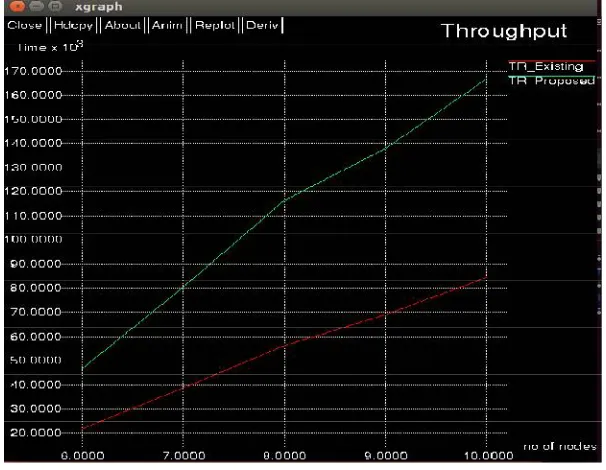
1. Throughput: Network throughput is the amount of data packets moved successfully from one place to another
in a given time period and its typically measured mbps, as in gbps. Throughput is calculated by using following formula:
Throughput= No. of packet sent/Time taken
Graph shows that proposed system provides high throughput as compared to the existing system.
Fig. 5: Throughput of existing Vs proposed system
2. Packet Loss: The calculation of Packet loss is based on received and generate packets as recorded in the trace
file. In general packet loss is defined as failure of one or more transmitting packet to arrive at their destination. Packet loss is calculated by using following formula:
Packet Loss= Packet drop/Packet sent
Fig. 6: Packet loss of existing Vs proposed system
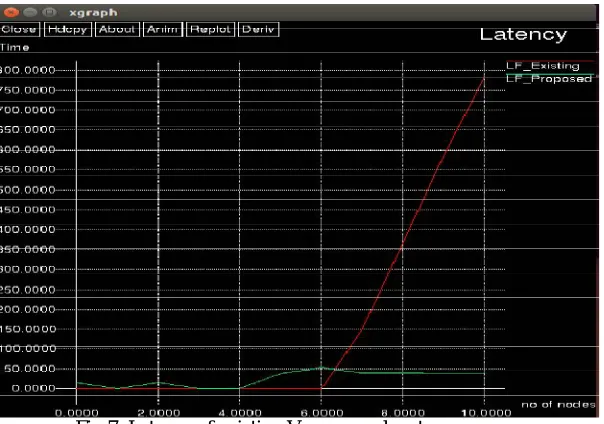
3. Latency: Latency is generally total time that data packets take to travel from one node to anothernode.
Latency is calculated by using following formula: Latency= Total time/ No. of packets sent
Graph shows that the proposed system provides the low latency as compared to the existing system.
Fig.7: Latency of existing Vs proposed system
4. Cost: The cost of services offered is a major consideration to users and may affect the users choice of access
Fig.8: Cost of existing Vs proposed system
V. CONCLUSION
When a mobile user moving with a vehicular speed then there are number of heterogeneouswireless networks are available. When mobile node is moving within differentwireless networks then it needs a vertical handover. Vertical handover should be seamlessso that user can take advantage of service continuity while moving within variousnetworks.
This report discussed the novel vertical handover technique called Context aware vehicularhandover algorithm, that uses MIH framework which considers the different factorssuch as the surrounding context, the application requirements, the user preferences, andthe different available wireless networks. In handover management procedure, handoverdecision phase plays very important role to select the best network from available heterogeneouswireless network. So for decision making process multi attribute decisionmaking algorithms are used. AHP is used for assigning a weight to different attributesand GRA is used for ranking the network. By combining these two algorithms it fairlyevaluate the candidates and choose the most suitable one that meets the multiple requirementsdefined.
Proposed system is compared with the existing system and the result successfully showsthat the proposed system provide smooth vertical handover between the heterogeneouswireless network, achieves high throughput, provide better performance in terms of packet loss,latency and cost as compared with the existing system.
REFERENCES
[1] Johann M. Marquez-Barja, Hamed Ahmadi, “Breaking the VehicularWireless Communications Barriers: Vertical Handover Techniques forHeterogeneous Networks”, IEEE TRANSACTIONS ON VEHICULARTECHNOLOGY, VOL. 64, NO. 12, DECEMBER 2015.
[2] Atiq Ahmed, Leila Merghem Boulahia, “Enabling Vertical HandoverDecisions in Heterogeneous Wireless Networks: A State-of-the-Art andA Classification”, IEEE 2014.
[3] D. Li, E. Van Lil, and A. Van de Capelle, “Improving slow-start basedprobing mechanisms for flow adaptation after handovers,” Comput.Netw., vol. 56, no. 1, pp. 329–344, 2012.
[4] N. Saxena and A. Roy, “Novel framework for proactive handover withseamless multimedia over wlans,” Communications, IET, vol. 5, no. 9,pp. 1204 –1212, 2011.
[6] G. Tamea, M. Biagi, and R. Cusani, “Soft multi-criteria decisionalgorithm for vertical handover in heterogeneous networks,” IEEECommun. Lett., vol. 15, no. 11, pp. 1215 –1217, 2011.
[7] H.-L. Wang and S.-J. Kao, “A vertical handover scheme from wmanto wlan by taking into account the maximum available resource,” inComputer Science Education, 6th International Conference on, 2011,pp. 1373 –1378.
[8] Drissi and Mohammed Oumsis, “Performance Evaluation of Multi- Criteria Vertical Handover for Heterogeneous Wireless Networks”, IEEE 2015.
[9] E. Stevens-Navarro, V. W. S. Wong, “Comparison between vertical handoff decision algorithms for heterogeneous wireless networks”, in Proc. 63rd IEEE Veh. Technol. Conf., Melbourne, Vic., Australia, May 710, 2006, pp. 947951.
[10] J.-M. Kang, S.-s.Seo, J. Strassner, and J. W.-K. Hong, “Hmntoolsuite:tool support for mobility management of mobile devicesin heterogeneous mobile networks,” in Proc. 14th Communicationsand Networking Symposium, ser. CNS ’11. Society for Computer
Simulation International, 2011, pp. 95–102.
[11] J.-M. Kang and J. W.-K. Hong, “Autonomic management for personalizedhandover decisions in heterogeneous wireless networks,”in Proc. 5th international conference on Autonomous infrastructure,management, and security: managing the dynamics of networks and
services, ser. AIMS’11. Springer-Verlag, 2011, pp. 57–60.
[12] N. Psimogiannos, A. Sgora, and D. D. Vergados, “An ims-basednetwork architecture for wimax-umts and wimax-wlan interworking,”Comput. Commun., vol. 34, no. 9, pp. 1077–1099, 2011.
[13] F. Baroncelli, B. Martini, V. Martini, and P. Castoldi, “Extendingnext generation network (ngn) architecture for connection-orientedtransport,” Comput. Commun., vol. 34, no. 9, pp. 1100–1111, 2011.