The Many Functions of Discourse Particles: A Computational Model of Pragmatic
Interpretation
Gabriele Scheler ([email protected])
Department of Computer Science Munich University of Technology
D-8290 M¨unchen
Kerstin Fischer ([email protected])
Universit¨at Bielefeld
Fakult¨at f¨ur Linguistik und Literaturwissenschaft Postfach 100131, D 33501 Bielefeld
Abstract
We present a connectionist model for the interpretation of dis-course particles in real dialogues that is based on neuronal principles of categorization (categorical perception, prototype formation, contextual interpretation). It can be shown that discourse particles operate just like other morphological and lexical items with respect to interpretation processes. The de-scription proposed locates discourse particles in an elaborate model of communication which incorporates many different aspects of the communicative situation. We therefore also attempt to explore thecontentof the categorydiscourse parti-cle. We present a detailed analysis of the meaning assignment problem and show that 80% – 90% correctness for unseen dis-course particles can be reached with the feature analysis pro-vided. Furthermore, we show that ‘analogical transfer’ from one discourse particle to another is facilitated if prototypes are computed and used as the basis for generalization. We conclude that the interpretation processes which are a part of the human cognitive system are very similar with respect to different linguistic items. However, the analysis of discourse particles shows clearly that any explanatory theory of language needs to incorporate a theory of communication processes.
Discourse Particles, Meaning Assignment, and
the Communication System
In a number of papers (Scheler, 1994; Scheler, 1996b), it has been argued that feature-based categorization is an effective model for morphological and lexical meaning analysis. This applies to the issue of generating a morphological category or a lexeme from a given feature representation, but it is even more effective in extracting meanings from the context of a written text or dialogue. The central idea is that linguistic elements are used in communication (whether with self or others) via reference to a conceptual level, which is closely tied to cognitive categories (event and temporal structure, spatial cognition, knowledge about objects, motion, changes etc.).
In this paper, it will be argued that pragmatic meanings ba-sically operate in the same way: a limited number of discourse elements in a language serves to communicate a greater num-ber of pragmatic meanings in a predictable way. This model of categorization as meaning assignment will be instantiated fordiscourse particles, characteristic items of spoken lan-guage discourse, such aswell, yes, oh, ah, okay, uhandum. These elements fulfill many different functions with respect to the turn-taking system, speech management, discourse struc-ture, and the interactive level between the communication partners. For example, they segment utterances; they indicate new topics and mark important information; they establish a
harmonious atmosphere between speakers and hearers; they help taking, yielding or holding the turn, and they signal speaker-attitude (Levelt, 1983; Schiffrin, 1987; Grosz et al., 1989).
Most analyses of these particles are characterized by re-stricted perspectives on their function, which is mirrored in a large number of terms for the phenomena under consideration, for instancesegmentation marker, cue phrase, connector, interjection(Fischer, 1996b). Additionally, so far no auto-matic methods for assigning discourse functions to discourse particles have been proposed. Using a specific model of the communication situation (Fischer, 1996a), a method for as-signing discourse functions to particles in natural dialogues will be presented which is based on neuronal categorization principles as embodied within the connectionist framework of
NEUROSEM1.
The aims of the paper are therefore
- to show that feature-based categorization is an effective model for pragmatic interpretation processes;
- to automatically assign meanings to occurrences of dis-course particles in context;
- to show how knowledge about the functions of one dis-course particle can support another by means of general-ization from prototypes.
A Computational Model of Discourse Function
The linguistic model developed for discourse particles was motivated by the goal of finding consistent patterns of the pragmatic function of these particles, which seem to occur almost randomly at first sight. However, our hypothesis was that if we apply a computational model that is capable of accounting for a high degree ofcontext-dependencyand
mul-tifunctionality, the different meanings of discourse particles
can be computed with a considerable degree of accuracy. In the following we shall present briefly the linguistic model and the computational model applied to it. We refer the reader to (Fischer, 1996a) and (Scheler, 1997) for a fuller account of these approaches.
The Linguistic Model In contrast to studies on discourse particles so far, the model proposed here is not restricted to a particular function discourse particles fulfill in spoken language discourse but it considers the whole range within a model of communication.
The model proposed treats discourse particles as lexemes with an invariable cognitive content which is employed on
different communicative levels. The variablility of aspects of the communicative situation a particle can refer to causes the apparent multifunctionality of the class. In particular, the content can refer to the following communicative domains: the speaker’s mental state, the hearer’s supposed mental state, the propositional level, the speaker-hearer interaction level, as well as the action level (Fischer, 1996b).
It is assumed that the occurrence of each discourse particle has a specific reading in a natural dialogue. A number of such
discourse functionshas been identified in hypothesis-test
cy-cles on four German corpora. The basic idea is that although many different features are involved on many different com-municative levels, there is categorical perception involved in the interpretation of discourse particles. I.e. discourse func-tions are proposed to be more or less stable feature bundles of surface and pragmatic properties (Fischer, 1996a; Fischer, 1996b). The inventory of these discourse functions is sup-posed to be valid for all discourse particles, defining these linguistic elements from a functional perspective.
As an example for different, yet related readings of a dis-course particle consider the following two occurrences of En-glishyes: Both are reactions to a proposal. In the first case, the semantic content ofyes“you and I think the same” refers to the propositional level, signalling agreement on the subject in question as an answer particle. In the second example,yes is used to signal basic agreement to the communication part-nerALTHOUGHthe speaker has to reject the proposal. Here the semantic content refers to the interaction level.
Example 1 yes, that would suit me.
Example 2 yes, it is problematic because of the holidays.
The meanings of discourse particles are consequently mod-eled with a fixed lexical core and additional context-dependent features which refer to different levels of communication. This renders the postulation of several polysemous items su-perfluous, and exploits context-dependentsystematic ambigu-ityinstead.
Occurrences of discourse particles can be characterized fur-ther according to the specific functions they fulfill with respect to the turn-taking system, the speech formulation and plan-ning process, the discourse structure, as well as concerplan-ning their surface-level properties in utterances. For instance,yes can be used to take the turn as in example 3, to introduce a new topic (or even to open a conversation as in example 4) , and in utterance repairs (example 5).
Example 3 yes, what would you suggest?
Example 4 yes, hi hello my name is Quell.
Example 5 oh yes, sorry, June.
The individual features of description used concern both surface features (such as turn position: initial) and func-tions located in different pragmatic domains, for instance turn-taking or speech management functions.
The corpus under consideration was recorded in a setting where one speaker had to teach another one to build a toy-airplane (Sagerer et al., 1994). A simple example of a surface feature concerns the speaker’s role in uttering a discourse par-ticle: for instance, it is more likely that a feedback signal
is uttered by the constructor than the instructor. Other fea-tures, for example, concern the position of the particle in an utterance, as well as its combinations with other particles.
Besides the functions a particle displays, an example of a pragmatic feature is constituted by the speech act the particle occurs in. It was found in distributional and functional anal-yses that there are significant correlations between particular dialogue acts, domain-specific speech acts of the preceding and the current utterance (Schmitz and Quantz, 1997), and the respective discourse particle (Fischer and Johanntokrax, 1995). Consequently, the preceding and current dialogue acts were coded for the feature-based description as pragmatic fea-tures. A catalogue of features and discourse functions is given in the appendix.
To sum up, the linguistic features which are employed con-cern the many different functions of discourse particles in spoken language discourse, the different communicative do-mains the cognitive content of discourse particles refers to, as well as the surface realization of an occurrence.
Principles of Linguistic Categorization Feature-based analysis has a long tradition in linguistics. Feature represen-tations play a prominent role in most phonological theories, and they are also of considerable impact in theories of lexical meaning and grammatical categories. Looking at linguistic categorization from a cognitive perspective, we may empha-size the symbolic, i.e. binary (or n-ary) nature of representa-tional features and the transient, context-dependent nature of category assignment.
An exciting possibility from a neurocognitive point of view concerns the interpretation of linguistic units as truly per-ceptual categories on a par with visual image formation or auditory percepts (Scheler, 1997). Main analogies concern the existence ofcategorical perception, i.e. classification to stable higher-level units from lower-level descriptive input features,prototype formation, which concerns the abstraction from a large set of input patterns to a few central reference patterns, and contextual interpretation, which refers to the human brain’s ability to switch between various classifica-tions of the same item depending on the perceived context. The system NEUROSEM has been developed with the goal of providing the specific tools necessary to perform connec-tionist semantic analysis for a wide range of applications. A precursor of NEUROSEM was used for machine translation of aspectual categories and text correction of definite and indefi-nite articles (Scheler, 1996b; Scheler, 1996a). The main parts of NEUROSEM concern a flexible binary encoding scheme VGEN, an optional input tagger for surface categories (Bauer, 1995), a data analysis tool DATMAP, and a set of statistical and connectionist learning procedures.
Clustering and Data Analysis
Representation Issues and Sample Size According to the feature catalogue, a feature-based analysis was carried out on
150 randomly chosen occurrences ofja in a large German
corpus (cf. (Sagerer et al., 1994)) and an additional set of
20 occurrences ofoh. We arrive at a database of atomic
0 20 40 60 80 100 120 0
10 20 30 40 50 60 70 80 90 100
feature no
freq
Figure 1: Frequency of feature values in the attested sample
bc ac ch an md tu rm fr
0 5 10 15 20 25 30 35 40 45
discourse function
no items
Sample Size for each DF
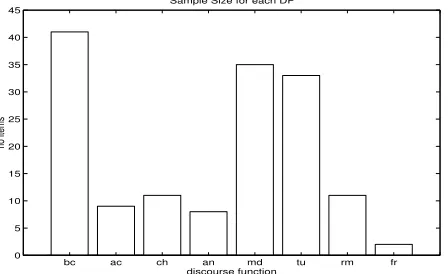
Figure 2: Distribution of Patterns according to Discourse Function
effectively realize meaning assignment for discourse particles in context given the features involved.
Our emphasis in this paper is on how speakers perform meaning analysis, looking at this question from a theoretical perspective which opens up the possibility of using this ap-proach in practical language engineering tasks as well. This is in contrast to statistical natural language processing where it has become customary to conduct analyses on the scale of 10’s of millions of words. It seems, however, that small-scale, intensive analyses such as the one presented here are more realistic with respect to the language learner than analyses conducted on large corpora. It is doubtful whether large-scale statistical analysis will be applicable to the situation of a per-son taking in one case at a time, but the method proposed here is amenable to such on-line learning.
Similarity Measures, Clustering and Frequency Counts
The data we are using are the result of a specific represen-tational method, namely using attribute-value descriptions, where several values attach to each descriptional dimension (or attribute). They are further pre-processed by being con-verted into binary data vectors, for which a number of options are available (optimal binary coding, linear 1-of-n coding, error-correcting coding etc.), and where optimal binary cod-ing was chosen. (The data used are sparse in the sense that for
bc ac
ch an
md tu
rm fr
bc ac ch an md tu rm fr5 10 15 20 25
distance
Figure 3: Mean Distances for Patterns according to Discourse Function
each pattern several attributes were not used, so binary coding produced good results.)
We performed some initial analyses of the data such as frequency counts, clustering based on Hamming distance and computing within-class and between-class distances of the data labeled according to discourse function.
There are 127 different input features (values of attributes) which are arranged in 17 dimensions. These features occur with varying frequency in the dataset (cf. Fig. 1). (Mean frequency of a feature in the total set is 13.8).
Class-labeled Data In Fig. 2 we show the number of pat-terns in each class defined by discourse functions. We also compute the mean overall Hamming distance of pairs of pat-terns both taken from the same class and from different classes (cf. Fig. 3).
These data show that within-class distances (data points on the diagonal) are generally smaller than those between different classes. They present evidence for the linguistic classification to be supported by the descriptive features in attested patterns.
Finally, for each class we may select the pattern with the smallest overall mean distance to other patterns in the same class. These are the most central attested patterns, which can be regarded as theprototypicalmember of that category. We will be using these prototypes in meaning assignment tasks.
Meaning Assignment
Interpretation with Full and Reduced Feature Sets In the first set of experiments, it was determined in how far it is possible to automatically assign discourse functions tojaand ohusing the paradigm of supervised learning. We show the influence of using different training and testing samples and experiment with reduced feature sets to determine the specific influence of surface features (1-7), pragmatic features (8-17) and discourse function (18) respectively. (The numbers in parentheses here and below refer to the feature numbering in the appendix.)
50-20 40 60 80 100 120 140 40
50 60 70 80 90 100
Training Set Size
Correct Patterns (in %)
Training
Generalization
Figure 4: Influence of the Training Set Size on Training and Generalization
10-4 net was used for training. The training procedure used in all cases was standard backpropagation, which allowed to create a large number of easily comparable generalization results.
The basic experiment concerned the task of learning a tional mapping between input features and discourse func-tions, using a training set and generalizing to a test set from the 170 coded examples. We experimented with different sizes of training sets and different feature sets.
In Fig. 4 we show the influence of the training set size on generalization performance. We can see that performance starts to level off when we use about 50 patterns for training. This boundary condition on the training size has interesting implications for lexical learning. It may underscore the no-tion that lexical learning requires only a comparatively small set of examples to realize a functional mapping from input to meaning for a great number of other cases (cf. (Scheler, 1996b)). Below we show that analogical transfer to a new particle may be successful for an even smaller,prototypical training set.
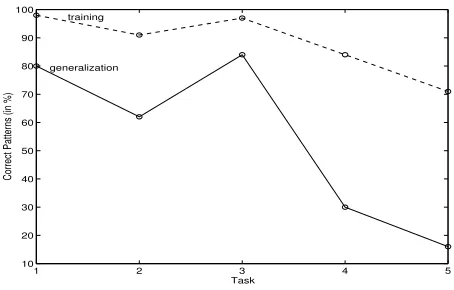
Reduced Feature Sets The surface features used are easily extractible from text corpora using preprocessing and statis-tical corpus analysis tools (cf. (Bauer, 1995)). Therefore it is of great practical interest to perform meaning assignment given only the surface features. In that case there would be no need for human intervention in the training process, and a fully automated discourse function assignment system would result. Accordingly, we have experimented with various re-duced feature sets. We used a 100 training set, 70 test set scenario in all cases. The results are shown in Fig. 5. Task 1 refers to the basic experiment with the full feature set (1-17 input, 18 output). In task 2 we restricted the input to the sur-face features (1-7) and learned the assignment of the discourse function (18). We see that both training and generalization performance drop from 98% to 91% and 80% to 62% respec-tively. In Task 3 we used only the pragmatic features (8-17) to predict discourse function (18) and find that the performance matches or exceeds that of the full feature set (98%, 84%). Task 4 and 5 confirm the view that the contribution of prag-matic features concerns information that cannot be extracted from the surface features. In each case, we tried to predict
1 2 3 4 5
10 20 30 40 50 60 70 80 90 100
Task
Correct Patterns (in %)
training
generalization
Figure 5: Results for Learning with Reduced Feature Sets: 1: input features discourse function(DF) 2: surface
fea-tures (sfs) DF, 3: pragmatic features DF, 4: sfs
dialogue act, 5: sfs pragmatic features
pragmatic features from surface features alone, and find only weak dependencies between feature sets. In task 4 the out-put was a single pragmatic feature, the dialogue act of the current utterance (9) (which has 14 different feature values), and in task 5 the output was the whole range of pragmatic features (8-17). These results show that discourse functions may be predicted frompragmaticfeatures alone as well as from surface and pragmatic features combined. The prag-matic features used here have been manually encoded using operationalized guidelines for intersubjective agreement. We may assume that they are in themselves complex features, which incorporate some surface cues, i.e. they are not statis-tically independent of the surface features. This is evidenced in task 3 and task 4. Therefore, given the complex, pragmatic features, the surface features are not really needed to perform the meaning assignment. However, pragmatic features are difficult to derive automatically, because they incorporate ad-ditional properties of a wider context and shared-background understanding. In that light, the level of performance achieved using only surface features is rather encouraging. It seems that a considerable part of the discourse function assignment can be performed by looking at the immediate surface utterance context of a discourse particle.
We conclude that we do get significant generalization re-sults for the meaning assignment of discourse functions given a full feature analysis of the linguistic and pragmatic context. All of these features contribute towards the determination of a function of a particular lexeme - for fully automated anal-ysis to be feasible there must be a way to extract pragmatic features from discourse as well.
from one discourse particle to the other, using the computed prototypes forjato speed up the learning process. We found that performance on generalization was 50% correctness with the unedited sample, it was slightly higher (55%), when the frequency of prototypes was significantly increased (10x), but the best results were achieved with a training set of only pro-totypes (i.e. 8 patterns) (65%).
Obviously it is easier to classify a set of descriptive patterns if a net has been trained on a small set of most salient, central patterns than if a lot of spurious feature patterns are reflected in the weights of the network. This is a general property of network learning which should occur when we have stable, consistent pattern-class mappings. These results underline the usefulness of using neurally inspired classification methods for linguistic tasks: We can make the notion of ‘analogical transfer’ more explicit and improve performance for language engineering tasks as well.
Uniqueness of Meaning Assignment A question not adressed in this paper is the uniqueness of discourse function. The examples used have all been analysed for their domi-nant reading only. It is a general feature of natural languages that disambiguation procedures are not always completely realized (e.g. pp-attachment, systematic lexical ambiguity, pronominal reference) (cf. e.g. (Green, 1996)) and subjective judgments on meaning assigment problems vary. We must expect a certain level of dubious cases even with a perfect meaning assignment model. In our attempt to characterize the individual’s capacity for understanding, the role of inter-active clarification processes and unresolved mis-assignments in everyday communication should not be underestimated. It is possible that even humans may perform only in the 80%-90% range (of correctly understood discourse meanings) in real settings.
Conclusion
Discourse particles offer a fascinating view on linguistic cog-nitive abilities because of their simultaneous reference to the communicative setting and their expression of semantic con-tent. Viewing language as a cognitive ability automatically puts spoken language discourse at the center of attention, rather than the derived ability of producing written text ac-cording to the norms of a standard language. We need to test our theories of linguistic ability against the empirical data of real dialogues as embodied in spoken language corpora. In this paper we have tried to move a step in that direction.
The experiments reported above show that discourse parti-cles follow the general pattern of categorical meaning assign-ment and that the contribution of different types of features from the communicative situation can be explored in consid-erable detail.
Prototype abstraction was shown to be a significant factor in learning a new discourse particle on the basis of the contex-tual distribution and functional properties of another. Mean-ing assignment for discourse particles may be regarded as an exemplification of general lexical interpretation processes -where the influence of the communicative situation is highly apparent. We may conjecture that cognitive models of other types of lexical or morphological items may similarly have to be constrained by discourse factors, at least when analysed in the context of spoken language.
References
Bauer, S. (1995). Entwicklung eines Eingabe-Taggers f¨ur lexikalisch-syntaktische Information. Master’s thesis, Technische Universit¨at M¨unchen.
Fischer, K. (1996a). A construction-based approach to the lexicalization of interjections. In: M. Gellerstam, S. Malmberg, K. Noeren, L. Rogstrom, and C. R. Papmehl (eds.)Proceedings of EuraLex’96.
Fischer, K. (1996b). Distributed representation formalisms for discourse particles. In: D. Gibbon (ed.) Natural
Language Processing and Speech Technology.
Mouton-de Gruyter.
Fischer, K. and M. Johanntokrax (1995). Ein linguistisches Merkmalsmodell f¨ur die Lexikalisierung von
diskurss-teuernden Einheiten. Technical Report SFB-360-18,
Universit¨at Bielefeld.
Green, G. M. (1996). Ambiguity resolution and discourse interpretation. In: K. van Deemter and S. Peters (eds.),
Semantic Ambiguity and Underspecification, Cambridge
University Press. (CSLI Publications)
Grosz, B., M. Pollack and C. L. Sidner (1989). Discourse. In: M. Posner (ed.)Foundations of Cognitive Science. MIT Press.
Levelt, W. (1983). Monitoring and self-repair in speech.
Cog-nition, 14:41–104.
Sagerer, G., H. Eikmeyer and G. Rickheit (1994). "Wir bauen jetzt ein Flugzeug": Konstruieren im Dialog. Technical Report SFB 360-1, University of Bielefeld.
Scheler, G. (1994). Feature selection with exception han-dling – an example from phonology. In: R. Trappl (ed.), Proceedings of the European Meeting on Systems and
Cybernetics.
Scheler, G. (1996a). Generating English plural determiners from semantic representations. In: S. Wermter, E. Riloff,
and G. Scheler (eds.) Learning for natural language
processing: Statistical, connectionist and symbolic
ap-proaches, Springer.
Scheler, G. (1996b). Learning the semantics of aspect. In: H. Somers (ed.)New Methods in Language Processing. University College London Press.
Scheler, G. (1997). Feature-based perception of semantic con-cepts. In: C. Freksa (ed.)Cognition and Computation, Springer. (Lecture Notes in Computer Science)
Schiffrin, D. (1987).Discourse Markers. Cambridge Univer-sity Press.
Schmitz, B. and J. Quantz (1997). Dialogue acts in automatic dialogue processing. In:Proceedings of the Conference on Theoretical and Methodological Issues in Machine
Translation.
Inventory of Descriptive Features
Surface Features
lexeme(1) (here:jaandoh);
turn(2) andutterance(3)positionof the discourse parti-cle, i.e.own, init, 2nd, medial, final;
right(4) andleft(5)context, i.e. the preceding and fol-lowing syntactic constituents, for instance,NP, VP, PP, but
alsopause, adverb, etc.;
combinationwith other discourse particles (6), such asso,
ah, gut;
therole(7) the speaker fulfills in the discourse situation,
i.e. instructororconstructor.
Pragmatic Features
pragmatic functions, with respect to the:
turn-taking system (10), i.e. taking, holding, yielding
andsupportinga turn;
information management domain (17), e.g. signalling the beginning of anew topicorhighlightingimportant information,segmentingutterances or indicating that the current utterance isrelevantto the preceding one;
speech managementlevel (11), e.g. concerning thetime for speech planning activities;
domain-specific dialogue acts, of the:
preceding utterance(8), e.g. request, acknowledgment;
current utterance(9), with the same set of values; cognitive content ofohandja, refering to:
themental stateof thespeaker(12);
the supposedmental stateof thehearer(13); theactionlevel (14);
thepropositionallevel (15); and theinteractionallevel (16).
Discourse Functions
(18)
take-up(tu): gives feedback to the other speaker and signals
that one intends to take the turn to say something relevant;
backchannel(bc): gives feedback and supports the other’s
turn;
frame(fr): introduces a new topic or concludes the previous
one;
repair marker(rm): signals problems in the formulation
process;
answer(an): signals agreement on the same proposition;
action(ac): refers to the task the speaker fulfills in the
situation; for instance in the toy-airplane construction dia-logues, Germanjacan be used to indicate that the action is completed;
check(ch): signals the hearer that the speaker would like to
get positive feedback;
modal(md): refers to the hearer’s supposed mental state.
Acknowledgments: