Face Recognition under Different Lighting
Conditions Using Multiple Feature Fusion
Kothamasu Jahnavi1, K.Satya Prasad2
M.Tech Student, Department of E.C.E, University College of Engineering, JNTUK, Kakinada, A.P, India1
Professor, Department of E.C.E, University College of Engineering, JNTUK, Kakinada, A.P, India2
ABSTRACT: Face recognition has received substantial attention from researchers in biometric pattern recognition. The common challenges faced by the face recognition technology are the range of appearance variations due to changes in illumination, pose, facial expression, aging etc.The objective of this paper is to make face recognition reliable under uncontrolled lighting conditions. This is achieved by an integrated framework consisting of illumination normalization, local texture based face representation, robust feature extraction and multiple feature fusion. Each stage increases resistance to illumination variations. Local ternary pattern, local binary pattern and gabor wavelets are used to extract local feature sets.In the proposed method, an additional feature set is extracted using Elongated Multi Block Local Ternary Pattern (EMB-LTP). It improves the reliability of the algorithm. This multiple feature fusion technique can achieve a higher acceptance ratio and a lower rejection ratio compared to the cases where a single feature set is used.
KEYWORDS: Biometric pattern recognition; Local Binary Pattern; Local Ternary Pattern, Gabor wavelets
I. INTRODUCTION
Face Recognition has a gained substantial place in the area of research in computer vision and image processing during the past several decades. It is one of the most important tasks, and as such has received a great deal of attention because of its applications in various domains such as automated crowd surveillance, access control, mug shot identification, face reconstruction, design of human computer interface and multimedia communication[1].
In general, there are several challenges that one can encounter during the process of facial recognition. They are caused due to variation in illumination, pose, age, facial expressions, aging and partial occlusions. This paper makes an attempt to overcome the challenge of correctly recognizing a face when presented in different illumination conditions. Such variations are overcome by the proposed method involve facial features extracted from multiple methods.
Computer recognition of face images involves two crucial aspects: facial feature representation and classifier design [3]. Facial representation is to derive a set of features from the original face for describing faces. If inadequate features used, even the best classifier will fail to achieve facial recognition. Therefore it is essential to extract discriminative facial features for facial representation. A set of good facial features are said to consist of following properties: first, can tolerate within class variations whilst discriminate different classes well; second, can easily be extracted from the raw images to allow fast processing; and finally, lie in a space with the low dimensionality in order to avoid computationally expensive classifiers.
A single feature extraction technique generally cannot gather both the macro and micro structural information associated with the image. Hence the concept of multiple feature fusion comes into play to create a set of facial features that overcome the former complaints. In this paper, few feature extraction techniques are utilized to get a fused outcome that can assist in facial recognition in a more outstanding way than when the techniques are implemented individually. Those techniques comprise of Local Binary Pattern, Local Ternary Pattern, Gabor filter, Elongated Multi Block Local Ternary Pattern. The classifier used in our paper is PCA[6].
II. RELATED WORK
Of the mentioned facial feature extraction methods, Local Binary Pattern (LBP) is the oldest and was introduced by Ojala for the aim of texture classification. It has been extensively exploited in many applications.For instance, face image analysis, image and video retrieval, environment modeling, visual inspection, motion analysis, biomedical and aerial image analysis, and remote sensing. Theapproach followed is that proposed by Ahonen et al.The face image is divided into a grid of small of nonoverlapping regions, where a histogram of the LBP code foreach region is constructed. The similarity of two images isthen computed by summing the similarity of histograms fromcorresponding regions.
LBP method is not only relatively simple and with lowcomputation complexity, but also has the properties ofrotational invariance, gray scale invariance and othersignificant advantages.Despite the great success of LBP in early applications, its practical results are not satisfactory indifferent fields. Hence, many researchers have improved theLBP and achieved lots of significant results. Some of these variants are: The elongated LBP (ELBP) method forface recognition proposed by Liao et al. The local ternary patterns (LTP)introduced by Tan et al. which is less sensitive tonoise in uniform regions. LTP has stronger discriminationability against the changes of noise and illumination thanLBP in the uniform region. But the issues of image multi-scalevariation and partial occlusion are needed to solve.
The EMB-LTP (Elongated Multi Block Local Ternary Pattern) is a novel variant of LBP capturing the prominent features of ELBP, MB-LBP and LTP which themselves are variants of LBP developed at different stages. The ELBPfeatures are more generic in nature than the conventional LBP. It isable to capture anisotropic information from the facialimages, which are important features as there are manyimportant parts of the face such as eyes, mouth are allelongated structures. The multi-scale block local binary pattern (MB-LBP)encodes not only microstructures but also macrostructures ofimage patterns. TheElongated LTP (ELTP), another variation of the basic LTP is performed best than basic LBP. Anothervariation of LBP called multi-scale block local ternarypattern proposed by XiaofeiJia et al. for fingerprintvitality detection and results show nits superiority than thebasic LBP and by Zhe Wei et al. for face detection.
Principal Component Analysis(PCA) is an unsupervised dimensionality reduction technique that is used for compression and recognition problems. It is also known as Eigenspace projection or Karhunen-Loeve Transformation. It is used to find a subspace whose basis vectors correspond to maximum variance directions in original space.
III.PROPOSED ALGORITHM
In this paper, the algorithm used is mainly divided into three stages such as Illumination normalization, robust feature extraction followed by subspace representation.
3.1 Illumination Normalisation
The source of variation in facial appearance is the illumination of the face. The majority of thetechniques proposed to deal with this problem exploit the low dimensionality of the face space under varying illumination conditions. They either use several images of the same person recorded under varying illumination conditions or it relies on the availability of 3D face models and different maps to generate novel views. The main shortcoming of this approach is the requirement in practice of large example sets to achieve good reconstructions. Our approach on the other hand
builds an illumination varying subspace by constructing artificially illuminated colour images from an original image. The robustness of lighting conditions is achieved using pre-processing chain.
3.1.1 Pre-processing chain
Pre-processing is an operation with images at the lowest level of abstraction, both input and output are intensity images. Image pre-processing methods generally involve the use of considerable redundancy in images. Neighboring pixels corresponding to one project in real images have essentially the same or similar brightness value, so if a distorted pixel can be picked out from the image. It can usually be replaced with the average value of neighbouring pixels.
Pre-processing is done to remove unwanted illumination effects such as non-uniform illumination, shadowing, aliasing and blurring, noise. It retains useful information like Facial features: eyes, nose, wrinkles, local shadowing, and shading. It involves the following steps,
Step 1: Gamma correction.
Step 2: Difference of Gaussian filtering. Step 3: Contrast normalization.
3.1.1.1 Gamma correction
It is a nonlinear gray-level transformation that replaces I gray-level with I^γ where γ is a user-defined parameter. This enhances the local dynamic range of the image in dark or shadowed regions while compressing it in bright regions and at highlights. A power law with exponent γ is used. Here we use γ=0.2.
3.1.1.2 Difference of Gaussian Filtering
Gamma correction does not eliminate the influence of overall intensity gradients such as shading effects. DoGfiltering is a convenient way to achieve the resulting band pass behaviour. Fine details remain critically important for recognition so the inner (smaller) Gaussian is typically quite narrow(σ0≤1pixel) while the outer one σ1 might have of
2–4 pixels or more, depending on the spatial frequency at which low frequency information becomes deceptive rather than informative.
3.1.1.3 Contrast Equalization
The final stage of our preprocessing chain rescales the image intensities to standardize a robust measure of overall contrast or intensity variation. It is important to use a robust estimator because the signal typically comprises of extreme values produced by highlights, small dark regions such as nostrils, garbage at the image borders, etc. One could use (for example) the median of the absolute value of the signal for this, but here we have preferred a simple and rapid approximation based on a two stage process as follows:
Here, a is a strongly compressive exponent which reduces the influence of large values, гis a threshold used to .truncate large values after the first phase of normalization, and the mean is over the whole By default we use a= 0.1 and г= 10. Here we use the hyperbolic tangent I(x, y) →τ tanh (I(x, y)/τ), limiting I to the range (-τ,τ).
3.2 Robust Feature Extraction
Robustness is the quality of being able to withstand stresses, pressures, variations or changes in procedure or circumstance [5]. A system, organism or design may be said to be "robust" if it is capable of coping well with variations (sometimes unpredictable variations) in its operating environment with minimal damage, alteration or loss of functionality. Our algorithm strives to achieve this robustness by incorporating some worthy feature extraction techniques. Current feature sets offer quite good performance under illumination variations but there is still room for improvement.
3.2.1 Local Binary Pattern (LBP)
Local Binary Pattern was introduced by Timoojala. The standard version of the LBP of a pixel is created by thresholding the 3x3 neighborhood of each pixel value with the center pixel’s value. Let gcbe the center pixel gray level
and gi (i=0,1,..7) be the gray level of each surrounding pixel “Fig. 3a” illustrates the basic LBP operations. If giis
smaller than gc, the binary result of the pixel is set to 0 otherwise set to 1. All the results are combined to get 8 bit
value. The decimal value of the binary is the LBP feature.
g5 g6 g7
g4 gc g0
g3 g2 g1
Fig3a: The LBP operator of pixel with 3x3 neighborhood
Fig3b:Illustration of basic LBP Operator
3.2.2 Local Ternary Pattern (LTP)
LTP consistently outperforms LBP by a small margin. LBPs have proven to be highly discriminative features for texture classification and they are illumination variation resistant in the sense that they are invariant to monotonic gray-level transformations. However because they threshold at exactly the value of the central pixel they tend to be sensitive to noise, particularly in near-uniform image regions, and to smooth weak illumination gradients. This technique extends LBP to 3-valued codes, in which gray-levels in a zone of width ± t around are quantized tozero, and the ones above this are quantized to +1 whereas the ones below it to −1. Coding way of LTP is shown in “Fig. 4”.
7
The calculation of the three values is shown as follows:
Here t is a user-specified threshold, which is set as 5.
3.2.3 Gabor filter
Wavelet transform could extract both the time (spatial) and frequency information from a given signal, and the tunable kernel size allows it to perform multi-resolution analysis.Among various wavelet bases, Gabor functions provide the optimal resolution in both the time (spatial) and frequency domains, and the Gabor wavelet transform seems to be the optimal basis to extract local features for several reasons:
Biological motivation:The simple cells of the visual cortex of mammalian brains are best modeled as a family of self-similar 2D Gabor wavelets.
Mathematical and empirical motivation:Gabor wavelet transform has both the resolution and multi-orientation properties and are optimal for measuring local spatial frequencies. Besides, it has been found to yield distortion tolerance space for pattern recognition tasks.
3.2.4 Elongated Multi Block Local Ternary Pattern (EMB-LTP)
It is a novel variant of LBP accommodating the main merits of three variants of LBP namely Elongated LBP, Multi Block LBP and LTP. In this model, the computation is done based on average values of block subregions rather than individual pixels. In this method, a multi scale block pattern is obtained considering the elliptic neighbourhood definitionthen a ternary pattern is obtained from the multi-scale block pattern.
We split each ternary into its positive and negative parts to reduce the running time. Then we obtain the positive and the negative EMB-LTP codes. In the positive parts, the negative values were set to zero, while the others remained. In the negative parts, both the positive values of LTP and zero ones were set to zero, and the negative values were set to one. In this way, the MBLTP code is divided into two LBP codes.
The EMB-LTP operator encodes not only the microstructure but also the anisotropic structural information and macrostructure of face image patterns, and hence provides a more complete image representation.
3.3 Principal Component Analysis (PCA)
PCA is a statistical approach used for reducing the number of variables in face recognition. In PCA, every image in the training set is represented as a linear combination of weighted eigenvectors called Eigenfaces. These eigenvectors are obtained from covariance matrix of a training image set. The weights are calculated out after selecting a set of most relevant Eigenfaces. Recognition is performed by projecting a test image onto the subspace spanned by the Eigenfaces to find the set of weights that describe the contribution of each vector. Next classification is done by measuring minimum Euclidean distance.The advantage of this approach over other face recognition systems is in its simplicity, speed and insensitivity to small or gradual changes on the face.
IV.RESULTSANDDISCUSSION
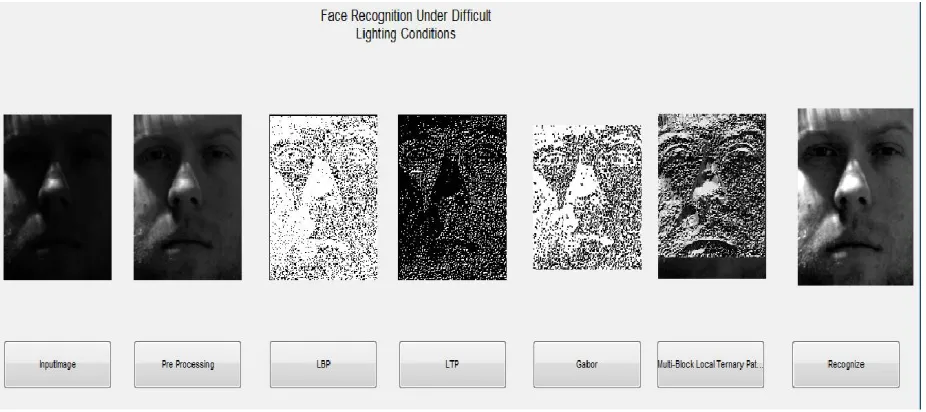
In this section we present Matlab simulation results of our method. The database used to test our proposed method is extended Yale B database that has images of human faces with different subjects under varying illumination conditions and facial expressions.Table 1 gives the default values of the parameters used in the algorithm.
Table 1: Default Parameter Values
The metrics used to determine the performance of a face recognition algorithm are face verification rate and True rejection rate. They utilize terms such as true positive, true negative, false positive and false negative. The accuracy or the face verification rate is the measure of the test images being correctly identified if present in the training database. The rejection rate gives the information of the actual images of the database that are falsely rejected by the face recognition algorithm. The experiment is conducted over a number of subjects and Face Verification Rate and True Rejection Rate are calculated yielding a 90% Face Verification Rate and 4.4% True Rejection Rate.
V. CONCLUSION
This paper presents a novel face recognition algorithm that can surpass the challenges encountered due to varying illumination conditions because of its robust pre-processing techniques associated with a holistic measure of facial feature extracted by fusing multiple feature extraction techniques and thus compensating the shortcomings of one extraction technique with the advantage of another.
REFERENCES
1. Xiaoyang Tan and Bill Triggs,’ Enhanced Local Texture Feature Sets for FaceRecognition under Difficult Lighting Conditions’, IEEE TRANSACTIONS ON IMAGE PROCESSING, VOL. 19, NO. 6, JUNE 2010.
2. Lim Song Li, NorashikinYahya,’Face Recognition Technique using Gabor Waveletsand Singular Value Decomposition (SVD)’,2014 IEEE International Conference on Control System, Computing and Engineering, 28 – 30 November 2014, Penang, Malaysia
3. C. Taouche, M. C. Batouche, M. Chemachema, A. Taleb-Ahmed, and M. Berkane,’New face recognition method based on local binary patternHistogram’,15th international conference on Sciences and Techniques of Automatic control& computer engineering - STA'2014, Hammamet, Tunisia, December 21-23, 2014.
4. K.Meena, Dr.A.Suruliandi,’LOCAL BINARY PATTERNS AND ITSVARIANTS FOR FACE RECOGNITION’,IEEE-International Conference on Recent Trends in Information Technology, ICRTIT 2011©2011 IEEEMIT, Anna University, Chennai. June 3-5, 2011. 5. P.Kalaiselvi, S.Nithya,’Face Recognition System under Varying Lighting Conditions’,IOSR Journal of Computer Engineering
(IOSR-JCE)e-ISSN: 2278-0661, p- ISSN: 2278-8727Volume 14, Issue 3 (Sep. - Oct. 2013), PP 79-88.
6. Liton Chandra Paul, Abdulla Al Sumam,’Face Recognition Using Principal Component Analysis Method’,International Journal of Advanced Research in Computer Engineering & Technology (IJARCET)Volume 1, Issue 9, November 2012.
7. AmritpalKaur, Sarabjit Singh, Taqdir,’Face Recognition Using PCA (PrincipalComponent Analysis) and LDA (LinearDiscriminant Analysis) Techniques’,International Journal of Advanced Research in Computer and Communication Engineering Vol. 4, Issue 3, March 2015.