ISSN(Online): 2320-9801
ISSN (Print): 2320-9798
International Journal of Innovative Research in Computer
and Communication Engineering
(An ISO 3297: 2007 Certified Organization)
Vol. 4, Issue 11, November 2016
Microcontroller Based Prepaid Energy Meter
to Control Electricity Theft
Tajeen K Hundekari
1, Prof. G. P. Jain
2, Mr. Sagar R Somani
3PG Student, Dept. of Electronics Engineering, Walchand Institute of Technology, Solapur, Maharashtra, India1,3
Associate Professor, Dept. of Electronics & Telecommunication Engineering, Walchand Institute of Technology,
Solapur, Maharashtra India2
ABSTRACT: In India electricity meters have mainly been electromechanical in nature but are gradually being replaced by more sophisticated and accurate digital and electronic meters. A high percentage of electricity revenue is lost due to power theft, incorrect meter reading and billing, and reluctance of consumers towards paying electricity bills on time. This paper proposes a new methodology to implement a controller based smart prepaid energy meter which can also control electricity thefts. The energy meter makes use of the global system for mobile communication [GSM] network to incorporate the facility of prepaid metering system and remote load control. A prepaid energy meter is installed in every consumer home which makes use of an ARM 7[LPC 2148] microcontroller to calculate the energy consumed and a server unit is maintained at the service provider side. Both the units are well equipped with GSM modem. LCD display is used to display the amount of energy consumed. The user can recharge the meter as per his requirements by sending an SMS to the server. The user needs to make an initial recharge to deal with the issues of unpaid bills and human error in billing which eventually ensures justified revenue collection. Also different aspects of electricity theft can be dealt using the proposed algorithms.
KEYWORDS: Smart prepaid energy meter, Electricity theft, GSM, SMS.
I. INTRODUCTION
Electrical metering instrument technology has come a long way from the original bulky meters with heavy magnets and coils to the recent electronic meters. There have been many innovations those have resulted in size & weight reduction in addition to improvement in features and specifications. Despite of the rapid development in majority of the sectors in India only few developments are made in electricity sector. As limited non-renewable resources are present in our daily life, electricity is one of them which are utilized in every country [1].Electric energy is a vital resource in everyday life and a backbone of every industry. As electricity is limited resource its proper use and measurement is very important. In Conventional metering system to measure power consumption the energy provider company hire persons who visit each house and record the meter reading manually. These meter readings are used for electricity bill calculation and this bill sent to consumer house by post. This makes the system sluggish and laborious [2][3]. The human error can open an opportunity for corruption due to human interventions. So the problems arise in the billing systems which make them inaccurate and inefficient. The availability of wireless communication media has made the exchange of information fast, secured and accurate. Communication media like the internet, GSM networks, etc. exists everywhere. Wireless meter reading puts more control into the hands of both utilities and consumers by giving them more detailed information about power consumption. This allows utilities to better regulate the power supply. So, remote & wireless meter reading system with prepaid technique is becoming a trend now.
ISSN(Online): 2320-9801
ISSN (Print): 2320-9798
International Journal of Innovative Research in Computer
and Communication Engineering
(An ISO 3297: 2007 Certified Organization)
Vol. 4, Issue 11, November 2016
electricity pilfering. Although periodic inspection can substantially reduce electricity theft but such measure requires large manpower and huge labour[7]. Some of the technical ways to detect pilferage are use of central observer meter at secondary terminals of distribution transformer, harmonic generator, genetic support vectormachines, extreme learning machine and power line impedance technique [8][9]. However, these technical approaches can be effectively implemented only if proper communication is ensured between the central control station and the appropriate test points. Traditional electromechanical meters still widely used today are prone to drift over temperature and time as a result of the analog and mechanical nature of the components in these meters [10]. Collection of meter readings is also inefficient, because a meter reader has to physically be on- site to take the readings. This method becomes more problematic and costly. There exists chance for missing bills, absence of consumer etc.
II. RELATED WORK
In paper[1], a new concept of energy meter is discussed where maximum demand of energy of a consumer is indicated in the meter used by the consumer. After exceeding the maximum demand, the meter and hence the connection is automaticallydisconnected by an embedded system inserted in the meter itself. Paper[2] presents the design of a simple low cost wireless GSM energy meter and its associated web interface, for automating billing and managing the collected data globally. This system replaces traditional meter reading methods and enables remote access of existing energy meter by the energy provider. Also they can monitor the meter readings regularly without the person visiting each house. Paper [3] deals with automatic meter reading and theft control system in energy meter. Current transformer is used to measure the total power consumption for house or industrial purpose. This recorded reading is transmitted to the electricity board for every 60 days once. For transmitting the reading of energy meter GSM module is used. To avoid theft, infrared sensor is placed in the screw portion of energy meter seal. If the screw is removed from the meter a message is sent to the electricity board. The paper [4] proposes a design of an intelligent energy metering system that can efficiently control the amount of electricity consumed by the user. Electricity users can buy specific amount of energy to use, only when they need it. This is achieved by interfacing energy meter with smart card technology .The system also alerts when the payment was not cleared.Paper [5] presents the development of Automatic Trip Control System for Energy Management using GSM. This system monitors the usage level of electricity of every consumer at all the time. During excess of electrical energy used by consumer, the system will give the alerts through an alarm circuit. After the alarm circuit, the consumer has to take an alternative solution to cut-off excess supply from the Electricity Board (EB) to stop alarming.
III. PROPOSED SYSTEM FRAMEWORK
The major drawbacks of post-paid electric energy metering system are uncontrolled usage of electricity from the consumer’s side and lot of wastage of power due to the consumer’s lack of planning in electricity consumption. In this paper we have proposed to design a prototype of GSM based prepaid energy meter which will consist of a server to maintain the supply of electricity to the users, a consumer unit to perform the power billing and communicate it to the server as well as user through SMS, also detect electricity thefts and substantially reduce it using the algorithms designed. According to the proposed system a server unit is installed at the power utility side and every user is provided with a consumer unit which is the actual prepaid energy meter. The GSM modem makes use of the GSM network to establish communication between the server units, the consumer unit as well as with the user also. The server unit consists of a microcontroller (ARM 7-LPC2148), GSM modem (SIM 900), 16x2 LCD display. The consumer unit consists of a microcontroller (ARM 7-LPC 2148), GSM modem (SIM 900), 16x2 LCD display, current transformers, potential transformer and relays. The output signal of the current and potential transformers is provided to the in-built ADC of the microcontroller of the consumer unit. The microcontroller calculates the power consumption using the output pulses from the ADC. Fig.1. shows the block diagram of server unit and consumer unit.
ISSN(Online): 2320-9801
ISSN (Print): 2320-9798
International Journal of Innovative Research in Computer
and Communication Engineering
(An ISO 3297: 2007 Certified Organization)
Vol. 4, Issue 11, November 2016
line using the relay until the user recharges his/her meter again. Whenever there is any type of theft, billing irregularity or illegal practices detected at the consumer end the energy meter immediately disconnects the load from the mains supply and reports this malfunctioning to the server by sending a message through the GSM modem. The central authority can take actions against the defendants. Thus this system avoids the irregularities associated with traditional billing system and ensures revenue collection.
Fig. 1. Block diagram of server unit and consumer unit
IV. ELECTRICITY THEFT DETECTION & CONTROLLING
1. Prevention from bypassing of the phase line –
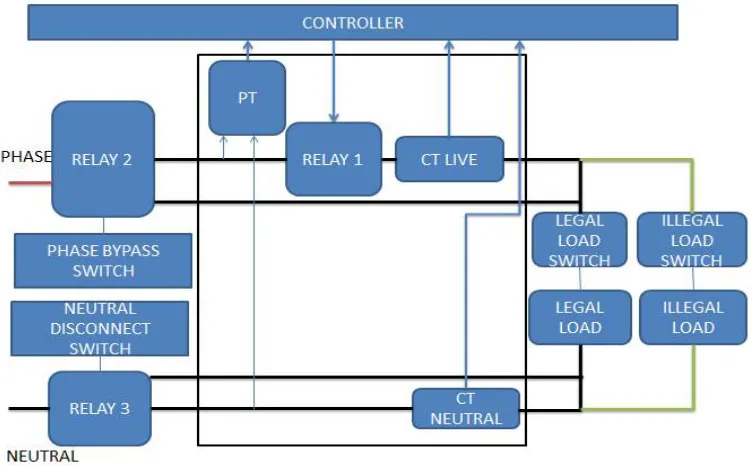
A popular method to bypass conventional meter is shorting the phase line as shown in Fig.2.This type of bypassing of the phase line can be detected with the help of potential transformer PT and the current transformer CT live those are connected in the phase line. As soon as the phase line gets bypassed the voltage sensed by PT will be zero and the current sensed by CT live will also be zero amperes. Hence the microcontroller gets intimation and it immediately sends a message to the authorized person of the theft. The authority in charge can take legal actions against the accused user.
ISSN(Online): 2320-9801
ISSN (Print): 2320-9798
International Journal of Innovative Research in Computer
and Communication Engineering
(An ISO 3297: 2007 Certified Organization)
Vol. 4, Issue 11, November 2016
2. Prevention from disconnecting the neutral line –
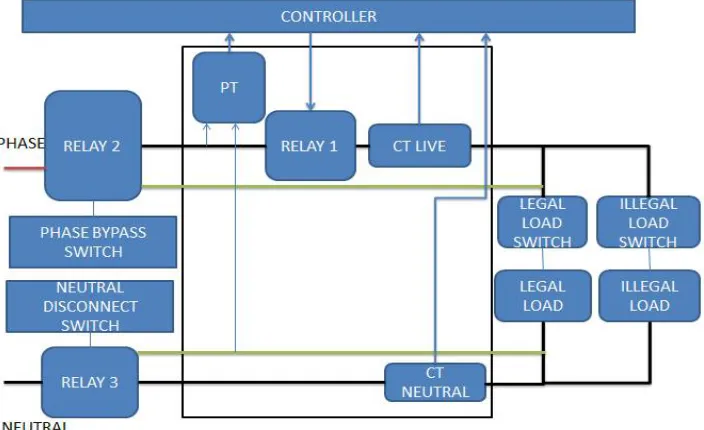
Another method of electricity theft is to disconnect the neutral line as depicted in Fig.3. If a neutral line happens to be disconnected then there will be difference between the output voltages of CT1 and CT2. After comparing the voltages of CT1 and CT2 if any major difference is found, the microcontroller actuates the relay to disconnect the load. Also the energy meter warns the authorized person in charge of the corresponding theft by sending a SMS and hence the authority can take legal action against the user.
Fig. 3. Disconnecting the neutral line
3. Prevention against whole meter bypass –
Bypassing the whole electricity meter is another type of electricity theft as shown in the Fig.4. In this case the meter detects no energy consumption. The potential transformer connected detects zero voltage when the whole meter gets bypassed and hence intimates the microcontroller of this particular theft. The meter hence sends a SMS to the authorized person so that the authority in charge can take legal actions against that particular customer.
ISSN(Online): 2320-9801
ISSN (Print): 2320-9798
International Journal of Innovative Research in Computer
and Communication Engineering
(An ISO 3297: 2007 Certified Organization)
Vol. 4, Issue 11, November 2016
4. Prevention against connecting an illegal load –
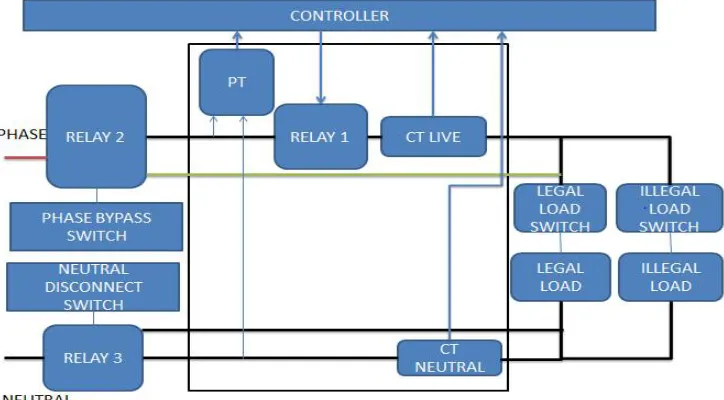
Electricity theft can also take place by connecting an illegal load as shown in the Fig.5. This type of theft is detected by the microcontroller when the current sensed by the current transformer CTLIVE exceeds a specified limit. The microcontroller then actuates the relay to cut the power supplied to the load and sends an alerting message to authority in charge to take legal actions against the consumer.
Fig. 5. Connecting an illegal load
5. Prevention from perverting the electricity meter –
The user or professional person can try to open the energy meter and make changes into it, to show low or no power consumption. This also proves to be a major form of electricity theft. To tackle this problem a switch is connected to the proposed energy meter. One terminal of the switch is connected to +3.3V dc supply and the other is connected to the microcontroller as shown in the Fig.6. In normal conditions, the switch will be closed and the microcontroller will detect +3.3V at its input pin. If consumer tries to open the energy meter the switch is disconnected and the microcontroller will detect 0V at its input pin. If this occurs, the microcontroller immediately sends a notification SMS to the server and disconnects the load from the supply.
Fig. 6. Prevention against tampering
V. RESULTS
ISSN(Online): 2320-9801
ISSN (Print): 2320-9798
International Journal of Innovative Research in Computer
and Communication Engineering
(An ISO 3297: 2007 Certified Organization)
Vol. 4, Issue 11, November 2016
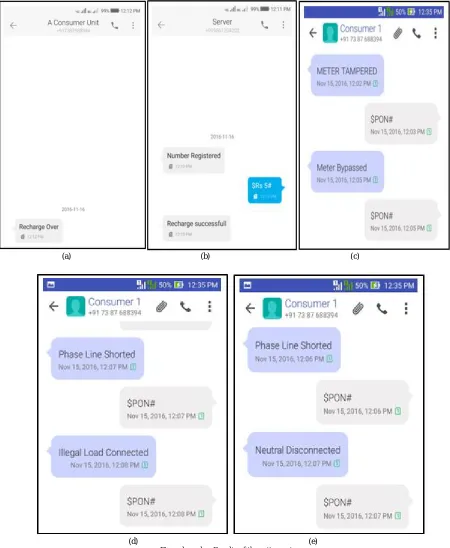
detected and legal actions are taken against the consumer, a Power ON (PON) SMS needs to be sent back to the meter from the authorised person to turn it ON again and resume to its normal operation.
(a) (b) (c)
(d) (e)
ISSN(Online): 2320-9801
ISSN (Print): 2320-9798
International Journal of Innovative Research in Computer
and Communication Engineering
(An ISO 3297: 2007 Certified Organization)
Vol. 4, Issue 11, November 2016
VI. CONCLUSION
In this paper an idea of implementing a smart prepaid energy meter to control electricity theft has been presented. Herein stepwise procedure needs to be followed to design the meter which has resulted in reduced maintenance.This system is advantageous to reduce issues like unpaid bills, billing irregularities, inaccurate meter readings and illicit payment from customer because of bribed service man.The use of GSM modem facilitates establishing direct communication between the server and user end.This system can be a powerful tool for having efficient use of electricity.Through this system five different forms of electricity theft can be detected and controlled. The existing lethargic system can be made more efficient and accurate with the implementation of this system; also it reduces the laborious work to a great extent.
ACKNOWLEDGEMENT
We would like to take this opportunity to thank one and all who have provided their valuable advice, without their guidance this work would not have been a success, we have to thank who have helped us directly or indirectly since they have given us more than just guidance. Our profound thanks to Dr. S R Gengaje, Head of the Department, Department of Electronics Engineering, Walchand Institute of Technology, Solapur, for his invaluable advice and constant encouragement to complete this work in a successful manner. I would like to convey our sincere thanks to management and supportive staff of Walchand Institute of Technology, Solapur, for encouraging us to come up with this paper work.
REFERENCES
1. Subhashis Maitra “Embedded Energy Meter- A New Concept To Measure the Energy Consumed By A Consumer And To Pay The Bill” 978-1-4244-1762-9/08 ©2008 IEEE.
2. Salai Thillai Thilagam.J, E.Moni Silviya, K.Meena Vinodhini, “GSM Based Automatic Energy Meter Reading System with Instant Billing”International Journal of Advanced Research in Electrical, Electronics and Instrumentation Engineering[IJAREEIE],Vol. 3, Special Issue 3, April 2014.
3. P. Rakesh Malhotra, Dr.R.Seethalakshmi, “Automatic Meter Reading and Theft Control System by Using GSM”,International Journal of Engineering and Technology [IJET], Vol 5 No 2 Apr-May 2013.
4. Athira.P.M, D.Jeslin Jeniba, “Electricity Theft Control Using Smart Prepaid Energy Meter”,International Journal on Applications in Electrical and Electronics Engineering,Volume 1, Issue 3: March 2015.
5. S.Sukhumar ,P.Mukesh Aravind , L.Manivannan , P.Naveen Kumar and N.Suthanthira Vanitha,“GSM based Automatic Trip Control System for Energy Management”International Journal of Innovative Research in Science, Engineering and Technology[IJIRSET], Vol. 2, Issue 12, December2013
6. Nabil Mohammad, Anomadarshi Barua and Muhammad Abdullah Arafat, “A Smart Prepaid Energy Metering System to Control Electricity Theft” Proceedings of 2013IEEE International Conference on Power, Energy and Control (ICPEC).
7. Maninderpal Singh, Er.Varun Sanduja, “Minimizing Electricity Theft: A Review”, International Journal of Advance Foundation and Research In Science & Engineering (IJAFRSE)Volume 1, Special Issue, 2015.
8. M.Leelavathi, K.Aswini”SMART ENERGY METER WITH READING INDICATION USING GSM”, International Research Journal of Engineering and Technology (IRJET), Volume: 02 Issue: 02, May-2015
9. Shailaja Kumari, V. Dara, M.Veda Chary, “Pre-paid Remote Energy Meter monitoring and Overvoltage Protection through Electricity using GSM Network”, International Journal of Science, Engineering and Technology Research (IJSETR) Volume 2, Issue 9, September 2013. 10. S.Sukhumar, P.Mukesh Aravind, L.Manivannan, P.Naveen Kumar and N.Suthanthira Vanitha,“GSM BASED AUTOMATIC TRIP
CONTROL SYSTEM FOR ENERGY MANAGEMENT”, International Journal of Innovative Research in Science,Engineering and Technology,Vol. 2, Issue 12, December 2013.
11. Damminda Alahakoon, Member, IEEE and Xinghuo Yu, Fellow IEEE, “Smart electricity Meter Data Intelligence for Future Energy Systems: A Survey”, IEEE TRANSACTIONS ON INDUSTRIAL INFORMATICS,2015.
12. S.Ezhilaraus, Raju, K Venkatesh, M Varatharaj, “An Enhancement of Prepaid energy Meter Using Smart Card and GSM Module Techniques”, International Journal of Research in Electronics-IJRE,vol:02,issue:03,2015.
13. Sai Kiran Ellenki, Srikanth Reddy G, Srikanth Ch, “An Advanced Smart Energy Metering System for Developing Countries”, International Journal Of Scientific Research And Education IJSRE Vol 2 Issue 1 Jan. 2014.
14. Athira.P.M, D.Jeslin Jeniba, “Electricity Theft Control Using Smart Prepaid Energy Meter”, International Journal on Applications in Electrical and Electronics Engineering Volume 1: Issue 3: March 2015, pp 16-20.
15. K.Sheelasobanarani, S.Dineshraja, B.Dhanraj, K.Manickam, K.Karthhikraja, “An Integrated Prepaid energy Meter using GSM”, International Journal of Industrial Electronics and Electrical Engineering, ISSN: 2347-6982 Volume-2, Issue-5, May-2014.
ISSN(Online): 2320-9801
ISSN (Print): 2320-9798
International Journal of Innovative Research in Computer
and Communication Engineering
(An ISO 3297: 2007 Certified Organization)
Vol. 4, Issue 11, November 2016
BIOGRAPHY
Ms. Tajeen Kalim Hundekari has received B.E. degree in Electronics and Telecommunication Engineering Department, WIT from Solapur University in 2014. She is currently pursuing M. E. from the Electronics Engineering Department, Solapur University. Her main areas of interest are Embedded systems and Networking.
Prof. G. P. Jain has received M.E degree in ElectronicsEngineering. Currently he is working as Professor in Department of Electronics and Telecommunication engineering at Walchand Institute of technology, Solapur. His areas of interest are Electronic Circuit Design, Embedded systemsand VLSI Design.