ABSTRACT
GENTRY, ALLISON JOYCE. Evaluating Men’s Tie Designs Using Semantic Differential Scales. (Under the direction of Dr. William Oxenham).
While no longer a mandated accessory of every professional workplace, the tie is still a
significant element of many men’s style and wardrobe. Worn for a wide variety of reasons, this study
examines what wearing a tie “means” and how neckwear design can influence this meaning. After
reviewing literature on the social, linguistic, and aesthetic impacts on the tie, a survey using semantic
differential was created. The survey was designed to assess whether semantic differential could be a
useful tool in understanding the meaning of design; as well as provide data on the impact of pattern
design and the diversity of demographics on the tie’s meaning. While the current study was
deliberately restrictive on pattern type, the results seem to indicate the potential usefulness of
semantic differential as a tool, to be used in conjunction with other resources, in predicting consumer
behavior and preferences for textile designs and ultimately in the creation of new product design, for
© Copyright 2014 Allison Joyce Gentry
Evaluating Men’s Tie Designs Using Semantic Differential Scales
by
Allison Joyce Gentry
A thesis submitted to the Graduate Faculty of
North Carolina State University
in partial fulfillment of the
requirements for the degree of
Master of Science
Textiles
Raleigh, North Carolina
2014
APPROVED BY:
_______________________________
Dr. William Oxenham
Committee Chair
________________________________
________________________________
BIOGRAPHY
After receiving a BFA in Theatrical Production Arts from Ithaca College in 2009, Allison
Gentry moved to New York City, where she worked in the film and theatre industry as a freelance
costumer. In 2012, upon being accepted to participate in a textile conservation internship at the
Smithsonian’s Museum Conservation Institute, Allison moved to Washington DC. Enjoying both the
research and textile elements of this internship lead Allison to North Carolina State University in the
ACKNOWLEDGMENTS
Vigorous gratitude goes to my mom for her endless newspaper clippings and adept editorial
skills, and to my advisor, Dr. Oxenham, for his inordinate support and funny anecdotes. Additionally
this thesis would not have been completed without the patience and wisdom of my committee,
Professor Powell and Dr. Annett-Hitchcock; and Dr. Nancy Whelchel, the Qualtrics guru. Lastly,
TABLE OF CONTENTS
LIST OF TABLES ... vi
LIST OF FIGURES ... vii
CHAPTER 1| INTRODUCTION ... 1
1.1 THE TIE’S SIGNIFICANCE IN APPAREL AND MENSWEAR INDUSTRY ... 1
a. The Neckwear Industry ... 2
b. Preliminary Dialogue with Neckwear Designers ... 3
c. Neckwear Perceptions & Importance of the Tie ... 4
1.2 WHY SEMANTIC DIFFERENTIAL COULD BE A USEFUL TOOL FOR EXAMINING DESIGN ... 5
1.3 SIGNIFICANCE OF STUDY AND EXPECTED RESULTS ... 6
CHAPTER 2| LITERATURE REVIEW ... 8
2.1 NECKWEAR EVOLUTION AND HISTORY ... 8
a. The Necktie Silhouette ... 10
b. Symbolism in Neckties ... 11
2.2 DESIGN,FABRIC, AND MANUFACTURING ... 12
a. Categories for Necktie Patterns ... 12
i. Design chart b. Color in Neckties ... 16
c. Manufacturing of Neckties ... 17
d. Knots for Neckties ... 20
2.3 COMMUNICATION,DRESS, AND IDENTITY ... 21
a. The Functions of Dress and Dress Ambivalence ... 22
b. Uniforms and Work Place Dress ... 24
c. Dress and Identity ... 26
d. Are Ties Current or Out of Date? ... 27
e. Linguistics of Dress ... 28
2.4 SEMANTIC DIFFERENTIAL ... 30
a. The Origins of Semantic Differential ... 31
b. Examining Aesthetics using Semantic Differential ... 33
c. Other Semantic Differential Studies ... 37
2.5 SUMMARY OF LITERATURE REVIEW ... 38
CHAPTER 3| METHODOLOGY ... 39
3.1 RESEARCH DESIGN ... 39
b. Designing the Methodology ... 41
i. Selection of concepts to be judged ... 43
ii. Selection of bipolar adjective scales to be included ... 44
iii. Selected degrees of difference ... 46
iv. Design of a question on the survey ... 47
c. Survey Platform ... 49
CHAPTER 4| FINDINGS & ANALYSIS ... 51
4.1 INTRODUCTION TO SURVEY FINDINGS ... 51
a. Participants and General Demographics ... 51
4.2 FINDINGS ... 54
a. Language and “Meaning Space” ... 54
b. Left-Handed vs. Right- Handed Stripe ... 57
c. Emblem ... 58
d. Color and Width ... 60
e. Other Findings ... 66
CHAPTER 5| DISCUSSION & CONCLUSION ... 69
1. DISCUSSION OF FINDINGS ... 69
a. Language & Meaning Space ... 69
b. Evaluation of Design Factors ... 71
c. Evaluation of Demographic ... 73
2. RECOMMENDATIONS &SUGGESTIONS FOR FUTURE WORK ... 75
3. CONCLUSION ... 78
REFERENCES ... 79
APPENDICES ... 84
Appendix A| MEN’S TIES SURVEY ... 85
Appendix B| IRBAPPROVAL ... 93
Appendix C| FINDINGS ARRANGED BY SAMPLE GENDER AND GENERATION ... 98
LIST OF TABLES
Table 2.1 Design Chart (Edwards, 2009; Stall-Meadows, 2004; Molloy, 1975; Chaille, 1994) ... 14
Table 2.2 Example of SD Question; Concept, Scales, and Dimensions are from Kerlinger's book (1964, p. 571) based off of Osgood, Suci, & Tannenbaum's research (1957) ... 32
Table 3.1 “Factor loading for Non-Artists on Seven Representational Painting” (Osgood et al., 1957, p.69) ... 45
Table 3.2 Options for Ranking on 7- Step Scale ... 46
Table 4.1 Ethnicity of Participants ... 52
Table 4.2 Education of Participants ... 53
Table 4.3 Employment Status of Participants ... 53
Table 4.4 Mean data points for the Grey, Black, & White Stripe tie segmented by demographic .... 66
Table 4.5 Responses to the question: "When was the last time you purchased a necktie either for yourself or for someone else?” ... 66
Table 4.6 Responses to the question: "For whom was the last necktie you purchased?" ... 66
Table 4.7 Responses to the question: "About how often over the past five years or so have you purchased neckties at each of the following types of retailers?" ... 67
Table 4.8 Responses to the question: "About how many neckties did you purchase in the last 12 months?” ... 67
Table 4.9 Responses to the question: "About how many neckties do you own?” ... 67
Table 4.10 Responses to the question: "Do you subscribe or read any of these publications?" ... 68
Table 5.1 Ranking of Ties on the Adjective Pairs Chaotic: Ordered & Unique: Commonplace ... 71
LIST OF FIGURES
Figure 1.1 Obama and Putin (Jewel Samad/AFP/Getty Images; June 17, 2013) ... 1
Figure 2.1 Matching Shirt and Tie Photo (Esquire September, 1968, p140) ... 8
Figure 2.2 Ten Necktie Patterns (Images from TheTieBar.com, September 19, 2014) ... 14
Figure 2.3 Stripe Tie worn by the Prince of Wales (Chaille, 1994, p.77) ... 16
Figure 2.4 Underside of Tie (Tortora, 2003, 147) ... 17
Figure 2.5 Hand pinned tie from Gitman (photo by Gentry) ... 18
Figure 2.6 Liba machine at Gitman (photo by Gentry) ... 19
Figure 2.7 The Four-in-Hand Knot (Stall Meadows, 2004, p246) ... 20
Figure 2.8 TOP- "The Color Image Scale in two dimensions for Munsell hue designations” BOTTOM-“The Adjective image Scale” (Kobayashi, 1981, p.102-103) ... 36
Figure 3.1 "Authentic Regimental Ties" from the Robert Talbott Company (Chaille, 1994, p.77) .. 39
Figure 3.2 Images used in SD Survey (Ralphlauren.com; 2014) ... 42
Figure 3.3 Example of Question from Survey ... 48
Figure 4.1 Participants by gender and generation ... 52
Figure 4.2 Comparative findings from all 12 necktie images ... 56
Figure 4.3 Left-handed and Right-Handed Stripe ties for comparison ... 57
Figure 4.4 LH vs. RH: Navy Narrow Stripe Tie & Navy/ Green Wide Stripe ... 58
Figure 4.5 Comparison of Ties with and without Emblems ... 59
Figure 4.6 EMBLEM: Navy Narrow Stripe Tie ... 59
Figure 4.7 EMBLEM: Navy and Red Wide Stripe Tie ... 60
Figure 4.8 Comparison of Color on Wide Stripe Ties ... 61
Figure 4.10 Comparison of Color on Narrow Stripe Ties ... 62
Figure 4.11 Color & Width Comparison of Pink vs. Navy & Yellow Ties ... 63
Figure 4.12 Comparison of Three color, varying width Stripe Ties ... 64
Figure 4.13 Color & Width Comparison of Three Colored Ties: Grey/ Black/ White vs. Navy/ Blue/
White ... 64
Figure 4.14 Perception of Grey, Black, & White stripe tie segmented by gender and generation. .... 65
Figure 5.1 Graph representing Average of All Ties ... 70
CHAPTER 1| INTRODUCTION
Figure 1.1 Presidents Obama and Putin in Ireland, June 2013 (Jewel Samad/AFP/Getty Images; June 17, 2013)
1.1|THE TIE’S SIGNIFICANCE IN APPAREL AND MENSWEAR INDUSTRY
When two of the world’s most powerful leaders, American President Barack Obama and
Russian President Vladimir Putin, sat down at the G8 Summit in Ireland in June, 2013 to discuss
current world events, absent from their conversation were their ties. Traditionally a very formal affair,
media sources publicized both men’s coordinated casual attire. Several months later The Wall Street
Journal published the article titled “The Tie is Dead. (Long Live the Tie),” which asked the question
“Can the new generation of menswear aficionados keep [the tie] safe from extinction?” (Ortved,
2013, p. D1). With this once mandatory fashion accessory no longer a requirement in most corporate
dress codes, the question that men are more frequently asking themselves is “to tie or not to tie?”
Should men wear a tie? Do they need to? Do they want to? These questions have been
asked repeatedly in men’s publications like Esquire, Men’s Health, and Maxim with answers falling
question is no longer should one wear a tie, but instead, if a man chooses to wear a tie, what can that
tie say about him? And therein lies the purpose of this research: which is to use the semantic
differential methodology to find out consumers’ perceptions and feelings towards specific necktie
designs and how an understanding of these perceptions and preferences can help designers create a
more targeted product? The semantic differential tool has been used to evaluate aesthetic objects, but
not the meaning, design, and language of the necktie.
1.1a| The Neckwear Industry
In the past five years the makers of luxury brands have increasingly focused on making and
marketing goods for men. This trend can be attributed to the increased share of luxury brand
products, which are being purchased by (and for) men. A recent study published by Bloomberg
BusinessWeek, researched by HSBC Bank, found that the newly targeted demographic for luxury
brands is “Yummies--young, urban males.” This article which is titled, “Luxury Brands Are
Targeting Global Yummies: Young Urban Males,” names luxury brands Burberry (BRBY), Coach
(COH), and Michael Kors (KORS) as “making significant investment in luring male shoppers”
(Stock, 2014, n.p.). Michael Kors “is hoping to grow its annual menswear revenue to $1 billion,
which would amount to almost a sevenfold increase” (Stock, 2014, n.p.). Additionally, last year
(2013) the Sourcing Journal Online published the report "Menswear Helps Apparel Prices Stabilize
in June", based on information from the Consumer Price Index (Russell, July 2013) and Women’s
Wear Daily published the article, “Strong Men's Sales Seen Continuing Through 2013,” which cited
the current trend of “Men-ization,” as the reason for higher sales (Women's Wear Daily 205.2; 2013).
While the menswear industry has seen exponential growth, this profit cannot be attributed to
necktie sales. According to NPD Group, a market search firm, US tie sales peaked at $1.3 billion in
likely attributed to fashion induced diminishing demand. According to Eric Jennings, Vice President
and Men’s Fashion Director at Saks Fifth Avenue, “The tie is definitely not dead. It’s just not a
growing business at the moment” (Ortved, 2013, D1).
1.1b| Preliminary Dialogue with Neckwear Designers
During the initial research for this study two local menswear companies were consulted about
their design process. For both Lumina’s designer Barton Strawn and High Cotton® Tie’s co-owner
James Hill, their initial design question was the same: “who is my target customer and what do they
want?” (B. Strawn, personal communication, May 27, 2014; J. Hill, personal communication, May
28, 2014). All other design choices including pattern and color selection; material choice; and
seasonal width were answered with their targeted demographic in mind. Besides the problem of
predicting a product’s success, both companies were concerned with the extended time required for
the design and production process (Hill, personal communication, May 28, 2014; Strawn, personal
communication, May 27, 2014).
While these companies have different targeted demographics, their representatives both spoke
about the importance of color and pattern. Lumina’s collection has seven solid-colored ties because
the company believes that solid-colored ties work well with their patterned shirts; with burgundy,
navy, and a mustard yellow being among the top sellers (Strawn, personal communication, May 27,
2014). According to Strawn, Lumina does not “step out in color” and is limited in pattern choices.
While the company has found that check ties sell well, it is Strawn’s belief that stripes and plaids are
“on the way out” (Strawn, personal communication, May 27, 2014). Conversely, High Cotton®
Ties’ look is “preppy” and often features a pastel color palate (Hill, personal communication, May 28,
2014). The majority of High Cotton® Ties’ business, about 80%, comes from bow tie sales, only
High Cotton® Ties purchases most of its fabrics at open source markets, with the exception of its
paisley prints, which are exclusively its own pattern. High Cotton® Ties’ uses a fabric agent to help
illustrate and print one-of-a-kind paisleys (Hill, personal communication, May 28, 2014).
Unlike most neckties for sale in department stores, both company’s products are
manufactured in the United States. Other manufactures of neckties in North America include Brooks
Brothers in New York; Robert Talbott in Monterey, California; and Gitman Bros. Neckwear located
in Pilot Mountain, North Carolina. Gitman Bros manufactures High Cotton’s ties as well as their
own-labeled product. In chapter 2, Larry Marshall C.O.O. of Gitman Neckwear provided detailed
information about Gitman’s manufacturing process.
1.1c| The Neckwear Perceptions & Importance of the Tie
The deliberation over selecting the “right” tie stems from the idea that clothing can serve as a
non-verbal communicator of certain attributes like “sex, occupation, nationality, and social standing”
(Flügel, 1950, p.15), as well as indicating personal preferences, “group affiliations, gender ideology,
fashion sense, wealth, and opinions” (Huun, 2008, p.33). It is extremely important to understand
dress, because aside from facial expressions and hand gestures, clothes are what observer’s first
notice (Flügel, 1950, p.15). (New Research from the Public Library of Science, studied the
relationships between “measured IQ, perceived intelligence, and facial shape” and found that
“Perceived Intelligence is Associated with Measured Intelligence in Men but not Women” (Kleisner,
K., Chvatalova, V., & Flegr, J. 2014)).
Observers tend to adjust their behavior toward the tie wearer, “long before the more delicate
analysis of feature and of speech can be attempted” (Flügel, 1950, p.15). These changes in behavior
are often made subconsciously, making it all the more important to understand the meanings,
“Meanings communicated by dress may emanate from its basic type, one of its
properties (e.g., color, shape), or a composite of its component types and/ or
properties. Thus the color (a single property) of a businessman’s tie may be a more
important indicator of his identity that is his total ensemble of suit, shirt, tie, socks,
and shoes” (Roach-Higgins & Eicher; 1992, p.4).
Researchers have studied the impact of dress on communication: examining both the information that
can be attained from clothes and the role that dress plays in the way people interact with others.
According to Mary Ellen Roach-Higgins and Joanne B. Eicher the authors of Dress and Identity,
“dress of an individual is an assemblage of modifications of the body and/ or supplements to the
body” (Roach-Higgins & Eicher; 1992, p.1). It is the complex interactions between dress, identity,
social behaviors and expected roles that allows for dress to be used as form of non-verbal
communications.
1.2| Why Semantic Differential could be a Useful Tool for Examining Design1
The purpose of this research is to determine whether semantic differential tools can be used to
quantify perceptions of different necktie designs. The semantic differential (SD) tool, which was laid
out by Charles E. Osgood, George J. Suci, and Percy H. Tannenbaum, in their book The Measurement
of Meaning, 1957, provides one of the first examples of studying the visual meaning of objects.
Osgood, Suci, and Tannenbaum use the SD tool to quantify intangible thoughts and feelings that are
hidden in people’s associations with specific objects or words. Two of their SD studies, “Effects of
Color on the Meanings of Advertised Products” and “Effects of Color on the Meaning of Sculptured
Objects” analyze how color can alter perceptions and influence overall meaning (Osgood, Suci, &
Tannenbaum, 1957, p.299-301).
“The semantic differential is essentially a combination of controlled association and
scaling procedures. We provide the subject with a concept to be differentiated and a
set of bipolar adjectival scales against which to do it, his only task being to indicate,
for each item (pairing of a concept with a scale), the direction of his association and
its intensity on a seven-step scale. The crux of the methods, of course lies in
selecting the sample of descriptive polar terms.” (Osgood, Suci, & Tannenbaum,
1957, p.20)
Success in this research would verify whether SD can be used as a tool to assist designers
understand why some patterns are preferred to others. Furthermore, and specifically to the research in
hand, by understanding the connotative meanings of designs, the designer and wearer may be able to
better understand the language of the tie and its communicative properties.
1.3| Significance of the Study and Expected Results
The literature review, chapter two, will cover the history of the tie production techniques, and
the ten broad categories that classify all necktie patterns. Additionally, the literature review surveys
some psychological, sociological, and fashion/ textile perspectives on dress and the language of
fashion, with special focus played to the necktie. Chapters three and four outline the design and
methodology of the preference study using the SD tool, which will utilized data obtained on peoples’
perspectives on necktie design- Evaluating Men’s Tie Designs Using Semantic Differential Scales.
This thesis demonstrates the utility of using SD for understanding consumer’s preferences towards
design. The concluding chapters examine the results of the SD study and propose other ways that SD
as providing suggestions for evaluating and refining the technique of semantic differential for textile
CHAPTER 2| LITERATURE REVIEW
Figure 2.1 Matching Shirt and Tie Photo (Esquire September, 1968, p.140)
2.1|NECKWEAR EVOLUTION AND HISTORY OF THE TIE
The Oxford English Dictionary defines the necktie as “a narrow band of material worn round
the collar of a shirt and tied in front, typically forming part of a man's smart or formal outfit” (OED,
2014). Historians and fashion writers who study sartorial trends have interpreted this singularly male
accessory with much symbolism; describing the tie as a sign of status, an emblem of the elite, the
projection of masculinity, and even a phallic symbol (Stall-Meadows, 2004, p.239- 258; Huun, 2008,
p.33-51; Flügel, 1950, p.22). Additionally, terms like power, masculinity, and dominance often
surround the male persona and have been used interchangeably in describing male attire. With no one
singularly appropriate definition for the symbolic meaning of the necktie, age, class, gender, and
cultural climate must all be taken into account when interpreting the wearer’s intentions.
Before attempting to understand what motivates a customer to choose a tie, it is important to
while historians have suggested that the tie is adapted from the scarf, the origin of neckwear is
unknown (Mosconi & Villarosa, 1985, p.9-11). The earliest known neckwear dates back to the third
century B.C. when terra-cotta warrior statues wearing neckerchiefs were buried with the first Chinese
Emperor Ch’in Shih Huang-ti. Around the same time as this Emperor’s burial, Roman soldiers wore
knotted scarves around their neck as a symbol of victory as well as for warmth (Mosconi & Villarosa,
1985, p.9-11; Chaille, 1994, p.23). Despite these two appearances of neckwear, many centuries
passed before wearing fabric around the neck would become a popular fashion. Fashion historian
Avril Hart, in her book Ties (1998), describes the first appearance of the neckwear, “from the end of
the sixteenth century, the word ‘band’ was loosely applied to any neckwear that was not a ruff” (Hart,
1998, p.67). Over time and with subtle changes the “band” became termed the “cravat”, then the
“stock”, and then was replaced by many other forms of fabric tied around the neck, but it was not
until the second half of the nineteenth century that the necktie became an essential accessory to a
man’s attire (Hart, 1998). Hart describes four different styles of essential neckwear: the bow tie, the
“scarf or neckerchief”, the ascot and the “four-in-hand or sailor’s knot, [which is] generally referred
to as the ‘long tie’” (1998). The “long tie” is essentially identical to the blade-shaped necktie that men
wear today (Gibbings, 1990).
From the establishment of the “long tie” at the end of the nineteenth century to the
mid-twentieth century, wearing a tie was the social norm for all men. Neckties can suggest competency,
trust, and professionalism (Rubinstein, 2001, p.86). Since they are most often worn with formal or
work-place attire they project a level of respectability. Prior to World War I, professional men
normally wore a bespoke morning-coat or frock-coat for formal occasions and a three-piece “sack”
suit for informal occasions. Post World War I, people began referring to the “sack” suit as “the
business suit”, and it “became the symbol of the businessman even into the 1960’s” (Blackman, 2009,
of the suit and tie has been essentially the same since the 1820s (Hollander, 1994, p.55). Prior to the
mid-Fifties it would be unusual to see a man outside of the home not wearing a tie; but with the
1960’s Peacock Revolution (Stall- Meadows, 2004) and as more casual looks have become popular,
as seen in advertisements for sportswear, casual-wear, and weekend-wear during the 1960s, the
obligation to wear a tie faded. It is difficult to pinpoint what triggered casual trends, but during the
Sixties magazines like Esquire increasingly advertised the leisure suit, turtleneck, and other casual
looks; many of these casual garments were made of synthetic fibers. In spite of the increased
abundance of casual attire during the Sixties, many jobs still required a tie, but as time passed and
companies relaxed their dress code, wearing a tie became an acknowledgement of choice. Men could
make a visual statement about themselves through the color, fabric, and design they wore around their
neck.
2.1a| The Necktie Silhouette
Examining the tie styles of a period can provide insights on fashion trends of the time,
because ties cost less than other components of the male wardrobe, and ties can be more easily
replaced. Currently, a tie can be purchased new for as little as 15 U.S. dollars. Changing ties offers an
easy way to refresh one’s look, with minimal cost. Also, with its low cost, ties are an easy way to add
color and experiment with extreme styles at low risk. Because of its small size, ties pack well on
business trips. Also because of its convenient cost and its one-size fits all, it is often given as a gift in
a personal or business situation.
Traditionally the standard length of a necktie is 52-58 inches (Stall Meadows, 2004; Tortora,
2003); but in today’s market, websites like the “Tie Bar” offer American consumers extra-long,
63-inch ties and double extra long (XXL) 68-63-inch ties. It has been suggested that when tied, the tip of the
Tie width has ranged significantly with fashion trends, but generally their width lies between
2 ¾ and 3 ½ inches (Tortora, 2003). There have been some extremes in tie width. The exceptionally
wide “kipper” ties of the late sixties and early seventies expanded to almost five inches in width
(Gavenas, 2008, p.205). Actually, some of today’s popular widths do not fall within those
parameters. North Carolina based menswear companies The Lumina Clothing Co. and High Cotton®
are currently (2014) producing ties 2 5/8 inches wide and 3 ¼ inches wide respectively; with High
Cotton® describing its width as “classically traditional,” but not conservative (Strawn, interview,
2014; Hill, interview, 2014). Both Lumina and High Cotton are producing neckwear for younger
men. Excluding the extremes, the general thought is that “the tie should be harmonious with the
width of the suit lapels” (Molloy, 1975, p.73).
2.1b| Symbolism in Neckwear
A comment on the imagery of the shape of the tie—several authors including Hollander
(1994, p.55), Huun (2008, p.33-51), and Flügel (1950, p.22) have referenced the resemblance of the
tie to a phallus. While, it is arguable whether this shape is accidental or intentional, the tie certainly
has sex appeal. Countless adverts have prominently featured the tie in heavily sex-laden scenarios.
The above authors have discussed in detail the merits and controversy of the tie being a phallic shape.
Exploring the implications that the tie might be more than a visual sign of masculinity, and could
possible alter the wearers confidence, making them feel more masculine. Other imagery that the tie
evokes includes symbolism between the tie and the sword. Barthes wrote, “the tie has replaced the
sword” (Barthes, 2006, p.23).
Additionally gender issues often surround objects and accessories that tend to favor a singular
sex—the tie being just one example. Women have worn ties or fabric tied around their neck for
couple of decades there has been a trend where women wore ties as a fashion statement. Especially
during the 1970s and 1980s Vogue featured women wearing neckties and the movie Annie Hall
featured the lead female character in ties.
2.2|DESIGN,FABRIC, AND MANUFACTURING
“The categorization and classification of looks and styles is notoriously difficult; they
are interwoven, overlapping and slippery – anomalies, omissions and repetitions are
inevitable” (Blackman, 2009, Intro).
When trying to describe and categorize fabric design there are two main ways in which ties
are normally classified--pattern and color. Beyond these two main categories, ties can also be
described by their material, fabric type (woven, printed, or knit), width, luster, texture, hand,
performance, special effects, surface embellishments, and limitations. This section will describe the
ten general categories into which all necktie patterns can be classified as well as highlight the use of
color in neckties, how to tie a tie, and how a tie is made.
2.2a| Categories for Necktie Patterns
Usually necktie fabric incorporates an all-over pattern, meaning that the pattern is small in
scale and repeat size, and continues all over the surface of the fabric. Having a singular, overall repeat
can be beneficial, because it decreases production time, makes cutting and pattern matching easier,
and it minimizes fabric waste. There are some popular or novel exceptions to the all-over pattern, like
the piano tie or pin-up girl ties, which have a singular image. While there can be overlap between tie
categories and the terms used to label them, for example a club tie and Ivy League tie could be the
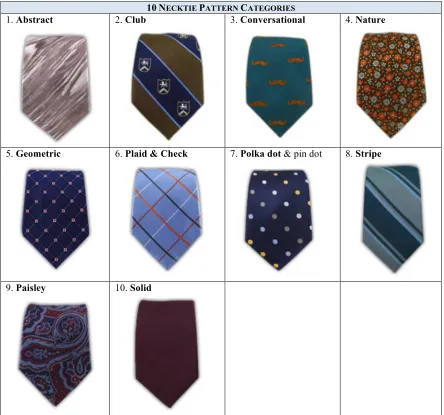
same tie (solid with an emblem). Generally speaking all necktie patterns and motifs can be organized
novelty), Nature (floral, ditsy, and fauna), Geometric (foulard), Plaid & Check, Polka dot & pin
dot, Stripe & regimental stripe, Paisley, and Solid. The following four texts- Know Your Fashion
Accessories by Celia Stall Meadows (2004), The Book of Ties by François Chaille (1994), Dress for
Success by John T. Molloy (1975), and Clive Edward’s, How to Read Pattern: A Crash course in
Textile Design (2009)- contributed to this list. See Figure 2.2, for a visual representation of the “Ten
Necktie Pattern Categories.” Table 2.1, “10 Necktie Pattern Categories,” visually explains how these
four authors’ pattern categories contributed to the above list.
Table 2.1 Design Chart (Edwards, 2009; Stall-Meadows, 2004; Molloy, 1975; Chaille, 1994) How to Read Pattern:
A Crash course in Textile Design by Clive Edwards
Know your Fashion Accessories by Celia Stall-Meadows
Dress for Success
by John T. Molloy
The Book of Ties by Francois Chaille
Abstract Abstract
Club- “a print of picture that represents an association, sport, or group”
Club tie
Conversational
Conversational-“interesting or whimsical print…reflects the interest or likes of the wearer”
Humorous motifs, gag ties, & artistic ties
Natural world, flora, & fauna
Floral Figurative motifs:
sporting and hunting, animals, & plants
Geometric Foulard- “small
geometric shapes, diamonds”
Geometric designs
Objects Novelty- “cartoon or
licensed produced”
Plaid Plaid/ plaid-type tie Plaids
Polka dot/ pin dot Polka dot tie Dots
Grids & stripes Stripe or repeating stripe Rep (repeating stipe) Tie Stripe
Solid Solid tie
Stylized Paisley Paisley Tie Paisley
10NECKTIE PATTERN CATEGORIES
1. Abstract 2. Club 3. Conversational 4. Nature
5. Geometric 6. Plaid & Check 7. Polka dot & pin dot 8. Stripe
9. Paisley 10. Solid
Figure 2.2 Ten Necktie Patterns (Images from TheTieBar.com, September 19, 2014). The numbering system is for clarity and not a marker of preference or ranking.
Celia Stall-Meadows (2004) and François Chaille’s (1994) books are specifically written to
encompass all neckwear patterns. Both authors use eleven pattern classifications, however
Stall-Meadows’ categories are much more complete, where there are gaps and overlaps in Chaille’s
categories. John T. Molloy gained much notoriety after publishing his fashion etiquette book for
lasting success than similar books of this kind. Molloy organizes tie pattern into eight classifications.
Due to the conservative nature of Molloy’s book, his list of classifications is incomplete. Unlike
Stall-Meadows and Chaille, Molloy does not acknowledge more whimsical pattern categories such as
novelty, conversational, and nature-based floral and fauna patterns. Lastly, Clive Edwards, the author
of How to Read Pattern: A Crash Course in Textile Design divides pattern types into ten broad
categories. While Edward’s text was not meant to be necktie specific, it a complete guide to all
textile patterns and holds many important crossovers with tie specific patterns (Edwards, 2009).
Table 2.1 is a comparison of the various pattern classifications.
Pattern types, especially novelties, have come and gone from popularity. During prohibition
“patterns relating to prohibition (machine guns, bottles, and padlocks) and nightclubs (soubrettes
dancing on tabletops)” were popular (Huun, 2008, p.43). Additionally, seasonal ties like Christmas
and St. Patrick’s Day as well as college-colored ties may never go completely out of fashion because
they are worn for a specific reason. Most seasonal ties belong in the conversational or novelty
category.
The lineage of most tie patterns is quite long and often unknown. Since stripe tie images are
the form most studied in the current research, the next paragraph provides more detail about the
striped ties’ origin and how and when it came to America.
The stripe tie has been worn by business executives and uniformed school children; but its
success as a tie pattern can be linked to the English military (Chaille, 1994). According to the Brooks
Brothers website, its company popularized “The Repp Tie” in America in 1902. “Brooks reverses the
direction of the stripes in rep ties (formerly left to right, or ‘from heart to sword’), divorcing form
from meaning and opening up the patterns to everyman” (BrooksBrothers.com; October 5th 2014). In
to the United States. On his trip he wore a “broad blue and red stripe” tie, which is the regimental tie
of the “Grenadier Guards” (Chaille, 1994, p.78).
Figure 2.3 is an example of the tie that the Prince of Wales
wore on his trip America in 1919. This tie was created by Lewin &
Sons, a London based company, is made of silk (Chaille, 1994).
Notice when looking at the tie how the stripe angles from right down
to the left, this is the British way and is referred to right-handed or
Z-shaped stripe. The reverse is the American stripe, which slopes from
left down to the right and is referred to as left-handed or S-shaped
stripe.
Figure 2.3 Stripe Tie worn by the Prince of Wales (Chaille, 1994, p.77)
2.2b| Color in Neckties
Color is often the first and most lasting impression that an observer might have of a tie. John
Molloy (1975), Ruth La Ferla (1986), and Ruth P. Rubinstein (2001), as well as many other
contemporary fashion stylists have debated the rules of color in neckwear. Alina Dizik recently
published an article titled “What the colour of your tie says about you” (2014) where she explained
the importance of picking the “right” color tie, for conveying a message to your audience. The “all
powerful reds,” the “royal purples,” and “Fifty Shades of Blue” are among the most universally
common colors for ties. Dizik found that blacks, greens, and neutral colored ties can be more
challenging to wear, saying that black can come across as “arrogant,” green as “loud,” and neutral’s
“can signal a dull personality” (Dizik, 2014, n.p.). Understanding the way people react to color is
The importance of how color and pattern influence people’s perceptions can be transferred
from the body and compared to the office design environment. The Fast Company article titled
“Inside The Offices of 12 Psychoanalysts”(2014), discussed the idea of using interior design to create
a perceived safe space: “if you’re a psychoanalyst, the presentation of your work space has to be
impeccably thought out, designed to foster a sense of sanctuary and privacy” (Dunne, 2014, n.p.).
Color, texture, and nonspecific imagery are all used by psychoanalysts to create spaces conducive to
their style of therapy. “Studies show that blue walls foster creativity; red walls inspire vigilance and
passion; and green creates a sense of calm” (Dunne, 2014, n.p.).
Section 2.4, explains some past semantic differential studies, one of the most influential
studies for this thesis was Taft’s use of SD in evaluating how a color’s meaning can be affected by the
object which is colored. Color’s importance in understanding preference is undeniable. Individual’s
preferences on both colors and patterns are often subject to changes in seasonal trends.
2.2c| Manufacturing of Neckties
The traditional blade-shaped tie is made from fabric that is
cut on the bias, meaning it is cut at a 45 degree angle to the salvage
(Beech, 1988). While this method offers interesting dimensionality
and offers a good drape, it is not the most efficient use of material,
because it often wastes fabric. The body of the tie is made from two
or three pieces of fabric not including the lining; the use of three
pieces is considered higher quality (Stall Meadows, 2004, p.243).
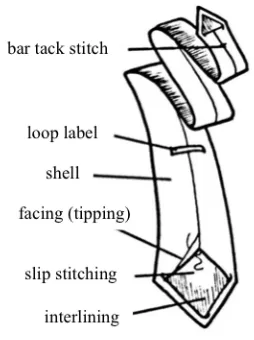
The body of the tie consists of the front blade, (apron) neck gusset,
and under blade (tail); plus the lining and facing (tipping) (Stall
Meadows, 2004, p.243).
The lining provides weight and stiffness, helping the constructed tie maintain its shape. The
tie fabric pattern pieces are assembled and sewn together by hand, using the slipstitch, which is a
nearly invisible loose stitch. “The tie can move along [the slipstitch] thread as it is wrapped, the
thread prevents the tie from ripping, and when the tie is removed, the thread brings it back into its
proper shape” (Tortora, 2003, p.147). Lastly, a bar tack stitch, back loop, and label are added. Figure
2.4 shows the underside of the tie.
Larry Marshall, the C.O.O of
Gitman Bros. Neckwear explained that
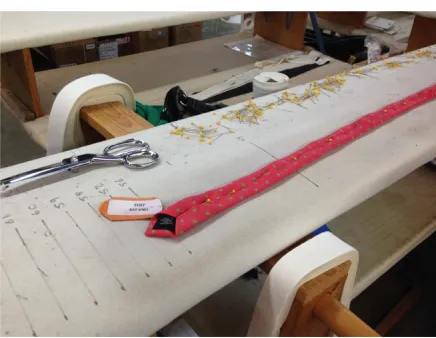
every tie in Gitmans’ facility is hand cut
on the bias from three separate pieces of
fabric. Western tie fabric traditional
comes in widths of 27 or 55 inches; while
fabric made in Asia often is 84” wide and
it is cut into more manageable widths
before manufacturing (L. Marshall,
personal communication, September 23,
Figure 2.5 Hand pinned tie from Gitman (photo by Gentry)
2014). It takes a little less than half a yard of 27” wide fabric to produce one tie (L. Marshall,
personal communication, September 23, 2014).
Marshall explained that there are two ways to cut and sew a tie—by hand and by machine.
Handmade ties are better quality, and normally the type of tie Gitman Bros. produces, but they have
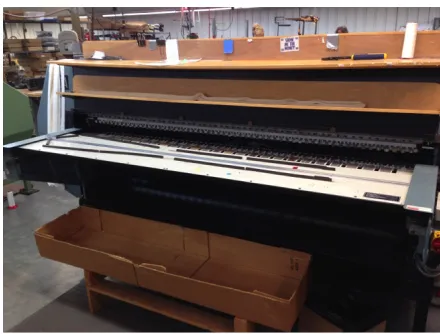
the equipment to produce machine made ties. The Gitman Bros. facility has several ‘Liba’ machines
that slipstitch the tie. According to Marshall, the ‘Liba,’ which is made is Germany, “is the industry
handmade ties are preferred by Gitman’s buyers, the average seamstress can make 70 ties a day,
while the ‘Liba’ averages 1000 ties a day. Figure 2.5 is a photo of a hand pinned tie from Gitman and
Figure 2.6 is a photo of a Liba machine at Gitman.
Figure 2.6 Liba machine at Gitman (photo by Gentry)
Common materials used for manufacturing ties include silk, polyester, wool, and cotton
woven or knitted fabric. Polyester and other synthetic fibers may be blended with a natural fiber to
create the desired weight and wrinkle and stain resistance. Alternative materials that are less
commonly used include rayon, nylon, acrylic, and suede. Yarns of almost any material type can be
woven into elaborate designs using jacquard or dobby weaves; woven and then digitally or
screen-printed; woven using anti-microbial fibers; coated with water and stain-repellent coatings; or knitted
(Stall-Meadows, 2004).
According to Kathleen Huun the first tubular knitted neckties were made in 1906. Initially
they were considered a feminine item of clothing (Huun, 2008). Knitted ties normally have a square
2.2d| Knots for Neckties
While many men are accustomed to tying their tie the same way each wearing, there are
actually quite a few distinguishable necktie knots, with the four-in-hand knot being the most
commonly tied knot (Stall Meadows, 2004, p.246). According to Celia Stall-Meadows the
four-in-hand knot is “believed to have [been] originated by coachmen driving a coach pulled by four horses”
(Celia Stall Meadows, 2004, p.246).
Figure 2.7 The Four-in-Hand Knot (Stall Meadows, 2008, p.246)
The other main necktie knots include the Windsor, the half Windsor, the cross knot, the
Prince Albert, the small knot, the ascot, and the bow tie (Stall Meadows, 2004, p.246). The Book of
Ties, 188 knots for necks: history, techniques and photographs by Davide Mosconi and Riccardo
Villarosa (1986), published by the Tie Rack™, illustrates and explains how to tie seventeen different
knots for neckties. Mosconi and Villarosa claim that the four-in-hand knot as it is called in England
and the régate knot as it is called in France “appeared suddenly about 1860, without any apparent
reason” (p.69). The four-in-hand and régate are the same knot and have led to “innumerable
variations” (Mosconi & Villarosa, 1986). Additionally pre-tied or clip on ties can be purchased by
According to stylists the necktie knot should complement the tie material and the wearer’s
shirt. For example the Windsor knot creates a wide triangular knot and should be worn with a
“wide-spread shirt collar”, while the four-in-hand creates a long and lean look in a “standard shirt collar”
(Molloy, 1975). The decision of which knot to use depends on both the type of material and the
wearer’s preference. Looser knots have the added benefit of not constricting their wearer.
2.3|COMMUNICATION,DRESS, AND IDENTITY
“A necktie speaks its own language. Its tone may be muted or shrill, direct or
oblique, but it always makes a point” (La Ferla, 1986, p.66).
This passage, from a June 1986 New York Times Magazine article titled “Tales That Ties Tell: The
choice of a necktie can reveal much about the nature of its wearer,” discusses the “language” and
symbolism of the necktie. Fashion writer Ruth La Ferla, like many other fashion forecasters,
historians, psychologists, and linguists, including Flügel (The Psychology of Clothes, 1950); Barthes
(The Language of fashion, 2006); and Carter (Stuff and Nonsense: The limits of the linguistic model of
clothing, 2012) has analyzed, criticized, and categorized the major points involved in the
communication and language of dress. In this article La Ferla writes about an idea, often repeated,
that the necktie is representative of its wearer’s character or personality. La Ferla believes that most
men pick ties illustrative of their character: “consciously or unwittingly classing themselves within
one of four broad categories: collegiate, corporate, cosmopolitan and iconoclastic” (La Ferla, 1986,
p.66). These four categories represent a tie style as well as corresponding personality characteristics
of its wearer—the “corporate man’s tie suggests power, authority and unflappable decorum,” often
through a “weighty pattern” like a “thick-and-thin stripe on a back ground of blue or claret colored
but these categories can be useful in establishing a frame work to understand the complexities of
using dress for communication.
2.3a| The Functions of Dress and Dress Ambivalence
Dress has been acknowledged for serving three main functions, “decoration, modesty, and
protection” (Flügel, 1950, p.16). These three functions are the most basic and have been used to
explain why, psychologically, people get dressed; but they do not help explain how people relate to
their clothes; their motivation behind choosing certain clothing choices, and why fashions change?
Additionally, it has been argued that communication should be added to this list of basic functions
(Carter, 2012). To better understand these clothing choices this study will examine how other
researchers have described the relationship between man and his attire.
J. C. Flügel was one of the first psychologists to study the relationship between people and
clothing. He first published his book, The Psychology of Clothes, in 1930 and subsequently
republished it in 1940 and 1950. Flügel wrote that “decoration, modesty, and protection” (1950,
p.16) are the three main functions of dress. He believed that the very basis of clothing psychology
stems from the opposition between people’s want for “decoration” and their need for “modesty.”
These two seemingly contradictory attitudes can be seen in all dressing choices. He describes these
contradictions as a person’s “ambivalent” feeling toward their clothes (Flügel, 1950, p.20). Flügel is
not the only researcher to describe the relationship people have with their clothes as being
ambivalent, more recently sociologist Fred Davis (1985, 1988, 1992) has written extensively about
ambivalence in dress. Davis explains that “identity ambivalence” and “identity polarities” are
embedded in the way western people “conceive themselves” (Davis, 1988, p.23). People’s mixed or
contrary feelings exist as the “subjective tensions of youth vs. age, masculinity vs. femininity,
worldliness” (Davis, 1985, p.25; Davis, 1988, p.25), and it is these “tensions” that dictate the way
people express themselves, whether it be through dress or other forms of self-expression.
“For ambivalence is ambivalence about something and that something is almost
invariably a social object: some artifact, thought, belief, image, practice, goal, etc.
invested with meaning; that is to say, something about which we can communicate
via gesture, expression, ornament, emblem, sign and, with what most distinguishes
humans from other animals, language” (Davis, 1988, p.25).
While fashion often draws inspiration from everyday ambivalences toward age, gender, and social
status (Davis, p.26), it is the relationship between “work vs. play” and “masculinity vs. femininity”
that may be the most important for neckwear. Kang, Sklar, and Johnson (2010), the authors of the
study "Men at Work: Using dress to communicate identities," found that young professional men who
felt incomplete in their “work identities” often purchased “items symbolic of their professions” (Kang
et al., 2010, p.412). Additionally, men who purchased professional items and attire, expected to
attain certain outcomes as a consequence of their work place dress. This paper explains how “work
vs. play” ambivalence may manifest itself in the purchasing of a “symbolic item” like a tie.
Davis provides ties as an example of one of the many garments that demonstrate the
ambivalence between masculinity and femininity. Masculinity and male status along with the theme
of men at work and work-place dressing are often brought up when discussing the language of dress.
Gender plays a very large role in the way people dress and often influences the way people are
perceived. Both women and men have used the themes of gender and work ambivalence to inform
their way of dressing. The tie is just one of the clothing accessories that women have borrowed from
men.
“Since the industrial revolution, at which point males came increasingly to fall under
masculine vs. feminine ambivalence in clothing to reveal itself almost exclusively on
the side as women have opted periodically… to incorporate into their personae
insignia of male status and masculinity” (Davis, 1988, p.27).
Additionally, Davis believes that “the restricted character of men’s dress code” stems from
the strong focus given to “work, career, and occupational success for male identity” (Davis, 1988,
p.31). This strong work focus has been reflected in men’s dress, to the point where other sides of their
personality have not been represented in their dress (Davis, 1988). Furthermore, Davis continues to
stress that middle class male’s dress code is focused on “occupational success and the money and
prestige” that comes from a strong work ethic (Davis, 1988, p.32). For a man, the link between work
place success and dress provides greater importance than other role or identity he might take on
(Davis, 1988).
2.3b| Uniforms and Work Place Dress
Like Davis, other researchers have drawn significance from the relationship between dress
and work. Claudia Brush Kidwell and Valerie Steele, co-authors of Men and Women: Dressing the
Part (1989) and Ruth P. Rubinstein author of Dress Codes: Meanings and Messages in American
Culture (2001) along with others, have stated how work place dressing is often times similar to a
uniform. Arguing that the suit and tie is the “nonuniform uniform in the corporate world”
(Rubinstein, 1995, p.86). The suit and tie can provide a look of authority or an image of
professionalism.
“The male suit in its form-following style denied the body; in its somber color it
repudiated public expression on feeling. It indicated that, so attired the individual
will suppress personal desires and sentiments and conduct himself or herself in the
Uniforms allow for the wearer to disassociate from themselves and their personal preferences,
instead taking on the traits of the group that the uniform represents. While the traits that the uniform
represents depend on the type of uniform- police, nurse, and nun- often times they are viewed as
symbols of authority. Of course, the specific context and the history of a profession will also
influence a uniform’s meaning (Kidwell & Steele, 1989, p.64). Additionally, Anne Hollander author
of Sex and Suits (1994) writes that wearing a uniform can help people feel “safely similar” to their
peers. “Once in uniform, they can choose their personal details, feel unique, and then sneer at the
members of other tribes who all seem ridiculously alike in their tribal gear.” (Hollander, 1994, p.185)
“Sex segregation-stereotyping” which can surround a specific work-place’s culture, often
influences the meaning of an outfit or uniform.
“The masculine stereotype was strong, intelligent, authoritative. Whether a
brain-worker, a muscle brain-worker, or a fighter, his clothing still owed something to that
quintessential masculine dress—the military uniform—at least indirectly, as with the
business ‘uniform’” (Kidwell & Steele, 1989, p.91).
Masculine stereotypes projected on to the work-place uniform, can affect our perception of
the necktie; leading to concepts like “the power tie”. Kidwell & Steele give “the power tie”, in
conjunction with the power suit, as a non-verbal sign. Stressing that the power look should be given
as much consideration as all other items representative of a business (Kidwell & Steele, 1989, p.89).
The Journal of Fashion Marketing Management published “The influences of clothing on first
impressions” (2013), an online study comparing perceptions related to bespoke versus off-the-rack
suits. Participants of the study (n= 274) rated faceless images on “five dimensions (confidence,
success, trustworthiness, salary, and flexibility).” The study found that the images of men wearing
bespoke suits were “rated more positively on all attributes apart from trustworthiness” (Howlett, Pine,
questions about how to use pattern, color, texture, to create a silhouette that enhances the wearer’s
perceived attributes and increase others’ perceptions of the wearer.
2.3c| Dress and Identity
It is the “relationships among the interlinked systems of technology (involved in
creating dress) and systems of aesthetic and moral beliefs, which limit how identities
can be expressed, are both intricate and subject to alterations as change in one of the
systems is likely to stimulate change in the others” (Roach-Higgins & Eicher, 1992,
p.6-7).
In 1992, Mary Ellen Roach-Higgins and Joanne B. Eicher published their article “Dress and
Identity” in the Clothing and Textile Research Journal. Their research, which is thought of as one of
the leading perspectives, considered the connections among dress, identity, and communication,
defining two important concepts. First, they define “dress” as a comprehensive term that
encompasses the body, appearance, costume, and general attire without providing any value
judgments. “Dress of an individual is an assemblage of modifications of the body and/ or supplements
to the body” (Roach-Higgins & Eicher, p.1). A person’s self-identity is often based on external
assignments or achievements, most influential being “those that organize kinship, economic,
religious, and political activities” (Roach-Higgins & Eicher, 1992, p.1). Additional influences
include “technology and society-wide moral and aesthetic standards for dress” (Roach-Higgins &
Eicher, 1992, p.1). Of course these influences may change over time, affecting the types and
characteristics of dress that help us communicate identity. Secondly, Roach-Higgins & Eicher also
explain “body modifications” and “body supplements” in respect to how these devices can serve as
social class, school affiliations, or religion.” “Ultimately the meanings communicated… depend on
each person’s subjective interpretations of them” (Roach-Higgins & Eicher, 1992, p.4).
2.3d| Are Ties Current or Out of Date?
J.C. Flügel, in his research on “Types of Dress,” discusses why and how clothing has changed
and developed. He asserts that there are two classifications of clothing; the “fixed” outfit that
changes very little over time, its value being in its longevity and the “modish” or fashionable dress,
the popularity of which changes quickly. For the most part, Western clothing falls in the “modish”
category. Flügel’s work highlights some of the conflicting ideas about the meaning of a necktie.
While Flügel believes that most Western clothes are “modish,” he asserts that uniforms are
considered a “fixed” costume. According to Flügel there are three types of uniforms: military,
occupational, and associational. The last being the most important, because “associational costumes
are those which distinguish special societies formed for private ends within the large social groups”
(Flügel, 1950, p.132). Club, school, and sports ties that have insignias or are made with a specific
group’s colors fall into this category of “fixed” attire. Those who wear these types of ties feel great
attachment to the history and traditions that surround their group and their attire. They may feel like
wearing the tie as a privilege and feel uncomfortable and infringed upon when someone not in the
group wears the tie (Flügel, 1950, p.133).
Unfortunately, psychologically, “fixed” attire is in complete opposition to “modish” attire,
which values “newness” and discards all attire at the first sign of it being outdated. One should
understand these two perspectives on attire and neckties when trying to understand the language of
ties. Different group associations and past situations will provide the wearer’s reasons behind
view neckties as out of date or strongly connected with tradition, others wear them because they are a
part of current trends.
2.3e| Linguistics of Dress
Previously the paper discussed the motivations behind why people wear clothes: protection,
modesty, and ornamentation. Roland Barthes (2006) a French linguist, looked at finding the
linguistic and semiotic nature of dress.
“Language, like dress, is both a system and a history, an individual act and a
collective institution. Language and dress are at any moment in history, complete
structures, constituted organically by a functional network of nouns and forms”
(Barthes, 2006, p.8).
Barthes’ work centers on the belief that dress is a “vestimentary system” where meaning and value
comes from all of the individual pieces and how they relate to the whole outfit (Barthes, 2006, p.7). It
was Barthes’s belief that dress and clothing can be converted into a language. Taking more of a
historical or sociological perspective, he looked at dress as an institution; “the historian and the
sociologist are not charged with simply studying tastes, fashions or comfort; they must list, coordinate
and explain the rules of matching and usage, of what is constrained or prohibited, tolerated or
allowed” (Barthes, 2006, p.7).
Barthes asserts that in order to study clothing one needs to look at not only the individuals,
but also a society as “a history, an economy, an ethnology, a technology, and maybe even…
linguistics” (Barthes, 2006, p.21). Often, people look at attire based on the role of the wearer --
father, banker, and lawyer. The problem with studying dress as a “compilation” of a role is that
designers are often most interested in “picturesque” not the principles behind the dress system
Barthes’ language of dress is important for understanding societal feelings toward attire and
creating a dialogue to describe the dress of a historical period. Additionally understanding the
cultural and social nature of attire can help give meaning to a garment as a whole. A tie is an article
of clothing, but only with a shirt, suit, and shoes does it become an outfit. Meaning can be found in
the tiny details of the tie or in the overall attire (Barthes, 2006). It is Barthes belief that “we are
forced to look for clothing’s unit of meaning not in whole, isolate items, but in true functions,
oppositions, distinctions, and congruencies” (Barthes, 2006, p.28).
---
Michael Carter, one of the translators of Barthes’ book, discusses the merits of a linguistic
model of dress in his paper Stuff and Nonsense: the Limits of the Linguistic Model of Clothing (2012).
While he agrees with Barthes on some points, Carter believes that “clothing is not created within
communication but is rather incorporated into system of meaning after its material appearance.”
(Carter, 2012, p. 348) Dress is not always as structured as language; cultural ideals, preconceived
beliefs, and preference must all be taken into account. Also by describing dress as language and
giving it a “linguistic model,” one is saying that the rules of the language are clear and understandable
to at least some group of the population. While dress can and does communicate the wearer’s values
and associations, this communication is often done on a subliminal or unconscious level, the “rules”
of the language of dress are not as clear as other languages (Carter, 2012). Instead of the language of
the tie, it may be more applicable to say that dress serves as a nonverbal communicator. It is only
through being worn that a tie takes on any semantic value.
“The fundamental semantic unit, the garment, or dress part, undergoes a profound
change as it shifts from being a material object with a distinctive set of physical
The writing of Barthes and Carter about the differences between an object’s semiotic
(symbolism) and semantic (meaning) value are important for this study. Carter claims that the
semiotic importance behind the tie comes from its relationship to the suit and shirt; while the
semantic value of the tie lies in the way it is perceived (Carter, 2012, p.347). It is easy to talk about
dress and attire and their cultural meaning, but the tie’s true meaning comes from the way it is “read”
and seen (Carter, 2012).
Clearly pattern and color play a large role in supporting this dialogue. So what meaning can
be found in a man’s choice of pattern? If the shape of the tie, its width and length, are a study into the
semiotics of the tie; then the design, pattern, color, and scale are a study into the semantics of design.
Hollander (1994) describes how dress can have meaning in this ending quote:
“What the immediate meaning usually comes from is available imagery, past or
present, the suggestive pictures that have pervaded public consciousness and are
loaded with shared associations. But wideness and narrowness, which have derived
both from common imagery and from unconscious desire to modify earlier kinds of
wide or narrow form, are often wrongly lent such intrinsic meaning” (Hollander,
1994, p.26).
2.4|SEMANTIC DIFFERENTIAL
The semantic differential instrument was first developed as a tool for helping social scientists
understanding “the way people organize and use semantic space” (Punch, 2005, p.100). As part of a
survey questionnaire participants are asked to rate “concepts” on a “scale” of bi-polar adjective pairs,
providing researchers with a clearer idea of survey participant’s perceptions, tastes, and reactions.
Most adjective pairs fall into one of three primary “dimensions” of thought expression—evaluative,
H. Tannenbaum (1957); Kerlinger’s book the Foundations of behavioral research (1964); and
Semantic differential technique; a sourcebook by Snider and Osgood (1969) are the most complete
guides to understanding semantic differential (Punch, 2005). Since its creation, the SD tool has been
adapted for many questionnaire-based experiments, where the researchers want to gain knowledge
about their participant’s likes and perceptions. This section will cover several aspects of Osgood,
Suci, & Tannenbaum’s book as well as some more recent aesthetic and textile studies that have used
the SD tool.
2.4a| The Origins of Semantic Differential
The language and meaning of dress can be hard to articulate. Meaning most often connotes
“something inherently nonmaterial, more akin to ‘idea’ and ‘soul’ than observable stimulus and
response” (Osgood et al., 1957, p.1). It is “uniquely and infinitely variable,” and is dependent on
every situation; in fact “the most important factor in social activity is meaning and change in
meaning” (Osgood et al., 1957, p.1). In Osgood, Suci, & Tannenbaum’s book the authors discuss at
length the “meaning of meaning” looking at both a linguistic and a psychosocial perspective.
Believing that an object’s “meaning” comes from its relationships with other objects or the
association that people have with the object. And while people often view things differently, it is the
thought “there must be some common core meanings in all concepts” (Kerlinger, 1964, p.564) that
drives researchers to use SD.
In the Meaning of Meaning, Osgood, Suci, & Tannenbaum describe semantic space in
different “dimensions,” the main three descriptive dimensions or “factors” being evaluative
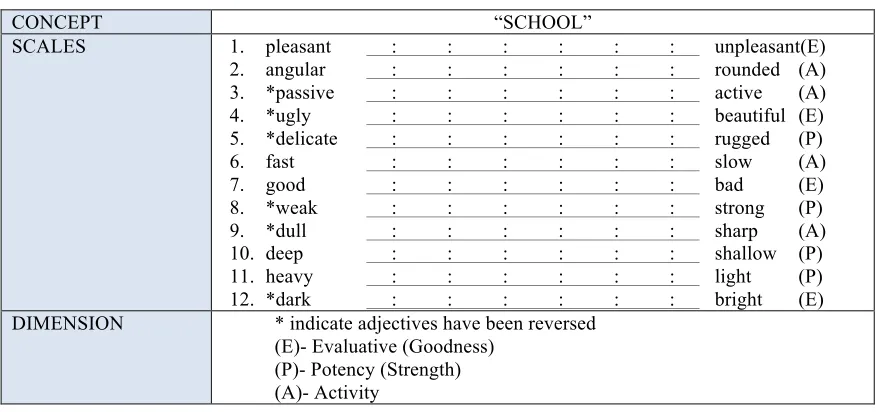
(goodness), potency (strength), and activity (1957). Each semantic scale, also referred to as bipolar
adjective pair, is representative of at least one dimension; good-bad and beautiful-ugly for example
loading” refers to the rotated factor analysis, variance, d-method of factoring and other
inter-correlation tests that Osgood, Suci, & Tannenbaum performed on over 75 different bipolar adjective
pairs (1957; p. 31-75). By using these tests, each adjective pair’s dimension can be determined. Table
2.2 provides an example of what a semantic definitional question could look like; the concept and
scales have been labeled along with each scales dimension.
Table 2.2 Example of SD Question; Concept, Scales, and Dimensions are from Kerlinger's book (1964, p. 571) based off of Osgood, Suci, & Tannenbaum's research (1957)
CONCEPT “SCHOOL”
SCALES 1. pleasant : : : : : : unpleasant(E)
2. angular : : : : : : rounded (A)
3. *passive : : : : : : active (A)
4. *ugly : : : : : : beautiful (E)
5. *delicate : : : : : : rugged (P)
6. fast : : : : : : slow (A)
7. good : : : : : : bad (E)
8. *weak : : : : : : strong (P)
9. *dull : : : : : : sharp (A)
10. deep : : : : : : shallow (P)
11. heavy : : : : : : light (P)
12. *dark : : : : : : bright (E)
DIMENSION * indicate adjectives have been reversed
(E)- Evaluative (Goodness) (P)- Potency (Strength) (A)- Activity
Since all parts of the SD can be changed or manipulated, it is the relationships between
concepts, scales, and subjects that can be measured. SD is a very versatile “instrument for measuring
the meaning variables in human behavior” (Osgood et al., 1957, p.76). Kerlinger describes how to
use SD to find semantic space, writing:
“If two concepts are close together in semantic space, they are alike in meaning for the