Evaluating vector space models using human semantic priming results
Allyson Ettinger Department of Linguistics
University of Maryland
Tal Linzen
LSCP & IJN, ´Ecole Normale Sup´erieure PSL Research University
Abstract
Vector space models of word representa-tion are often evaluated using human sim-ilarity ratings. Those ratings are elicited in explicit tasks and have well-known sub-jective biases. As an alternative, we pro-pose evaluating vector spaces using im-plicit cognitive measures. We focus in particular on semantic priming, exploring the strengths and limitations of existing datasets, and propose ways in which those datasets can be improved.
1 Introduction
Vector space models of meaning (VSMs) repre-sent the words of a vocabulary as points in a multi-dimensional space. These models are often evalu-ated by assessing the extent to which relations tween pairs of word vectors mirror relations be-tween the words that correspond to those vec-tors. This evaluation method requires us to select a word relation metric that can serve as ground truth, and it requires us to identify the particular types of relations that we would like our models to repre-sent accurately.
Typical approaches to VSM evaluation use hu-man annotations as ground truth: in particular, similarity ratings for pairs of words. Some eval-uation datasets focus on similarity per se: hot
-scalding would rate highly, while antonyms like
hot-cold and associates like hot-stove would not (Hill et al., 2015). Others do not distinguish sim-ilarity from other types of relations: synonyms, antonyms and associates can all receive high rat-ings (Bruni et al., 2014).
While the distinction between similarity and re-latedness is important, it represents only a prelim-inary step toward a more precise understanding of what we mean—and what we should mean—when
we talk about relations between words. The no-tions of “similarity” and “relatedness” are fairly vaguely defined, and as a result human raters asked to quantify these relations must carry out some interpretations of their own with respect to the task, in order to settle upon a judgment schema and apply that schema to rate word pairs. The fact that the definition of the relation structure is left to the annotator’s judgment introduces inter-annotator variability as well as potentially unde-sirable properties of human similarity judgments: for example, the fact that they are not symmetric (Tversky, 1977).
The subjectivity of this task, and the involve-ment of the conscious reasoning process needed to arrive at a rating (Batchkarov et al., 2016), raise the question: to what extent does the rela-tion structure that emerges from such rating tasks reliably reflect the relation structure that under-lies human language understanding? After all, humans process language effortlessly, and natural language comprehension does not require reason-ing about how similar or related words are.
This does not mean that the brain does not perform computations reflecting relations between words—evidence suggests that such computa-tions occur constantly in language processing, but that these computations occur on a subconscious level (Kutas and Federmeier, 2011). Fortunately, there are psycholinguistic paradigms that allow us to tap into this level of processing. If we can make use of these subconscious cognitive measures of relatedness, we may be able to continue taking ad-vantage of humans as the source of ground truth on word relations—while avoiding the subjectiv-ity and bias introduced by conscious rating tasks.
We propose to evaluate VSMs using seman-tic priming, a cognitive phenomenon understood to reflect word-level relation structure in the hu-man brain. We show some preliminary results
exploring the ability of various VSMs to predict this measure, and discuss the potential for finer-grained differentiation between specific types of word relations. Finally, we argue that existing datasets (both explicit similarity judgments and semantic priming) are too small to meaningfully compare VSMs, and propose creating a larger se-mantic priming resource tailored to the needs of VSM evaluation.
2 Semantic priming
Semantic priming refers to the phenomenon in which, when performing a language task such as deciding whether a string is a word or a nonword (lexical decision), or pronouncing a word aloud (naming), humans show speeded performance if the word to which they are responding is pre-ceded by a semantically related word (Meyer and Schvaneveldt, 1971; McNamara, 2005). For in-stance, response times are quicker to a word like
dog (referred to as the “target” word) when it is preceded by a word like cat (referred to as the “prime”), than when it is preceded by a prime like
table. This facilitation of the response todog is taken to be an indication of the relation between
dog andcat, and the magnitude of the speed-up can be interpreted as reflecting the strength of the relation.
Since priming results provide us with a human-generated quantification of relations between word pairs, without requiring participants to make con-scious decisions about relatedness—the task that participants are performing is unrelated to the question of relatedness—this measure is a strong candidate for tapping into subconscious properties of word relations in the human brain.
Several studies have already shown correspon-dence between priming magnitude and VSM mea-sures of relation such as cosine similarity or neigh-bor rank (Mandera et al., 2016; Lapesa and Evert, 2013; Jones et al., 2006; Pad´o and Lapata, 2007; Herda˘gdelen et al., 2009; McDonald and Brew, 2004). These positive results suggest that some of the implicit relation structure in the human brain is already reflected in current vector space mod-els, and that it is in fact feasible to evaluate rela-tion structure of VSMs by testing their ability to predict this implicit human measure.
However, to our knowledge, there has not yet been an effort to identify or tailor a priming dataset such that it is ideally suited to evaluation of VSMs.
Semantic priming experiments make use of many different methodologies, and test many different types of relations between words. In selecting or constructing a priming dataset, we want to be informed about the methodologies that are best-suited to generating data for purposes of VSM evaluation, and we want in addition to have con-trol over—or at least annotation of—the types of relations between the word pairs being tested.
3 Experimental setup
3.1 Cognitive measurements
Most previous work has modeled small prim-ing datasets. By contrast, we follow Mandera et al. (2016) in taking advantage of the online database of the Semantic Priming Project (SPP), which compiles priming data from 768 subjects for over 6000 word pairs (Hutchison et al., 2013). This dataset’s size alone is advantageous, as it po-tentially allows us to draw more confident conclu-sions about differences between models (as dis-cussed below), and it ensures broader coverage in the vocabulary.
The SPP has two additional advantages that are relevant for our purposes. First, it contains data for four methodological variations on the seman-tic priming paradigm: all combinations of two tasks, lexical decision and naming, and two stim-ulus onset asynchronies (SOA), 200 ms and 1200 ms, which represent the amount of time between the start of the prime word and the start of the tar-get word. We assess the usefulness of each of the methods for evaluating VSMs, in order to iden-tify the methodological choices that generate opti-mal data for evaluation. A second advantage of the SPP is that it contains annotations of the relation types of the word pairs; this property can allow for finer-grained analyses that focus on relations of particular interest, as we will discuss in greater detail below.
3.2 Vector-space models
gen-erated by adding uniform random noiseU(-2,2) to the vectors of the SG5 model, as an example of a model that we would expect to perform poorly.
3.3 Evaluation
We evaluated the VSMs by fitting linear regression models to the human response times, with cosine similarity between prime and target as the predic-tor of interest.1 As a simple baseline model, we
entered only word frequency as a predictor. Word frequency is widely recognized as a strong predic-tor of reaction time in language tasks (Rubenstein et al., 1970). While it is only one among the fac-tors known to affect the speed of word recognition (Balota et al., 2004), it is by far the most impor-tant, and unlike factors such as word length, it is represented in many vector space models (Schn-abel et al., 2015), making it all the more important to control for here.
4 Results
4.1 Cognitive measures
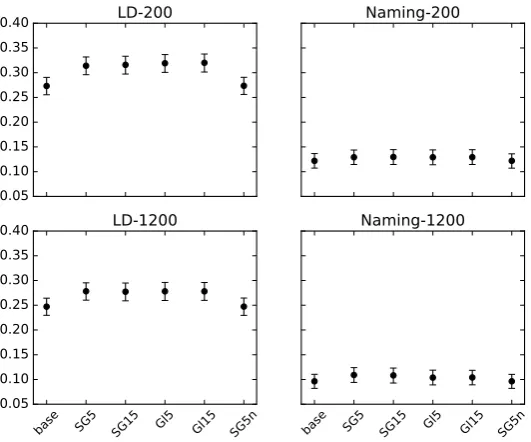
We first compare the four methodological varia-tions on the semantic priming paradigm. Figure 1 shows ther2values, which quantify the proportion of the variance explained by the regression model. Recall that the baseline regression model (“base”) contains only frequency as a predictor of response time, while the other regression models contain as predictors both frequency and cosine similarity between prime and target, as determined by each of the respective VSMs.
The greatest amount of variance is accounted for in the lexical decision task, with somewhat more variance accounted for with the 200 ms SOA. There is a more substantial margin of im-provement over the frequency baseline in the 200 ms SOA, suggesting that the results of the LDT-200 ms paradigm constitute the most promising metric for assessing the extent to which VSMs re-flect cognitive relation structure.
The four normally-trained VSMs (SG5, SG15, Gl5, Gl15) perform quite similarly to one an-other on this metric. Within those conditions in which we do see improvement over the frequency baseline—that is, primarily the lexical decision task conditions—the introduction of noise (SG5n)
1Lapesa and Evert’s (2013) result suggests that rank of the target among the vector space neighbors of the prime may model priming results more closely; we intend to experiment with this measure in future work.
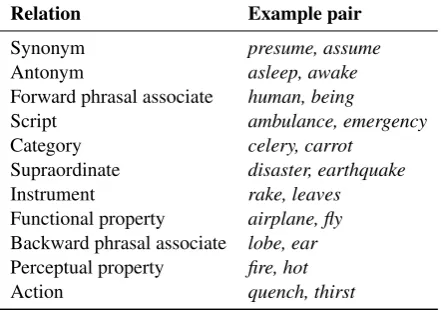
Relation Example pair
Synonym presume, assume
Antonym asleep, awake
Forward phrasal associate human, being
Script ambulance, emergency
Category celery, carrot
Supraordinate disaster, earthquake
Instrument rake, leaves
Functional property airplane, fly
Backward phrasal associate lobe, ear
Perceptual property fire, hot
[image:3.595.310.531.65.220.2]Action quench, thirst
Table 1: Annotated relations in SPP
nullifies that improvement. This suggests that the additional variance accounted for by the four nor-mal VSMs is indeed a reflection of their quality.
4.2 Relation types
Each word pair in the Semantic Priming Project is additionally annotated for the category of the rela-tion between the words in the pair (see Table 1 for examples). Having access to information about the particular relations embodied by a given word pair can be quite important for maximizing the util-ity of our evaluation metrics, as we are likely to care about different relations depending upon the downstream task to which we intend to apply our vector representations. For instance, we may care more about faithfulness to script relations when performing document-level tasks, but care more about performance on synonym and antonym re-lations for word- and sentence-level tasks such as sentiment analysis and entailment.
0.05 0.10 0.15 0.20 0.25 0.30 0.35
0.40
LD-200
Naming-200
base SG5 SG15 Gl5 Gl15 SG5n
0.05 0.10 0.15 0.20 0.25 0.30 0.35
0.40
LD-1200
base SG5 SG15 Gl5 Gl15 SG5n
[image:4.595.163.429.75.296.2]Naming-1200
Figure 1: r2 values for linear models fit to priming results in full SPP dataset, under different priming conditions. Baseline model (“base”) contains only frequency as a predictor, while other models contain cosine values from the indicated VSMs. Error bars represent bootstrapped 95% confidence intervals.
baseSG5SG15Gl5 Gl15SG5n
0.05 0.10 0.15 0.20 0.25 0.30 0.35 0.40
0.45 fpa,381
baseSG5SG15Gl5 Gl15SG5n antonym,244
[image:4.595.85.295.383.540.2]baseSG5SG15Gl5 Gl15SG5n script,183
Figure 2:r2values for linear models fit to priming results in specific relation categories. Number of items in category is indicated in subplot title.
4.3 Similarity datasets
Finally, for the sake of comparison with con-ventional metrics, we include Figure 3, which shows the same baseline and vector space regres-sion models, assessed as predictors of the rat-ings in the MEN (Bruni et al., 2014) and Sim-Lex (Hill et al., 2015) datasets. Frequency appears to be a poorer predictor of explicit similarity rat-ings than of the implicit cognitive measures. Al-though there is some variation in performance
be-tween the four normally-trained VSMs, it is less straightforward to distinguish between them once we take confidence intervals into account; this is-sue of overlapping confidence intervals is much more pronounced with smaller datasets such as RG-65 (Rubenstein and Goodenough, 1965) and MC-30 (Miller and Charles, 1991).
base SG5 SG15 Gl5 Gl15 SG5n
0.1 0.0 0.1 0.2 0.3 0.4 0.5
0.6 MEN
base SG5 SG15 Gl5 Gl15 SG5n SimLex
[image:4.595.307.514.517.677.2]5 Discussion
We have presented here a proposal to leverage implicit measures of relation structure in the hu-man brain to evaluate VSMs. Such measures can sidestep the subjectivity introduced by standard similarity rating tasks, and tap more directly into the relation structure fundamental to language pro-cessing by humans.
In our exploratory results above we find, con-sistent with previous studies, that VSMs can pre-dict priming beyond the variance explained by fre-quency alone, at least in certain cognitive mea-surements (in particular, lexical decision with a short SOA), suggesting that priming magnitude could be used as a VSM evaluation metric. We have also reported preliminary results taking ad-vantage of the relation-specific annotation in the SPP. Relation-specific evaluation sets could prove valuable for finer-grained understanding of the re-lations captured in a given VSM. We see, however, that if we are to make statistically valid conclu-sions about differences between models, we must extend our dataset substantially. This could be ac-complished by the same basic procedures used to build the SPP, extended to a massive scale using an online platform such as Mechanical Turk.
Finally, it may be useful to experiment with other implicit cognitive measures known to reflect relation structure. A prominent example is the N400, a neural response elicited by every word during sentence comprehension (Kutas and Fed-ermeier, 2011). The amplitude of the N400 re-sponse is modulated by the relation of the word to its context: the worse the fit to context, the larger the N400 amplitude. As a result, the N400 is often used to study the effects of context on word processing. There is existing evidence that vector space model representations of preceding context and target words can predict N400 ampli-tude (Parviz et al., 2011; Ettinger et al., 2016). In future work, the N400 may therefore prove use-ful for assessing VSM relation structure above the word level.
Acknowledgments
This work was supported in part by an NSF Gradu-ate Research Fellowship to Allyson Ettinger under Grant No. DGE 1322106. Any opinions, findings, and conclusions or recommendations expressed are those of the authors and do not necessarily re-flect the views of the NSF. Tal Linzen’s research
was supported by the European Research Coun-cil (grant ERC-2011-AdG 295810 BOOTPHON) and the Agence Nationale pour la Recherche (grants 10-IDEX-0001-02 PSL and ANR-10-LABX-0087 IEC). This work benefited from the helpful comments of two anonymous review-ers, and from discussions with Philip Resnik, Colin Phillips, and other members of the Univer-sity of Maryland language science community.
References
David A. Balota, Miachael J. Cortese, Susan D. Sergent-Marshall, Daniel H. Spieler, and Melvin J. Yap. 2004. Visual word recognition of single-syllable words. Journal of Experimental Psychol-ogy: General, 133(2):283.
Miroslav Batchkarov, Thomas Kober, Jeremy Reffin, Julie Weeds, and David Weir. 2016. A critique of word similarity as a method for evaluating distribu-tional semantic models. InProceedings of the First Workshop on Evaluating Vector Space Representa-tions for NLP.
Elia Bruni, Nam-Khanh Tran, and Marco Baroni. 2014. Multimodal distributional semantics. Journal of Artificial Intelligence Research, 49:1–47. Allyson Ettinger, Naomi H. Feldman, Philip Resnik,
and Colin Phillips. 2016. Modeling N400 ampli-tude using vector space models of word representa-tion. In Proceedings of the Annual Meeting of the Cognitive Science Society.
Amac¸ Herda˘gdelen, Katrin Erk, and Marco Baroni. 2009. Measuring semantic relatedness with vector space models and random walks. In Proceedings of the 2009 Workshop on Graph-based Methods for Natural Language Processing, pages 50–53. Felix Hill, Roi Reichart, and Anna Korhonen. 2015.
Simlex-999: Evaluating semantic models with (gen-uine) similarity estimation. Computational Linguis-tics.
Keith A Hutchison, David A Balota, James H Neely, Michael J Cortese, Emily R Cohen-Shikora, Chi-Shing Tse, Melvin J Yap, Jesse J Bengson, Dale Niemeyer, and Erin Buchanan. 2013. The seman-tic priming project. Behavior research methods, 45(4):1099–1114.
Michael N Jones, Walter Kintsch, and Douglas JK Me-whort. 2006. High-dimensional semantic space ac-counts of priming. Journal of Memory and Lan-guage, 55(4):534–552.
Gabriella Lapesa and Stefan Evert. 2013. Evaluat-ing neighbor rank and distance measures as predic-tors of semantic priming. In Proceedings of the ACL Workshop on Cognitive Modeling and Compu-tational Linguistics (CMCL 2013), pages 66–74. Paweł Mandera, Emmanuel Keuleers, and Marc
Brys-baert. 2016. Explaining human performance in psy-cholinguistic tasks with models of semantic similar-ity based on prediction and counting: A review and empirical validation. Journal of Memory and Lan-guage.
Scott McDonald and Chris Brew. 2004. A distribu-tional model of semantic context effects in lexical processing. In Proceedings of the Annual Meet-ing of the Association for Computational LMeet-inguis- Linguis-tics, page 17.
Timothy P McNamara. 2005. Semantic priming: Per-spectives from memory and word recognition. Psy-chology Press.
D.E. Meyer and R.W. Schvaneveldt. 1971. Facilita-tion in recognizing pairs of words: evidence of a de-pendence between retrieval operations. Journal of experimental psychology, 90(2):227.
Tomas Mikolov, Kai Chen, Greg Corrado, and Jef-frey Dean. 2013. Efficient estimation of word representations in vector space. arXiv preprint arXiv:1301.3781.
George A Miller and Walter G Charles. 1991. Contex-tual correlates of semantic similarity. Language and Cognitive Processes, 6(1):1–28.
Sebastian Pad´o and Mirella Lapata. 2007. Dependency-based construction of semantic space models. Computational Linguistics, 33(2):161–199. Mehdi Parviz, Mark Johnson, Blake Johnson, and Jon Brock. 2011. Using language models and latent semantic analysis to characterise the n400m neu-ral response. In Proceedings of the Australasian Language Technology Association Workshop 2011, pages 38–46.
Jeffrey Pennington, Richard Socher, and Christo-pher D. Manning. 2014. Glove: Global vectors for word representation. InEmpirical Methods in Nat-ural Language Processing (EMNLP), pages 1532– 1543.
Herbert Rubenstein and John B Goodenough. 1965. Contextual correlates of synonymy. Communica-tions of the ACM, 8(10):627–633.
Herbert Rubenstein, Lonnie Garfield, and Jane A Mil-likan. 1970. Homographic entries in the internal lexicon. Journal of verbal learning and verbal be-havior, 9(5):487–494.
Tobias Schnabel, Igor Labutov, David Mimno, and Thorsten Joachims. 2015. Evaluation methods for unsupervised word embeddings. InProceedings of
the Conference on Empirical Methods in Natural Language Processing.