Stochastic Gradient
Optimization of Importance
Sampling for the Efficient
Simulation of Digital
Communications Systems
w.
A.
Al-Qaq
M. Devetsikiotis
J.
K. Townsend
Center for Communications and Signal Processing
Department of Electrical and Computer Engineering
-North Carolina State University
Submitted to the IEEE Transactions on Communications
Stochastic Gradient Optimization of Importance Sampling for the
Efficient Simulation of Digital Communication Systems
1Wael A. AI-Q a q2 Michael Devetsikiotis
J. Keith Townsend
Center for Communications and Signal Processing, Department of Electrical & Computer Engineering, North Carolina State University, Raleigh, NC 27695-7914
Tel: (919)515-5200 Fax: (919)515-5523
Abstract
Importance sampling (IS) techniques offer the potential for large speed-up factors for bit error rate (BER) estimation using Monte Carlo (MC) simulation. To obtain these speed-up factors, the IS parameters specifying the simulation probability density function (pdf) must be carefully chosen. With the increased complexity in communication systems, analytical optimization of IS parameters can be virtually impossible.
In this paper, we present a new IS optimization algorithm based on stochastic gradient techniques. The formulation of the stochastic gradient descent (SGD) algorithm presented in this paper is quite general and system-independent, and its applicability is not restricted to a specific pdf or biasing scheme. The generality and effectiveness of the SGD algorithm are demonstrated by two examples of communication systems where IS techniques have not been applied before. The first example is a communication system with diversity combining, slow nonselective Rayleigh fading channel and non coherent envelope detection. The second example is a binary baseband communication system with a static linear channel and a recursive least square (RLS) linear equalizer in the presence of additive white Gaussian noise (AWGN).
IPortions of this work were presented at GLOBECOM '93.
Stochastic Gradient Optimization ... , Al-Qaq, Devetsikiotis, and Townsend
1
Introduction
1
Importance sampling (IS) techniques can substantially accelerate bit error rate (BER) es-timation using Monte Carlo (MC) simulation, provided that the proper IS biasing scheme and parameter values are used. Analytical optimization techniques [1, 2] typically require a closed form expression for the IS estimator variance. Optimization of IS parameters us-ing techniques based on large deviations theory (LDT) are applicable to a larger class of problems, including systems with additive Gaussian noise and a "moderate nonlinearity"
[3, 4, 5].
Efficient simulation methods of communication links characterized by slow, time varYIng channels and linear least mean square adaptive equalizers were recently presented in [6].Approaches that optimize IS parameters based on statistical estimates of the IS estimator variance are more system independent [7, 8]. The most general of these techniques uses mean field annealing (MFA), a stochastic optimization algorithm, to perform the optimization [8]. However, the MFA approach can be affected by long run times due to high dimensionality in the IS parameter space.
In this paper, we formulate and develop an IS methodology for the efficient simulation of low BER digital communication systems based on stochastic gradient descent (SGD) optimization. In this methodology, near-optimization with respect to the IS parameters is achieved by using a SGD in the cost function (IS estimator variance). Furthermore, this methodology is combined with an IS methodology derived in [4] using a conditional IS scheme to further improve the IS estimator efficiency. In [9], we present the SGD approach in the different context of queueing system simulation.
Stochastic Gradient Optimization ... , Al-Qaq, Devetsikiotis, and Townsend 2
We demonstrate the effectiveness of the SGD algorithm via two practical examples where
IS techniques have not been applied before. The first example is a communication system in
a frequency nonselective Rayleigh fading channel with diversity and noncoherent envelope
detection of binary orthogonal FSK signaling [10]. In this example, the SGD algorithm is used to determine the optimal nonuniform variance scaling (VS)parameters of Rayleigh
dis-tributed random variables. The second example is a binary baseband communication system with a static linear channel and an RLS linear equalizer in the presence of additive white
Gaussian noise (AWGN). Here, the SGDalgorithm is applied to search for the near-optimal
IS parameters in a 3D-dimensional space using mean translation (MT) [2] and nonuniform
VS (11] as a biasing technique.
The conditional IS formulation and the SGD algorithm are introduced in Section 2and 3
respectively. The examples as well as the simulation results are presented in Section 4. Our
results show runtime speed-up factors of 2 to 10orders of magnitude for second and fourth order diversity systems with noncoherent envelope detection. Speed-up factors include the
overhead of the SGD algorithm. Speed-up factors of 6 to 9 orders of magnitude were also obtained for the RLS adaptive equalization example for error probabilities in the range of
10-6 to 10-9•
2
Conditional Importance Sampling Formulation
Consider a communication system with two input random vectors X and Y. The random
vector X is assumed to be m-dimensional with a marginal probability density function (pdf)
!x(X,
8), where 0 is a parameter vector. The conditional pdf of the n-dimensional random vector Y given X is assumed to be Gaussian with a mean vectorJ.L and a diagonal covariancematrix :EYIX = ~In, where L, is an n X n identity matrix. This conditional pdf will be denoted as !YIX(Y,JLIX). Let the decision random variable G(X, Y) (G : ~m X ~n ~ ~)
be a nonlinear transformation of the random pair (X, Y) to the decision space, and let
Stochastic Gradient Optimization ... , Al-Qaq, Devetsikiotis, and Townsend
The probability of a detection error P is given by
3
J
{k(x)!YIX(Y,
JLIX)dY}!x(X,
8)dXEe{EJJ{lo(X)}}
Ee{P(X)} (1)
(2)
(3)
where
P :
iRd(0 )x
iRn -+[0, 1] ,
and d(8) is equal to the dimensionality of the parameter vector 8. Ee { .} and EJ.l{.} denote the expectations with respect to the pdf's !x(X,0)and !YIX(Y,
JL!..tY)
respectively. lo(X) is the indicator function of the set !l(X)==
{Y :I(G(X,
Y))=
I} (lo(x)=
1 when Y E f2(X) and lo(x)=
0 when Y FJ. !l(X)), andP(X)
isthe conditional probability of a detection error given the random vector X. A
Me
estimator of (1) is given by the sample mean expression1 N.x:
P
=N
I:
p(X(j))X i=l
with
F(X(j))
=
~ ~
I(G(X(j),Y(i,j)))y i=l
where X(j) and Y(i,j) are i.i.d. repetitions of X and Y, respectively. In order to apply IS, observe that (1) can be written as
P
=
P(0,JL)=
J
{k(X)WYIX(Y'JL'JL~IX)fYIX(Y'JL~IX)dY}WX(X,8,8*)fx(X,8*)dX
_ Ea -{EJl~
{l
o(X)wYIX(Y,JL,JL~IX)}wx(X, 8, 8*)}_ Ee-{P(X)wx(X,8, 8*)}
(4)
where the IS weight functions are given by
and
wx(X,
8, 0*)
=!x(X, 0)/!x(X, 0*)
(5)
(6)
Stochastic Gradient Optimization... , Al-Qaq, Devetsikiotis, and Townsend 4
1, · · ·
,Ni
are drawn from a marginal biased density!x(X,e*).
For each fixedi,
independent samples Y(i,j), i = 1. .. ,Ny,
are drawn from a biased conditional density !YIX(Y,JL;IX).Thus, we have the following IS estimator 1 Ni:
P
=
N* L P(X(j))wx(X(j),e, e*)
X j=l
where the conditional IS estimator P(X(j)) is given by
A 1
Ny
P(X(j))
=
N* LI(G(X(j), Y(i,j)))wYIX(Y(i,j),JL,JL;IX(j))y i=l
(7)
(8)
It is easy to show that the estimator in (7) is an unbiased estimator of P. It was shown in [4] that the variance of (7)is given by
V{P}
V(0,0*,JL,JL;)(VI
+
Ny V2)/(NiNy)
(9)
where V :lRd(0 ) x lRd(00) x ~n X lRn ---+
[0,
00),
and
V2
=
Ve-{P(X)wx(X,0, 0*)}(10)
(11)
Ve- {.} and Vu: {.}.., denote the variances with respect to the simulation pdf's. The empirical precision of the estimator in
(7)
may be found by using the sample variance estimatorfi· A
1 x
p2
V{p}
=
N*2 L P2(X(j))wi:(X(j),e,
e*) -
N*X ;=1 X
(12)
For a given relative precision ao
>
0, the simulation is terminated when the condition';V{P}/
P :::;
eto is satisfied.Stochastic Gradient Optimization ... , Al-Qaq, Devetsikiotis, and Townsend 5
parameter vectors J.L~t and 8~t. In the examples considered in this paper, the components of X are dominant. Thus, choice of the marginal simulation distribution !x(X, e*) will
significantly impact V {P} and the efficiency of the applied IS methodology. Selecting an optimal !x(J'Y,0*) is typically a difficult task since it involves a joint minimization of
Vi
andVi·
In this paper, optimization of !x(X,0) is achieved using a stochastic gradient descent (SGD) algorithm which is described in Section 3. Optimizing the conditional simulation distribution !YIX(Y,JL;
IX) for every X==
X, will in effect minimize the conditional variance(;y)V~;{ln(x)wYIX(Y,J.L,J.L~IX)}. The approach we adopt to minimize this conditional variance is given in
[4]
and summarized in the next subsection.2.1
Minimization of the Conditional Variance
In this Section, we summarize the method of mean translation (MT), as discussed in [4], in order to minimize the conditional variance
Vi
in (10) for every given X. Let af2(X) de-note the boundary of the set n(X). Consider a conditional simulation density of the formfYlx(Y,J.L~IJ'Y)==
(2:)n/2
ex p(- , II
Y - J.L~1I2/2). It was shown in[4]
that for the conditional simulation density to be asymptotically optimal, two conditions must be satisfied: the con-dition liID.-r-+ooJ.L; = J.L~ = J.L~t, and the forbidden set condition. J.L~t E af2(X) is called a minimum rate point. For the examples considered in this paper, there is always a unique minimum rate point. The case where there are multiple minimum rate points is discussed in[3].
The asymptotically optimal !YIX(Y,JL;IX) is given by
(13)
Thus, the problem of determining the asymptotically optimal conditional simulation distri-bution
hIX(Y,
JL~tIX)reduces to identifying the minimum rate point JL~t· DeterminingJL:"t
Stochastic Gradient Optimization ... , Al-Qaq, Devetsikiotis, and Townsend
subject to
6
(14)
Later on, the set an(..IY) will be defined in the context of the examples considered in this paper. In the subsequent notation, the parameter vector JL; will be replaced by JL':.r,t.
3
The Stochastic Gradient Descent (SGD) Algorithm
After choosing !YIX(Y,J.L~tl..lY), our next goal is to determine the marginal simulation dis-tribution !x(..IY,8*) in order to minimize V
{P}
in (9), which for most practical cases does not have a closed form expression. It was justifiably argued in [4] that for the op-timal !YIX(Y,
J.L~t1..1\)
derived in the preceding Section, V{p} is minimized by selectingfx(~Y, e~t) ex:
P(..IY)!x(X,0).
The difficulty encountered with this simulation pdf is that in most practical cases its implementation leads to a tautology because it requires knowledge of the probability of error Pin a closed form. In[4,5],
approximations based on ideal cases were made to yield implement able but suboptimal marginal simulation pdf's.This difficulty is surmounted by using an algorithm based on a stochastic gradient tech-nique to specify the near-optimal IS parameter vector that will minimize the cost function
V{P}
in (9). To begin, let the gradient ofV{F}
=
V(e,e*,JL,JL':.r,t) with respect to 0* be denoted asvre.V{F}
==
V'0.V(0,0*,JL,JL~t). It is well known[12],
that(15)
constitutes a necessary, but not a sufficient, condition for a vector 0~t to be a local or global minimum of V(0,e*,p"JL~t). Thus, in seeking a minimum, the optimization algorithm involves a descent in the cost function V{p}
=
V(0,0*,/.L,J.L':.r,t) in a direction given by V"e.V(0, O",JL, p,':.r,t). This well known deterministic gradient descent (DGD) algorithm [12], is an iterative scheme with the kth iteration given by(16)
Stochastic Gradient Optimization ... , Al-Qaq, Devetsikiotis, and Townsend 7
Since in most practical applications, a closed form expression of Ve.V(0,E).,JL,JL~t) is not available, we use an unbiasedestimate
V
e.V(E), E).,JL,JL~t) of the gradient. Replacing the deterministic gradient with its unbiased stochastic estimate results in the following stochastic gradient descent (SGD) algorithm(17)
The algorithm in (17) is of the Robbins-Monro (RM) type [13, 14]. In this paper, this algorithm is used to specify the near-optimal IS parameters, namely 8~t. The almost sure convergence (i.e., Prob{limJc--.oo e*(k) = e~t}
=
1)of an RM type algorithm like the one in (17) is proved in [14] provided that a proper step sizej3(
k) is chosen. The RM algorithm is used in a variety of applications such as least mean square adaptive filtering (the Widrow algorithm)[15]
and stochastic steady-state optimization of regenerative systems[16].
In order to apply the algorithm in (17), we need to derive an expression for an unbiased estimate ofV'a-V(0, O",JL,JL~t) using an approach (similar to [13, 17]) based on the following proposition:
Proposition 1 Let 0 ::; I(X)
<
00 be independent ofthe parameter vector 8* withEa{I(X)wx(X, 0,e*)}
<
00, and let wx(X,8,0*) be continuously differentiable withre-spect to
0*.
Then we haveV'a-Ea-{l(X)wi(X, 0, 8*)} yre-Ee{I(X)wx(X,8,e*)}
Ee{l(X)V' e-wx(X,
0,0*)}Ee-{I(X)wx(X,
8, 0*)\7 e-wx(X, 0, 8*)}
(18)
(19)
Proving the above proposition merely requires the justification of interchanging the gradient and expectation operators in (18). This is done in the Appendix. Note that the last step in (19) is simply a result of applying the IS weight function wx(X,E),0·) to (18). This step will prove to be valuable in implementing the SGD algorithm.
Stochastic Gradient Optimization ..., Al-Qaq, Devetsikiotis, and Townsend
where
8
(20)
and
We can estimate (20) using the following unbiasedestimator
(22)
Note that the result in
(23)
can be attained by simply taking the gradient of the first term on the right-hand side of(12),
interchanging the gradient and summation operators, and multiplying the result by 1/2.Observe that during the course of performing the SGD algorithm in (17), the IS weight function wYlx(Y,JL,JL~tIX)wx(X,8,8·(k))is used in the IS estimator of all three quanti-ties, namely P, V{p}, and V'0-V{p}. Although in the limit as k ~ 00 this approach yields
an optimal distribution function !x(JY,0~t) for the estimator of P, it will generally provide suboptimal estimates of V{p} and V7o-V{p}. Fortunately, in most practical cases these suboptimal estimates are sufficiently accurate to successfully perform the SGD algorithm. The ability to use the IS pdf !x(JY,0*(k)) at the kth iteration in all three estimates is very valuable in implementing the simulation algorithm efficiently, because it permits the SGD algorithm to be started at a point,
8*(1),
where there is a sufficient "raw" (i.e., unweighted) error count to accurately estimate(20)
using(23).
Also, the fact that the optimal condi-tional simulation distribution !YIX(Y,JL~tIX)is used in(23)
contributes to a better estimate of (20).3.1
The SGD
Simulation
Algor'it hm
For a given signal to noise ratio (SNR) and a fixed relative precision ao
>
0, the algorithmStochastic Gradient Optimization... , Al-Qaq, Devetsiliotis, and Townsend
• For k
=
1, 2, ...For j = 1,2, ... ,NJT
*
SampleX(j)
from!x(X,
e*(k))
*
Computewx(X(j),
e, e*(k)) using (6) and\leowx(X(j),
e, e*)leo=eo(le)*
Compute J.L~t,j by solving(14)
*
For i=
1, ... ,Ny
· Using J1.~t,j' sample
Y(i)
from fylx(Y,J1.~t,jIX(j))· If an error is detected, compute wYIX(Y(i),J1.,J1.~t,jIX(j))using (5)
· Next i
*
Compute p(X(j)) using(8)
*
Next jCompute
P
using (7),V
{F}
using (12), and\leo
V{F}leo=eo(le)
using (23)- if
a(k)
=
jV{P}/ F
~
a
o stop, elseCompute
e*(k
+
1)
using(17)
Next k
9
To overcome the difficulty involved in specifying a starting point e*(l), the above
algo-rithm can be applied at a low SNR
(F
= 10-2"-J 10-3) . Thus, 0*(1)
=
0 (or some startingpoint in the proximity of e) can be used to accurately estimate VeoV{F}leo=eO(l) using a
reasonable number of decisions
(Ni
xNy
=
100 "-J 1000). The optimal parameter vectore:"t
determined for a low SNR is then used as the starting point 0·(1) at a higher SNRand so on. With this technique applied efficiently, the overhead Noh (in number of decisions)
involved in determining 0:"t at a high SNR willbe insignificant compared to the savings in
number of decisions
Ni
x Ny needed to accurately estimate a low P. In other words, for a given accuracy we would still haveNx
x Ny ~Ni
xNy
+
Noh.In the examples considered in this paper, a fixed step size {3 was used in (17). The
Stochastic Gradient Optimization ... , Al-Qaq, Devetsikiotis, and Townsend 10
To Decision Device
Figure 1: Model of a digital communication system with diversity reception.
terminated, namely a(k) :::; 0:0 • For a given application, a fixed step size
f3
is experimentallychosen to assure a convergent behavior of the SGD algorithm. As in the case of the DGD
algorithm, it was observed that for small values of j3 in
(17),
the sequence {E>*(k)} would closely follow the correct path of the gradient descent. However, the use of very small stepsizes would result in a very slow convergence rate. On the other hand, the use of larger
step sizes increases the rate of convergence, but may cause a deviation from the correct path
of the gradient descent. Therefore, choosing {3 is a design issue based on trade-off between accuracy and overhead.
4
Applications and Simulation Results
4.1
Diversity Reception in a Nonselective Rayleigh Fading
Chan-nel
Fig. 1 shows the block diagram of a digital communication system in which Lth order di-versity reception is used to compensate for the distortion caused by a non-selective fading channel and additive noise. A frequency non-selective channel results in a multiplicative
Stochastic Gradient Optimization ... , Al-Qaq, Devetsikiotis, and Townsend 11
process may be regarded as a constant for the duration of at least one signaling interval [10].
Thus, if the transmitted signal is u(t), then the received equivalent complex lowpass signal on the ith diversity over one signaling interval (0 ~ t ~ T) is given by
i
==
1, ...,Lwhere for all i, 1 :::; i :::; L, c; is the fading gain of the ith fading channel which is a complex
Gaussian random variable (CGRV) with E{Ci} == 0 and
E{ICiI
2}==
2u2• The complex
additive noise on the ith antenna is given by Yi(t), where each Yi(t) is a complex AWGN with E{Yi(
t)}
==
0and E{Yi(t)Yi*(t+
T)}=
2YQ5(r)
(* denotes the complex conjugate), with Yi(t) and Yj(t) being independent processes for i=I
j.For noncoherent detection, we consider envelope detection
[10]
with binary orthogonal FSK signaling. In this case, the optimum demodulator for the signal received from the ithdiversity consists of two matched filters, with impulse responses Ul(t - T) and U2(t - T)
respectively, where
Ul(t)
=
It;
exp(j27rtljt) , andU2(t)
=
~exp(j47rtljt). In the case of orthogonal signaling, the quantity p==
~J
Pl(t)P2(t)dt is zero. Let the sequences {Xli} and {X2i} be i.i.d. Rayleigh random variables (RRV's), withE{xi
i }==
20"2 andE{x;i}
==
2YQe,and let the sequences{v«} and
{Y2i}
be i.i.d. zero-mean Gaussian random variables (GRV's), with E{Y~i}==
E{Y~i}=
YQe. Then if weletand
the decision variable for noncoherent envelope detection will be given by
L
G(X, Y)
==L
g(Xli' X2i, Yli, Y2i)i=l
where for i
=
1, ...,L
(24)
Stochastic Gradient Optimization ... , Al-Qaq, Devetsikiotis, and Townsend 12
It is important to point out that in most practical communication systems with Rayleigh fading channels, the Rayleigh fading process X is more dominant compared to the AWGN process Y. Hence, choice of the marginal simulation distribution fx(~Y,e*) will significantly impact V{p} and the efficiency of the applied IS methodology.
Note that Y is an n-dimensional (n == 2L) zero mean Gaussian random vector with a conditional diagonal covariance matrix :Ey\X
=
~r,., (-y=
1/1'0£).
We apply the result in (14) to minimize the conditional varianceVi
in (10) for every given X. In this case8f2(X)
==
{Y : G(X, Y) = O}. Thus, we need to minimize IIYl12 subject to G(X, Y) =o.
Solving this constrained minimization using the Lagrange multipliers technique [12], yields
* [ . * •
*]
h f-Lopt==
J.Lll'J-L21' • • • ,f-LlL ,J.L1L were1 L
J.L~i
== - -
L
eXli - X2iL i=l
i = 1, ...,L
and J-L;i
==
0,i==
1, ...,L.After choosing !Y1X(Y,/-L~tIX), we turn our attention to choosing the optimal marginal simulation distribution !x(X, e~t)in order to minimize (9). For an Lth order diversity sys-tem, observe that the decision variable in
(24)
is the sum of the i.i.d. r.v.'sg(Xli' X2i, Y1i, Y2i). As a result, it can be easily shown that since the random variables {Yi} are equally biased, the random variables {Xi}, i == 1, ... ,L should be equally biased as well. This reduces a 2L-dimensional search in the space ofe*
to a two-dimensional search. Thus, if we let0*
==
[0-;,
0";]t("t"
denotes the transpose), this will result in the following simulation distri-butionwith the gradient of the IS weight function given by
... ... * _
[8
WX(X ,0,0*) owx(X,0,e*)]
t'\J
e.wx(X, 0, 0 ) -
a •
18 •
0"1 0"2
where
8wx(X,0, e*)
[2L
2:f:l
Xli]
(X 0 0*)--~---==
- -
w x " ,
80",~ (j~J (j~3J
Stochastic Gradient Optimization ... , Al-Qaq, Devetsikiotis, and Townsend 13
Define the SNR per diversity as Eb/No
=
~E{xiJ/2YQe. For a given SNR per diversity and a fixed Q o>
0, the SGD algorithm starts with a first order diversity and progresses tohigher order diversities. Since an increase in diversity order corresponds to an increase in the
effective SNR, we can apply the technique discussed in the previous section. Specifically, we
simulate a second order diversity system using the same procedure, with the starting point
being 8~t of a first order diversity system. This approach willeffectively place the starting point in a neighborhood close to the optimal, thereby contributing to a better estimate
of \7e-V
{F}
and reducing the number of iterations required to locate the near-optimal ISparameters.
For example, the starting point 8* for a second order diversity system at a SNR of 20
dB was chosen as 0~t ~ [.0716, .0725] of a first order diversity system at the same SNR
(F
=
2.5 X 10-a,e
=
[.707, .05]). To attain e~t for a first order diversity, only N.r
x Ny=
100 x 1 decisions were used in (7) and (23) to estimate P and yr0-V
{F},
respectively, at each iteration. It was empirically observed that the variance of V'0-V{F}le-=e-(k)
improvesas k increases (i.e., as the minimum is approached). The simulation was terminated when
a(
k) became less than Uo=
.15 based on 100 decisions. In general, the SGD algorithmmay be used to simulate an Lth order diversity system with the starting point being the
optimal simulation density of a diversity system of order L - 1 or L - 2. A fixed step size of
j3 ::;
10-
2min{O";(1),
O"i
(I)} /
II
V'0-
V{F}10-=0-(1)
II,
was experimentally observed to guaranteethe convergence of the SGD algorithm.
The results of applying the above algorithm to second and fourth order diversity systems
along with the optimal IS parameters are shown in Table1for a per-diversity SNR of 20 and 30 dB . Note that since the asymptotically optimal translation JL~t is determined in closed
form, rather than numerically as in [4], the cost of sampling Y is insignificant. Therefore,
we chose
Ny
==
1 for the simulations. This choice ofNy
is justified by recalling that, for most practical cases, Y is not the main contributor of randomness in the communicationsystem being considered. In each case, the transmit filter was normalized
(e
=
1).V{p}
was calculated using an ensemble of NE==
20 estimates of P. Note that for a given SNR,Stochastic Gradient Optimization ... , Al-Qaq, Devetsilciotis, and Townsend
(E&/No ) L 0·o-pt
P
V·{P}
Speed-up(Sp) NXxNy
Noh20 dB 2 .0802 7.9825 x 10⁻⁵ 4.7x10⁻¹ 1 3.92
XlQ2 1000X1 63.1X1Q3 .0705
20 dB 4 .0844 2.5928X10 8 9.48X10⁻¹⁸ 6X10⁵ 1000X1 67.1X1Q3 .0686
30 dB 2 .0253 8.1684x 10⁻⁷ 3.3 X10- 15 4.07X1Q4 2000xl 76.2X1Q3
.0227
30 dB 4 .0269 2.7458X10 12 2.8 X10⁻²⁶ 1.57X10¹⁰ 2000xl 81.1X1Q3 .0217
14
Table 1: Simulation data and speed-up factors for noncoherent reception with diversity. A SNR's of 20 and 30 dB per diversity were used in the simulations.
diversity. This suggests that one cannot simply obtain the optimal set of IS parameters for a
first order diversity and then arbitrarily apply it to each channel in a higher order diversity
system. Such a technique may lead to some of the potential pitfalls of improper IS biasing
(e.g., overbiasing, "apparent underestimation") as discussed in [7].
The speed-up factor (Sp) was calculated according to
s -
NxNyP - NiNyNE
+
Noh(26)
NX Ny is the conventional
Me
number of decisions required to attain the same accuracy asour IS scheme using the estimator in (2). NxNy was computed based on a 95% confidence
interval [18]. Nohis the overhead of the SGD algorithm in number of decisions and is given by Noh = NL X Ni, where NL is total number of iterations needed to locate e~tof an Lth order
diversity system, and
Ni
is the number of decisions used per iteration (100 in this example).The number of iterations required to determine the starting point is also included in NL ·
The overhead Noh includes the computational effort required to locate e~tfor a first order diversity, which is used as e*(1) for a second order diversity. This is overly conservativeif one is interested in performance of the system for allorders of diversity up to the L-th order. From the tables, observe the large improvement factors over conventional
Me.
Empirically, the overhead of the SGD algorithm reduced the speed-up results by a factor ranging fromStochastic Gradient Optimization ... , Al-Qaq, Devetsikiotis, and Townsend 15
AWGN
I(.)
RLS
---~
Equalizer
h(X)
Receiver
input during training
x(l)=s(l)+n(1)sample y(l)
=
Jl(l)+n(l)~-_...
input after training
Channel
ransmitter
Figure 2: Block diagram of a baseband communication system with a linear static channel and an RLS linear equalizer.
4.2
Recursive
Least Square (RLS) Adaptive Equalization
Fig. 2 depicts a block diagram of a binary baseband digital communication system with a
static linear channel and an M-tap linear adaptive equalizer in the presence of AWGN. The adaptive algorithm considered in this example is the RLS algorithm [15, 19]. The signaling format is assumed to be BPSK with levels of -A and +A corresponding to 0 and 1 data values respectively. Initially, a known training sequence {d(l)},l
=
O, ... ,L -1, is transmitted to the receiver for the purpose of adjusting the equalizer coefficients. We assumethat the receiver is a linear matched filter with a memory that spans the duration of one
symbol. In this case, since the output of the receiver is sampled once every symbol period,
the noise sequence {n(l)} to the input of the equalizer is a sequence of i.i.d. GRV's with
zero mean and variance (J'2. Let
x
= [x(L -1),
x(L -2), ... ,
x(O)]tbe the random vector of the input sequence to the RLS equalizer during the training period.
Where x(l)
=
8(1)+
n(l), 1== 0, ... ,L - 1, and 8(1) is the noise-free, lSI distorted inputsequence (corresponding to a fixed training sequence) to the adaptive equalizer. Thus, X is
a Gaussian random vector with mean S ==
[8(L - 1),8(L - 2), ... , 8(O)]t,
and a covariancematrix ~x
==
(J'2IL, where IL is an L X L identity matrix. After training, the M taps of theequalizer are fixed. The resulting impulse response of the RLS equalizer at the end of the
Stochastic Gradient Optimization ..., Al-Qaq, Devetsikiotis, and Townsend 16
[~ ,,\L-1-IXM(l)X~(l)
+
,,\L-15I
M]-1~
,,\L-1-IXM(1)d(l)(27)
where XM(I)
==
[x(l),x(l-l), ... ,x(l- M+
l)]t, and 0<
A ~ 1 is a weighting factor which was chosen to equal 1 since the channel is static. The initial matrix 5IM is addedto guarantee the existence of the inverse in (27), and 8 is a small positive number. For
computational efficiency, the actual implementation ofh(X) is done recursively by updating
the inverse in (27) at each time instant I. The time-update equations of this inverse can be
found in [15, 19].
After freezing the taps, the probability of error will be dominated by the sequence that
yields the worst-case lSI
[10].
Thus, for equally likely symbol sequences we havePr[detection error] ::; Prjworst-case lSI] - P
(28)
Our goal is to apply IS to the estimate of P in (28). Let the memory of the static channel (in
symbols) be equal to K, then the number of symbols that contribute to a specific lSI pattern is equal to K
+
M - 1. Let the input sequence to the equalizer after training be defined by the random vector Y = [y(M - 1), y(.iVI - 2), ... , y(O)]t which is an n-dimensional (n==
M) Gaussian random vector with a mean ~ reflecting the worst-case lSI along with the decisionsymbol, and a conditional covariance matrix ~YIX == (T2IM. The output decision random
variable G(X,Y) is given by the following highly nonlinear transformation:
G(X, Y) == yth(X)
and 8f2(X) = {Y : G(X, Y) =
O}.
Solving the constrained minimization in(14)
will yieldjL:r,t = jL - (jLth(X )/ llh(X )112) h(X) which is simply the minimum rate point of a linear
system in AWGN
[2,
4]. In this case, the conditional probability of error P(X) is available in a closed form and is given by(
JLth(X) )
P(X) =
Q
O"llh(X)11
(29)
Stochastic Gradient Optimization ... , Al-Qaq, Devetsikiotis, and Townsend
of the IS estimator in (7) will be given by
V{p} -
_1V
0 {(JLth(X))
... ...}
- N1
0Q
ullh(X)1I wx(X,0, 0 )17
(30)
To minimize the variance in (30), consider biasing the random vector X using a
combi-nation of MT and nonuniform VS. In other words, Let
C*
=
[*
CL-l' CL-2' · · ·*
,Co*]t
and
A*
=
[*
aL-l,aL-2,···,ao**]t
with
then the goal is to locate the optimal parameter vector 0~t. This optimal vector yields a
biased mean vector S*opt
=
S+
C*OPt and a biased covariance matrix:Ex·
,OPt = :EA -opt:Ex:E~.apt,where ~A"opt is a diagonal matrix with the diagonal elements
{aiopt},
, i=
L - 1,L - 2, ... ,0. In this case, for a general non-diagonal covariance matrix:Ex,
the IS weight function is givenand the gradient is given by
where
V'c-wx(X,(3, (3*)
=
wx(X,8,e*):EA~:Eil:EA~(S+
C* - X)and
with
... ... * _ [
8W
X(X , 0,(3*) 8wx(X,e,e*)]
tV"
AOWX(X,
0, 0 ) -a
* , ... ,a
*Stochastic Gradient Optimization ... , Al-Qaq, Devetsikiotis, and Townsend
i == L - 1, ... ,0. The entries of the L
X
L matrix:Ei1
are given by{
~il(m,n) if m
==
i or n == i,m:;6 n:Ei1(m,n)
==
2~il(m,n) ifm
==
n==
io
other~se18
As an example, consider a baseband system with a signal level +A
==
1, a four-tap RLS equalizer, a static linear channel with a normalized exponentially decaying impulse responsethat spans the duration of two symbols
[6],
and a receiver with a normalized raised cosine frequency response corresponding to a rolloff factor of .25, and a 50 KHz symbol rate. In this case, the data sequence [-1, -1, 1, -1, -1, -1] yields the worst-case lSI. The last datavalue in this sequence, namely -1, represents the decision symbol. During the simulations,
each symbol was represented by 8 samples. A training sequence which is 15 symbols long
(L
==
15) is sufficient to guarantee the convergence of a four-tap RLS equalizer [15]. The SGD algorithm was applied to search for e~t in a 2L-dimensional space (2L==
30). The search was done for a SNR==
A/a-
of 20.97 dB (F == 3.9 X 10⁻³) with Ni XNy
==
1000 X 1decisions per estimate of P and \7e.V{F}. For each of the lVJ~ decisions, the equalizer taps were initialized to zero and retrained using a fixed training sequence with 5
==
.0004. The starting point was 0*(1)==
0, whereThe search was terminated for a relative precision a(k) == .014. The mean vector S, and the resulting
C:r,t
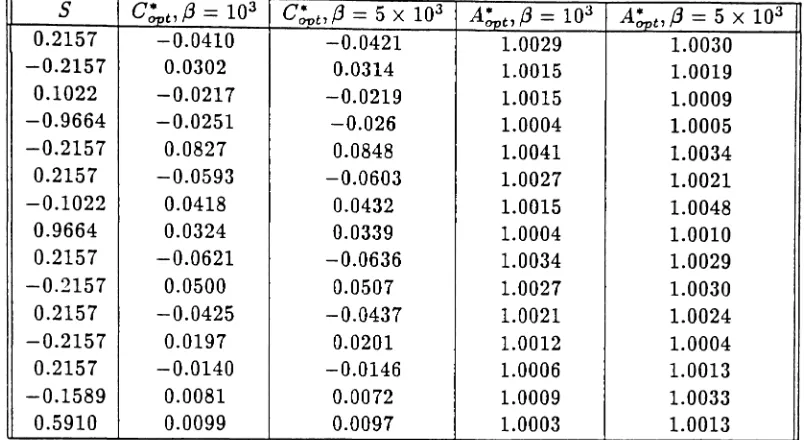
and A~t vectors for a step size off3
=
103 andf3
=
5 X 10³ are shown inTable 2. A plot ofa(k)
=
/V(
0,0-(k),1-£,I-£'"ar,t)/p=
lv
{p} /P
versus number of iterationsk
forf3
= 103 (e~t ~ 0-(472)) andf3
= 5 X 10³ (0~t :::= 0-(103)) is shown in Fig 3. As mentioned earlier, the use of a larger step size results in a faster convergence of the SGDalgorithm, but will also less accurately estimate the actual 0~t. Inspite of that, sufficiently accurate results were obtained using the step size {3
==
5 X 10³ as compared to {3 = 103 withStochastic Gradient Optimization ... , Al-Qaq, Devetsikiotis, and Townsend
a(t<)
0.1
19
0.05
3
~= 10
0'---1
o 100 200 300 400Number of iterations (k)
soo
(31) Figure 3: A plot of the relative precision a(k) versus number of iterations (k) for two different step sizes
f3
=
103 and (3 := 5 X 10³. Note the faster convergence attained for
f3
:= 5 X 10³.The stochastically computed optimal parameter vector e~t using
f3
= 5 X 10³ at a SNRof 20.97 dB was used as the starting point (0*(1)) at a SNR of 25.7 dB. The SGD algorithm
displayed no significant decrease in the variance of the estimator implying that 0*(1) was
already very close to 8~t. The same behavior was observed at a SNR of 27.7 dB. Thus, for
a one time overhead of Noh := 1.03 X 10⁵, we were able to efficiently estimate P over a range
of 10-3 to 10-9
• The results are shown in Table 3.
V
{F},1il
{F}, and P were computedusing an ensemble of NE
==
20 estimates of NX x Nv==
Ni x Ny==
10000 x 1 decisions perestimate. The quantity
1il
{F}
represents the variance of the estimator in (2). The speed-up factor(S
P), corresponding to V {F} and the estimator in (7)was calculated according toS - NM c
P - NiNE
where NMC is the conventional
Me
number of decisions required to attain the same accuracyas our IS scheme. NMC was computed based on a 95% confidence interval [18]. The speed-up
factor SPI, corresponding to
1il
{p} and the estimator in (2), was also computed in a similar fashion with Nx replacing Ni·A plot of SplSPl versus log(11p) is shown in Fig 4. To illustrate the significance of this gain factor, consider the estimate
P
=
1.21 X 10⁻⁸ in Table 3. A satisfactory precision ofStochastic Gradient Optimization ... , Al-Qaq, Devetsikiotis, and Townsend
S C~t,{3 == 103 C~t,(3 == 5X 10³ A*'Of}t,f3 - 103 A~t,{3 - 5 X 10³
0.2157 -0.0410 -0.0421 1.0029 1.0030 -0.2157 0.0302 0.0314 1.0015 1.0019 0.1022 -0.0217 -0.0219 1.0015 1.0009 -0.9664 -0.0251 -0.026 1.0004 1.0005 -0.2157 0.0827 0.0848 1.0041 1.0034 0.2157 -0.0593 -0.0603 1.0027 1.0021 -0.1022 0.0418 0.0432 1.0015 1.0048 0.9664 0.0324 0.0339 1.0004 1.0010 0.2157 -0.0621 -0.0636 1.0034 1.0029 -0.2157 0.0500 0.0507 1.0027 1.0030 0.2157 -0.0425 -0.0437 1.0021 1.0024 -0.2157 0.0197 0.0201 1.0012 1.0004 0.2157 -0.0140 -0.0146 1.0006 1.0013 -0.1589 0.0081 0.0072 1.0009 1.0033 0.5910 0.0099 0.0097 1.0003 1.0013
20
Table 2: Optimal IS parameter vector 0~tfor the given mean vector S and a step size off3
=
103and f3
==
5 X 10³•r
A/a-P
~\{P} SPI IV{P}
Sp25.68 dB 1.532x10⁻⁶ 4.332 X10⁻¹³ 2.87X10² 6.542X10⁻¹ 7 2.34X10⁶
26.58 dB 1.116x10⁻⁷ 8.05 X10⁻¹ 5 8.96x1()2 2.845x10⁻¹ 9 3.91 X10⁷ 27.21 dB 1.21x10⁻⁸ 1.48 X10⁻¹⁶ 4.5X10³ 2.32X10⁻²¹ 5.2x10⁸
27.70 dB 1.796x10⁻⁹ 8.323 X10⁻¹⁸ 5.57x1Q3 1.097x10⁻² 2 1.63 X10⁹
Table 3: Simulation data and speed-up factors for the binary communication systemwith an RLS adaptive equalizer.
other hand, the same accuracy can be attained using only 16 decisions if the IS estimator of (7) is used and X is biased using e~t in Table 2 for
f3
==
5 X 10³•5
Conclusion
Stochastic Gradient Optimization ... , Al-Qaq, Devetsikiotis, and Townsend 21
9 8
7
log ( 1/P)
6
0 ' - - - "
5
xlc1
Figure 4: A plot of the gain Sp]SPI versus log(l/
p).
noncoherent envelope detection, and a baseband communication system with a static linear
channel and an RLS equalizer. Speed-up factors of 2 to 10 orders of magnitude over
conven-tional Me were achieved for second and fourth order diversity systems, and of 6 to 9orders
of magnitude for the RLS adaptive equalization system for error probabilities in the range of 10-6 to 10-9.
References
[1] K. S. Shanmugan andP.Balaban. AModified Monte-Carlo Simulation Technique for the Evaluation of Error Rate in Digital Communication Systems. IEEE Trans. Commun., COM-28(11):1916-1924, Nov. 1980.
[2] D. Lu and K. Yao. Improved Importance Sampling Techniquefor Efficient Simulation ofDigital Communication Systems. IEEE J. Select. Areas Commun., 6(1), Jan. 1988.
Stochastic Gradient Optimization ... , Al-Qaq, Devetsikiotis, and Townsend 22
[4] J-C. Chen, D. Lu, J. S. Sadowsky, and K. Yao. On Importance Sampling in Digi-tal Communications - Part I: Fundamentals. IEEE J. Select. Areas in Commun.,
11(3):289-299, Apr. 1993.
[5]
JC. Chen and J. S. Sadowsky. On Importance Sampling in Digital Communications -Part II: Trellis-Coded Modulation. IEEE J. Select. Areas in Commun., 11(3):300-308,Apr. 1993.
[6] W. A. AI-Qaq, M. Devetsikiotis, and J. K. Townsend. Importance Sampling Method-ologies for Simulation of Communication Systems with Time- Varying Channels and Adaptive Equalizers. IEEE J. Select. Areas in Commun., 11(3):317-327, Apr. 1993.
[7] M. Devetsikiotis and J. K. Townsend. An Algorithmic Approach to the Optimization of Importance Sampling Parameters in Digital Communication System Simulation. IEEE
Trans. Commun., 41(10), Oct. 1993.
[8] M. Devetsikiotis and J. K. Townsend. Statistical Optimization of Dynamic Importance Sampling Parameters for Efficient Simulation of Communication Networks. IEEE/ACM
Trans. Networking, 1(3), June 1993.
[9] M. Devetsikiotis, W. AI-Qaq, J. A. Freebersyser, and J. K. Townsend. Stochastic Gra-dient Techniques for the Efficient Simulation of High-Speed Networks Using Importance Sampling. In Proc. IEEE Global Telecom. Coni., GLOBECOM '93, Houston, Dec. 1993.
[10] John
G.
Proakis. Digital Communications. New York: McGraw-Hill, 1989.[11]
B. R. Davis. An Improved Importance Sampling Method for Digital Communication System Simulations. IEEE Trans. Commun., COM-34(7):715-719, Jul. 1986.[12]
C. Nelson Dorny. A Vector Space Approach to Models and Optimization. New York:Stochastic Gradient Optimization..., Al-Qaq, Devetsikiotis, and Townsend 23
[13] P. W. Glynn. Stochastic Approximation for Monte Carlo Optimization. In Proc. ofthe Winter Simulation Conference, Wilson, J., Henriksen, J. and Roberts, S. (eds), IEEE Press, 1986.
[14] M. Metivier and P. Priouret. Applications of a Kushner and Clark Lemma to
Gen-eral Classes of Stochastic Algorithms. IEEE Trans. Inform. Theory,IT-30(2):140-151,
March 1984.
[15] S. S. Haykin. Adaptive Filter Theory. Englewood Cliffs, New Jersey: Prentice-Hall,
1986.
[16] P. W. Glynn. Likelihood Ratio Gradient Estimation: An Overview. In Proc. of the
Winter Simulation Conference, Thesen, A., Grant, H., Kelton, W. D., (eds), IEEE Press, 1987.
[17] P. W. Glynn. Likelihood Ratio Gradient Estimation for Stochastic Systems. Comm. ACM, 33(10):75-84, Oct. 1990.
[18] M. C. Jeruchim. Techniques for Estimating the Bit Error Rate in the Simulation of Digital Communication Systems. IEEE J. Select. Areas Commun., SAC-2(1):153-170,
Jan. 1984.
[19] John G. Proakis and Dimitris G. Manolakis. Digital Signal Processing. New York: Macmillan, 1988.
Appendix
In this Appendix, we justify the interchange of the gradient and expectation operators used
· (18) L t 0· (ll. ll* ll*]t Gl·ven the following assumptions:
ill . e ..
=
(]1'U2 ' ••·'U n •1. 0 ~ I(X)
<
00,2. I(X) is independent of the parameter vector 0*,
Stochastic Gradient Optimization ... , Al-Qaq, Devetsiliotis, and Townsend
4. wx(X,8,0*) is continuously differentiable with respect to 0*,
we need to show that
v e.Ee{l(X)wx(X,
0,
e*)} == Ee{l(X)V'e.wx(X,
8,e*)}Proof: It is only sufficient to show that for i == 1, ... ,n
aEe{I(X)wx(X,8, 8*)}
=
E. {Z(X) 8wx(X,0, 0*)}
ao~\ e ao~
,
Applying the definition of the derivative, we get
24
(32)
(33)
aEe{I(X)wx(X, 8, 8*)}
=
lim Ee{I(X)wx(X,8, 8*)llJi =tii } - E{I(X)wx(X,8, 8*)}8fJi 9~ -.8~, , {}~
,
- o~,
Using assumption 3 , we can write
aEe{I(X)wX:X, 8, 8*)}
=
_lim Ee
{1(X)[WX(X,
8, 8*}llJi =tii - wx(X, 8, 8*)]}ao;
.
8~ -.8~, , IJ~,
- IJ~,
Applying the mean value theorem of calculus, we get
aEe{I(X)wx(X,8,8*)}
=
lim Ee{1(X)8w
x(X,e,e*)I . ,.}
80* .. 80* 8. =8. ,
i 87-.87 i ' ,
Define
II
w'11 -
- sup{8w
x(X,
8f)*0,
e*)I
8!=8~,}
X,0,0· i "
and
Illl/
== sup{l(X)}
XBy assumption 1, IIll/
<
00, and by assumption 4,Ilw'll
<
00. Therefore, we may writeleX)
awx(~~~8,
8*)1lJi=tii~
Illllllw'll
<
00,I
Thus, we can apply the Lebesgue Dominated Convergence Theorem (DCT)
.
{
8wx(X,
8, 8*) } _ { .8wx(X,
8,(3*) }i~i
Ee leX) a(J: 1lJi=tii -s,
leX)tiP3
i a(J: 1lJi=tii