ABSTRACT
GAUVIN, JENNIFER LYNN SHANNON. Stepwise Hypothesis Testing with
Appli-cations in Pharmaceutical Responses. (Advisor: Dr. Roger L. Berger)
In some studies researchers seek to identify conditions under which a mean response
exceeds a specified threshold. This work examines the case in which such conditions are
defined in terms of two quantitative independent variables. For example, a
pharmaceu-tical researcher might want to identify what values of dose and post-dose time yield an
average blood concentration above a certain threshold.
New methods of specifying a rectangular set of (time,dose) values for which the
researcher can assert that the mean response exceeds the threshold are described. By
using intersection-union tests applied in a stepwise fashion, the methods maintain a
specified high probability that the rectangular set contains no (time,dose) values for
which the mean response is lower than the threshold.
The observations at each (time,dose) value must be independent, but neither method
requires independent observations at different (time,dose) values. For example,
concen-trations measured on a subject at different time points may be correlated.
Exact calculations and simulation studies are used to assess the error rates and
STEPWISE HYPOTHESIS TESTING WITH APPLICATIONS IN PHARMACEUTICAL RESPONSES
by
Jennifer Lynn Shannon Gauvin
A dissertation submitted to the Graduate Faculty of
North Carolina State University
in partial fulfillment of the requirements for the
Degree of Doctor of Philosophy
DEPARTMENT OF STATISTICS
Raleigh, NC
2003
APPROVED BY:
Roger L. Berger Dennis D. Boos
Chair of Advisory Committee
Dedication
Biography
Jennifer Lynn Shannon Gauvin was born in Warren, Ohio on September 20, 1973. She
received a Bachelor of Science degree in Interdisciplinary Mathematics: Statistics from
the University of New Hampshihre in 1995. After a year, Jennifer enrolled in graduate
school at North Carolina State University in the Department of Statistics. In 1998, she
received a Master of Statistics degree from North Carolina State University. Jennifer
continued her studies in statistics, completing her doctoral degree in 2003 from North
ACKNOWLEDGEMENTS
I am grateful and honored to have had the privilege of working with my advisor, Dr.
Roger L. Berger. Without his expertise, guidance and patience this dissertation would
not be complete.
Thank you to my committee members Drs. Dennis Boos, Bill Swallow and Butch
Tsiatis for your suggestions and teaching during my education. Dr. Sastry Pantula,
thank you for teaching me essential study tips and test taking strategies. I appreciate
how freely you gave your time despite your full schedule.
Thank you to Wendy Czika, Buffy Hudson-Curtis and Steve Novick for their valuable
support during my graduate studies.
Over my many years as a student I have learned from my fellow students and
col-leagues. Hearing their insightful comments and observing their approaches to statistical
challenges has made me a better statistician.
I am very fortunate to have amazing people in my life who encouraged and supported
me throughout this entire experience. I cannot thank them enough.
To my parents, Raymond and Marsha Shannon, thank you for teaching me the value
of diligence. To my sisters, Hilary and Heather, and my brother and sister-in-law, Michael
and Allyson, thank you for listening to all my trials and adventures. To my husband,
Contents
List of Tables vii
List of Figures ix
1 Overview 1
1.1 Introduction . . . 1
1.2 Historical Background . . . 4
2 A New Problem 10 2.1 Introduction . . . 10
2.2 The Original Method of Constructing a Rectangular Set . . . 13
2.3 Controlling the Error Probability . . . 33
2.4 Possible Problems and Shortcomings . . . 37
2.5 The Adaptive Method . . . 45
3.1.1 The Bonferroni Method . . . 55
3.2 Sample Simulation Shapes . . . 56
3.2.1 The Rectangle Shape . . . 57
3.2.2 The Ridge Shape . . . 60
3.2.3 The Dome Shape . . . 64
3.2.4 The Largest Rectangular Set Using the Bonferroni Method . . . . 67
3.3 A Poor Choice of Initial Point . . . 70
3.3.1 The Rectangle Shape . . . 70
3.3.2 The Ridge Shape . . . 73
3.4 Grid Size and µin the Bonferroni Method . . . 76
3.5 Is the Error Rate of the Adaptive Method Too Conservative? . . . 79
3.6 Correlated Data . . . 83
4 Summary 89 4.1 Conclusions . . . 89
4.2 Future Work . . . 91
List of Tables
1.1 Points tested in each of the four regions at steps 1 and 2. . . 9
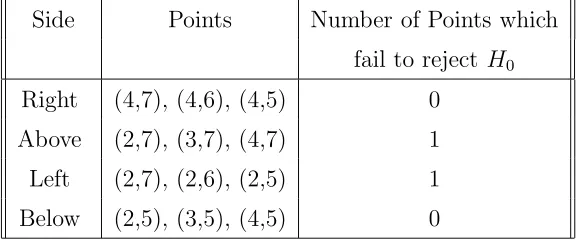
2.1 The points tested at each step in each region of a 7×7 grid. . . 22 2.2 Step 1: Snapshot of data points surrounding the initial point in Pattern D. 47
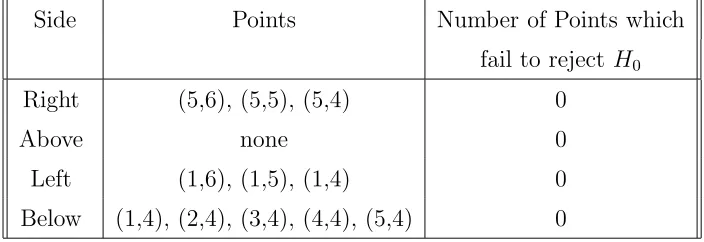
2.3 Step 2: Adaptive algorithm snapshot of data points for Pattern D. . . . 48
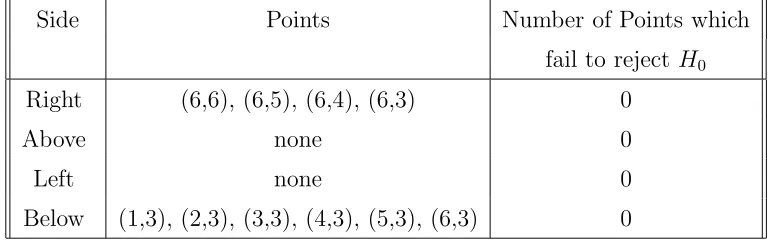
2.4 Step 3: Adaptive algorithm snapshot of data points for Pattern D. . . . 49
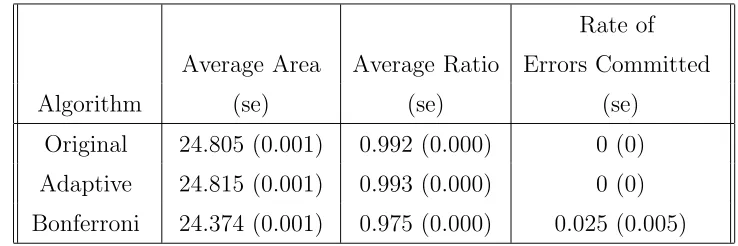
3.1 1000 simulations of the rectangle shape. Standard errors are listed in
parentheses. . . 58
3.2 1000 simulations of the ridge shape. Standard errors are listed in
paren-theses. . . 61
3.3 1000 simulations of the dome shape. Standard errors are listed in
paren-theses. . . 65
3.4 The largest rectangular set under the Bonferroni method in 100
simula-tions of each shape using the parameters in Secsimula-tions 3.2.1, 3.2.2 and 3.2.3.
3.5 1000 simulations of the rectangle shape with the initial point (5,5).
Stan-dard errors are listed in parentheses. Results from the initial point (4,4)
are given in Table 3.1. . . 72
3.6 1000 simulations of the ridge shape with the initial point (4,3). Standard
errors are listed in parentheses. Results from the initial point (4,4) are
given in Table 3.2. . . 74
3.7 1000 simulations are run to study the effect of µ and grid size on the
Bonferroni method. Standard errors are listed in parentheses. . . 77
3.8 1000 simulations show an error rate near 5% for Original and Adaptive
methods. Standard errors are listed in parentheses. . . 82
3.9 Correlation between pairs of observations in an AR(1) model. . . 85
3.10 1000 simulations of the rectangle shape with AR(1) correlated data.
Stan-dard errors are listed in parentheses. . . 86
3.11 1000 simulations of the ridge shape with AR(1) correlated data. Standard
errors are listed in parentheses. . . 87
3.12 1000 simulations of the dome shape with AR(1) correlated data. Standard
List of Figures
1.1 Regions and steps in the Original algorithm . . . 7
2.1 The asymmetric shape is trimmed into a rectangular set. . . 23
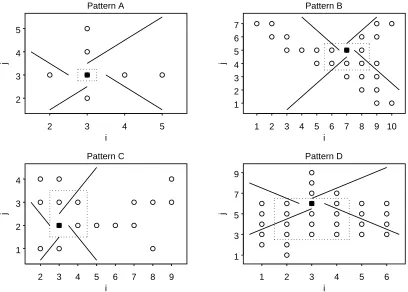
2.2 Patterns which are difficult to detect. The Original algorithm finds the
rectangular set in the dotted lines. . . 39
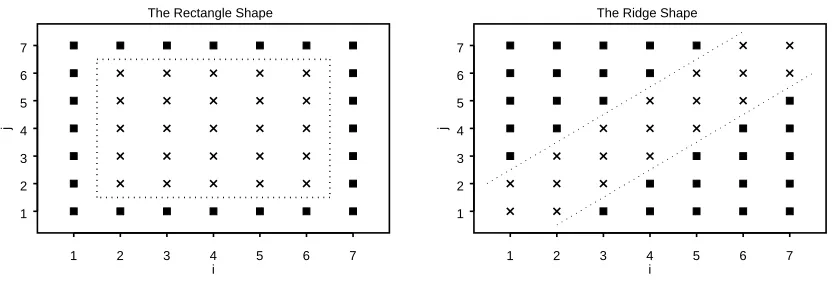
3.1 The rectangle and ridge shapes. µ >0 for points marked by ×. µ= 0 for points marked by squares. . . 60
3.2 The dome shape. The vertical axis represents values of µij. . . 64
3.3 The rectangle shape with initial point (5,5). µ = 1 for points marked by
×. µ= 0 for points marked by squares. The initial point is marked with a diamond. Regions are separated by solid lines. Rectangular sets are
3.4 The ridge shape with initial point (4,3). µ > 0 for points marked by ×.
µ = 0 for points marked by squares. The initial point is marked with a
diamond. Regions are separated by dotted lines. The rectangular set is
outlined with dotted lines. . . 75
3.5 This shape is constructed to demonstrate that the Adaptive method
Chapter 1
Overview
1.1
Introduction
In many studies, researchers may seek to identify a set of conditions for which the
popula-tion quantity exceeds a desired threshold,δ. The population quantity,µfor example, may
depend on quantitative factors or conditions, such as time or drug dosage. Correlation
may exist between the observations at the same dose and different time points.
While it is interesting to explore the values of µ, this research places additional focus
on compiling a useful set of conditions for which the confidence statement,µexceeds the
threshold, can be asserted. These conditions are the set of values for the independent
variables, time and drug dosage. Ultimately, a collection of (time,dose) pairs will describe
the region where the confidence statement is valid. The region will consist of pairs,
pairs of values.
The region must be easy to understand and interpretable. Suppose the region is
{(1,1),(5,5),(3,2)}. The corresponding confidence statement, using this region, is µ
exceeds the threshold at 1 hour for 1 mg, at 5 hours for 5 mg and at 3 hours for 2 mg.
There is no pattern in the pairs. Suppose the region is{(1,1),(1,2),(1,3),(1,4),(1,5)}. The confidence statement isµ exceeds the threshold at 1 hour for doses 1, 2, 3, 4, and 5
mg. The pattern in these pairs is clear.
If drawn on a grid, the second collection of points produces a line or rectangle of
adjacent pairs. The pairs in the first example do not take any simple shape. Keeping
in mind the grid framework, the rectangle has appeal because of the simple statements
which can be made. Clear, concise statements describe the rectangle. For example, {
a≤time≤b and c≤dose≤d } describes a rectangle.
Confidence statements are constructed for parameters. This research explores the
val-ues of the independent variables for which confidence statements about µ are asserted.
Values of independent variables depend on the variable and its application
(pharma-ceutical, industrial, otherwise). As described, a collection of desirable pairs is found.
Further, the region of points (time,dose) will adhere to a rectangular pattern. With
these requirements, the final result is more meaningful to the application.
The region will contain the set of (time,dose) pairs for the confidence statement that
the population quantity µexceeds the threshold δ. The proposed methodology does not
to those at 2 hours for dose =c.
Simultaneous inferences are required to test and assert a condition such as µ > δ for
dose d1 at time points t1, t2, and t3. This statement can be rewritten as an intersection of three distinct statements {µ > δ at (time = t1,dose = d1) and µ > δ at (time =
t2,dose = d1) and µ > δ at (time = t3,dose = d1)}. Often, simultaneous inferences re-quire multiplicity adjustments. Unfortunately, such adjustments can lead to conservative
estimates of error.
Using the intersection-union method and stepwise hypothesis testing, the overall
sig-nificance level of the test is controlled without multiplicity adjustments. In stepwise
hypothesis testing, test hypotheses are ordered a priori such that testing continues in a
sequence if and only if significance is found at the previous step. As an example, consider
the hypotheses
H01:µ≤δ for at least one (t, d) such that d∈ {d1} and t∈ {t1, t2, t3}
Ha1 :µ > δ for all (t, d) such that d∈ {d1} and t∈ {t1, t2, t3} and
H02 :µ≤δ for at least one (t, d) such that d∈ {d1, d2} and t∈ {t1, t2, t3}
Ha2 :µ > δ for all (t, d) such that d∈ {d1, d2} and t ∈ {t1, t2, t3}.
The null hypothesis H01 tests the parameter µ. Its alternative, Ha1, will be asserted at
If the test fails to reject H01, clearly H02 will also fail to be rejected. If the test for
H01 is significant, there is a chance that the test for H02 may also be significant. Test
H02 if and only if H01 is rejected. IfH01 is not rejected, there is no reason to test H02. With each step of testing, more points are included in the region. In the previous
example, µ is tested at three (time,dose) points in the first step with null hypothesis
H01. In the second step, H02, µ is tested at the same three points and three additional points.
The methods proposed in this work do not retest points at sequential hypotheses as
is done in the previous example. Points farther from the initial point are tested in steps,
increasing the number of points tested at each step, expanding the testing away from the
initial point. Stepwise testing protects the confidence region from being unnecessarily
conservative.
1.2
Historical Background
Prior to this research, Berger and Boos addressed the same question. However, their
research only allowed for one independent variable (Berger and Boos 1999). Using time
as an example, they concludedµ > δfor all timetsuch thatt∈[t1, t2]. In brief summary, they chose a point, tap, such that 0 ≤ tap ≤ tn, where tn is the longest time available.
Using stepwise methods, they assertµ > δfor allt ∈[t1, tap) andµ > δfor allt∈(tap, t2].
Using Bonferroni’s inequality, the information in these separate pieces can be combined
Berger and Boos laid a careful foundation for further studies. This research seeks to
construct a 100(1−α)% confidence statement forµ,µ > δ for all (i, j)∈ {a≤i≤b, c≤
j ≤d}. Here, two independent variables, Aand B, are under simultaneous consideration with levels of A represented by i = 1, . . . , I and levels of B represented by j = 1, . . . , J.
Using the previous example, A would correspond to time and B would correspond to
dose. If one of the two independent variables is set to a fixed value, the situation is a
case of Berger and Boos’ work. For example, µ > δ for all (i, j)∈ {a≤i≤b, j =c}. In order to discuss confidence statements, the type I error must be clearly defined. A
type I error occurs if the set {a ≤i≤b, c≤j ≤d} contains any (i, j) at which µij ≤δ.
The probability of committing a type I error is at most α; the probability that the set
{a≤i≤b, c≤j ≤d} contains any (i, j) with µij ≤δ is at most α.
A first step in this research is to determine how, if at all, to apply Bonferroni’s
inequality. Having information about the values of the independent variables is essential.
For example, if each variable takes only two values, the largest possible region of paired
independent variable values contains four points, for example,{(1,1),(1,2),(2,1),(2,2)}. Testing µat each (i, j) point with level α
4 seems reasonable and simple. However, if each independent variable can take one of ten values, it seems naive to test µ at each (i, j)
point with level α
100. Using such a small significance level will lead to very conservative results and, quite possibly, a strangely shaped region which is meaningless in applications.
Consider the a priori element of Berger and Boos’ method. They begin their study
information about the application or past data. The choice of an initial point is somewhat
arbitrary, but should be made carefully and thoughtfully with intent that the initial point,
(iap, jap), will be in the set.
With one independent variable, there are two directions around the initial point,
right or left. Berger and Boos apply Bonferroni’s inequality and construct two intervals,
each having error probability α
2. With two independent variables, there are four direc-tions around the initial point, right, up, left or down. Applying Bonferroni’s inequality
to a method which constructs four regions around the initial point, each having error
probability α
4, will produce a rectangular set having error probabilityα.
Consider a sequential manner for testing µ at points within each of the four regions.
For Region 1, test points to the right of the initial point. For Region 2, test points above
the initial point. For Region 3, test points to the left of the initial point. For Region
4, test points below the initial point. Overlap can be avoided by assigning upper right
points to Region 1, upper left points to Region 2, lower left points to Region 3 and lower
right points to Region 4. The null and alternative hypotheses are, in general,
H0 :µ≤δ for at least one (i, j) in the described set
Ha:µ > δ for all (i, j) in the described set.
The described set of (i, j) in the hypotheses depends on the region and the sequential
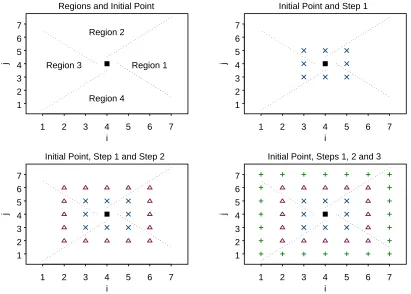
step, which are illustrated in Figure 1.1. These tests, which are intersection-union tests,
have properties beneficial to this work. Details are provided in later sections. The null
Regions and Initial Point
i
j
1 2 3 4 5 6 7
1 2 3 4 5 6 7 Region 1 Region 2 Region 3 Region 4
Initial Point and Step 1
i
j
1 2 3 4 5 6 7
1 2 3 4 5 6 7
Initial Point, Step 1 and Step 2
i
j
1 2 3 4 5 6 7
1 2 3 4 5 6 7
Initial Point, Steps 1, 2 and 3
i
j
1 2 3 4 5 6 7
1 2 3 4 5 6 7
intersection of statements. These hypotheses could be rewritten as follows to explicitly
demonstrate this characteristic. Suppose the described set is {i = 1 and j = 1 or 2}. Then, the hypotheses are
H0 :{µ≤δ for (1,1)} or{µ≤δ for (1,2)}
and
Ha:{µ > δ for (1,1)}and {µ > δ for (1,2)}.
Stepwise testing is utilized to limit multiplicity adjustments. If the test is significant
at the first step, testing can continue to the second step. If testing is not significant
at step 1, further testing will not occur. Since an initial point is selected, each point
immediately adjacent to the initial point will be tested in the first steps. Testing will
occur in the four regions which are described in Figure 1.1. In the first step, each point
immediately adjacent to the initial point will be tested in one of four regions. Suppose
the initial point is (iap, jap), where 1 ≤ iap ≤ I and 1 ≤ jap ≤ J. For the independent
variable A, iap+ 1 represents one level greater than iap and iap−1 represents one level
smaller than iap. For example, if i = 1,2,3,4,5 and iap = 3 then iap + 1 = 4 and
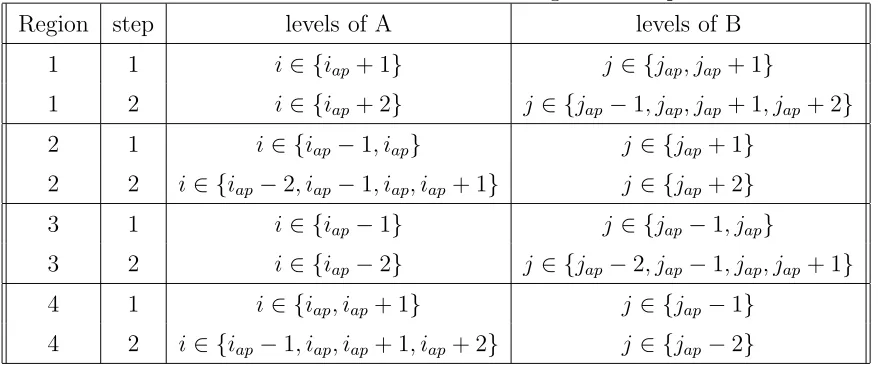
iap−1 = 2. Steps 1 and 2 are described in Table 1.1 for each of the four regions.
The proposed method maintains an overall significance level ofα, but hypothesis
test-ing at each grid point, except the initial point, is performed at level α
4. Stepwise testing requires no adjustment. The test for Region 1, step 1 has the same error probability
as the test for Region 1, step 2 and so on. This method of testing is not
Table 1.1: Points tested in each of the four regions at steps 1 and 2.
Region step levels of A levels of B
1 1 i∈ {iap+ 1} j ∈ {jap, jap+ 1}
1 2 i∈ {iap+ 2} j ∈ {jap−1, jap, jap+ 1, jap+ 2}
2 1 i∈ {iap−1, iap} j ∈ {jap+ 1}
2 2 i∈ {iap−2, iap−1, iap, iap+ 1} j ∈ {jap+ 2}
3 1 i∈ {iap−1} j ∈ {jap−1, jap}
3 2 i∈ {iap−2} j ∈ {jap−2, jap−1, jap, jap+ 1}
4 1 i∈ {iap, iap+ 1} j ∈ {jap−1}
4 2 i∈ {iap−1, iap, iap+ 1, iap+ 2} j ∈ {jap−2}
increases as well. While this does not make it more difficult to detect significance at
individual points, it does become more difficult to find large sets of points where the
test is significant at each (i, j) point. As the described sets become larger, the number
of points simultaneously tested in a null hypothesis increases. Recall, the test at each
of the points must be significant in order to reject the null hypothesis for the step. If
the test at any of the points fails to reject the null hypothesis the stepping stops; the
rectangular set will not expand.
The ideas in this section are a small subset of what has been explored. Issues of
concern that ultimately affected the final solution are the ability to find the largest
possi-ble region under feasipossi-ble data trends with respect to independent variapossi-bles, conservative
significance levels for testing, patterns for testing such as the rectangle and theoretical
Chapter 2
A New Problem
2.1
Introduction
The focus of this work is to construct a 100(1−α)% confidence statement for the mean parameter at all points in the rectangular set of pairs of independent variable values. In
general, for two independent variables, A and B, let µij represent the population mean
at the ith level of A and the jth level of B. A has I levels, with i = 1, . . . , I, and B
has J levels j = 1, . . . , J. The levels of each factor must be ordered. In the example in
Section 1.1, A denoted time and B denoted dose. The levels of A must be in increasing
or decreasing order such as{5,10,20,50}or {50,20,10,5} minutes. Similarly, the levels of B must be in increasing or decreasing order such as {3,10,13,20} or {20,13,10,3} mg. The levels need not be equally spaced.
the ith level of A and thejth level of B. Here,ǫ
ijk represents the error of thekth response
with k = 1, . . . , nij. The errors are identically distributed normal random variables at
each (i, j) level; ǫijk ∼ N(0, σij2). Errors are independent at each (i, j) level, but need
not be independent between (i, j) levels. This model differs from a two-way anova model
because the independent variables are order restricted and observations may have unequal
variances. Ordering necessary for stepwise testing will be discussed later.
As mentioned previously, the set of (i, j) pairs for which the mean exceeds the
thresh-old δ must be efficacious and practical. A rectangular set meets these requirements and
will be utilized in this research. The set of (i, j) pairs can be fully described and explained
by a rectangular set such as all (i, j) where {a≤i≤b and c≤j ≤d}.
For this research, constructing the rectangular set will begin with an initial (i, j) pair
chosena priori, before the data are observed. The initial point, (iap, jap), should be chosen
based on the application, previous data, previous studies or desirable characteristics.
Naturally, research will be most productive if the initial point is expected to be in the
final rectangular set.
A t-test of H0 :µiapjap ≤δ, performed at the initial point, should reject H0 if
yiapjap −δ
r
s2
iapjap
niapjap
> t(1−α),(niapjap−1).
A t-test of H0 :µij ≤δ, performed at any other grid point, should reject H0 if
yij−δ
r
s2
ij
nij
Notice, the significance level, α, at the initial point. The algorithm has greater chance of
rejecting the null hypothesis and beginning the stepwise process at the initial point than
at each subsequent step where the level is more conservative, α
4.
In keeping with traditional definitions, the sample variance of observations at (i, j) is
defined as
s2ij = 1
nij −1 nij
X
k=1
(yijk−yij.)2
and the sample mean is
yij = 1
nij nij
X
k=1
yijk .
The variance estimate has not been pooled because there is no assumption of
ho-moscedasticity. That is, the estimated variance at each (i, j) depends only on the nij
observations at (i, j). A pooled estimate of variance would be calculated for data which
assumes homoscedasticity. The pooled estimate of variance is presented in the following
formula.
s2 = PI 1
i=1
PJ
j=1(nij −1) I X i=1 J X j=1
(nij −1)(s2ij)
= 1
(PI
i=1
PJ
j=1nij)−IJ I X i=1 J X j=1 nij X k=1
(yijk−yij.)
2.
Recall the grid of points, Figure 1.1, as described in Section 1.2. At any one (i, j) grid
point, there are nij observations. Building on the example from Section 1.1, suppose A
takes values {5,10,15,30,45,60,75}minutes, then i= 1 corresponds to A at 5 minutes. Similarly, i = 5 corresponds to A at 45 minutes. Further, suppose B takes values
corresponds to B at 30 mg. In this example, the (i, j) pair at (1,5) corresponds to data
observed at 5 minutes for 30 mg.
This section outlines the research problem and proposes ideas about finding a
solu-tion or result. The remainder of Chapter 2 explains, in detail, methods which answer
the research problem. In Section 2.2, the method for constructing the rectangular set
is defined. Error probability is discussed in Section 2.3. Potential problems with the
Original method from Section 2.2 are discussed in Section 2.4. The Adaptive method is
described in Section 2.5; in addition, the distinction between the Adaptive and Original
algorithms is made clear by contrasting the benefits of each process.
2.2
The Original Method of Constructing a
Rectan-gular Set
The experimental goal is to answer the question at which doses for which time points
does the population mean exceed a desired threshold. This section explains how a set
of pairs of doses and times will be constructed in answer to the experimental question.
Details in this section will be given in terms of (i, j) pairs that represent the levels of
time and dose levels. The method of constructing the rectangular set of (i, j) points,
{a≤i≤b and c≤j ≤d}, will be described in this section. Proof of how the algorithm maintains a specified error probability of α and an explanation of how the algorithm
A 7×7 grid will be used to illustrate how the set is constructed. After describing the method for the specific example of a 7×7 grid, detailed steps will be outlined for the general case, an I×J grid. The regions and steps are illustrated on a 7×7 grid in Figure 1.1.
An initial point must be chosen to begin constructing a set of (i, j) pairs where the
100(1−α)% confidence statement is valid for the population mean. Recall that the choice
is made a priori. If no information suggests otherwise, choose (4,4), the center point of
a 7×7 grid for the initial point. The choice of initial point can greatly affect the success or failure of constructing the rectangular set. The algorithm must recover from a poor
initial choice and benefit from a wise initial choice.
To begin, a t-test of H0 : µ4,4 ≤ δ againstHa : µ4,4 > δ is performed using all n4,4 observations at the initial point (4,4). The t-test should reject H0 if
y4,4−δ
q
s2 4,4
n4,4
> t(1−α),(n4,4−1).
If the test fails to reject the null hypothesis, no further tests will be performed; no set can
be found based on the initial start value (4,4). If the test rejects the null hypothesis, the
procedure of hypothesis testing will continue. Assuming the test rejects, the algorithm
can assert that the mean exceeds the desired threshold at (4,4) with error probabilityα.
Next, consider expanding the set, now {(4,4)}, to include more points. The choice for direction of expansion is arbitrary. Recall the method of expansion introduced in
Section 1.2. Consider grouping the points around the initial point into four regions. The
using points where j > jap. The third group is constructed using points where i < iap.
The fourth group is constructed using points where j < jap.
Hypothesis testing will be done in steps within each region. The hypothesis tested at
step 1 in the first group is
H011 :µij ≤δ for at least one (i, j)∈ {(5,4),(5,5)}
against
Ha11 :µij > δ for all (i, j)∈ {(5,4),(5,5)}.
These points, {(5,4),(5,5)}, are represented in Figure 1.1 of Section 1.2 in Region 1. The null hypothesis can be rejected if and only if the t-test is significant at both
(5,4) and (5,5). For (5,4), if
y5,4−δ
qs2 5,4
n5,4
> t(1−α4),(n5,4−1) (2.1)
and for (5,5), if
y5,5−δ
qs2 5,5
n5,5
> t(1−α4),(n5,5−1) (2.2)
then reject H011 , the null hypothesis for the first step in the first region. If either test is
not significant,H1
01fails to be rejected and the expansion halts in the direction of the first group. This also signifies a boundary or border for the final rectangular set; by design,
no point in the final set will have i >4.
The null hypothesis, H1
01, can be written as a union of two statements which can be tested by two hypotheses. H0111 : µij ≤ δ for (i, j) ∈ {(5,4)} or H0121 : µij ≤
represent the null hypothesis for the first point at the first step in the first region,
{(5,4)}. Similarly, let H1
012 represent the null hypothesis for the second point at the first step in the first region, {(5,5)}. Using the same notation, the alternative can be written as Ha11 : {µij ≤δ for at least one (i, j) ∈ {(5,4),(5,5)}}c which is equivalent to
H1
a11 : µij > δ for (i, j) ∈ {(5,4)} and Ha112 : µij > δ for (i, j) ∈ {(5,5)}. In order to
assert the alternative hypothesis and reject H1
01, both H0111 and H0121 must be rejected. The rejection region forH011 isR11 =R111T
R121 , where R111 is the rejection region defined by Equation 2.1 and R1
12 is the rejection region defined by Equation 2.2.
R111 and R121 are each level-α
4 rejection regions of H 1
011 and H0121 , respectively. By the intersection-union test method, it follows that R11 = R111T
R121 is the level-α
4 rejection region of H1
01 (Casella and Berger 2002). The intersection-union test method requires no multiple test adjustment.
Assuming H011 was rejected, the algorithm can assert that the mean exceeds the
desired threshold at points {(4,4),(5,4),(5,5)}. The rejection region at the initial point is a level-α region and the rejection region for step 1 in Region 1, {(5,4),(5,5)}, is a level-α
4 rejection region. A full explanation of error probability is given in Section 2.3. Stepwise expansion in the direction of the first group, continues in step 2 by examining
data at points {(6,3),(6,4),(6,5),(6,6)}. In Figure 1.1 from Section 1.2, these points are represented by triangles in Region 1. The hypothesis tested at step 2 for the first
region is
against
Ha12 :µij > δ for all (i, j)∈ {(6,3),(6,4),(6,5),(6,6)}.
The null hypothesis can be rejected if and only if the t-test is significant at each
(i, j)∈ {(6,3),(6,4),(6,5),(6,6)}. For each (i, j) in this group, if
yij −δ
r
s2
ij
nij
> t(1−α4),(nij−1)
then rejectH1
02, the null hypothesis for the second step in the first group. If the t-test at any of the four points is not significant, H021 fails to be rejected and the expansion halts in the first group.
The null hypothesis, H1
02, can be written as a union of four statements. There is one hypothesis for each test point. H0211 : µij ≤ δ for (i, j) ∈ {(6,3)} or H0221 : µij ≤
δ for (i, j) ∈ {(6,4)} or H0231 : µij ≤ δ for (i, j) ∈ {(6,5)} or H0241 : µij ≤ δ for (i, j) ∈
{(6,6)}. H1
021 represents the null hypothesis for the first point at the second step in the first region. H0221 represents the null hypothesis for the second point at the second step in the first region. H0231 represents the null hypothesis for the third point at the second
step in the first region. Similarly,H1
024 represents the null hypothesis for the fourth point at the second step in the first region.
Using the same notation, the alternative can be written as Ha12 :{µij ≤δ for at least
one (i, j) ∈ {(6,3),(6,4),(6,5),(6,6)}}c which is equivalent to H1
a21 : µij > δ for (i, j)∈
{(6,3)} and Ha122 :µij > δ for (i, j)∈ {(6,4)} and Ha123 :µij > δ for (i, j)∈ {(6,5)} and
and only if the hypotheses H0211 and H0221 and H0231 and H0241 are all rejected.
The rejection region for H1
02 isR21 =R121
T R1 22 T R1 23 T R1
24, where R121, R122,R231 and
R124are the level-α
4 rejection regions ofH 1
021, H0221 , H0231 , and H0241 . The intersection-union test method requires no multiple test adjustment so R12 is a level-α
4 rejection region of
H1
02. Error probabilities are discussed in Section 2.3. Assuming H1
02 was rejected, the algorithm can now assert that the mean exceeds the desired threshold at points
{(4,4),(5,4),(5,5),(6,3),(6,4),(6,5),(6,6)}.
At step 3 in Region 1, the null hypothesis is
H031 :µij ≤δ for at least one (i, j)∈ {(7,2),(7,3),(7,4),(7,5),(7,6),(7,7)}
against
Ha13 :µij > δ for all (i, j)∈ {(7,2),(7,3),(7,4),(7,5),(7,6),(7,7)}.
The null hypothesis can be rejected if and only if the t-test is significant at each (i, j)∈ {(7,2),(7,3),(7,4),(7,5),(7,6),(7,7)}. For each (i, j) in this group, if
yij −δ
r
s2
ij
nij
> t(1−α4),(nij−1)
then reject H031 , the null hypothesis for the third step in the first region. If the t-test at any of the six points is not significant, H031 fails to be rejected and the expansion halts
The null hypothesis, H031 , can be written as a union of six statements. There is one
hypothesis for each of the six test points at this step. These points,
{(7,2),(7,3),(7,4),(7,5),(7,6),(7,7)},
are represented in Figure 1.1 of Section 1.2 with + (plus) signs. The alternative is
literally,
Ha13 :{µij ≤δ for at least one (i, j)∈ {(7,2),(7,3),(7,4),(7,5),(7,6),(7,7)}}c,
which is equivalent to
Ha13 :µij > δ for every(i, j)∈ {(7,2),(7,3),(7,4),(7,5),(7,6),(7,7)}.
The alternative hypothesis, H1
a3, can be asserted if and only if the null hypotheses at each (i, j) is rejected.
The rejection region for H031 is R13, a level-α
4 rejection region. Assuming H 1 03 was rejected, the algorithm can assert that the mean exceeds the desired threshold at points
from each step in Region 1:
initial point { (4,4),
step 1 (5,4),(5,5),
step 2 (6,3),(6,4),(6,5),(6,6),
step 3 (7,2),(7,3),(7,4),(7,5),(7,6),(7,7) }.
To find the full set of points where the mean exceeds the desired threshold the
algo-rithm must step through the three other regions. In each region, the first step consists
In the second region, j > jap. This region is depicted in Figure 1.1 in Section 1.2.
The hypothesis test at step 1 in Region 2 is
H012 :µij ≤δ for at least one (i, j)∈ {(3,5),(4,5)}
against
Ha21 :µij > δ for all (i, j)∈ {(3,5),(4,5)}.
These points, {(3,5),(4,5)}, are represented in Figure 1.1. The algorithm advances to the next step if and only if the intersection-union test rejects H2
01. The data points to examine in step 2 are
{(2,6),(3,6),(4,6),(5,6)}.
Similarly, if the algorithm reaches the third step, H032 is a union of six statements. There is one hypothesis for each of the six test points described by{(i, j) : 1 ≤i≤6 andj = 7}. For Region 2, the group of (i, j) tested in step 1 can be described by j = 5 and 3≤
i ≤ 4. The set of (i, j) in step 2 can be described as (i, j) where j = 6 and 2 ≤ i ≤ 5. Similarly, the set of points for the third step can be described as (i, j) where j =
7 and 1≤ i≤6.
Recall, the third region is characterized byi < iap. In the third region, the hypothesis
test at step 1 is
H013 :µij ≤δ for at least one (i, j)∈ {(3,3),(3,4)}
against
For the third region, the set of (i, j) in step 1 is all (i, j) where i= 3 and 3≤j ≤4. The set of (i, j) in step 2 can be described as (i, j) where i= 2 and 2≤j ≤5. Similarly, the set of points for the third step can be described as (i, j) where i= 1 and 1≤j ≤6.
The fourth region is characterized by j < jap. In the fourth and final region, the
hypothesis tested at step 1 is
H014 :µij ≤δ for at least one (i, j)∈ {(4,3),(5,3)}
against
Ha41 :µij > δ for all (i, j)∈ {(4,3),(5,3)}.
The set of (i, j) in step 1 is all (i, j) where j = 3 and 4≤i≤5. The set of (i, j) in step 2 can be described as (i, j) where j = 2 and 3 ≤ i ≤ 6. Similarly, the set of points for the third step is all (i, j) where j = 1 and 2≤i≤7.
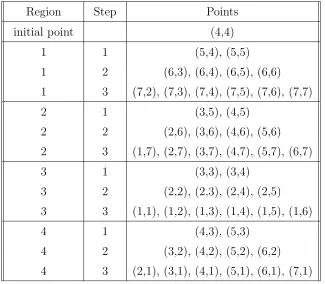
Using this 7×7 example, a summary of the algorithm for each step in each region is listed in Table 2.1. This example demonstrates how the procedure would test all the
data in a 7×7 grid, beginning with the initial point at the center, (4,4). In review, the overall grid is divided into four regions. Within each region, data is tested in a series
of steps. The hypothesis test at each step is an intersection-union test for two or more
points. Each sequential step tests data farther from the initial point than its previous
step; each step is one i orj unit farther from the initial point than the previous step.
For example, including all regions, step 2 forms a box around step 1. In Figure 1.1 of
Table 2.1: The points tested at each step in each region of a 7×7 grid.
Region Step Points
initial point (4,4)
1 1 (5,4), (5,5)
1 2 (6,3), (6,4), (6,5), (6,6)
1 3 (7,2), (7,3), (7,4), (7,5), (7,6), (7,7)
2 1 (3,5), (4,5)
2 2 (2,6), (3,6), (4,6), (5,6)
2 3 (1,7), (2,7), (3,7), (4,7), (5,7), (6,7)
3 1 (3,3), (3,4)
3 2 (2,2), (2,3), (2,4), (2,5)
3 3 (1,1), (1,2), (1,3), (1,4), (1,5), (1,6)
4 1 (4,3), (5,3)
4 2 (3,2), (4,2), (5,2), (6,2)
1 2 3 4 5 6 1 2 3 4 5 6 i j
Pairs found, separated by Region, Initial Point highlighted
1 2 3 4 5 6
1 2 3 4 5 6 i j
Rectangular Set after trimming, five points excluded
Figure 2.1: The asymmetric shape is trimmed into a rectangular set.
points are tested only once. For example, the upper right corner is assigned to Region 1,
but it is not assigned to Region 2. Similarly, the upper left corner is assigned to Region
2. The lower left corner is assigned to Region 3 and the lower right corner is assigned to
Region 4.
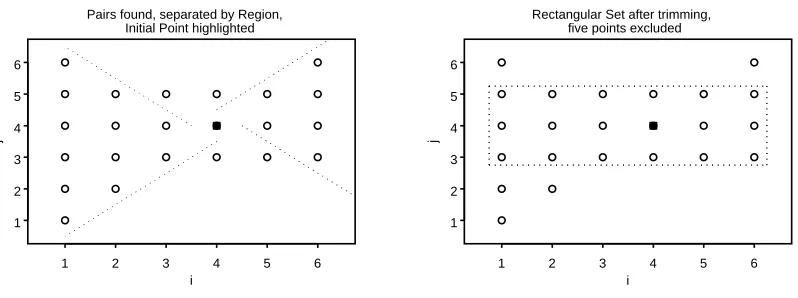
In reality, this procedure may not encounter complete success. The algorithm may
not proceed through all three steps in all four regions for every data example. Suppose
a test fails to reject the null hypothesis in a region at a step. In this case, the final set
may look more asymmetric than rectangular. Figure 2.1 depicts an example in which the
algorithm finds only the points that are marked.
In words, the points depicted in Figure 2.1 are the initial point and points from Region
1 at steps 1 and 2, Region 2 at step 1, Region 3 at steps 1, 2 and 3 and Region 4 at step
1. The largest possible rectangle within this shape can be described by the set of (i, j)
easily interpretable shape, a rectangular set.
Trimming the points is handled within each region by retaining maximum or minimum
values. For the first region, step testing occurs by increasing the value ofiand varying the
values of j with each step. Upon the last successful step in the first region, a maximum
value will be stored for i, imax. For the second region, step testing occurs by increasing the value of j and varying the values of i with each step. Upon the last successful step
in the second region, a maximum value will be stored for j, jmax. For the third region,
step testing occurs by decreasing the value of i and varying the values of j with each
step. Upon the last successful step in the third region, a minimum value will be stored
for i, imin. For the fourth region, step testing occurs by decreasing the value of j and
varying the values of iwith each step. Upon the last successful step in the fourth region,
a minimum value will be stored forj,jmin. Having stored minimum and maximum values for i and j, the procedure can report that the mean exceeds the desired threshold δ at
each of the points in the rectangular set of{(i, j) :imin ≤i≤imax and jmin ≤j ≤jmax}. Thus far, the method for answering the research question, at which doses for which
time points does the population mean exceed a desired threshold, has been described by
example. The detailed steps must be documented for a general I×J grid.
An initial point must be chosen a priori. Let (iap, jap) be the initial point. There
are no restrictions on the initial point, so, (iap, jap) may be equal to (I, J) or (1,1), for
niap,jap observations at the initial point (iap, jap). The t-test should reject H0 if
yiap,jap−δ
r
s2
iap,jap
niap,jap
> t(1−α),(niap ,jap−1).
If the test fails to reject the null hypothesis, no further tests will be performed; no
rectangular set can be constructed based on the initial start value (iap, jap). If the test
rejects the null hypothesis, the algorithm can assert that the population mean exceeds
the desired threshold at {(iap, jap)} with probability of an error no more than α. The
procedure of hypothesis testing will continue.
Begin expanding the set, now {(iap, jap)}, by testing points in Region 1 where i > iap.
If iap < I there are I −iap potential steps in Region 1. Clearly, if iap = I there is no
expansion in Region 1. The first step of expansion in Region 1 involves points (iap+1, jap)
and (iap + 1, jap+ 1), for iap < I. However, the algorithm must protect against these
points being outside the I×J grid, so, the set can be rewritten more generally as
{(i, j) :i=iap+ 1 andj ∈ {max(1, jap),min(jap+ 1, J)}}.
The hypothesis tested at step 1 is
H011 :µij ≤δ for at least one (i, j) such that
i=iap+ 1 and
j ∈ {max(1, jap),min(jap+ 1, J)}
against
i=iap+ 1 and
j ∈ {max(1, jap),min(jap+ 1, J)}.
The null hypothesis is rejected if and only if the t-test is significant at both test points.
For (iap+ 1, jap), if
yiap+1,jap−δ
r
s2
iap+1,jap
niap+1,jap
> t(1−α4),(niap+1,jap−1)
and for (iap+ 1, jap+ 1), if
yiap+1,jap+1−δ
r
s2
iap+1,jap+1
niap+1,jap+1
> t(1−α4),(niap+1,jap+1−1)
then reject H011 and assert that the mean exceeds the desired threshold at {(iap +
1, jap),(iap + 1, jap + 1)} and at the initial point. If either test fails to reject, a
max-imum is set for i, imax =iap, and expansion in Region 1 halts.
Let l denote the steps of expansion. If iap < I there are I −iap potential steps in
Region 1. For l= 1, . . . , I−iap, the hypothesis at the lth step is
H01l:µij ≤δ for at least one (i, j) such that (2.3)
i=iap+l and
j ∈ {max(1, jap−(l−1)), . . . ,min(jap+l, J)}
against
Hal1 :µij > δ for all (i, j) such that (2.4)
i=iap+l and
If the procedure fails to reject the null hypothesis at the lth step, i
max =iap+ (l−1). If
the procedure successfully steps through allI −iap steps, imax =I.
Having finished testing in Region 1, the algorithm continues expanding the set by
testing points from Region 2, wherej > jap. Ifjap < J there areJ−jap potential steps in
Region 2. Clearly, ifjap =J there is no expansion. The first step of expansion in Region
2 involves points (iap, jap+ 1) and (iap−1, jap+ 1). Recall, upon completing expansion in
Region 1,imax was assigned and will bound the final rectangular set, but not subsequent
expansions in Regions 2, 3, and 4. Values for iare bounded by iap−1< iap ≤I. In this
step, to protect against these points being outside the I ×J grid, the set is rewritten more generally as
{(i, j) :i∈ {max(1, iap−1), iap} and j =jap+ 1}.
The hypothesis tested at step 1 is
H012 :µij ≤δ for at least one (i, j) such that
i∈ {max(1, iap−1), iap} and
j =jap+ 1
against
Ha21 :µij > δ for all (i, j) such that
i∈ {max(1, iap−1), iap} and
The null hypothesis is rejected if and only if the t-test is significant at both test points.
For (iap, jap+ 1), if
yiap,jap+1−δ
r
s2
iap,jap+1
niap,jap+1
> t(1−α4),(niap,jap+1−1)
and for (iap−1, jap+ 1), assuming max(1, iap−1) =iap−1, if
yiap−1,jap+1−δ
r
s2
iap−1,jap+1
niap−1,jap+1
> t(1−α4),(niap−1,jap+1−1)
then reject H012 and assert that the mean exceeds the desired threshold at the initial point, at points from Region 1 and at {(iap, jap+ 1),(iap−1, jap+ 1)}. If either test fails
to reject, the maximum set for j is jmax =jap, and expansion in Region 2 halts.
Let l denote the steps of expansion. If jap < J there are J −jap potential steps in
Region 2. For l= 1, . . . , J−jap, the hypothesis at the lth step is
H02l :µij ≤δ for at least one (i, j) such that (2.5)
i∈ {max(1, iap−l), . . . ,min(I, iap+ (l−1))} and
j =jap+l
against
Hal2 :µij > δ for all (i, j) such that (2.6)
i∈ {max(1, iap−l), . . . ,min(I, iap+ (l−1))} and
j =jap+l.
If the procedure fails to reject the null hypothesis at the lth step, j
max = jap + (l−1).
Having completed expansion for both Region 1 and Region 2, expansion can continue
in Region 3 by testing points where i < iap. If iap >1 there are iap−1 potential steps
in Region 3. The first step of expansion in Region 3 involves points (iap −1, jap) and
(iap−1, jap−1). Clearly, if iap = 1 there is no expansion.
The set tested at step 1 is written as
{(i, j) :i=iap−1 and j ∈ {max(1, jap−1), jap}}.
The hypothesis tested at step 1 is
H013 :µij ≤δ for at least one (i, j) such that
i=iap−1 and
j ∈ {max(1, jap−1), jap}
against
Ha31 :µij > δ for all (i, j) such that
i=iap−1 and
j ∈ {max(1, jap−1), jap}.
The null hypothesis is rejected if and only if the t-test is significant at both test points.
Assuming max(1, jap−1) =jap−1, then for (iap−1, jap−1), if
yiap−1,jap−1−δ
r
s2
iap−1,jap−1
niap−1,jap−1
and for (iap−1, jap), if
yiap−1,jap−δ
r
s2
iap−1,jap
niap−1,jap
> t(1−α4),(niap−1,jap−1)
then rejectH013 and assert that the mean exceeds the desired threshold at the initial point,
at points from Region 1, at points from Region 2 and at{(iap−1, jap−1),(iap−1, jap)}.
If either test fails to reject, the minimum set fori is imin =iap, and expansion in Region
3 halts.
Let l denote the steps of expansion. If iap > 1 there are iap −1 potential steps in
Region 3. For l= 1, . . . , iap−1, the hypothesis at the lth step is
H03l :µij ≤δ for at least one (i, j) such that (2.7)
i=iap−l and
j ∈ {max(1, jap−l), . . . ,min(J, jap+ (l−1))}
against
Hal3 :µij > δ for all (i, j) such that (2.8)
i=iap−l and
j ∈ {max(1, jap−l), . . . ,min(J, jap+ (l−1))}.
If the procedure fails to reject the null hypothesis at thelth step theni
min =iap−(l−1).
Otherwise, upon stepping through alliap−1 steps, imin is assigned the value 1.
Last, expansion continues in the final region by testing points wherej < jap. Ifjap >1
involves points (iap, jap−1) and (iap+ 1, jap−1).
The test points must be within theI×J grid. Clearly, ifjap = 1 there is no expansion.
The test points are rewritten more generally as
{(i, j) :i∈ {iap,min(I, iap+ 1)} and j =jap−1}.
The hypothesis tested at step 1 is
H014 :µij ≤δ for at least one (i, j) such that
i∈ {iap,min(I, iap+ 1)} and
j =jap−1
against
Ha41 :µij > δ for all (i, j) such that
i∈ {iap,min(I, iap+ 1)} and
j =jap−1.
The null hypothesis is rejected if and only if the t-test is significant at both test points.
For (iap, jap−1), if
yiap,jap−1−δ
r
s2
iap,jap−1
niap,jap−1
> t(1−α4),(niap,jap−1−1)
and for (iap+ 1, jap−1), assuming min(I, iap+ 1) =iap+ 1, if
yiap+1,jap−1−δ
r
s2
iap+1,jap−1
niap+1,jap−1
then reject H014 and assert that the mean exceeds the desired threshold at the initial
point, at points from Region 1, at points from Region 2, at points from Region 3 and
at {(iap, jap−1),(iap+ 1, jap−1)}. If either test fails to reject, the minimum is set for
j at jmin =jap and expansion in Region 4 halts.
Let l denote the steps of expansion. As stated above, if jap > 1 there are jap −1
potential steps in Region 4. Forl = 1, . . . , jap−1, the hypothesis at the lth step is
H04l :µij ≤δ for at least one (i, j) such that (2.9)
i∈ {max(iap−(l−1),1), . . . ,min(iap+l, I)} and
j =jap−l
against
Hal4 :µij > δ for all (i, j) such that (2.10)
i∈ {max(iap−(l−1),1), . . . ,min(iap+l, I)} and
j =jap−l.
If the procedure fails to reject the null hypothesis at thelth step then j
min =jap−(l−1).
Otherwise, upon stepping through alljap−1 steps, jmin is assigned the value 1.
When testing within the fourth region is complete, a set has been constructed
contain-ing the initial point and points from each of the four regions. In addition, the boundaries
imin, imax, jmin and jmax have been assigned. The set will be evaluated against these
boundaries in order to produce a rectangular set such as Figure 2.1. The graph depicts
with i < imin,i > imax,j < jmin orj > jmax will be trimmed from the set. The resulting
set is
{(i, j) :i∈ {imin, . . . , imax} and j ∈ {jmin, . . . , jmax}}.
The next section shows how a rectangular set constructed in this way has probability no
greater thanα of committing an error.
2.3
Controlling the Error Probability
This section shows how the probability of committing an error is controlled when
con-structing the rectangular set of (i, j) pairs whereµij > δ. An error is committed when an
(i, j) pair with mean lower than the specified threshold δ is included in the rectangular
set. There are two stages where an error may occur, at the initial point or in any of the
four regions.
The test of the null hypothesis at the initial point (iap, jap) compares the test statistic
yiap,jap−δ
r
s2
iap,jap
niap,jap
againstt(1−α),(niap,jap−1). In doing so, the probability of an error is at mostα. The chance
of including an initial point, (iap, jap), with mean less than δ into the rectangular set is
at mostα.
If the initial point is included in the rectangular set, expansion continues by examining
data at points in each of four regions. This is the second stage where an error may occur.
Within each region, there is a multilevel structure for testing. The first level of
testing requires assigning an order to stepwise hypotheses. Second, an intersection-union
test is performed at the first stepwise hypothesis. The third level of this structure is
to evaluate the criterion for advancing to the second stepwise hypothesis. If the first
stepwise hypothesis was rejected then the second stepwise hypothesis may be tested.
If the criterion is satisfied, an intersection-union test will be performed for the second
stepwise hypothesis. A loop of testing stepwise hypotheses and then evaluating the
criterion to take additional steps continues until the criterion fails. The criterion to
advance to thelth stepwise hypothesis is satisfied if the (lth−1) stepwise hypothesis was
rejected. Testing within the region is complete when the lth stepwise hypothesis is not
rejected.
Koch and Gansky discuss ordering multiple hypotheses a priori, each at α
signifi-cance level, in order to assert a final conclusion, with overall α significance level (Koch
and Gansky 1996). That is, an α significance level can be used for each separate
step-wise hypothesis test while maintaining an α significance level for all assessments taken
together. Their theories are summarized in Theorem 2.1.
Theorem 2.1 A set of hypotheses are tested in an a priori given order. Each individual hypothesis is tested at α significance level. Testing advances to the next step only if the
previous test was significant. This stepwise method of testing hypotheses maintains the
overall significance level α.
initial point. If the mean varies in a smooth way related to the dose and time, and the
mean at the initial point is above the threshold, it follows that points surrounding the
initial point may also be in the set. If the rectangular set of points were known, the best
selection for an initial point is one that is in the center of these points. Regions and
steps are constructed around the choice of initial point. The hierarchy of steps is based
on this logic. If points immediately surrounding the initial point are not in the set, there
is no reason to perform testing at points farther from the initial point. If the test at step
1 fails to reject, testing stops within the region, however, if the test at step 1 rejects,
testing continues a step farther from the initial point, to step 2, within the region.
For Region 1, the ordered hypotheses areH011 , H021 , H031 , . . . , H0(1I
−iap) such that for the
lth step, the null hypothesis is
H01l :µij ≤δ for at least one (i, j) such that
i=iap+l and
j ∈ {max(1, jap−(l−1)), . . . ,min(jap+l, J)}.
The hypotheses are ordered in this fashion to utilize the test information from the initial
point and previous steps. In Region 1, stepwise hypothesis tests are performed for data
at increasing values of iwhile expanding the values ofj. The first step, l= 1, tests data
at points closest to the initial point, where i=iap+ 1. The grid size requires 1≤i ≤I
and 1 ≤j ≤J. So, in increasing order ofi, the step, l =I−iap, farthest from the initial
point is at i=I.
introduced by Berger (Berger 1982) and summarized by Casella and Berger (Casella and
Berger 2002). An α−level test ofH1
01 rejects if and only if every H011k is also rejected at
α level significance, here, k = 1,2. Instead of an α−level test at each step within each region, the results in this research will use an α
4−level test. If the intersection-union test rejects H1
01 at α4 significance, H021 is tested. If the intersection-union test rejects H1
02 at α4 significance, H 1
03 is tested and so on. When
H01l fails to be rejected at the lth step, testing in Region 1 is complete. All those points
tested in H1
01, H021 , . . . , H0(1l−1) may be included in the rectangular set. Proceeding in
this manner, the chance of rejecting a true null hypothesis in Region 1 is at most α
4 by Theorem 2.1. There is no need for multiplicity adjustment.
The probability of committing an error while testing in Region 1 is α
4. Similarly, within Regions 2, 3 and 4, the probability of committing an error is α
4 for each region. Using Bonferroni’s probability inequality, it is clear that the probability of committing
an error at any time while testing within the four regions is less than or equal to the
sum of the probabilities of testing within each region, (α
4 + α 4 + α 4 + α
4) = α. Thus, the probability of committing an error while testing in any region is at most α.
This section began by stating two stages where an error may occur, at the initial point
or in any of the four regions. The probability that an error is committed is maintained
by combining the information at each stage. Theorem 2.1 is applied to control the
probability. The first stage is a stepwise hypothesis test of the mean at the initial point.
initial point must first be rejected. The second stage, or step, is the combination of the
multilevel structure of testing for each region. The significance level of this step isα. By
testing and rejecting the hypothesis at the initial point before testing within regions, the
overall significance level of constructing the rectangular set is at most α.
In conclusion, the probability of committing an error by including an (i, j) pair with
mean lower than or equal to the specified threshold in the rectangular set is no greater
than α.
The next section describes the disadvantages of this method. An alternative method
is proposed to produce more favorable results.
2.4
Possible Problems and Shortcomings
The success of finding the set of (i, j) pairs at which µij > δ within the grid of i =
1, . . . , I and j = 1, . . . , J, depends on many characteristics of the algorithm. A poor
choice of initial point may initialize the algorithm in a section of the I ×J grid where
µij ≤δ. In addition, the default assignment of points to Regions 1, 2, 3 and 4 may result
in tests which force the algorithm to halt too soon.
A change in the assignment of points to regions may affect the outcome. For example,
upper right points are included in the right region, Region 1, and Region 1 is tested first.
The upper right points could be included in the upper region, Region 2, or Region 1
could be tested second. There are numerous alternatives. These modifications can be
in Section 2.2, produces extremely successful results under certain conditions, however,
under a broad range of examples, the algorithm fails to find the largest rectangular set
where µij > δ.
For the purposes of this section, an assumption is made that no errors are committed.
That is, if
HR
0l :µij ≤δ for at least one (i, j) at step l, in Region R
is true, it is not rejected.
Consider a simple example of four points in a row in which µij > δ for i = 2,3,4,5
and j = 2. Let (iap, jap) = (4,2). Using the algorithm in Section 2.2, this rectangular set
would not be found. The only point included in the rectangular set would be the initial
point. After including (4,2) in the set, the next step of testing would be in Region 1 at
(5,3) and (5,2). The test would fail because (5,3) does not belong in the set of pairs.
Similarly, the tests in Regions 2, 3 and 4 also fail.
If testing were ordered differently, such as Region 2, Region 4, Region 1, Region 3,
and knowledge of stopping points was used, it seems entirely likely that the full region
i= 2,3,4,5 andj = 2 could be found.
The next four examples feature complicated arrangements of points to illustrate how
the algorithm struggles to find all points where µij > δ. Plotted points in the four
patterns in Figure 2.2 indicate (i, j) pairs whereµij > δ.
Pattern A is similar to the simple example. The choice of initial point and order of
Pattern A
i
j
2 3 4 5
2 3 4 5 Pattern B i j
1 2 3 4 5 6 7 8 9 10
1 2 3 4 5 6 7 Pattern C i j
2 3 4 5 6 7 8 9
1 2 3 4 Pattern D i j
1 2 3 4 5 6
1 3 5 7 9
the initial point is (3,3). The algorithm would not add any additional points to the
rectangular set. In Region 1, H1
01 tests the points (4,3) and (4,4). The null hypothesis is not rejected because µ4,4 ≤ δ. From Region 2, neither (3,4) nor (2,4) are included in the rectangular set. Points (2,3) and (2,2) are not added from Region 3. Lastly, in
Region 4,µ4,2 ≤δ, so H014 is not rejected. Thus, (4,2) and (3,2) are not included in the rectangular set.
For Pattern A, one of two rectangles could be found by changing the order of testing
and limiting testing to i and j values which are within the minimum and maximum
boundaries. Suppose the algorithm tests first in Regions 1 and 3, and then in Regions 2
and 4.
Testing first in Region 1 would fail to include any points i > 3 in the rectangular
set, but future tests can be restricted to points in which i ≤ 3. Similarly, no points are included in the rectangular set from Region 3, however, further testing on Regions 2
and 4 can be restricted to points in which 3≤ i. From Regions 1 and 3, the restriction on i is simply i = 3. Now, in Region 2, at the first step, only (3,4) is studied because
i6= 3 is ignored. This point can be included in the rectangular set, as can (3,5) in step 2. Finally, in Region 4, (3,2) is included in the rectangular set. Imposing boundaries
while following testing in the order of Regions 1, 3, 2, 4 results in the rectangular set
restrictions on testing, allows a much larger rectangular set to be found.
The largest rectangle where µ > δ within Pattern B holds the eight points where
i= 5,6,7,8 andj = 4,5. Suppose the initial point is in this set, (7,5). The
intersection-union test at first step in Region 1 tests the hypothesis on points (8,5) and (8,6). Both
points may be included in the rectangular set, but additional testing in Region 1 will
fail. The first step in Region 2 tests hypotheses at points (7,6) and (6,6). The test will
fail to reject H012 . Testing will not continue in Region 2. The first step in Region 3 will
test hypotheses at points (6,5) and (6,4). H3
01 will be rejected; (6,5) and (6,4) will be included in the rectangular set. Just like in Region 1, testing beyond step 1 will also
fail in Region 3. The first step in Region 4 tests hypotheses at points (7,4) and (8,4).
H4
01 will be rejected; (7,4) and (8,4) will be included in the rectangular set. Step 2 in Region 4 will fail to reject H024 so expansion in Region 4 is halted. The points in the set are {(7,5),(8,5),(8,6),(6,4),(6,5),(7,4),(8,4)}. With testing complete in all four regions, restrictions must be considered. Boundaries, from testing within each region,
are imposed on the rectangular set: from Region 1: i ≤ 8, from Region 2: j ≤ 5, from Region 3: 6 ≤ i and from Region 4: 4 ≤ j, such that 6 ≤ i ≤ 8 and 4 ≤ j ≤ 5. So, the actual reported rectangular set is{(7,5),(8,5),(6,4),(6,5),(7,4),(8,4)}, listed in the order in which points entered the set.
Suppose instead, testing occurred in the following order, with boundary restrictions
imposed during testing: Region 2, Region 1, Region 4, Region 3. Intuitively, testing in
from Region 2. However, testing first in Region 2 serves to set restrictions for subsequent
testing in Regions 1, 4 and 3. These restrictions are, in fact, benefits which improve the
testing algorithm.
Restrictions to set boundary values on i and j ensure that testing will not extend
to points outside the boundaries. In this way, restrictions, or boundaries, may limit
the number of points tested at each step within Regions (1, 4 and 3). When testing is
complete within all four regions, fewer points will have been tested, the rectangular set
will be complete and no trimming is required.
Testing in Region 2 first sets a boundary above, limiting tests to points with j ≤ 5 and ignoring points where j >5.
Testing in Region 1 would look at points (8,5) and (8,6), however, with limits
im-posed, only data for (8,5) is tested in H011 . Further testing fails in Region 1. The boundary to the right is i ≤10 which may seem redundant because there are no points wherei >10. At this point, the rectangular set consists of{(7,5),(8,5)}. The boundary to the right is revised to i≤8.
Testing in Region 4 would examine (7,4) and (8,4). The boundaries do not restrict
any points in H4
01. These points will be included in the rectangular set. At step 2 in Region 4, the points involved are {(6,3),(7,3),(8,3),(9,3)}. Again, the limits on j do not affect this test. The restrictions on i eliminate (9,3) from being tested. H024 fails
to be rejected, so a limit below is set. Test points must now satisfy 4≤ j. Points with
limitations on testing points are 4≤j ≤5 and i≤8.
Testing at the first step in Region 3 would include (6,5) and (6,4). H3
01 is rejected. At step 2, test points would include{(5,6),(5,5),(5,4),(5,3)}, however, with boundaries imposed, only two points, (5,5) and (5,4), satisfy the restrictions. So, H024 is rejected.
The hypothesis at step 3 will test {(4,7),(4,6),(4,5),(4,4),(4,3),(4,2)}. Four points are eliminated by boundaries; only (4,5) and (4,4) are tested. H4
03 is not rejected. After step 3 in Region 4, the final boundary, from the left, is added to the restrictions, 5 ≤i. Testing in Region 3 adds {(6,5),(6,4),(5,5),(5,4)}to the rectangular set.
At the conclusion of testing, the rectangular set is
{(7,5),(8,5),(7,4),(8,4),(6,5),(6,4),(5,5),(5,4)}
and the restrictions or boundaries 5≤i≤8 and 4≤j ≤5 have already been imposed. In Pattern C, suppose the initial point is (3,2). Using the algorithm from Section 2.2,
the rectangular set would include {(3,2),(4,2),(4,3),(3,3)}. This set is found by first testing (4,2) and (4,3) in Region 1 at step 1. Then, at step 2,{(5,1),(5,2),(5,3),(5,4)} are tested but not included in the rectangular set. In Region 2, (3,3) and (2,3) are
tested in step 1. Both points may be included in the rectangular set. In step 2,
{(2,4),(3,4),(4,4)} are tested but fail to be included. The first step in Region 3 tests (2,2) and (2,1). These points are not included in the rectangular set. Last, in Region 4,
step 1 tests (3,1) and (4,1), but neither are included in the rectangular set. Because of
Instead, suppose testing were ordered as follows, Region 3, Region 4, Region 1, Region
2. Testing in Region 3 would not add any points to the rectangular set, but would restrict
future testing to 3 ≤i. No points from Region 4 would be added, but testing would be further restricted by 2 ≤j. In Region 1, only (4,2) and (4,3) would be added. Further testing would be adjusted by restrictingi≤ 4. Finally, in Region 2, only (3,3) would be included in the rectangular set because 3 ≤ i. The j boundary is set at j ≤ 3. In this example, the same rectangular set was found, {(3,2),(4,2),(4,3),(3,3)}. Changing the order of testing yielded no worse results than the Original algorithm produced.
In Pattern D, the change in testing order can have a dramatic effect. Suppose (3,6) is
the initial point. The first step of testing in Region 1 would include points (4,6) and (4,7)
in the rectangular set. In the second step,H1
02tests{(5,5),(5,6),(5,7),(5,8)}and fails to be rejected. In Region 2, the first step of testing would examine data at (3,7) and (2,7).
H012 is not rejected so no points are added to the rectangular set. Data at points (2,6) and (2,5) are tested at the first step in Region 3. H3
01is rejected and these points are included in the rectangular set. The second step in Region 3 tests {(1,7),(1,6),(1,5),(1,4)}. H023
is not rejected. At the first step in Region 4, (3,5) and (4,5) are studied. H014 is rejected.
H4
02 tests {(2,4),(3,4),(4,4),(5,4)} and may include all these points in the rectangular set. H034 tests {(1,3),(2,3),(3,3),(4,3),(5,3),(6,3)} and may include all these points in the rectangular set. H044 tests {(1,2),(2,2),(3,2),(4,2),(5,2),(6,2)} and fails to be rejected. Testing in Region 4 includes the following points in the rectangular set