Copyright2001 by the Genetics Society of America
Drosophila
Lyra
Mutations Are Gain-of-Function Mutations of
senseless
Riitta Nolo,*
,1Lois A. Abbott
‡,1and Hugo J. Bellen*
,†*Howard Hughes Medical Institute,†Department of Molecular and Human Genetics, Program in Developmental Biology, Division of
Neuroscience, Department of Molecular and Cellular Biology, Baylor College of Medicine, Houston, Texas 77030 and‡Molecular,
Cellular, and Developmental Biology Department, University of Colorado, Boulder, Colorado 80309
Manuscript received July 31, 2000 Accepted for publication October 13, 2000
ABSTRACT
TheLyramutation was first described by Jerry Coyne in 1935.Lyracauses recessive pupal lethality and adult heterozygous Lyra mutants exhibit a dominant loss of the anterior and posterior wing margins. Unlike many mutations that cause loss of wing tissue (e.g.,scalloped, Beadex,cut, andapterous-Xasta),Lyra
wing discs do not exhibit increased necrotic or apoptotic cell death, nor do they show altered BrdU incorporation. However, during wing disc eversion, loss of the anterior and posterior wing margins is apparent. We have previously shown thatsenseless, a gene that is necessary and sufficient for peripheral nervous system (PNS) development, is allelic toLyra.Here we show by several genetic criteria thatLyra
alleles are neomorphic alleles ofsenselessthat cause ectopic expression of SENSELESS in the wing pouch. Similarly, overexpression of SENSELESS in the wing disc causes loss of wing margin tissue, thereby mimicking the Lyra phenotype.Lyramutants display aberrant expression of DELTA, VESTIGIAL, WING-LESS, and CUT. As inLyramutants, overexpression of SENSELESS in some areas of the wing pouch also leads to loss of WINGLESS and CUT. In summary, our data indicate that overexpression of SENSELESS causes a severe reduction in NOTCH signaling that in turn may lead to decreased transcription of several key genes required for wing development, leading to a failure in cell proliferation and loss of wing margin tissue.
L
IKELyra, many mutations that affect wing morpho- deletion uncovering cytological bands 70A2-3;A5-6 genesis have mutant phenotypes in which there (Coyne1935;ZhimulevandFeldman1982;Lindsley are missing sectors of the wing margins. These include andZimm1992). It is a dominant mutation that causes vestigial, Notch, Delta, cut, apterous, and others (Jack et a regular and predictable pattern of loss of the anterior al.1991;Cohenet al.1993;Kimet al.1996;Artavanis- and posterior wing margins along with a small amount Tsakonaset al.1999), which have been shown to play of nearby wing surface tissue. The presence of a duplica-important roles during fruitfly development. It is known tion of the chromosomal region carrying the wild-type that many of these so-called “wing scalloping” muta- Lyralocus in aLyra1background does not suppress thetions, includingcutandvestigial, are caused by excessive Lyra phenotype (AbbottandSprey1990). Hence, the cell death in the prospective wing margins of late larvae dominant phenotype is not due to haploinsufficiency. following a period of apparently normal development This suggested thatLyrais a gain-of-function mutation (Fristrom1968, 1969). InLyramutants, although there and is likely to be a neomorphic allele (Muller1932) is a significant reduction (10–20%) of the number of characterized by spatial and/or temporal misregulation cells in the adult wing, no evidence of apoptotic or of expression of a gene product. In addition, the results necrotic cell death was found by transmission electron of clonal analysis with wild-type clones in Lyra/⫹flies microscopy, acridine orange, or trypan blue staining in indicate a non-cell-autonomous function (Abbott third instar and pupal discs (Abbott1986). These and 1986), suggesting that the Lyra mutation may affect other data have led to the suggestion that Lyra may processes requiring cross-talk among cells such as speci-affect more fundamental parameters of cell growth and fication of positional information or lateral inhibition. specification. The Lyra mutant has therefore been of Properties of the Lyra1phenotype were studied
exten-interest to those exten-interested in wing margin development sively byAbbott(1986) andAbbottandSprey(1990). (e.g.,Abbott1986;AbbottandSprey1990;Jackand Some of their key observations and conclusions were Delotto1992;SturtevantandBier1995). the following. First, excessive cell death in the putative
TheLyra1mutation is associated with an X-ray-induced
wing margins of third instar and early pupal wing discs does not account for margin loss inLyra adult wings. Second, although Lyra mutants do not form anterior
Corresponding author:Hugo J. Bellen, Department of Molecular and
and posterior wing margins, there is a normal dorsal/ Human Genetics, Rm. T634, MS BCM235, Baylor College of Medicine,
ventral compartment boundary as well as a zone of non-Houston, TX 77030. E-mail: [email protected]
1These authors contributed equally to this work. proliferating cells (ZNC) along the “de facto”Lyrawing
sensE2red e/TM3, Sb e(H. Irick)
margin. Third, a monoclonal antibody, which binds the
sensE53red e/TM3, Sb e(H. Irick)
unidentified E1C antigen expressed in the larval wing
sensE54red e/TM3, Sb e(H. Irick)
margin precursor, enabled them to demonstrate that sensE58red e/TM3, Sb e(H. Irick)
an effect ofLyraon anterior and posterior wing margins sensE69red e/TM3, Sb e(H. Irick)
vgBE-lacZandvgQE-lacZ(S. Carroll, Madison, WI) is apparent early in the third larval instar. Fourth,
mar-gin rescue experiments using clonal analysis showed
The GAL4- drivers used wereC96-GAL4(R. Bodmer, Ann that wild-type Lyrais not required for bristle develop- Arbor, MI),C1003-GAL4( J. Lopez, New York), anddpp-GAL4/ mentper se.Fifth, further analysis of shape and position TM6B(G. Mardon, Houston) withUAS-lacZandUAS-sens (C5,
C6 )(Noloet al.2000) lines. of clones indicated that the wing margin, defined as a
Immunohistochemistry and antibody staining:X-Gal stain-set of several rows of cells along either side of the dorsal/
ing was performed as described (Bellenet al.1989). Primary ventral boundary, plays an important role in wing mor- antibodies used were guinea pig anti-SENSELESS (1:1000, phogenesis. This observation presaged the current para- Nolo et al. 2000), mouse anti--galactosidase (1:1000, Pro-digm that interactions among a number of gene prod- mega, Madison, WI), mouse anti-WINGLESS (1:10, a gift from S. Cohen), mouse anti-CUT (1:30,Bodmeret al.1987), rabbit ucts expressed in the margin region, often acting across
SCUTE (1:100, a gift from G. Panganiban), mouse anti-the compartment boundary, serve to organize wing
de-DELTA (1:100, a gift from M. Muskavitch), and rabbit anti-velopment (for review seeBrooket al.1996).
VESTIGIAL (1:500, a gift from G. Halder). Fluorescent sec-Here we show thatLyramutations correspond to neo- ondary antibodies were from Molecular Probes (Eugene, OR) morphic/gain-of-function mutations of senseless. The or Jackson ImmunoResearch (West Grove, PA; ALEXA and Cy3, respectively). Biotinylated secondary antibodies were senseless gene plays a key role in peripheral nervous
from Vector Laboratories (Burlingame, CA) and were used system (PNS) development. Its loss causes a severe loss
according to the manufacturer’s instructions. Confocal images of external peripheral sensory organs in embryos, and
were captured using an MRC 1024 microscope (Bio-Rad, Rich-its overexpression causes the formation of extra PNS mond, CA) and all figures were processed with Adobe Pho-organs (Nolo et al. 2000). Our data indicate that in toshop software.
In situhybridization:stringcDNA (a gift from B. Edgar) was Lyra mutants, SENSELESS is ectopically expressed in
used as a template for digoxigenin-labeled RNA probes (RNA the wing pouch and that this ectopic expression goes
labeling kit; Roche, Indianapolis). hand in hand with localized loss of DELTA, VESTIGIAL,
WINGLESS, and CUT expression. We therefore pro-pose that the loss of wing margin inLyramutants is due
RESULTS to ectopic expression of SENSELESS, which also causes
loss of expression of genes essential for wing margin Lyra alleles are gain-of-function alleles of senseless: Salzberg et al. (1994, 1997) showed that thesenseless and wing development, including but not limited to
wingless,vestigial, andcut.We suggest that it is this loss gene affects the development of the PNS and report-ed three alleles: two ethyl methanesulfonate (EMS)-of normal pattern (EMS)-of gene expression in the developing
wing margin that leads to failure of differentiation of induced alleles (sensM256andsensI235) and one induced by
P-element dysgenesis (sens1228/4). The lethality associated
the sensory organ precursors in the wing discs and, later,
to the loss of wing margin tissue seen in Lyra wings. with these alleles was mapped by meiotic recombination to 3-40.5, whereLyra1maps (Noloet al.2000). As shown
However, the tissue loss because of ectopic expression
of SENSELESS in the wing margin is quite different in Table 1,senselessmutationsM256 andI235 failed to complement the lethality of Lyra1, which is associated
from the excess PNS organs (bristles) that arise from
overexpression of SENSELESS in some areas of the fly with deletion 70A2-3;70A5-6 (Lindsley and Zimm 1992). TheLyra1deletion uncovers three essential
com-integument (Noloet al.2000).
plementation groups: l(3)70Aa,l(3)70Ab, andl(3)70Ac (Zhimulevand Feldman 1982). Unfortunately, these
MATERIALS AND METHODS mutants no longer exist. However, Holly Irick and Peter
Cherbas carried out an EMS mutagenesis to identify Drosophila stocks: The wild-type stock was Canton-S
lethal mutations uncovered byDf(3L)BK10(71C3;71E5). (Bloomington Stock Center). The other stocks used in this
Because theDf(3L)BK10chromosome was marked with work are as follows:
Lyra1 we suspected that some of their lethals were in
yw; P[lacZ, w⫹]64A sensM256th st cu sr esca/TM6, Hu P[w⫹,
abdA-the Lyra1 deficiency. We tested 27 lethal mutants that
lacZ] e Tb ca(Salzberget al.1994)
failed to complement the Lyra1 Df(3L)BK10
chromo-yw; P[lacZ, w⫹]64A sensI235th st cu sr esca/TM6, Hu P[w⫹,
abdA-some and isolated 8 lethal mutations that failed to com-lacZ] eTb ca(Salzberget al.1994)
yw; Df(3L)1228/4 P[lacZ, w⫹]/TM3, Ser Sb (Salzberg et al. plement theLyra1deficiency.
1997) As shown in Table 1, complementation tests for the
Ly1/TM3, Sb(Abbott1986)
lethal phenotype showed that six of these mutations are LyraSx67/TM3, Sb(P. Heizler, Strasbourg, France)
alleles ofsenselessreferred to as complementation group P{hsneo}l(3)neo19(Spradlinget al.1999)
l(3)70Adin FlyBase. This complementation group is pre-Delta130P{ry[⫹]⫽lArB}A77.1M3/TM3, Sb ry
complementa-TABLE 1
Complementation tests
M256 I235 E1 E2 E53 E54 E58 E69 1228/4 Ly1 LySx67 delta130 P257
M256
I235 ⫺
E1 ⫺ ⫺
E2 ⫺ ⫺ ⫺
E53 ⫺ ⫺ ⫺ ⫺
E54 ⫺ ⫺ ⫺ ⫺ ⫺
E58 ⫺ ⫺ ⫺ ⫺ ⫺ ⫺
E69 ⫺ ⫺ ⫺ ⫺ ⫺ ⫺ ⫺
1228/4 ⫺ ⫺ ⫺ ⫺ ⫺ ⫺ ⫺ ⫺
Ly1 ⫺ ⫺ ⫺ ⫺ ⫺ ⫺ ⫺ ⫺ ⫺
LySx67 ⫹ ⫹ ⫹ ⫹ ⫹ ⫹ ⫹ ⫹ ⫹ NA
delta130 ⫺ ⫺ ⫺ ⫺ ⫺ ⫺ ⫺ ⫺ ⫺ ⫺ ⫹
P257 ⫹ ⫹ ⫹ ⫹ ⫹ ⫹ ⫹ ⫹ ⫺ ⫹ ⫹ ⫺
M256, sensM256; I235, sensI235; E1, sensE1; E2, sensE2; E53, sensE53; E54, sensE54; E58, sensE58; E69, sensE69; 1228/4,
Df(3L)1228/4;delta130, an imprecise excision #130 ofP{ry[⫹]⫽lArB}A77.1M3;P257,P{hsneo}l(3)neo19; NA, not applicable.
tion groups described by Zhimulev and Feldman function, regulatory mutations of senseless. First, the dominant phenotype associated with Lyra1 could not
(1982). The sens alleles were designated E1, E2, E53,
E54,E58,E64,E69, andE87.(H. IrickandP. Cherbas, be recombined onto a senseless mutant chromosome, indicating that both mutations map at the same site and personal communication to FlyBase). All but E64and
E87are still available. that the Lyra phenotype may be breakpoint dependent. Second, molecular analyses show that the distal The Lyra1deficiencyin transto othersenselessalleles
causes lethality but these mutant embryos do not display breakpoint ofDf(3L)Ly1affects a genomic fragment that
contains the 3⬘ end, including the 3⬘ untranslated re-a severe loss of neurons re-as typicre-ally seen in homozygous
senselessmutations (Noloet al.2000). Indeed, the follow- gion, of thesensgene (data not shown). Third, an X-ray-induced revertant ofLyraSX67,LyraSX67R12, is homozygous
ing observations suggest that theLyra1mutation is not a
loss-of-function allele ofsenseless.First,Lyra1/sensmutant lethal and fails to complement all thesenseless alleles,
showing thatLyraSX67is associated withsenseless.Fourth,
embryos display either no loss of PNS neurons or a very
subtle loss, indicating that the deficiency associated with bothLyramutations cause ectopic expression of SENSE-LESS in wing imaginal discs (see below). These observa-Lyra1 does not result in the lack of the senseless gene
product. Second, none of the senselessalleles causes a tions strongly indicate that theLyraalleles are neomor-phic/gain-of-function mutations ofsenseless.
loss of wing margin phenotype in heterozygous flies
(sens/⫹), indicating that haploinsufficiency ofsensdoes The complementation data, combined with data from anti-SENSELESS-stained embryos, and the analysis of not cause the Lyra phenotype, in agreement with the
observations ofLindsleyet al.(1972). Third, a second, the severity of the phenotypes in which there is loss of PNS neurons in embryos support the allelic series that independently generated dominant allele of Lyra,
LyraSX67, interacts additively withLyra1to produce a more is shown in Table 2. We propose to keep the name
senseless, which refers to the loss of PNS organs, and to severe margin loss, but complements allsenselessalleles
(Table 1). SinceLyramutations are dominant and their refer toLyra alleles ofsenselessas neomorphic/gain-of-function alleles that affect the wing margin.
phenotype is not caused by haploinsufficiency of
sense-less, they are presumed to be either antimorphic (domi- SENSELESS is ectopically expressed in the wing
pouch ofLyramutants:We have previously shown that
nant negative) or neomorphic (gain of function) in
nature (Muller1932). An antimorphic nature is most senseless is expressed in the sensory organ precursors (SOPs) of the embryonic and adult PNS (Nolo et al. unlikely since duplications of the chromosomal region
do not ameliorate the phenotype associated withLyra1 2000). In wild-type imaginal wing discs, SENSELESS is
expressed in the SOPs along the presumptive wing mar-(Muller1932;AbbottandSprey1990). Furthermore,
the Lyra1/sensmutants do not display obvious defects gin (Figure 1A). To determine if the expression pattern
of SENSELESS is altered in wing discs of Lyra1 and
in the PNS, as would be expected ifLyrawas a
dominant-negative allele ofsenseless.We therefore conclude that LyraSx67we carried outin situhybridization and
immuno-histochemical staining with antibodies raised against the Lyramutations are neomorphic mutations.
gain-of-TABLE 2
Characteristics of differentsenselessmutations
Loss or gain Strength of
Allele of function allele Rescue Messenger Protein
sensM256 Loss Strong ⫹ ⫹⫹ ⫹
sensI235 Loss Strong ⫹ ⫹⫹ ⫹
sensE1 Loss Strong ⫹ ⫹ ⫾
sensE2 Loss Strong ⫹ ⫹⫹ ⫹
sensE53 Loss Strong ND ⫹⫹ ND
sensE54 Loss Strong ⫹ ⫹⫹ ⫹
sensE58 Loss Strong ⫹ ⫹⫹ ⫹
sensE69 Loss Weak ⫹ ⫹⫹⫹ ⫹⫹
1228/4 Loss Strong ND ⫺ ⫺
Ly1 Gain Weak ND ⫹⫹⫹ ⫹⫹⫹
LySx67 Gain Very weak NA * *
yw wt N/A NA ⫹⫹⫹ ⫹⫹⫹
ND, not determined; NA, not applicable;⫹⫹⫹, wild-type levels;⫹⫹, mildly reduced;⫹, strongly reduced; ⫾, extremely reduced; *, unable to establish, as theLySx67carries at least one other early lethal mutation.
broad band of SENSELESS-positive cells in the anterior GAL4 rather specifically in the wing disc. Most and possibly all GAL4 drivers that cause widespread expres-and posterior regions of the wing pouch of Lyra1/⫹
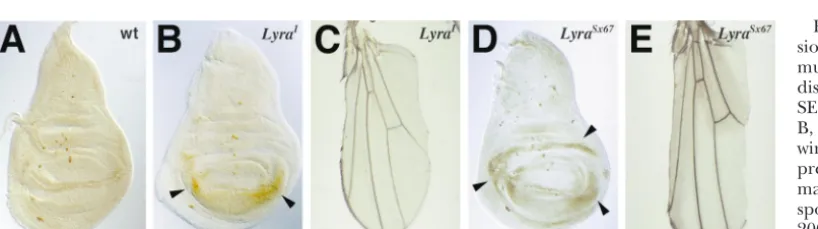
mutant wing discs. As shown in Figure 1D, the ectopic sion of GAL4 are lethal in the presence ofUAS-senseless. As shown in Figure 2, A and B, ectopic expression of expression of SENSELESS surrounding the anterior and
posterior margin precursors in the wing pouch of SENSELESS in the wing disc using the C1003-GAL4 driver causes a phenotype that is similar to that observed LyraSx67/⫹ is even more pronounced than in that of
Lyra1/⫹wing discs. The difference in expression levels in Lyra mutants in that the wing margins are severely
affected whereas the rest of the wing is unaffected. As is also observed with in situ hybridizations (data not
shown). These expression levels correlate positively with shown in Figure 2, C and D, expression of SENSELESS in a domain that corresponds to the wing margin using the loss of wing tissue in the anterior and posterior wing
margin as the phenotype is more severe in LyraSx67/⫹ theC96-GAL4driver (GustafsonandBoulianne1996)
also causes a loss of wing margin. In this case the loss wings (Figure 1E) than in those of Lyra1/⫹ (Figure
1C). Hence, these data indicate that the anterior and is not as severe as that induced by the more ubiquitous driver. These observations clearly show that ectopic ex-posterior margins of the presumptive wing are highly
sensitive to ectopic SENSELESS expression and suggest pression of SENSELESS is sufficient to cause loss of wing margin tissue. Conversely, they indicate that other areas that the wing margin loss inLyramutants may well be
triggered by ectopic SENSELESS. of the wing disc do not respond to ectopic SENSELESS expression with tissue loss. Instead, as reported pre-Ectopic expression of SENSELESS causes loss of wing
margin: To demonstrate that ectopic expression of viously (Noloet al.2000), we consistently observed that
ectopic SENSELESS causes scattered supernumerary SENSELESS can mimic the Lyra phenotype, we
con-structed flies that carried different UAS-senseless trans- bristles on nonmargin surfaces of adult wings. More-over, ectopic expression of SENSELESS in wing discs, genes under the control of GAL4 drivers that express
Figure 1.—Overexpres-sion of SENSELESS inLyra
mutants. Third instar wing discs were stained with anti-SENSELESS antibodies (A, B, and D). (A) Canton-S wing disc. Note that the ex-pression is confined to many single cells that corre-spond to SOPs (Noloet al.
Figure 2.—Ectopic expression of SENSELESS affects the wing margin. Third instar wing discs (A and C). Wings (B and D). (A)
C1003-GAL4/UAS-lacZ wing disc stained with anti--galactosidase. Note the scattered lacZ expres-sion. (B)C1003-GAL4/UAS-sens(C6)
wing. Although SENSELESS is ex-pressed in many of the wing pouch cells, tissue loss is mostly obser-ved at the wing margin. (C) C96-GAL4/UAS-lacZwing disc stained with anti--galactosidase.lacZ ex-pression is confined to the wing margin and adjacent cells. (D)
C96-GAL4/UAS-sens(C5)wing dis-plays some wing margin loss. The loss is more severe in the distal and posterior area of the wing.
using a dpp-GAL4 driver, resulted in large clusters of antibody shows a different pattern of expression inLyra wing discs in the anterior and posterior area of the wing extra bristles on the notum as well as parts of the wing
surface. In leg discs, this driver caused a severe loss of pouch when compared to wild type (Figure 3G). We do not know what underlies this altered pattern, but Figure all distal parts of the leg (data not shown). We conclude
that ectopic expression of SENSELESS causes very dif- 3A suggests that it may be due to loss of VESTIGIAL expression at the dorso-ventral boundary. Since loss-of-ferent phenotypes: loss of tissue in some areas of
imagi-nal discs and extra sensory organs in others. function clones ofvestigial(vg⫺/vg⫺) do not proliferate in the wing (Kimet al. 1996), the loss of wing margin
Lyra mutations cause loss of DELTA, VESTIGIAL,
WINGLESS, and CUT expression: To determine the tissue inLyramutants could be caused by a partial loss
of VESTIGIAL expression at the anterior and posterior effects ofLyramutations on the expression of key genes
that have been shown to play important roles in wing wing boundary. This in turn may cause loss of cell prolif-eration during pupal wing development.
development we tested four markers. Thevestigialgene
can be viewed as the wing selector gene as its lack of In addition tovestigial,winglesshas also been shown to play an essential role in wing development (Baker expression causes wing loss and its ectopic expression
causes extra wing tissue (Kimet al. 1996). VESTIGIAL 1988). WINGLESS protein is secreted and is produced in a stripe of three to four cell rows stradling the dorso-expression at the dorso-ventral boundary is essential to
wing margin development. Furthermore, vestigial is a ventral boundary (Williams et al. 1993; Couso et al. 1994). The stripe of WINGLESS-expressing cells in-marker for wing identity and has an important function
in wing growth (Kimet al.1996;NeumannandCohen duces neighboring cells to differentiate into the bristles that are present at the wing margin (Phillips and 1996;KleinandMartinez Arias1999).
We tested the effect of both Lyra mutants on the Whittle 1993; Couso et al. 1994). Removing WING-LESS in second or early third instars results in the loss expression pattern oflacZdriven by thevestigial
bound-ary enhancervgBE (Williamset al.1994). As shown in of tissue from the wing margin (Cousoet al.1994; Diaz-Benjumea and Cohen 1995; Neumann and Cohen Figure 3, A and F, lacZ expression of the boundary
enhancer is almost entirely lost in the anterior and pos- 1996). The role of WINGLESS with respect to regulation of VESTIGIAL expression at the dorso-ventral boundary terior portion of the wing pouch ofLyra1but is restored
in the revertant, which has the same pattern of expres- is still controversial (Goet al.1998;KleinandMartinez Arias 1999). However, it is fairly clear that NOTCH sion as the wild-type adult wing. The pattern is similar
inLyraSX67(data not shown), except that slightly more signaling is the primary inducer ofvgBE. Hence,
WING-LESS expression inLyramutants may provide an inde-prospective margin is missing, in agreement with the
more severe margin loss in the adult wing.Lyrahas no pendent means to assess the effect ofLyramutations on wing development. As shown in Figure 3C, WINGLESS effect on the vestigial quadrant enhancer,vgQE (data
not shown), which controls later VESTIGIAL expression expression is severely reduced in the anterior and poste-rior domain of the wing pouch ofLyra mutants (com-and growth of the nonmargin portion of the wing pouch
(Williamset al.1993, 1994;Kimet al.1996). In this case pare with Figure 3H). With exception of the central domain of the dorso-ventral boundary, where WING-VESTIGIAL is expressed throughout the wing blade but
Figure3.—Loss of vestigial, Wingless, Cut, and Delta in third instar wing discs ofLyramutants. Third instar wing imaginal discs ofLyramutants (A–E) and controls (F–J). (A and F)Lyra/⫹;vgBE-lacZ/⫹(A) and aLyraSx67revertant (F) stained with X-gal. Note the loss oflacZexpression in the anterior and posterior wing margin in A. (B and G)LyraSx67/⫹wing disc stained with anti-VESTIGIAL antibodies shows aberrant staining in mutants when compared to wild-type disc (G). (C and H)Lyra1/⫹and wild-type discs stained with anti-WINGLESS (C). (D and I)LyraSx67/⫹(D) and wild-type disc (I) stained with anti-CUT. Note the loss of CUT staining in the anterior and posterior wing pouch (D). (E and J) Anti-DELTA staining ofLyraSx67/⫹(E) and control ( J) discs.
domain in which levels of Wingless protein are reduced cause of high background levels. As shown in Figure 3E, there is an obvious reduction in the expression of severely. Since WINGLESS is an important secreted
fac-tor for wing margin development, this reduction in ex- DELTA in the anterior and posterior wing pouch along the presumptive wing margin (compare to Figure 3J). pression inLyramutants may act in an additive fashion
with the loss or severe reduction of VESTIGIAL expres- Hence, one of the key known activators of NOTCH signaling at the dorso-ventral boundary is altered and sion.
Given the similarities between the loss of wing margin reduced in its expression pattern. In summary, four known markers that have previously been shown to be tissue in somecutandLyramutants (JackandDelotto
1992) we also investigated CUT expression inLyramu- required for the development of the wing margin and the rows of bristles along the margin are not expressed tants. CUT is expressed in a row that is two to five cells
wide at the dorso-ventral boundary (Jack et al. 1991; properly inLyra mutants. In addition, the domains of expression that are affected in these mutants corre-Blochlinger et al. 1993). This expression is largely
overlapping with that of WINGLESS and the vestigial spond to the domains that are affected inLyramutant discs and adult wings and are contained within the do-boundary enhancer (Williams et al.1994) but occurs
in the mid-third instar, much later than either WING- mains in which SENSELESS is expressed ectopically. These data suggest that ectopic expression of SENSE-LESS or vgBE. Loss of CUT expression on both sides
of the wing boundary results in extensive notching of LESS inLyramutants may be able to downregulate the expression of several genes that play a pivotal role in the margin (Jack et al.1991; Dorsett 1993). cut has
been shown to be a direct target of Notch, but not of wing margin development, possibly by downregulating NOTCH signaling.
wingless(Micchelliet al.1997). In addition, while the
initiation of WINGLESS expression is not dependent Ectopic expression of SENSELESS affects
WING-LESS and CUT expression:To further investigate the
oncut, maintenance of WINGLESS expression is
depen-dent oncut(Micchelliet al.1997). As shown in Figure ability of SENSELESS to downregulate the expression of specific genes, we tested the effect of ectopic expression 3, D and I, CUT expression is essentially abolished in
Lyra mutants in the anterior and posterior region of of SENSELESS on WINGLESS and CUT expression. Ectopic expression of SENSELESS using theC96-GAL4 the wing pouch.
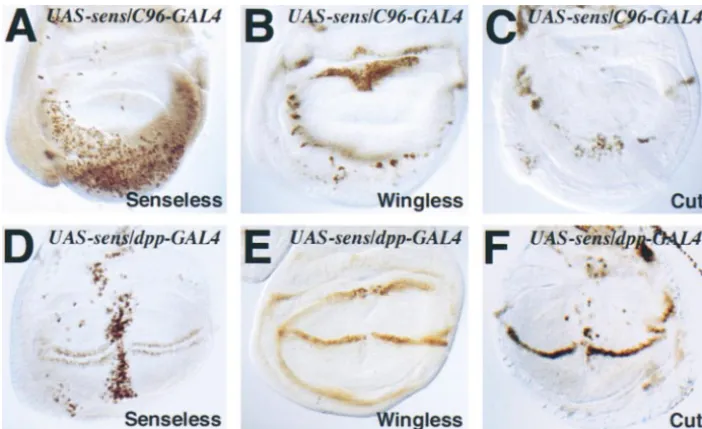
Since NOTCH signaling plays a prominent role in wing margin driver and staining with anti-SENSELESS is shown in Figure 4A. SENSELESS overexpression the regulation of the expression of vgBE,wingless, and
cut (Go et al. 1998), we attempted to determine if causes a dramatic downregulation of WINGLESS (Fig-ure 4B) and CUT protein levels (Fig(Fig-ure 4C), although NOTCH signaling is affected. We stainedLyrawing discs
be-Figure 4.—Ectopic expression of SENSELESS causes loss of WING-LESS and CUT expression. In all pan-els ectopic expression of SENSELESS is achieved using the UAS-sens(C5)
transgene (Noloet al.2000). (A–C) The driver isC96-GAL4, causing ec-topic expression in the wing margin area. (D–F) Ectopic expression is along the anterior-posterior wing boundary using thedpp-GAL4driver. (A–C) Ectopic expression of SENSE-LESS along the wing boundary (A) causes a severe reduction of WING-LESS immunoreactivity (compare Figure 4B with 3H) and CUT staining (compare Figure 4C with 3I). (D–F) Ectopic expression of SENSELESS along the anterior-posterior wing boundary (D) causes a small gap in WINGLESS (E) and CUT (F) expres-sion. In addition, in other areas of the disc, CUT is ectopically expressed in cells where it is not normally ex-pressed (F). This gap in WINGLESS and CUT expression causes a loss of the distal wing margin (data not shown).
GAL4 driver to ectopically express SENSELESS along Lyrawing development begins shortly after pupariation and continues during the first half of pupal develop-the anterior-posterior wing boundary (Figure 4D) we
find a precise disruption in the continuity of WINGLESS ment (AbbottandSprey1990). This is the time win-dow in normal development when differentiation of (Figure 4E) and CUT (Figure 4F) expression where the
dppstripe is normally expressed. This downregulation bristles and trichomes takes place as well. To further examine how ectopic SENSELESS affects wing margin correlates with a loss of the distal tip of the wing (data
not shown). Note also that ectopic SENSELESS expres- specification and differentiation duringLyrawing devel-opment we have studied the expression pattern of sion causes ectopic CUT expression in some cells of
the wing pouch that normally do not express CUT, as SCUTE and string.
scute is a proneural gene belonging to the achaete/ expected from previous observations (Noloet al.2000).
In summary, these data demonstrate that ectopic expres- scute complex and a basic Helix Loop Helix (bHLH) transcription factor required for determination of SOPs sion of SENSELESS in the wing margin is a potent
re-pressor of expression of key players previously shown in the anterior wing margin (Skeath and Carroll 1991). We observe a downregulation of SCUTE expres-to function in wing margin development.
Margin loss inLyramutants:The loss of wing margin sion in the anterior pouch of the wing disc (Figure 5,
A and B). Indeed, inLyraSx67wings, there are few SOPs
inLyramutants can be viewed as the sum of two
compo-nents. The first component is an effect on margin deter- expressing SCUTE at the anterior wing margin (Figure 5B). This is in sharp contrast to ectopic expression of mination in the developing wing disc. Indeed, our data
are in agreement with numerous observations showing senselessin other epithelial cells of the wing disc where it causes induction of SCUTE expression (Noloet al. that loss of NOTCH signaling causes loss of expression
in the wing margin of the patterning geneswinglessand 2000).
The failure to form SOPs in the wing discs of Lyra vestigial(Cousoet al.1995;Diaz-BenjumeaandCohen
1995;Kimet al.1995, 1996;RulifsonandBlair1995; mutants predicts that the set of two cell divisions re-quired for differentiation of margin bristles in the early De Celiset al.1996;Dohertyet al.1996). The second
component corresponds to an effect on cell prolifera- pupa will not take place. The reason for the loss of the surrounding unspecialized margin cells in the adult tion. Indeed, loss and gain of NOTCH signaling
experi-ments have been shown to cause a severe decrease and wings of Lyra is not as obvious, but one hypothesis is that these cells also fail to proliferate. To test this we increase in cell proliferation, respectively (Go et al.
1998). Our data suggest that loss of DELTA causes a examined the mRNA expression pattern ofstring. string mRNA is normally expressed in the central cells of both loss of NOTCH signal and a loss of cell proliferation in
proneural SOP determinantsacheateandscute.In addi-tion, CUT expression in third instar discs has been shown to be dependent on WINGLESS expression, while CUT is also required for the maintenance of WINGLESS expression (Neumann and Cohen 1996, 1997). Since CUT is essential for all wing margin bristles, both innervated and noninnervated (Jacket al.1991), we propose that the combined reduction in WINGLESS and CUT expression inLyramutants may cause a sec-ondary reduction in proneural gene expression in the wing margin, as revealed by SCUTE staining. This reduc-tion in expression should lead to a loss of numerous bristles in the anterior and posterior wing margin. How-ever, these observations do not provide a rationale for the loss of wing blade cells adjacent to the margin, which are also observed inLyra mutants.
Figure5.—Expression of SCUTE and stringinLyra wing Kimet al.(1996) have provided compelling evidence discs. Third instar wing discs of wild-type (A and C) and
thatvestigialcan be viewed as a “wing selector” gene, a LyraSx67/⫹ larvae (B and D). (A and B) Mutant discs show
view that is supported by the observation that its ectopic decreased levels of SCUTE expression in the anterior wing
expression can rescue loss of WINGLESS (Kleinand margin (B). Hence, ectopic expression of SENSELESS can
lead to an induction of SCUTE in some domains of the wing Martinez Arias1999). Loss of VESTIGIAL in the wing disc (Noloet al.2000) and loss of SCUTE in other areas. (C disc causes also a failure of wing cells to proliferate (Kim and D)In situhybridizations withstring.Note the loss ofstring
et al.1996). Goet al.(1998) andKleinandMartinez in the anterior and posterior wing margin (D).
Arias(1999) have recently proposed a model of wing development in which thevgBE is induced by NOTCH signaling when and where WINGLESS is active at the third instar larval stage (Johnston and Edgar 1998)
even though margin cells are arrested at that time and developing wing margin. It has been proposed that the cell proliferation does not begin until early pupariation. main function of WINGLESS is to enforce gene expres-Our in situexperiments with string confirmed this ex- sion in the wing disc rather than to initiate it. Hence, pression pattern in wild-type discs. But in Lyra third the combined loss ofvestigialexpression at the boundary instar wing discs the mitosis-inducing phosphatase and the strong reduction in WINGLESS expression at STRING (Cdc25) is severely downregulated in the ante- the wing margin may affect cell proliferation and cell rior and posterior area of the prospective wing margin identity not only in the wing margin, but also in a few as indicated byin situ hybridization (Figure 5D). This cell rows adjacent to the anterior and posterior wing is consistent with an overall lack of proliferation in the margin. This model is in agreement with the observation anterior and posterior margin region. However, it is also that we find no alterations in the expression pattern of possible that the non-bristle-forming cells are present in the quadrant enhancer ofvestigialinLyramutants (data the wing margin, but that they lose their capacity to not shown) and thatLyrawing discs exhibit a dramatic flatten and secrete margin elements (trichomes), which reduction in string expression in the cells along the serve as the visible hallmark of each cell. This could be dorso-ventral boundary (Figure 5, C and D). Sincestring caused by their lack of exposure to the sequence of has been shown to induce mitosis, and sinceLyra mu-proteins required for determination of the wing margin. tants exhibit no cell death and a loss of cells in pupal development, we propose a causal relationship between these observations. At the root of the Lyra phenotype DISCUSSION
may be the observation that the DELTA signal is im-The data presented in this article provide strong evi- paired, which should lead to a decrease in NOTCH dence that Lyra mutations are gain-of-function/neo- signaling. This decrease may explain the loss of WING-morphic alleles of senseless that cause overexpression LESS, VESTIGIAL, and CUT expression, which have all of senseless in third instar imaginal discs. This ectopic previously been shown to depend on NOTCH signaling. expression ofsenselesscauses a loss of anterior and poste- We propose that this defect inLyra mutants underlies rior wing margin tissue. The data presented in this arti- the effect on margin determination in the developing cle provide a molecular framework to understand this wing disc and the reduction in cell proliferation in early
phenotype. pupae.
Wingless is required for differentiation of bristles late
specification and is regulated by a distant enhancer. Development tute. This work was supported in part by a NASA grant to H.J.B. and
113:735–747. Huda Zogbhi.
Johnston, L. A.,andB. A. Edgar,1998 Wingless and Notch regulate cell-cycle arrest in the developing Drosophila wing. Nature394:
82–84.
Kim, J., K. D. IrvineandS. B. Carroll, 1995 Cell recognition,
LITERATURE CITED
signal induction, and symmetrical gene activation at the dorsal-ventral boundary of the developingDrosophilawing. Cell82:795–
Abbott, L. A.,1986 Restoration of wing margins inLyramutants
ofDrosophila melanogaster.Dev. Biol.115:233–248. 802.
Kim, J., A. Sebring, J. J. Esch, M. E. Kraus, K. Vorwerket al., 1996
Abbott, L. A.,andT. E. Sprey,1990 Components of positional
information in the developing wing margin of theLyramutant Integration of positional signals and regulation of wing formation and identity byDrosophila vestigialgene. Nature382:133–138. ofDrosophila.Roux’s Arch. Dev. Biol.198:448–459.
Artavanis-Tsakonas, S., M. D. RandandR. J. Lake,1999 Notch Klein, T.,andA. Martinez Arias,1999 The Vestigial gene product provides a molecular context for the interpretation of signals signaling: cell fate control and signal integration in development.
Science284:770–776. during the development of the wing inDrosophila.Development
126:913–925.
Baker, N. E.,1988 Embryonic and imaginal requirements for
wing-less, a segment-polarity gene inDrosophila.Dev. Biol.125:96–108. Lindsley, D. L.,andG. G. Zimm,1992 The genome ofDrosophila melanogaster.Academic Press, San Diego.
Bellen, H. J., C. J. O’Kane, C. Wilson, U. Grossniklaus, R. K.
Pearsonet al., 1989 P-element-mediated enhancer detection: Lindsley, D. L., L. Sandler, B. S. Baker, A. T. C. Carpenter, R. E. Denellet al., 1972 Segmental aneuploidy and the genetic gross a versatile method to study development inDrosophila. Genes
Dev.3:1288–1300. structure of theDrosophilagenome. Genetics71:157–184.
Micchelli, C. A., E. J. RulifsonandS. S. Blair,1997 The function
Blair, S. S.,1994 A role for the segment polarity geneshaggy-zeste
white 3in the specification of regional identity in the developing and regulation ofcutexpression on the wing margin ofDrosophila: Notch, Wingless and a dominant negative role for Delta and wing ofDrosophila.Dev. Biol.162:229–244.
Blochlinger, K., L. Y. JanandY. N. Jan,1993 Postembryonic pat- Serrate. Development124:1485–1495.
Muller, H. J.,1932 Further studies on the nature and causes of terns of expression ofcut, a locus regulating sensory organ identity
inDrosophila.Development117:441–450. gene mutations. Proceedings of the 6th International Congress of Genetics1:213–255.
Bodmer, R., S. Barbel, S. Shepherd, J. W. Jack, L. Y. Janet al., 1987
Transformation of sensory organs by mutations of thecutlocus Neumann, C. J.,andS. M. Cohen,1996 A hierarchy of cross-regula-tion involvingNotch,wingless,vestigialandcutorganizes the dorsal/ ofD. melanogaster.Cell51:293–307.
Brook, W. J., F. J. Diaz-BenjumeaandS. M. Cohen,1996 Organiz- ventral axis of theDrosophilawing. Development122:3477–3485.
Neumann, C. J.,andS. M. Cohen,1997 Long-range action of Wing-ing spatial pattern in limb development. Annu. Rev. Cell Dev.
Biol.12:161–180. less organizes the dorsal-ventral axis of theDrosophilawing. Devel-opment124:871–880.
Cohen, B., M. E. McGuffin, C. Pfeifle, D. SegalandS. M. Cohen,
1993 apterous: a gene required for imaginal disc development in Nolo, R., L. A. AbbottandH. J. Bellen,2000 Senseless, a Zn finger transcription factor, is necessary and sufficient for sensory
Drosophilaencodes a member of the LIM family of developmental
regulatory proteins. Genes Dev.6:715–729. organ development inDrosophila.Cell102:349–362.
Phillips, R. G.,andJ. R. S. Whittle,1993 winglessexpression
medi-Couso, J. P., S. A. BishopandA. Martinez Arias,1994 The wingless
signalling pathway and the patterning of the wing margin in ates determination of peripheral nervous system elements in late stages ofDrosophila wing disc development. Development118:
Drosophila.Development120:621–636.
Couso, J. P., E. KnustandA. Martinez Arias,1995 Serrateand 427–438.
Rulifson, E. J.,andS. S. Blair,1995 Notchregulateswingless
expres-winglesscooperate to inducevestigialgene expression and wing
formation in Drosophila. Curr. Biol.5:1437–1448. sion and is not required for reception of the paracrinewingless
signal during wing margin neurogenesis inDrosophila.
Develop-Coyne, J.,1935 Crossing-over within a closely linked group of genes
near locus 40.4 of chromosome 3. Dros. Inf. Serv.4:59. ment121:2813–2824.
Salzberg, A., D. D’Evelyn, K. L. Schulze, J.-K. Lee, D. Strumpfet
De Celis, J. F., A. Garcia-BellidoandS. Bray,1996 Activation
and function ofNotchat the dorsoventral boundary in theDrosoph- al., 1994 Mutations affecting the pattern of the PNS inDrosophila
reveal novel aspects of neuronal development. Neuron13:269–
ilawing imaginal disc. Development122:359–369.
Diaz-Benjumea, F. J.,andS. M. Cohen,1995 Serrate signals through 287.
Salzberg, A., S. N. Prokopenko, Y. He, P. Tsai, M. Palet al., 1997 Notch to establish a Wingless-dependent organizer at the dorsal/
ventral compartment boundary of theDrosophilawing. Develop- P-element insertion alleles of essential genes on the third chromo-some of Drosophila melanogaster: mutations affecting embryonic ment121:4215–4225.
Doherty, D., G. Feger, S. Younger-Shepherd, L. Y. JanandY. N. PNS development. Genetics147:1723–1741.
Skeath, J. B.,andS. B. Carroll,1991 Regulation ofachaete-scute
Jan,1996 Delta is a ventral to dorsal signal complementary to
Serrate, another Notch ligand, in Drosophila wing formation. gene expression and sensory organ pattern formation in the Genes Dev.10:421–434. Drosophilawing. Genes Dev.5:984–995.
Dorsett, D., 1993 Distance-independent inactivation of an en- Spradling, A. C., D. Stern, A. Beaton, E. J. Rhem, T. Laverty,et al., hancer by the suppressor of Hairy-wing DNA-binding protein of 1999 The Berkeley Drosophila Genome Project gene disruption
Drosophila.Genetics134:1135–1144. project. SingleP-element insertions mutating 25% of vital
Dro-Fristrom, D.,1968 Cellular degeneration in wing development of sophila genes. Genetics153:135–177.
the mutant vestigial ofDrosophila melanogaster.J. Cell Biol. 39: Sturtevant, M. A.,andE. Bier,1995 Analysis of the genetic
hierar-488–491. chy guiding wing vein development inDrosophila.Development
Fristrom, D.,1969 Cellular degeneration in the production of some 121:785–801.
mutant phenotypes inDrosophila melanogaster.Mol. Gen. Genet. Williams, J. A., S. W. PaddockandS. B. Carroll,1993 Pattern
103:363–379. formation in a secondary field: a hierarchy of regulatory genes
Go, M. J., D. S. EastmanandA. Artavanis-Tsakonas,1998 Cell subdivides the developingDrosophilawing disc into discrete subre-proliferation control by Notch signaling in Drosophiladevelop- gions. Development117:571–584.
ment. Development125:2031–2040. Williams, J. A., S. W. Paddock, K. VorwerkandS. B. Carroll, Gustafson, K.,andG. L. Boulianne,1996 Distinct expression pat- 1994 Organization of wing formation and induction of a wing-terns detected within individual tissues by the GAL4 enhancer patterning gene at the dorsal/ventral compartment boundary. trap technique. Genome39:174–182. Nature368:299–305.
Jack, J.,andY. Delotto,1992 Effect of wing scalloping mutations Zhimulev, I. F.,andM. S. Feldman,1982 Genetic loci in theLyra -oncutexpression and sense organ differentiation in theDrosophila deficiency region of theD. melanogaster3L chromosome. Dros.
wing margin. Genetics131:353–363. Inf. Serv.58:152.
Jack, J., D. Dorsett, Y. DelottoandL. Liu,1991 Expression of