Copyright © 1998 by the Genetics Society of America
Genetics 148: 893–904 ( February, 1998)
Genetic Conflicts, Multiple Paternity and the Evolution
of Genomic Imprinting
Hamish G. Spencer,* Marcus W. Feldman
†and Andrew G. Clark
‡*Department of Zoology, University of Otago, Dunedin, New Zealand, †Department of Biological Sciences, Stanford University, Stanford, California 94305, and ‡Department of Biology, Pennsylvania State University, University Park, Pennsylvania 16802
Manuscript received May 12, 1997 Accepted for publication October 8, 1997
A B S T R A C T
We present nine diallelic models of genetic conflict in which one allele is imprintable and the other is not to examine how genomic imprinting may have evolved. Imprinting is presumed to be either maternal (i.e., the maternally derived gene is inactivated) or paternal. Females are assumed to be either completely monogamous or always bigamous, so that we may see any effect of multiple paternity. In contrast to previ-ous verbal and quantitative genetic models, we find that genetic conflicts need not lead to paternal im-printing of growth inhibitors and maternal imim-printing of growth enhancers. Indeed, in some of our mod-els—those with strict monogamy—the dynamics of maternal and paternal imprinting are identical. Multiple paternity is not necessary for the evolution of imprinting, and in our models of maternal imprint-ing, multiple paternity has no effect at all. Nevertheless, multiple paternity favors the evolution of paternal imprinting of growth inhibitors and hinders that of growth enhancers. Hence, any degree of multiple pa-ternity means that growth inhibitors are more likely to be paternally imprinted, and growth enhancers ma-ternally so. In all of our models, stable polymorphism of imprinting status is possible and mean fitness can decrease over time. Neither of these behaviors have been predicted by previous models.
Such an advantage has been hypothesized by Haig and his colleagues in terms of genetic conflicts among fathers, mothers and their offspring: “an embryo’s pa-ternal genome is selected to take more resources from maternal tissues than is the embryo’s maternal ge-nome” (Haig 1992). In brief, taking eutherian mam-mals as the model organisms, all the offspring in one (or more) pregnancies have the same mother, and so it is in her best genetic interest to share the resources she passes on equally among them. A father, however, has no such assurance, and so it is in his genetic interest to arrange for his offspring to get more of the resources than others with different fathers. This is a form of pa-rental genetic conflict that depends on the existence of multiple paternity. There is, however, a second possible form of genetic conflict: a form of mother–offspring conflict. All offspring do better if they obtain more of the mother’s resources, but she may improve her repro-ductive success by holding some back for future preg-nancies. In mammals in particular, a mother may have birthing problems if the offspring are too large. There is also a third possible source of genetic conflict be-tween sibs only: it is in each sib’s interest to obtain more resources at the expense of other siblings.
As a result of the first of these conflicts, it was pre-dicted that growth enhancers acting early in develop-ment will be maternally inactivated, whereas growth in-hibitors will be paternally inactivated (Haig 1992; Haig and Graham 1991). This prediction appears to be well supported. For example, Igf-2 is a growth en-Corresponding author: Andrew G. Clark, Department of Biology,
Pennsylvania State University, University Park, PA 16802. E-mail: [email protected]
ENOMIC imprinting is the differential expression of genes, depending on the sex of the parent from which they were inherited (Barlow 1995; John and Surani 1996; Franklinet al. 1996). In its typical form, imprinting is the nonexpression in at least some tissues for some period of development of a paternally or maternally derived gene. The best known example is that of insulin-like growth factor II (Igf-2) in humans and mice: in most tissues, only the paternally derived al-lele is expressed and the maternally derived alal-lele is si-lent (Giannoukakiset al. 1993; DeChiaraet al. 1991). This form of non-Mendelian expression thus renders the individual functionally haploid at the imprinted lo-cus. Theoretical arguments suggest that diploidy is strongly favored in organisms with high levels of recom-bination, such as mammals (Otto and Goldstein 1992), leading to the question of how an imprinted sys-tem might arise. Spencer and Williams (1997) showed that without some direct advantage to imprint-ing, the frequency of a modifier gene that caused its target locus to be imprinted would change at a rate only of the order of the mutation rate at the target lo-cus. Hence, they argued, imprinting is unlikely to spread unless there is some direct selective advantage to being imprinted.
894 H. G. Spencer, M. W. Feldman and A. G. Clark
hancer that in most tissues is normally maternally im-printed (i.e., only the paternal copy is active) in both mice and humans. Igf-2 receptor (Igf2-r) is a growth in-hibitor that in mice is only maternally expressed. In humans, however, Igf2-r appears to be polymorphically imprinted: some small number of individuals have mono-allelic expression, but most are bimono-allelic (Xuet al. 1993). One explanation for this difference between mice and humans invokes different levels of multiple paternity in the two species (Xu et al. 1993). After studying some quantitative models, Mochizuki et al. (1996) claimed that multiple paternity was essential for the evolution of imprinting.
In this paper, we develop a series of explicitly genetic models that incorporate some of the genetic conflicts described above, and we allow females to be either mo-nogamous or bigamous so that we can assess the role of multiple paternity. (A classification of the models is shown in Table 1.) We particularly examine the dynamics and stability of a single-locus diallelic system in which allele
A is never inactivated, but allele a is inactivated when passed on by an individual of the imprinting sex (thus permitting either maternal or paternal imprinting). The assumption that an imprinted gene is completely inacti-vated is not crucial, as we note below. Whereas Haig’s models are mostly verbal and often describe the genetic conflicts in terms of game theory, we have chosen to start with explicitly genetic models that allow the evolu-tionary consequences of conflicts to be reflected in changes in genotype frequencies. These different ap-proaches lead to different conclusions (in an analogous way to the optimality and modifier theory approaches for analysis of the evolution of recombination; see Feldmanet al. 1997). Our models also address the criti-cism of Franklinet al. (1996) that Haig’s treatment of the genetic conflict hypothesis does not adequately consider the effects over more than one generation.
M O D E L S
SM1: Sibling conflict, maternal imprinting,
monoga-mous females: We assume each female has two
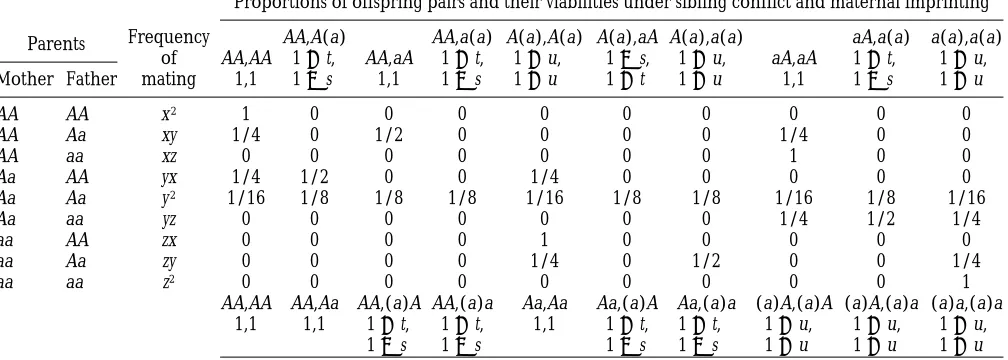
off-spring by the same father, but mating occurs at ran-dom. Imprinting is assumed to be maternal: the a allele is inactivated if passed on by the mother. If both off-spring are imprinted (by which we mean that they carry
an inactivated a allele), they each have viability 1 1 u, relative to 1 for offspring in families without imprint-ing. If one sib is imprinted and the other not, then the relative viabilities are 1 2s and 1 1t. In the case of a growth-enhancing gene like Igf-2, s and t are both posi-tive, since an imprinted offspring is smaller than its un-imprinted sib. If, as a result of both offspring being im-printed, the mother has more resources postpartum to aid the offspring, the value of u would also be positive. It might be argued, however, that u 5 0, since any re-duction in the prore-duction of growth factor could have been selected previously for the same reason, without the evolution of imprinting. Since the algebra does not preclude negative values for any of these parameters, however, we put no restrictions on their signs. Indeed, for a growth inhibitor like Igf2-r, s and t are negative, because imprinting makes the offspring larger. Never-theless, we must have s# 1 and t, u$21.
Let x be the frequency of AA genotypes, y that of Aa
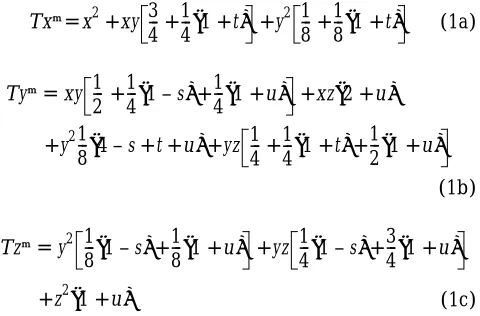
heterozygotes, and z (5 1 2 x 2 y) that of aa geno-types. With the aid of Table 2, in which the paternal al-lele is written first and an imprinted alal-lele is in paren-theses, we derive the following recursions
(1a)
(1b)
(1c)
where T is the mean viability, namely the sum of the right sides of Equations 1a, 1b and 1c. After the algebra,
(1d)
The substitutions and p5x11⁄
2y and q5 1 2p lead to (2a)
(2b)
Tx′ x2+xy 3
4 --- 1
4 ---+ (1+t)
= y2 1
8 --- 1
8 ---+ (1+t)
+
Ty′ xy 1
2 --- 1
4
---(1–s) 1
4 ---(1+u)
+ xz 2( +u)
y21
8
---(4–s+ +t u) yz 1
4 --- 1
4
---+ (1+t) 1
2 ---(1+u)
+
+ +
+ +
=
Tz′ y2 1
8
---(1–s) 1
8 ---(1+u)
+ yz 1
4
---(1–s) 3
4 ---(1+u)
+
z2(1+u)
+
+ =
T 1 (1–x)u 1
4
---(s–t+3u)y.
– +
=
x′ = pB,
y′ = p 1( –B)+qB,
TABLE 1
Classification of models by form of genetic conflict, which sex imprints, and mating system
Sibling conflict Parent–offspring conflict
Maternal imprinting Paternal imprinting Maternal imprinting Paternal imprinting
Females monogamous SM1 SP1 P-OM1 P-OP1
(2c)
(2d)
where B 5 (p 1 yt/4)/T. Since p951⁄
2(p 1 B) at equi-librium 5 , all equilibria have the quasi-Hardy-Weinberg form ( , , ) 5 ( 2,2 , 2). This simpler form of recursion is not surprising in retrospect, since the model is one in which inheritance via the father fol-lows Hardy-Weinberg assumptions (hence the p and q terms in Equations 2, a–d) with selective differences arising only through the effect of maternally inherited genes (hence the terms with B). For example, in con-structing the equation for x9, an A allele must be inher-ited from the father, which occurs at frequency p, and similarly one must be inherited from the mother. This also occurs at a frequency p, but there is also a selective advantage, t, to those with an imprinted sib, namely one quarter of those with a heterozygous mother.
There are three equilibria of this system: two trivial ones at which A and a, respectively, are fixed, and the third is given by
(3)
which is feasible (i.e., 0 # , , # 1) if and only if 2s , 2u , t or both inequalities are reversed. We can deter-mine the (local) stability of any one of these equilibria by examining the leading eigenvalue of the system lin-earized around that equilibrium. Near fixation of A [i.e., (x, y, z) 5 (1, 0, 0)], the leading eigenvalue is 1 2 1⁄
4(s 2 u). Thus, a population fixed for A is stable to in-vasion by a alleles if u , s. (If u 5 s, a consideration of the quadratic terms of the expansion shows that the
re-z′ = q 1( –B),
t 1 qu y1
4
---(t–s–u),
+ +
=
ˆ
p Bˆ
ˆ
x ˆy ˆz pˆ pˆq ˆqˆ
xˆ (2u–t)
2
s–t+u
( )2
---, yˆ 2 2u( –t)(s–u)
s–t+u
( )2
---, zˆ (s–u) 2
s–t+u
( )2
---= ,
= =
ˆ
x ˆy ˆz
quirement for stability is t . 2u.) If the inequality is re-versed, a will invade at a rate proportional to the differ-ence u 2 s. Similarly, near fixation of a, the leading eigenvalue is
and A will invade if t . 2u. (If t 5 2u, the quadratic terms of the expansion show that the requirement for stability is u . s. Note that this condition is simply the invasibility condition at the other fixation.)
The stability of the internal equilibrium depends on the leading eigenvalue
(4)
Feasibility of the equilibrium implies that either the de-nominator of the right-hand term is negative and the numerator is positive (when 2s , 2u , t), or both are positive (when the inequalities are reversed). Thus, the polymorphic equilibrium is stable and feasible only when both fixation equilibria are unstable.
This analysis proves local stability, but in fact, as we now show following the method of Karlin (1972), the internal equilibrium is globally stable whenever it is lo-cally stable. We first require that the transformation
F(p,B) 5 (p9,B9) be bimonotonic, by which we mean that if both p # and B # , then we have that both p9 # 9 and B9# with strict inequality unless both p 5 and B 5 . Since it can be shown that all four partial derivatives p9/p, p9/B, B9/B and B9/p are
posi-tive, F is indeed bimonotonic. Second, we require just one internal equilibrium. Third, we require that both fixation equilibria are locally unstable if the internal equilibrium is locally stable. Thus, all populations that
1 t–2u 4 1( +u)
---, +
λi 1
2u–t
( )(s–u)
4 s( –t+u)+2t s( –u)
---. +
=
˜
p B˜
˜
p B˜
˜
p B˜
TABLE 2
Mating table when females are monogamous
Parents Frequency of mating
Proportions of offspring pairs and their viabilities under sibling conflict and maternal imprinting
AA,AA 1,1
AA,A(a) 1 1 t, 1 2 s
AA,aA 1,1
AA,a(a) 1 1 t, 1 2 s
A(a),A(a) 1 1 u, 1 1 u
A(a),aA 1 2 s, 1 1 t
A(a),a(a) 1 1 u, 1 1 u
aA,aA 1,1
aA,a(a) 1 1 t, 1 2 s
a(a),a(a) 1 1 u, 1 1 u Mother Father
AA AA x2 1 0 0 0 0 0 0 0 0 0
AA Aa xy 1/4 0 1/2 0 0 0 0 1/4 0 0
AA aa xz 0 0 0 0 0 0 0 1 0 0
Aa AA yx 1/4 1/2 0 0 1/4 0 0 0 0 0
Aa Aa y2 1/16 1/8 1/8 1/8 1/16 1/8 1/8 1/16 1/8 1/16
Aa aa yz 0 0 0 0 0 0 0 1/4 1/2 1/4
aa AA zx 0 0 0 0 1 0 0 0 0 0
aa Aa zy 0 0 0 0 1/4 0 1/2 0 0 1/4
aa aa z2 0 0 0 0 0 0 0 0 0 1
AA,AA AA,Aa AA,(a)A AA,(a)a Aa,Aa Aa,(a)A Aa,(a)a (a)A,(a)A (a)A,(a)a (a)a,(a)a 1,1 1,1 1 1 t,
1 2 s
1 1 t, 1 2 s
1,1 1 1 t, 1 2 s
1 1 t, 1 2 s
1 1 u, 1 1 u
1 1 u, 1 1 u
are not fixed for one allele move away from the fixa-tions (because they are locally unstable) without cy-cling (because of the bimonotonicity) all the way (be-cause of the uniqueness of the internal equilibrium and bimonotonicity) to the polymorphic equilibrium (because it is locally stable). In other words, the inter-nal equilibrium is globally stable.
We can easily show, however, that the mean viability,
T, need not increase or be maximized at equilibrium
(see Figure 1 for some numerical examples), even when the internal equilibrium is feasible and stable. Moreover, even though all equilibria have a quasi-Hardy-Weinberg form, the value of T restricted to such points is not maximized at equilibrium. To show this property, we substitute y 5 2pq into Equation 2d, differ-entiate T with respect to q, equate the result to zero and solve for q, giving q˜ 5 (t 2 s 1 u)/2(t 2 s 2 u) ± .q˜
(Since 2T/q25 u 1 s 2 t , 0 when the internal equi-librium exists, we are sure of a maximum rather than a minimum. Of course, if is not between 0 and 1, T will be maximized at either q 5 0 or 1.)
In summary, a population will be stably nonimprint-ing if the advantage of two imprinted sibs is less than the disadvantage of an unimprinted individual with an imprinted sib (i.e., u , s). If this advantage is greater, then an imprintable allele will invade, but it will only move to fixation if this advantage is more than half that of an imprinted individual with an unimprinted sib (i.e., 2u . t). It is particularly worth noting that (1) multiple paternity is not necessary for the evolution of imprinting and (2) imprinted sibs may have greater via-bilities than unimprinted sibs (i.e., u . 0) and yet im-printing may still not evolve.
A growth-enhancing gene is likely to be maternally imprinted if (0 ,) s , u and (0 ,) t , 2u. But a growth inhibitor may also be maternally imprinted, provided that s , u and t , 2u. Since a growth inhibitor would likely have negative values for s and t, if u is positive (which will be true if larger offspring have little effect on the mother), these conditions will always be ful-filled. In other words, if imprinting is beneficial both for a single sib and for two sibs, it is likely to be fixed. Thus, sibling conflict does not predict the paternal and maternal imprinting of, respectively, growth inhibitors and enhancers.
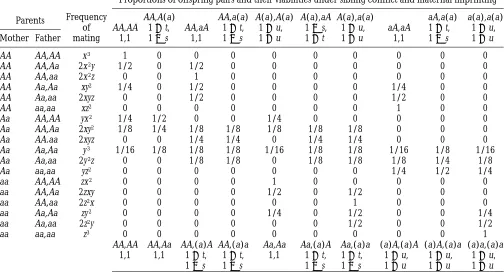
SM2: sibling conflict, maternal imprinting, bigamous females: We now assume that each female has two off-spring by different fathers, leaving all other assump-tions unchanged. With the aid of Table 3 and a little al-gebra, we find that the recursions are identical to those above. The reason for this identity is simply that all pos-sible sibships occur in the same proportions. Thus, not only is multiple paternity unnecessary for the evolution of maternal imprinting if pure sibling conflict is the driving mechanism, but its presence would not help the process.
SP1: sibling conflict, paternal imprinting, monoga-mous females: This model is identical to SM1, except that imprinting is assumed to be paternal, as is the case for Igf2-r in mice. The same mating table (Table 2) ap-plies, except that the offspring are imprinted differ-ently (the bottom lines of the table). This change in the offspring’s imprinting pattern cancels out, however, and again we are left with the recursions shown above (Equation 1). Thus, the conditions for the evolution of paternal imprinting (given sibling conflict as the driv-ing force) are the same as those for maternal imprint-ing. In particular, conditions exist for invasion of both growth enhancers and growth inhibitors that are pater-nally imprinted.
SP2: sibling conflict, paternal imprinting, bigamous females: This model is the obvious parallel to SM2. The recursions, however, are different from the previ-ous three models because the sibships arise from two
˜
q
Figure 1.—Mean viability, T (solid line), and frequency of
fathers who pass on differently imprinted genes (unlike the situation under maternal imprinting). Table 3 and a little algebra give the following recursions
(5a)
(5b)
(5c)
where
(5d)
Tx′ x3 x2y 3
2 --- 1
2
---+ (1+t) x2z 1( +t) y3 1
8 --- 1
8
---+ (1+t) xy2 3
4 --- 1
2 ---+ (1+t)
y2z1
4
---(1+t) xyz 1( +t)
+ +
+ +
+ +
=
Ty′ x2y1
2
---(2–s) x2z 2( –s) y31
8
---(4–s+ +t u)
xy21
4
---(6–2s+ +t u) y2z1
4
---(6–s+2t+2u)
xz2(2+ +t u) yz21
2
---(2+ +t u) xyz 4( –s+ +t u)
+ +
+ +
+ + +
=
Tz′ y31
8
---(2–s+u) xy21
4
---(1–s) y2z1
4
---(5–2s+3u)
z3(1+u) xz2(1–s) yz21
2
---(4–s+3u)
xyz 1( –s),
+ +
+ + +
+ =
T 1 u (s–t+2u) x 1
2 ---y
+
+(s–t+u) x 1 2 ---y
+
2 . –
+ =
Again, the substitutions p 5 x 11⁄
2y and q 5 1 2 p lead to a simpler recursion
(6a)
(6b)
(6c)
(6d)
where C 5 p(1 1 tq)/T. Because p9 5 1⁄
2(p 1 C) we again have that at equilibrium, the genotype frequen-cies are quasi-Hardy-Weinberg. There are again three equilibria, two of which are the fixations, but the third is given by quasi-Hardy-Weinberg equations that differ from Equation 3
(7)
Near fixation of A (i.e., x 5 1), the leading eigen-value of the linearized system is 1 21⁄
2s, and so the re-quirement for the invasion of an imprintable allele is simply that there is an advantage to the imprinted sib of an unimprinted offspring. The cost to the unim-printed offspring is immaterial to the initial invasion of the imprintable allele. (If s 5 0, the quadratic terms of the expansion show that the fixation is stable if t . u, in which case this cost does matter.) Similarly, near fixa-tion of a, the leading eigenvalue is
x′ = pC
y′ = p 1( –C)+qC
z′ = q 1( –C)
T = 1+(t–s)pq+uq2,
xˆ (u–t)
2
s–t+u
( )2
---, yˆ 2s u( –t)
s–t+u
( )2
---, zˆ 4s 2
s–t+y
( )2 ---. =
= =
TABLE 3
Mating table when females have two offspring by different fathers
Parents Frequency of mating
Proportions of offspring pairs and their viabilities under sibling conflict and maternal imprinting
AA,AA 1,1
AA,A(a) 1 1 t, 1 2 s
AA,aA 1,1
AA,a(a) 1 1 t, 1 2 s
A(a),A(a) 1 1 u, 1 1 u
A(a),aA 1 2 s, 1 1 t
A(a),a(a) 1 1 u, 1 1 u
aA,aA 1,1
aA,a(a) 1 1 t, 1 2 s
a(a),a(a) 1 1 u, 1 1 u Mother Father
AA AA,AA x3 1 0 0 0 0 0 0 0 0 0
AA AA,Aa 2x2y 1/2 0 1/2 0 0 0 0 0 0 0
AA AA,aa 2x2z 0 0 1 0 0 0 0 0 0 0
AA Aa,Aa xy2 1/4 0 1/2 0 0 0 0 1/4 0 0
AA Aa,aa 2xyz 0 0 1/2 0 0 0 0 1/2 0 0
AA aa,aa xz2 0 0 0 0 0 0 0 1 0 0
Aa AA,AA yx2 1/4 1/2 0 0 1/4 0 0 0 0 0
Aa AA,Aa 2xy2 1/8 1/4 1/8 1/8 1/8 1/8 1/8 0 0 0
Aa AA.aa 2xyz 0 0 1/4 1/4 0 1/4 1/4 0 0 0
Aa Aa,Aa y3 1/16 1/8 1/8 1/8 1/16 1/8 1/8 1/16 1/8 1/16
Aa Aa,aa 2y2z 0 0 1/8 1/8 0 1/8 1/8 1/8 1/4 1/8
Aa aa,aa yz2 0 0 0 0 0 0 0 1/4 1/2 1/4
aa AA,AA zx2 0 0 0 0 1 0 0 0 0 0
aa AA,Aa 2zxy 0 0 0 0 1/2 0 1/2 0 0 0
aa AA,aa 2z2x 0 0 0 0 0 0 1 0 0 0
aa Aa,Aa zy2 0 0 0 0 1/4 0 1/2 0 0 1/4
aa Aa,aa 2z2y 0 0 0 0 0 0 1/2 0 0 1/2
aa aa,aa z3 0 0 0 0 0 0 0 0 0 1
AA,AA AA,Aa AA,(a)A AA,(a)a Aa,Aa Aa,(a)A Aa,(a)a (a)A,(a)A (a)A,(a)a (a)a,(a)a 1,1 1,1 1 1 t,
1 2 s
1 1 t, 1 2 s
1,1 1 1 t, 1 2 s
1 1 t, 1 2 s
1 1 u, 1 1 u
1 1 u, 1 1 u
so A does not increase if t , u. (If t 5 u, the require-ment is s , 0.)
The third equilibrium is feasible if and only if u , t and s , 0, which are also the conditions for it to be a protected equilibrium, or both inequalities are re-versed. Its leading eigenvalue turns out to be
(8)
which is ,1, and the equilibrium is therefore (locally) stable whenever it is protected.
Because the equation for T can be written in terms of allele frequencies rather than genotype frequencies [i.e., Equation (6d)], this system is simpler than that of SM1. This simplicity arises because the bigamous mat-ing system we use is essentially one of random matmat-ing. One consequence of this relative simplicity is that we can prove that any equilibrium is globally stable when-ever it is locally stable by showing that the recursion for
p is monotonic because monotonicity excludes any
cy-cling. Now, it suffices to show that C is monotonic, which follows from the positivity of C/p. The
condi-tions 0 # p # 1, s # 1, and t, u $ 21 ensure that this quantity is strictly positive, except possibly in biologi-cally uninteresting cases when u 5 21 and either (or both) p 5 0 or s 5 1.
Again, the mean fitness, T, may decrease and need not be maximized at equilibrium. Solving T/p 5 0 gives the value of p that maximizes T, namely 5 (2u 1
s 2 t)/2(u 1 s 2 t) ± . (We can rule out a minimum, since 2T/p25 2(u 1 s 2 t) , 0 whenever the internal equilibrium is stable. If the internal equilibrium does not exist, the system iterates to one of the boundaries.) It is extremely unusual for one-variable, random-mat-ing, viability-selection schemes to neither minimize nor maximize mean fitness.
Comparing the results of SP1 and SP2 allows us to see the effects of multiple paternity. Let us first con-sider a growth inhibitor (i.e., s, t , 0). The invasion of an imprinting allele (a) is clearly more likely under multiple paternity, since the requirement s , 0 is always true if imprinting is advantageous in a mixed sibship, whereas under monogamy, the requirement s , u may not be. Multiple paternity means that the advantage to a solitary imprinted offspring need not be greater than the advantage to each of a pair of imprinted sibs, this difference arising because each member of the pair has a different father. Similarly, near fixation of a, an unim-printable allele (A) will find it harder to invade under multiple paternity even if u , 0, since the condition t .
u is more restrictive than that under monogamy, t . 2u. Thus, multiple paternity favors the evolution and fixa-tion of the paternal imprinting of a growth inhibitor when sibling conflict is the driving force.
1 t–u 2 1( +u)
---, +
λi 1
s u( –t)
2 s 1[ ( +t)+u–t]
---, +
=
˜
p
ˆ
p
For a growth enhancer (i.e., s, t . 0), however, multi-ple paternity retards the evolution of imprinting. The condition for the invasion of a (s , 0) is now contra-dicted, and that for the stability of the fixation of a (t ,
u) is less likely than under monogamy (t , 2u).
P-OM1: parent–offspring conflict, maternal imprint-ing, monogamous females: We now develop a model in which the genetic conflict is between the mother and her offspring, and imprinting is maternal. (An alterna-tive formulation is derived in appendix A.) In the case of a growth enhancer, bearing unimprinted offspring, which requires more maternal resources, has a direct cost to a mother, whereas an imprinted offspring con-fers an advantage on the mother’s viability. For a growth inhibitor, however, imprinting is beneficial to the off-spring but (probably) detrimental to the mother. We will assume that there is no sibling conflict (i.e., no cost to an imprinted individual with an unimprinted sib). We also assume that the A allele is never imprinted, but the
a allele always is imprinted when passed on maternally.
Suppose that an imprinted offspring has viability 1 2
s relative to an unimprinted sibling. Again, we will
as-sume that each female has exactly two offspring by the same father. Further suppose that the increase in a fe-male’s fertility per imprinted offspring is t/2, which we model by assuming that the whole sibship’s viability in-creases by this amount. (In the model of appendix A, this selection pressure acts solely on females.) Thus, for growth enhancers s, t . 0 (and s # 1), while these val-ues are negative for growth inhibitors (although t $ 21). Using Table 2 as the mating table (but with differ-ent selection parameters), we derive the following
(9a)
(9b)
(9c)
where
(9d)
Again, the substitutions p 5 x 1 1⁄
2y and q 5 1 2 p lead to a simpler recursion
(10a)
(10b)
(10c)
(10d)
Tx′ x2 xy 1 1
8 ---t
+
y2 1 4 --- 1
16 ---t
+
,
+ +
=
Ty′ xy 1 1
2 ---s
– 3
8 ---t 3
8 ---st
– +
xz 2( –s+t–st)
y2 1
2 --- 1
4 ---s
– 1
4 ---t 3
16 ---st
– +
yz 1 1
2 ---s
– 5
8 ---t 1
2 ---st
– +
+
+ +
=
Tz′ y2 1
4 --- 1
4 ---s
– 3
16 ---t 3
16 ---st
– +
yz 1–s 7
8 ---t 7
8 ---st
– +
z2(1–s+t–st),
+
+ =
T 1 (t–s–st) 1–x 1
2 ---y
–
1
8 ---sty.
+ +
=
x′ = pD
y′ = p 1( –D)+qD
z′ = q 1( –D)
T 1+(t–s–st)q 1
8 ---sty
+ ,
where D 5 (p 11⁄
8ty)/T. Hence, all equilibria are quasi-Hardy-Weinberg. There are two fixation equilibria, as before, and the third possible internal equilibrium is given by ( , , ) 5 ( 2,2 , 2), where 5 (4s 2 3t 1 4st)/st and 5 (24s 1 3t 2 3st)/st (5 1 2 ), which is feasible whenever
(11)
with the right inequality ignored if s .3⁄
4. Near fixation of A (i.e., x 5 p 5 1), the leading eigenvalue of the lin-earized system is 1 1 (24s 1 3t 2 3st)/8 5 1 1 st/8. Thus, whenever the internal equilibrium is feasible, fix-ation of A is unstable. Similarly, the other fixfix-ation (x 5
p 5 0) is also unstable whenever the internal equilib-rium is feasible, because the leading eigenvalue is
(12)
The leading eigenvalue for the internal equilibrium is li5 1 2 s2/6(1 2 s), and so feasibility implies (lo-cal) stability. The stability conditions are summarized in Figure 2. In short, both growth enhancers and growth inhibitors may evolve to be maternally imprinted under this process, but it is not enough for the parameters s and t to be of the appropriate sign; imprinting only evolves in a subset of the parameter space. Global stabil-ity can be shown in the same manner as for model SM1.
ˆ
x ˆy ˆz pˆ p ˆˆq ˆq pˆ ˆ
q pˆ
4s 3–3s
--- t 4s
3–4s ---,
< <
ˆ
q
λ0 1
pˆst
8 1( –s)(1+t)
---. +
=
ˆ
p ˆq
P-OM2: parent–offspring conflict, maternal imprint-ing, bigamous females: We now assume that each fe-male has two offspring by different fathers, leaving all other assumptions unchanged. Table 3 is the appropri-ate mating table. Again, because all possible sibships occur in the same proportions, model P-OM2 is identi-cal to model P-OM1. Multiple paternity has no effect on the ability of parent–offspring conflict to lead to ma-ternal imprinting.
P-OP1: parent–offspring conflict, paternal imprint-ing, monogamous females: This model is identical to P-OM1, except that imprinting is assumed to be pater-nal. This difference, however, has no effect on the geno-type frequency recursions. Thus, as is the case in our model with sibling conflict, the conditions for the evo-lution of paternal imprinting given parent–offspring conflict as the driving force are the same as those for maternal imprinting. In particular, conditions exist for the invasion of both growth enhancers and growth in-hibitors that are paternally imprinted.
P-OP2: parent–offspring conflict, paternal imprint-ing, bigamous females: This model is the natural ex-tension of P-OP1 to the case in which each pair of off-spring of a female have different fathers. This time, however, as with sibling conflict, multiple paternity does affect the recursions. Using Table 3 as the mating table, we derive the following equations
(13a)
(13b)
(13c)
where
(13d)
Tx′ x3 x2y 2 1
4 ---t
+
x2
z 1 1
2 ---t
+
xy2 5 4 --- 1 4 ---t +
xyz 1 1
2 ---t
+
y3 1 4 --- 1 16 ---t +
y2
z 1 4 --- 1 8 ---t + + + + + + + =
Ty′ x2y 1 1
2 ---s
– 1
4 ---t 1
4 ---st
– +
x2
z 2–s 1
2 ---t 1
2 ---st – +
xy2 3
2 --- 3 4 ---s – 5 8 ---t 1
2 ---st
– +
xz2
2–s 3
2 ---t–st
+
xyz 4–2s 2t 3
2 ---st
– +
y3 1
2 --- 1 4 ---s – 1 4 ---t 3
16 ---st – +
y2z 3
2 --- 3 4 ---s – 7 8 ---t 5
8 ---st
– +
yz2
1 1
2 ---s
– 3
4 ---t 1
2 ---st – + + + + + + + + =
Tz′ xy2 1
4 --- 1 4 ---s – 1 8 ---t 1
8 ---st
– +
xz2
1–s 1
2 ---t 1
2 ---st – +
xyz 1–s 1
2 ---t 1
2 ---st
– +
y3 1
4 --- 1 4 ---s – 3 16 ---t 3
16 ---st – +
y2z 5
4 --- 5
4 ---s
– +t–st
yz2
2–2s 7 4 ---t 7
4 ---st – +
z3(1–s+t–st), +
+ +
+ +
+ =
T (1–s)(1+t) s–t 3
2 ---st
+
x 1
2 ---y
+
1
2 ---st x 1
2 ---y
+
2 . –
+ =
Figure 2.—Regions of parameter space determining
The substitutions p 5 x 11⁄
2y and q 5 1 2 p lead to a simpler recursion
(14a)
(14b)
(14c)
(14d)
where E 5 p(1 11⁄
2tq)/T. Hence, as before, all equilib-ria are quasi-Hardy-Weinberg. There are two fixation equilibria, as before, and the third possible internal equilibrium is given by ( , , ) 5 ( 2,2 , 2), where 5 (2s 2 t 1 2st)/st and 5 (22s 1 t 2 st)/st, which is fea-sible whenever
. (15)
Near fixation of A (i.e., x 5 p 5 1), the leading eigen-value of the linearized system is 1 1 (22s 1 t 2 st)/4 5 1 1 st/4. Thus, whenever the internal equilibrium is feasible, the fixation of A is unstable. Similarly, the other fixation (i.e., x 5 p 5 0) is also unstable whenever the internal equilibrium is feasible, because the leading eigenvalue is
(16)
The leading eigenvalue for the internal equilibrium is li5 1 2 s2/2(1 2 s), so feasibility implies (local) sta-bility. Notice the similarity in form between these eigenvalues and those for P-OM1. The stability condi-tions are summarized in Figure 3.
A comparison of Figures 2 and 3 (or Inequalities 11 and 15) shows that for growth inhibitors (s, t , 0), the likelihood of paternal imprinting is increased by
multi-x′ = pE
y′ = p 1( –E)+qE
z′ = q 1( –E)
T (1–s)(1+t) s–t 3
2 ---st
+
p 1
2 ---stp2, – +
=
ˆ
x ˆy ˆz pˆ p ˆˆq ˆq pˆ ˆ
q
2s 1–s
--- t 2s
1–2s
---< ---<
ˆ
q
λ0 1
pˆst
4 1( –s)(1+t)
---. +
=
ˆ
p ˆq
ple paternity, because the region of parameter space af-fording imprinting under monogamy is a subset of that under bigamy. Similarly, multiple paternity does not fa-vor the evolution of nonimprinting alleles. We cannot, however, deduce the relative likelihood of polymor-phism. The mere size of regions of parameter space does not permit us to make such a deduction, since dif-ferent regions of parameter space need not all have the same prior probability of being encountered. See Spen-cer and Marks (1993) for a fuller explanation. Analo-gously, for growth enhancers, multiple paternity favors nonimprinting over paternal imprinting.
As in SP2, the bigamous mating system allows us to write the mean fitness, T, and the allelic recursions in terms of allele frequencies. Again, we can prove that any equilibrium is globally stable whenever it is locally stable by showing the monotonicity of the recursion for
p. It suffices to show that E is monotonic, which follows
from the positivity of E/p. The conditions 0 # q # 1,
s # 1 and t $21 ensure that this quantity is strictly pos-itive, except when s 5 1, or both t 5 21 and q 5 1, which are not biologically relevant.
Again, the mean fitness, T, may decrease and need not be maximized at equilibrium. Solving T/p 5 0 gives the value of p that maximizes T, namely 5 (s 2 t 1 3⁄
2st)/st ± . (We can rule out a minimum, since 2T/ p252st , 0 whenever the internal equilibrium is sta-ble. If the internal equilibrium does not exist, the sys-tem iterates to one of the boundaries.)
D I S C U S S I O N
The results of our explicitly genetic modeling con-tradict those of previous verbal and quantitative genetic models for the evolution of imprinting of growth en-hancers and inhibitors. First, our models (including that in Appendix A) imply that genetic conflicts need not lead to growth enhancers being maternally printed and growth inhibitors being paternally im-printed, as has been suggested (Haig 1992; Haig and Graham 1991). In fact, under sibling conflict with mo-nogamous females, the dynamics of our paternal and maternal imprinting models were identical. Moreover, in all of our models, some range of parameter values permits the evolution of imprinting of growth enhanc-ers and, for some different range, imprinted growth in-hibitors can increase when rare.
Second, our models suggest that multiple paternity need not play a role in the evolution of imprinting,
con-tra Mochizuki et al. (1996). Two pairs of our models that differed in just this aspect—maternal imprinting driven by sibling or parent–offspring conflict with mo-nogamous and bigamous females—were dynamically equivalent. Multiple paternity can, however, make a dif-ference in some circumstances, particularly with pater-nal imprinting. In our models of sibling and parent– offspring conflict, multiple paternity favors the
pater-˜
p
ˆ
p
Figure 3.—Regions of parameter space determining
nal imprinting of growth inhibitors, but it retards pater-nal imprinting of growth enhancers.
Nevertheless, in spite of our first result, our models do predict that mammalian growth enhancers are more likely to be maternally imprinted, and mamma-lian growth inhibitors paternally so (rather than vice versa), a sort of qualified Haig prediction. Thus, the objection of Franklin et al. (1996) that the genetic conflict hypothesis fails to adequately consider what happens over more than one generation appears unim-portant. Because paternal imprinting of growth inhibi-tors is more likely with bigamous females (SP2 and P-OP2) than monogamous females (SP1 and P-OP1), the equivalence of models SP1, SM1 and SM2, as well as P-OP1, P-OM1 and P-OM2, means that it is also more likely than maternal imprinting of growth inhibitors (whatever the mating system). The prediction that growth inhibitors are more likely to be paternally im-printed follows because no mammals are likely to be strictly monogamous. A similar argument holds for why growth enhancers are more likely to be maternally rather than paternally imprinted. This asymmetry emerges from the interaction between multiple pater-nity and genetic conflict.
Exceptions to Haig’s prediction are likely to occur in species with either (or both) low levels of multiple paternity or the parts of parameter space where both maternal and paternal imprinting are favored. In the parent–offspring conflict models, for instance, these overlapping parts of parameter space are where there are larger values of t for a given s. In other words, pater-nal imprinting of growth enhancers and materpater-nal im-printing of growth inhibitors is possible if the fertility benefit to a mother is large (or the cost small) com-pared to the disadvantage to the offspring. Of course, even in these circumstances, as well as under strict mo-nogamy, Haig’s prediction is as likely to hold as not.
Third, our models (including that in appendix A) consistently suggest that some genes can be polymor-phically imprinted, and that this polymorphism can be at least locally stable. Again, our findings contradict those of Mochizuki et al. (1996), who found no equi-libria in which both parental alleles could be expressed (except in the unlikely circumstance of complete mo-nogamy). Our polymorphisms may exist for either pa-ternal or mapa-ternal imprinting, with monogamous and bigamous females and under sibling and parent–off-spring conflict. In all models (except that in appendix A), the form of the internal equilibrium mimicked a standard Hardy-Weinberg equilibrium. This parallel arises because the gamete passed on by one sex is never imprinted and is irrelevant to selection. The only selec-tive differences occur because of the imprinting status of the other gene. As a result, the genotype frequency iterations take a special form (e.g., Equations 2a–d), which ensures that all equilibria have this quasi-Hardy-Weinberg form. This property has also been observed
in some apparently unrelated models of sexual selec-tion (Karlin 1978). The polymorphic imprinting of the Wilm’s tumor suppressor gene (WT1) and the Igf2-r gene in humans (Jinno et al. 1994; Xu et al. 1993) could be mediated by these mechanisms. It is worth noting that a stable, viability-maintained polymorphism of imprinting alleles is not possible because of the hap-loid nature of imprinting systems (Pearce and Spen-cer 1992).
Fourth, our models suggest that imprinting need not always evolve, even under conditions that in verbal treatments would seem to favor it. For example, in model P-OP2, s 5 0.1 and t 5 0.2 keep the nonimprint-ing allele (A) fixed even though imprintnonimprint-ing is favored (s . 0) and the familial fertility decrease per imprinted offspring (t/2) is equal in size. The genetic conflict hy-pothesis can, therefore, explain why some genes in-volved in the development of the placenta (e.g., mouse platelet-derived growth factor-B, PDGF-B, Levéen et al. 1994; Franklin et al. 1996) are not imprinted. The fail-ure of Haig’s verbal explanations to explain either polymorphism in imprinting status or the nonimprint-ing of genes like PDGF-B was seen as a significant prob-lem for the hypothesis by Franklin et al. (1996).
This last result does not agree with Mochizuki et al. (1996), who found that whenever imprinting was fa-vored, any degree of multiple paternity would lead to the evolution of imprinting. To explain why some genes affecting embryonic growth are not inactivated, they were forced to invoke a negative selective effect of deleterious mutations. Even then, it appears from their paper that some degree of asymmetry in expression of paternally and maternally derived genes always evolved; true Mendelian expression was not possible. This in-complete inactivation can be thought of as a general-ized form of imprinting (Hall 1990). We should point out that although we motivate our modeling by consid-ering an imprinted gene to be completely inactivated, our treatment applies equally well to this generalized imprinting. An A(a) individual, for instance, is one in which the paternal A gene is expressed at a greater level than the maternal a gene.
operate through a viability effect, W(z), and a fertility effect. In females, the number of offspring produced is the total resource available (which is independent of genotype) divided by the resource demand per off-spring. The precise parameterization of selection dif-fers somewhat from our models, but the essential ele-ments are the same. The difference in the models lies in the way the genes are transmitted. Mochizuki et al. (1996) have no genes in their model, but instead, they consider the competition between a continuous series of clones. We explicitly examine the transmission of the imprintable gene, which means there are two classes of heterozygotes having opposite phenotypes. The essen-tial feature of imprinting is this dependence of pheno-type on the sex that transmits the allele, and it is only by having heterozygotes that the unexpressed allele gets transmitted with selection parameters that depend on the expressed homolog. The model of Mochizuki
et al. (1996), by ignoring heterozygotes, overlooks an
essential attribute of genomic imprinting, so it is not surprising that polymorphism is nearly nonexistent, and their model requires polygamy to set up the com-petition between alleles.
Fifth, in all our models, certain reasonable parameter values led the mean fitness, T, to decline, sometimes for many generations. This unintuitive property implies that purely verbal models of imprinting may give an incom-plete and inaccurate picture of its evolution. In evolution-ary genetic models where the dynamical system involves two genotypic frequencies, it is rare that the mean fit-ness increases under all selection regimes. Even in our models that could be described in terms of allele fre-quencies, the mean fitness did not necessarily increase. A further reason for the differences between Haig’s (1992) game theoretic results and our genetic ones lies in the different way that families are treated. For exam-ple, if a female is heterozygous and mates with homozy-gous males, half the offspring are heterozygotes and half are homozygotes, and Haig’s models have just two pa-rameters (a2 and a3) describing their relative resource allocations from the mother. But there are three types of two-offspring families in our models, those with two homozygotes, those with one homozygote and one het-erozygote, and those with both heterozygotes. In our models of sibling conflict, we have three parameters to describe the fitnesses (s, t and u), and the fitnesses are also different in our parent–offspring conflict models. In short, Haig (1992) does not have a sibship effect.
One shortcoming of our models is that they do not explain why imprinting should be fixed for long peri-ods of evolutionary time. Why is Igf-2, for example, im-printed the same way in humans and mice when these species have had separate evolutionary lineages for more than 60 million years (Penny and Hasegawa 1997)? An imprintable allele could easily be replaced in this time by an unimprintable one (with appropriate selection parameters). The conservation of imprinting
status may be telling us something about the distribu-tion of selecdistribu-tion coefficients of newly arising mutadistribu-tions. Although our models include features missing from previous analyses, they are clearly simplistic in a num-ber of respects. For instance, the assumption that all fe-males have exactly two offspring and the strict monog-amy/bigamy rule are both made for mathematical tractability, and do not hold for real populations. Nev-ertheless, it seems unlikely that relaxing these assump-tions would have any substantive effect on our deter-ministic models. Indeed, the assumption of two off-spring is not critical; what matters is that families have the same mean size. The alternative formulation of par-ent–offspring conflict and maternal imprinting in the model of appendix A does not lead to qualitatively dif-ferent results. More important is our assumption that the imprinting status is determined solely by the allele at the target imprintable locus. It is also plausible that whether or not a gene is imprinted depends on alleles at a second modifier locus (as in Spencer and Will-iams 1995, 1997). In the case of Igf-2, for instance, re-duced expression of the downstream H19 gene region (arising from either the deletion or abnormal methyla-tion of H19) leads to loss of maternal imprinting and resultant overexpression of Igf-2 (Leighton et al. 1995; Steenman et al. 1995). Finally, we have assumed that only imprinting status causes different selective pres-sures. It is quite possible, of course, that alleles that dif-fer in their ability to be imprinted also difdif-fer in their di-rect viability effects.
All well-studied examples of imprinting in animals come from placental mammals (Barlow 1995; John and Surani 1996). Moore and Haig (1991) have ar-gued that this restriction to live bearers is to be ex-pected from the theory of genetic conflicts in preg-nancy. A recent instance of parent-of-origin effect on the methylation of a transgene in the externally fertiliz-ing and developfertiliz-ing zebrafish Danio rerio (Martin and McGowan 1995) suggests, however, that imprinting may yet be discovered in other vertebrate groups. We note that the genetic conflicts (especially sibling con-flict) analogous to those occurring in our models may be found in many nonmammalian species.
We thank Janine Barnett for discussions about the model in the Appendix, as well as Ian Morison and Gary Franklin for pointing
out recent developments in the molecular biology of imprinting.
John Sved, Chung-I Wu and an anonymous reviewer critically read an
earlier version of the manuscript. This work was done while H.G.S. was on study leave with A.G.C. and M.W.F. Financial support was provided by the Division of Sciences of the University of Otago (H.G.S.), the New Zealand Lottery Grants Board Health Sciences Committee (H.G.S.), National Institutes of Health grant GM 28016 (M.W.F.) and National Science Foundation grants DEB 9419631 and 9527592 (A.G.C.).
L I T E R AT U R E C I T E D
Barlow, D. P., 1995 Gametic imprinting in mammals. Science 270:
1610–1613.
Evolution of Genomic Imprinting 903
Parental imprinting of the mouse insulin-like growth factor II gene. Cell 64: 849–859.
Feldman, M. W., S. P. Otto and F. B. Christiansen, 1997
Popula-tion genetic perspectives on the evoluPopula-tion of recombinaPopula-tion. Annu. Rev. Genet. 30: 261–295.
Franklin, G. C., G. I. R. Adam and R. Ohlsson, 1996 Genomic
im-printing and mammalian development. Placenta 17: 3–14.
Giannoukakis, N., C. Deal, J. Paquette, C. G. Goodyer and C. Polychronakos, 1993 Parental genomic imprinting of the
hu-man IGF2 gene. Nature Genet. 4: 98–101.
Haig, D., 1992 Genomic imprinting and the theory of
parent-off-spring conflict. Sem. Dev. Biol. 3: 153–160.
Haig, D., and C. Graham, 1991 Genomic imprinting and the
strange case of the insulin-like growth factor II receptor. Cell 64:
1045–1046.
Hall, J. G., 1990 Genomic imprinting: review and relevance to
hu-man diseases. Am. J. Hum. Genet. 46: 857–873.
Jinno, Y., K. Yun, K. Nishiwaki, T. Kubota, O. Ogawa et al.,
1994 Mosaic and polymorphic imprinting of the WT1 gene in humans. Nature Genet. 6: 305–309.
John, R. M., and M. A. Surani, 1996 Imprinted genes and
regula-tion of gene expression by epigenetic inheritance. Curr. Opin. Cell Biol. 8: 348–353.
Karlin, S., 1972 Some mathematical models of population
genet-ics. Am. Math. Monthly 79: 699–739.
Karlin, S., 1978 Comparisons of positive assortative mating and
sexual selection models. Theor. Popul. Biol. 14: 281–312.
Lande, R., 1979 Quantitative genetic analysis of multivariate
evolu-tion, applied to brain:body size allometry. Evolution 33: 402– 416.
Leighton, P. A., R. S. Ingram, J. Eggenschwiler, A. Efstratiadis
and S. M. Tilghman, 1995 Disruption of imprinting caused by
deletion of the H19 gene region in mice. Nature 375: 34–39.
Levéen, P., M. Pekny, S. Gebre-Medhin, B. Swolin, E. Larssonet al., 1994 Mice deficient for PDGF B show renal, cardiovascular and hematological abnormalities. Genes Devel. 8: 1875–1887.
Martin, C. C., and R. McGowan, 1995 Parent-of-origin specific
ef-fects on the methylation of a transgene in the Zebrafish, Danio re-rio. Dev. Genet. 17: 233–239.
Mochizuki, A., Y. Takeda and Y. Iwasa, 1996 The evolution of
ge-nomic imprinting. Genetics 144: 1283–1295.
Moore, T., and D. Haig, 1991 Genomic imprinting in mammalian
development: a parental tug-of-war. Trends Genet. 7: 45–49.
Otto, S. P., and D. Goldstein, 1992 Recombination and the
evolu-tion of diploidy. Genetics 131: 745–751.
Pearce, G. P., and H. G. Spencer, 1992 Population genetic models
of genomic imprinting. Genetics 130: 899–907.
Penny, D., and M. Hasegawa, 1997 The platypus put in its place.
Nature 387: 549–550.
Spencer, H. G., and R. W. Marks, 1993 The evolutionary
construc-tion of molecular polymorphisms. N. Z. J. Bot. 31: 249–256.
Spencer, H. G., and M. J. M. Williams, 1995 Failure of imprinting
at Igf-2: two models of mutation-selection balance. Am. J. Hum. Genet. 56: 434–437.
Spencer, H. G., and M. J. M. Williams, 1997 The evolution of
ge-nomic imprinting: two modifier-locus models. Theor. Popul. Biol. 51: 23–35.
Steenman, M. J. C., S. Rainier, C. J. Dobry, P. Grundy, I. L. Horon et al., 1995 Loss of imprinting of IGF2 is linked to reduced ex-pression and abnormal methylation of H19 in Wilm’s tumor. Na-ture Genet. 7: 433–439.
Xu, Y., C. G. Goodyer, C. Deal and C. Polychronakos, 1993
Functional polymorphism in the parental imprinting of the
human IGF2R gene. Biochem. Biophys. Res. Commun. 197:
747–754.
Communicating editor: C.-I Wu
A P P E N D I X A : A N A LT E R N AT I V E M O D E L O F PA R E N T- O F F S P R I N G C O N F L I C T W I T H
M AT E R N A L I M P R I N T I N G
In this appendix, we present an alternative formula-tion of parent–offspring conflict and maternal imprint-ing. This model has interesting mathematical proper-ties, and it has the novel feature of selection acting differently on males and females because of the effect of offspring size on female fertility, but it cannot be compared directly to P-OP1 and P-OP2. The biological conclusions from this model and P-OM1 and P-OM2 are not significantly different.
As in P-OM1, we assume that there is no sibling con-flict (i.e., no cost to an imprinted individual with an un-imprinted sib) and that the A allele is never imprinted, but the a allele always is imprinted when passed on ma-ternally. It is clear that there are four types of zygotes produced—AA, A(a), aA, and a(a)—with respective fre-quencies in males and females of m11, m12, m21, m22, f11,
f12, f21, and f22. Viability selection arising from body size is identical in both sexes. Hence, the respective viabilities of the four types are 1, 1 2s, 1, and 1 2s, where 0 ,s, 1 for a growth enhancer and s, 0 for a growth inhibitor. The four types of females have, respectively, none, half, half, and all their offspring imprinted; thus, sex-depen-dent selection acts on females (only) with respective vi-abilities of 12t, 12t/2, 12t/2, and 1, with 0 ,t, 1 for a growth enhancer and t, 0 for a growth inhibitor. For the same reasons that P-OM1 and P-OM2 are equivalent, we need not concern ourselves about multiple paternity. If pm is the frequency of the A allele in sperm and pf is the frequency in eggs, then after selection the geno-typic proportions are shown in Table A1. The recursion equations in pm and pf are as follows
(A1a)
(A1b)
pm9
pm(1–s)+pf+pmpfs
2 1[ –(1–pf)s]
---=
pf9
pmpf(1–t) 1
2
---[pm(1–s)+pf–pmpf(2–s)] 1 1 2 ---t
–
+
1 1
2
---(pm+pf)t–(1–pf)s 1
2
---+ pm(1–pf)st
–
---=
TABLE A1
Offspring genotype frequencies for an alternative model of parent–offspring conflict and maternal imprinting
Genotype Male Female
AA pmpf pmpf(1 2 t)
A(a) pm(1 2 pf)(1 2 s) pm(1 2 pf)(1 2 s)(1 2 t/2)
aA (1 2 pm)pf (1 2 pm)pf(1 2 t/2)
Equilibria occur where 5 pm and 5 pf. Solving this system gives three equilibria, the first of which corre-sponds to the fixation of the imprintable allele, a: pm5 pf 5 0, near which the Jacobian’s leading eigenvalue is
(A2)
Hence, imprinting is stable when t . 2s (because we al-ways have s , 1). For a growth enhancer, therefore, im-printing is stably fixed when the benefit to mothers from having two smaller (imprinted) children is more than twice the viability advantage of larger (unim-printed) offspring. For a growth inhibitor, the condi-tion is that the benefit to a mother with two smaller
p9m p9f
λ0 1
t–2s 4 1( –s)
---. –
=
(imprinted) offspring is less than twice the viability dis-advantage of smaller (imprinted) offspring.
The second equilibrium corresponds to the fixation of the unimprintable allele, A: pm5 pf5 1, near which the leading eigenvalue is
(A3)
Thus the nonimprinting equilibrium is stable when t , 2s/(1 1 s), provided s .21; t . 2s/(1 1 s) when s ,21. For a growth enhancer, this condition occurs when the disadvantage of having larger offspring is sufficiently small (certainly ,2s).
There may also be a third internal equilibrium,
(A4a)
(A4b)
which requires that 0 , s , t , 2s or t , 2s , 0 for bio-logical feasibility (i.e., 0 , m, pf , 1). This internal equilibrium is stable when the leading eigenvalue
(A5)
is ,1. Combining this stability requirement with that for feasibility gives t . 2s/(1 1 s) when s .21, the re-verse of the stability condition for the second equilib-rium. The existence and stability conditions are sum-marized in Figure A1.
This analysis proves local stability, but Karlin’s (1972) method (as outlined for model SM1 above ap-plied to the function F(pm, pf) 5 , ) shows that the internal equilibrium is actually globally stable whenever it is locally stable.
λ1 1
2s–t 1( +s)
4 1( –t)
---– .
=
pˆm
2s–t st
---, =
pˆf
1–s
( )(2s–t)
2s t( –s)
---, =
ˆ
p
λi 1
t–2s
( )[2s–t(1+s)]
2 1( –s)t2
---–
=
p9m p9f
Figure A1.—Regions of parameter space determining