Inhibition of mRNA Turnover in Yeast by an
xrn1
Mutation Enhances the
Requirement for eIF4E Binding to eIF4G and for Proper Capping of
Transcripts by Ceg1p
Justin T. Brown, Xianmei Yang and Arlen W. Johnson
Section of Molecular Genetics and Microbiology and the Institute for Cellular and Molecular Biology, University of Texas, Austin, Texas 78712-1095
Manuscript received September 7, 1999 Accepted for publication January 18, 2000
ABSTRACT
Null mutants of XRN1, encoding the major cytoplasmic exoribonuclease in yeast, are viable but accumu-late decapped, deadenyaccumu-lated transcripts. A screen for mutations synthetic lethal with xrn1⌬identified a mutation in CDC33, encoding eIF4E. This mutation (glutamate to glycine at position 72) affected a highly conserved residue involved in interaction with eIF4G. Synthetic lethality between xrn1 and cdc33 was not relieved by high-copy expression of eIF4G or by disruption of the yeast eIF4E binding protein Caf20p. High-copy expression of a mutant eIF4G defective for eIF4E binding resulted in a dominant negative phenotype in an xrn1 mutant, indicating the importance of this interaction in an xrn1 mutant. Another allele of CDC33, cdc33-1, along with mutations in CEG1, encoding the nuclear guanylyltransferase, were also synthetic lethal with xrn1⌬, whereas mutations in PRT1, encoding a subunit of eIF3, were not. Mutations in CDC33, CEG1, PRT1, PAB1, and TIF4631, encoding eIF4G1, have been shown to lead to destabilization of mRNAs. Although such destabilization in cdc33, ceg1, and pab1 mutants can be partially suppressed by an xrn1 mutation, we observed synthetic lethality between xrn1 and either cdc33 or ceg1 and no suppression of the inviability of a pab1 null mutation by xrn1⌬. Thus, the inhibition of mRNA turnover by blocking Xrn1p function does not suppress the lethality of defects upstream in the turnover pathway but it does enhance the requirement for7mG caps and for proper formation of the eIF4E/eIF4G cap recognition complex.
T
RANSLATION initiation, mRNA degradation, and 1998). eIF4E, encoded by CDC33, Pab1p, encoded by the relationship between the two are the subject of PAB1, and either of the two different forms of eIF4G,much research (reviewed inBeelmanandParker1995; encoded by TIF4631 and TIF4632 (Goyer et al. 1993),
JacobsonandPeltz1996;Pain1996). These processes are all essential for viability.
are regulated by trans-acting factors and cis-acting ele- Some translation factors also participate in mRNA ments of the mRNAs including the polyadenylate degradation. For example, Pab1p has been reported to [poly(A)] tail and the 5⬘-7-methylguanosine (7mG) cap. prevent degradation of mRNAs (Caponigroand Par-The synergistic stimulation of translation by 7mG cap
ker1995;Colleret al. 1998). Transcript degradation
and poly(A) is mediated by the interaction of eIF4F is thought to be initiated by deadenylation (Vrekenand with cap and poly(A) binding protein (Pab1p) with Raue1992;DeckerandParker1993;Muhlradet al.
poly(A) (reviewed inPain1996;Sachset al. 1997;Gal- 1994) resulting in reduced Pab1p binding. The associa-lie1998; McCarthy1998). In yeast, the cap-binding tion of Pab1p with eIF4F suggested the model that re-complex (eIF4F) consists of eIF4E, the cap-binding pro- duced Pab1p binding to deadenylated mRNAs dimin-tein that is required for recruitment of the translation ished eIF4E binding to the 5⬘-cap, allowing access to initiation complex to the 5⬘-end of the mRNA (Alt- the cap for decapping enzyme Dcp1p (LaGrandeur mannandTrachsel1989;Langet al. 1994;Vasilescu andParker1998). However, the stabilizing function of
et al. 1996;TarunandSachs1997), and eIF4G, which Pab1p appears to be independent of eIF4G binding, binds multiple factors including eIF4E and Pab1p suggesting an alternative and yet unknown mechanism (Tarun and Sachs 1996; reviewed in Morley et al. of mRNA stabilization (Colleret al. 1998). Subsequent
1997). Pab1p is a multifunctional RNA binding protein to decapping, the body of the transcript is degraded by that is necessary for poly(A)-dependent stimulation of the 5⬘-exoribonuclease Xrn1p (Stevens and Maupin translation (reviewed inTarunandSachs1995;Gallie 1987; Hsu and Stevens 1993; Beelman et al. 1996). The suppression of the lethality of a PAB1 disruption by a dcp1 partial loss-of-function mutation (Hatfieldet
Corresponding author: Arlen Johnson, Molecular Genetics and
Micro-al. 1996) suggests that transcript stabilization is a
pri-biology, Experimental Science Bldg. 325, University of Texas, Austin,
TX 78712-1095. E-mail: [email protected] mary function of Pab1p. In addition to PAB1, mutations
in CDC33, TIF4631, PRT1, encoding a subunit of eIF3, plained as the result of completely blocking mRNA turn-over by inhibiting two different degradation pathways. and the eIF4A gene TIF1 have been shown to moderately
destabilize certain mRNAs (Linzet al. 1997;Schwartz We now report that a separate class of synthetic lethal mutations affects cap-specific processes but does not act andParker1999). Furthermore this destabilization
de-by blocking transcript degradation. pends on the 5⬘-degradation pathway since it can be
partially suppressed by mutations in XRN1 (Schwartz andParker1999).
MATERIALS AND METHODS In a previous screen for mutations that are synthetic
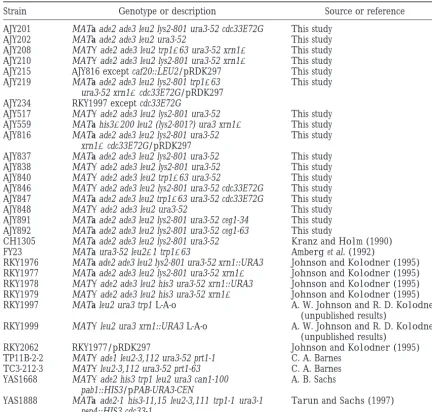
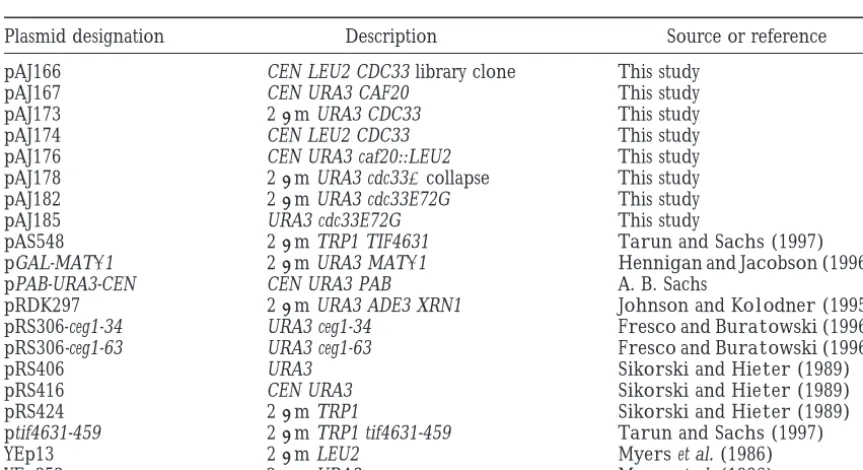
lethal with xrn1⌬, mutations in SKI2 and SKI3 were Strains, media, and plasmids: The yeast strains used are identified (JohnsonandKolodner 1995). ski8 muta- described in Table 1. Construction of new strains is described tions are also synthetic lethal with xrn1 (Jacobs below. Standard media including synthetic complete medium (SC) were described previously (Roseet al. 1990). Low Ade Anderson and Parker 1998; J. T. Brown and A. W.
medium contained 6 mg/L adenine. Yeast transformations Johnson, unpublished results). Since SKI2, SKI3, and
were performed as described elsewhere (GietzandSchiestl
SKI8 are all required for normal 3⬘–5⬘ exonucleolytic 1995). Plasmids are listed in Table 2.
mRNA degradation (Jacobs Anderson and Parker Isolation ofcdc33E72G:To identify mutations synthetic le-thal with xrn1⌬, UV mutagenesis was performed on yeast strain 1998), synthetic lethality with xrn1⌬ is most easily
ex-TABLE 1
Yeast strains
Strain Genotype or description Source or reference
AJY201 MATa ade2 ade3 leu2 lys2-801 ura3-52 cdc33E72G This study AJY202 MATa ade2 ade3 leu2 ura3-52 This study AJY208 MAT␣ade2 ade3 leu2 trp1⌬63 ura3-52 xrn1⌬ This study AJY210 MAT␣ade2 ade3 leu2 lys2-801 ura3-52 xrn1⌬ This study AJY215 AJY816 except caf20::LEU2/pRDK297 This study AJY219 MATa ade2 ade3 leu2 lys2-801 trp1⌬63 This study
ura3-52 xrn1⌬cdc33E72G/pRDK297 AJY234 RKY1997 except cdc33E72G
AJY517 MAT␣ade2 ade3 leu2 lys2-801 ura3-52 This study AJY559 MATa his3⌬200 leu2 (lys2-801?) ura3 xrn1⌬ This study AJY816 MATa ade2 ade3 leu2 lys2-801 ura3-52 This study
xrn1⌬cdc33E72G/pRDK297
AJY837 MATa ade2 ade3 leu2 lys2-801 ura3-52 This study AJY838 MAT␣ade2 ade3 leu2 lys2-801 ura3-52 This study AJY840 MAT␣ade2 ade3 leu2 trp1⌬63 ura3-52 This study AJY846 MAT␣ade2 ade3 leu2 lys2-801 ura3-52 cdc33E72G This study AJY847 MATa ade2 ade3 leu2 trp1⌬63 ura3-52 cdc33E72G This study AJY848 MAT␣ade2 ade3 leu2 ura3-52 This study AJY891 MATa ade2 ade3 leu2 lys2-801 ura3-52 ceg1-34 This study AJY892 MATa ade2 ade3 leu2 lys2-801 ura3-52 ceg1-63 This study
CH1305 MATa ade2 ade3 leu2 lys2-801 ura3-52 KranzandHolm(1990)
FY23 MATa ura3-52 leu2⌬1 trp1⌬63 Amberget al. (1992)
RKY1976 MATa ade2 ade3 leu2 lys2-801 ura3-52 xrn1::URA3 JohnsonandKolodner(1995) RKY1977 MATa ade2 ade3 leu2 lys2-801 ura3-52 xrn1⌬ JohnsonandKolodner(1995) RKY1978 MAT␣ade2 ade3 leu2 his3 ura3-52 xrn1::URA3 JohnsonandKolodner(1995) RKY1979 MAT␣ade2 ade3 leu2 his3 ura3-52 xrn1⌬ JohnsonandKolodner(1995) RKY1997 MATa leu2 ura3 trp1 L-A-o A. W. JohnsonandR. D. Kolodner
(unpublished results)
RKY1999 MAT␣leu2 ura3 xrn1::URA3 L-A-o A. W. JohnsonandR. D. Kolodner
(unpublished results) RKY2062 RKY1977/pRDK297 JohnsonandKolodner(1995) TP11B-2-2 MAT␣ade1 leu2-3,112 ura3-52 prt1-1 C. A. Barnes
TC3-212-3 MAT␣leu2-3,112 ura3-52 prt1-63 C. A. Barnes YAS1668 MAT␣ade2 his3 trp1 leu2 ura3 can1-100 A. B. Sachs
pab1::HIS3/pPAB-URA3-CEN
RKY2062 as described (JohnsonandKolodner1995). The Matings of yeast strains: Novel xrn1⌬and wild-type yeast strains used in this report were constructed as follows. The gene for one arbitrary mutation (AJY816) was cloned by
com-plementation from a LEU2 centromeric yeast library (ATCC mating type of yeast strain CH1305 was switched to MAT␣by the method ofHerskowitzandJensen(1991). The resultant no. 77162, P. Hieter). Sequence analysis [Institute for Cell
and Molecular Biology Core Facility (ICMB CF), University strain (AJY517) was mated with FY23 and sporulated to give the haploid strains AJY837, AJY838, and AJY840. AJY840 was of Texas at Austin] of a complementing clone (pAJ166)
re-vealed that the genomic insert contained CDC33. A HindIII mated with RKY1977 and sporulated to give the xrn1⌬strains AJY208 and 210.
fragment containing CDC33 as the only intact open reading
frame subcloned into YEp352 (yielding pAJ173) comple- Tetrad dissection of RKY1979 mated to AJY816 demon-strated cosegregation of synthetic lethality and temperature mented the synthetic lethality of AJY816. The
CDC33-con-taining HindIII fragment from pAJ166 was also subcloned into sensitivity by the 2:2 segregation of white:redts. Tetrad dissec-tion of RKY1999 mated to AJY234 demonstrated synthetic a centromeric plasmid to give pAJ174. The genomic CDC33
locus from AJY816 was amplified by PCR and sequenced lethality between xrn1::URA3 and cdc33E72G in an L-A virus-deficient, nonmutagenized background by the absence of (ICMB CF, University of Texas at Austin).
Gap rescue and integration ofcdc33E72G:pAJ173 was di- Ura⫹temperature-sensitive spore clones at room temperature. Tetrad dissection of RKY1978 mated to YAS1888 demonstrated gested with SpeI and religated to create a collapsed plasmid
(pAJ178) lacking the CDC33 open reading frame. This plasmid the synthetic lethality between xrn1::URA3 and cdc33-1 by the absence of Ura⫹temperature-sensitive spore clones. The origi-was then linearized with SpeI and transformed into AJY816 to
gap rescue the cdc33E72G allele onto the plasmid (yielding nal xrn1⌬cdc33E72G synthetic lethal strain (AJY816) was back-crossed twice either (i) to wild-type strains AJY840 and then pAJ182). A cdc33E72G-containing HindIII fragment was moved
from pAJ182 to HindIII-digested pRS406, a URA3-containing AJY838 to make cdc33E72G strains AJY846 and AJY847 and CDC33 strain AJY848 or (ii) to wild-type strains AJY840 and plasmid that lacks yeast replication sequences (Sikorskiand
Hieter1989). The resultant plasmid (pAJ185) was linearized then AJY837 to make cdc33E72G strain AJY201 and CDC33
strain AJY202. AJY219, the cdc33E72G xrn1⌬ double mutant with AvrII and transformed into RKY1997. Ura⫹transformants
were streaked to YPD to allow homologous recombination to containing pRDK297, was obtained from tetrad dissection of AJY847 mated with AJY210 carrying pRDK297. The cdc33E72G occur between the integrated cdc33E72G and CDC33, thus
losing the URA3 gene and one copy of CDC33. Isolates were allele was scored by temperature sensitivity and the xrn1⌬ allele was scored by PCR. Tetrad dissection of RKY1976 mated then patched to 5-fluoroorotic acid (5-FOA) plates to select
for Ura⫺ recombinants. To identify cdc33E72G integrants, with TP11B-2-2 and TC3-212-3 demonstrated the lack of syn-thetic lethality between xrn1::URA3 and both 1 and prt1-5-FOA-resistant isolates were scored for temperature sensitivity
that could be complemented by a centromeric CDC33 plasmid 63, respectively, by the presence of Ura⫹temperature-sensitive spore clones. Tetrad dissection of RKY1978 mated with AJY891 (pAJ174). One such isolate (AJY234) was used for further
study. and AJY892 demonstrated the synthetic lethality between xrn1::URA3 and both ceg1-34 and ceg1-63, respectively, by the Integration of ceg1 alleles: The plasmids pBR306-ceg1-34
and pBR306-ceg1-63 (S. Buratowski) were linearized within absence of Ura⫹temperature-sensitive spore clones at 30⬚. We did not observe synthetic lethality between cdc33E72G and the CEG1 gene with BamHI and transformed into CH1305.
Southern blotting identified correct integrants. 5-FOA-resis- either ceg1-34 or ceg1-63 after sporulation of diploids made by crossing AJY846 with AJY891 and AJY892, respectively. For tant, temperature-sensitive integrants were then identified
(AJY891 and AJY892, respectively). the xrn1⌬pab1::HIS3 cross, AJY559 (xrn1⌬) was mated with
TABLE 2
Plasmids
Plasmid designation Description Source or reference
pAJ166 CEN LEU2 CDC33 library clone This study
pAJ167 CEN URA3 CAF20 This study
pAJ173 2m URA3 CDC33 This study
pAJ174 CEN LEU2 CDC33 This study
pAJ176 CEN URA3 caf20::LEU2 This study
pAJ178 2m URA3 cdc33⌬collapse This study
pAJ182 2m URA3 cdc33E72G This study
pAJ185 URA3 cdc33E72G This study
pAS548 2m TRP1 TIF4631 TarunandSachs(1997) pGAL-MAT␣1 2m URA3 MAT␣1 HenniganandJacobson(1996)
pPAB-URA3-CEN CEN URA3 PAB A. B. Sachs
pRDK297 2m URA3 ADE3 XRN1 JohnsonandKolodner(1995) pRS306-ceg1-34 URA3 ceg1-34 FrescoandBuratowski(1996) pRS306-ceg1-63 URA3 ceg1-63 FrescoandBuratowski(1996)
pRS406 URA3 SikorskiandHieter(1989)
pRS416 CEN URA3 SikorskiandHieter(1989)
pRS424 2m TRP1 SikorskiandHieter(1989)
ptif4631-459 2m TRP1 tif4631-459 TarunandSachs(1997)
YEp13 2m LEU2 Myerset al. (1986)
YAS1668 (pab1::HIS3 carrying PAB1 on a URA3 CEN vector). The resulting diploid was sporulated and tetrads were dis-sected. The pab1::HIS3 allele was scored by histidine prototro-phy and the xrn1⌬allele was scored by PCR. All pab1::HIS3 and xrn1⌬pab1::HIS3 isolates were sensitive to 5-FOA.
CAF20disruption:The CAF20 locus was amplified by PCR
and ligated as a SpeI-EcoRI fragment into pRS416 (yielding pAJ167). A LEU2-containing Bst YI fragment of YEp13 was ligated into BglII-BclI-linearized pAJ167, deleting the CAF20 open reading frame from nucleotide 7 to 168 (yielding pAJ176). The caf20::LEU2-containing XbaI-HindIII fragment of pAJ176 was transformed into AJY816. A Leu⫹transformant (AJY215) was confirmed as a disruption integrant by PCR.
Biochemical techniques: 7-methyl-GTP (7mGTP) column chromatography was performed essentially as previously de-scribed (TarunandSachs1996). Briefly, 2 liters of RKY2062 and AJY816 were grown to a density of 1.5⫻107cells/ml in SC-Ura. The cells were washed with water and then
resus-Figure 1.—Synthetic lethality between xrn1 and cdc33.
pended in 12 ml buffer A (100 mmpotassium acetate, 2 mm
Strains RKY1977 (xrn1⌬), AJY201 (cdc33E72G), and AJY219 magnesium acetate, 0.5g/ml leupeptin, 0.7g/ml pepstatin
(xrn1⌬ cdc33E72G/pXRN1-URA3) were patched onto plates A, 0.5 mmPMSF, 7 mm-mercaptoethanol, 30 mmHEPES
containing 5-FOA and incubated at 30⬚for 3 days. The same pH 7.4) in a 50-ml tube. Glass beads (48-g) were added. The
results were observed at room temperature (data not shown). tubes were then placed in a multivortexer and vortexed seven
times for 1 min each with 1-min periods on ice in between. The samples were centrifuged twice at 30,000⫻g for 5 min
each. The extracts (ⵑ10 ml) were then loaded onto separate trary mutation from this screen was cloned by comple-0.5-ml7mGTP Sepharose 4B columns (Pharmacia, Piscataway,
mentation. The mutant was found to contain a temp-NJ) preequilibrated in buffer A. The columns were washed
erature-sensitive mutation in CDC33, which encodes with 15 ml buffer B [100 mm potassium chloride, 0.2 mm
translation initiation factor eIF4E (Figure 1). The tem-EDTA, 0.01% Triton X-100, 0.5g/ml leupeptin, 0.7g/ml
pepstatin A, 0.5 mmphenylmethylsulfonyl fluoride (PMSF), perature sensitivity and synthetic lethality cosegregated 7 mm-mercaptoethanol, 20 mmHEPES pH 7.4] and then after multiple backcrosses. Amplification by PCR and with 10 ml buffer B⫹0.1 mmGDP. Proteins were eluted with subsequent sequencing of the mutant genomic cdc33 buffer B⫹0.1 mm7mGTP.
locus identified the mutation as an A to G transition at Extracts for analysis of eIF4G degradation were prepared
nucleotide 215 resulting in a change of glutamate to as follows. Actively growing cultures of AJY201 and AJY202 at
glycine at amino acid 72. To confirm that the synthetic 26⬚ were split equally and placed at either 26⬚ or 37⬚ and
grown for an additional 2 hr at which time the cells were lethality was not strain-specific or due to the presence harvested and broken with glass beads and vortexing in the of the double-stranded RNA virus L-A, the cdc33 muta-presence of a buffer consisting of 20 mmTris (pH 7.5), 150
tion was introduced into an L-A virus-deficient strain of a mmNaCl, 0.5 mmEDTA, and one Complete Mini, EDTA-free
different genetic background. The cdc33E72G mutation protease inhibitor cocktail tablet (Boehringer-Mannheim,
In-again conferred temperature sensitivity. This strain was dianapolis) per 7 ml of buffer. Anti-eIF4G1 antiserum was a
generous gift of Alan Sachs. Western blot analysis was carried mated with an L-A-deficient xrn1::URA3 strain and the out as previously described (Johnson1997). resulting diploid was sporulated. No viable temperature-Northern blot analysis:For transcriptional pulse chase ex- sensitive Ura⫹ spores were recovered (see materials periments, 40-ml cultures of strains carrying pGAL-MAT␣1
and methods). Thus, synthetic lethality was indepen-were grown to mid-log in SC-Ura liquid medium. Cultures
dent of both strain background and of the L-A virus, were washed and concentrated to 15 ml and then induced
for 20 min with a 2% final concentration of galactose. Aliquots whose capsid protein is known to decap mRNAs (Blanc (1.9-ml) were taken before and at various times after addition et al. 1994;Masisonet al. 1995). The cdc33E72G muta-of glucose (final concentration muta-of 2%) and flash frozen in a tion was a recessive partial loss-of-function mutation and dry ice ethanol bath. For transcriptional inhibition
experi-synthetic lethality could be overcome by high-copy ex-ments, 50-ml cultures were grown to mid-log in YPD liquid
pression of the cdc33E72G mutant allele (data not medium and then concentrated to 10 ml. Aliquots (1.9-ml)
shown). To determine if other CDC33 mutations were were taken before and at various times after addition of
thio-lutin to 10g/ml and flash frozen in a dry ice ethanol bath. also synthetic lethal with xrn1, a strain bearing a cdc33-RNA was prepared, fractionated, blotted, probed, and imaged 1 (AltmannandTrachsel1989) allele was crossed to as previously described (Johnson1997).
an xrn1::URA3 strain. No temperature-sensitive Ura⫹ spore clones were recovered, indicating synthetic lethal-ity between cdc33-1 and xrn1::URA3 (data not shown). RESULTS
cdc33E72Gdisrupts the eIF4E/eIF4G interaction:The interaction of eIF4G with eIF4E is important for the
Synthetic lethality betweenxrn1⌬andcdc33:A screen
for mutations synthetic lethal with xrn1⌬(Johnsonand stimulation of cap-dependent translation initiation (Mader et al. 1995; Tarun and Sachs 1997; Gallie Kolodner1995) was repeated and identified five
applied to7mGTP Sepharose 4B columns (Pharmacia) and after extensive washing the bound proteins were eluted with free7mGTP. Although similar amounts of wild-type and mutant eIF4E were retained on these col-umns (Figure 2B), there was a striking reduction in the amount of eIF4G retained by the mutant eIF4E on the 7mG column (Figure 2C). Since wild-type and mutant extracts contained similar levels of eIF4G (Figure 2D), the reduction in eIF4G retained on the column by mu-tant eIF4E was due to poor binding with mumu-tant eIF4E. Thus the mutant eIF4E is severely impaired for eIF4G binding. The slight reduction in the amount of mutant eIF4E retained on the column compared to wild type may reflect the reduced in vitro binding of eIF4E to7mG in the absence of eIF4G (Ptushkinaet al. 1998). Our
results differ from those recently reported in which eIF4E mutations at glutamate-72 (E72A and E72D) were shown to have only a modest effect on the in vitro bind-ing of the eIF4E bindbind-ing domain of eIF4G to eIF4E at 4⬚ (Ptushkina et al. 1998). This difference may arise
from the use of different alleles or from the fact that the work of Ptushkina et al. was carried out with purified recombinant eIF4E protein and a recombinant eIF4G protein fragment in vitro in contrast to the work pre-sented here using yeast extracts.
Interestingly, eIF4G degradation products were ob-served in the mutant eIF4E strain that were not apparent or were present at much lower levels in the wild-type strain (Figure 2, C and D). This enhanced proteolysis
Figure 2.—Binding of eIF4G and cap analog by mutant of eIF4G cosegregated with the cdc33E72G mutation but
eIF4E and novel degradation patterns for eIF4G in an eIF4E
was not temperature dependent (Figure 2D) and thus mutant. (A) Similar amounts of column input extracts from
did not appear to be the cause for the temperature synthetic lethal strain AJY816 (xrn1⌬cdc33E72G/pXRN1) or
parent strain RKY2062 (xrn1⌬CDC33/pXRN1) were analyzed sensitivity of cdc33E72G. eIF4G is highly susceptible to by colorimetric Western blot using antibody raised against degradation in vitro and to proteolysis by various viral eIF4E. Equal amounts of protein eluted off of7mGTP
Sepha-proteases in vivo. eIF4G proteolysis has also been noted rose 4B columns were separated on 12% SDS-PAGE gels and
in the absence of strong eIF4E/eIF4G interaction (Ber-visualized either (B) by Coomassie staining or (C) by
colori-set et al. 1998). To test if a lowered level of eIF4G
metric Western blot using antibody raised against eIF4G1. The
identity of the band in B as eIF4E was confirmed by Western due to proteolysis in the cdc33E72G mutant strain was blot (data not shown). In D, equal amounts of protein from responsible for synthetic lethality with xrn1⌬, we asked crude extracts from either AJY201 (cdc33E72G) or AJY202 if high-copy eIF4G could suppress this lethality in a (CDC33) grown at either 26⬚or 37⬚(2-hr shift) were separated
plasmid shuffle assay. A high-copy plasmid containing on 12% SDS-PAGE gels and visualized by colorimetric Western
TIF4631 encoding eIF4G1 (pAS548) was transformed
blot using antibody raised against eIF4G1. The Western blot
appeared unchanged when performed with cells that were into AJY219 (xrn1⌬cdc33E72G/pXRN1-URA3). Elevated
grown at these temperatures for an additional 5 hr (data not levels of eIF4G1 protein were confirmed by Western shown). blotting (data not shown). Transformants were scored for the ability to sector and for growth on 5-FOA. No complementation was observed (data not shown). Addi-mutant, is a highly conserved residue. Crystal structures tionally, high-copy eIF4G1 was unable to reduce the of eIF4E (Marcotrigiano et al. 1997; Matsuo et al. temperature sensitivity of a cdc33E72G mutant (data not 1997) show that this residue lies on the surface of eIF4E shown). Similarly, high-copy PAB1, which binds eIF4G, that is involved in interaction with eIF4G, suggesting did not rescue the xrn1⌬cdc33E72G mutant, nor did it
that this mutation would affect eIF4G binding but not reduce the temperature sensitivity of a cdc33E72G single cap binding per se. These expectations were borne out mutant (data not shown). Thus, synthetic lethality be-experimentally. Protein extracts prepared from the wild- tween xrn1⌬and cdc33E72G results from the disruption type and cdc33E72G strains had similar levels of eIF4E of eIF4E interaction with eIF4G and not simply from as measured by Western blotting (Figure 2A and data the loss of eIF4G due to heightened degradation.
to a functional homologue of Caf20p (mammalian 4E-BP2) identified residue E70 of mouse eIF4E (analogous to E72 of yeast eIF4E) as involved in 4E-BP binding (Matsuoet al. 1997). It could be argued that in the cdc33E72G mutant, the wild-type electrostatic repulsion
between a negatively charged phosphate group and a negatively charged glutamate would be disrupted, allowing Caf20p to remain associated more tightly to eIF4E. It is also possible that normal interaction of Caf20p with eIF4E could more efficiently compete with weakened eIF4E/eIF4G interaction, thus blocking effi-cient translation initiation of capped transcripts. To ex-amine whether the synthetic lethality was due to en-hanced competition by eIF4E binding protein, CAF20 was disrupted in the synthetic lethal strain (xrn1⌬
cdc33E72G/pXRN1-URA3). This strain is unable to grow
on 5-FOA plates because it requires XRN1 on a URA3-containing plasmid for viability. Deletion of CAF20 in this strain did not allow growth on 5-FOA. Thus, en-hanced competition of binding by Caf20p is not respon-sible for synthetic lethality between xrn1 and cdc33E72G.
Thecdc33E72Gmutation causes a modest mRNA de-stabilization effect:Although the mutant eIF4E binds 7mG in vitro, disruption of its interaction with eIF4G may lead to reduced cap binding or translation initiation in
Figure3.—Dominant negative phenotype of an
eIF4E-bind-vivo (HaghighatandSonenberg1997;Ptushkinaet
ing mutant eIF4G in an xrn1 mutant. Cotransformants of
al. 1998). Such reduced cap binding by eIF4E could
AJY208 (xrn1⌬) carrying pRDK297 (pXRN1-URA3-ADE3) and
either (A) pRS424 (empty vector), (B) pAS548 (pTIF4631), result in increased access of the decapping enzyme or (C) ptif4631-459 were streaked onto Trp⫺low Ade plates (Dcp1p) to the cap, leading to a general destabilization and incubated at 30⬚for 5 days. of mRNAs by exposing these transcripts to the processive 5⬘–3⬘decay pathway (Sonenberget al. 1979; LaGran-deur and Parker 1998). Indeed, different alleles of was critical in an xrn1 mutant by asking if overexpression cdc33 have recently been shown to have varying modest of an eIF4G mutant defective for eIF4E binding (tif4631- effects on mRNA stability (Linzet al. 1997;Schwartz
459;TarunandSachs1997;Tarunet al. 1997) would andParker1999). The stability of MAT␣1 mRNA was
confer a dominant negative phenotype in an xrn1 mu- examined in cdc33E72G and CDC33 strains at permissive tant. High-copy vectors bearing mutant eIF4G1, wild- and nonpermissive temperatures using a transcriptional type eIF4G1, or empty vector were transformed into an pulse chase analysis (Figure 4A). No change in stability
xrn1 mutant bearing an XRN1-ADE3 plasmid. Trans- was seen in the cdc33E72G mutant. The stabilities of
formants were scored for the ability to lose the XRN1- CYH2, preCYH2, and PAB1 mRNAs were also examined
ADE3 plasmid, indicated by sectoring on low Ade plates. at permissive temperature after inhibition of
transcrip-Indeed, high-copy mutant eIF4G1 prevented the loss tion with thiolutin. PreCYH2 is targeted for rapid degra-of the XRN1-ADE3 plasmid, indicated by the solid red dation in the cytoplasm by the nonsense-mediated decay colonies in the mutant eIF4G1 transformant (Figure 3). pathway (Leedset al. 1992;Heet al. 1993;
Ruiz-Eche-CAF20 does not mediate synthetic lethality between varriaet al. 1996; ZhangandMaquat 1997;Hentze
xrn1⌬andcdc33E72G:4E-binding proteins (4E-BPs) in andKulozik 1999; reviewed inCulbertson 1999). A higher eukaryotes and Caf20p in yeast are negative regu- modest destabilization was observed for CYH2 mRNA lators of eIF4E function that bind eIF4E competitively (t1/2⫽23 min in wild type and 16 min in the mutant) with eIF4G (Haghighat et al. 1995; Altmann et al. and for preCYH2 mRNA (t1/2⫽10 min in wild type and 1997;Ptushkinaet al. 1998). They can be phosphory- 5 min in the mutant; Figure 4B) and no significant lated by mitogen-activated protein kinase via the FRAP/ change in stability of PAB1 mRNA was observed (data TOR signaling pathway in mammalian cells and by ca- not shown). Thus, the cdc33E72G mutation leads to de-sein kinase II via the TOR pathway in yeast (Linet al. stabilization of some RNAs.
1994; Zanchin and McCarthy 1995; Barbet et al. Reduced nuclear capping of mRNA is synthetic lethal
Figure 4.—Stability of MAT␣1 and CYH2 transcripts in an eIF4E mutant. (A) Cultures of AJY202 (CDC33) and AJY201 (cdc33E72G) carrying pGAL-MAT␣1 were transiently induced with galactose to produce MAT␣1 transcript. Temperature shift was for 2 hr. Northern blots were probed with a radiolabeled probe derived from random priming an EcoRV to HindIII digest of MAT␣1. “R” indicates cells growing in raffinose, before the addition of galactose for GAL promoter induction. The zero time point indicates cells growing in galactose, before the addition of glucose for repression of the GAL promoter. Other times indicate minutes after addition of glucose. (B) A thiolutin time course was performed on cultures of AJY848 (CDC33) and AJY846 (cdc33E72G) at 30⬚. Northern blots were probed with a radiolabeled probe derived from random priming a BamHI to EcoRI digest of CYH2. The zero time point indicates cells growing in the absence of thiolutin. Other times indicate minutes after addition of thiolutin.
transferase that is responsible for capping RNA polymer- suppression of temperature-sensitive ceg1 mutations by temperature-sensitive mutations in RAT1, encoding the ase II transcripts in yeast (Fresco and Buratowski
1996). Mutants of ceg1 generate unstable transcripts that nuclear counterpart of Xrn1p (Kennaet al. 1993;Poole andStevens1995;Johnson1997), no genetic interac-can be stabilized by deleting XRN1 (Schweret al. 1998).
In experiments to test the suppression of temperature- tion was observed (data not shown).
Synthetic lethality withxrn1⌬is specific to cap-related
sensitive ceg1 mutations by xrn1⌬, we found that ceg1
mutations were synthetic lethal with xrn1⌬ at 30⬚, a processes: Because of the importance of 7mG cap in translation initiation, mutations in the cap-binding com-temperature at which the ceg1 single mutants grew well
plex (eIF4F) or in the capping enzyme (Ceg1p) reduce (Figure 5). Thus even though deletion of XRN1 can
the overall translational efficiency in a cell (Altmann suppress the transcript instability of ceg1 mutants,
stabili-andTrachsel 1989;Tarunet al. 1997;Schwer et al.
zation of the uncapped mRNAs resulting from the ceg1
1998; Schwartz and Parker 1999). Thus it seemed mutation is lethal. In separate experiments to test the
possible that reduced levels of translation in general, and not a cap-specific defect, were responsible for the lethality observed in xrn1⌬mutants. We tested this idea by asking if temperature-sensitive alleles of PRT1 are synthetic lethal with xrn1⌬. PRT1 encodes an essential subunit of the eIF3 complex that is involved in bringing the eIF2-GTP-Met-tRNAf ternary complex to the 40S ribosomal subunit (Feinberget al. 1982; Hanic-Joyce
et al. 1987b; Naranda et al. 1994; Chaudhuri et al.
1997). In addition, a prt1-63 mutant shows destabiliza-tion of mRNAs (SchwartzandParker1999). Double mutants of xrn1::URA3 and either prt1-1 or prt1-63 were constructed by mating and dissecting the appropriate strains. The presence of temperature-sensitive Ura⫹ spore clones that were viable at all temperatures at which the single prt1 mutants were viable indicated no en-hanced temperature sensitivity (Figure 6). Since the
prt1 single mutants display significantly lower translation
rates as temperature increases (Hanic-Joyce et al.
1987a), the lack of enhanced temperature sensitivity indicated that reduced translation in general was not
Figure 5.—Synthetic lethality between xrn1 and ceg1. A responsible for lethality between xrn1⌬ and cdc33.
diploid strain (XRN1/xrn1::URA3 ceg1-34/CEG1) was sporu- Hence the genetic interaction is restricted to a subset of lated and dissected. Spore clones shown were grown on YPD
translation initiation factors. Additionally, even though at either room temperature for 3 days or at 30⬚ for 2 days.
lesions in cdc33, ceg1, and prt1 accelerate the decay of The same results were obtained with the ceg1-63 allele (data
Figure7.—The lack of suppression of pab1 by xrn1. Diploid strain (XRN1/xrn1⌬ pab1::HIS3/PAB1) was sporulated and
Figure6.—The lack of synthetic lethality between xrn1 and dissected. Spore clones shown were grown on 5-FOA at room
prt1. A diploid strain (XRN1/xrn1::URA3 prt1-1/PRT1) was temperature for 4 days. sporulated and dissected. Spore clones shown were grown on
YPD at 32⬚ for 3 days. The same results were obtained with the prt1-63 allele (data not shown).
taining centromeric plasmid. The diploid was sporu-lated and tetrads were dissected. All pab1::HIS3 xrn1⌬ spore clones were 5-FOA-sensitive, indicating inviability in the absence of the URA3-plasmid-borne PAB1 (Figure observed if distinctly cap-specific processes are
per-7). A similar lack of suppression of pab1⌬by xrn1⌬has turbed.
been observed by others (Morrisseyet al. 1999). Thus,
Disruption ofPAB1is not suppressed byxrn1⌬:
Muta-as with cdc33 and ceg1 mutants, stabilization of uncapped tions in CDC33, CEG1, PRT1, and PAB1 destabilize
mRNAs by disruption of xrn1 is not sufficient to suppress mRNAs (Caponigro and Parker 1995; Fresco and
the inviability of a PAB1 disruption. Buratowski 1996; Linz et al. 1997; Barnes 1998;
Schweret al. 1998;SchwartzandParker1999). This destabilization of RNA can be suppressed by mutations
DISCUSSION in XRN1 that block the degradation of decapped
tran-scripts (CaponigroandParker1995;Hatfield et al. Genetic interactions between XRN1 and cap-related processes:In this report we have shown that a class of 1996;Schweret al. 1998;SchwartzandParker1999).
Pab1p is a multifunctional protein required for efficient mutations affecting capping of mRNAs or the proper formation of the cap-binding complex eIF4F genetically translation of poly(A) mRNA as well as stabilization of
mRNAs (Caponigro and Parker 1995; Coller et al. interacts with xrn1. This class includes mutations in
CDC33, CEG1, and TIF4631. CEG1 encodes the nuclear
1998). Inactivation of Pab1p results in accelerated
mRNA decapping and degradation. It has been sug- guanylyltransferase responsible for adding the7mG cap to RNA polymerase II transcripts and CDC33 and gested that stabilization of mRNAs in a pab1 mutant
by inactivation of downstream degradation steps can TIF4631 encode the translation initiation factors eIF4E
and eIF4G, respectively, which together form eIF4F and rescue the inviability of a PAB1 deletion, indicating that
stabilization of mRNA is an essential function of Pab1p bind the 7mG cap. The cdc33E72G mutation that we found from a synthetic lethal screen with xrn1⌬disrupts (CaponigroandParker 1995;Hatfield et al. 1996).
Since Pab1p interacts with the eIF4G/eIF4E complex, eIF4E/eIF4G interaction and renders cells temperature sensitive. This is consistent with the prior observation we expected mutations in these genes to show similar
genetic interactions with xrn1⌬. Because we observed that mutations in the eIF4E binding site of eIF4G result in temperature sensitivity (Tarunet al. 1997). The cdc33-1
synthetic lethality between xrn1 and either cdc33 or ceg1
mutations (rather than suppression of inviability), we mutant protein, which is unable to bind cap analog (AltmannandTrachsel1989) and has reduced eIF4G decided to reinvestigate the genetic interaction of pab1⌬
with xrn1⌬. We found that an xrn1 deletion did not binding (TarunandSachs1997), was synthetic lethal with xrn1⌬as well. Synthetic lethality between cdc33 and rescue the inviability of a PAB1 deletion mutant. In this
experiment, an xrn1⌬ mutant was crossed to a pab1:: xrn1 was also observed in a strain deficient for L-A virus,
ruling out the possibility that increased binding of L-A
URA3-con-Gag protein to cap (Blancet al. 1994; Masisonet al. ever, we have shown that regardless of the suppression of the mRNA instability phenotype, xrn1 mutations in 1995) was responsible for lethality when eIF4E binding
was reduced. Supporting the idea that deletion of XRN1 combination with ceg1 or cdc33 mutations result in syn-thetic lethality. In addition, we observed genetic interac-enhances the requirement for eIF4E/eIF4G interaction,
high-copy expression of a tif4631 mutation that inhibits tion between mutations in XRN1 and TIF4631 and no suppression of the inviability of a pab1 deletion mutant. eIF4E binding gave a dominant negative phenotype in
an xrn1 mutant. Indeed, synthetic lethality between xrn1 and pab1
muta-tions has recently been reported (Morrissey et al.
In addition to the genetic interaction with cdc33 and
tif4631, we found that ceg1 mutations were synthetic 1999). These results are contrary to a model in which stabilization of mRNA turnover by deletion of XRN1 lethal with xrn1. Ceg1p is a nuclear enzyme required for
capping mRNAs. Since Xrn1p is a cytoplasmic protein, suppresses the inviability of mutations in upstream fac-tors in the turnover pathway (CaponigroandParker synthetic lethality with ceg1 suggests that the ceg1 defect
giving rise to synthetic lethality is manifest in the cyto- 1995). We conclude that the accumulation of uncapped messages in an xrn1 mutant is detrimental to a cell when plasm. This was further supported by a lack of genetic
interaction between ceg1 alleles and a mutation in the coupled with particular defects in translation initiation.
Why are defects in cap-specific processes synthetic
nuclear exoribonuclease encoded by RAT1 (A. W.
John-son, unpublished results). Previously it was reported lethal with inhibition of mRNA turnover?Several models could explain the observed synthetic lethality. Deletion that ceg1 xrn1⌬double mutants are viable but grow very
slowly (Schwer et al. 1998). Our finding of synthetic of XRN1 is synthetic lethal with SKI2 or SKI3 (Johnson andKolodner1995) or SKI8 (Jacobs Andersonand lethality may be due to the use of different alleles,
strains, or temperature. Parker1998;J. T. BrownandA. W. Johnson,
unpub-lished results). Ski2p, Ski3p, and Ski8p form a complex These genetic interactions appeared to be specific to
defects in nuclear capping of transcripts or assembly of in vivo (Brownet al. 2000) and are required for a 3⬘–5⬘ mRNA degradation pathway (Jacobs Anderson and the eIF4E/eIF4G cap-binding complex and not a result
of reduced overall translational capacity since prt1 muta- Parker1998) and repression of translation of deadeny-lated mRNAs (reviewed inWickner1996;Benardet al.
tions showed no synthetic interaction with xrn1⌬. PRT1
encodes an essential subunit of the translation initiation 1998). Hence, the mechanism for the synthetic lethality between xrn1 and either ski2, ski3, or ski8 has been factor 3 complex (Hanic-Joyceet al. 1987b;Naranda
et al. 1994). eIF3 is required for recruitment of 40S proposed to be the complete inhibition of RNA decay by mutations in both the highly processive 5⬘pathway ribosomes and formation of the preinitiation complex
(Chaudhuriet al. 1997), a step distinct from cap recog- and alternate 3⬘pathway (Jacobs Andersonand Par-ker1998). This is not the case for the synthetic lethality nition by eIF4F. We have found that several additional
mutations that lead to substantially reduced 60S levels, between xrn1 and either cdc33 or ceg1 as these mutations lead to the destabilization and not stabilization of including deletion of SPB2 or RAI1, are also not
syn-thetic lethal with xrn1⌬(HoandJohnson1999;Y. Xue mRNAs (Schweret al. 1998). Furthermore, mRNAs in
an xrn1 cdc33-42 double mutant are less stable than in and A. W. Johnson, unpublished results). Thus
low-ering the translational capacity of a cell in general is an xrn1 mutant alone, ruling out enhanced RNA stability as the cause of lethality (SchwartzandParker1999). not lethal in an xrn1 mutant. Because cdc33, tif4631,
and ceg1 mutants all affect cap-dependent reactions, we Inhibition of mRNA turnover in yeast by deletion of
XRN1 leads to a general stabilization of deadenylated
suggest that defects in assembling the eIF4F complex
on the 5⬘-cap are lethal in combination with an xrn1 decapped transcripts (Hsu and Stevens 1993). Al-though such degradation intermediates are not nor-mutation.
Suppression of RNA instability but not lethality by mally translated, in xrn1⌬cells these RNAs accumulate to high levels and they sediment in sucrose gradients
xrn1: Mutations in CDC33, TIF4631, PRT1, PAB1, and
CEG1 all lead to destabilization of mRNAs (Caponigro in a position corresponding to polysomes, suggesting that they are translated (HsuandStevens1993;
Capo-et al. 1993;Fresco and Buratowski1996;Linzet al.
1997;Barnes1998;Schweret al. 1998;Schwartzand nigroandParker1995). The translation of uncapped mRNAs is suggested from other work as well (Masison Parker1999) with mutations in PAB1 giving the most
severe phenotype. Except for CEG1, mutations in these et al. 1995;Loet al. 1998). It is possible that the
accumu-lation of high levels of decapped deadenylated mRNAs genes lead to premature decapping followed by
degra-dation of the transcript by Xrn1p. Transcripts in ceg1 titrates out RNA binding proteins and/or translation factors. This in turn would lead to reduced rates of mutants are unstable presumably because they are not
protected by a cap structure. Thus, it is not surprising translation of newly transcribed transcripts and relax-ation of the gene regulrelax-ation program of the cell. This that the RNA stability phenotype of cdc33, ceg1, and pab1
mutations can be partially suppressed by deletion of situation in combination with mutations in factors re-quired for cap-dependent translation may be lethal.
XRN1 (Caponigro et al. 1993; Hatfield et al. 1996;
novel inhibitor of cap-dependent translation initiation in yeast:
mutation does not suppress the lethality of a pab1
muta-p20 competes with eIF4G for binding to eIF4E. EMBO J. 16:
tion, a mutation in DCP1, encoding the decapping activ- 1114–1121.
Amberg, D. C., L. A. GoldsteinandC. N. Cole,1992 Isolation
ity required prior to Xrn1p degradation, does suppress
and characterization of RAT1: an essential gene of Saccharomyces
the lethality of a pab1 mutant (Hatfield et al. 1996).
cerevisiae required for the efficient nucleocytoplasmic trafficking Since a dcp1 mutation stabilizes capped but deadeny- of mRNA. Genes Dev. 6: 1173–1189.
Barbet, N. C., U. Schneider, S. B. Helliwell, I. Stansfield, M. F. lated mRNAs, this suggests that there is a qualitative
Tuiteet al., 1996 TOR controls translation initiation and early
difference between stabilizing capped vs. decapped
G1 progression in yeast. Mol. Biol. Cell. 7: 25–42.
transcripts. Barnes, C. A.,1998 Upf1 and Upf2 proteins mediate normal yeast
mRNA degradation when translation initiation is limited. Nucleic
An alternate model that explains the genetic
observa-Acids Res. 26: 2433–2441.
tions we have made with an xrn1 mutation is that the
Beelman, C. A.,and R. Parker,1995 Degradation of mRNA in
decapped mRNAs that accumulate in xrn1 mutants are eukaryotes. Cell 81: 179–183.
Beelman, C. A., A. Stevens, G. Caponigro, T. E. LaGrandeur, L. translated aberrantly. Without cap-dependent
recruit-Hatfieldet al., 1996 An essential component of the decapping
ment of the translation machinery to the 5⬘-ends of
enzyme required for normal rates of mRNA turnover. Nature
messages and with the accumulation of decapped dead- 382:642–646.
Benard, L., K. Carroll, R. C. ValleandR. B. Wickner,1998 Ski6p
enylated mRNAs, translation may initiate at sites
down-is a homolog of RNA-processing enzymes that affects translation
stream of the normal initiation codon. This would lead
of non-poly(A) mRNAs and 60S ribosomal subunit biogenesis.
to the production of truncated and novel proteins that Mol. Cell. Biol. 18: 2688–2696.
Beretta, L., A. C. Gingras, Y. V. Svitkin, M. N. HallandN. Sonen-could be lethal for the cell. General RNA binding
pro-berg,1996 Rapamycin blocks the phosphorylation of 4E-BP1
teins suppress cindependent translation in vitro,
ap-and inhibits cap-dependent initiation of translation. EMBO J. 15:
parently by masking alternative initiation codons (Svit- 658–664.
Berset, C., H. TrachselandM. Altmann,1998 The TOR (target
kinet al. 1996). Thus, under in vitro conditions in which
of rapamycin) signal transduction pathway regulates the stability
RNA binding factors are limiting, translation can initiate
of translation initiation factor eIF4G in the yeast Saccharomyces
at internal and downstream sites. Similarly, the accumu- cerevisiae. Proc. Natl. Acad. Sci. USA 95: 4264–4269.
Blanc, A., J. C. Ribas, R. B. WicknerandN. Sonenberg,1994
His-lation of decapped mRNA in an xrn1 mutant may titrate
154 is involved in the linkage of the Saccharomyces cerevisiae L-A
cytoplasmic RNA binding proteins. When coupled with
double-stranded RNA virus Gag protein to the cap structure of
defects in recruitment of the ribosome to the 5⬘-end of mRNAs and is essential for M1 satellite virus expression. Mol.
Cell. Biol. 14: 2664–2674.
an mRNA by eIF4F/cap interaction, this may lead to
Brown, J. T., X. BaiandA. W. Johnson,2000 The yeast antiviral
aberrant internal initiation at downstream AUG codons.
proteins Ski2p, Ski3p, and Ski8p exist as a complex in vivo. RNA
The resulting translation products may then be respon- 6:449–457.
Caponigro, G., andR. Parker, 1995 Multiple functions for the
sible for the observed lethality. Because a dcp1 mutant
poly(A)-binding protein in mRNA decapping and deadenylation
accumulates capped transcripts, higher levels of
cap-in yeast. Genes Dev. 9: 2421–2432.
dependent initiation would be maintained, resulting in Caponigro, G., D. MuhlradandR. Parker,1993 A small segment
of the MAT alpha 1 transcript promotes mRNA decay in
Saccharo-greater fidelity of initiation. Recently, we have found a
myces cerevisiae: a stimulatory role for rare codons. Mol. Cell. Biol. mutation in GCD2 that is synthetic lethal with deletion
13:5141–5148.
of XRN1 (J. T. BrownandA. W. Johnson,unpublished Chaudhuri, J., A. ChakrabartiandU. Maitra,1997 Biochemical
characterization of mammalian translation initiation factor 3
results). GCD2 is a subunit of the eIF2B complex
re-(eIF3). Molecular cloning reveals that p110 subunit is the
mam-quired for recycling eIF2, an essential translation
initia-malian homologue of Saccharomyces cerevisiae protein Prt1. J. Biol.
tion factor that delivers charged initiator tRNA to the Chem. 272: 30975–30983.
Coller, J. M., N. K. GrayandM. P. Wickens,1998 mRNA
stabiliza-40S ribosomal subunit. Since mutations in GCD2 can
tion by poly(A) binding protein is independent of poly(A) and
affect the position of translation reinitiation events
(re-requires translation. Genes Dev. 12: 3226–3235.
viewed in Hinnebusch 1997), synthetic lethality be- Culbertson, M. R., 1999 RNA surveillance. Unforeseen
conse-quences for gene expression, inherited genetic disorders and
tween mutations in XRN1 and GCD2 supports a model
cancer. Trends Genet. 15: 74–80.
in which aberrant translation initiation is lethal when
Decker, C. J.,andR. Parker,1993 A turnover pathway for both
mRNA turnover is inhibited by a mutation in XRN1. stable and unstable mRNAs in yeast: evidence for a requirement
for deadenylation. Genes Dev. 7: 1632–1643. We thank S. Buratowski for supplying the ceg1 alleles, A. B. Sachs
Feinberg, B., C. S. McLaughlinandK. Moldave,1982 Analysis for supplying antibodies and cdc33-1 and pab1 strains, C. A. Barnes
of temperature-sensitive mutant ts 187 of Saccharomyces cerevisiae for supplying prt1 strains, and J. H. Ho for performing the mating- altered in a component required for the initiation of protein type switch. We also thank K. S. Browning, A. B. Sachs, and especially synthesis. J. Biol. Chem. 257: 10846–10851.
E. E. Wyckoff for critical reading of the manuscript. This work was Fresco, L. D.,andS. Buratowski,1996 Conditional mutants of supported by National Institutes of Health grant GM53655 to A. W. the yeast mRNA capping enzyme show that the cap enhances,
but is not required for, mRNA splicing. RNA 2: 584–596. Johnson.
Gallie, D. R.,1998 A tale of two termini: a functional interaction between the termini of an mRNA is a prerequisite for efficient translation initiation. Gene 216: 1–11.
Gietz, R. D.,andR. H. Schiestl,1995 Transforming yeast with
LITERATURE CITED
DNA. Methods Mol. Cell. Biol. 5: 255–269.
Goyer, C., M. Altmann, H. S. Lee, A. Blanc, M. Deshmukhet al., Altmann, M.,andH. Trachsel,1989 Altered mRNA cap
recogni-tion activity of initiarecogni-tion factor 4E in the yeast cell cycle division 1993 TIF4631 and TIF4632: two yeast genes encoding the
high-molecular-weight subunits of the cap-binding protein complex mutant cdc33. Nucleic Acids Res. 17: 5923–5931.
motif-like sequence and carry out an essential function. Mol. Cell. Linz, B., N. Koloteva, S. VasilescuandJ. E. McCarthy,1997 Dis-ruption of ribosomal scanning on the 5⬘-untranslated region, and Biol. 13: 4860–4874.
Haghighat, A.,andN. Sonenberg,1997 eIF4G dramatically en- not restriction of translational initiation per se, modulates the stability of nonaberrant mRNAs in the yeast Saccharomyces cerevis-hances the binding of eIF4E to the mRNA 5⬘-cap structure. J.
Biol. Chem. 272: 21677–21680. iae. J. Biol. Chem. 272: 9131–9140.
Lo, H. J., H. K. HuangandT. F. Donahue,1998 RNA polymerase
Haghighat, A., S. Mader, A. PauseandN. Sonenberg,1995
Re-pression of cap-dependent translation by 4E-binding protein 1: I-promoted HIS4 expression yields uncapped, polyadenylated mRNA that is unstable and inefficiently translated in Saccharomyces competition with p220 for binding to eukaryotic initiation
factor-4E. EMBO J. 14: 5701–5709. cerevisiae. Mol. Cell. Biol. 18: 665–675.
Mader, S., H. Lee, A. PauseandN. Sonenberg,1995 The
transla-Hanic-Joyce, P. J., G. C. JohnstonandR. A. Singer,1987a
Regu-lated arrest of cell proliferation mediated by yeast prt1 mutations. tion initiation factor eIF-4E binds to a common motif shared by the translation factor eIF-4gamma and the translation repressors Exp. Cell. Res. 172: 134–145.
Hanic-Joyce, P. J., R. A. SingerandG. C. Johnston,1987b Molecu- 4E-binding proteins. Mol. Cell. Biol. 15: 4990–4997.
Marcotrigiano, J., A. C. Gingras, N. SonenbergandS. K. Burley,
lar characterization of the yeast PRT1 gene in which mutations
affect translation initiation and regulation of cell proliferation. 1997 Cocrystal structure of the messenger RNA 5⬘cap-binding protein (eIF4E) bound to 7-methyl-GDP. Cell 89: 951–961. J. Biol. Chem. 262: 2845–2851.
Hatfield, L., C. A. Beelman, A. StevensandR. Parker,1996 Muta- Masison, D. C., A. Blanc, J. C. Ribas, K. Carroll, N. Sonenberg et al., 1995 Decoying the cap⫺mRNA degradation system by a tions in trans-acting factors affecting mRNA decapping in
Sacchar-omyces cerevisiae. Mol. Cell. Biol. 16: 5830–5838. dsRNA virus and poly(A)⫺mRNA surveillance by a yeast antiviral system. Mol. Cell. Biol. 15: 2763–2771.
He, F., S. W. Peltz, J. L. Donahue, M. RosbashandA. Jacobson,
1993 Stabilization and ribosome association of unspliced pre- Matsuo, H., H. Li, A. M. McGuire, C. M. Fletcher, A. C. Gingras et al., 1997 Structure of translation factor eIF4E bound to mRNAs in a yeast upf1⫺mutant. Proc. Natl. Acad. Sci. USA 90:
7034–7038. m7GDP and interaction with 4E-binding protein. Nat. Struct. Biol.
4:717–724.
Hennigan, A. N.,andA. Jacobson,1996 Functional mapping of
the translation-dependent instability element of yeast MATalpha1 McCarthy, J. E. G.,1998 Posttranscriptional control of gene expres-sion in yeast. Microbiol. Mol. Biol. Rev. 62: 1492–1553. mRNA. Mol. Cell. Biol. 16: 3833–3843.
Hentze, M. W.,andA. E. Kulozik,1999 A perfect message: RNA Morley, S. J., P. S. CurtisandV. M. Pain,1997 eIF4G: translation’s mystery factor begins to yield its secrets. RNA 3: 1085–1104. surveillance and nonsense-mediated decay. Cell 96: 307–310.
Herskowitz, I.,andR. E. Jensen,1991 Putting the HO gene to Morrissey, J. P., J. A. Deardorff, C. Hebronand A. B. Sachs,
1999 Decapping of stabilized, polyadenylated mRNA in yeast work: practical uses for mating-type switching. Methods Enzymol.
194:132–146. pab1 mutants. Yeast 15: 687–702.
Muhlrad, D., C. J. DeckerandR. Parker,1994 Deadenylation of
Hinnebusch, A. G.,1997 Translational regulation of yeast GCN4.
A window on factors that control initiator-tRNA binding to the the unstable mRNA encoded by the yeast MFA2 gene leads to decapping followed by 5⬘→3⬘digestion of the transcript. Genet. ribosome. J. Biol. Chem. 272: 21661–21664.
Ho, J. H.,andA. W. Johnson,1999 NMD3 encodes an essential Dev. 8: 855–866.
Myers, A. M., A. Tzagoloff, D. M. KinneyandC. J. Lusty,1986 cytoplasmic protein required for stable 60S ribosomal subunits
in Saccharomyces cerevisiae. Mol. Cell. Biol. 19: 2389–2399. Yeast shuttle and integrative vectors with multiple cloning sites suitable for construction of lacZ fusions. Gene 45: 299–310.
Hsu, C. L.,andA. Stevens,1993 Yeast cells lacking 5⬘→3⬘
exoribo-nuclease 1 contain mRNA species that are poly(A) deficient and Naranda, T., S. E. MacMillanandJ. W. Hershey,1994 Purified yeast translational initiation factor eIF-3 is an RNA-binding pro-partially lack the 5⬘cap structure. Mol. Cell. Biol. 13: 4826–4835.
Jacobs Anderson, J. S.,andR. P. Parker,1998 The 3⬘to 5⬘degrada- tein complex that contains the Prt1 protein. J. Biol. Chem. 269: 32286–32292.
tion of yeast mRNAs is a general mechanism for mRNA turnover
that requires the SKI2 DEVH box protein and 3⬘ to 5⬘ exo- Pain, V. M.,1996 Initiation of protein synthesis in eukaryotic cells. Eur. J. Biochem. 236: 747–771.
nucleases of the exosome complex. EMBO J. 17: 1497–1506.
Jacobson, A.,andS. W. Peltz,1996 Interrelationships of the path- Poole, T. L.,andA. Stevens,1995 Comparison of features of the RNase activity of 5⬘-exonuclease-1 and 5⬘-exonuclease-2 of Sacchar-ways of mRNA decay and translation in eukaryotic cells. Annu.
Rev. Biochem. 65: 693–739. omyces cerevisiae. Nucleic Acids Symp. Ser. 33: 79–81.
Ptushkina, M., T. von der Haar, S. Vasilescu, R. Frank, R. Birk-Johnson, A. W.,1997 Rat1p and Xrn1p are functionally
interchange-able exoribonucleases that are restricted to and required in the enhageret al., 1998 Cooperative modulation by eIF4G of eIF4E-binding to the mRNA 5⬘ cap in yeast involves a site partially nucleus and cytoplasm, respectively. Mol. Cell. Biol. 17: 6122–
6130. shared by p20. EMBO J. 17: 4798–4808.
Rose, M. D., F. WinstonandP. Hieter,1990 Methods in Yeast Genet-Johnson, A. W.,andR. D. Kolodner,1995 Synthetic lethality of
sep1 (xrn1) ski2 and sep1 (xrn1) ski3 mutants of Saccharomyces ics: A Laboratory Course Manual. Cold Spring Harbor Laboratory
Press, Cold Spring Harbor, NY.
cerevisiae is independent of killer virus and suggests a general
role for these genes in translation control. Mol. Cell. Biol. 15: Ruiz-Echevarria, M. J., K. CzaplinskiandS. W. Peltz,1996 Mak-ing sense of nonsense in yeast. Trends Biochem. Sci. 21: 433–438. 2719–2727.
Kenna, M., A. Stevens, M. McCammonandM. G. Douglas,1993 Sachs, A. B., P. SarnowandM. W. Hentze,1997 Starting at the beginning, middle, and end: translation initiation in eukaryotes. An essential yeast gene with homology to the
exonuclease-encod-ing XRN1/KEM1 gene also encodes a protein with exoribo- Cell 89: 831–838.
Schwartz, D. C.,and R. Parker,1999 Mutations in translation nuclease activity. Mol. Cell. Biol. 13: 341–350.
Kranz, J. E.,andC. Holm,1990 Cloning by function: an alternative initiation factors lead to increased rates of deadenylation and decapping of mRNAs in Saccharomyces cerevisiae. Mol. Cell. Biol. approach for identifying yeast homologs of genes from other
organisms. Proc. Natl. Acad. Sci. USA 87: 6629–6633. 19:5247–5256.
Schwer, B., X. MaoandS. Shuman,1998 Accelerated mRNA decay
LaGrandeur, T. E.,andR. Parker,1998 Isolation and
characteriza-tion of Dcp1p, the yeast mRNA decapping enzyme. EMBO J. 17: in conditional mutants of yeast mRNA capping enzyme. Nucleic Acids Res. 26: 2050–2057.
1487–1496.
Lang, V., N. I. Zanchin, H. Lunsdorf, M. TuiteandJ. E. McCarthy, Sikorski, R. S.,andP. Hieter,1989 A system of shuttle vectors and yeast host strains designed for efficient manipulation of DNA in 1994 Initiation factor eIF-4E of Saccharomyces cerevisiae.
Distribu-tion within the cell, binding to mRNA, and consequences of its Saccharomyces cerevisiae. Genetics 122: 19–27.
Sonenberg, N., M. A. Morgan, D. Testa, R. J. ColonnoandA. J.
overproduction. J. Biol. Chem. 269: 6117–6123.
Leeds, P., J. M. Wood, B.-S. LeeandM. Culbertson,1992 Gene Shatkin,1979 Interaction of a limited set of proteins with dif-ferent mRNAs and protection of 5⬘-caps against pyrophosphatase products that promote mRNA turnover in Saccharomyces cerevisiae.
Mol. Cell. Biol. 12: 2165–2177. digestion in initiation complexes. Nucleic Acids Res. 7: 15–29.
Stevens, A.,andM. K. Maupin,1987 A 5⬘→3⬘exoribonuclease of
Lin, T. A., X. Kong, T. A. Haystead, A. Pause, G. Belshamet al.,
1994 PHAS-I as a link between mitogen-activated protein kinase Saccharomyces cerevisiae: size and novel substrate specificity. Arch.
Svitkin, Y. V., L. P. Ovchinnikov, G. DreyfussandN. Sonenberg, altered mRNA cap binding specificity reprogram mRNA selection by ribosomes in Saccharomyces cerevisiae. J. Biol. Chem. 271: 7030– 1996 General RNA binding proteins render translation cap
de-pendent. EMBO J. 15: 7147–7155. 7037.
Vreken, P.,andH. A. Raue,1992 The rate-limiting step in yeast
Tarun, S. Z., Jr.,andA. B. Sachs,1995 A common function for
mRNA 5⬘and 3⬘ends in translation initiation in yeast. Genes PGK1 mRNA degradation is an endonucleolytic cleavage in the 3⬘ -terminal part of the coding region. Mol. Cell. Biol. 12: 2986–2996. Dev. 9: 2997–3007.
Tarun, S. Z., Jr.,andA. B. Sachs,1996 Association of the yeast Wickner, R. B.,1996 Prions and RNA viruses of Saccharomyces cerevis-poly(A) tail binding protein with translation initiation factor eIF- iae. Annu. Rev. Genet. 30: 109–139.
4G. EMBO J. 15: 7168–7177. Zanchin, N. I.,andJ. E. McCarthy,1995 Characterization of the
Tarun, S. Z., Jr., and A. B. Sachs, 1997 Binding of eukaryotic in vivo phosphorylation sites of the mRNA cap-binding complex
translation initiation factor 4E (eIF4E) to eIF4G represses transla- proteins eukaryotic initiation factor-4E and p20 in Saccharomyces tion of uncapped mRNA. Mol. Cell. Biol. 17: 6876–6886. cerevisiae. J. Biol. Chem. 270: 26505–26510.
Tarun, S. Z., Jr., S. E. Wells, J. A. DeardorffandA. B. Sachs,1997 Zhang, J.,andL. E. Maquat,1997 Evidence that translation reinitia-Translation initiation factor eIF4G mediates in vitro poly(A) tail- tion abrogates nonsense-mediated mRNA decay in mammalian dependent translation. Proc. Natl. Acad. Sci. USA 94: 9046–9051. cells. EMBO J. 16: 826–833.
Vasilescu, S., M. Ptushkina, B. Linz, P. P. MullerandJ. E.