Abstract—The information structure and visualization design in nuclear power plant is based on careful analysis and understanding of the work domain of the operator. Piping and instrumentation diagram (P&ID) based layouts tend to require more display space. Overuse of mimic layouts can result in visual clutter. P&ID based layouts of controls are usually less easily operated configurations than those provided by other array conventions. Thus, a display method is emerging to minimize P&ID based display. The information minimalism concept is a monitoring and controller display method for each operation mode based on log analyses of operator actions. This method provides the monitoring information and control means necessary for the operator, according to operation mode, to perform a specific operation. This method can reduce the time spent searching for information and the transition between display pages. The aim of this paper was to verify the feasibility of implementing new concepts by establishing an information minimalism prototype. The validity of the function, performance, and operational test methods were verified by testing one such information minimalism prototype.
In this paper, we describe prototyping and testing methods for the information minimalism concept for NPPs. In the future, this concept is to be added to the concept of operator support with the existing display configuration and navigation, and thereby extend its application range while actually utilizing it.
.H\ZRUGV—Monitoring System, Human Factors Engineering, Human-Machine Interface
I. INTRODUCTION
The information display in a digital based control room of a Korean NPP (Nuclear Power Plant) consists of a hierarchically structured piping and instrumentation (P&ID)-based system, components and function-oriented pages. The operator obtains the monitoring and controller information necessary for particular operation modes by navigating information that is hierarchically distributed over five or more display pages. Due to the distraction from these additional tasks, reaction time is delayed and it is difficult to maintain the cognitive context, which can cause cognitive error in emergencies.
Therefore, it is necessary that the structure used for presentation of information and visualization should be designed to minimize the cognitive burden of recognition,
memory, and judgment on the relationship between complex systems when an unexpected event occurs. The information structure and visualization design should be based on careful analysis and understanding of the work domain of the operator. To solve the above problem, the monitoring system designer has to decide how to reduce the amount of information to be displayed on the screen so that the operators can work more easily. It is also important to provide a means for the operator to move easily among the information display pages and to make a natural cognitive transition to display page with a high degree of information hierarchy.
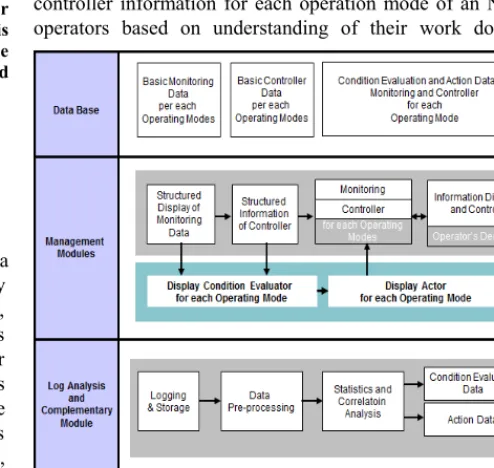
Two years ago, we proposed a monitoring and controller display method for each operation mode based on log analyses of operator actions to overcome the above problems [1, 2]. This method minimizes the existing information navigation by providing the monitoring and control means necessary for the operator to perform a specific operation mode on one or two display pages. The method provides the monitoring and controller information for each operation mode of an NPP to operators based on understanding of their work domains.
Method for Prototyping and Testing the
Information Minimalism Concept of Nuclear
Power Plants
Gwi-sook Jang, Gee-yong Park
I&C and HFE Research Division, Korea Atomic Energy Research Institute, 989-111, Daedeok-daero, Yuseong-gu, Daejeon 305-353, Republic of Korea
JVMDQJ#NDHULUHNU
Moreover this method complements the monitoring information and the means of control for each operation mode through analysis of the operation behavior logs obtained during operation, to improve the efficiency of display for each operation mode (see Fig.1).
In this paper, we propose more detailed functions and design issues of the information minimalism concept than in the previous paper (see Fig.2). We also propose methods for prototyping and testing to verify it.
II. PROTOTYPE DEVELOPMENT STRATEGIES
The development principles of the prototype needed to verify the information minimalism concept are as follows:
Standardization and modularization of the development process by improving development productivity and reuse Establishment of a prototype product sharing system Establishment of prioritized development items and
step-by-step development
Identification of common risk factors and design security for safe software development
Performing objective risk analysis and testing of all prototyping outputs
Satisfying the development principles described above, required the following prototype development strategies. A. Component Based Development (CBD)
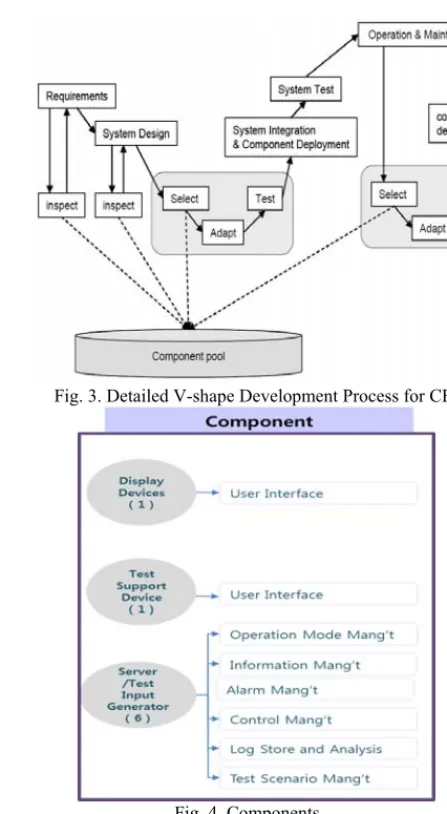
The process of developing S/W components and component-based systems differs in many significant ways from the “classical” development process of software systems. The main difference is in the separation of the development process of components from the development process of systems. The primary idea of the component-based approach is the reuse of the existing components instead of adding new ones, thereby building systems from already existing components, whenever possible [3]. Fig. 3 shows a detailed V-shape development process for CBD. Fig. 4 and Fig. 5 show components and a component diagram, respectively, for this prototype according to the CBD method.
Fig. 4. Components
Because this CBD-based prototyping aims for increased reusability of existing components, the efforts needed for their implementation decreases, and the effort for system verification
Fig. 3. Detailed V-shape Development Process for CBD
Fig. 2. Design Ideas and Issues
increases. The components of the prototype will be used as inputs for future human factor engineering validation and verification mock-up of a new Korean reactor.
B. Seven Touchpoints of Secure Software
The control and monitoring system of a nuclear power plant is operated in a closed network within the external network. However the non-safety monitoring system is linked to the general business network to provide information about operation of the nuclear power plant to a large number of users. In addition, non-safety monitoring systems use commercial H/W and S/W, so there is a high probability of malicious and non-malicious cyber infestation.
Therefore, in this paper, we propose a secure software development process for the non-safety monitoring system of NPP through this prototyping.
The secure SDLC (Software Development Life Cycle) process ensures that security assurance activities such as penetration testing, code review, and architectural analysis are an integral part pf the development effort. Software security touchpoints are based on good software engineering practice and involve explicitly pondering security throughout the software lifecycle. This means knowing and understanding common risks (including language-based implementation bugs and architectural flaws), designing for security and subjecting all software artifacts to thorough, objective risk analyses and testing. “Software Security Touchpoints” specifies one set of touchpoints and shows how software practitioners can apply them to the various software artifacts produced during software development [4]. This secure method consists of seven major points in the S/W SDLC (see Fig. 6).
1) Code review 2) Risk analysis 3) Penetration testing 4) Risk-based security test 5) Abuse cases
6) Security requirements 7) Security operation
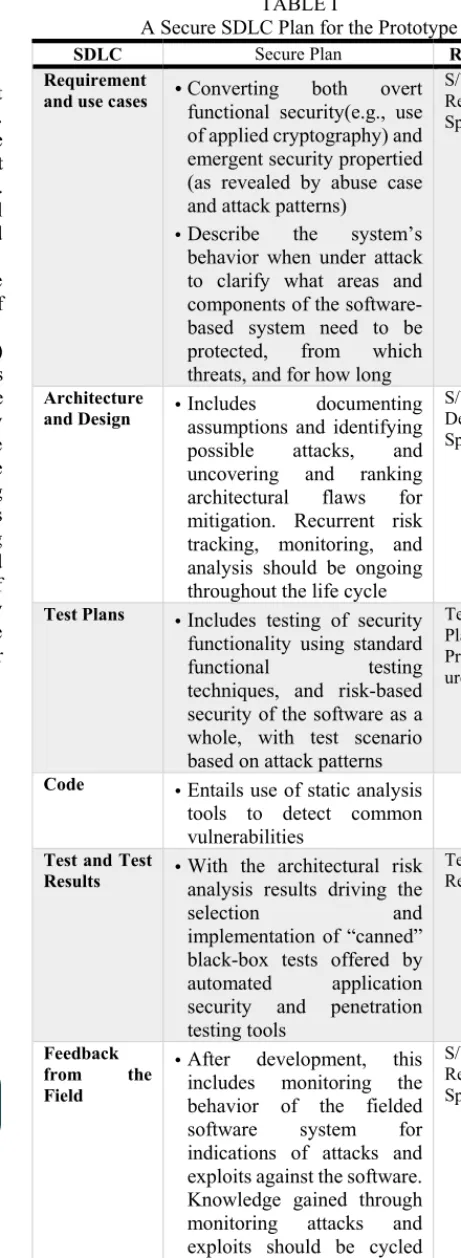
T$%/( I shows a secure SDLC plan for this prototype based on the seven touchpoints of secure software.
T$%/( I
A Secure SDLC Plan for the Prototype
SDLC Secure Plan Result
Requirement
and use cases Converting both overt functional security(e.g., use of applied cryptography) and emergent security propertied (as revealed by abuse case and attack patterns)
Describe the system’s behavior when under attack to clarify what areas and components of the software-based system need to be protected, from which threats, and for how long
S/W Req’ts Spec.
Architecture
and Design Includes documenting assumptions and identifying possible attacks, and uncovering and ranking architectural flaws for mitigation. Recurrent risk tracking, monitoring, and analysis should be ongoing throughout the life cycle
S/W Design Spec.
Test Plans Includes testing of security functionality using standard
functional testing techniques, and risk-based
security of the software as a whole, with test scenario based on attack patterns
Test Plan & Proced ure
Code Entails use of static analysis tools to detect common vulnerabilities
Test and Test
Results With the architectural riskanalysis results driving the selection and implementation of “canned” black-box tests offered by automated application security and penetration testing tools Test Report Feedback from the Field
After development, this includes monitoring the behavior of the fielded software system for indications of attacks and exploits against the software. Knowledge gained through monitoring attacks and exploits should be cycled back into the other touchpoints
S/W Req’ts Spec.
III. PROTOTYPING METHOD
A. Hardware and Software Configurations of the Prototype The H/W configuration of the prototype follows in Fig. 7 and the S/W configuration of the prototype follows in Fig. 8.
Fig. 7. Hardware Configuration
Fig.8. Software ConfigurationG
B. Security Vulnerabilities of the Prototype
The expected security vulnerabilities of the prototype are as follows in Fig. 9. These vulnerabilities are managed according to the plans in T$%/( I.
Fig. 9 Expected Security Vulnerabilities of the Prototype C. Display Design of the Prototype
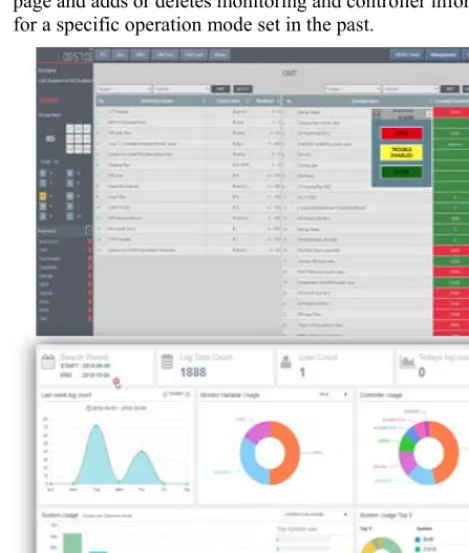
The monitoring and controller display for each mode based on log analyses of operator actions, is as follows in Fig. 10. The first page is the monitoring and controller display page of a specific operation mode. When an operator clicks a controller name in the controller list, the controller pops-up on the page. The second page is the statistics and correlation analysis page. The operator analyzes the operator activity log information page and adds or deletes monitoring and controller information for a specific operation mode set in the past.
IV. TESTING METHOD
The test steps of this prototype include unit test, functional test, operability test and performance test as shown in Fig. 11. Moreover the detailed test items for each test step according to the CBD based cyber security development process are as shown in Fig. 11.
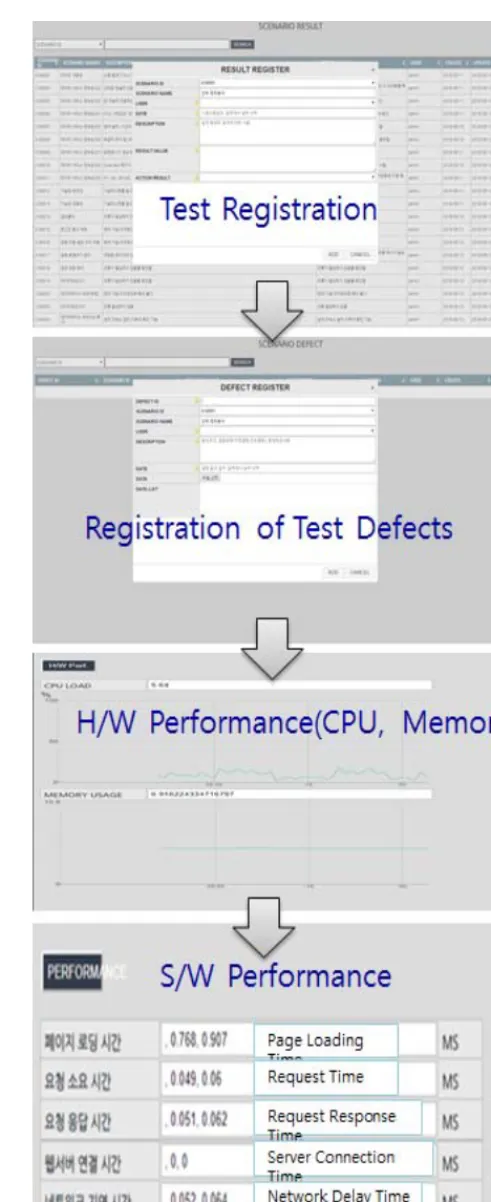
The test support utility supports a unit test, performance test, and system utilization analysis test of the prototype, as shown in Fig. 12.
1) Unit Test
Check the coding rules of the source code Tool : LDRA
2) Performance Test Check the response time Tool : Wireshartk
3) System Utilization Analysis Test Check CPU, memory usage